Technology Learning Lab Hosted at Bucksport Middle School

Submitted by Evelyn Beaulieu, Director of Curriculum and Academic Achievement at RSU 25. 

On Wednesday, June 5, 2019, Bucksport Middle School (BSM) hosted teachers from around the state in a Learning Lab, sponsored by the Maine Department of Education. The Learning Lab’s purpose was to demonstrate how BMS uses technology to enhance learning, and for the visiting educators to take new ideas and skills back to their community.

One of the day’s main focuses was to have students and their experiences be front and center. Members of the school’s Digital Media Club discussed the process of establishing, then writing and distributing the school’s first Digital newspaper. Members J-Lynn Farren, Abbigail Farricker, Kasey Findley, Dylan Wombacher, Emily West, Brianna Grass, Hannah Varnum, Kelsea Gaff, Wynn Therrien and Ella Orcutt also answered guest questions regarding the success and struggles they had experienced establishing the newspaper, and what the group’s long term goals were for the upcoming years, and plans for video announcements and more.

IMG_8027

“My favorite part was teachers asking us questions and us being able to teach them how to do stuff,” said Kasey Findley, writer of the paper’s Kasey’s Korny Korner. “I think they gained a lot of resources that they will be able to bring to future classes.”

The school’s GT Art Program had students Ella Hosford, Ayden Maguire, and Diego Harvey working with GT Coordinator Amanda Hoffert doing photo manipulation. They were able to show examples of their photos, and go over the process and technology they used to manipulate the photos.

IMG_6671

8th graders Alyx Frazell and Wynn Therrien were on hand to show the amazing work they did with 8th Grade Social Studies teacher Donna Short’s Greek Mythology Research project. Mrs. Short used project based learning to have her student’s demonstrate their understanding of the research process. Through student voice and choice 8th graders used a variety of genres to express new learning, from posters and slide shows to Ms. Frazell’s pottery and Mr. Therrien’s computer program written in Scratch. Guests were able to see the various types of technology that were used, and how Mrs. Short integrated them into project based learning in her classroom.

The final group, were students Wynn Therrien, Dylan Courtney, Andrew Braley, Bo Provencher and Kasey Findley to demonstrate BMS’s 3D printing program. All BMS students take Information Technology class with Mrs. Braley and learn coding, and 3D printing engineering and design. Mr. Provencher and Mr. Courtney showed the boats they had designed in 6th grade, Mr. Findley discussed the bubble wands they had made in 5th grade, and Mr. Therrien and Mr. Braley demonstrated Tinkercad, the program the students use to create their 3D projects. The students went over the design process, the engineering skills that were taught, and how they used problem solving to fix issues that arose when designing their projects.

“I was incredibly proud of all of our students.” Mrs Braley stated. “It was important to us to have the students be front and center, so that instead of teachers listening to just Donna, Mandy and I, they were getting first hand testimonies and examples from the students that we are teaching, and they were able to ask them what they thought was successful and what needed improvement. Having our students be able to demonstrate their learning in such a positive way was incredibly rewarding for us.”


Lincoln Academy Takes New Approach to Vaping

Submitted by Jake Abbott, Dean of Students and Director of Residential Life, Lincoln Academy. Link to original article.

Vaping among teens has been called an epidemic by the US Surgeon General. Lincoln Academy’s new policies respond with education rather than just punishment.

E-cigarette use among teens has skyrocketed nationwide over the last two years. In December of 2018 US Surgeon General Jerome Adams declared it an “epidemic” and the 2018 Monitoring the Future study funded by the National Institute of Health found the 2017-18 e-cigarette use increase to be the “largest ever single-year increase in the use of a substance.”

In response to the epidemic in teen e-cigarette use, also known as vaping, high schools have scrambled to keep policies current with student habits.

Lincoln Academy has made several policy changes in 2019 to address the use of e-cigarettes in school. The new policy has shifted from a punishment model to one focused on education, according to LA Dean of Students and Director of Resident Life Jake Abbott. After their first vaping violation, students are now assigned a “learning detention” where they research the health effects and risks of vaping as well as the truth behind deceptive e-cigarette marketing. After their research is complete, students write a letter about what they have learned to a parent, a teacher, or a local newspaper.

“The focus of this work is to educate and spread information to both the student and the broader community,” said Abbott. “So far students have taken this research to heart… the policy seems to make a difference in how students feel about vaping.”

One student wrote in an essay written during detention, “Learning about the propensity toward addiction that Juuling [Juul is a popular brand of e-cigarettes marketed to teens] and other vaping products bring to the table has completely and utterly disgusted me. I have no desire to consume any products similar to Juul ever again. Knowing the amount of people, minors included, that have become addicted to nicotine is terrifying, especially since a recent census has shown that ‘10.7 million youth aged 12-17 are at risk for using e-cigarettes.’”

Another essay reads, “going forward, I plan to completely cut vaping out of my life. Not only will I stop doing it myself, but I will also try to educate my friends on the dangers of Juul and other vaping products. I never want to vape again. These reports have driven me into utter hatred for the companies behind the propaganda and brainwash of young children and teens.”

A third student wrote, “I do not want to cause myself health problems later in life that are easily avoidable. I do not want to lose the respect of adults and my peers for such an idiotic move. I think when I really put my mind to something I have very strong will power, and I think the combination of knowing I want to quit, and avoiding associating with people I know use nicotine can help me quit. I do not want to be a slave to nicotines grasp any longer and I am ready to quit.”

“The vaping epidemic took us by surprise,” said Abbott. “The adults didn’t have enough information, and the products are marketed directly to young people. They came on the market as smoking cessation devices, but instead of helping people quit smoking, they caused students who previously didn’t smoke cigarettes to get addicted. Often when students start using these devices they believe they contain only flavoring, but most e-cigarettes actually contain high doses of nicotine–one of the most addictive substances we know of.

“We hope our new policy will not just punish a behavior, but help students stop and think about the harm that vaping causes to themselves and others. This restorative philosophy works well for other offenses, and we are hoping it will make a difference with vaping, too.”

“It is impossible to know with certainty whether this consequence actually deters vaping over time, but at least we know students are learning something; are educating themselves about the real consequences,” said Abbott. “We are fighting an information war: the corporations that produce these devices are telling teens they are harmless. At least our policy can help students and their parents learn the facts so they can make informed choices in the future.”


Lewiston Adult Education Graduate Shares Story of Perseverance

(Pictured: Nasra Houssein, who served as the student speaker on Tuesday night, pauses after receiving her diploma.)

Submitted by Mike Reagan, Education and Marketing Coordinator, Lewiston Adult Education.

Nasra Houssein praised the people who convinced her to return to her studies during Lewiston Adult Education’s graduation on Tuesday night in the Lewiston High School gymnasium.

The native of Djibouti dropped out of her classes last year because she could not fit them in with her work schedule. She credited Lewiston Adult Education teachers Don Roux and Amy Hatch for their encouragement along with coworkers at Trinity Jubilee Center in Lewiston.

She returned to her classes after a three-month absence. On Tuesday, served as the student speaker at graduation.

“Without all your help, it would have been difficult for me or anybody else. So thank you all for giving us your time to help us succeed,” Houssein said.

The 30 Lewiston Adult Education graduates at the ceremony received their high school credential by taking the High School Equivalency Test. The HiSET exam has replaced the GED for high school equivalency.

Beth Derenberger received the Lifelong Learner Award for her commitment as a teacher and for exemplifying the sharing of knowledge at Lewiston Adult Education. She learned rug braiding from an adult education course in Oxford Hills. After a few years of practice, Derenberger ended up teaching in Oxford Hills and at Lewiston Adult Education.

She taught rug braiding at Lewiston since 2004 and retired at the end of the Winter-Spring 2019 semester.

“I have made so many friends from my teaching. It’s awesome. Students come because they want to come. People come because they’re interested. And that’s half the battle,” she said before the ceremony.

Adult Ed Graduate and Teacher
Student speaker Nasra Houssein celebrates after the graduation with Barabara McAllister of the Lewiston Adult Education’s Adult Learning Center on Tuesday night.

Outgoing Superintendent of Schools Bill Webster served as the keynote speaker at graduation and received a round of applause for his support of adult education. Lewiston Adult Education Director Bill Grant gave retiring teacher Diane Whiting a bouquet of flowers during the ceremony to thank her for her service of more than 25 years.

Maine Adult Education Programs Featured on PBS News Hour

Maine and its Adult Education programs, including Spruce Mountain Adult Education, Portland Adult Education, and Turner Adult Education have been featured on PBS News Hour for a story about adult education programming and why it is so important.

Click the link or image below to view the 8 minute story.

Why 36 million American adults can’t read enough to work — and how to help them

PBS News Hour Screen Shot

Saco’s Young School Loves to Walk

Submitted by Peter Harrison, Principal at Young School, Saco Schools. Text Written by Ken Studtmann, Wokka Wokka Coordinator. Photos by Dr. Peter Harrison and Ken Studtmann.

For several years the Young School students have participated in a much beloved walking program during their Wednesday’s lunch time recess. The students fondly named it “Walking Wednesday”.

Appalachian Trail Comparison Map
Appalachian Trail Comparison

During Walking Wednesday, the students walk, skip, hop or move in creative movements 1/8-mile laps around the school while parent and adult volunteers track and tally the number of laps each student completes. The number of laps completed are recorded for individual students and collectively tallied for  classroom, and the entire school. For every 2.5 miles the student walks they receive an incentivizing award of a “toe token”. At the end of the year, the classroom from each grade level with the highest number of laps receives an extra recess.

Geography Lesson

For the past two years, a lesson in geography has been integrated into the program. Last year, the laps walked by the students represented a unit of distance along the Appalachian Trail. The students successfully completed 1,378 miles of the Appalachian Trail; Maine to Virginia. The student’s progress was tracked on a large map displayed in the school’s front entry hallway for students, teachers and staff, and visitors to watch the progress. This year the laps represented the number of times the students crossed the Penobscot bridge; 3,541 times and growing.

Language

As a means to further enhance the program, a language component was introduced in the beginning of this current school year with the reading of “HOW DO YOU WOKKA-WOKKA”, c 2009 by Elizabeth Bluemle, art by Randy Cecil. The book was a great inspiration to the students, staff, and adult volunteers of the program. The book’s premise of finding your own walking style was embraced by the students with lots of styles emerging. The students even changed the program’s name into “Wokka Wokka Wednesday”. The Wokka Wokka Wednesday is a much-loved program at Young School.

Fun Fact #1: The Appalachian Trail is among the longest continuously marked trails through 14 states; Maine to Georgia. The trail is marked with approximately 165,000 white blazes along the trail guiding hikers all 2,186 miles.

Penobscot bridge
Penobscot bridge

Fun Fact #2: The Penobscot bridge spans 2,120 feet from the east shore to the west shore of the Penobscot river. The design of the bridge’s two towers was inspired by the Washington Monument.

Fun Fact #3: Young School Students love to Walk! Last year, the Young School students collectively walked fictitiously from Maine to Virginia on the Appalachian Trail and this year they walked 3,541 times across the Penobscot the bridge.

For additional information to learn how to implement a walking program at your school, please contact Dr. Peter Harrison, Young School Principal.

Julie Meltzer Named 2019 Curriculum Leader of the Year

Submitted by Heidi McGinley, Executive Director, Maine Curriculum Leaders’ Association.

Julie Meltzer, Director of Curriculum, Assessment, and Instruction for the Mount Desert Island Regional School System (AOS #91) is Maine’s 2019 Curriculum Leader of the Year. “I’m truly honored to join the group of curriculum leaders recognized in Maine. I’m honored to have them as my colleagues. I don’t know another group of people so focused on teaching and learning practices,” Julie said.

Julie is a passionate advocate for the learning and development of all students, leading the development of common standards the staff will “go to the mat” for across the district. She has developed community partnerships, found necessary resources, and introduced evidence-based instructional practices. But she credits widespread staff engagement in decision making for what superintendent Marc Gousse calls “marked improvement in learning and achievement and increased student success” across the district.

When she joined the district six years ago, Julie wanted all staff to have a voice in decision making and be engaged in professional learning opportunities so they would have the tools they needed to “do the best job they can for kids”. She wanted to maintain the strengths and uniqueness of each school and honor the professional autonomy of teachers while increasing student learning. The innovative professional learning and decision making structures she created made a difference.

“I’m proud of how everyone is starting to play a similar rhythm,” Julie says, “although the melodies are different, as they should be.” This year, 110 teachers and education technicians voluntarily served on a “collaboratory” – a temporary task force formed around a problem of practice, working to identify solutions, make decisions, and develop all the learning, strategies and tools needed to implement those solutions. In the process, staff and administrators became partners in professional development both in and outside the district. 100 teachers, education technicians and administrators led internal professional development sessions and 30 presented their work at state or national conferences. “Good things are happening for kids,” she said. “We’re getting to the ground of student learning and walking the talk in more ways.”

Julie’s journey to Mt. Desert began when her work at the Regional Laboratory led to a three-year content literacy consulting project in Washington County. She fell in love with Maine and with Acadia, eventually buying an old farmhouse in the area, which she and her husband started renovating on weekends. Her consulting work took her all over the country, so she ended up with two homes — a Portland rental to be closer to the jetport and a close-to-Acadia farmhouse. Her daughter started high school at Mount Desert and encouraged her to apply when the curriculum position opened. “I was lucky to be hired,” Julie said, “and I’ve been honored to have this position. I’ve learned much more in the last six years than I did earning my doctorate.”


Successes Shared by Districts at Closing Event of 4-Year Preschool Expansion Grant

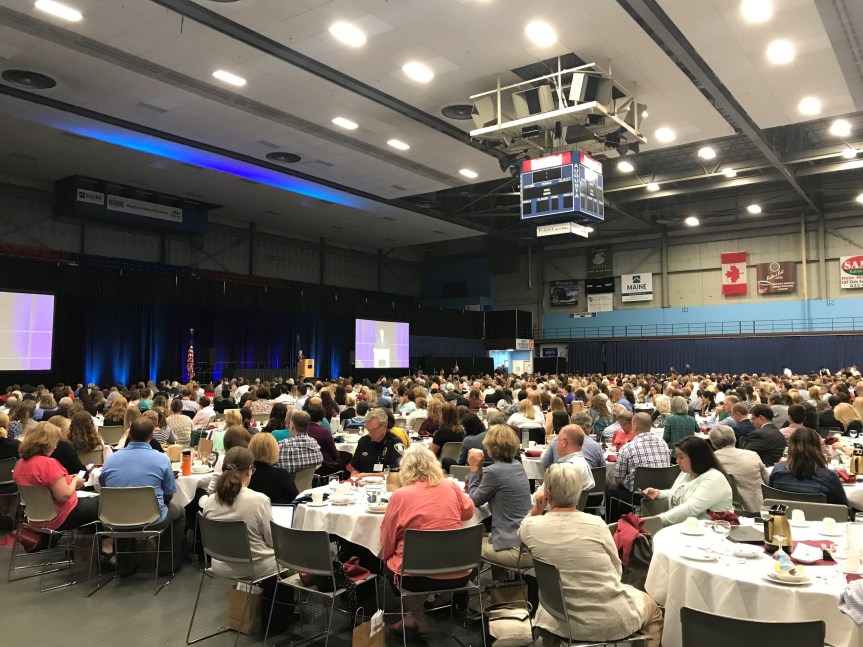
(Pictured: Kindergarten teacher Heidi Sturgeon, pre-k teacher Olesia Pazdro, and Curriculum Director Suzanne Day from MSAD 55- Sacopee Valley, talk to the audience about their goals for their Birth – Third Grade Action Plan.)

The Maine Department of Education hosted a closing event of the 4-year Preschool Expansion Grant (PEG) that was awarded to Maine DOE in December 2014 by the US Department of Education.  Eighteen states were awarded grants to support local school districts in the development of new preschool classrooms, and to expand access to high-quality, full-day pre-k programs for children whose families were at or below 200%  Federal Poverty Level.

Maine used the grant to launch and expand pre-k programs for 13 districts in Maine, 8 of which used the opportunity to partner with local Head Start programs. The districts included RSU 12, RSU 13, MSAD 17, RSU 23, SAD 37, SAD 44, RSU 55, RSU 74, Cornville Regional Charter School, Cherryfield, Lewiston (Longley Elementary), Millinocket, Vassalboro. The 13 districts were chosen for their percentage of students with an economic disadvantage and willingness and availability to embark on the effort.

The grant allowed these districts to add or expand their pre-k classroom spaces and resources, hire and train needed teachers in using evidence based curricula and instructional practices, align appropriate assessment of pre-k students with kindergarten assessments, develop a plan for kindergarten transition, and form a community literacy team, all as part of a long-term “Birth to Third Grade plan” that aligns with the districts’ strategic goals. The grant implementation was supported by grant coordinators at each of the participating districts, and trained coaches, all of whom were former Maine educators.

A cross-section of state employees from Maine DOE, Department of Health and Human Services (DHHS) and Child Development Services (CDS) worked collaboratively on this project,  with facilitation provided by the Education Development Center (EDC).

IMG_0229
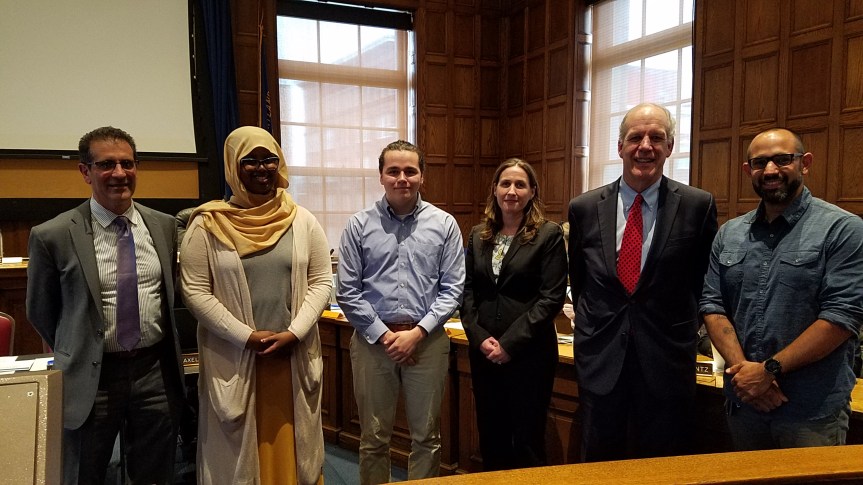
(Left to right) Sarah Adkins, Kathryn Zwicker, Nena Cunningham, Karen Bergeron, Nicole Madore, Lee Anne Larsen, Dee Saucier, Sue Reed, Crystal Arbour, Jessica Nixon, Rich Meserve, David Jacobson.

Three years into the 4-year grant, tremendous improvements in child outcomes were celebrated, including:

  • 76%-86% of children moved out of the high-risk identification in all developmental domains
  • 76%-96% of children moved out of high-risk identification in literacy skills (predictive of kindergarten success)
  • 53% of children moved out of high-risk identification in the Peabody Picture Vocabulary Test, which assesses receptive language and is a predictor of later reading success

The end of the year event was an opportunity for each of the participating districts to present their Birth to Third plans to their peers and to reflect on their successes, lessons learned, and plans moving forward.

IMG_0196_cropped
RSU 12 Curriculum Coordinator, Deb Taylor (right) and Southern Kennebec Child Development Center Head Start Director Cristina Salois (left) shared details of their  action plan with the full audience which included a “ghost walk” to each pre-k classroom across the district’s 4 elementary schools. This was an opportunity for pre-k teachers to share and collaborate on environmental design and instructional practices and learn from one another.

The gathering included presentations by each participating district, who all began by sharing varied and often-times unique community challenges. For example, while some experienced a lack of licensed child care providers to connect with and engage families early on, another had migrant families with students in and out of school frequently. There were many other unique community characteristics shared, yet all of the districts had the common challenge of a high percentage of families facing economic disadvantage.

The common areas of focus for each Birth to Third Grade action plan included a focus on quality, shared teaching and learning practices, family engagement starting before children enter pre-k, a focus on positive transitions from pre-k to kindergarten, social emotional learning and trauma informed teaching.

The closing event was a successful day of presenting, idea sharing, and collaboration by early childhood educators from across the state who will now be able to continue their research based, and collaborative birth to third grade plans for district-wide success and beyond.


State of the School Graphic Used to Celebrate a Year of Academic Success at James Otis Kaler Elementary School

The State of the School graphic was submitted by Bonnie Hicks, Principal of James O. Kaler Elementary School.

James Otis Kaler Elementary school in South Portland is celebrating student learning with State of the School. Through this unique tool, they are able to articulate the things they are proud of with their surrounding community and beyond.

For example, math and literacy scores are on the rise this year.  Students at the school were also able to produce over 1,000 works of art. Ten international languages are taught at Kaler Elementary, and on Multicultural Night local families taught students about seven different countries. The school partners with community members to provide support for students and their families. Mentors were provided for the students via Foster Grandparent and Big Brother Big Sister programs. Food, clothing, bikes, and presents were also donated to students in need. Kaler Elementary instructs students through service-based learning projects as well. Over ten tons of organic materials were composted by the students. This year was a success for Kaler Elementary, and the community looks forward to continued success in the next academic year.

James Otis Kaler Elementary School – State of the School (PDF)

This story was written by Maine DOE Intern Simon Handleman in collaboration with James Otis Kaler Elementary School. If you have a story idea or would like to submit a written story for the Maine DOE Newsroom, email Rachel Paling at rachel.paling@maine.gov.

WCC Washington County Educator Profile: Jeanna Carver,

Submitted by Sarah Woog from the The Washington County Consortium. 

Meet Jeanna Carver, Pre-K Teacher at Jonesport Elementary School and 2019 Washington County Teacher of the Year

When the announcement was made that Jeanna Carver was Washington County’s 2019 Teacher of the Year, I knew she was the next educator to profile. I met Jeanna Carver in her classroom at Jonesport Elementary last week during her 45 minute “specials” break.

After talking with Jeanna for a few minutes, I told her she was going to be a legend. A little further into the conversation, I was thinking she may already be. Jeanna achieved future legend status in my mind when she shared she hoped to be the Pre-K teacher at Jonesport Elementary until retirement, or “as long as I can physically handle it.” Sitting on rugs and and keeping up with little ones is physically taxing! Jeanna has been at Jonesport Elementary for her entire teaching career. A teacher from a rural coastal town, educated first on an island school and then at the local college, the University of Maine at Machias, to teach in the community in which she was raised, and staying to reach generations of Pre-K students at the same school, now that’s the making of a legend.

But let’s talk about Jeanna’s current legend status. She was nominated for Teacher of the Year by a parent. The parent said of Jeanna: “Mrs. Carver is great at what she does and always made them feel comfortable. She is very nurturing and kind. She creates a safe learning environment and demonstrates extreme patience for those just starting to learn. She is also very creative with her lessons and this instills a love of learning for her students.” And that only scratched the surface.

Jeanna is not only nurturing and kind with her students, but with their families as well. Jeanna shared, “Bringing kids to school for the first time can bring back bad memories.” She is keenly aware of the many reasons families in Washington County may not engage with their children’s schools- their own negative experiences in school, feelings of shame around lack of resources, apprehension because content or routines feel inaccessible. Jeanna works to engage families and make them feel like welcome and vital partners in their children’s education. She regularly takes pictures of her students busy in school and shares them with their parents. “Parents love pictures. I send pictures home, and it gives parents an entry point.” Her attendance for open house nights is near 100%.

Jeanna wanted to make it clear to me her success doesn’t exist in a vacuum. She wanted to share credit. I feel like that’s a very educator thing to do. Fortunately, at Jonesport Elementary, there is a lot of credit to go around. Jeanna’s collaboration with the Kindergarten teacher, Allison Beal, is an important aspect of her success. They bounce ideas off each other, share strategies for engagement, and make sure there is consistency in routines from one grade level to the next. Also deserving of credit is the collaboration between TREE (Transforming Rural Experience in Education) and Jonesport Elementary. It has brought food pantry and clothing closet, offering resources for families in a way that destigmatizes accessing such resources. In partnership with TREE there are also school-wide celebrations and the implementation of trauma-informed practices. The whole staff at Jonesport Elementary deserves credit, too. Together they implement practices from Responsive Classroom (https://www.responsiveclassroom.org) and the principal, Melissa Tenney, has designated time for the entire school to hold morning meetings.

There are a lot of great things going on at Jonesport Elementary. Jeanna Carver is doing a lot of great things. I suppose we do not have to determine whether Jeanna is a current or future legend. She’s our Teacher of the Year, nominated by a parent, sitting on rugs as long as her body can handle it, raising duck eggs, caterpillars and salmon eggs with Pre-K kids, and celebrating the work of those around her. That’s legendary enough.

Portland Public Schools’ Casco Bay High School Wins ‘Schools of Opportunity’ Gold

Submitted by Tess Nacelewicz, Communications Coordinator, Portland Public Schools

The Portland Public Schools’ Casco Bay High School (CBHS) is one of only seven schools from across the country this year to receive recognition as a “School of Opportunity.” The designation honors excellent public high schools that engage in research-based practices that build on students’ strengths and create rich, challenging learning opportunities for all students.

The recognitions are given in “silver” and “gold” categories. CBHS has been awarded the top honor: a 2018-2019 Gold Recognition. CBHS held a school assembly last month to inform the school community and celebrate.

After an extensive application review and culminating site visit, a team from the Schools of Opportunity high school recognition program reported to Casco Bay officials that they were “particularly impressed with the broad and rich learning opportunities that Casco Bay offers all students, and the myriad ways you extend students’ learning options through authentic, community-focused activities, meaningful assessments of students’ understanding, and relevant, inquiry-based professional development for your staff.”

Casco Bay Principal Derek Pierce said, “I am beyond proud to work in a community of teens and adults that’s committed to finding, supporting and growing the greatness in each of us, while also harnessing our collective power and voices to narrow the gap between the world we have and the world we need.”

Portland Superintendent Xavier Botana said, “Our Portland Promise talks about the importance of reducing the opportunity gaps that some of our students experience, as a way of helping all of our students achieve their potential. Casco Bay High School was conceived on this idea. I am grateful, but not surprised, that Casco Bay has been selected as Maine’s first ever School of Opportunity. Every day, Casco Bay’s staff works to help every student to aspire to and follow the roadmap to their greatest self. Congratulations, Casco Bay High School! All of Portland’s public schools join you in celebrating this accomplishment.”

Casco Bay and the six other 2018-2019 recipients, join 45 other public high schools that are part of the Schools of Opportunity network, an initiative of the National Education Policy Center (NEPC), based at the University of Colorado Boulder.

The NEPC started the Schools of Opportunity recognition program to honor public high schools in the United States. Test scores are NOT part of the rigorous application process, which includes in-depth narratives, supporting documentation of practices, and site visits.

Instead of test scores, the designation’s criteria draw upon the principles of “Closing the Opportunity Gap,” a 2013 book jointly edited by Prudence Carter, who is the dean of the University of California, Berkeley, Graduate School of Education, along with NEPC’s director Kevin Welner. The book describes research-based policies and practices with the potential to increase students’ opportunities to learn and thrive in school.

Project manager, Dr. Adam York, reports, “These schools have each demonstrated, with ample evidence, deep care and commitment to their students through equitable learning opportunities and strong positive school cultures.”

In recognizing seven new “Schools of Opportunity,” NEPC is calling attention to the kinds of approaches that can and do increase learning opportunities.

Here’s a summary of the types of opportunities the NEPC found at Casco Bay that benefit learning for all students:

Casco Bay High School’s overall educational philosophy focuses on flexible learning time to support learning expeditions that incorporate field work, culminations, week-long intensives twice a year, outside speakers, “weekly exceeds” reading and math for students to seek structured challenge beyond the core curriculum, crew meeting, and annual transformative learning experiences (Freshmen Quest, Sophomore Solo, Junior Journey, and Senior Quest).

Students have multiple expedition opportunities and a rich interdisciplinary program of project-based learning. Each year culminates in multiple exhibitions, with students sharing their work with each other and the local community. Exhibitions include themes such as Africa Rising, Income Inequality, and the Chemistry of Climate Change that allow students freedom to pursue their interests within a broader framework of social justice.

The curriculum includes ample opportunities for struggling students to catch up or for all students to enrich their experiences. In addition to within-school and after-school supports, students can earn course credits in Frost School (December), Mud School (late March), and Summer School.

The challenging, interdisciplinary curriculum works because of the collaboration and leadership of Casco Bay’s teachers. Professional development is focused on equity and Casco Bay responds to teachers’ and students’ needs. Casco Bay’s staff and administration show an amazing dedication to self-reflection as a vehicle for self-improvement.

Although Casco Bay was already exemplary in many of the Schools of Opportunity criteria, they chose to use the application process as a chance to reflect on how they can improve, which means that we can look forward to even greater things from Casco Bay High School moving forward.

Casco Bay High School is the Portland Public Schools’ newest high school, founded in 2005. The high school is a Mentor school within the EL Education network and is recognized as a national leader in project-based and “deeper” learning. It is intentionally smaller, with less than 100 students per grade level, so staff can get to know each student deeply. The 2018-2019 enrollment is 387 students.

More details are available at the project website, including expanded profiles of each of these remarkable schools, including CBHS at: http://schoolsofopportunity.org/

For an Washington Post article on these Schools of  Opportunity, including CBHS, titled “Here are 7 ‘Schools of Opportunity’ that ‘show us a way forward,’” go to: https://www.washingtonpost.com/education/2019/05/20/here-are-schools-opportunity-that-show-us-way-forward/?utm_term=.67bb282babd1