Hampden Academy Soars into the Future with New Drone Education Program

(Pictured: Student Pilot Marysssa LaBlanc and RSU 22 School Board member Ellen Hassan.)

Something exciting is taking off at Hampden Academy! Starting in the 2025-2026 school year, Hampden Academy is launching a cutting-edge drone education program, Higher Vision: Sparking Creativity and Careers Through Drones, designed to prepare students for the skies—and for the future.

With 67 students already enrolled, this two-course program is about more than flying drones; it is about building real-world skills, exploring emerging industries, and learning to think critically and ethically about powerful new technologies.

For enrolled students, the journey begins with an Introduction to Drones course, where students will start with the fundamentals—FAA regulations, Maine-specific laws, and best practices for safe and ethical drone operation. From flight simulators to piloting real drones, they will gain hands-on experience while exploring how drones are already transforming fields like agriculture, filmmaking, and emergency response.

In the second course, Commercial Drones, students learn advanced flight skills, mission planning, weather impacts, and drone data analysis. They will also prepare for the FAA Part 107 commercial drone pilot certification, which will give them a head start on careers in this growing field.

One of the program’s most unique aspects is its strong network of nine local partners—from Hampden Public Safety and Cianbro to News Center Maine and the U.S. Military—who will offer students real-world insights and hands-on learning opportunities in areas like public safety, construction, media, forestry, surveying, and more. (See a full list of partners at the end of this article.)

“This program represents our dedication to providing RSU 22 students with educational opportunities that connect directly to tomorrow’s careers,” Todd Moore, Technology Teacher at Hampden Academy, said. “This is about more than learning to fly; it is about building futures.”

With its blend of classroom rigor, practical experience, and community engagement, Hampden Academy’s drone program is lifting off—and bringing students along for a thrilling, high-tech ride into the future.

Hampden Academy would like to extend a big thank you to the following partners for helping to make this new program possible:

  • Hampden Public Safety for demonstrating emergency response applications and public safety uses for drone technology.
  • Cianbro Corporation for showcasing industrial applications in construction and infrastructure development.
  • News Center Maine for illustrating journalistic and media applications of drone photography and videography.
  • Haley Ward Civil Engineering for providing insights on surveying, mapping, and engineering applications.
  • American Forest Management for highlighting environmental monitoring and forestry management techniques.
  • Matt Thomas Media Productions: for sharing expertise in commercial drone photography and cinematography.
  • Allan Gordon Jr. Surveying for demonstrating precision mapping and land surveying applications.
  • United States Military for offering perspectives on drone operations and career opportunities in defense.
  • University of Maine at Augusta for advanced drone programs.

For more information about this program, please contact Todd Moore (tmoore@rsu22.us) or Charlie Huff (chuff@rsu22.us), Technology Teachers at Hampden Academy.

Information for this article was provided by Hampden Academy. To submit your good news to the Maine DOE, fill out our Good News Submission Form.

Bowdoinham Community School Founds Its First ‘Play Club’

Second graders at Bowdoinham Community School experiment with old truck tires during Play Club earlier this spring. Kids find creative ways to play with standard, natural, and unusual playground items during this unstructured time.

Jonathan Haidt’s book “The Anxious Generation” planted a seed that took hold with Bowdoinham second-grade teacher, Kaleigh Frye. While much of the national conversation surrounding Haidt’s book has focused on phone-free schools, a second concept – “play-full schools” – piqued the interest of Bowdoinham Community School staff during professional conversations in August. Soon after, Frye approached Principal Chris Lajoie with a proposal: “I want to start a Play Club.”

Play Clubs promote a simple concept similar to neighborhoods of the past: They allow space and time for students of mixed ages to free play. Kids can play how they wish, are expected to organize and referee their own games, and find solutions to problems by themselves. Parents who sign their students up must acknowledge that not all kids may be happy all the time at Play Club, and supervising adults will intervene only in the case of an emergency or another big problem.

Utilizing a free implementation framework for schools from Let Grow, an organization dedicated to growing kids’ independence, the fall session of Bowdoinham Play Club started on Mondays after school, rain or shine. Fifty students spanning grades K-5 Participated. Students were allowed to use a wide swath of school property, including playground structures, natural play spaces in the woods, sports fields, and shady sitting spots.  

Early on, it took some trial and error for kids to navigate playing with much older or younger students—who, many times, were not their usual friends. 

“It didn’t come organically at first,” Frye recalled. “Kids innately want to involve an adult as soon as something goes wrong, so it has taken time and effort to learn how to handle these situations on their own.”

A Bowdoinham parent commends both the multi-age and extended-time aspects of Play Club – one full hour – compared to shorter and more grade-specific recess.

“I get the impression that the longer format on the playground feels more relaxing because they can really engage in whatever they are doing, uninterrupted by regular tasks,” the parent said.

After a winter reset, and as soon as the days became long enough once again, Frye started up a spring session of Play Club. Many students returned to the program, while welcoming a handful of new participants. The rules remained the same: 1. Don’t hurt anyone intentionally, and 2. Stay within the designated boundaries. Other than that, the supervising adults’ only role is just to say, “Go play!”

The impacts of Play Club have filtered into the school day. Teachers have reported hanging back and allowing kids to sort out recess disagreements, when in the past they may have stepped in more quickly. 

“We’ve watched as kids encounter trouble and then work with each other to find a fair and just solution,” Frye said. 

In many instances, the more time a teacher gave students to work out an issue, the more likely they were to navigate the challenge and resume play. Office referrals for recess conflict have dropped.

“Something changes for kids when they know the adults trust them to handle these things on their own,” Lajoie added. 

A parent of a third grader remarked that friendship issues for her son have greatly improved this year because “they are owning the resolution on their own.”

While some of these outcomes may have been predictable, one other result was not expected: Bowdoinham’s rate of chronic absenteeism has been cut nearly in half this year. Surely not all the credit can go to Play Club, but in the words of one young student whose attendance has been spotty, “Dude, I would never miss a Play Club day!”

This story was submitted by Bowdoinham Community School. To submit a good news story to the Maine DOE, please fill out the good news submission form.
Forest Friday Engages Phippsburg Elementary School Students in Place-Based Outdoor Learning 

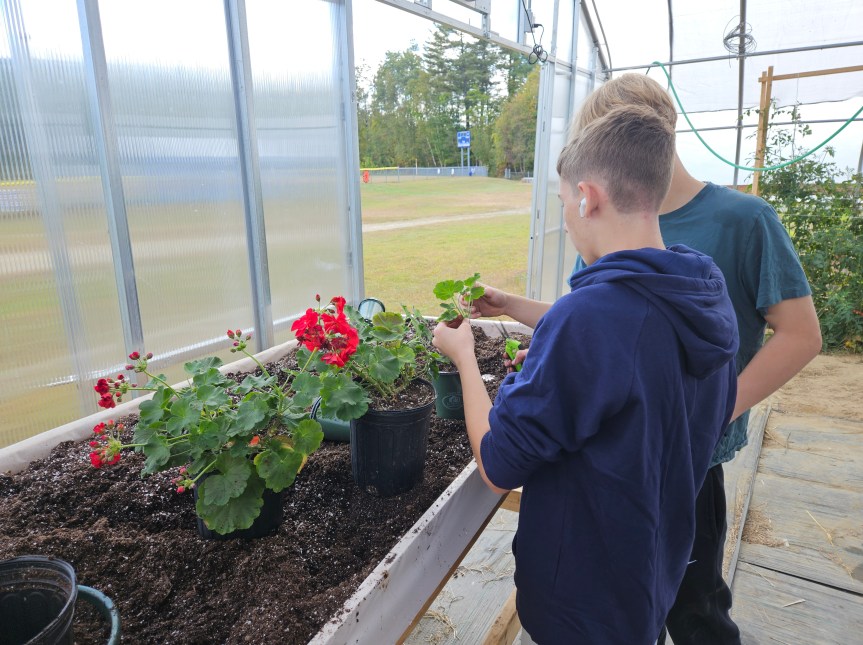
(Pictured: First and fourth grade students during Forest Friday)

After a long week of learning inside of the traditional brick-and-mortar classroom, students at Phippsburg Elementary School head outdoors to immerse themselves in nature for what’s known as “Forest Friday.”

Forest Friday is an academic block of time when students experience place-based outdoor learning. Through professional development and shared teaching and learning experiences, teachers have embraced this as a time to focus on hands-on learning, grounded in science and social studies standards. 

In elementary school, much of a student’s day is focused on reading, writing, arithmetic, and—especially at the K-2 level—on how to be a learner and a student. That is one reason why the opportunity to have time for outdoor learning has become quite popular among Phippsburg School students and staff. Students look forward to this time to learn outside with one another in a way that allows them to be a bit more inquisitive. Movement is also always a part of Forest Friday, as it is proven to have a direct impact on improving students’ cognitive functioning.  

Outdoor education is not new to Phippsburg School, as the town has an active conservation committee and garden club run by volunteers. In fact, from 2019 to 2024, Phippsburg had a dedicated outdoor educator one day a week, who was also the physical education teacher. With the loss of COVID funding and restructuring of school personnel, Phippsburg School’s leadership team was left with the question of what to do next and how to keep outdoor education as part of students’ educational experience. 

When the school year started, many teachers and staff had experience with outdoor learning. Some did not, but everyone at Phippsburg School jumped in with ideas about how to keep outdoor education alive. Each week on Friday afternoon—rain, shine, or snow—the school principal takes two classes (an upper grade and a lower grade) and plans an outdoor learning experience. This is how Forest Friday began. This time not only engages students in nature; it also assists in helping to build strong working relationships among students—an integral part of the school culture at Phippsburg School.

On the weeks when grade levels don’t collaborate, classroom teachers plan outdoor learning experiences for their own classes: From historical hikes to visiting graveyards with local historians to snowshoeing to tree identification, staff at Phippsburg School are embracing stepping out of their comfort zone and keeping this meaningful learning alive. 

“Sometimes, we do a very focused lesson that ties into our classroom learning. Sometimes, we do hands-on science experiments, like building snow volcanoes and animal habitats.  Sometimes, we use Forest Friday as an opportunity for play and social emotional learning. The goal is to have fun and expose students to learning that they may not experience on a daily basis,” Principal Nina Willette said.  

5th and 2nd grade students learning about the life cycle of a pumpkin

The town of Phippsburg has many natural spaces that provide outdoor, nature-based experiences, from hiking trails to beaches, rivers, and ponds; however, many students may not have access to all that Phippsburg has to offer. One of the school’s goals is to bring equitable accessibility to outdoor learning experiences in the community.

Phippsburg School students begin the school year with an annual trip to two local beaches. Students in grades 3-5 hike Morse Mountain to Seawall Beach, and K-2 students visit Totman’s Cove (a local beach) to help pick up trash during Coastal Clean-Up Week. These place-based visits set the stage for community-based outdoor learning.

3-5 students at Seawall Beach in Phippsburg

This spring, students in Phippsburg will have opportunities for place-based learning that connects to Phippsburg’s Climate Change Resilience Committee’s work. In pre-K to grade 5 classrooms, students will study the plants and animals that live in their community and learn how they can protect them to promote the sustainability of marine industries. Students in fifth grade will go on a kayak trip to Malaga Island. Students in fourth grade will reseed a local clam flat, led by diggers from Phippsburg’s shellfish committee, and release wild salmon they are currently raising in a classroom aquarium. Students in third grade will visit the Coast Guard Wharf at Fort Popham to board a local lobster boat, and students in second grade will visit the West Point oyster farm. All of these experiences will be part of a culminating celebration of learning where students showcase their research.

“The thing that I love most about experiential learning is that it provides opportunities for students to connect to their community through service-learning projects, scientific discovery, and local history. Students are often the drivers of these educational experiences, which makes learning meaningful and relevant. It can be simple or complex by design. The most magical part is seeing students in action as they discover the world around them,” Principal Nina Willette said.

Phippsburg School looks forward to continuing to bridge connections between traditional education, community, and nature-based outdoor education, which is an integral part of the school’s community. 

This story was submitted by Phippsburg School. To submit a good news story to the Maine DOE, please fill out the good news submission form.

#TeachWithTech Grant in Action: LEGO Robotics Peer Mentoring at Windsor Elementary School

Thanks to funding from the Maine Department of Education (DOE) Maine Learning Technology (MLTI) #TeachWithTech Grant, Windsor Elementary School (WES) has been able to bring LEGO robotics kits into the hands of eager learners. The results have been both innovative and inspiring.

Fifth-grade students in Mrs. St. Onge’s class and Mrs. Brockway’s class at WES quickly became enthusiastic engineers, exploring coding, problem-solving, and teamwork through LEGO robotics. Recognizing both the excitement and the learning potential, Mrs. Kristal Anuszewski, Library, Learning Commons, and Technology Teacher at Windsor Elementary School—and the 2024 Kennebec County Teacher of the Year—wanted to extend this same opportunity—to build and code LEGOs in a meaningful way—to two first-grade classes, a group with less coding and robotics experience.

To bridge the gap in access and ensure developmental appropriateness, Mrs. Anuszewski designed a cross-grade mentorship experience: Fifth graders took on the role of robotics mentors to first graders. Each mentoring session allowed students to work side by side in mixed-grade pairs, as older students guided younger ones through building and basic programming challenges. These collaborative activities helped first graders to experience early STEM learning, while reinforcing leadership, communication, and collaboration skills in fifth-graders.

This initiative:

  • Provided equitable access to hands-on technology for early elementary students.
  • Created transformative, student-led learning experiences.
  • Encouraged peer teaching and inter-grade community building.
  • Showcased how supplemental technology can foster innovation and learning partnerships in our classrooms.

The success of this project highlights how thoughtfully-integrated technology, supported by MLTI funding, can empower all learners and build a culture of mentorship and curiosity.

This story was submitted by Windsor Elementary School. For further information about lesson planning, please reach out to kanuszewski@svrsu.org.  To submit a good news story to the Maine DOE, please fill out the good news submission form.

Students Take Action: Salt Marsh Restoration Project on Mount Desert Island Connects Science, Community, and Climate Solutions

In the fall of 2024, students at Tremont Consolidated School (TCS) embarked on an exciting, real-world science project just steps from their classroom—a Salt Marsh Restoration Project, focused on restoring and protecting the fragile coastal ecosystem that borders their school on Mount Desert Island, Maine.

This year, seventh and eighth grade students are exploring how sea level rise is affecting coastal communities, tying this real-world challenge into their Maine Forest Collaborative project. They are investigating how salt marsh restoration efforts can help to mitigate the effects of rising seas, reduce damage to coastal infrastructure, and how to take meaningful, local action to support climate resilience.

As part of this initiative, TCS educator Mrs. Prentice has been having her middle school science students unbox 1,000 native salt marsh grass plugs this spring. While most will be replanted in a degraded section of the marsh, a portion is being used in student-designed experiments to determine optimal growing conditions.

The students are diving into authentic scientific research—collecting and analyzing water quality data, mapping plant biodiversity, and tracking seasonal changes to better understand the ecological impact of their efforts over time.

This project, which launched in September 2024, will continue throughout the school year, integrating seasonal monitoring, scientific reflection, and presentation of findings. It ties directly into the students’ classroom studies in Life and Earth Systems, as they learn about topics such as ecology, biodiversity, climate change, and the human impact on ecosystems.

The salt marsh—just across the street from TCS and bordering Bass Harbor near Acadia National Park—serves as a natural outdoor classroom and living laboratory.

This inspiring initiative is made possible thanks to powerful community collaboration. TCS students and teachers are working alongside the Maine Forest Collaborative, through the Rural Aspirations Project; Maine Coast Heritage Trust; Acadia National Park; the Gulf of Maine Research Institute; and A Climate to Thrive.

These partners have provided resources, expertise, and support to ensure students are not just studying science but living it. Salt marshes are vital ecosystems that offer flood protection, water filtration, wildlife habitat, and carbon sequestration. With the impacts of climate change and rising seas, these areas are increasingly at risk. By restoring a section of the local marsh, students are actively contributing to solutions and becoming solutionary thinkers—young leaders who understand complex problems and take informed, compassionate action in response.

This project is about more than science—it’s about empowering students to realize they can make a real difference in their community.

“Our students aren’t just learning from books,” Prentice said. “They’re working alongside experts, getting their hands dirty, and developing the skills and confidence to be future leaders in sustainability. They’re learning that their voices and actions matter when it comes to protecting the places they love.”

This story was submitted by Tremont Consolidated School. To submit a good news story to the Maine DOE, please fill out the good news submission form.

Kennebec Valley Superintendents’ Association Hosts Successful Biannual Student Showcase Event

On March 27, 2025, more than a dozen school administrative units (SAUs) gathered at Cony High School in Augusta for the biannual Kennebec Valley Superintendents’ Association (KVSA) Showcase. This interactive event, which takes place every two years, serves as a platform for students and teachers from central Maine to share more about the great work happening in their schools with a wider audience.

Each SAU that participated in the event had an opportunity to showcase one or two of their projects or initiatives. Participating school units included:

  • Augusta Public Schools
  • MSAD 11
  • MSAD 13
  • MSAD 49
  • MSAD 53
  • MSAD 54
  • MSAD 59
  • MSAD 74
  • Richmond Public Schools
  • RSU 2
  • RSU 18
  • Waterville Public Schools
  • Winslow Public Schools
  • Winthrop Public Schools

Nearly 200 people in total attended the Showcase, including more than 100 students. Also invited to the event were local representatives from the Maine Legislature and the Education and Cultural Affairs Committee, Maine State Board of Education members, school board members, representatives of higher education, and members of the public.

“We are very proud of all of our students, staff, and administrators who created an arena where students so proudly displayed and talked about their creativity. All students were proud to share the incredible work and ingenuity that happens in all of our public school districts in central Maine,” Keith Morin, Assistant Superintendent of RSU 18, said. “We were pleased with those who were able to attend the event, which included area superintendents and assistant superintendents, teachers, members of the Maine School Management Association, and members of the Maine State Board of Education from member school districts.”

Projects and initiatives that participating school units chose to showcase ranged from the Monster Project, a collaborative art project with first-graders and high school students in MSAD 13; to outdoor classroom efforts at MSAD 59 for grades 6-8; to the use of VR goggles at Augusta Public Schools for middle and high schoolers; to the Monmouth VEX Robotics team; to media arts learning at RSU 18, where students create a daily news broadcast that airs every school day at 9 a.m.

“The event featured impressive projects, performances, and presentations that highlighted the creativity, talent, and innovation thriving in our public schools,” Sandra MacArthur, KVSA President, said. “This showcase serves as a powerful reminder of the value of public education and the dedication of students and educators alike. KVSA is proud to support and spotlight the incredible learning happening every day in our schools.”

To submit a good news story to the Maine DOE, please fill out the good news submission form.

Carl J. Lamb Elementary Students Get a Sweet Lesson in Science, Math, and New England Tradition

Students at Carl J. Lamb Elementary School in Springvale have had a sweet lesson in science, math, and New England tradition, thanks to a school-wide maple sugaring project.

This initiative transformed playground maple trees into educational tools, as children collected sap, tracked data, and ultimately created their own maple syrup in a unique cross-curricular learning experience.

“We have to check the buckets to make sure the sap is going up every time,” second-grader Morrigan Duggan explained. “The temperature needs to be above freezing for the sap to come out.”

This project, years in the making, is the brainchild of teachers Kim Minchin and Robert Rothwell (also known as “Mr. Bob”), who have transformed a New England tradition into a comprehensive learning opportunity for the entire school.

“We’ve been talking about doing this for probably four or five years,” Minchin shared. “This was the year we decided to go whole-school because a lot of our students don’t get to experience maple syrup weekend, where you go to farms and see the process.”

What makes this project particularly valuable is how it integrates multiple subjects. Students learn across disciplines – geography, math, science, and literacy – all through the authentic context of maple syrup production.

In math classes, students track the gallons of sap collected daily. Fourth-graders work on converting measurements (gallons to cups, pints, and quarts), while second-graders calculate temperature differences to understand how weather affects sap flow.

“I have a little more flexibility in math,” Minchin said. “We can still work on what they’re learning in the classroom but use the context of maple syrup and sap collection to make it meaningful.”

The maple sugaring process begins with identifying and tapping maple trees on school grounds. Though the playground features red maples rather than sugar maples, they still produce sap. Mr. Bob has also tapped about 14 sugar maple trees at the Spring Road library to ensure enough sap for production.

Students are involved in every step – from drilling holes and inserting taps to collecting sap daily and measuring volumes. They learn that it takes approximately 40 gallons of sap to produce just one gallon of maple syrup—a ratio that amazes even adults.

“It looked like water,” second-grader Thomas Lapointe recalled of the first sap collection, “but, when we tried to taste it, it was a little bit sugary.”

Beyond academics, this initiative builds community and life skills. Students work together, communicating and problem-solving as they carefully collect and measure the sap.

“There’s a lot of teamwork,” Mr. Bob said. “They have to communicate and plan together.”

For many students, especially those who struggle in traditional classroom settings, the hands-on nature of this project provides a confidence boost.

“Our students don’t always feel like they have that success,” Minchin noted. “So, to be able to have the floor and teach others about something they’ve experienced firsthand – it’s pretty uplifting for their confidence.”

This story was submitted by Carl J. Lamb Elementary School. To submit a good news story to the Maine DOE, please fill out the good news submission form.

Westbrook Middle School STEAM Students Take Flight with WozED Drone Curriculum

Students in grades 5-8 at Westbrook Middle School are—literally—reaching new heights, thanks to an innovative STEAM (Science, Technology, Engineering, Arts, and Mathematics) program integrating drone technology.

Under the guidance of STEAM teachers Stephen Moulen and Frank Lynham, students are participating in the WozED Drone Curriculum, a hands-on learning experience that combines aeronautics, problem-solving, and teamwork. It engages students in piloting small, unmanned aerial vehicles (UAVs), while developing critical skills in engineering, physics, and digital literacy. Through a series of structured modules, students learn the fundamentals of drone operation, including pre-flight checklists, basic and advanced maneuvers, and real-world applications of UAV technology.

“The students are not just learning how to fly drones; they’re applying scientific concepts, honing their communications skills, and working collaboratively to complete flight challenges,” Moulen said. “It’s exciting to see their enthusiasm and problem-solving abilities take off—literally and figuratively!”

The drones used in this program were funded by the Maine Department of Education (DOE) Teach with Tech grant, which supports innovative technology integration in classrooms across the state. This funding has enabled students to gain hands-on experience with cutting-edge tools that enhance their learning and prepare them for future careers in STEM fields.

As part of the program, students take on various roles, such as pilot-in-command and visual observer, to ensure safe and effective drone operation. They engage in mission-based activities, including navigating obstacle courses, performing precision landings, and even designing delivery systems to transport objects via drone.

Beyond technical skills, the WozED Drone Curriculum also emphasizes responsible drone usage, including discussions on safety regulations, ethical considerations, and the broader impact of UAVs in industries like agriculture, search and rescue, and environmental monitoring.

The hands-on learning approach has proven to be a hit with students.

“I love flying drones because it feels like I’m learning and having fun at the same time,” one 7th-grade participant said. “It’s really cool to see how drones are used in real life and to actually control one myself.”

Westbrook Middle School’s implementation of the WozED Drone Curriculum reflects a growing commitment to providing students with future-ready skills. By integrating drone technology into the STEAM program, the school is preparing students for careers in STEM fields, while fostering creativity, innovation, and critical thinking.

For more information about the WozED Drone Curriculum and its impact on student learning, click here.

This article was submitted by Westbrook Middle School. To submit a good news story to the Maine DOE, please fill out the good news submission form.

Washington County Expands Its Extended Learning Opportunities for Youth

(Pictured: Youth at the DownEast Teen Leadership Camp.)

Thanks to an Extended Learning Opportunities (ELO) Expansion grant from the Maine Department of Education (DOE), Healthy Acadia is working to provide more ELO opportunities to young people in Washington County in a variety of ways.

Last July, forty-three teenagers from Downeast Maine enjoyed Healthy Acadia’s 2024 DownEast Teen Leadership Camp (DETLC), a weeklong overnight summer camp experience at the Cobscook Institute in Trescott. DETLC is primarily a camp for youth, led by youth. The program challenges and empowers youth by providing them with the skills necessary to be leaders and workers in their communities.

The program begins months before the actual summer camp experience in January, when a youth advisory team takes the lead in planning the camp’s activities, ensuring that campers have a say in shaping their own experiences. This unique approach allows for the camp to feel personalized, as activities and discussions are specifically designed to reflect the interests of the participants.

Throughout the week, campers engage in various activities to promote leadership, community bonding, and holding space for healthy discussions. Students participate in workshops sponsored by regional and statewide businesses and organizations, as well as other physical team-building exercises that further build self-confidence and community. These immersive activities help campers to explore new interests, push their comfort zones, and form lasting connections.

“One of my favorite parts of camp as a youth staff member is the family groups,” Naomi Eyerman, DETLC 2024 Student Staff Media and Arts Coordinator, shared. “It’s great to get to know campers on a more personal level. Family groups really foster connections and are safe spaces where campers can have fun, as well as open up and get deep. DETLC overall has so many unique experiences that make camp truly memorable.”

Family group time plays an important role in the overall philosophy and structure of DETLC.  Through Community Sessions and Mini-Workshops, students begin to develop an awareness of relationships, coping skills and issues with substances and other sensitive topics.  Family Group is a place to question, discuss, and put into practice what campers learn in the community sessions and mini-workshops. This can be done by questioning and discussing workshop content, relating issues to their personal lives, sharing thoughts and feelings, practicing life skills, and building on their self-esteem.

ELO coordinator Corrie Hunkler, who works for Healthy Acadia, spearheaded DETLC. In her recent endeavors, Hunkler has also worked with the Coastal Washington County Institute of Technology (CWCIT) and Maine Youth Action Network (MYAN) to further her work with ELOs in Washington County and the surrounding areas.

Hunkler is helping to create tangible pathways for students to explore their interests and career aspirations. This hands-on support is reflected in the 53 students she has helped to engage in meaningful work opportunities, such as coordinating the Washington County Leadership Challenge, which allows students, teachers, and civic leaders to collaborate to formulate plans and create goals to address relevant local civic issues; and group trips like the Maine Youth Leadership Conference, which brings eight students to Augusta, providing workshops and guest speakers to help participants learn valuable leadership skills.

Through programs like these, ELOs continue to open doors for young people in the region. The Early Childhood Education program at CWCIT has embedded ELOs into its Wednesday class time, for example, ensuring that even more students are introduced to these vital opportunities—and that those opportunities remain accessible to all students in the region.

Students at the Coastal Washington County Institute of Technology. 

“We don’t have classes on gender studies; we don’t have classes on environmental science; and so it’s [ELOs] allowing kids who maybe have an interest or passion to be able to do what they’re interested in, and I think that’s so important,” Hunkler said. “This work is just so key in places that don’t have as much access to things.”

Corrie Hunkler presents on ELOs at the Youth Development Summit held at Washington County Community College on April 29, 2025.

These efforts are integral to broadening the horizons of students in Maine who may otherwise lack the resources and opportunities to explore their passions. Providing these pathways for personal and academic growth is vital for creating a more inclusive and empowered future generation, especially in rural communities like those in Washington County.

Students at Maine Youth Action Network.

To view a short clip of ELOs in Washington County and to learn more about Healthy Acadia and its ELO community support, contact Corrie Hunkler at corrie.hunkler@healthyacadia.org.

For more information about Extended Learning Opportunities, contact Lana Sawyer at lana.sawyer@maine.gov. Healthy Acadia was an awardee of Maine Jobs and Recovery Plan grants, starting in 2022, that supported 26 programs across Maine, covering 13 counties.

Designing the Future: Developing Climate Awareness and Resilience on Deer Isle

Since the summer of 2024, Healthy Acadia, JustME for JustUS, and Deer Isle – Stonington High School have partnered to develop and implement a year-long project called “Designing the Future.” The school-wide program has engaged the entire high school community in a series of events, activities, and guest speakers and has also brought together teams of students to develop proposals for specific challenges facing the island community.

The devastating storms in January of 2024 heightened the awareness of the island community of the dangers represented by climate change. Students, families, and school staff alike experienced the impact of the storms, whether due to personal loss, the impact felt by neighbors, or just by witnessing the causeways under four feet of water. The storms highlighted the vulnerability of the island community, while presenting an opportunity for students to think about how they could have a positive impact on climate resilience.

Designing the Future kicked off with a full day of activities on November 14 and culminated in March with STEM Week, when students collaborated to create a vision for one place on Deer Isle that represents the future that they want to live in. This project is inspired by Arts Week, in which each student group collaborates with a visiting professional to imagine, draft, and present a project that responds to a local need and answers the question: “What could we build here?” The faculty, staff, and student body are divided into five groups based on interest, each working collaboratively on a different project across the island.

The kick-off event in November included a visit to each site and feedback from a community member living or working at the site. The five areas explored were: Sunshine Causeway, Lily Pond, Stonington Main Street, Greenhead Lobster, and Billings Diesel and Marine.

In November, students heard from Gayle Bowness of the Gulf of Maine Research Institute, James Rutter of the Haystack Fab Lab, and Genevieve McDonald, a Stonington resident and the local school board chair.

In December, students heard from Will Steinharter of Osprey’s Echo about the effects of storms on the island ecosystem and ecotourism economy.

In February, students heard from Linda Nelson, the town of Stonington’s Director of Economic and Community Development, about the impact of climate change on Stonington. Also in February, the entire school visited the University of Maine Process Development Center and the Advanced Structures and Composites Center to learn more about emerging technologies and their role in climate resilience.

In addition, the five faculty, staff, and student body groups have met several times throughout the year to collect information, consider their sites, and, most importantly, think creatively and critically about possible solutions to the challenges they face.

The final project in March included a tabling event and presentation to the school and community members, as students shared their vision for the future of their chosen site on the island.

Deer Isle – Stonington High School, Healthy Acadia, and JustME for JustUS are grateful to the following partners for their support throughout this project with expertise, facilities, and funding: Healthy Acadia; Andrew Simon, JustME for JustUS; Isidora Muñoz Segovia, Gulf of Maine Research Institute (GMRI); Meggie Harvey, Haystack School of Crafts; James Rutter, Island Heritage Trust; Martha Bell and Alex Drenga, University of Maine; Renee Kelly, Maine App Challenge; Matt Jones, Maine Math and Science Alliance; Alexandria Brasili, Kleinschmidt Associates; Nicholas Ciomei (Deer Isle-Stonington High School ‘05); Katy Rinehart and Herb Carter, Opera House Arts; Allison Melvin, Greenhead Lobster; Genevieve McDonald, Billings Diesel and Marine.

This story was submitted by Deer Isle – Stonington High School, Healthy Acadia, and JustME for JustUS. To submit a good news story to the Maine DOE, please fill out the good news submission form.