Resources to Support Mental Health Awareness Month in May

May is Mental Health Awareness Month, and the Maine Department of Education (DOE) and Maine Center for Disease Control and Prevention (CDC) are providing resources to recognize, address, and support youth mental health.

Data from the 2023 Maine Integrated Youth Health Survey (MIYHS) indicates that, among other outcomes, more than one in three Maine high school students felt sad or hopeless for two or more weeks in the past year. Similar data is available for middle school students and reveals significant youth mental health needs across the board.

Though this issue is complex, various resources are available to support schools as they support students during Mental Health Awareness Month.

Below is a listing of graphics, resources, and materials that can be used to spread messages of hope, help, and strength this May. Please share these materials and resources widely within your networks.

Campaigns and Shareable Graphics

  • The Maine CDC relaunched the Filter Out the Noise youth suicide prevention campaign in mid-April. This campaign is designed to help young people recognize and remove negative influences or “noise” from their lives. It offers self-care tips, guidance on recognizing suicide warning signs, and encouragement for help-seeking behaviors. Visit the campaign website for more information or reach out to TSUP.DHHS@maine.gov for posters or other social media shareable videos, graphics, and content from the campaign.
  • The Substance Abuse and Mental Health Services Administration (SAMHSA) has released a Mental Health Awareness Month Toolkit with downloadable graphics, messaging, and promotional materials designed for a variety of audiences, including youth.
  • The National Institute of Mental Health (NIMH) has its own digital Mental Health Awareness Month toolkit with a range of helpful content related to youth and mental health.
  • The American Foundation for Suicide Prevention (AFSP) offers a set of general social media shareables.

Order Free Resources and Materials

The Maine Prevention Store is a year-round, one-stop shop for FREE prevention-related resources. Bookmarks, self-care cards, and other resources specific to suicide prevention and support after a suicide loss are available. A few example images of these resources are included below. Visit the Maine Prevention Store to place an order.

Maine Department of Education Launches Math Pathways Toolkit to Support Student Success

The Maine Department of Education (DOE) is excited to announce the launch of the Math Pathways Toolkit, a comprehensive resource designed to enhance mathematical learning and decision-making for students, educators, and families across the state.

The Math Pathways Toolkit provides clear guidance on various pathways for students, allowing them to choose the right courses based on their individual needs and future goals. This toolkit is an essential component of the Maine DOE’s commitment to ensuring that every student has access to high-quality math education.

Key features of the Math Pathways Toolkit include:

  • Student Decision-Making Resources: A dedicated section that helps students and families understand the different math pathways available to them, empowering informed decisions about course selection. Learn more here.
  • Implementation Guides for Educators: Comprehensive resources for educators to effectively implement the Math Pathways in their classrooms, ensuring that all students receive personalized and relevant math instruction. Explore the implementation resources.
  • Support for Educators: Tailored materials and best practices aimed at helping educators enhance their teaching strategies and foster a supportive learning environment. Access educator resources.
  • Statewide Commitment: The toolkit reflects the Maine Department of Education’s dedication to providing a consistent and high-quality math education across the state, aligning with Maine’s educational goals and standards. Discover Maine’s commitment.

“The launch of the Math Pathways Toolkit is a significant step toward improving math education in Maine,” said Beth Lambert, Chief Teaching and Learning Officer at the Maine Department of Education. “By offering clear pathways and resources, we are empowering students and educators to work together in achieving mathematical proficiency and confidence.”

The Math Pathways Toolkit is now available on the Maine DOE’s website, providing a user-friendly platform for all stakeholders to access these resources. To explore the toolkit and start utilizing its features, visit the Math Pathways page.

If you have questions about this or other Teaching and Learning Initiatives of the Maine DOE, please contact Beth Lambert, Chief Teaching and Learning Officer, at beth.lambert@maine.gov.


The Promoting Stronger Connections ECHO© Series Starts This Week: An Opportunity Open to All Maine Educators

The Maine Department of Education invites Maine educators to attend the Promoting Stronger Connections ECHO© series with once-monthly sessions starting on October 9. Made possible by the Bi-Partisan Safer Communities Act Stronger Connections grant and a statewide Title II funding opportunity, there is no cost to participate in this program, and it is open to all school-based personnel throughout Maine.

Through MCD Global’s partnership as a formal ECHO© hub with the University of New Mexico, participants will experience high-quality ECHO© services that strictly adhere to the evidence-based model, ensuring fidelity and excellence. The ECHO© series provides for problem-solving in real-time, thanks to Maine educators sharing case studies. After each case study, subject-matter experts and participants provide relevant recommendations and immediate answers to pressing issues. The series also features didactic learning opportunities, which are short, focused segments on the most urgent topics affecting Maine’s educators. Participants will leave the individual sessions with implementation tools and strategies to promote mental health and wellness or “Stronger Connections”.

Register here: https://app.smartsheet.com/b/form/e778af70c5234feca95df61019eb799a

Scheduled sessions take place on five selected Wednesdays, starting at 3:30 p.m.

DATE Topic Presenter
Oct. 9 Regulation and Classroom Management Emily Daniels, founder and author of The Regulated Classroom®
Nov. 13 Resilient Systems Courtney Angelosante, Maine PBIS Coach
Dec. 11 Restorative Practices Stacey Barlow, Maine DOE Restorative Practices Specialist
Jan. 8 Radical Self-Care and Wellness Kellie Bailey, Maine DOE Social Emotional Learning Specialist
Feb, 12 Establishing Bi-Directional Empathy Heather Rockwell, RSU 67 Director of Curriculum and Academic Achievement


The Promoting Stronger Connections ECHO© series creates a virtual learning environment that empowers educators in Maine by providing them with the knowledge, skills, and support necessary to foster resilient learning environments. The program focuses on enhancing educator preparedness and response by equipping them with practical strategies and best practices for managing classroom behaviors, addressing trauma, and responding to crises. The series of sessions will promote emotional and mental well-being by establishing a collaborative network of educators and mental health professionals and offering a forum for presenting de-identified cases for review and recommendations by colleagues and subject matter experts, including Greg Marley, Emily Daniels, Courtney Angelosante, several local superintendents and principals, and Maine DOE specialists.

What our Maine school-based participants are saying about ECHO:   

“I am better able to understand the trauma responses that children exhibit at school. I understand that children are often not in control of their own behavior, and they need adults to help them learn the lagging skills.”

“I gained a toolkit of strategies to use with challenging behaviors. We are implementing PBIS in our district, and I feel the ECHO sessions will help me implement that more effectively with students who present challenging behaviors.”

“It helped me remember to connect and consult with others—even across the state. There are people who will help.”

“I became more aware of resources available in the community and gained greater confidence in my abilities to navigate complex situations. Collaborating with a team of experienced colleagues boosted my confidence in my practice.”

This series is made possible thanks to the Bi-Partisan Safer Communities Act Stronger Connections grant and a statewide Title II funding opportunity. For questions related to the project, contact Julie Smyth, Director of the Office of School and Student Supports, at julie.a.smyth@maine.gov.  For questions regarding the ECHO© series, contact Lori Fecteau at lfecteau@mcd.org .


Scholarship Opportunities Available for Maine School Counselors and School Social Workers

The Maine Department of Education (DOE) recognizes the importance of supporting student mental health. Data from the U.S Center for Disease Control and the Maine Integrated Youth Health Survey reflect increased student mental health needs.

In 2023, Maine DOE received a five-year Expanding Access in School Environments (EASE) grant to increase school-based mental health staff and services in Maine schools. The Maine DOE will spend the next year providing opportunities to the current workforce of school counselors and school social workers to build upon their expertise and to promote evidence-based practices in Maine schools. This emphasis on school-based mental health workforce development strengthens the quality of mental health services in schools.

The following scholarship opportunities are being presented to school counselors and school social workers working in Maine schools:

  • With the goal of increasing the number of school counselors benefiting from access to their professional communities, Maine school counselors (up to 31) will be given scholarship opportunities to obtain full membership in the American School Counselor Association (ASCA). This membership opportunity will connect more Maine school counselors with their professional community, providing access to additional networking, training, evidence-based practice resources, and research. Eligible ASCA members will also be able to pursue national school counselor certification through ASCA. Once the application is created, it will be distributed through a Maine DOE school-based mental health listserv.
  • With the goal of increasing the number of nationally certified school counselors (ASCA) supporting Maine schools, the Maine DOE will provide scholarships to qualified school counselors (up to 10) to participate in the ASCA national certification process. At this time, ASCA has reported that Maine does not have any ASCA national certified school counselors working in Maine schools. Once the application is created, it will be distributed through a Maine DOE school-based mental health listserv.
  • With the goal of increasing the number of school social workers benefiting from access to their professional communities, Maine school social workers (up to 31) will be given scholarship opportunities to obtain full membership in the School Social Work Association of America (SSWAA). This membership opportunity will connect Maine school social workers with their professional community, providing access to additional professional networking, training, evidence-based practice resources, and research. Eligible members will also be able to pursue advanced national certification through the SSWAA National Certified School Social Work process. Once the application is created, it will be distributed through a Maine DOE school-based mental health listserv.
  • With the goal of increasing the number of nationally certified school social workers (SSWAA) supporting Maine schools, the Maine DOE will provide scholarships to qualified school social workers (up to 10) to participate in the SSWAA National Certified School Social Work process. This advanced national certification process requires applicants to link their school practices with the national school social work practice model. This funding support may result in a 1000% increase in National Certified School Social Workers in Maine schools and place Maine among the national leaders in national school social work certification. Once the application is created, it will be distributed through a Maine DOE school-based mental health listserv.

To be eligible for these opportunities, school counselors and school social workers must meet the eligibility requirements for each individual activity, be employed as a school counselor or school social worker in a Maine school, hold 075 certification from the Maine Department of Education (school counselors), or hold a valid social work license from the Maine Social Work Licensing Board (school social workers). Interested school counselors and school social workers must use the forthcoming application to request access to these scholarship opportunities. Each of these opportunities will be provided on a first come, first serve basis.

For more information, contact kenneth.a.rautiola@maine.gov.

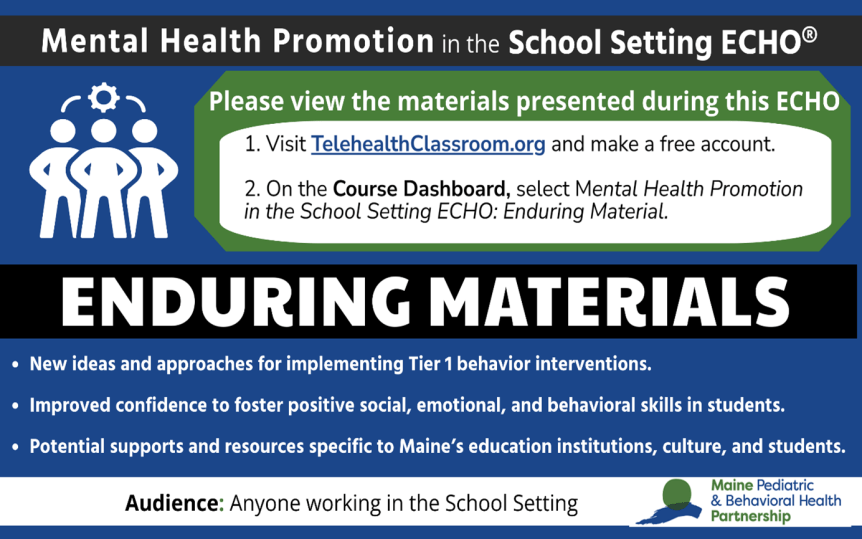
Resources for Mental Health Promotion in the School Setting

In early 2023, The Maine Pediatric and Behavioral Health Partnership, a partnership between The Department of Health and Human Services, Northern Light Acadia Hospital, and MaineHealth, used ECHO® Methodology to connect 125 participants across Maine, including teachers, ed techs, school nurses, social workers, counselors, and administrators to specialists in child and adolescent mental health.

Each of the six ECHO sessions contained a brief high-yield didactic presentation and provided a structured forum for those working in Maine schools to bring forward complicated behavioral health cases for exploration and review.

As a learning collaborative, we were reminded of mental health promotion skills we were already using and gained new ideas to put into action. We addressed the needs of our student population by learning from each other using case-based methodology.

As a result of the learning collaborative, MCD Global Health created the Mental Health Promotion Toolkit. A collection of helpful resources can be found inside. These materials provide information on mental health promotion, tips for addressing health disparities, and roadmaps for implementing innovative strategies to improve mental health and substance use prevention efforts in schools.

For more information about the Maine Pediatric and Behavioral Health Partnership Program, please call 1-833-MPBHP11 (1-833-672-4711) or contact Melissa Maurais at Melissa.Maurais@maine.gov