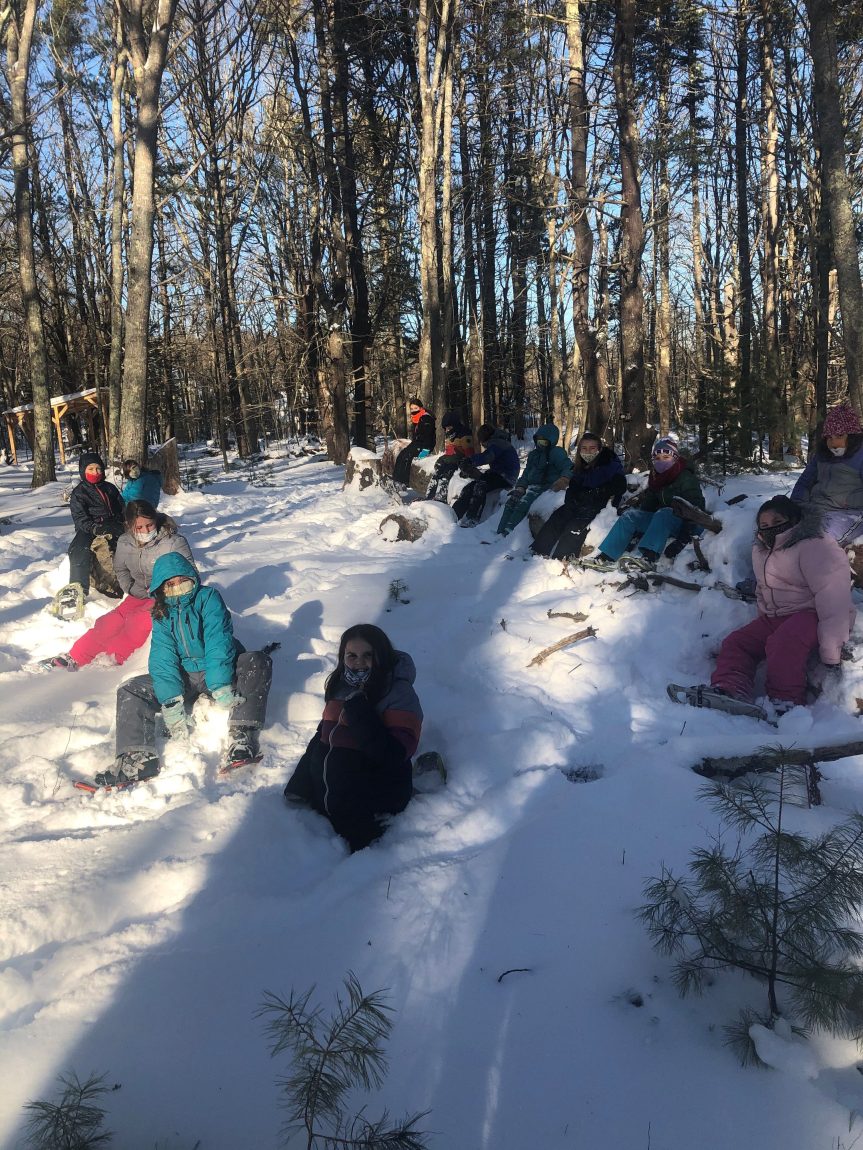
Georgetown Central School Adopts Outdoor Teaching with the Help of Juniper Hill School

With the looming restrictions of school reopening in a pandemic this summer, Georgetown Central School created an outdoor education team and invited teachers, staff, community members and parents, to help brainstorm how Georgetown could adjust teaching practices to bring learning outdoors. A school already rich in the tradition of community, outdoor, and project-based learning, we knew that we had to make adjustments to a normal year (when students would participate in hands-on field trips such as digging for clams or studying the migration habits of crabs). In August, two teachers spent four days learning at Juniper Hill School ’s Summer Institute for Educators: Teaching with Nature. Juniper Hill School, a community school for PK-5th grade students, was founded 10 years ago on the foundation of outdoor, nature-based teaching and learning. Anne Stires, the School’s founder, offers year long coaching, professional development workshops, and summer institutes for educators.

Georgetown School began to pivot. With a lot of help from community members, parents and staff, and the guidance and vision of the teachers who attended the summer training at Juniper Hill, we were able to set up roughly twelve outdoor classroom spaces on school property and conservation land beyond the property. A musical garden was formed across from our school’s garden. Swinging reading nooks were created for younger classrooms, and rocks and roots were pulled from land to create a pathway to multiple classroom spaces.

WRITING CLASS, 1st/2nd graders, Georgetown Central School

Using CARES money and writing our title four federal funds application for outdoor education, we were able to supply classrooms with the instructional supplies and tools they needed. We purchased individual swings for students in kindergarten and grades one and two – a quiet space for students to take a break from the mandates of a pandemic education – and an opportunity to escape into the world of literature. We set up outdoor seating areas, using stumps and camp chairs, and purchased chalkboards to bring teaching outside.

As we asked ourselves the question, “How do we do this?” we knew it would be best to reach out to the experts. Anne Stires, from Juniper Hill School, brought outdoor learning professional development workshops to Georgetown Central School such as, “Stepping Outside for the First Time,” “Teaching with Nature: Curriculum,” “Teaching in Winter,” and lastly, “Safety and Risk Management.” From there, teachers have been bringing in more ideas around using the elements of nature to support learning. We have purchased a library collection of professional learning resources directly connected to outdoor education, and built classroom libraries with books that focus primarily on learning in nature and with nature.

In one class, morning meeting takes place outside; calendar and the days of the week are sung as children sit on donated tree stump seats arranged underneath a canopy of trees. An old playground slide is positioned neatly on the hillside leading to the classroom, a welcome experience for students as they make their way to a chalkboard and mud kitchen supplied with pots and pans. Imagination for students in these spaces runs wild and play-based learning has become more evident for the early childhood students. Instead of worksheets with math equations, students jump from sliced tree stump to tree stump adorned with numbers in order.

An experimental year, teachers have been learning first hand how to balance indoor and outdoor learning, especially as we approach the winter months. Simple things have allowed us to take students outside even on colder days. Each student in Georgetown has a warm pair of wool socks, a thermos to bring hot water or tea outside, a winter hat and a fleece neck gaiter (all items gathered by the community or purchased with CRF funds). Outdoor learning in the winter is all about movement. Students study tracks in the snow or other signs of animals that have quietly come and gone without notice on a walk through the playground fields or surrounding woods. An outdoor math class (counting by ones or tens), has students jumping in the snow–making tracks as they jump as far as they can to represent tens and as short as they can to represent ones.

Teachers bring out materials on their individual classroom carts or, in colder months, they will use the jet sleds purchased with CARES money to travel to outdoor classrooms. Outdoor education supplies are kept organized in a shed that is designated specifically for the outdoor classrooms. A walk further into the woods on conservation land, leads students and teachers to a beautiful open pavilion structure we are hoping to enclose, that acts as a shelter in the woods for learning. The timber frame structure was a collaborative effort between the school and school families.

Georgetown School will be continuing ongoing coaching with Anne Stires for the remainder of the year, beginning with our PK-2nd grade teachers. With model lessons, project-based integrated curriculum planning, and feedback sessions, teachers will gain even more confidence and creativity in working with their students outdoors. The ongoing pivot is exciting and rewarding and students and teachers are healthier and happier as a result!
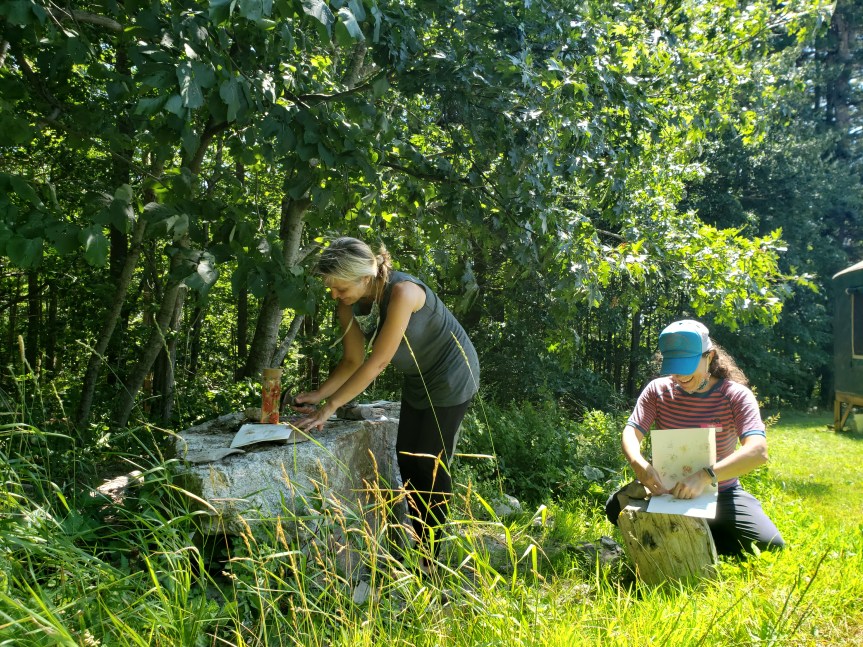
teachers working together outside, smiling
Images taken at Juniper Hill School’s Teaching with Nature: Summer Educator Institute

This story as provided by Juniper Hill School and Georgetown Central School as part of the Maine Schools Sharing Success Campaign. To submit a story or an idea, please email it to Rachel at rachel.paling@maine.gov.



Maine DOE Update – December 18, 2020

From the Maine Department of Education


Reporting Items

Graduation Certification Report to Open December 21st, 2020

New for 2019-2020: To assist schools in the data process, there have been changes to the Graduation Certification Report. The transfer-In/Out counts of students will no longer be used to determine adjusted cohort, and there will be no more validating of the start and exit codes of students during this report. The report will also no longer be required to be ‘Accepted’ by the Maine Department of Education (DOE). | More

| Visit the DC&R Reporting Calendar |


News & Updates

Mills Administration Updates COVID-19 School Health Advisory System

Cumberland joins Androscoggin, Oxford, and York counties in yellow designation; all others designated green The Mills Administration today released an update to its color-coded Health Advisory System that classifies counties’ relative risk of COVID-19 transmission to assist schools as they continue with their plans to deliver instruction and support to students safely. The Maine Department of Health and Human Services (DHHS) and Maine Center for Disease Control and Prevention (Maine CDC) continue to review evidence that indicates lower transmission of COVID-19 in schools compared to the general population. Over the last 30 days, the rate of new cases is 25.2 per 100,000 staff and students, compared to 62.5 per 100,000 people statewide. This lower rate of new cases in schools is consistent with previous weeks. | More

Update – Teacher Shortage Areas

The U.S. DOE annually designates teacher shortage areas for purposes of deferment of loan repayments or reductions of teaching obligation.  On November 30, 2020 the Department of Education requested input regarding designated teacher shortage areas for federal reporting.   The Department would like to thank all those who submitted information related to teacher shortage and, because of public input, have added a number of teaching endorsements to the US DOE proposal.  The Maine DOE will be proposing the following as K-12 teacher shortage areas for the 2021-2022 school year: | More

Controlling Indoor Air Quality to Reduce COVID-19 Transmission: Guidance for Building Managers and Education Leaders

Now that cold weather has arrived in Maine, people are spending more time indoors, adding additional considerations for indoor air and mitigation strategies for COVID-19. This webinar will cover some basic strategies including ventilation and filtration techniques that building managers and other education leaders can use to manage indoor air quality in a way that will help reduce the spread of the virus.  Health engineers from Maine CDC will be joined by indoor air quality experts from the Maine Indoor Air Quality Council for this brief presentation, to be followed by a Q & A session. | More

Maine DOE Launches a New Web Resource to Support Multi-Tiered Systems of Support Framework Implementation

The Maine Department of Education is thrilled to announce the launch of a new web experience designed to provide relevant content and valuable information about Multi-Tiered Systems of Support (MTSS). The new resource aims to be a useful guide and implementation tool that will help schools with the complex task of fully implementing MTSS. | More

Seeking Maine Educators to Create Learning Modules for MOOSE

The Maine Department of Education is seeking educators to create learning modules for MOOSE, Maine’s Online Opportunities for Sustained Education. MOOSE is an initiative that is grounded in innovation and made possible by technology. Learn with MOOSE is committed to creating learning experiences for students that are accessible and inclusive of all learners, and serves to provide anytime, anywhere learning options and resources for educators, students and their families. Integrated across subject areas and project-based, these asynchronous modules ensure that learning is active, engaging, and continuous. | More

Get to Know the DOE Team: Meet Carole King

Maine DOE Team member Carole King is being highlighted this week as part of the Get to Know the Maine DOE Team Campaign. Learn a little more about Carole. | More


Maine Schools Sharing Success Stories

| Submit your Maine School Success Story |


Professional Development & Training Opportunities

| Visit the Professional Development Calendar |


Latest DOE Career/Project Opportunities

View current Maine Department of Education employment opportunities here


Seeking Maine Educators to Create Learning Modules for MOOSE

The Maine Department of Education is seeking educators to create learning modules for MOOSE, Maine’s Online Opportunities for Sustained Education. MOOSE is an initiative that is grounded in innovation and made possible by technology. Learn with MOOSE is committed to creating learning experiences for students that are accessible and inclusive of all learners, and serves to provide anytime, anywhere learning options and resources for educators, students and their families. Integrated across subject areas and project-based, these asynchronous modules ensure that learning is active, engaging, and continuous.

As a content creator of the Learn with MOOSE initiative, you will embark on an innovative instructional design journey that will push the bounds of your professional skillset. Grounded in inclusive design, MOOSE modules are created to meet Universal Design for Learning and to be accessible for all learners, regardless of ability.

Participants must be Maine educators, including but not limited to teachers, curriculum leaders and Maine educational community organizations such as museums, libraries, and educational centers. The module creation work begins January 4th and concludes on April 16th. Each participant will be trained in a-synchronous instructional design by Maine DOE digital learning specialists, as well as supported in their content by Maine DOE content specialists. Stipends of $1000 will be provided for successful completion of the project.

To register click here.

For more information please contact Beth Lambert, beth.lambert@maine.gov or Page Nichols, page.nichols@maine.gov.

Are you a teacher or parent using MOOSE modules with your students? Share your story with us! @mdoenews #LearnwithMOOSE 

MEDIA RELEASE: Mills Administration Updates COVID-19 School Health Advisory System

Cumberland joins Androscoggin, Oxford, and York counties in yellow designation; all others designated green

AUGUSTA — The Mills Administration today released an update to its color-coded Health Advisory System that classifies counties’ relative risk of COVID-19 transmission to assist schools as they continue with their plans to deliver instruction and support to students safely.

The Maine Department of Health and Human Services (DHHS) and Maine Center for Disease Control and Prevention (Maine CDC) continue to review evidence that indicates lower transmission of COVID-19 in schools compared to the general population. Over the last 30 days, the rate of new cases is 25.2 per 10,000 staff and students, compared to 62.5 per 10,000 people statewide. This lower rate of new cases in schools is consistent with previous weeks.

DHHS and Maine CDC assessed COVID-19 data and trends for all counties. Based on this assessment, the following designations have been determined:

  • REMAIN YELLOW: Androscoggin, Oxford and York counties have rising positivity rates, exceeding the statewide average.
  • NOW YELLOW: Cumberland County experienced an increase in both the new case rate per 10,000 people and positivity rate.

All other counties remain in the green designation.

Under the “yellow” designation, which indicates an increased (moderate) level of community risk, schools may consider additional precautions, such as limiting numbers of people in school buildings at the same time, suspending extracurricular or co-curricular activities including competitions between schools, limiting interaction through cohorting, or other measures based on the unique needs of each school community.

These designations are made out of an abundance of caution and for the consideration of school administrative units in their decisions to deliver instruction.

It is essential that school districts across the State of Maine continue to implement plans that adhere to the six requirements for returning to in-person instruction, regardless of their county’s designation.

The Health Advisory System categorizations are defined as follows:

  • RED: Categorization as “red” suggests that the county has a high risk of COVID-19 spread and that in-person instruction is not advisable.
  • YELLOW: Categorization as “yellow” suggests that that the county has an elevated risk of COVID-19 spread and that schools may consider additional precautions and/or hybrid instructional models to reduce the number of people in schools and classrooms at any one time.
  • GREEN: Categorization as “green” suggests that the county has a relatively low risk of COVID-19 spread and that schools may consider in-person instruction, as long as they are able to implement the required health and safety measures.  Schools in a “green” county may need to use hybrid instruction models if there is insufficient capacity or other factors (facilities, staffing, geography/transportation, etc.) that may prevent full implementation of the health and safety requirements.

The county-level assessments are based on both quantitative and qualitative data, including but not limited to recent case rates, positivity rates, and syndromic data (e.g., symptoms of influenza or COVID-19). Those data are publicly posted every week on the Maine CDC website. DHHS and Maine CDC also consider qualitative factors, such as the presence of outbreaks that may potentially affect school-age children.

The Health Advisory System reflects ongoing analysis of evolving data, and serves as one piece of information that school and district leaders can use to make decisions about how to deliver education during the school year. The qualitative and quantitative considerations and data used by the CDC in determining community transmission risk levels for schools can be located here: How County Risk Levels for Maine Schools are Determined

The Health Advisory System can be found on the Maine DOE website in Part I of the Framework for Reopening Schools and Returning to In-Person Classroom Instructionhttps://www.maine.gov/doe/framework/part-I.

The next update will be provided in the afternoon of Thursday, December 31, 2020, one day earlier due to the holiday on January 1, 2021.

###


Maine DOE Launches a New Web Resource to Support Multi-Tiered Systems of Support Framework Implementation

The Maine Department of Education is thrilled to announce the launch of a new web experience designed to provide relevant content and valuable information about Multi-Tiered Systems of Support (MTSS). The new resource aims to be a useful guide and implementation tool that will help schools with the complex task of fully implementing MTSS.

The creation of a MTSS website resource began with the establishment of a full time MTSS Specialist in November of 2019. With support and input from a variety of specialists across the Department, as well as many discussions with stakeholders from the field, one thing became clear: Maine educators need a resource they can access that will not only provide information about MTSS, but empower them to take action on a MTSS problem or challenge.  With the theme “what they need, when they need it” in mind, each page of the website seeks to provide a way for educators to find what they are looking for, quickly and easily, so Maine students have access to the supports they need to grow academically, behaviorally, and socially.

Braiding together the “What” and the “How”

Understanding that educators utilize web resources to learn something new, seek answers to questions, or explore solutions to a challenge, the MTSS website seeks to braid together the “what” of MTSS and the “how” of MTSS.  The site provides a combination of informational content and links, learning opportunities, and downloadable tools that can be used immediately.  For example, looking for information on team leadership?  The MTSS Framework page unpacks the “team leadership” component of MTSS and provides tools and resources to put into place as soon as  you leave the site.  Or, maybe you want to learn something new about implementation fidelity or how to facilitate school and family partnerships.  The Professional Learning page offers short learning modules and webinar resources you can participate in to help you on your journey.

The MTSS Framework page and the Professional Learning page are just two examples of what you will find when you visit the MTSS website. Other features include problem solving through technical assistance, information on opportunities for how you can get involved, and trail maps and action guides to help move you forward no matter where you are on your MTSS journey.

A work in Progress

Above all, the MTSS website will be continually growing, adapting, and changing as needs  arise or change. Some sections of the website are still under construction, but plenty of content is already available. Visit the site often to stay up to date on new resources .  If you are looking for something in particular, simply click the contact tab and reach out.  The MTSS Specialist will be in touch to help.

To visit the MTSS website visit http://www.maine.gov/doe/mtss to get started.  For more information contact Andrea Logan, MTSS Specialist via email at andrea.logan@maine.gov, or phone (207) 592-2011.

Controlling Indoor Air Quality to Reduce COVID-19 Transmission: Guidance for Building Managers and Education Leaders

Now that cold weather has arrived in Maine, people are spending more time indoors, adding additional considerations for indoor air and mitigation strategies for COVID-19. This webinar will cover some basic strategies including ventilation and filtration techniques that building managers and other education leaders can use to manage indoor air quality in a way that will help reduce the spread of the virus.  Health engineers from Maine CDC will be joined by indoor air quality experts from the Maine Indoor Air Quality Council for this brief presentation, to be followed by a Q & A session.

  • Presenters: Maine Center for Disease Control & Prevention, Division of Environmental & Community Health
  • December 22, 2020 – 11:00am-12:00pm
  • Register in advance for this presentation: https://zoom.us/meeting/register/tJUvd-qhrzIvHtxO-A7aCsqESVXH_NL1jWX9
  • After registering, you will receive a confirmation email containing information about joining the meeting.

Lewiston Adult Education Computer Training Prepares Students For Future Careers

Computer Support Specialist student Santo Panzo took a moment during November mock interviews for a photo outside the Adult Learning Center at the Longley Multipurpose Center.

Lewiston Adult Education students have completed the first part of Computer Support Specialist training for technology sector jobs. The combination of in-person and distance learning lessons in the fall focused on digital literacy, English skills and work readiness. Successful completion of the program results in a level one Computer Specialist microbadge that can be accepted for college credit and is recognized by employers around the state.

“The students were very motivated and showed a great work ethic. All of them work full time yet were able to participate in and successfully complete this intense program,” English teacher Irina Petranek said.

Student Santo Panzo thanked computer teacher Greg Yates in an email.

“We are more than proud of the opportunity Lewiston Adult Education provided to us,” Panzo said.

On Nov. 20, Panzo and his classmates participated in mock interviews with staff and community members as another preparation for the workforce. Local partners in the interviews included Carbonite, Bates College and RoundTable Technology. Some of the interviews were remote while others were in person with social distancing and mask-wearing.

Computer Support Specialist student Ester Bassa sat for an outdoor photo during November mock interviews at the Adult Learning Center at the Longley Multipurpose Center.

“Lewiston Adult Education is proud to have pioneered in this innovative work. The opportunity to invest in training that results in badges that are recognized for college credit and by local employers is of tremendous benefit to our adult learners,” Lewiston Adult Education Assistant Director Jen Tiner said. “We admire the initiative and persistence that our students demonstrated throughout this program.”

The students’ next step will be taking the National Retail Federation Customer Service and Sales program in collaboration with RSU 16 Adult Education. It will include English classes with a focus on technical writing and speaking skills.

“This class of students reminds us all of the importance of embracing the new ‘global language’ – Information Technology.  A diverse set of students in age, background and origin, they were eager to master the skills of today’s explosion in computer technology,” Yates said.

The Computer Support Specialist Program is funded by the Lumina Foundation and developed in partnership with the University of Maine System, the Maine Department of Labor and the Maine Department of Education.

This story was provided by Lewiston Adult Education Center as part of the Maine Schools Sharing Success Campaign. To submit a story or an idea, email it to Rachel at rachel.paling@maine.gov.

Buckfield Junior Senior High School Teacher Takes on Morning Announcements to Stay Connected with Students

With many schools offering various learning modes through the COVID-19 pandemic, educators and staff alike are going above and beyond to stay connected with their students, both to keep them engaged in learning and to support their wellbeing.

Buckfield Junior Senior High School Teacher Annette Caldwell has been providing morning announcements and news to her school community recently, including the weather and some tips and tricks for staying on track while learning remotely.

While the school was providing learning in a hybrid model, the morning announcements were created by students, with direction and guidance from Annette. More recently, the school has transitioned to a fully remote learning model and Annette has taken on doing the announcements completely. She makes a point to do one everyday for students.

Check out a recent announcement created by Annette in the embedded video below.

“So many of our staff across RSU 10 are going above and beyond,” said RSU 10 Superintendent Deborah Alden.

Lets all take a moment to appreciate and thank our schools, educators, administrators, and staff members for everything they are doing to keep students engaged and learning during this difficult and exhausting time.

Information for this story was provided by RSU 10 as part of the Maine Schools Sharing Success Campaign. To submit a story or an idea email it to Rachel at rachel.paling@maine.gov.

Update – Teacher Shortage Areas

The U.S. DOE annually designates teacher shortage areas for purposes of deferment of loan repayments or reductions of teaching obligation.  On November 30, 2020 the Department of Education requested input regarding designated teacher shortage areas for federal reporting.   The Department would like to thank all those who submitted information related to teacher shortage and, because of public input, have added a number of teaching endorsements to the US DOE proposal.  The Maine DOE will be proposing the following as K-12 teacher shortage areas for the 2021-2022 school year:

  • Early Elementary (K-3)
  • Early Childhood (Pre-K)
  • Teacher of Students with Disabilities
  • Teacher – Severe Impaired
  • Blind/Visually Impaired
  • Deaf/Hearing Impaired
  • English/Language Arts
  • Social Studies
  • French
  • Spanish
  • Health
  • English – Second Language
  • Mathematics
  • Physical Education
  • Adapted Physical Education
  • Physical Science
  • Industrial Arts / Technology
  • Visual Arts
  • Gifted/Talented
  • CTE (Firefighter/EMT, Automotive Mechanics, Truck, Automotive Body Repair, Diesel Engine Mechanic, Carpentry, Marine Maintenance, Electrician, Computer Info Services, Machine Toll Oper/Shop, Weld Braze Solder, Building Maintenance, Plumbing, Agricultural Prod. Gen, Allied Health, Nursing Asst., Law Enforcement, Forestry Prod & Proc., Food Production Manager, Child Care/Guidance, Business Admin/Manager)

The Maine Department of Education received additional input regarding specialist and administrator certificates.  However, the Department has already exceeded the allowable federal shortage percentage and is providing additional documentation in our proposal to obtain as many teacher shortage endorsements as possible.

Get to Know the DOE Team: Meet Carole King

Maine DOE Team member Carole King is being highlighted this week as part of the Get to Know the Maine DOE Team Campaign. Learn a little more about Carole in the question and answer below.

What are your roles with DOE?

I began working in DOE afternoons while I was still employed at Cony High School as an Office Secretary to the Principal 1979-2009. I worked full time in the summer months as my position at the school was school-year-only. After two years, I resigned from the position at school and began work at MDOE full time under a contract through the Maine Math and Science Alliance.

What do you like best about your job?

I enjoy the variety of work I perform for the Specialists on the Maine DOE Learning Systems Team. The work has varied over the years and I have assisted each specialist at one time or another setting up interviews, sending out letters, making entries into Advantage for Contracts, POs, and other clerical duties as requested.

How or why did you decide on this career?

I’ve always enjoyed working in the field of education supporting students and teaching staff.

What do you like to do outside of work for fun?

I enjoy time with my family, knitting, gardening and spending time outside during all our seasons. We are so lucky living in Maine!