Get to Know the DOE Team: Meet Julie Pelletier

Maine DOE team member Julie Pelletier is being highlighted this week as part of the Get to Know the Maine DOE Campaign. Learn a little more about Julie in the question and answer below.

What are your roles with DOE?

I am the administrative support for the Special Services Monitoring Team. I maintain all their schedules for Monitoring, Professional Development and travel as well as supporting them with the clerical aspects of the monitoring process.

What do you like best about your job?

I like that my days are never the same. From working with the team on monitoring, communicating with Special Ed Directors to facilitating meetings and trainings my day is never dull!

How or why did you decide on this career?

I didn’t chose a career in education, it pretty much chose me. After years in the Insurance world I started volunteering in my daughters elementary school while taking the time to decide what I wanted to do next. Before I knew it I was the Admin in a K-5 elementary school and loved it! I was there for 15 years before coming here to the Maine DOE!

What do you like to do outside of work for fun?

Be it by the fire or celebrating life events, I love spending time with family and friends. I also enjoy a good book, hiking, kayaking, snow shoeing and old movies!

Maine DOE Provides Complimentary 2020-2021 Law Books to Superintendents

The Maine Department of Education has acquired enough copies of the Maine Education and School Statutes 2020-2021 Edition law book from the publisher, Swan Island Press, to distribute one, at no charge, to each superintendent of schools in Maine.

The law books are in the mail and should be received soon. To purchase additional copies of this law book directly from Swan Island Press, please contact Aaron Chase of Swan Island Press at swanislandpress@gmail.com.


Maine DOE Update – July 24, 2020


From the Maine Department of Education


Reporting Items

Annual Audit Reminder: Key Dates and Important Information for District Admins

We know that superintendents are extremely busy this summer, preparing for a new school year in a climate full of unknowns. As there is much to organize, we are providing an annual audit reminder, with key dates so that you can mark your calendars and take any initial steps needed. | More

| Visit the DC&R Reporting Calendar |

News & Updates

COVID-19 Infographics Available for Schools, Families, and Youth 

The Maine Department of Education (DOE) and the Maine Center for Disease Control (CDC) have collaborated on two COVID-19 graphic tools to aid school staff in screening a child for COVID-19 if the child appears or feels unwellAn additional pre-screening tool with a list of COVID-19 symptoms has been created for schools to distribute to families to help them determine if a child is well enough to attend school. | More

Get to Know the DOE Team: Meet Paula Nadeau

Maine DOE Team member Paula Nadeau is being highlighted this week as part of the Get to Know the Maine DOE Campaign. Learn a little more about Paula | More

Maine Schools Sharing Success Stories

| Submit your Maine School Success Story |

Professional Development & Training Opportunities

| Visit the Professional Development Calendar |


Latest DOE Career/Project Opportunities

View current Maine Department of Education employment opportunities here
 

Annual Audit Reminder: Key Dates and Important Information for District Admins

We know that superintendents are extremely busy this summer, preparing for a new school year in a climate full of unknowns. As there is much to organize, we are providing an annual audit reminder, with key dates so that you can mark your calendars and take any initial steps needed.

Initial Report to the Commissioner Due November 1st:

As is required by Title 20-A MRSA 6051 §4, statements of assurance and Maine Education Financial System reconciliations are due to the Department by November 1, 2020. Please submit via email to DOE.audit@maine.gov .

  • Any adjustments identified by these reconciliations should be uploaded to the Maine Education Financial System in NEO by November 30, 2020.

Annual Audit Reports Due December 30th

Annual audit reports are due within six months after the end of the audit period (e.g., reports for the fiscal year ending June 30th are due on or before December 30th).

  • Per statute, the auditor is required to review the audit with the school board.
  • Per statute, it is the school board’s responsibility to submit the annual audit document unless it is stated in the engagement letter that the audit firm will submit the audit to the Department on behalf of the school board.
  • Municipal school units are required to submit either a combined annual audit or a school department audit and a municipal audit to the Department. The municipal annual report (a.k.a. town report) cannot be accepted in lieu of the complete municipal annual audit.
  • Per statute, Maine DOE must receive a Schedule of Expenditure of Federal Awards (SEFA), which includes federal award expenditures for all reporting entities, even if a Single Audit (formerly A-133 audit) is not required to be conducted. The SEFA provides information needed by Maine DOE to conduct sub-recipient monitoring as required by the US Department of Education and is due at the time of the annual audit.
    • Municipal school units, please note: where a combined audit is not conducted, Maine DOE should receive two audits: an audit with a SEFA for the school department, and an audit for the city/town including a SEFA.
  • If a management letter is prepared by the auditor, a copy must be submitted to Maine DOE with the annual audit, as this letter provides us with information needed to conduct sub-recipient monitoring, as required by US DOE.

Extensions and Subsidy Payments

If an extension or exception is needed for the deadline to submit either the municipal or school department audit, the superintendent must contact us to request the extension.

The forms are available on the Fiscal Review and Compliance webpage, under forms on the menu bar.

  • Extensions will expire no less than 30 days from the date the extension was submitted.
  • Extension requests will be considered until June 30th (six months after due date); extensions will not be valid after June 30th and all municipalities and school administrative units with overdue audits that have not submitted an extension request before May 31th may have a delay in subsidy release. Those who have not submitted an extension request will have subsidy withheld until addressed.

Exception for a Municipal School Audit

  • Municipalities that do not operate a school and have different fiscal year end than the school may request an exception for the school audit. The exception form and more information may be found on the  Fiscal Review and Compliance webpage.

Please submit all annual audit documents, reports, information requests, questions and other audit correspondence via email to DOE.Audit@Maine.gov or via the direct link provided on the Fiscal Review and Compliance webpage.


MSAD 54 Serves 500k Meals, Travels 48k Miles to Feed Kids During Pandemic

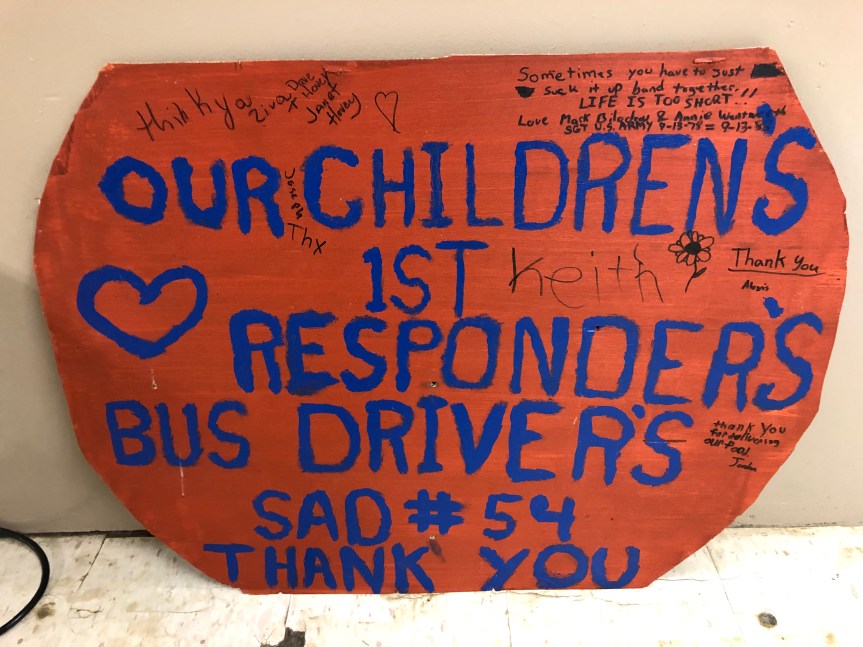
Our MSAD 54 family has had great success in feeding our students during the COVID-19 pandemic. With the help of our transportation department, administration, ed techs and of course or school nutrition team we were able to serve close to 500k meals and traveled 48k miles between the months of March-June.

We received many words of appreciation, cards, photos of the children, and signs around the towns thanking us for all that we have done. It has been a great and humbling experience for all of us that have been involved over the last couple of months.

This story was submitted by Jana Wacome, Director – School Nutrition, RSU 54/MSAD 54 as part of the Maine Schools Sharing Success Campaign. To submit a story or an idea, email it to Rachel Paling at rachel.paling@maine.gov.

Efficiency Maine Helps Brighten More than 50 Maine Public Schools with Incentives to Support Lighting Upgrades

More than 50 Maine public schools are upgrading the quality of their interior and exterior lighting through a special Efficiency Maine initiative.

The principal goal of Efficiency Maine’s School Lighting Retrofit initiative is to reduce electric energy consumption from Maine K-12 municipal schools and to accelerate the conversion to efficient LED lighting. The offer supported project work for electricians and encouraged schools to complete the lighting conversions over the 2020 summer while school buildings are unoccupied.

“We were very glad to see broad participation stretching from Kittery to Calais to the County,” said Michael Stoddard, executive director of the Efficiency Maine Trust.

Eligible electrical efficiency lighting retrofit projects include interior and exterior lighting upgrades in classrooms, hallways, lobbies, entryways, stairways, auditoriums, libraries, cafeterias, offices, gymnasiums, parking lots, and public restrooms.

“This grant program will help 50 schools across the state to have better lighting while conserving energy and reducing costs,” said Dan Burgess, director of the Governor’s Energy Office. “This initiative not only helps our state meet its energy goals, but it allows schools to use the savings to support students and teachers in other important ways.”

Limestone Community School in Limestone is among the schools that has benefited from the incentive program. The school received more than $38,000 in incentives to upgrade lighting in its classrooms, auditorium, library, offices, bathrooms and parking lot. The school will see an estimated annual savings of more than $19,000 (129,975 kWh) and will realize a return on investment in an estimated 2.3 years.

 According to Superintendent Bill Dobbins, they are elated with the results and already have received inquiries from other district schools interested in pursuing similar projects.

“We viewed this project as a way to create a better atmosphere for the educational growth of our children,” explained Dobbins. “Efficiency Maine’s School Lighting Retrofit program enabled us to combine and accelerate two projects that our budget alone couldn’t accommodate in the same year. We were able to complete it using less money from Limestone taxpayers and while the children weren’t in school. We’re hoping the new brighter, uniform lighting will make it easier for them to do their schoolwork. In the meantime, we’ve already heard from our local police department that it’s easier for them to patrol the school grounds because the exterior lighting is so improved.”

St. John Valley Technology Center in Frenchville is equally satisfied. The school contributed approximately $20,000 to the project and Efficiency Maine contributed $13,000 to upgrade lighting in its entryways, hallways, and gyms. The school will see an estimated annual savings of nearly $7,000 (46,163 kWh) and will realize a return on investment in an estimated 2.8 years.

“There’s no question, improving lighting enhances the ability of students to learn,” said Kevin Lavoie, director of St. John Valley Technology Center. “We’re reducing our carbon footprint because LED lighting is more energy efficient. This program also has reduced the tax burden on our community and has created jobs for Maine’s workforce. That’s a triple win as far as we’re concerned. In addition, we’re especially pleased we could complete the project this summer.”

Songo Locks Elementary School and the Educational Services building for the Lake Region Vocational Center in Naples have brighter futures, as well. Together, the schools received more than $10,000 in incentives to upgrade exterior lighting and will see an estimated annual savings of more than $5,000 (39,481 kWh).

 Andrew Madura, director of Transportation, Facilities and Food Services for Naples schools, is confident the projects will help the schools save money and energy. Two years ago, Madura managed an interior lighting project using incentives from Efficiency Maine, which resulted in a 20% to 25% reduction in energy consumption for those measures.

“We’re constantly looking for ways to be more efficient,” explained Madura. “With a limited budget, this program was very helpful. We were able to complete both projects without allocating additional capital funds. It has particularly benefited the Educational Services building, which houses our buses and equipment. The exterior lighting at the building is on constantly in the evenings for security purposes, making the energy consumption fairly high.

“The nighttime staff have noticed and appreciate the improved lighting,” said Madura. “Aesthetically, it’s much more attractive. It’s also more controlled lighting, ensuring that our residential neighbors don’t experience light spill. Overall, we now have better lighting that requires less maintenance and uses less energy. To me, that’s an efficiency trifecta.”

Louis DiFrederico, facilities manager for the Millinocket School Department, managed projects at Stearns Junior – Senior High School and Granite Street Elementary School. DiFrederico already is a firm believer in the savings he can derive from Efficiency Maine initiatives, having managed a similar lighting upgrade 10 years ago with incentive funds. This time around, the projects improved lighting in the gymnasiums and corridors at the high school and upgraded lighting in the elementary school classrooms, hallways, cafeteria, and lobby. By matching Efficiency Maine’s incentives, DiFrederico estimates the school department will save $7000 a year for the elementary school and $6000 a year for the high school.

“Given the nature of limited school budgets and funding, I had to look for creative ways to get the job done,” explained DiFrederico. “This was a relatively easy process that was readily available and translated into real dollar savings up front and long-range. Without Efficiency Maine’s incentives, I would not have been able to complete these projects.”

DiFrederico was especially keen after he did the math. He calculated that by upgrading the lighting in all the elementary school classrooms energy load dropped from 1100 watts per classroom to 400 watts. Together, both projects will save an estimated 87,000 kWh annually.

“It used to cost $1.33 a day to light each elementary school classroom and now it costs 48 cents,” he said. “The new LED fixtures not only provide better light, but they look better, and provide a modern update to the buildings. Teachers and staff have also thanked me for brightening their classrooms and the building. To me, those benefits are a win-win for the district.”

Efficiency Maine accepted applications for the School Lighting Retrofit Funding Opportunity Notice (FON) between February 10, 2020, and June 1, 2020. The funding opportunity is now closed. Funding was calculated based on the amount of electricity saved by each project in the first year and was subject to caps of 80% of the total project cost and $100,000 per school district.

Efficiency Maine’s Prescriptive Program, which funded the school initiative, offers fixed incentives to reduce the cost of projects and to improve energy efficiency for businesses, municipalities, schools and higher education facilities, manufacturing and other industrial facilities, other non-residential facilities, and multifamily and condominium buildings with five or more units.

To learn more about the Efficiency Maine Prescriptive Program and how to maximize its benefits visit https://www.efficiencymaine.com/at-work/ci-prescriptive-incentive-program/.

About Efficiency Maine Trust
Efficiency Maine Trust is the independent administrator for programs to improve the efficiency of energy use and reduce greenhouse gases in Maine. The Trust does this primarily by delivering financial incentives on the purchase of high-efficiency equipment or changes to operations that help customers save electricity, natural gas and other fuels throughout the Maine economy. The Trust is a quasi-state agency governed by a Board of Trustees with oversight from the Maine Public Utilities Commission. Visit www.efficiencymaine.com for more information.

COVID-19 Infographics Available for Schools, Families, and Youth 

The Maine Department of Education (DOE) and the Maine Center for Disease Control (CDC) have collaborated on two COVID-19 graphic tools to aid school staff in screening a child for COVID-19 if the child appears or feels unwellAn additional pre-screening tool with a list of COVID-19 symptoms has been created for schools to distribute to families to help them determine if a child is well enough to attend school. 

  • FOR DISTRIBUTION TO FAMILIES: COVID-19 Pre-screening Tool for School Attendance (Updated 8.3.20)In addition to English, this tool will be translated into the top ten languages spoken by Maine students: Arabic (Jordan), Chinese (People’s Republic of China), French (France), Khmer (Cambodia), Kinyarwanda (Rwanda), Kiswahili/Swahili (Congo, DRC), Portuguese (Angola), Somali (Somalia), Spanish, Vietnamese (Vietnam). These additional versions will be available as soon as possible. 
  • FOR SCHOOL NURSES AND OTHER STAFF TASKED WITH EVALUATING STUDENT HEALTH: COVID-19 Child Feels or Appears Unwell Flowchart (Updated 8.4.20) 

The two infographics above have also been linked to the Framework for Returning to Classroom Instruction and the Maine DOE’s COVID-19 webpage under Health Resources.  

In addition, the CDC has produced a series of factsheets for young adults, ages 15-21. The factsheets cover a variety of topics, including what test results mean, how to stay safe at the pool or beach, how to wear a face covering and other preventive measures.  

If schools have further questions about these health resources, please contact Maine DOE School Nurse Consultant Emily Poland at emily.poland@maine.gov.

Get to Know the DOE Team: Meet Paula Nadeau

Maine DOE Team member Paula Nadeau is being highlighted this week as part of the Get to Know the Maine DOE Campaign. Learn a little more about Paula in the brief question and answer below.

What are your roles with DOE?

My role within DOE is Office Specialist I. What that means within Child Nutrition is that I take care of RFPs, contracts, our website, scheduling webinars and training and whatever else comes my way. Now that our meetings and upcoming trainings are virtual, that’s added a new spin to it all.

What do you like best about your job?

I couldn’t ask for a better group of people to work with. I also love that no two days are really ever the same; I can come in thinking it is going to be a relatively quiet day and before I know it, it is 4:00 and I haven’t stopped.

How or why did you decide on this career?

How I chose this career? Well, that’s a long story and it chose me.

What do you like to do outside of work for fun?

Outside of work, I love to spend time in my craft room, sit on my front porch reading a book or working on my somewhat green thumb.

Mountain Valley High School Rolls Out the Bikes!

Every year when students enrolled in Todd Papianou’s Lifetime Pursuits physical education class at Mountain Valley High School when they return from April vacation, they are given the opportunity to choose their next unit. The Lifetime Pursuits course is an outdoor skills based class, and in the spring, students are able to choose between kayaking, canoeing, and biking. This year, things looked a little bit different.

About 15 years ago, in a combined effort between RSU 10 and the Dirigo District (RSU 56), Todd Papianou, a physical educator at MVHS, applied for and was awarded a federal physical education program grant, specifically, the Carol M. White Physical Education Grant. With the award from the grant, he and a group of physical educators were able to purchase 110 bicycles to be shared between 4 schools.

Papianou collaborated with the Bike Coalition in conjunction with the DOT to pilot bike education curriculum in Maine. With the Coronavirus impacting schooling and forcing a switch to distance learning, Todd jumped at the opportunity to adjust his bike curriculum and continue to make it accessible during this period of remote learning. His adjusted unit has a focus on bike awareness and commuter safety. To make this work, he has implemented a new plan that uses content, videos, and teaching tools produced by the League of American Bicyclists.

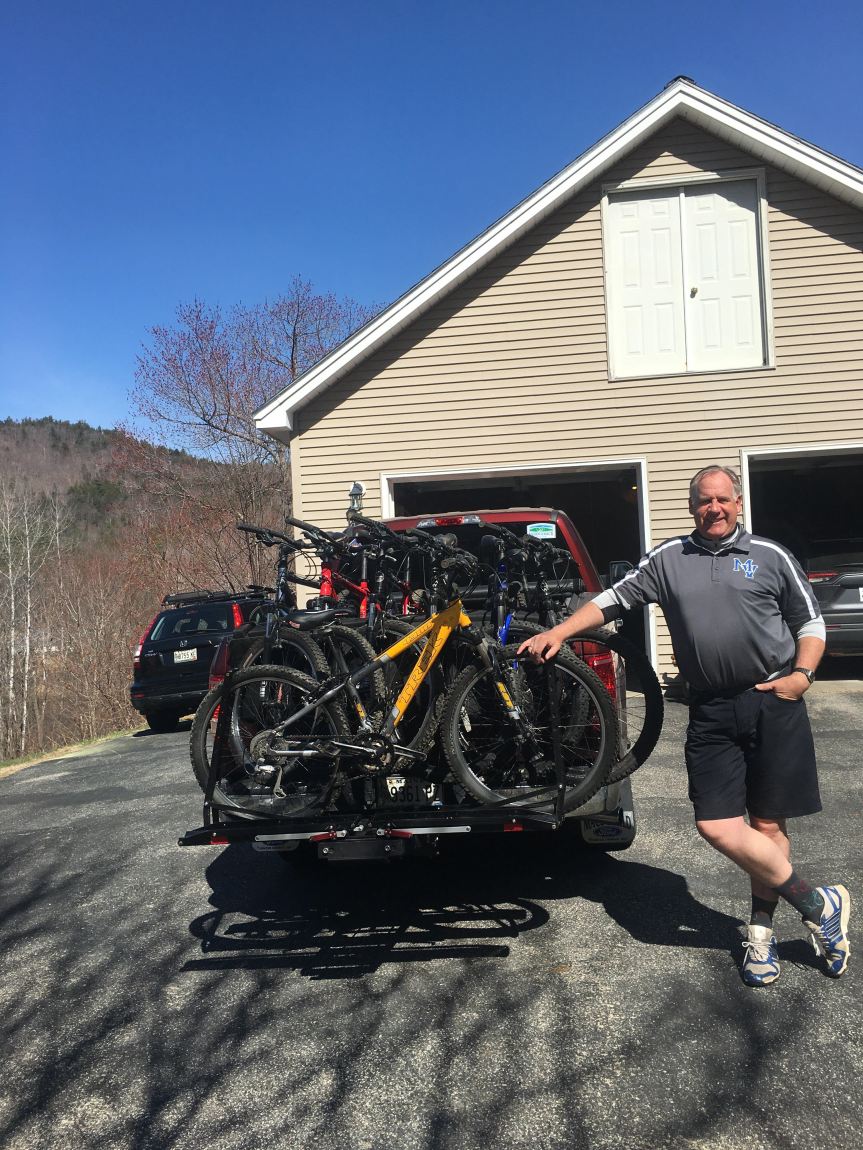
Papianou knew that he wanted to get the bikes out to students, but was not able to at first. The school was being deep cleaned and he couldn’t get in. After a conversation with his principal, Matt Gilbert, they decided that it was time to “roll out” the bikes. After gaining permission from the principal, Todd rushed home, got his trailer, and headed back to the school so that he could load up the bikes. He brought all 25 bikes home and stored them in his barn which became a makeshift bike shop. He then tuned each bike before sending them out to his students.

Over the course of two days, Todd Papianou and Matt Gilbert drove around delivering bikes to students by placing them at the end of each student’s driveway. Todd said that the bike roll out was exciting and that he was happy to see both students and parents (from a distance) while dropping off the bikes. He has received a lot of positive feedback from parents who were grateful that their children now had an additional option to get outside and to get active.

Todd has taken advantage of new technology to assist in the bike roll out and distance learning. He set students up with an app called Strava, which tracks ride analytics including distance and time. This data was shared between himself and his students so that he could see the progress they were making. In relation to using this new technology, Todd said “Being ready for the past decade with a comprehensive ‘Commuter Bike/Trail Bike Unit’ online already makes me feel proud that I had the foresight to prep and commit myself to Senator King’s vision to transition our learning/teaching delivery to include technology.”

To wrap up the school year, Todd planned an in-person assessment day for his students to show of their new skills, demonstrate bike control, and return the bikes. On this day, Todd focused on discussing what worked and what didn’t work in regards to remote instruction with his students. Todd said that both personally and professionally, the biggest takeaways from distance learning were that “nothing replaces instantaneous feedback, discussion, and banter…[and that] teachable moments arise and present themselves.” In a time where many of us have been stuck at home, Todd provided an option to get outside and be active for his students, his determination and innovation made the bike roll out highly successful.

This article was written by Maine DOE Intern Aidan Sachs in collaboration with Todd Papianou, a physical educator at MVHS as part of the Maine Schools Sharing Success Campaign. To submit a story or an idea email it to Rachel Paling at rachel.paling@maine.gov.

Maine DOE Update – July 17, 2020


From the Maine Department of Education


Reporting Items

| Visit the DC&R Reporting Calendar |


News & Updates

The Learning Space a Huge Success – Maine DOE Thanks Teacher Contributors!

At the end of March, in the midst of transitioning their own classrooms to emergency distance learning, Maine teachers went above and beyond the call of duty to develop over forty original video lessons (aligned with Maine’s Learning Results) to provide exceptional learning opportunities for Maine students in grades 3-5, which aired on Maine Public Television’s new program, The Learning Space, a project of Educate Maine, the Maine Department of Education, Maine Public, and additional partners (MSMA, MCLA, MSTOYA, NBCTs of Maine, MEA, MPA, MADSEC, Dead River Company, Finance Authority of Maine, John T. Gorman Foundation, Kennebunk Savings, Maine Community Foundation, University of Maine at Augusta, Machias Savings Bank). | More

Task Force on Language Development for Children who are Deaf and Hard of Hearing to Meet 7/21

The Task Force on Language Development for Children who are Deaf and Hard of Hearing will meet via Zoom on Tuesday, July 21 from 1:00 pm until 2:30 pm.  Interested parties who wish to observe the meeting are requested to contact Karen Kusiak | More

Team Long Run Provides Free Programs to Keep Kids Physically Active all Summer

Team Long Run, a non-profit organization that supports active play for kids, has a series of free programs they have developed and are distributing to schools, community organizations, and families who are trying to help kids stay active and fit during a time when many summer programs have been disrupted by COVID-19. | More

Get to Know the Maine DOE Team: Meet Lisa Perry

Maine DOE team member Lisa Perry is being highlighted this week as part of the Get to Know the Maine DOE Team Campaign, learn a little more about Lisa in the brief question and answer. | More


Maine Schools Sharing Success Stories

| Submit your Maine School Success Story |


Professional Development & Training Opportunities

| Visit the Professional Development Calendar |


Latest DOE Career/Project Opportunities

View current Maine Department of Education employment opportunities here