Maine Forest Collaborative Brings Together Rural Students for Resource-Based Educational Opportunity

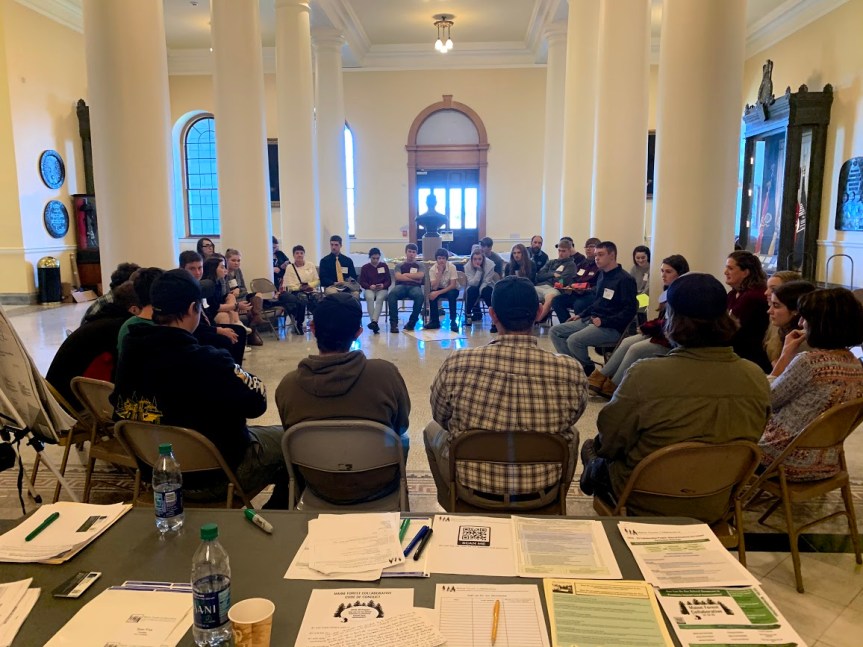
Maine students from rural communities came to the Maine State Capitol last week as part of a unique learning opportunity offered by The Maine Forest Collaborative. The collaborative, created and administered by the Rural Aspirations Project, is a cooperative of rural schools embedded in forest industry communities in rural Maine, which aims to give students in rural communities the opportunity to develop deeper connections to their community through participating and contributing in ways that make it stronger.

In its first cohort, with around 30 students participating last week, there were students from Buckfield, Forest Hills, Jackman, and Greenville, and more on deck to start in the next semester. The learning opportunity provides students with a three-unit curriculum: Identifying Challenges, Rapid Prototyping Solutions, and Investigating Solutions. Grounded on the question, “How can we use natural resources to positively impact local communities,” the lesson invites students to work together to identify challenges that their community is facing, and then find solutions to those challenges by using resources available within the community.

The second unit, Rapid Prototyping Solutions, is what students were working on last week at the Maine State Capitol’s Fall of Flags. The location was chosen as a way to raise awareness about the project, but also to show participating students the impact they have on decision making at the State level, as they work among lawmakers and politicians who grapple with many of the same challenges and problem solving, whether they are rural and community-based or State level.

Students started the day by presenting the story of their community, with posters they made ahead of time. Their presentations included information about the geography of their community, the natural resources present, who they are, what is amazing about their community, their hopes and dreams, and questions they still have. After the presentations, they began working in groups to identify challenges, pick a challenge to work on, and brainstorm a solution to that challenge. Maine forest industry professionals were also present to help facilitate the group work and lend a helping-hand.  lending their years of work experience in Maine’s forest industry with Maine’s many natural resources.

Students left the State House last week with a deep appreciation for not only their own community, but for their rural neighbors was well. They also got to participate in an interdisciplinary, project-based learning experience that strengthens their connection to their own community and the State as a whole, and aims to tackle a community challenge that they care deeply about.

Following last week’s lesson, students will embark on unit three, which will identify the economic, environmental, and social impacts of the solution they came up with, and they will also make a plan to communicate the solution to the public.

For more information about the Maine Forest Collaborative, the curriculum, or how to participate in this unique learning opportunity, please contact the Rural Aspirations Project.

Open Comment Period for Required Civil Rights Data Collection Revisions: Closes November 18!

The Maine Department of Education has just learned that the United States Department of Education (USED) has released proposed revisions to the data required as part of the Civil Rights Data Collection (CRDC), and that the comment period for the proposed revisions closes on Monday, November 18.  We wanted all school administrative unit (SAU) and school leaders, and any other interested parties, to be aware of this open comment period, and to have the opportunity to review the proposed revisions and provide feedback directly to the  USED.

The most clear documentation of changes we could find are located at the following link or by entering:

https://www.regulations.gov/document?D=ED-2019-ICCD-0119-0003

In particular, the files titled Data Groups, Data Categories and Directional Categories provide references to the proposed changes and new expectations for data submission by SAUs and schools.

Get to know the Maine DOE Team: Meet Debbie Violette

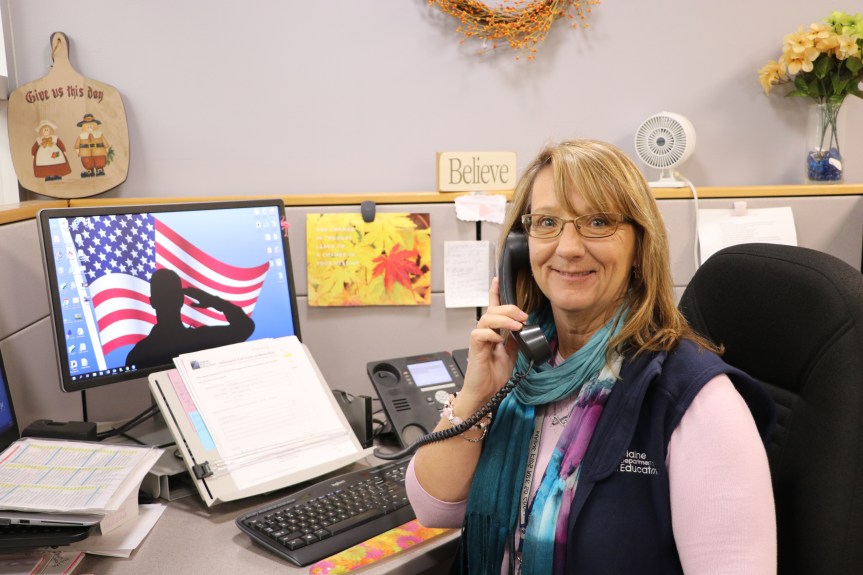
Maine DOE team member Debbie Violette is being highlighted this week as the part of a Get to know the DOE Team campaign! Learn a little more about Debbie in the brief question and answer below.

What are your roles with DOE? 

My job is to greet the public with a smile and gratitude, provide customer service to the public, scan home school applications, collect daily education news clips for Department staff, answer the Department’s 4-line switchboard, and direct our customers to the specialists that will best answer their questions. I also receive shipping and deliveries, maintain conference rooms, and have served as MSECCA (Maine State Employee’s Combined Charitable Appeal) Team leader for the past 15 years.

What do you like best about your job?

Decorating our lobby to make it a warm and inviting place for our public and the best place to work in Maine.  I’m a people person and love the days that are super busy, learning more and more about myself and the confidence that I have when answering questions after being here almost 32 years.

How or why did you decide on this career?

My mom was an educator in the Augusta School Dept. for 25 years and taught 2nd grade.  She held a regular education degree, but taught several levels of reading to the individuals with disabilities, too. I was always in her classroom during school summer breaks helping her get ready for the next group of young children to enter her door. I never realized that I had chosen this career in my early years of high school when I took all 4 years of business classes for secretarial work.  So here I am doing what my high school prepared me for: an administrative assistant for the Maine DOE, the way learning should be.

What do you like to do outside of work for fun? 

I like gardening, decorating my home, camping, knitting, swimming, bowling, and cooking.  I like to take a recipe and make it my own and I like knitting for charity events such as the Alfond cancer center for chemo patients. I am also deacon and greeter of the Manchester Community Church.

WCC Washington County Educator Profile: Mary Anne Spearin

Submitted by Sarah Woog, Executive Director at Washington County Consortium.

Meet Mary Anne Spearin, Principal of Calais High School

I first met Mary Anne when we were Middle School teachers together at Indian Township School. We connected pretty quickly, and would often share our books, our ideas, our practices, and our struggles. It was clear the way Mary Anne engaged with me as her colleague was not accidental or incidental. Mary Anne, then and now, has professional habits learned and practiced over time. Life-long learning and commitment to personal and professional growth are essential values that define how she teaches, how she leads, and how she engages with colleagues. I asked Mary Anne if I could interview her for a profile because I wanted to understand how she developed these habits, and how they impacted her steep trek up the professional ladder, from Ed. Tech, to teacher, to principal. 

Mary Anne began her career in education as an Ed. Tech I at Charlotte Elementary School. She had previously substituted in schools and had about 2.5 to 3 years of coursework behind her. Once an Ed. Tech at Charlotte Elementary, she gained two invaluable mentors, who served to push her, help her expand her vision of what is possible, and to understand professional growth as a welcome and wonderful professional responsibility. These mentors, Principal Peggy White, and Teacher Ann Luginbuhl supported Mary Anne in deciding to go back to school and she began accessing coursework at the Washington County Community College. They also encouraged her to learn and grow outside of the coursework and fostered a supportive community of educators who learned and grew together. Mary Anne soon went from Ed Tech I to Ed Tech III and began to believe she could become a teacher. When a teacher was out for medical leave, Mary Anne stepped in as a long term substitute, and realized that not only could she be a teacher, but that she loved it too. She enrolled at the University of Maine at Machias and finished her Bachelor’s degree in 2007, ten years after she first stepped into the classroom as an Ed Tech.

Mary Anne caught the learning and growing bug. Charlotte Elementary Principal Peggy White tapped her to start a Master’s cohort together immediately after Mary Anne finished her Bachelor’s degree, which they completed two years later, in 2009. Soon thereafter, Mary Anne was at it again, and completed a Certificate in Advanced Graduate Study (CAGS) from the University of New England. With this degree, Mary Anne also became a certified principal in 2011. She didn’t stop there, and she hasn’t stopped yet. Mary Anne participated in Educate Maine’s Education Leadership Experience Beta Class  in 2012/2013, and achieved her Superintendent’s certification in 2017. To this day, Mary Anne continues to engage in educational learning communities and still lends me books (and advice and support, too).

I admire Mary Anne. She is clearly admirable. I’m grateful she is my friend and colleague and I know a lot of other educators and students who are grateful for her too. She is a model of ambition and growth, collegiality and camaraderie. But Mary Anne’s career trajectory also imparts some important lessons we can all stand to gain from. I asked her what she attributes her trajectory and success to. First, she said, she attributes it to her colleagues, supervisors and administrators who supported her professional growth. Let’s be those colleagues. Second, she attributes it to the lesson she learned from Peggy and Ann, “that there is no finish line.” Let’s share that lesson with our students and in our professional communities. And, last, to an understanding she’s developed over time: “If we are going to work in education, we need to support education.” Let’s be those supporters. Let’s also take moments to express gratitude to those who have supported us along our paths, too. Thank you, Mary Anne, for giving me what others gave to you.

Hannaford Donates $1M to Support “Fuel Kids at School” Hunger Relief Efforts

Hannaford Supermarkets announced a $1 million donation as part of its new “Fuel Kids at School” initiative that is designed to directly address food insecurity and improve access to fresh and healthy food for children.

“Children can’t be at their best if they’re hungry—or thinking about where their next meal will come from. It is our hope that Fuel Kids at School will take us one step further in nourishing our communities, one child at a time,” said Mike Vail, President of Hannaford. “We want access to food to be easy for kids. Locating food pantries where they are—at their schools should make a lasting and deep impact on child nutrition across our five states.”

Hannaford, in partnership with area hunger relief organizations, will establish over two years, 90 school food pantries across Maine and other northeast states. In Maine, Good Shepherd Food Bank received nearly $300,000 to establish school-based food pantries in 30 Head Start preschools throughout the state.

“The correlation between access to nutritious food and early childhood development and learning makes Head Start locations the ideal match for our next phase of school-based pantries,” said Kristen Maile, President of Good Shepherd Food Bank. “We know that expanding our pantry sites to serve pre-school-aged children and their families will play an important role in ensuring a bright future for Maine’s youngest citizens.”

Designed to serve as a vital and convenient resource to students and families in need while also increasing access to healthy and nutritious food, the in-school pantries are dedicated spaces where students can select food they enjoy according to preference and cooking abilities to provide nourishment both during the day and after the school day.

“The Fuel Kids at School funding, with its focus on Head Start programs, will enable us to make nutritious food readily available to more families at risk of hunger in the critical years before their children enter the public schools,” said Kathryn Sargent, Executive Director of the Locker Project.

The announcement took place in conjunction with a donation of $1,000 in school food pantry staples to the East End Children’s Workshop along with chef-prepared food for the parents and students at the local pre-school.

Hannaford Supermarkets has a longstanding commitment to supporting hunger relief in its communities. In 2018, Hannaford donated nearly 26 million pounds of food throughout the Northeast, including 5.3 million pounds in New York; and raised $1.1 million in partnership with its shoppers to feed individuals in need through the annual Hannaford Helps Fight Hunger program. Earlier this month, Hannaford announced that it has donated more than $1 million to non-profits throughout New York and New England as a result of its reusable bag program, a portion of which is dedicated to hunger relief organizations and has funded more than 1.8 million meals to date.

Maine School of Science and Mathematics Earns No. 8 Spot on List of 5,000 top STEM High Schools

Submitted by Ryan McDonald, Summer Programs Director and Public Relations Coordinator at Maine School of Science and Mathematics.

Newsweek announced its ranking of the top 5,000 STEM high schools for 2019, honoring excellence in science, technology, engineering, and mathematics. Maine School of Science and Mathematics was named number 8.

With its long history of reporting on scientific breakthroughs, technological revolutions, and societal challenges, Newsweek partnered with STEM.org to rank America’s Best STEM High Schools. The list includes schools in every region of the country that offer skilled teachers who keep up with developments in these fields and who create dynamic learning environments to engage their students.

The top 5,000 schools were curated from STEM.org Educational Research™ (SER) using a proprietary scoring logic that took into consideration a broad set of quantitative and qualitative data inputs collected from Q2 2015–Q3 2019. The purpose was to determine which primary/secondary institutions in America best offer students experiences in science, technology, engineering, and mathematics (STEM)—as defined by the Congressional Research Service—while preparing them for post‐secondary outcomes. Additional factors, including affluence and median household income, were taken into consideration in compiling the rankings.

“Children don’t realize it, but they’re natural STEM students,” says Nancy Cooper, Newsweek Global Editor in Chief. “We need to make sure that innate drive, curiosity, and creativity aren’t lost along the way. These high schools are helping to ensure America’s future in science, technology, engineering, and mathematics is in good hands.”

Newsweek’s November 15 special double issue is available on newsstands now and includes the top 500 STEM high schools. The full list of 5,000 top STEM high schools will be available on Newsweek.com on November 8, National STEM Day.

About Newsweek

Newsweek is a premier news magazine and website that has been bringing high‐quality journalism to readers around the globe for over 85 years. Newsweek provides the latest news, in‐depth analysis, and ideas about international issues, technology, business, culture, and politics.

About STEM.org Educational Research™  

STEM.org Educational Research™ is the longest continually operating, privately held STEM education research and credentialing organization in America, based in Southfield, Michigan.

Portland High School Students Begin Internships

Submitted by Andrea Levinsky, Extended Learning Opportunities Coordinator, Portland High School.

Portland High School students are beginning internships in the community. One student is interning at Planned Parenthood, working on their youth education programming and political advocacy. She said about her first day, “It was great, the environment is so positive and everyone there is so intelligent!! I’m very excited to be doing it.”

Another is interning with Little Chair Printing, learning about design, working with customers, and running a print shop. The Maine Medical Center Research Institute is hosting a student do help a researcher in his lab. A senior is interning at Lyseth Elementary School learning about teaching and working with children. Three juniors are sharpening their research skills interning with the New England History Association through teacher Gavin Glider. There is also a student interning at Portland Stage Company in their costume shop, learning about the world of professional theater. The Portland High School Athletic Trainer is working with an intern to learn about how to work with injured athletes.

If your student is interested in doing an internship or you know of a business or organization who would like to host an intern, please reach out to Andrea Levinsky, Extended Learning Opportunities Coordinator at levina@portlandschools.org.

Nominate an Educator or School Employee for “Life Changer of the Year”

Life Changer of the Year is an annual program recognizing K-12 educators and school employees across the country. This includes teachers, para educators, custodians, secretaries, principals, lunch personnel, school nurses, guidance counselors, anyone who is employed by a K-12 school district. It is easy to nominate someone. Anyone can nominate up to 3 employees. Our program celebrates those who are making a significant difference in the lives of students by exemplifying excellence, positive influence and leadership. Nominations are now being accepted for the 2019-2020 Program.

We all know teachers and school district employees who inspire us and go above and beyond for their students. They could be a physical education teacher who started a nonprofit to teach students about art and music, an administrator who visits the homes of students in need, or a maintenance worker who fundraises for school programs. These educators and school employees are Life Changers, and we’re here to help you honor them.

Life Changer of the Year is sponsored by the National Life Group and the National Life Group Foundation. Since its inception in 2006, the goal of the National Life Group Foundation is to do good in the communities in which we live and work by supporting nonprofit and educational organizations.

Awards include:

  • 1 Grand Prize Winner: $10,000 to be split between a $5,000 individual cash reward and a $5,000 donation to the winner’s school/district.
  • 4 Grand Prize Finalists: $5,000 to be split between a $2,500 individual cash reward and a $2,500 donation to the winner’s school/district.
  • 10 Life Changer Awards: $3,000 to be split between a $1,500 individual cash reward and a $1,500 donation to the winner’s school/district
  • 30-35 Honor Roll Awards: $50 Visa gift card to the nominee, as well as some surprise goodies.

For a complete list of awards go to https://www.lifechangeroftheyear.com/awards

To nominate someone, go to https://www.lifechangeroftheyear.com/how-it-works

Nomination Deadline: December 31st, 2019

Symposium: Unpacking the Maine-Wabanaki Studies Law (LD 291) Past, Present and Future

Sponsored by Native American Programs and The Wabanaki Center.

Friday, November 15, 2019
9:00AM – 12:00PM

University of Maine
Mitchell Center, 107 Norman Smith Hall
Native American Programs

With Presentations by:

  • Dr. Rebecca Sockbeson, UMaine Visiting Libra Professor, University of Alberta
  • Donna Loring, Senior Advisor on Tribal Affairs to Governor Mills and Author of LD 291
  • James Francis, Director, Penobscot Nation Cultural and Historic Preservation Department
  • Dr. John Maddaus, Professor of Education (Retired)
  • John Bear Mitchell, Educator and Wabanaki Center Outreach and Student Development Coordinator
  • Dr. Darren Ranco, Chair of Native American Programs
  • Maulian Dana, Penobscot Nation Ambassador


PRIORITY NOTICE: Live Broadcast Link Available for Public Hearing on Proposed Revisions to Rule Chapter 132 (Career and Education Development, English Language Arts, and Mathematics Standards) on November 13, 2019

As a reminder, the Maine Department of Education has scheduled a public hearing on November 13th, 2019 as part of the scheduled periodic review of the Maine Learning Results. The Department is seeking public comments regarding the proposed revisions to Rule Chapter 132, revised career and education development, English language arts, and mathematics standards until 5 pm on November 27th, 2019.

The public hearing will take place in room 103A of the Burton Cross Building in Augusta from 1-4 pm. Anyone present may speak at the public hearing. People that wish to speak will be asked to sign in and, preferably, provide two written copies of comments, as well as an electronic copy. The live broadcast is for viewing the hearing only. You will not be able to provide public comment via the live broadcast.

Anyone unable to attend the public hearing may send written comments by 5 pm on November 27th, 2019. Written comments may be emailed to sis.doe@maine.gov with the subject “Career and Education Development Standards Review,” or “English Language Arts Standards Review,” or “Mathematics Standards Review” or mailed to Maine Department of Education, attn: Beth Lambert, 23 State House Station, Augusta, ME 04333.

Below is a list of relevant links, as well as the hearing information including a link for the live broadcast:

For further information about the standards review process contact Beth Lambert at Beth.Lambert@maine.gov.