Teams advance to Farm to School Cook-off Finals Competition


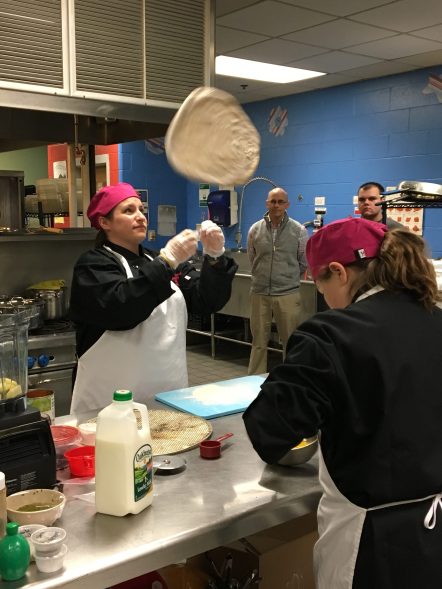
The Maine Department of Education Child Nutrition office kicked off their 4th annual Farm to School Cook-off last month. Cook-off teams representing nine school districts from across Maine participated in the event. The teams, consisting of a student and school nutrition staff member, served up tasty and nutritious breakfast and lunch meals within a specific time frame that showcased Maine grown ingredients. Apples donated from Ricker Hill Orchards and dried black beans donated from Fairwinds Farm were used as “challenge” ingredients in the competition. The regional cook-off’s were hosted by the culinary arts programs at the Lake Region Vocational Center, Bath Regional Career and Technical Center and Eastern Maine Community College.

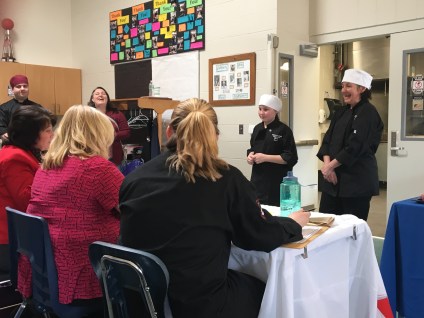
South Portland, RSU 12, and Cherryfield will be advancing to the Farm to School Cook-off finals competition on April 23rd from 10:00 a.m. to 1:30 p.m. at the Kennebec Valley Community College- Alfond Campus in Clinton. A panel of judges including a student, chef and school nutrition director, will score the dishes based on presentation, taste, creativity, and feasibility to be used in a school breakfast or lunch program. Other criteria will include food safety and time management.

The winning team will be awarded a plaque and have the opportunity to be spokespeople and participate on the judging panel for the cook off in School Year 2020.  Recipes used in the cook-off will later be shared with all schools in a Maine farm to school cook-book.

Members of the media are welcome to attend the final cook-off but need to confirm prior to the day of the event.

For more information about the event, please contact Stephanie Stambach at stephanie.stambach@maine.gov, or to confirm media coverage, contact: Kelli Deveaux at kelli.deveaux@maine.gov or 207-624-6747.

CTE Statewide Plan Development

The Maine Department of Education Career and Technical Education Team is currently developing a CTE Statewide Plan. This plan is being developed to address the requirements as part of the Carl D. Perkins federal funding that Maine receives to support CTE.  As part of developing this plan, we are holding regional stakeholder meetings throughout the state, in order to get feedback and input and to share some of the initiatives around Career and Technical Education. These meetings are open to the public and we welcome the opportunity to hear from many stakeholders.

The times and locations for all of the regional stakeholder meetings are as follows:

Tuesday April 23, 2019

United Technology Center; Bangor, Maine

From: 6:00-8:00 p.m.

Wednesday April 24, 2019

Westbrook Regional Vocational Center; Westbrook, Maine

From: 5:30-7:30 p.m.

Thursday April 25, 2019

Capital Area Technical Center; Augusta, Maine

From: 6:00-8:00 p.m.

Wednesday May 1, 2019

Caribou High School; Caribou, Maine

From: 6:00-8:00 p.m.

If you have any questions, please reach out to Dwight A. Littlefield, State Director for CTE, at dwight.a.littlefield@maine.gov.


Lewiston Adult Education Construction Students Build Their Futures Together

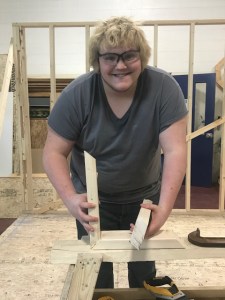
Tony Gulley – student in the program.

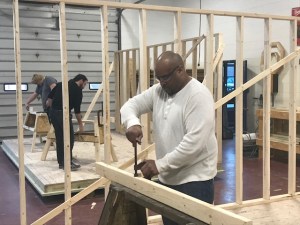
Students in Lewiston Adult Education’s Construction Training Program measured and cut wood last month as part of their hands-on work.

The wood framing marked a first project to prepare them for entry-level jobs in construction. The integrated training also includes work experience, case management, and job coaching of students.

Charles Outten, Michael Gibson, and Tony Gulley – students in Lewiston Adult Education’s Construction Training Program.

Students who complete the program will transition to on-the-job training and full-time employment. Employees of local construction companies have made presentations in class about the kind of work they do and what they are looking for in new hires.

Graduates will receive a WorkReady credential, OSHA 10 certification, a National Center for Construction Education and Research and a Renovation credential as well as a Renovation, Repair and Painting credential.

Charles Outten – student in the program.

The Construction Training Program is a partnership with the Lewiston CareerCenter, Western Maine Community Action, the John T. Gorman Foundation, Community Concepts, the city of Lewiston, Youthbuild Goodwill Northern New England Take 2 and FedCap. This year’s employer partners include Northeast Painting & Coating, Hahnel Brothers Company, Consigli Construction, H.E. Callahan, and St. Laurent and Son Excavation, Inc.


MSAD49 Superintendent Dr. Reza Namin Named Harvard University Fellow

Submitted by Reza Namin, Superintendent of MSAD#49.

Dr. Reza Namin, Superintendent of MSAD#49 has been selected and named the Harvard University Fellow for the Harvard University Graduate School of Education Summer Institute. Participants are teachers and administrators from all around the United States and the World.

Fellows are typically educators who have experience with the Project Zero ideas and are committed to deepening work with Project Zero ideas in their communities. This will take place from July 21-26 at the Harvard University Campus.

The Project Zero is a professional learning and development experience where the fellow can advance his/her understanding of Project Zero ideas, frameworks and practices. Fellows participate fully in all the events of the institute, including plenary sessions, mini-courses that have space available, faculty meetings, fellow meetings, and social gatherings. As a member of a study group team, the fellow will also be a part of the smooth running of the institute, helping behind the scenes when needed.

Commission on Educational Opportunity for Military Children Meeting Date

The next meeting of the Commission on Educational Opportunity for Military Children will be held on Friday May 3rd at 9 am in Room 400 of the Cross Office Building in Augusta.

All 50 states, plus the District of Columbia, belong to the Military Interstate Children’s Compact Commission (MIC3). Each state appoints a council to oversee the implementation of the Compact at the state level.

States that sign on to the Compact commit to doing what it takes to:

  • Enroll children of military families at their new schools as quickly and seamlessly as possible, even in the absence of normally required official records and immunizations; and
  • Ensure that students with parents in the Armed Forces stay on track to graduate on time, even when such students’ academic records don’t comply perfectly with local graduation requirements.

More information about MIC3 is available at http://www.mic3.net/

Employee of the Week: Tyler Backus

Tyler Backus is the Maine Department of Education’s Employee of the Week this week. Get to know a little more about Tyler through this brief question and answer:

What are your roles with DOE?

I oversee the School Finance & Compliance teams. We ensure each of the school districts submit accurate information that informs the school funding formula. A major focus for my role is the financial information that is submitted each year. What that really means is I get to talk with business managers, accounting managers, superintendents, special education directors, and lots of other school staff to ensure they understand how the information they submit impacts the state’s funding formula. I also am the Military Family Liaison for the State of Maine, where I get to work with the School Liaison Officer at Portsmouth Naval Shipyard, to help students of military personnel during their transition into and out of Maine schools.

What do you like best about your job?

I really enjoy interacting with the field. Maine’s school funding formula is considered one of the most equitable funding formulas in the country, but to achieve that equity it is an extremely complex formula. That means most people do not understand the formula. So I love explaining the funding formula to anybody who is willing to take the time to learn it. I also enjoy coming up with creative ways to explain the formula, even with the use of food.

How or why did you decide on this career?

I do not know that I necessarily decided on this career. After leaving the Army (driving M1A1 Abram tanks) I started at UMF for Secondary Education Math, and after a couple of changes in major and a deployment to Iraq, I ended up with Political Science degree. I worked for 18 months at Maine Commission on Governmental Ethics and Election Practices reviewing financial submissions for legislative candidates. I then was hired by Jan Breton to review the use of Individual of Disability Education Act funding. During that time I visited about 75 school districts, where I got to interact with business managers, special education directors, and superintendents. During the time in this role I got to learn parts of the funding formula and account coding for school departments. When a position opened up on the School Finance team I applied for the position.

What do you like to do outside of work for fun?

Outside of work I mostly focus on my soon to be 6 year old son. I enjoy trying to get him excited about learning and trying different activities, some of which he still enjoys like soccer and swimming. I enjoy attempting to stay in shape (but I hate the gym) so I try different workout routines, running, bicycling, and playing soccer. I also enjoy trying to do my own work around the house including replacing the bathroom in our house, building a patio (including moving around 100 yards of material), pouring a 400 sq. ft concrete slab after building up the base, and this summer building a shed on the slab. Working in an office all day, I find it enjoyable to use as little mechanical assistance while doing these projects at home, and it also provide an opportunity for my son to help. We also get out camping as much as possible during the summer.

New Homeschool Portal and SAU Superintendent Office Online Entry Underway

The Department is pleased to announce the opening of the new Online NEO Homeschool Portal for school year 2019-2020, and the more efficient Notice of Intent to Homeschool form. The new portal brings some changes to the Homeschool Notice process, including an enhanced role for superintendents and/or SAU homeschool administrative designees who will now share responsibility for entering information into the new portal.

Summary of changes:

  • Parents submitting a Notice for 2019-2020 no longer need to submit the information in two places or use certified mail to ensure the delivery of the form. They may use one of the three methods described below.
  • The portal will be the point of entry for parents. Superintendents or SAU and DOE homeschool administrative designees who enter information on behalf of resident parents who choose option 2 or 3 below will also utilize the portal for data entry.
  • The new Notice of Intent to Homeschool combines and replaces the previous Notice of Intent and Subsequent Year forms.

The new portal will allow parents to submit the Notice of Intent and Subsequent Year Letter and assessments once in one of three ways:

  1. Enter information directly on the new NEO online homeschool portal, and upload prior year required assessment information;
  2. Complete the form by hand and take it, with prior year required assessments, to the resident Superintendent’s Office for upload and entry into the system; OR
  3. Complete the new paper form and mail it with prior year required assessments to the Department of Education or to the Superintendent’s Office, where it will be entered into the new system.

Submission using one of the below methods will result in the automatic generation of an acknowledgement to the parent/guardian via email; please ensure that a valid and correct email address has been provided.

Superintendents and/or designees will utilize the new online homeschool portal in NEO in 2019-2020 to:

  • Enter paper forms received from parents. The Department will also be entering paper forms, so a duplicate check must be performed prior to entry.
  • Assist resident parents in completing the online homeschool process.
  • View a list of all the resident homeschool students in the Superintendent’s SAU.
  • Comply with homeschool roster requirements in Maine DOE Rule Chapter 125, sec.12.02 Roster of Resident, Tuition, and Transfer Students
  1. A) The superintendent of each school administrative unit shall maintain a roster of all resident and tuition students attending schools operated by the unit.
  2. B) The superintendent of each school administrative unit shall maintain a roster of all students eligible to attend school within the unit who are receiving equivalent instruction in an approved or non-approved private school, or in an approved equivalent instruction program.

Parents may read Maine’s statute related to homeschooling, including information about required assessments using this link: Title 20-A, Section 5001-A, Sub-section 3(A)(4).

Please note that online Homeschool Portal functionality works for the 2019-2020 school year forward; it may not be used for 2018-2019 school year homeschool students.

Please direct any questions or concerns to our Pamela Ford-Taylor at pamela.ford-taylor@maine.gov or 207-624-6617.

Maine DOE Update – April 4, 2019

From the Maine Department of Education


Reporting Items

REMINDER: Submit board decisions about school calendar revisions (including weather-related) to Maine DOE by May 30

The Department is asking Superintendents to submit any board decisions about revising the School Administrative Unit calendar, including the number of weather-related makeup days using the extended hours option, as outlined in M.R.S. Title 20-A Section 4801. | More

| Visit the DC&R Reporting Calendar |


News & Updates

Registration Open for the 16th Annual MLTI Student Conference

Registration for the 2019 MLTI Student Conference, taking place on Thursday, May 23rd at the University of Maine campus in Orono, will be open from Monday, April 1st until Tuesday, April 23rd. | More

Important federal grants for local communities on school safety and security just opened, apply soon!

The Department of Education is committed to providing timely information and support to school communities, including federal grant opportunities, in the ongoing efforts to ensure safe schools in the State of Maine.  | More

Maine’s National Board-Certified Teachers Celebrate at Pinning Ceremony 

Friends, families, and colleagues throughout the state gathered at Cony High School to attend the ceremony, which was co-sponsored by the National Board-Certified Teachers of Maine Network and the Maine Education Association. | More

New Info-graphics for Schools and Communities on Electronic Nicotine Devices

At the Department of Education we recognize that schools across Maine are challenged on a daily basis with how to effectively address adolescent use of electronic nicotine devices.  | More

Maine State Science Fair Showcases High School STEM Talent

The 73rd annual Maine State Science Fair (MSSF), organized by The Jackson Laboratory and Maine Mathematics and Science Alliance, was held on March 23, 2019, and included 250 students representing 36 schools in 13 Maine counties. | More

Maine DOE Employee of the Week: Jean Zimmerman

Health Education and Physical Education Consultant, Jean Zimmerman is the Maine Department of Education’s Employee of the Week this week. | More


Maine Schools Sharing Success Stories

| Submit your Maine School Success Story |


Professional Development & Training Opportunities

Assessment Capable Learning for the 21st Century -Save the Date!

Join the Maine Department of Education as we explore knowledge, skills, and dispositions that are necessary for 21st century careers and the intentional actions of educators to support students developing the skill and will to fuel their learning. Participants will delve into the principles of assessment capable learning as they examine strategies for building units of instruction that integrate multiple content areas. | More

| Visit the Professional Development Calendar |


Latest DOE Career/Project Opportunities

Assessment Capable Learning for the 21st Century -Save the Date!

Join the Maine Department of Education as we explore knowledge, skills, and dispositions that are necessary for 21st century careers and the intentional actions of educators to support students developing the skill and will to fuel their learning. Participants will delve into the principles of assessment capable learning as they examine strategies for building units of instruction that integrate multiple content areas. Sessions will be led by teams of the Department’s content specialists. Units will integrate combinations of world language, social studies, visual and performing arts, science, English language arts, health education and physical education, and mathematics. Units will also incorporate strategies for technology integration and family engagement.

School districts are encouraged to bring teams of three or more people. We will gather as teams at the beginning of the day for a panel and some discussion. Then, each team member will attend a different breakout session where they will experience integrated lessons and units incorporating the principles of assessment capable learners. Finally, at the end of the day, teams will reconvene to share, process, and apply what they experienced in the breakout sessions. Teams may include educators, administrators, instructional coaches, and special education instructors.  Schools are encouraged to include representation from multiple grade levels and all content areas when forming their teams.

When:

Elementary (Pk-5):

July 9th at the Ramada in Lewiston

July 24th at Jeff’s Catering in Brewer

Secondary (6-12):

July 10th at the Ramada in Lewiston

July 25th at Jeff’s Catering in Brewer

Cost:

$130/ team of 3 or $50/ person; lunch provided. Individual registrations are accepted but teams are preferred.

More details about this opportunity and the registration will be provided after April school vacation week.

For more information please contact Lee Anne Larsen, leeann.larsen@maine.gov or Beth Lambert, beth.lambert@maine.gov.

Maine State Science Fair Showcases High School STEM Talent

The 73rd annual Maine State Science Fair (MSSF), organized by The Jackson Laboratory and Maine Mathematics and Science Alliance, was held on March 23, 2019, and included 250 students representing 36 schools in 13 Maine counties. Each high schooler presented their original research and engineering project to a state-wide audience of peers and mentors, in competition for coveted state titles and over $548,000 in scholarships and awards.

Maine Department of Education Commissioner Pender Makin attended the conference to give remarks of encouragement and acknowledgment to the student participants this year.

This year’s winners include:

  • 1st Grand Award – Tyler Delargy, Bangor High School, “Developing Three-Dimensional Spatial Cognition for the Visually Impaired Using Computational Depth Mapping and Vibro-Tactile Display”
  • 2nd Grand Award – Antonina Zakorchemna and Artem Laptiev, Fryeburg Academy, “Product Development of an Alternative Low-cost Braille E-reader”
  • 3rd Grand Award – Amara Ifeji, Bangor High School, “Testing the Effectiveness of Mycorrhizae in the Phytoremediation of Heavy Metals from Stormwater”
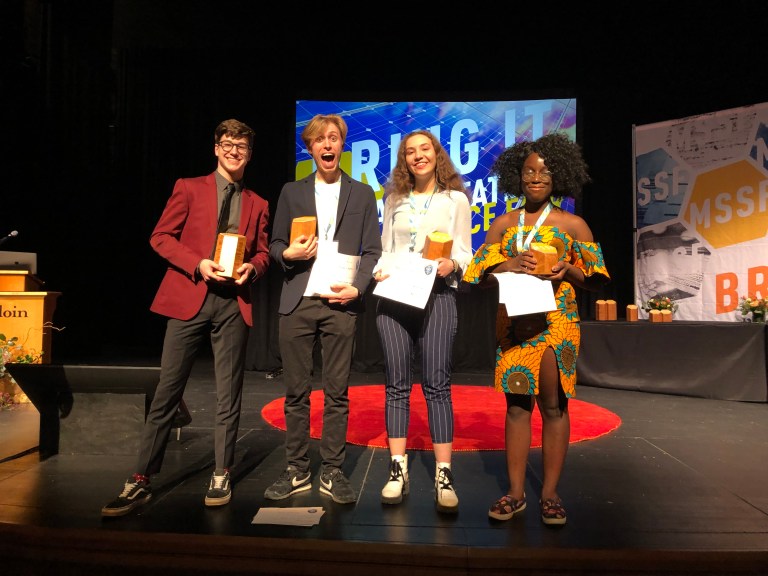
Delargy, Zakorchemna, Laptiev, and Ifeji will represent Maine at the prestigious Intel International Science and Engineering Fair (ISEF) in Phoenix, Ariz. The Intel ISEF is the premier global science competition for students in grades 9-12, and provides a forum for 1,700 students from 70 countries, regions, and territories to display their independent research.

“As a nonprofit biomedical research institution, we understand the importance of excellent STEM education, and we’re so proud to support the MSSF and students across the state of Maine,” said S. Catherine ‘Katy’ Longley, J.D., Executive Vice President and Chief Operating Officer, The Jackson Laboratory (JAX).  “On behalf of JAX, I would like to congratulate every one of these bright teenagers for their ingenuity and creativity.”

MSSF is one of the largest high school STEM programs in Maine. STEM professionals from 48 Maine companies, non-profit organizations, higher education, and governmental organizations volunteered to interact with students, provide feedback on their projects, and select the top projects in categories including Behavioral Sciences, Biological Sciences, Energy, Engineering, Environmental Sciences, and Physics.

In addition, over $548,000 in scholarships, including several full-tuition scholarships, from The University of Maine, College of the Atlantic, University of New England, University of Maine at Augusta, and Husson University were distributed to students who demonstrated creativity, innovation, aptitude and great scientific potential. In addition to scholarships, students were awarded spots in summer STEM enrichment programs at the Hurricane Island Center for Science and Leadership and in the Keller BLOOM program at the Bigelow Laboratory for Ocean Sciences.

“Science fairs are really cool, they give young people an opportunity to demonstrate their competence, but mostly, they give people the opportunity to follow their imagination, to do research, to have the fun of discovering things,” said U.S. Senator Angus King (I-ME). “This is really important for Maine and our country.”
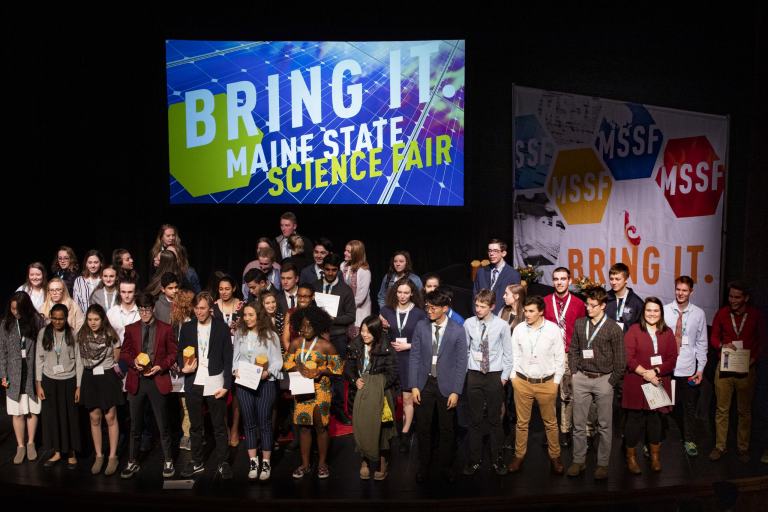
The following students received full tuition scholarships from the University of Maine:

  • Leila Davids, Bangor High School
  • Ijeoma Obi, Bangor High School
  • Rowan Andrews, Bangor High School
  • Madeline Ahola, Bangor High School
  • Madison Momenee, Noble High School
  • Emma Fitzpatrick, Greely High School
  • Amara Ifeji, Bangor High School
  • Connor Noddin, Bangor High School
  • Anthony Caccese, Bangor High School
  • Blake Erhard, Boothbay Region High School
  • Lily McLaughlin, Bangor High School
  • Marina Mohawass, Bangor High School

 The following students received a $20,000 yearly scholarship from the College of the Atlantic, renewable for four years.

  • Jennifer Noyes, John Bapst Memorial High School
  • Jordyn Miller, Bangor High School

The following students received a $5,000 yearly scholarship from the University of New England, renewable for four years:

  • Sarah Dorey, John Bapst Memorial High School
  • Adelaide Valley, John Bapst Memorial High School
  • Shannon O’Roak, Dexter Regional High School
  • Madison Momenee, Noble High School
  • Alyssa Ellis, Nokomis Regional High School

The following students received a $1,500 yearly scholarship from the University of Maine at Augusta, renewable for four years:

  • Lauren Underhill, Nokomis Regional High School
  • Jordyn Miller, Bangor High School

The following students received a $1,000 scholarship from Husson University:

  • Shannon O’Roak, Dexter Regional High School
  • Beau Briggs, Nokomis Regional High School
  • Madison Hopkins, Nokomis Regional High School
  • Vanessa Scott, Deering High School
  • Taya Wood, Washington Academy

The following students earned experiential awards for STEM enrichment programs in Maine:

  • Keller BLOOM at Bigelow Laboratory for Ocean Sciences: Jordyn Miller, Bangor High School
  • HurricaneIsland Advanced Marine Biology Camp: Wade Wahlig, Falmouth High School
  • iXplore STEM Summer Program: Swetha Palaniappan, Cape Elizabeth High School
  • UNE Health Careers Exploration Camp: Alya Theriault, Caribou High School

Additional winners from the Maine State Science Fair include:

  • Future Innovator Award for outstanding research and engineering projects by 1st year students, given by The Jackson Laboratory:
    • Sirohi Kumar, Mount Desert Island High School
    • Alden Wilcox, Caribou High School
    • Quinn D’Alessio, Bangor High School
    • Noah Coyle, Bangor High School
    • Lily Millard, Bangor High School
  • Reach Center Award for outstanding research and engineering projects by students from schools new to MSSF:
    • Dexuan Tang, Hebron Academy
    • Antonina Zakorchemna and Artem Laptiev, Fryeburg Academy
    • Blake Erhard and Lilley Harris, Boothbay Region High School
    • Erica Schlichting, Gray New Gloucester High School
  • Intel Computer Science Award for the most outstanding project in computer sciences: Ryan Kinney, Bangor High School
  • Society for Science and the Public Community Innovation Award for a project that will better humanity and improve conditions in the local community: Ibrahim Saleh, Greely High School
  • Stockholm Junior Water Prize, recognizing the most outstanding project in water and watershed research:
    • Merline Feero, Waterville Senior High School
    • Lily McLaughlin and Rowan Andrews, Bangor High School
  • Judges Fund Award for Excellence in Genetics: Brandon Aponte, John Bapst Memorial High School
  • Naval Science Award
    • Leila Davids, Bangor High School
    • Tyler Delargy, Bangor High School
    • Anthony Caccese, Bangor High School
    • Luke Conroy, Noble High School
  • Mu Alpha Theta: Samanthak Thiagrajan, Bangor High School

MSSF Category winners include:

  • Animal Sciences, general – Logan Eckmann, John Bapst Memorial High School
  • Animal Sciences, marine sciences – Vetri Vel, Bangor High School
  • Behavioral and Social Sciences, sociology – Micah Pietraho, Brunswick High School
  • Behavioral and Social Sciences, clinical, neurological, physiological, cognitive studies – Sirohi Kumar, Mount Desert Island High School
  • Biological Sciences and Engineering – Yu Dong, Gould Academy
  • Biomedical and Health Sciences – Blake Erhard, Boothbay Region High School
  • Chemistry and Materials – Marina Mohawass, Bangor High School
  • Computer Science and Mathematics – Ijeoma Obi, Bangor High School
  • Energy – Frederick Oldenburg, McKayla Kendall and Roland Ladd, Bangor High School
  • Engineering Mechanics – Tyler Delargy, Bangor High School
  • Environmental Sciences, general studies – Andrea Grossmann, John Bapst Memorial High School
  • Environmental Sciences, water quality – Maddie Brookings, Bangor High School
  • Physics and Astronomy – Lindsay Cote, Nokomis Regional High School
  • Plant Sciences – Amara Ifeji, Bangor High School

Maine State Science Fair is further supported by R.H. Reny, Inc., Texas Instruments, ON Semiconductor, Hurricane Island Center for Science and Leadership, Bigelow Laboratory for Ocean Sciences, Poland Springs, and Mölnlycke.

The Maine Mathematics and Science Alliance supports educators to teach STEM in more meaningful ways through professional development resources for K-12 educators, research and evaluation of STEM learning experiences, and building relationships and networks to sustain systemic statewide improvement.

The Jackson Laboratory offers educational programs for scientists throughout their careers — from STEM education for high school students and training for science and math teachers to courses and conferences for experienced researchers defining the cutting edge of genomics research and specialized training for physicians interested in incorporating genetics and genomics into their practices.