Maine students selected for United States Senate Youth Program

Maine DOE is pleased to announce the selection of students for the United States Senate Youth Program (USSYP).

High school students Caroline Baldacci of Bangor High School and Virginia Jewel Hugo-Vidal of Gorham High School will join U.S. Sens. Susan Collins and Angus King in representing Maine in the nation’s capital during the 56th annual USSYP Washington Week, to be held March 3-10.

Baldacci and Hugo-Vidal were selected from among the state’s top student leaders to be part of the 104 national student delegation. Each student will receive a $10,000 college scholarship for undergraduate study. Check out the Maine DOE USSYP for more information about the program in Maine.

Read the official news release here.

For more information on the USSYP visit the Maine DOE website or contact Joe Schmidt Social Studies Specialist for the Maine Department of Education (207) 624-6828.

MEDIA RELEASE: Maine partners in national innovative cybersecurity opportunity for young women in high school

To help educate more young women about the opportunities in the field of cybersecurity, Governor Paul R. LePage, the Maine Office of Information Technology and the Maine Department of Education are promoting ‘GirlsGoCyberStart’, an exciting national program that uses online games of discovery to introduce high school girls to the field.

“This innovative program offers young women in high school an opportunity to discover their aptitude and learn basic cybersecurity skills,” said Robert G. Hasson, Jr. Commissioner of the Maine Department of Education.

According to the U.S. Bureau of Labor Statistics, employment in the field of information security is projected to grow 28 percent from 2016 to 2026, much faster than the average for all occupations.

CyberStart was created by a national company called the SANS Institute, and first piloted to youth in the summer of 2017. The program enabled 3,500 students nation-wide to discover and demonstrate their aptitude for cybersecurity, yet only five percent of the students who participated were young women.  The results of the pilot sparked the GirlsGoCyberStart program, specifically designed to interest young women in grades 9, 10, 11 and 12.

“We are excited to join this wonderful opportunity to expand our talent pipeline by engaging young people interested in learning more about cybersecurity and directing them to the appropriate training and career coaching,” said James Smith, Chief Information Officer for the Office of Information Technology.

Maine students who participate in GirlsGoCyberStart will be doing so alongside students from Colorado, Connecticut, Delaware, Hawaii, Indiana, Iowa, Mississippi, Nevada, New Jersey, New York, North Carolina, Texas, Vermont, West Virginia, Wyoming and American Samoa.

Participating students do not need prior cybersecurity knowledge or programming experience. All that is required is a computer and an internet connection. Young women in high school who excel in the GirlsGoCyberStart game will have the opportunity to win computers and other prizes as well as a trip, with a parent, to the 2018 Women in CyberSecurity Conference.

The website explaining the program is available at GirlsGoCyberStart.com. Registration will begin on January 29 and end on February 16, 2018. The first 10,000 young women in high school who have registered by then, can play the game online from February 20 through February 25.

For more information about eligibility visit GirlsGoCyberStart.com and for more information about Maine’s participation in the program contact Dr. Kelly Rickert, Director of Workforce Development for the Maine Office of Information Services.


###

Maine DOE Seeks Proposals for 21st Century Community Learning Center Programs

The Maine Department of Education is pleased to announce the release of a request for proposals (RFP) seeking bids from interested parties to implement comprehensive 21st Century Community Learning Center (21st CCLC) programs in 2018-2019.

Authorized under Title IV, Part B of the Elementary and Secondary Education Act, as amended by the Every Student Succeeds Act (ESSA) Act of 2015, the 21st CCLC program provides competitive grant funding to support before school, after school, and summer learning programs that focus on improving the academic performance of students in Pre-Kindergarten through grade 12.

The primary purpose of Maine’s 21st CCLC program is to provide school and community partnerships with funding to establish or expand programs that provide students in high-need, economically-disadvantaged communities with academic enrichment opportunities designed to complement their traditional school day curriculum.  In addition, these programs can provide a broad array of additional support services related to overall student health and well-being.

Local 21st CCLC programs – which can be located in elementary schools, secondary schools or similarly accessible community facilities – provide high quality support services to students during non-school hours.  As such, these programs also support working parents and families by providing safe, supportive learning environments for students at times when school is not in session.

The request for proposal (RFP), which includes information regarding eligibility, program requirements, and more, is available here. An informational webinar for this RFP will be posted to the Department’s application website on January 30, 2018.  It is strongly encouraged that interested parties review this presentation prior to completing an application for 21st CCLC program funding.

For more information on the 21st Century Community Learning Center (21st CCLC) Program, contact Federal Grant Coordinator, Travis Doughty, at travis.w.doughty@maine.gov.

Administrative Letter: Legal Requirements to Provide English Language Acquisition Services to English Learners

Administrative Letter: #11         
Policy Code: IHBEA
TO: Public School Administrators
FROM: Robert G. Hasson, Jr., Ed. D. Commissioner
DATE: January 12, 2018
SUBJECT: The legal requirements for providing English for Speakers of Other Languages (ESOL) services to an English learner

Topics included in this letter:

  • Identification of English learners
  • Exit criteria from ESOL services
  • Delivery of ESOL services
  • Administration of ACCESS for ELLs®
  • Enrollment of immigrants and foreign students
  • Rights of English learners to education
  • English learners and Special Education

Identification of English Learners (EL)

It is a federal requirement that all English learners be identified within 30 days of enrollment from the beginning of the school year or within two weeks of enrollment during the school year.

Each School Administrative Unit (SAU) must administer the Maine Department of Education’s Language Use Survey to the parent/guardian of every student, pre-kindergarten through 12th grade, enrolling in the SAU for the first time. The Language Use Survey must be included in the SAU’s enrollment packet. If a student changes schools within an SAU, a new Language Use Survey is not required. The purpose of the Language Use Survey is to identify potential English learners. The Language Use Survey decision tree provides guidance on its use. If any question is answered with a language other than English (including Sign Language), the student is administered an English language proficiency screener. Students in kindergarten are administered either the Kindergarten W-APT® or K-MODEL®. Students in grades 1-12 are administered the WIDA Screener Online®. Students who score a composite proficiency level lower than 5.0 are classified as English learners. For students in pre-kindergarten, districts are permitted to use the screening tool of their choice, as there is not currently a WIDA screener assessment for students under age 4 and a half years old. The Maine Department of Education advises SAUs to employ rigorous criteria for identifying English learners in pre-kindergarten to ensure that all eligible students are served.

Available for download on the Maine Department of Education website and from TransACT is the Language Use Survey in English and 25 of Maine’s most commonly spoken languages. Parents/guardians are entitled to complete the Language Use Survey in their preferred language. SAUs must provide interpretation services upon request.

Exit Criteria from ESOL Services

In order to exit from ESOL services, a student must demonstrate English language proficiency. The Maine Department of Education defines English language proficiency as a composite proficiency level of 5.0 on ACCESS for ELLs®. No other measure qualifies an English learner for exit. While a district may choose to continue to provide language support services to students who have demonstrated English language proficiency, such students are no longer classified as English learners and are no longer administered ACCESS for ELLs®.

Delivery of ESOL Services

An SAU is required to determine the components of an effective English language acquisition program tailored to the needs of each student, which may include but is not limited to tutoring, additional classroom support, materials, sheltered instruction, professional development for content area teachers, or other strategies (Office for Civil Rights December 1985 Title VI policy memorandum, Title VI Language Minority Compliance Procedures).

The Maine Department of Education requires the English language support program of an English learner to be provided or overseen by a 660 ESOL-endorsed teacher. (See 34 Code of Federal Regulations C.F.R. Section 100.3 (b)(ii)). All English learners must be provided with English language support services that enable them to meaningfully access the curriculum in order to meet grade-level standards. English language development and content area knowledge are to be acquired simultaneously rather than consecutively. In other words, English language proficiency is not a prerequisite to participate in mainstream classes. If English learners receive services that remove them from content area classes (such as a newcomer program or pull-out services), any academic deficits that result must be remedied so the student remains on track with his/her non-EL peers academically.

English language support services are to be provided in a way that minimizes the isolation of English learners from the general student population and encourages English learners to participate in all aspects of the school program, including advanced coursework, career and technical education, gifted and talented programs, and extracurricular activities. English learners are entitled to ESOL services until exiting by demonstrating English language proficiency on ACCESS for ELLs®.

Administration of ACCESS for ELLs®

Federal and State laws require that the English language proficiency of all English learners be measured annually as a component of accountability under the Elementary and Secondary Education Act (ESEA). If a student is identified as an English learner, that student must be administered ACCESS for ELLs® annually until the student demonstrates English language proficiency. The Maine Department of Education defines English language proficiency as a composite proficiency level of 5.0 on ACCESS for ELLs®. Failure of all English learners to participate in the annual administration of ACCESS for ELLs® may affect ESSA Title IA funding.

State law requires that ACCESS for ELLs® be administered only by an individual trained it its administration. It is not required that this individual be an ESOL-endorsed teacher. However, only an ESOL-endorsed teacher is qualified to design, oversee, and implement an English learner’s English language support program, which includes the interpretation of ACCESS for ELLs® results. Funds under Title III of ESEA are not allowed to be used for the administration of ACCESS for ELLs®.

If parents/guardians have questions about the purpose of ACCESS for ELLs®, direct them to ACCESS for ELLs: FAQs for Parents/Guardians.

Enrollment of Immigrants and Foreign Students

Title VI of the Civil Rights Act of 1964 prohibits discrimination based on race, color, or national origin, among other factors, by public schools. SAUs are required under federal law to enroll children regardless of citizenship or immigration status (Plyler v. Doe). This applies to equally to immigrant students and international (i.e. foreign) students attending a Maine public school as an exchange student or tuition-paying student. All students, including immigrant and international students, must be screened for English learner status. Any student who is identified as an English learner, regardless of citizenship or immigration status, is entitled to ESOL services and must be administered ACCESS for ELLs® annually. International students are not exempt from Title I required state academic assessments. In Maine, recently arrived English learners who have been enrolled in a U.S. school for less than 12 months are exempt from one administration of the state’s English language arts assessment only.

SAUs are not permitted to discourage the enrollment of undocumented immigrant children by asking about their immigration status, denying enrollment to those with foreign birth certificates, or denying enrollment to children whose parents decline to provide their social security numbers or race and ethnicity information. Federal regulations allow schools to ask for children’s social security numbers to be used as student identifiers. However, they should inform parents of the purpose and that disclosure of such numbers is voluntary. Schools may not deny enrollment if parents refuse to provide a child’s social security number. SAUs may require proof that a child lives within SAU boundaries, which may include lease agreements, utility bills, or other documents. However, schools may not ask parents about a child’s immigration status to establish residency. SAUs may require proof of a child’s age, but they may not bar enrollment because a child has a foreign birth certificate or no birth certificate. See this fact sheet from the Departments of Justice and Education for more details about acceptable documentation requests.

Rights of English Learners to Education

The Civil Rights Act of 1964 remains the foundation of the legal rights of an English learner. Lau v. Nichols confirms that all English learners are entitled to meaningful access to the curriculum. If a parent refuses ESOL services this must be documented, but parental refusal does not release the school or SAU from its responsibility to provide meaningful education to an English learner. If an English learner cannot make academic progress without ESOL services, the student has a right to ESOL services even if a parent refuses. Parental consent is not required to administer an English language proficiency screener or ACCESS for ELLs®. Under State law SAUs are responsible for administering ACCESS for ELLs® to all English learners, regardless of parental consent (20-A M.R.S. §6209(1-A)). (See “The Legalities Surrounding ‘Opting-Out’ of Standardized Tests in Maine”.)

English Learners and Special Education

Students may qualify for and have legal entitlement to both ESOL and special education services. Appropriate screening is required to determine students’ eligibility for each type of service. Depending on a student’s learning disability and Individual Education Plan (IEP), universal testing tools or accommodations may be needed in order to measure English language proficiency. When evaluating an English learner for learning disabilities, screening must be linguistically and culturally appropriate. It is advisable to measure a student’s skills in the student’s primary language in order to clarify whether challenges are due to a learning disability or English language development.

English learners should not be placed in a special education program unless their exceptionality is well-documented and appropriate procedures for special education services have been followed. English learner status is not a disability and is not covered by the Individuals With Disabilities Education Act (IDEA) or Maine special education regulations.

For English learners with IEP teams, the United States Department of Education has provided the following guidance:

“It is important that IEP Teams for ELs with disabilities include persons with expertise in second language acquisition and other professionals, such as speech-language pathologists, who understand how to differentiate between limited English proficiency and a disability. The participation of these individuals on the IEP Team is essential in order to develop appropriate academic and functional goals for the child and provide specially designed instruction and the necessary related services to meet these goals.”

English learners with learning disabilities are eligible for exit from ESOL services when they demonstrate English language proficiency, whether by achieving a composite proficiency level of 5.0 on ACCESS for ELLs® or P2 on Alternate ACCESS for ELLs®.

If you have questions or would like further information regarding serving English learners, please contact April Perkins, ESOL/Bilingual Programs, at april.perkins@maine.gov, (207)624-6627.

 

Training schedule for Comprehensive Needs Assessment and SAU Consolidated Plan

The Maine Department of Education continues to provide support regarding the development and completion of a Comprehensive Needs Assessment and SAU Consolidated Plan  as required under the recently reauthorized Elementary and Secondary Education Act (ESEA). Completed SAU Consolidated Plans must be submitted to the Maine Department of Education on or before July 1, 2018. The utilization of the CNA and SAU Consolidated Plan template will ensure all required elements are included.

The Department has developed the following training schedule to support SAU Data Coordinators, SAU and school staff as they complete the Comprehensive Needs Assessment and SAU Consolidated Plan. Registration can be completed through the session title hyperlinks below.

Data Collection
The target audience for this session is SAU Data Coordinators
Tuesday February 13, 2018
9 AM – 12 Noon Augusta, Cross State Office Building, Room 103

Work session
The target audience for this session is SAU and school staff completing the CNA/SAU Consolidated Plan.
Tuesday February 6, 2018
1 pm – 4 PM Augusta, Cross State Office Building, Room 541

Work session
The target audience for this session is SAU and school staff completing the CNA/SAU Consolidated Plan.
Tuesday March 6, 2018
8:30 AM – 12 Noon Augusta, Cross State Office Building, Room 541

Data Dive and Evaluation
The target audience will be central office and plan development team members who will examine the data to determine root cause and next steps. The group will be divided into two groups for a work session: Group 1 – NWEA data, Group 2 – STAR data.
Monday March 19, 2018
9:00 AM – 1:00 PM, Augusta, Cross State Office Building, Room 103

Available resources to assist SAUs to complete the SAU Consolidated Plan include:

  • Guidance Document –  – This document provides guiding questions for SAUs to ponder and respond to when completing the CNA. The SAU Consolidated Plan will be developed after the CNA is completed.
  • Question and Answers – This document contains a summary of all questions posed during technical assistance sessions.

In order to register for the upcoming professional development sessions, please click on the hyperlinks included below. By clicking on the appropriate link, you will be brought to a registration form.

For further information please contact Janette Kirk, Deputy Director for the Office of Learning Systems at (207) 624-6707 or Janette.Kirk@maine.gov

Maine DOE Update – January 11, 2018

From the Maine Department of Education


 Reporting Items

MaineCare Seed adjustments to be made, review Q417 and Q118 reports by February 9, 2018

Due to time constraints, the recovery of Q417 and Q118 MaineCare Seed will occur in the February 2018 subsidy payment. | More

Quarter 2 reporting requirements for attendance, truancy and behavior delayed until further notice

Due to issues related to the attendance, truancy and behavior reporting functions of the Synergy Student Information System and the NEO system, Quarter 2 reporting requirements for these areas will be delayed until further notice. | More

| Visit the DC&R Reporting Calendar |


News & Updates

Nominations sought for 2019 Teacher of the Year

Nominations are now open for the 2018 County Teachers of the Year and 2019 Teacher of the Year.  Members of the public are encouraged to nominate educators who demonstrate a commitment to excellence and nurturing the achievement of all students at http://www.mainetoy.org through Feb. 5. | More

Read to ME Challenge Set to Kick-off February 1st

Year 3 of the Read to ME Challenge is scheduled to begin on February 1, 2018.  First Lady Ann LePage will launch the campaign by reading to children at a local school.  She will follow up her reading by issuing a challenge to participate in the 2018 campaign | More

CDS Committee Recommendations

On December 11, 2017, the Part B 619 Advisory Committee, which discussed the proposed transition of special education and related services for children ages 3 to 5 from Child Development Services to the public schools, held its final meeting. | More

Maine FFA Student Officers Review Maine Agriculture

Student State Officers of the Maine FFA Association (formerly known as “Future Farmers of America”) enjoyed in depth discussions with representatives of Maine’s agriculture and natural resources community on January 9, 2018 at the Agricultural Trades Show in the Augusta Civic Center.| More

More Dispatches | Press Releases | Priority Notices


Professional Development Opportunities

Training schedule for Comprehensive Needs Assessment and SAU Consolidated Plan

The Maine Department of Education continues to provide support regarding the development and completion of a Comprehensive Needs Assessment and SAU Consolidated Plan  as required under the recently reauthorized Elementary and Secondary Education Act (ESEA). Completed SAU Consolidated Plans must be submitted to the Maine Department of Education on or before July 1, 2018. The utilization of the CNA and SAU Consolidated Plan template will ensure all required elements are included. | More

Reminder of Restraint and Seclusion Overview and Awareness Information Course

As mid-school year approaches, this is a reminder of The Restraint and Seclusion Overview and Awareness Information Course that is provided by the Maine DOE to districts at no cost. | More

Visit the Professional Development Calendar |


Latest DOE Career/Project Opportunities

Read to ME Challenge Set to Kick-off February 1st

Year 3 of the Read to ME Challenge is scheduled to begin on February 1, 2018.  First Lady Ann LePage will launch the campaign by reading to children at a local school.  She will follow up her reading by issuing a challenge to participate in the 2018 campaign.  This simple but powerful campaign challenges adults to read to children for 15 minutes, to capture that reading episode via a photo and then post it on social media to challenge others to do the same.  The Read to ME Challenge will run for the month leading up to Read Across America Day on March 2, 2017.

If your organization is willing and able to promote the Read to ME Challenge, please follow this link to provide us with your contact information: Read to ME Challenge Partner 2018Read to ME Challenge resources, including a guidance document, public service announcements in a variety of languages, fliers and a list of engaging ways to incorporate the challenge are available on the Read to ME Challenge webpage.

Reading aloud to children is one of the most cost effective and highly beneficial methods of building children’s literate abilities.  The simple act of reading aloud to a child 15 minutes a day for five years results in 27,375 minutes of language exposure which can put children on the path to high literacy achievement.  Reading aloud exposes children to the world around them, helps them see reading as an enjoyable and valuable activity and often strengthens bonds with trusted adults.

Schools and organizations are invited to join the challenge and to encourage community members to do the same.  The collective voice of many key partners, leaders and those in respected positions will send a clear message about the vital importance reading to children plays in the social and economic well-being of Maine.   Maine DOE also encourages partners to be creative and to use this opportunity to enhance ongoing literacy education outreach efforts.

Thanks for your consideration of this opportunity, and don’t hesitate to contact leeann.larsen@maine.gov (624-6628) with any questions.

Reminder of Restraint and Seclusion Overview and Awareness Information Course

As mid-school year approaches, this is a reminder of The Restraint and Seclusion Overview and Awareness Information Course that is provided by the Maine DOE to districts at no cost.

In accordance with Chapter 33, “Annually, each covered entity shall provide overview and awareness information to all staff, including contracted providers, regarding the content of this rule and any local policies or procedures related to the use of physical restraint and seclusion” (Chapter 33, Section 4.2).

SafeSchools and Maine DOE collaborated to create this 25 minute, web based course specifically to address Chapter 33.

To register staff for the Restraint and Seclusion Overview and Awareness Information Course, contact Justin Moore at SafeSchools. He can be reached by calling 1-800-434-0154, ext 7028 or emailing at jmoore@safeschools.com.

Quarter 2 reporting requirements for attendance, truancy and behavior delayed until further notice

Due to issues related to the attendance, truancy and behavior reporting functions of the Synergy Student Information System and the NEO system, Quarter 2 reporting requirements for these areas will be delayed until further notice.

Department staff are working to ensure accuracy in the reporting process before requiring the reports to be submitted.

Please continue to keep district data updated and accurate within individual data systems to ensure the data is ready for submission once the reporting issues are resolved.

Forthcoming communications will be available in the Maine DOE Newsroom once this process is functional. For further questions contact the Maine DOE Help Desk at MEDMS.Helpdesk@maine.gov or 207-624-6896.

Maine FFA student officers review Maine agriculture

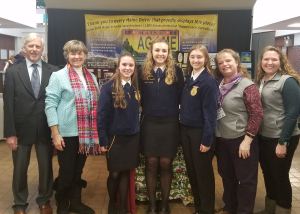
Maine FFA State Officers meet with grant sponsor Maine Agriculture in the Classroom (MAITC). Left to right: Doug Robertson, State FFA Advisor, Maine Department of Education; Maryjane Stafford, Chair, MAITC Association; Willie Sawyer Grenier, Executive Director; Kelsey Fortin, Assistant. In background is Maine Agricultural License Plate, whose revenues support $60,000 in educational grants each year.

Student State Officers of the Maine FFA Association (formerly known as “Future Farmers of America”) enjoyed in depth discussions with representatives of Maine’s agriculture and natural resources community on January 9, 2018 at the Agricultural Trades Show in the Augusta Civic Center.

The Maine FFA Association, devoted to leadership development, represents students in grades 7-12 (as well as collegiate alumni members) enrolled in classes related to agriculture and natural resources.  Some of these classes are offered through technical programs (such as horticulture and forestry) at secondary Career & Technical Education schools, while others are offered through middle and secondary classes in subjects such as science that are aligned to agriculture and natural resources.  Maine currently has 14 FFA chapters from Sanford to Caribou with over 500 members.  FFA members participate in state-level events as well as regional and national competitions, leadership training and other opportunities (such as over $2 million in scholarships) provided by the National FFA Organization.

The annual Agricultural Trades Show is organized by the Maine Department of Agriculture, Conservation and Forestry and features 3 days of presentations, lessons and displays involving representatives of numerous industry, governmental and non-profit organizations.

Maine’s State FFA Officer team came away from this year’s Trades Show with a greater understanding of the state’s agriculture and natural resources, as well as the names of many contacts to include in future partnerships.  They also had the opportunity to attend the luncheon hosted by Commissioner Walt Whitcomb of the Maine Department of Agriculture, Conservation & Forestry at which presentations included Governor Paul LePage and Dr. Barb Glenn, Chief Executive Officer of the National Association of State Departments of Agriculture.

For more information about Maine FFA and how to start an FFA chapter, please contact:  Doug Robertson, Agriculture & Natural Resources Specialist and Maine FFA State Advisor, Maine Department of Education, doug.robertson@maine.gov  (207) 624-6744

Maine FFA State Officers (center) – Micayla Driscoll, Secretary-Treasurer; Isabelle Wright, Vice President; Kaley Norsworthy, President – visit with representatives of major sponsor, Farm Credit East – Renee Poulin, Appraiser Trainee, and Jacob Vainio, Credit Representative/Analyst