Franklin County Adult Education Educator Recognized as Outstanding District Educator

Information submitted by Michael Burd, Franklin County Adult Education Technology Instructor/Integrator.

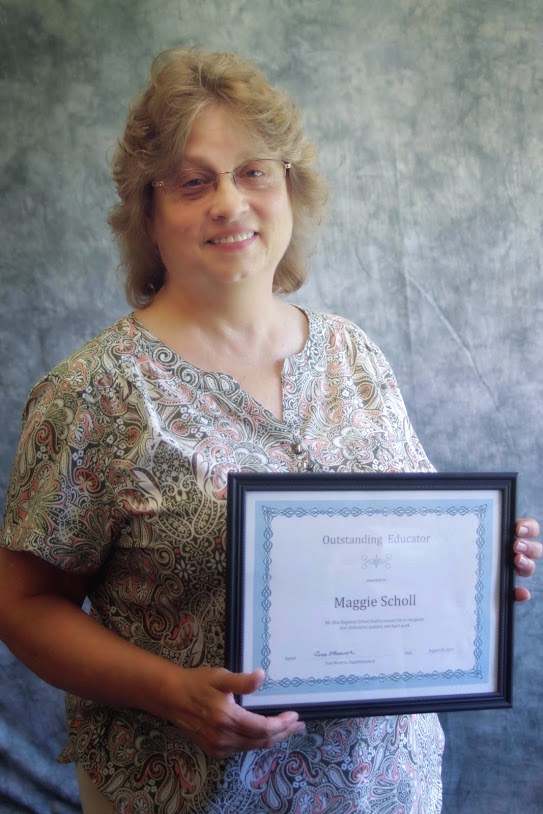
Long-time Adult Education Educator Maggie Scholl was recognized recently at an event that took place within her district.

Maggie is described as patient with a calm demeanor and the tenacity to make sure that each and every one of her students learns. She is known for maintaining positive communication with students, has a caring approach to education and a genuine interest in students.

Pleasant and collaborative with her colleagues, she contributes to the team both professionally and personally. One of her former students and a current colleague had this to say about Maggie, “I am the teacher that I am today because of great role models and this educator is definitely one of the larger role models of education for me.”

Maggie is a graduate of the University of Maine at Farmington where she later worked as a tutor in a program that helped veterans obtain a G.E.D. and improve their skills to go on to college. After a short stint working locally as a teacher, she left teaching to raise her children. Years later, she returned to the classroom when she accepted a position working for the Franklin County Adult Education Program in RSU 9 doing the same work she had enjoyed so much in the past. She has been teaching adult education there for more than 20 years.

Media Release: State Finalists Announced for 2020 Maine Teacher of the Year

Three Maine teachers have been announced as State finalists for the 2020 Maine Teacher of the Year. The finalists were chosen from the 2019 Maine County Teachers of the Year honored earlier this year at the Hall of Flags.

The Maine Teacher of the Year program honors outstanding teachers who represent the thousands of excellent educators in Maine. Maine’s Teacher of the Year serves as an advocate for the teaching profession, education and students, and represents Maine in the National Teacher of the Year program.

Each educator was nominated by a member of their community for their exemplary service in education and dedication to their students. They were selected by a distinguished panel of teachers, principals, and business community members from a pool of hundreds of other nominated teachers in their communities.

State Finalists:

Heather WhitakerHeather Whitaker

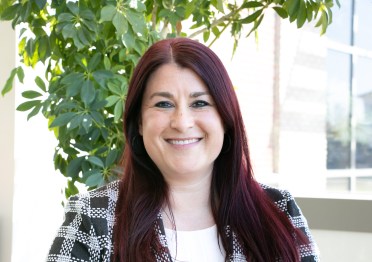
Heather Whitaker is the alternative education teacher at Gorham Middle School and earlier this year she was named 2019 Cumberland County Teacher of the Year.

Passionate about combining learning opportunities with the needs of the community, she started her school’s garden, which donates over 800 pounds of produce for the local food pantry each year. She also was a founding member of the Gorham BackPack Program, which provides students in her community, experiencing chronic hunger, with food over the weekend. Her alternative education students are active volunteers for both programs.

Whitaker is an advocate for and experienced in using restorative practices and experiential learning. She believes in the power of relationships and that learning should be meaningful to students. Whenever possible, Whitaker takes students out of the classroom on educational field trips and gets them involved in community volunteering.

Whitaker holds a Bachelor of Arts in Elementary Education from Boston College and a Master of Science in Literacy from University of Southern Maine and has been teaching for 18 years.

Rob TaylorRob Taylor

Rob Taylor started teaching in 1989.  He has spent his entire 30 year career in Maine Regional School Unit 73, teaching secondary math and science, Advanced Placement Environmental Science and also served as district Gifted and Talented Coordinator. He recently transferred to a middle school science position at Spruce Mountain Middle School in Jay and earlier this year was named the 2019 Franklin County Teacher of the Year.  He is an educational leader, working to implement standards via the district curriculum committee and address Maine’s teacher shortfall through participation in the Maine Math and Science Teaching Excellence Collaborative.

Taylor believes that students need to “get outside and connect to nature’. His Envirothon teams have won nine Maine Envirothon championships and were 1st in Aquatics and 6th overall at the 2018 International Envirothon.  His current school projects include greenhouse and aquaculture systems that provide produce for local pantries, participation in an American Chestnut Foundation restoration project, a drinking water monitoring program, and school renewable energy solar panel and wind turbine projects.

Taylor received a Bachelor of Science in Biology/Secondary Education from the University of Maine at Farmington and a Master of Education degree from the University of Maine.

Tom GrayTom Gray

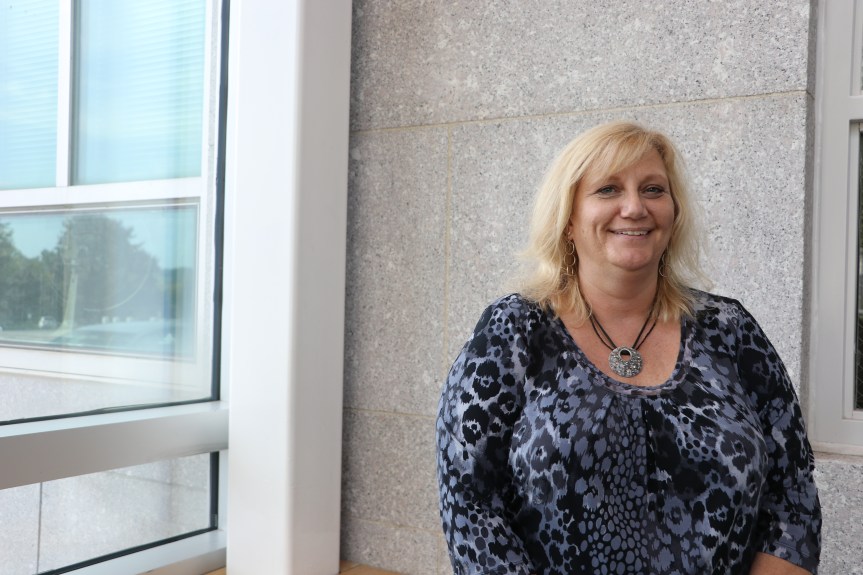
2019 Knox County Teacher of the Year, Tom teaches Social Studies, English, and Gifted and Talented at Camden Hills Regional High School (Five Town CSD).  He has been teaching for 21 years.

As the coordinator of the school’s Intercultural Program, he has developed direct connections with educators in partner schools around the world, from China, to France, to Morocco. These school-to-school partnerships offer opportunities for students to interact and collaborate with peers in other cultures to investigate real-world problems. By leveraging technology to transcend physical limitations he prepares his students to thrive as global citizens. Gray believes in the “transformational power of adventure” for students as a way to build into education an opportunity for kids to cope with the unknown so they can discover their own agency.

In the 2019-2020 school year, Tom will pioneer a new, district-wide initiative in Innovation Engineering, in partnership with the University of Maine.

Tom is a National Board Certified Teacher.  He holds a Bachelor of Arts from University of Delaware; Master of Arts in Teaching, Master of Arts in History from the University of Maine; Graduate Certificate in Gifted and Talented Education at the University of Maine at Farmington; and is currently enrolled in the St. Joseph’s College Master of Science in Educational Leadership program.

One of these three teachers will be named the 2020 Maine Teacher of the Year, an honor awarded each year to one teacher in Maine. The announcement will be in October after a school site visit and final interview.

Maine Teacher of the Year is a program of the Maine Department of Education, administered by Educate Maine. For more information, visit http://www.mainetoy.org.

Pre-K for ME: Open-Source Curriculum

Maine DOE is proud to announce the release of Prek for ME, an open-source curriculum for preschoolers.  Developed in response to public prek teachers looking for an evidence-based, whole child, content integrated curriculum that is low cost, Prek for ME builds on the Boston Public Schools preschool curriculum and contains a comprehensive program, including outdoor learning and technology activities appropriate for young children.

This is only one of many curriculum options from which school districts can choose as Maine DOE does not dictate curriculum.

Prek for ME can be found at: https://www.maine.gov/doe/learning/earlychildhood/PreK4ME.  Educators should read the guidance documents included with the curriculum materials to support successful implementation of the curriculum.

For more information contact Nicole Madore at nicole.madore@maine.gov.

Maine High School Students Can Still Apply for Early College Courses 

The University of Maine System released the following message yesterday regarding applications for early college courses:

Maine students and their families still have one week to explore and apply for Early College courses at all of Maine’s Public Universities using the ExploreEC Portal.  The portal is new for the fall semester and classes start September 3rd.  UMaine President Joan Ferrini-Mundy welcomed students and their families to Orono today for an Early College Orientation and urged everyone to share the news that students throughout the state still have to apply now for fall Early College courses.

Apply Now with New ExploreEC Portal:  The University of Maine System launched the ExploreEC portal to allow high school students to explore and apply for Early College courses at all seven campuses with one streamlined application.  Students from 120 Maine high schools and homeschooled students have already used the ExploreEC portal to register for classes this fall and over 300 school counselors have received training and access to support students with the online application process.  Students still have a week to explore and apply at: ExploreEC.maine.edu

Earn $3,000 in Free College Credits with Early College Career Exploration Certificates:  High school students can now explore and begin preparing for careers with immediate opportunities in the Maine workforce.  The Early College Career Exploration Certificates guide high school students as they learn about majors and career options.  Upon completion, students earn a designation on their university transcript. The college credits they earn can save their families approximately $3,000 in tuition costs.  Visit  https://academics.maine.edu/early-college/pathways/ to learn more about the Early College Career Exploration Certificates being offered.

Read the entire media release from the University of Maine System here or visit: http://www.maine.edu/thousands-heading-back-school-early-college/

ADMINISTRATIVE LETTER: Legal Requirements to Provide English Language Acquisition Services to Students Who are English Learners

Administrative Letter: Legal Requirements to Provide English Language Acquisition Services to Students who are English Learners

Administrative Letter: #27         
Policy Code: IHBEA
TO: Public School Administrators
FROM: Pender Makin, Commissioner
DATE: August 22, 2019
SUBJECT: The legal requirements for providing English for Speakers of Other Languages (ESOL) services to students who are English learners

Topics included in this letter:

  • Identification of students who are English learners
  • Exit criteria from ESOL services
  • Delivery of ESOL services
  • Administration of ACCESS for ELLs®
  • Enrollment of students who are immigrants and international students
  • Rights of students who are English learners to education
  • Students who are English learners and Special Education

Identification of Students Who are English Learners (EL)

It is a federal requirement that all students who are English learners be identified within 30 days of enrollment from the beginning of the school year, or within two weeks of enrollment during the school year.

Each School Administrative Unit (SAU) must administer the Maine Department of Education’s Language Use Survey to the parent/guardian of every student, pre-kindergarten through 12th grade, enrolling in the SAU for the first time. The Language Use Survey must be included in the SAU’s enrollment packet or online enrollment system. If a student changes schools within a SAU, a new Language Use Survey is not required.

The Language Use Survey is available for download on the Maine Department of Education website   in English and 25 of Maine’s most commonly spoken languages. Parents/guardians are entitled to complete the Language Use Survey in their preferred language. SAUs must provide translation/interpretation services upon request.

The purpose of the Language Use Survey is to identify potential students who are English learners. The Language Use Survey decision tree provides guidance on its use. If any question is answered with a language other than English, the student should be administered an English language proficiency screener. (Note that Sign Language is not a qualifying language for English learner status. However, if a student uses Sign Language and an additional language other than English, the student may be eligible for English learner status.) See the resource and policy guide, Serving Maine’s Students who are English Learners, for information about the required screeners and identification thresholds, by grade level.

Students who were screened for EL status but did not initially qualify may be rescreened at any time if a potential need for ESOL support becomes apparent.

Exit Criteria from ESOL Services

In order to exit from ESOL services, a student must demonstrate English language proficiency. The Maine Department of Education defines English language proficiency as an overall composite proficiency level of 4.5 on ACCESS for ELLs®. No other measure qualifies a student who is an English learner for exit. While a district may choose to continue to provide language support services to students who have demonstrated English language proficiency, such students are no longer classified as English learners and are no longer administered ACCESS for ELLs® (or Alternate ACCESS, if applicable).

Students who are English learners with an IEP exemption from a domain or domains on ACCESS for ELLs/Alternate ACCESS are eligible to exit based on their performance on the non-exempt domains. The Maine Department of Education calculates an overall composite proficiency level for such students, utilizing a score of 4.5 on the exempt domain(s) and weighting domains according to WIDA’s overall composite score weighted formula.

Monitoring and Reentry into EL Status

Per federal guidance, SAUs are to monitor the performance of former students who are English learners for at least two years after exiting. If, during the two years of monitoring, or at any time thereafter, a former student who is an English learner shows a potential need for continued ESOL support, the student must be rescreened with the WIDA Screener Online to determine English learner status. If a student scores below the state-defined identification threshold, he/she must be reentered into English learner status, must receive ESOL services, and must take ACCESS for ELLs (or Alternate ACCESS, if applicable) until exiting.

Delivery of ESOL Services

An SAU is required to determine the components of an effective English language acquisition program tailored to the needs of each student, which may include, but is not limited to, tutoring, additional classroom support, materials, sheltered instruction, professional development for content area teachers, or other strategies (Office for Civil Rights December 1985 Title VI policy memorandum, Title VI Language Minority Compliance Procedures).

The Maine Department of Education requires the English language support program for a student who is an English learner to be provided or overseen by a 660 ESOL-endorsed teacher. (See 34 Code of Federal Regulations C.F.R. Section 100.3 (b)(ii)). All students who are English learners must be provided with English language support services that enable them to meaningfully access the curriculum in order to meet grade-level standards. English language development and content area knowledge are to be acquired simultaneously, rather than consecutively. In other words, English language proficiency is not a prerequisite to participate in mainstream classes. If students who are English learners receive services that remove them from content area classes (such as a newcomer program or pull-out services), any academic deficits that result must be remedied so the student remains on track with his/her non-EL peers academically.

English language support services are to be provided in a way that minimizes the isolation of students who are English learners from the general student population and encourages students who are English learners to participate in all aspects of the school program, including advanced coursework, career and technical education, gifted and talented programs, and extracurricular activities. Students who are English learners are entitled to ESOL services until exiting by demonstrating English language proficiency on ACCESS for ELLs® (or Alternate ACCESS, if applicable).

Administration of ACCESS for ELLs® or Alternate ACCESS

Federal and State laws require that the English language proficiency of all students who are English learners be measured annually as a component of accountability under the Elementary and Secondary Education Act (ESEA). If a student is identified as an English learner, that student must be administered ACCESS for ELLs (or Alternate ACCESS, if applicable) annually until the student demonstrates English language proficiency. The Maine Department of Education defines English language proficiency as a composite proficiency level of 4.5 on ACCESS for ELLs or level P2 on Alternate ACCESS. Failure of all students who are English learners to participate in the annual administration of ACCESS for ELLs/Alternate ACCESS may affect ESEA Title IA funding.

State law requires that ACCESS for ELLs/Alternate ACCESS be administered only by an individual trained it its administration. It is not required that this individual be an ESOL-endorsed teacher. However, only an ESOL-endorsed teacher is qualified to design, oversee, and implement an English language support program, which includes the interpretation of ACCESS for ELLs/Alternate ACCESS results.

If parents/guardians have questions about the purpose of ACCESS for ELLs/Alternate ACCESS, direct them to ACCESS for ELLs: FAQs for Parents/Guardians.

Enrollment of Immigrants and International Students

Title VI of the Civil Rights Act of 1964 prohibits discrimination based on race, color, or national origin, among other factors, by public schools. SAUs are required under federal law to enroll children regardless of citizenship or immigration status (Plyler vs. Doe). This applies  equally to students who are immigrants and international students attending a Maine public school as an exchange student or tuition-paying student. All students, including those who are immigrants and international students, must be screened for English learner status. Any student who is identified as an English learner, regardless of citizenship or immigration status, is entitled to ESOL services and must be administered ACCESS for ELLs (or Alternate ACCESS, if applicable) annually. International/exchange students are not exempt from Title I required state academic assessments. In Maine, recently arrived English learners who have been enrolled in a U.S. school for less than 12 months are exempt from one administration of the state’s English language arts assessment only. See the

SAUs are not permitted to discourage the enrollment of children who are undocumented immigrants by asking about their immigration status, denying enrollment to those with international birth certificates, or denying enrollment to children whose parents decline to provide their social security numbers or race and ethnicity information. Federal regulations allow schools to ask for children’s social security numbers to be used as student identifiers. However, they should inform parents of the purpose and that disclosure of such numbers is voluntary. Schools may not deny enrollment if parents refuse to provide a child’s social security number. SAUs may require proof that a child lives within SAU boundaries, which may include lease agreements, utility bills, or other documents. However, schools may not ask parents about a child’s immigration status to establish residency. SAUs may require proof of a child’s age, but they may not bar enrollment because a child has an international birth certificate or no birth certificate. See this fact sheet from the Departments of Justice and Education for more details about acceptable documentation requests.

Rights of Students who are English Learners to Education

The Civil Rights Act of 1964 remains the foundation of the legal rights of aa student who is an English learner. Lau v. Nichols confirms that all students who are English learners are entitled to meaningful access to the curriculum. If a parent refuses ESOL services this must be documented, but parental refusal does not release the school or SAU from its responsibility to provide meaningful education to students who are English learners. If a student who is an English learner cannot make academic progress without ESOL services, the student has a right to ESOL services, even if a parent refuses. Parental consent is not required to administer an English language proficiency screener or ACCESS for ELLs/Alternate ACCESS. Under State law SAUs are responsible for administering ACCESS for ELLs® to all students who are English learners, regardless of parental consent (20-A M.R.S. §6209(1-A)).

Students who are English Learners and Special Education

Students may qualify for, and have legal entitlement to, both ESOL and special education services. Appropriate screening is required to determine students’ eligibility for each type of service. Depending on a student’s learning disability and Individual Education Plan (IEP), universal testing tools or accommodations may be needed in order to measure English language proficiency. When evaluating a student who is an English learner for learning disabilities, screening must be linguistically and culturally appropriate. It is advisable to measure a student’s skills in the student’s primary language in order to clarify whether challenges are due to a learning disability or English language development.

Students who are English learners should not be placed in a special education program unless their exceptionality is well-documented, and appropriate procedures for special education services have been followed. English learner status is not a disability and is not covered by the Individuals with Disabilities Education Act (IDEA) or Maine Unified Special Education Regulations (MUSER).

For students who are English learners with IEP teams, the United States Department of Education has provided the following guidance:

“It is important that IEP Teams for ELs with disabilities include persons with expertise in second language acquisition and other professionals, such as speech-language pathologists, who understand how to differentiate between limited English proficiency and a disability. The participation of these individuals on the IEP Team is essential in order to develop appropriate academic and functional goals for the child and provide specially designed instruction and the necessary related services to meet these goals.”

Students who are English learners with learning disabilities are eligible for exit from ESOL services when they demonstrate English language proficiency by achieving an overall composite proficiency level of 4.5 on ACCESS for ELLs (or level P2 on Alternate ACCESS, if applicable).

If you have questions, or would like further information regarding serving students who are English learners, please contact April Perkins, ESOL/Bilingual Programs, at april.perkins@maine.gov or (207)624-6627.

Media Release: Maine DOE Releases Thank You Video to Educators with the Help of Special Friends

The Maine Department of Education (DOE) released a Back to School Thank You video just in time for the many teacher in-service days that are taking place all over the state this week, prior to Maine schools welcoming students back into the classroom for the 2019-2020 school year.

View the video: Video can be viewed here or at https://www.maine.gov/doe/thankyou, where you can also find an MP4 available for download, in addition to a closed-captioned version of the video.

The video opens with a message from Maine DOE Commissioner Pender Makin, accompanied by a slide show of images taken in Maine schools all over the state.  Commissioner Makin’s message is followed by a montage of thank you messages from Maine students, Maine’s congressional delegation including Senator Susan Collins, Senator Angus King, Congresswoman Chellie Pingree, and Congressman Jared Golden, along with Governor Janet Mills, comedian Tim Sample, author Stephen King, Red Claws Mascot Crusher, Olympian Joan Benoit-Samuelson and Maine DOE staff, all saying thank you to all the dedicated professionals who work in, and on behalf of, Maine schools. We hope all of Maine will take a moment to thank our school employees, and remind them how valued and appreciated they are, as they embark on yet another year of positively impacting the lives of Maine students.

For more information, please contact Maine DOE Director of Communications Kelli Deveaux at (207) 624-6747 or at kelli.deveaux@maine.gov.

###

Get to Know the DOE Team: Meet Stephanie Clark

Maine DOE team member Stephanie Clark is being highlighted this week as the part of a Get to Know the DOE Team campaign! Learn a little more about Stephanie in the brief question and answer below.

What are your roles with DOE?

I am the fiscal compliance associate with School Finance and Compliance.  I am responsible for collecting and reviewing the financial audits from the School Administrative Units as well as the municipal schools and towns,  I am also responsible for the Special Education tuition financial reports and I conduct the audits for the school construction projects once the project is complete and closed.

What do you like best about your job?

I like the fact that I can help the districts with staying in compliance with what statute requires of them.  It is so rewarding to start with a person that is confused or doesn’t understand something work with them and explain why and how to help them complete the job they are trying to accomplish.

How or why did you decide on this career?

I have worked for the State of Maine for over 13 years and in that time I have worked in a few different agencies, I am happy to say that I am enjoying the Department of Education and the work that we do here the most.

What do you like to do outside of work for fun?

I have two dogs, Sadie, a Yorkshire terrier and Remy, a toy poodle named after the color announcer Jerry Remy of the Red Sox, with whom I like to cuddle and watch TV with.  Along with my dogs I like to spend time traveling with my husband Glen around and outside of the State.  I also enjoy spending time with my church family.

Regional Conversations Regarding Serving Children with Disabilities from Birth to 5 Years of Age

As most of you are aware, L.D. 1715, “An Act to Reorganize the Provision of Services for Children with Disabilities from Birth to 5 Years of Age” has been carried over to the next Legislative session. This bill proposes the transition of responsibility for special education services for preschool-age children from Child Development Services to the public schools.

The Department recognizes that there are many questions and issues involved with the proposed transition, and that they may vary significantly by region. Because of this, and in preparation for the Committee for Education and Cultural Affairs’ continued consideration of L.D. 1715, the Department of Education feels that it is critical to receive input from regional stakeholders. We have established regional stakeholder meetings, based on the established Superintendent Regions.

Each of these regional stakeholder meetings will include all Superintendents and Directors of Special Education who are available to attend, and the department will be inviting representatives who meet the following criteria:

  • A designee of the Commissioner of Education
  • A representative of a Special Purpose Preschool who is contracted with CDS to provide services
  • An individual who, as a sole proprietor, is contacted with CDS to provide services
  • A representative of a Head Start agency or program
  • An early childhood teacher from a public 4-year old program that includes eligible children
  • A principal of a public elementary school that includes eligible children in its public 4-year-old program
  • A representative of a statewide association of speech, language and hearing therapists
  • A representative of a statewide association of occupational therapists
  • A representative of a statewide association of physical therapists
  • A parent of a child with a disability between 3 and 5 years of age who is currently receiving services from CDS
  • A representative of a childcare program

Due to the limited space available, additional representatives from the above list may be accommodated depending on the response received from Superintendents and Directors of Special Education.

Regional Stakeholder meetings are scheduled for the following dates and locations. All meetings will be from 10:00 to 3:00:

Midcoast
September 16th at the Senator Inn, Augusta

Western
September 16th at the Senator Inn, Augusta

Kennebec
September 17th at the Senator Inn, Augusta

Washington and Hancock
September 17th at the Black Bear Lodge, Orono

Penquis
September 18th at Jeff’s Catering, Brewer

Aroostook
September 18th at Caribou Inn and Convention Center, Caribou

Cumberland and York
September 19th at the Westbrook Armory, Westbrook

Please respond to Jonathan.Madden@maine.gov with your availability to attend as soon as possible.

Thank you and we look forward to hearing your valuable input.

Back to School Backpack for Administrators!

As the students and staff arrive with their new, back to school items, we want to make sure that our administrators have what they need for a great new year, too!  The Department of Education has created a special “Back to School Backpack” for building and district leaders. In it, you will find resources that will help you with the climate, culture, inclusiveness and wellness of your schools and students, and a number of documents and ideas to consider for the new school year.  We encourage you to look through, and let us know how we can help you and your schools throughout the year!  Please be sure to sign up for our weekly updates, follow us on Facebook or Twitter, check out our expanding professional development offerings, send good news to us, and encourage your staff to join the content specific listservs by contacting the content specialist.

Grab your backpack, and have a great school year!

Maine Care Billing, What We Know

A number of schools have contacted us to ask for an update on the requirement that IEPs list Maine Care paid, medically necessary services for children with disabilities. Because the requirements for billing for Maine Care exceed what is required and typically included on the IEP, we will need to work with DHHS to find a mutually acceptable solution.  Please see our website (bottom right of page- recently changed forms) for our updated IEP form.  We are in contact with DHHS and the Maine Care School Liaison to assist in providing details to our colleagues in the field. At this time, we do not anticipate any further clarification or decisions until October, when we will be pursuing a discussion with federal contacts at the annual National Alliance for Medicaid and Education conference. We are advocating for a simplification of the process and documentation, and a narrowing of requirements.

We will keep you informed as we pursue information and answers, appreciate your patience, and welcome your feedback. For more information, please contact Jan Breton at janice.breton@maine.gov.