Save the Date for the 20TH Annual MLTI Student Conference!

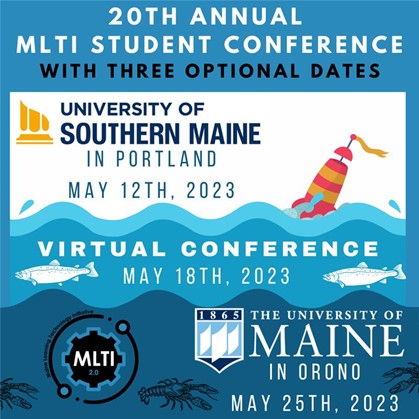
The Maine Learning Technology Initiative (MLTI) is excited to announce the dates and locations for the 20th annual MLTI Student Conference!

In our continued effort to engage all MLTI students in our annual conference, we’re offering three different options for participation this year. We’re partnering with the University of Maine System, to host two in-person MLTI Student Conferences!

University of Southern Maine’s Portland Campus
Friday, May 12th

University of Maine in Orono
Thursday, May 25th

Virtual MLTI Student Conference
Thursday, May 18th

The virtual conference will provide opportunities for students who may not be able to attend the in-person events. Last year’s classroom-based virtual conference was the largest attended in MLTI history with 55 schools, 5,672 students, and 696 educators participating!

We hope all MLTI schools can join us in their choice of engagement for the 20th annual MLTI Virtual Student Conference!

Please save the date for the 20th MLTI Student Conference and check our website for more announcements coming soon, including a call for proposals, t-shirt design contest, guest announcements, presenters, and session information.

We look forward to seeing all of you at one of our conference locations and sharing an exciting and innovative day with you and MLTI students!

For more information, reach out to the Maine DOE MLTI team.

Warming Center Locations and Resources Available in Response to Extreme Temperatures

Given the frigid and dangerous temperatures expected in the coming days, the Maine Department of Education is sharing information from the Maine Emergency Management Agency (MEMA) on Warming Centers and other resources for families and communities.

Warming and Charging Centers operated by local municipalities could open in communities across Maine. Visit MEMA’s website to find a location in or near your community. You may also dial 2-1-1 or visit their website for a list of locations.

Click here for additional resources and information from MEMA on how to prepare for the extreme temperatures and safety tips, including information on preventing and dealing with frozen water pipes.

Families are encouraged to stay tuned to alerts and warnings through media or by downloading the free FEMA app on their smart phone, which provides targeted preparedness information, alerts, and warnings for specific areas. For more information on preparedness, visit and follow MEMA on Facebook or Twitter.

Organizations Needed to Provide Complimentary Meals to Children This Summer   

With the assistance of the U.S. Department of Agriculture, Maine public schools have long offered a nutritious breakfast and lunch meal program to thousands of income eligible children in Maine during the school year. To extend this program, Maine Department of Education Child Nutrition (Maine DOE) is seeking organizations that would like to participate in the federally funded Summer Food Service Program (SFSP), which provides children healthy, free meals when school is not in session.

“By participating in this program, community groups and organizations can have a tremendous impact on the health and wellbeing of children in their communities,” said Maine Education Commissioner Pender Makin. “The Maine Department of Education is thankful to those organizations that join this program to ensure our children get the meals they depend on this summer”

In summer 2022, 119 sponsors were approved to operate 452 Summer meal sites across Maine. Although there are sponsors operating in every county in Maine, there is still a long way to go towards feeding all eligible children during the summer. Community partners are working to maximize the number of sponsors utilizing the availability of funds under the SFSP.

SFSP may be offered statewide in areas or at sites where more than 50 percent of the children are eligible for free or reduced meal benefits under the National School Lunch Program or census track data supports the need. Organizations that provide services in rural communities or near migrant farm workers and tribal populations are urged to participate. Eligible sponsoring organizations include schools, nonprofit residential summer camps, government agencies, and tax-exempt organizations including faith-based organizations.

Maine DOE encourages any eligible organization to consider providing this much-needed service to Maine children. The agency will begin accepting applications to participate in February. Approved sponsors will be reimbursed for eligible meals served to children during the long summer break.

Interested organizations should begin planning now for a successful summer. Potential sponsors are required to receive training from Maine DOE. Training will occur virtually, and DOE staff will assist in the onboarding process. Maine DOE is available to consult by phone and email to answer questions regarding summer meals.

For more information about the Maine DOE’s Summer Food Service Program, contact adriane.ackroyd@maine.gov, call 592-1722 or visit https://www.maine.gov/doe/schools/nutrition/programs/sfsp.

###

Federal
In accordance with Federal civil rights law and U.S. Department of Agriculture (USDA) civil rights regulations and policies, the USDA, its Agencies, offices, and employees, and institutions participating in or administering USDA programs are prohibited from discriminating based on race, color, national origin, sex, disability, age, or reprisal or retaliation for prior civil rights activity in any program or activity conducted or funded by USDA.

Persons with disabilities who require alternative means of communication for program information (e.g. Braille, large print, audiotape, American Sign Language, etc.), should contact the Agency (State or local) where they applied for benefits.  Individuals who are deaf, hard of hearing or have speech disabilities may contact USDA through the Federal Relay Service at (800) 877-8339.  Additionally, program information may be made available in languages other than English.

To file a program complaint of discrimination, complete the USDA Program Discrimination Complaint Form, (AD-3027) found online at: https://www.usda.gov/oascr/how-to-file-a-program-discrimination-complaint, and at any USDA office, or write a letter addressed to USDA and provide in the letter all of the information requested in the form. To request a copy of the complaint form, call (866) 632-9992. Submit your completed form or letter to USDA by:
(1)     mail: U.S. Department of Agriculture
Office of the Assistant Secretary for Civil Rights
1400 Independence Avenue, SW
Washington, D.C. 20250-9410;

(2)      fax: (202) 690-7442; or
(3)      email: program.intake@usda.gov.
This institution is an equal opportunity provider.

State
The Maine Human Rights Act prohibits discrimination because of race, color, sex, sexual orientation, age, physical or mental disability, genetic information, religion, ancestry or national origin.

Complaints of discrimination must be filed at the office of the Maine Human Rights Commission, 51 State House Station, Augusta, Maine 04333-0051. If you wish to file a discrimination complaint electronically, visit the Human Rights Commission website at https://www.maine.gov/mhrc/file/instructions and complete an intake questionnaire. Maine is an equal opportunity provider and employer.

NEO and Synergy – State Reporting Training

End-of-year reporting is just around the corner. If you would like to brush up on reporting requirements and/or Synergy and NEO navigation before reporting periods open, now is the best time of year!

The Maine Department of Education Data Team offers training in both NEO and Synergy for anyone looking to further develop their navigation skills of these systems for state reporting purposes. Trainings can be done with new or current users one-on-one, in small groups, or in a group setting for whole districts.

Training is targeted to meet the needs of anyone uploading or entering data into Synergy and/or NEO for Maine State reporting purposes.

Topics include, but are not limited to, data entry, uploads, and report navigation of;

  • Daily Attendance
  • Enrollment
  • Truancy
  • Staff
  • Special Education
  • Bullying

Trainings can be held virtually or in person at the preference of the district and/or user, and typically run for 1 hour. More time can be provided as needed.

For more information or to sign up for training please contact: AlLee Cookson, Maine DOE Data Quality Trainer Alexandra.Cookson@maine.gov or 207-446-3897, or submit an Onboard Training Registration online survey.

Maine’s National Board Certified Teachers Honored in Virtual Pinning Ceremony

“National Board taught and reminded me of the importance of being a beginner. At first, I thought it was about achievement, but it became very apparent not too long into the process that being a beginner is something to embrace,” said keynote speaker Sarah Brown Wessling, National Board Certified Teacher and 2010 National Teacher of the Year.  She added, “National Board puts the focus on the process of learning, we learn how our students learn.  That is the thing that is so beautiful about this process. Once we understand the how and the why, it makes us stronger teachers and colleagues.”

On January 26th, twenty Maine educators were celebrated for being newly certified by the National Board for Professional Teaching Standards during Team National Board Certified Teaching (NBCT) week. These outstanding educators join a growing network of teachers across the State who have undergone this highly reflective professional learning experience, including 61 of their colleagues who were recognized for National Board Certification renewal.

The pinning ceremony was hosted by the Maine Education Association (MEA) and the National Board Certified Teachers Network of Maine (NBCTs of Maine). Among those in attendance to celebrate were family members, colleagues, administrators, fellow NBCT’s, state legislators, and Maine Department of Education staff.  Words of congratulations were shared by Maine’s Department of Education Deputy Commissioner Daniel Chuhta; MEA President and NBCT Grace Leavitt; NBCTs of Maine Chair and NBCT, Heidi Goodwin; National Board Certified Teachers Network of Maine Chair and NBCT Matt Madore; and Keynote Speaker Sarah Brown Wessling.

The journey to National Board Certification, described by Maine educators as rigorous, deeply reflective, personally reassuring, and professionally rewarding, requires nearly 400 hours of time and effort to achieve.  Educators must submit a detailed portfolio that includes examples of student work, video recordings of classroom teaching, a reflection piece focused on student assessment and learning, and demonstrated mastery of the content of their chosen certification area. This evidence must meet the Five Core Propositions and the National Board Standards, a body of knowledge that is maintained by teachers. Practicing teachers, through a peer-review process, assess the portfolios.

“Attaining National Board Certification not only demonstrates that you are an accomplished teacher but also that you have a deep commitment to teaching and learning and, most importantly, to the students you work with and support in reaching their potential. It is really a huge achievement,” said Grace Leavitt.

NBCT’s and Professional Learning Facilitators Heidi Goodwin and Jennifer Dorman led this year’s pinning ceremony.  Attendees each had the opportunity to introduce themselves and be “pinned” by a family member or friend at home.

In pursuing and achieving National Board Certification, the following teachers have demonstrated an outstanding commitment to their students, schools, and districts. Please join us in congratulating them!

New National Board Certified Teachers:

Name School/SAU NB Certificate Achieved
Julie Bradstreet


James H Bean School, RSU 18 Generalist/Early Childhood
Matthew Buchwalder


Lincoln Academy Science/Early Adolescence
Larissa Costello Dike-Newell School, RSU 1 Exceptional Needs Specialist/Early Childhood through Young Adulthood
Lindsey Davis Leroy H Smith Elementary School, RSU 22 Generalist/Early Childhood
Dawn Dickey Madison Elementary School, MSAD 59 Generalist/Early Childhood
Beth French Kermit Nickerson School, RSU 71 Generalist/Early Childhood
Nesrene Griffin Connors Elementary, Lewiston Public Schools Generalist/Middle Childhood
Emily Hachey Benton Elementary School, MSAD 49 Generalist/Middle Childhood


Dorothy Dawson Hall George B Weatherbee School, RSU 22 Generalist/Middle Childhood


Alison Hinson (Formerly) Bonny Eagle, MSAD 6 Career and Technical Education/Early Adolescence through Young Adulthood
Jennifer Howes Connors Elementary, Lewiston Public Schools Literacy: Reading-Language Arts/Early and Middle Childhood
Sarah Latzke Connors Elementary, Lewiston Public Schools English as a New Language/Early and Middle Childhood
Kimberly Mitchell Hampden Academy, RSU 22 Exceptional Needs Specialist/Early Childhood through Young Adulthood
Amber Richard


Portland Arts and Technology High School, Portland Public Schools Career and Technical Education/Early Adolescence through Young Adulthood
Stephanie Robison Frank H Harrison Middle School, Yarmouth School Department English Language Arts/Early Adolescence
Robin Seeker


Falmouth Elementary School, Falmouth Public Schools Exceptional Needs Specialist/Early Childhood through Young Adulthood
Kristin Smythe


Thornton Academy Exceptional Needs Specialist/Early Childhood through Young Adulthood
Amanda Van Tine Ellsworth High School, Ellsworth School Department Social Studies-History/Adolescence and Young Adulthood
Sarah Wishart-Rogers Benton Elementary School, MSAD 49 Literacy: Reading-Language Arts/Early and Middle Childhood
Haley Wotton Thomaston Grammar School, RSU 13 Generalist/Early Childhood


National Board Certified Teachers who achieved “Maintenance of Certification”

Name National Board Certificate Maintained
Leslie Applebaum


English Language Arts/Adolescence and Young Adulthood
Ryan Avery Science/Early Adolescence
Emily Barriault English as a New Language/Early and Middle Childhood


Jennifer Briggs


Science/Adolescence and Young Adulthood
Rebekah Brockway


Generalist/Middle Childhood
Ashley Bryant


English Language Arts/Early Adolescence
Peggy Callahan


English as a New Language/Early Adolescence through Young Adulthood
Courtney Cole


Generalist/Early Childhood
Andrea Cram


Mathematics/Early Adolescence
Debra Demos


Generalist/Early Childhood
Robbin Dilley


Science/Adolescence and Young Adulthood
Jennifer Dorman


English Language Arts/Early Adolescence
Louis Dorogi


Social Studies-History/Adolescence and Young Adulthood
Katie Dutil


Generalist/Early Childhood
Joseph Feeney Social Studies-History/Adolescence and Young Adulthood
Stephanie Fogler


Generalist/Early Childhood
Patricia Forster


English Language Arts/Early Adolescence
Leslie Gallant


Generalist/Early Childhood
Heather Geoghan


Physical Education/Early and Middle Childhood
Julia Gibson


Exceptional Needs Specialist/Early Childhood through Young Adulthood
Kelley Goodfield


Library Media/Early Childhood through Young Adulthood
Heidi Goodwin


Literacy: Reading-Language Arts/Early and Middle Childhood
Mark Gorey


English Language Arts/Adolescence and Young Adulthood
Melissa Guerrette


Generalist/Middle Childhood
Elizabeth Hayden


Mathematics/Adolescence and Young Adulthood
Nell Herrmann


Science/Early Adolescence
Holly Houston


Art/Early Adolescence through Young Adulthood
Hillary (Hoyt) Bellefleur


Generalist/Middle Childhood
Jason Kash


Social Studies-History/Early Adolescence
Johna King


Generalist/Early Childhood
Marcella Lessard


Career and Technical Education/Early Adolescence through Young Adulthood
Abigail Luchies


Library Media/Early Childhood through Young Adulthood
Jeanne Lysobey


Science/Early Adolescence
Rebecca Maiorano


English as a New Language/Early and Middle Childhood
Megan Markgren


Generalist/Middle Childhood
Georgianna McAllister


Literacy: Reading-Language Arts/Early and Middle Childhood
Ryan Middleswart


English Language Arts/Adolescence and Young Adulthood
Luanne Mudgett


Mathematics/Early Adolescence
Mary Murphy Science/Adolescence and Young Adulthood
Jennifer Noel


Generalist/Early Childhood
Kelly O’Brien Weaver


School Counseling/Early Childhood through Young Adulthood
Jenine Olson


English Language Arts/Adolescence and Young Adulthood
Dawn Pendergrass


English Language Arts/Adolescence and Young Adulthood
 

Laura Phelps

Library Media/Early Childhood through Young Adulthood


Jill Plourd


Exceptional Needs Specialist/Early Childhood through Young Adulthood
Cherie Poole


Literacy: Reading-Language Arts/Early and Middle Childhood
Megan Praschak


Exceptional Needs Specialist/Early Childhood through Young Adulthood
Jamie Purnell


Science/Adolescence and Young Adulthood
Christina Rich


Generalist/Early Childhood
Shelly Richardson


Mathematics/Adolescence and Young Adulthood
Jaci Ritter


Mathematics/Early Adolescence
Diane Rodrigue


Career and Technical Education/Early Adolescence through Young Adulthood
Patricia Scully


Generalist/Early Childhood
Michelle Smith


Science/Adolescence and Young Adulthood
Justin Stygles


Generalist/Middle Childhood
Melissa Sylvester


Art/Early Adolescence through Young Adulthood
Theodore Taylor


Science/Adolescence and Young Adulthood
Shawn Towle


Mathematics/Early Adolescence
Amy Vacchiano


School Counseling/Early Childhood through Young Adulthood
Rita Vigneault Exceptional Needs Specialist/Early Childhood through Young Adulthood
Lisa Walker Mathematics/Adolescence and Young Adulthood


National Board certification is voluntary and open to all teachers who have at least three years of classroom experience and a bachelor’s degree. Certification is available in a variety of certificate areas, from preschool through 12th grade.

Maine offers an annual salary supplement for eligible educators who have achieved National Board Certification.  Scholarships are also administered through the Department of Education. More information can be found by visiting the DOE’s National Board webpage.

Contact information for National Board Certification in Maine:

NBCTS of Maine:

Heidi Goodwin: nbct.heidi@gmail.com

Jennifer Dorman: jdorman@msad54.org

Maine Education Association:

Mallory Cook: mcook@maineea.org

Maine Department of Education:

Emily Doughty: Emily.doughty@maine.gov


Education Commissioner Pender Makin Kicks Off Annual Read to ME Challenge by Reading to Sanford Pre-K Students 

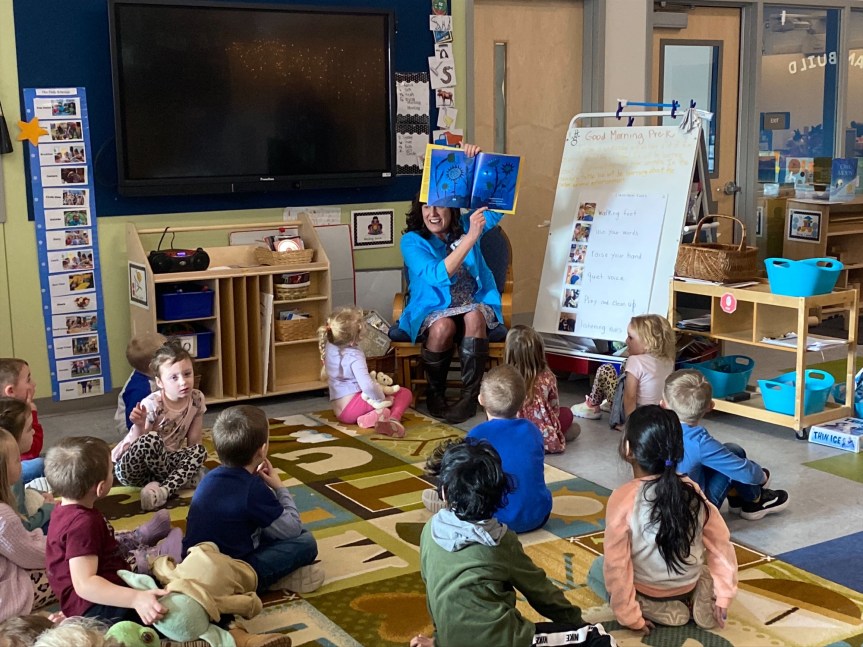
Maine Education Commissioner Pender Makin kicked off the state’s Read to ME Challenge at Sanford Regional Technical Center by reading If Only… to a group of spirited pre-k students. This is the eighth year that the Maine Department of Education is collaborating with schools, parents and communities on this month-long public awareness campaign to promote the importance of literacy for all of Maine’s students, regardless of age. You can watch video of Makin kicking off the challenge here.

The Read to ME Challenge encourages adults to read to children for 15 minutes, capture that moment via a photo or a video, and then post it to social media and challenge others to do the same using the hashtag #ReadtoME.

Makin also spent time talking with students who are part of Sanford Regional Technical Center’s early childhood education program. Students in the program split their time between their own classroom and interacting with children in the pre-k classroom. Sanford was also able to expand to full day pre-k this year after receiving a grant through the Maine Jobs and Recovery Plan.

“The Read to ME Challenge is about creating a love of reading with children and promoting literacy across our state—and it’s fun,” said Maine Education Commissioner Pender Makin. “Not only did I get to read to an amazing group of pre-k students today, but I had the wonderful opportunity to talk with high school students who are working hard to become future educators through this amazing early childhood education program at Sanford Regional Technical Center.”

The simple act of reading aloud to a child 15 minutes a day for five years results in 27,375 minutes of language exposure, which can put children on the path to high literacy achievement and helps them build knowledge and vocabulary. Research demonstrates a number of benefits to reading to children, from birth through their childhoods and even teenage years, including modeling reading as an enjoyable lifelong activity, stimulating brain development, reducing stress and anxiety, building knowledge of the world, and helping develop the skills necessary to succeed in their lives.

Schools and community organizations can find a toolkit and resources on the Department of Education website and the Department will be sharing videos, photos, and updates from the challenge all month long on social media.

Participants in the challenge are reminded to use the hashtag #ReadtoME and to tag the Maine DOE at @mdoenews on Twitter, @MaineDepartmentofEducation1 on Facebook, and @mainedepted on Instagram.

See who Commissioner Makin Challenged!

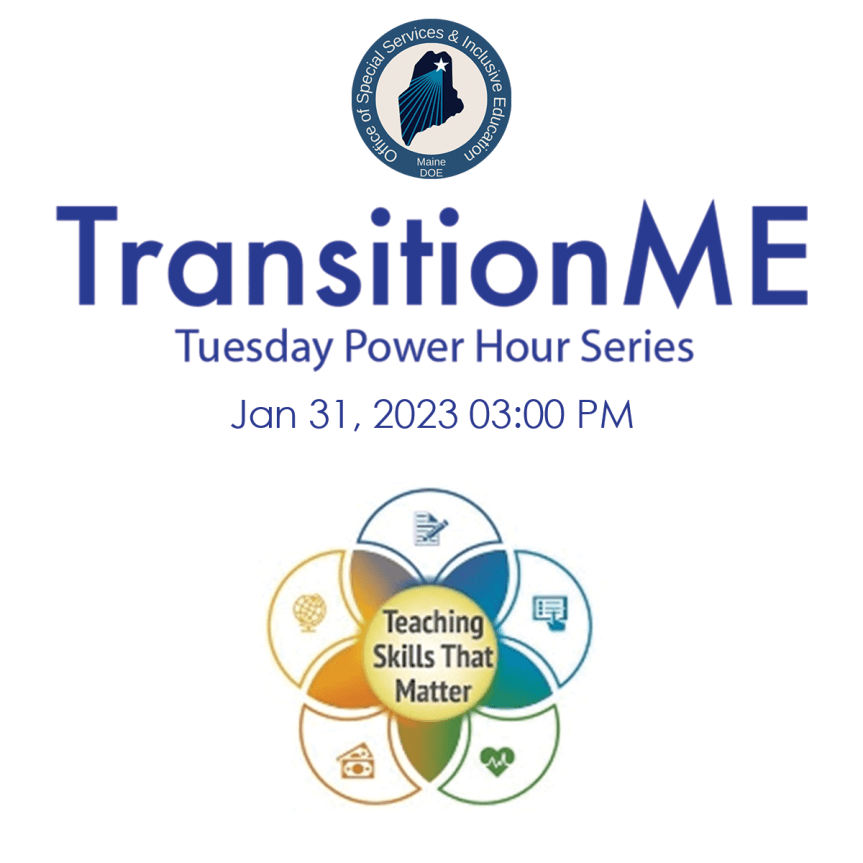
Virtual Tuesday Power Hour Series by TransitionME: 1/31 Session – Teaching Skills that Matter

The Maine Department of Education, Office of Special Services & Inclusive Education presents TransitionME Virtual Tuesday Power Hour Series, a best practices forum to provide opportunities for our State educators and transition leaders to grapple with and actuate strategies and support for our scholars’ diverse needs and pathways to post-secondary opportunities

Upcoming session: What central skills do students, including students with exceptionalities, need to find success in life and work?

Audience: All teachers; Highly recommended for Sped teachers, Case managers & Transition Leads

When: Jan 31, 2023 03:00 PM Eastern Time (US and Canada)

Amy Poland, a member of Maine Department of Education (DOE) Adult Education Team, will discuss nine central skills that are critical for success in life and work and will share the Teaching Skills that Matter toolkit, a set of high-quality lessons that integrate the skills into relevant contexts, such as civics education, health literacy, and workforce preparation. While written for adult learners, the TSTM toolkit materials are also relevant for high school learners, including multilingual learners.

Register here in advance for this meeting. After registering, you will receive a confirmation email containing information about joining the meeting. Participants who take part in this Professional Development will receive 1 contact hour.

For further information contact Titus O’Rourke, Maine DOE Eligibility & Transition Specialist at titus.orourke@maine.gov or call 207-215-6303.


Warsaw Middle Schoolers Put Courage to the Test with SpiritCorps

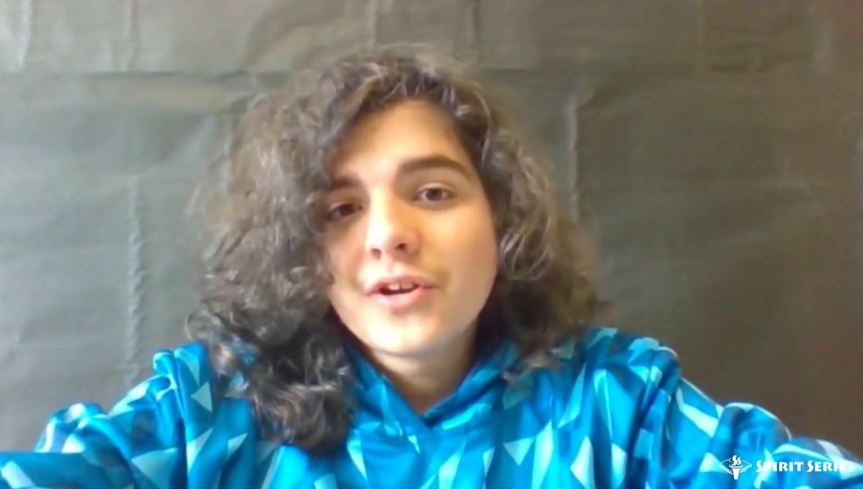
“I learned that I could face my fears if I put my mind to it,” one Warsaw 7th grader concluded as ELA teacher, Jake Marcoux, took his classes on a journey of self-discovery during their 3-week personal narrative writing and storytelling project celebrating Courage with SpiritCorps.

KEMPTON COURAGE – SPIRITCORPS.mp4 from Spirit Series on Vimeo.

Students engaged in a rigorous 5-step writing process to craft their stories of Courage. And they were supported along the way by their teacher, peer Story Partners, program videos and materials, as well as an adult SpiritCorps Story Coach. These trained program volunteers provide each student approximately one hour of personalized feedback to help them create their very best work. The best thing about SpiritCorps,” said another Warsaw 7th grader “is knowing that adults are out there helping children.”

The project culminates with students recording their story on video, then sharing and celebrating these with classmates and family, for an average of 2 hours of viewing time and 40 views for each 3-4 minute video.

In partnership with the Maine DOE, we can offer SpiritCorps to students statewide. Thanks to a federally funded grant, participating schools are given 100% scholarship in the first year. We would love to work with you and your students!

If you would like the SpiritCorps experience at your school, please email Dr. Christina O’Neal, our Director of Program Partnerships, at coneal@spiritseries.org.

Seeking Writing Teams and Targeted Reviewers for Update of the Maine Early Learning and Development Standards

The Maine Early Learning and Development Standards (MELDS) are the state’s learning standards for children ages three-five. Building from the Infant Toddler MELDS (IT MELDS) and bridging developmental expectations to the Maine Learning Results (MLRs), the MELDS inform all early childhood professionals about the typically developing expectations of young children as well as curriculum and assessment practices.

The MELDS Steering Committee is now accepting applications from individuals interested in being part of the review process to serve as participants on one of the writing teams, or as a targeted reviewer.  The Steering Committee is seeking professionals in the field of Early Care and Education that work or have worked with or on behalf of children. Prospective participants must apply  no later than February 21, 2023.

To understand the details of participation, please read the following Frequently Asked Questions (FAQ):

Q: What are the Maine Early Learning Development Standards (MELDS)?

A: Early Learning and Development Standards describe the concepts and skills children develop and learn along the developmental continuum from birth to kindergarten entry. Their purpose is to support the development and well-being of young children and to foster their learning.

The standards promote the understanding of early learning and development, provide a comprehensive and coherent set of early childhood educational expectations for children’s development and learning, and guide the design and implementation of curriculum, assessment, and instructional practices with young children.

Maine’s Early Learning and Development Standards (MELDS) serve as a guide for state and local early childhood educators’ efforts to improve practice and programs for young children during their preschool years.  The Infant/Toddler MELDS is a companion tool for ages birth-36 months.

Q: Who should consider participating?

A: In order to develop an evidence-based set of standards, we are seeking a diverse population of professionals from the Early Care and Education (ECE) field:

  • Child Care and School Administrators
  • Child Care Health Consultants
  • Child Care Providers and staff of all licensed programs (family, small facility, facility, nursery school, out of school time programs)
  • Child Care Providers and staff from licensed exempt programs
  • Early educators within the school setting (Pre-K through 3rd grade)
  • Ed Techs
  • English to Speakers of Other Languages (ESOL) Professionals
  • Head Start staff
  • Higher education professionals and their students within or specializing in the ECE/ECS field
  • Individuals that provide professional development to the Early Care and Education field
  • Parents, Guardians, Caregivers, or Family Members
  • Special Education Teachers / Specialists
  • Student and School Support Specialists: Speech, Occupational and Physical Therapists, School Counselors, School Social Workers, Interventionists, Title I staff
  • Other professionals serving families of young children

Q: What are writing teams and what is the time commitment?

A: Each of the domains of development will need a team of professionals to review content for relevance and alignment to current research in order for the MELDS to provide early childhood educators with guidance as they design inclusive environments, shape curriculum, lead professional development initiatives, build intentionality into teaching practice, engage families, and support children’s learning at home.  The domains include:

  • Social and Emotional Development
    • Goal Areas: Trust and emotional security, self-regulation; sense of self, self-awareness, and self-concept, relationships with adults, relationships with children
  • Approaches to Learning
    • Goal Areas: Engagement and persistence, initiative and curiosity, creativity
  • Early Language and Literacy
    • Goal Areas: Language comprehension (receptive language), language expression (Expressive/productive communication), emergent literacy
  • Physical Development and Health
    • Goal Areas: Perceptual development, gross motor (large muscle), fine motor (small muscle), self-help and adaptive skills
  • Cognitive Development
    • Goal Areas: exploration and inquiry, concept development and working memory, reflection and problem-solving, mathematical thinking, scientific reasoning, social studies learning

In addition to the domains of development, there are additional sections of the document that will need review.  Those sections include:

  • Introduction, History, Key Components of Early Learning Standards,
  • Purpose Statement and Potential Users, Guiding Principles and Universal Design for Learning
  • Introduction to the Stages of Development Ages 3-5

Time Commitment: The facilitator(s) for each writing team will determine the time necessary for both whole group and individual review. Participants should expect this to be no more than two hours per week. Writing teams will convene in March and work through June.

Q: What are targeted reviewers and what is the time commitment?

A:  Targeted reviewers will review the updated sections provided to them and offer structured feedback. Targeted reviewers will begin review once the initial updates have been made to provide feedback to the Steering Committee.

The time commitment will be less for targeted reviewers than writing team participants, however the  window for review and feedback will be shorter and more time sensitive (approximate document turnaround time of two weeks).

Q: What will I earn in exchange for my time and expertise?

A: Not only will individuals be afforded an opportunity to participate in furthering the field of Early Care and Education, but each participant will also be awarded contact hours at the completion of the writing team cycle based on attendance and at the discretion of the team leader.

Contact hours may be used for furthering education, documentation of professional development experiences, or for continuing education credits (CEUs) and/or training hour conversion.

Q: Why is periodic updating of learning and development standards important?

A: Research in the field of early care and education is constantly evolving.  A regular process of updating early learning and development standards helps to ensure their validity and alignment with other sets of standards across the birth to grade 12 spans.  The updated MELDS will result in a child-centered tool that will inform program development, instruction, assessment, policy decisions, and professional learning for early care and education efforts across Maine.

Q: What is the overall timeline for the MELDS revision?

A: MELDS revision began in the Fall of 2022 with the creation of the Steering Committee. This group has been meeting regularly to discuss the current format of Maine’s MELDS as well as to review feedback from the field, other states’ Early Learning and Development Standards and national research trends/findings. The remaining work is set to unfold on the following timeline:

  • January-February 2023: Recruit writing team members and targeted reviewers
  • February 2023: Assign Steering Committee members and teams to review the current standards
  • March-June 2023: Teams will work to review terminology, assure alignment to Maine’s Infant/Toddler MELDS and to the Maine Learning Results, and review for readability, diversity, inclusion and ease of use
  • July-August 2023: A final version will be translated and introduced to the field for further use

Thank you for time and consideration. If you have any questions, please contact the Department of Education’s Early Childhood Specialist, Nicole.Madore@maine.gov or the Office of Child and Family Services First4ME Program Manager, Megan.Swanson@maine.gov

MaineHealth Virtual Workshop: MindUP – A School and Community-Based Mental Health Resource

The following virtual workshop is being hosted by MaineHealth to Maine schools.

We are facing an unprecedented mental health crisis across the country, especially in the wake of the acute pandemic. The literature indicates it will take many strategies across community and clinical settings to address this.

MindUP is one school and community-based strategy that is based firmly in neuroscience and has proven to be effective to improve stress regulation, to enhance tools for self-regulation, and has demonstrated positive effects on reducing aggression and managing stress, including through four randomized control trials. Although its use and research has been focused in K-12 schools, MindUP can easily be taught in other settings and with adults.

We are fortunate to have implemented MindUP in several schools in Maine, including with the leadership of the Spruce Mountain public schools (RSU 73) in Jay, Livermore Falls, and Livermore and the Healthy Community Coalition at Franklin Community Health Network. David Evans Shaw, a Maine-based philanthropist, has generously funded the efforts to bring MindUP to Maine.

If you or others are interested in learning more and how you can bring MindUP to your school or community setting, please join leaders from RSU 73, Franklin Community Health Network, and MindUP for a one-hour informational zoom on Thursday February 16th, 11:00 am ET – 12:00 pm ET.

We ask that you register here in advance for this meeting.

After registering, you will receive a confirmation email containing information about joining the meeting. The meeting will be recorded, and registrants will receive a link to the recording afterward.

Learn more about about MindUP here (PDF).