On Wednesday, March 18, 2026, the Maine Department of Education (DOE) Green Schools Program, in partnership with Solen Works and Northeastern’s Roux Institute ClimateTech Incubator, will host a “Building a Sustainable Future for Maine Schools” roundtable workshop. The purpose of this workshop is to co-develop a practical, customizable Sustainability Action Plan template for Maine school administrative units (SAUs).
School leaders and educators are encouraged to register to attend to share best-practice sustainability plans and explore how to customize plans to the specific needs of each SAU. The goal is to create a shared, adaptable tool that helps SAUs strengthen budget development, as it pertains to sustainability; maintain momentum through leadership transitions; reduce operating costs; and support healthier learning environments across Maine.
This event will take place in person on March 18 from 1-5 p.m. at the Roux Institute in Portland (100 Fore Street, Portland, ME 04101). Attendance is free but limited to 32 participants. Those who are interested should register for the event here.
The agenda for the workshop is as follows:
1-2 p.m. – Introductions and Presentations
2-3 p.m. – Breakout Working Groups
3-4 p.m. – Recap, Facilitated Discussion, Next Steps
4-5 p.m. – Snacks and Networking
With questions, please visit this webpage to contact the event host.
The Maine Department of Education (DOE) is excited to announce the MaineSeal of Climate Literacy! This high school diploma endorsement prepares and empowers students with environmental literacy, traditional ecological knowledge, and green workforce skills to rise to the challenge of climate change for the future of Maine’s communities, workforce, and natural environment.
The Maine Seal of Climate Literacy is achieved by meeting specific criteria (listed below), as determined by each school administrative unit (SAU). It was designed based on an existing model in Colorado. Maine will be the second state in the nation to offer a Seal of Climate Literacy.
The Maine Seal of Climate Literacy pilot phase will launch in March 2026. Participating schools and students will test the design as it is currently written and provide feedback. The program will officially launch statewide in September for the 2026-2027 school year. To get involved now or next year and stay up to date with program developments, please complete this survey.
Criteria to earn the Maine Seal of Climate Literacy are as follows:
Students must participate in any two high school courses with a focus on climate and environmental literacy concepts and standards.
This may include, but is not limited to, earth science, Wabanaki studies, environmental-focused humanities, biology, or environmental studies. At least one course must include strong elements of traditional ecological knowledge. SAUs should work with students to determine what will qualify.
Students must complete an experiential project that demonstrates and publicly communicates their understanding of environmental literacy, green career exploration, and/or place-based climate action.
This project can range from a school compost campaign to engagement with local public policy, to data collection with community organizations, to green job exploration—and anything in between. SAUs should work with students to determine what will qualify.
SAUs are responsible for conferring the Maine Seal of Climate Literacy and should determine what courses, standards, and experiential projects will meet the criteria. The Maine DOE is available to support SAUs with resources, communications, and celebration of student achievement. SAUs and their students are encouraged to partner with community-based nonprofit organizations, local businesses, and higher education institutions.
With questions about the Maine Seal of Climate Literacy, please contact Maine DOE Climate Education Specialist Teddy Lyman at theodore.lyman@maine.gov.
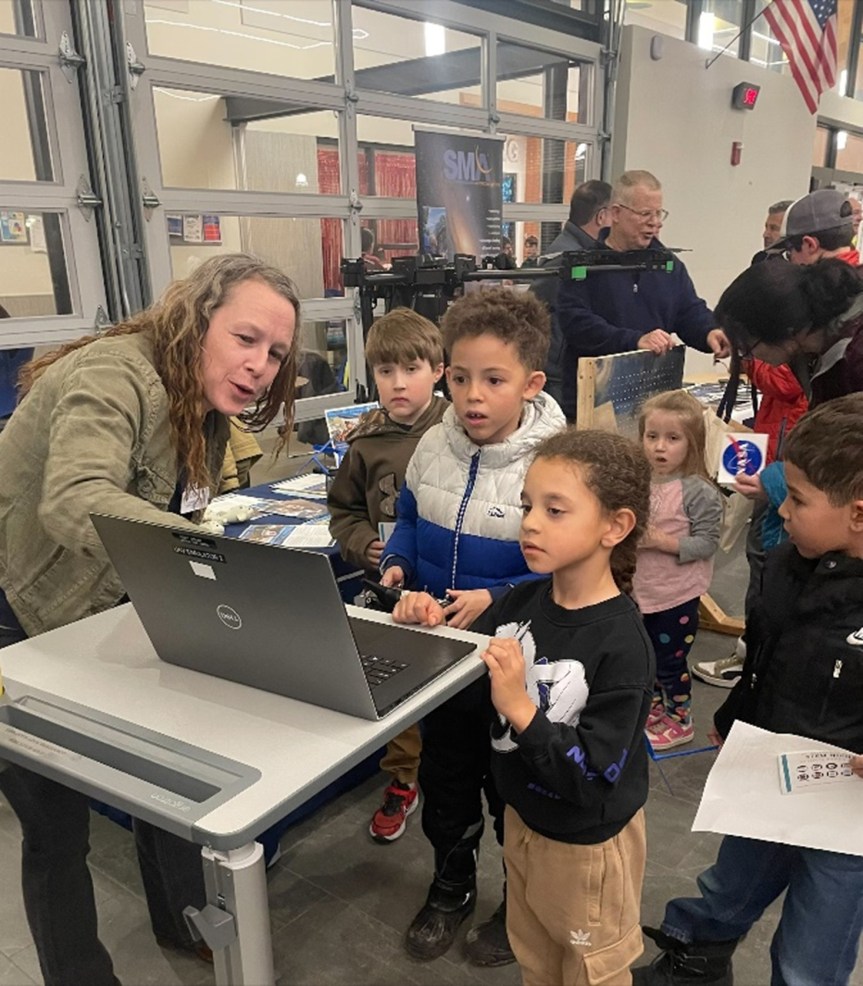
Pictured: Students practice landing a plane with an aviation simulator.
Community outreach and extended learning coordinators wear many hats inside a school. This role often sits at the intersection of academics, career readiness, partnerships, and student support, connecting what happens inside the building to real-world opportunities outside of it.
That work was on full display recently as Mt. Ararat High School in Topsham, under the co-leadership of Community Learning and Extended Learning Opportunities (ELO) Coordinator Doug Ware, hosted its second annual STEM (Science, Technology, Engineering, and Mathematics) Night on January 30, 2026. The event drew approximately 500 attendees and featured more than 40 vendors, transforming the school into a dynamic hub of innovation, collaboration, and hands-on discovery.
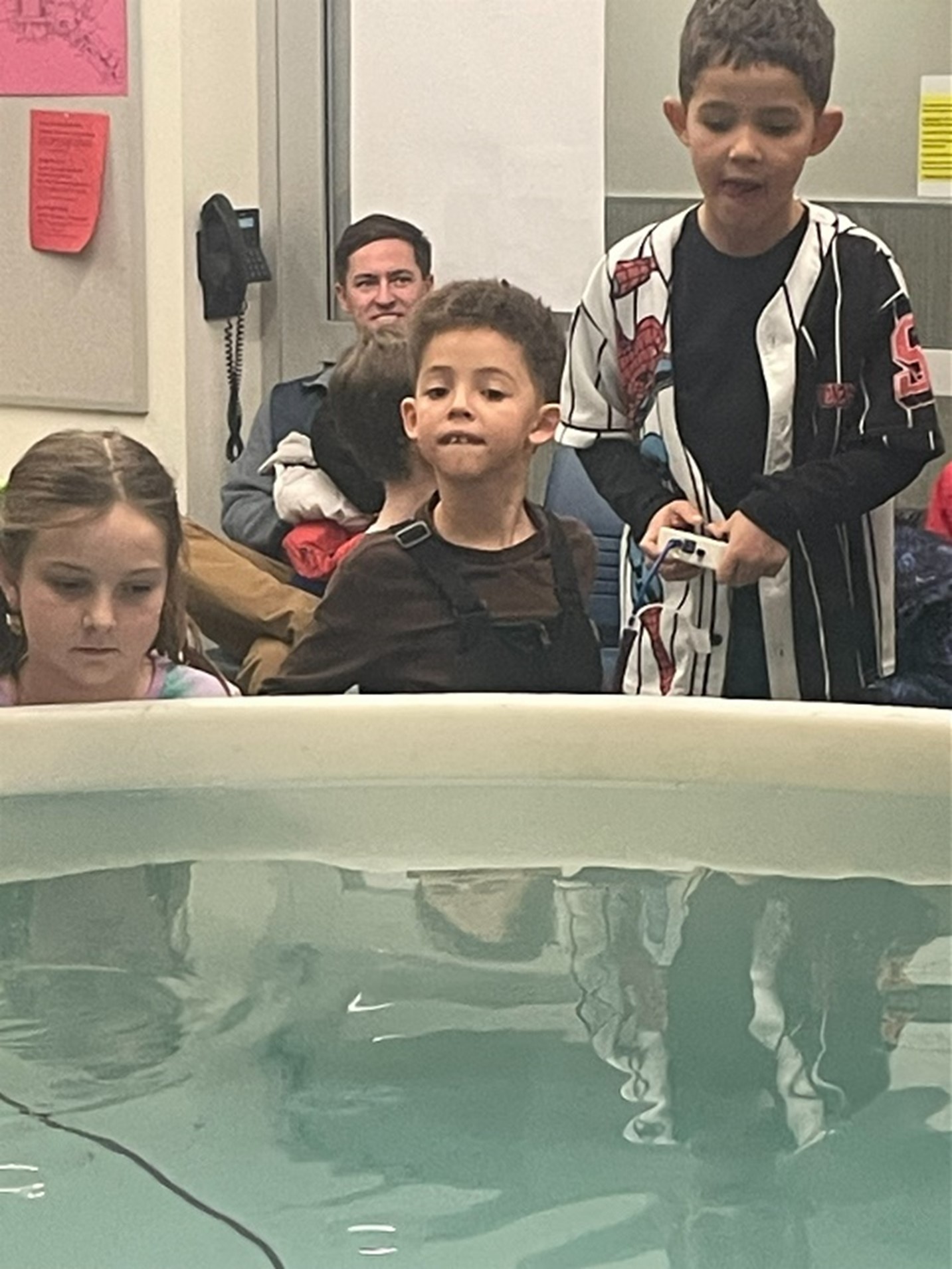
During this event, families and community members from MSAD 75 joined local businesses, industry leaders, and educators for a vibrant evening celebrating STEM. Participants of all ages engaged in activities ranging from virtual medical simulations and Lego robotics to tours of the Bath Iron Works virtual reality trailer and digital arts showcases.
For many attendees, the event highlighted the strength of Maine’s local STEM ecosystem. Paul McGuire, a local alum, entrepreneur, father, and veteran, attended with his family.
“Seeing employers represented from construction to aviation reminded me how strong our STEM community is,” McGuire said. “It’s great to know students can find those opportunities right in our backyard.”
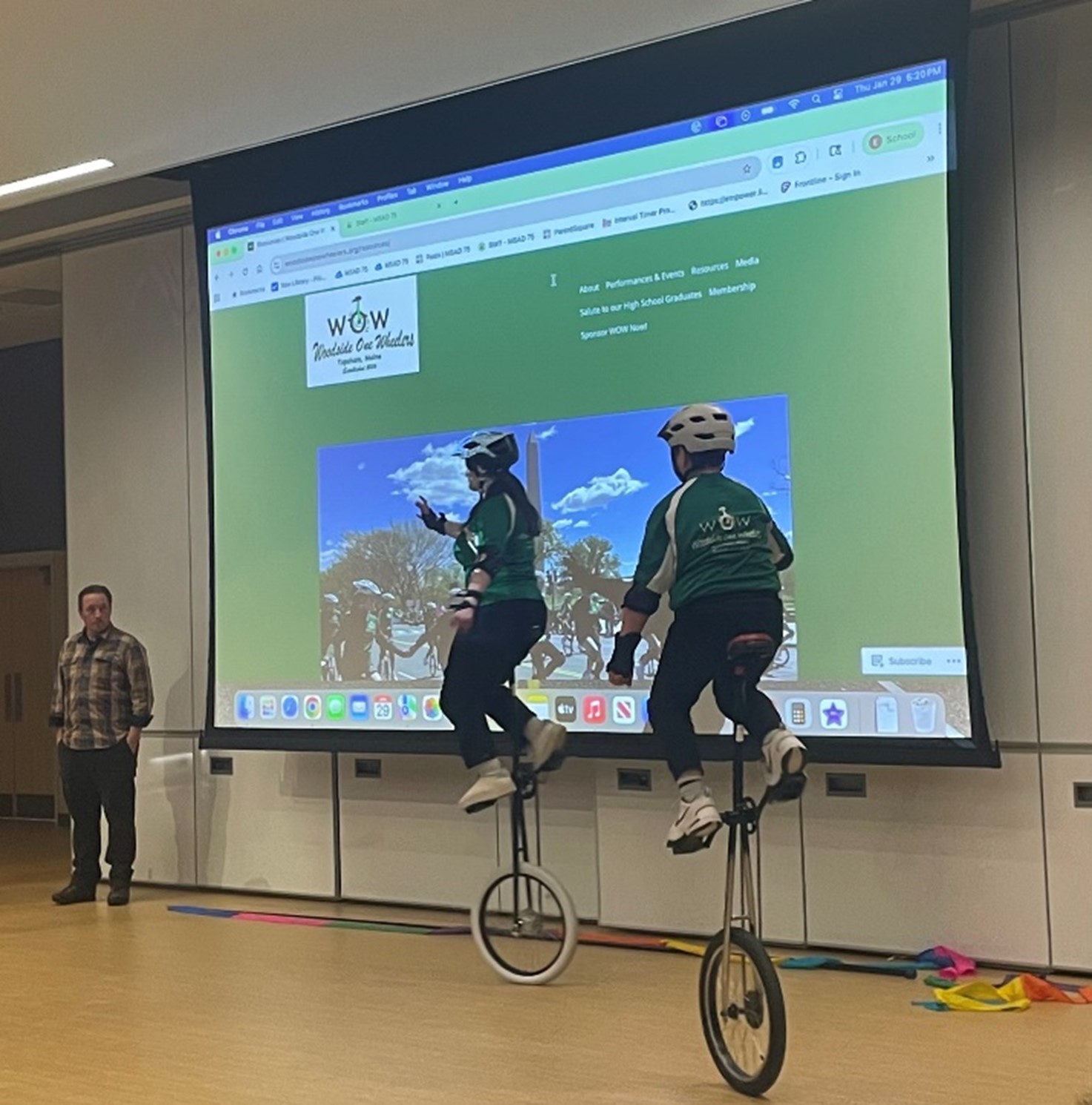
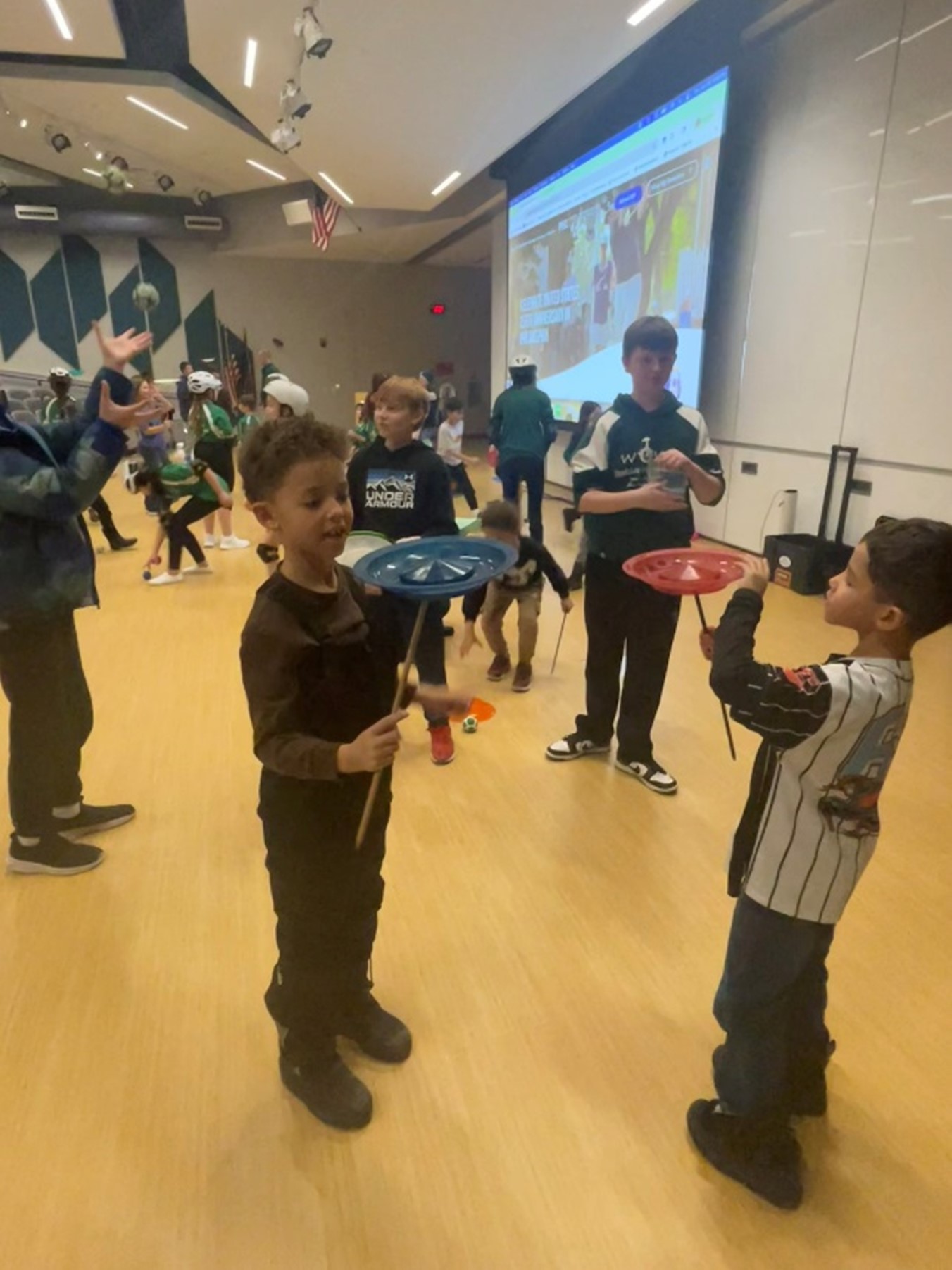
A highlight of the evening was a performance by the Woodside One Wheelers, a juggling and unicycling group from Woodside Elementary School. Students attached sensors to their unicycles to demonstrate how scientific data is gathered and how physics principles apply in motion, blending performance, engineering, and applied science in a way that captivated the audience. The group later performed at the halftime of a local girls’ basketball game, extending the celebration of learning beyond the STEM exhibits.
Events like STEM Night exemplify the multifaceted impact of community outreach and extended learning coordination. The role includes building community partnerships that bring businesses and civic organizations into the school experience; managing ELOs that allow students to earn credit through internships, job shadows, and real-world projects; supporting career and workforce development; encouraging student leadership and service; collaborating with faculty to connect curriculum with experiential learning; removing barriers to access; and telling the story of student success in ways that inspire continued investment and innovation.
Mt. Ararat High School has demonstrated exemplary leadership in advancing high-quality ELOs through its Maine DOE ELO Expansion grant. The school’s work demonstrates how innovative, community-connected learning deepens student engagement, supports informed postsecondary decisions, and helps students envision futures grounded in real experience, meaningful relationships, and opportunity.
STEM Night was an event that reflected what is possible when schools and communities work together. By bridging classroom learning with hands-on exploration and professional partnerships, Mt. Ararat High School continues to model how education can be both rigorous and relevant—preparing students not just for graduation but for life beyond it.
For further information about ELOs and Maine’s efforts to expand career exploration for Maine students, please visit the Maine DOE ELO webpage or contact Maine DOE Extended Learning Coordinator Lana Sawyer at Lana.Sawyer@maine.gov.
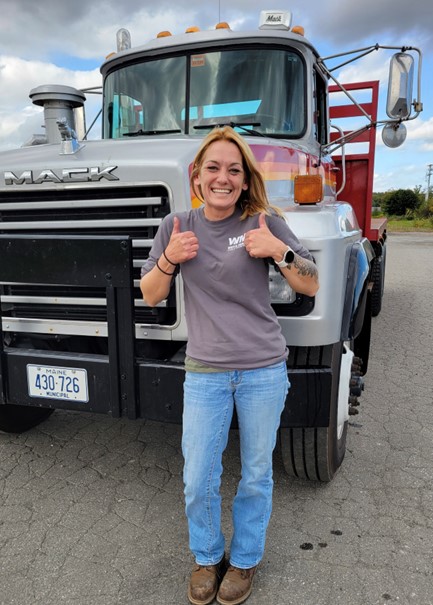
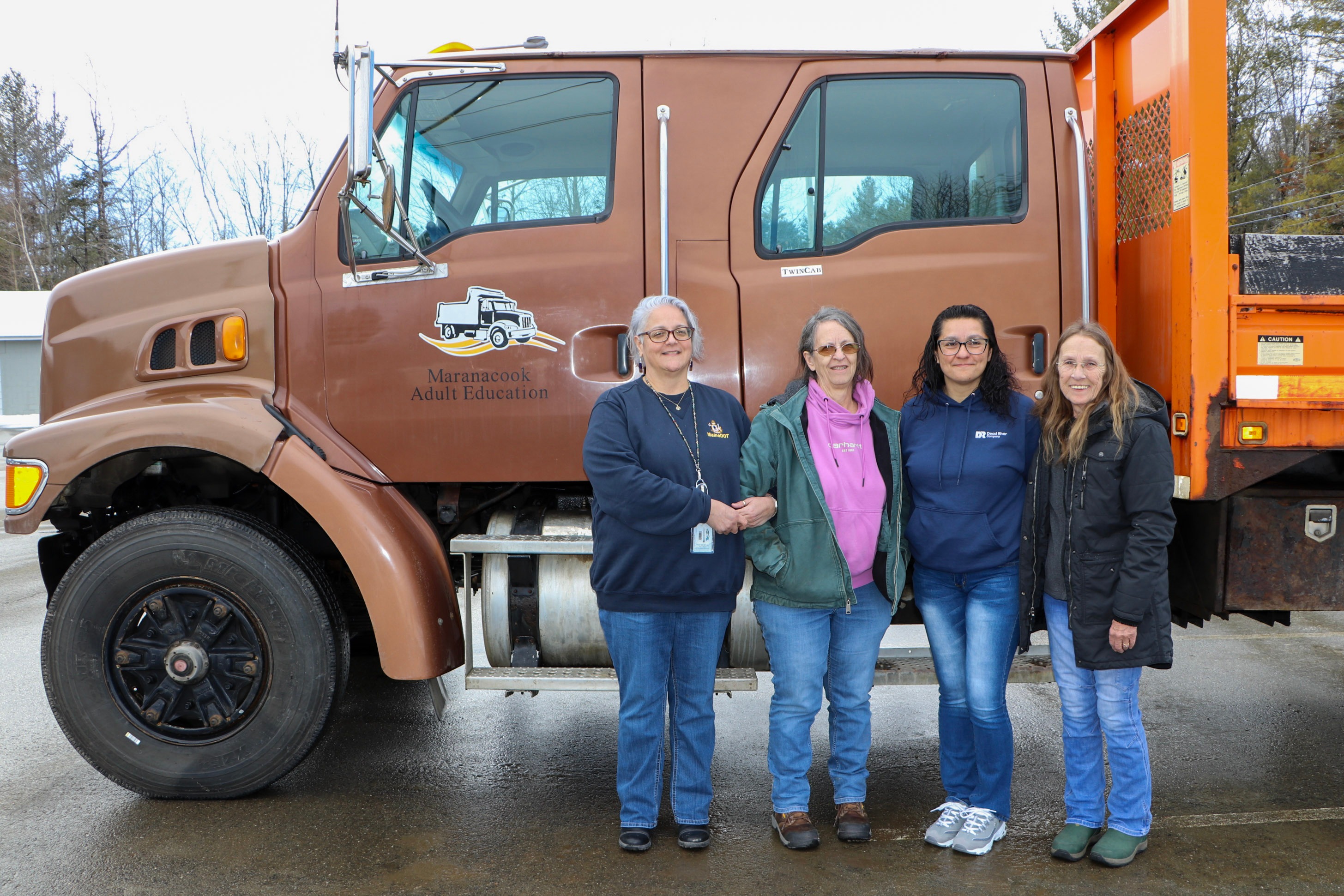
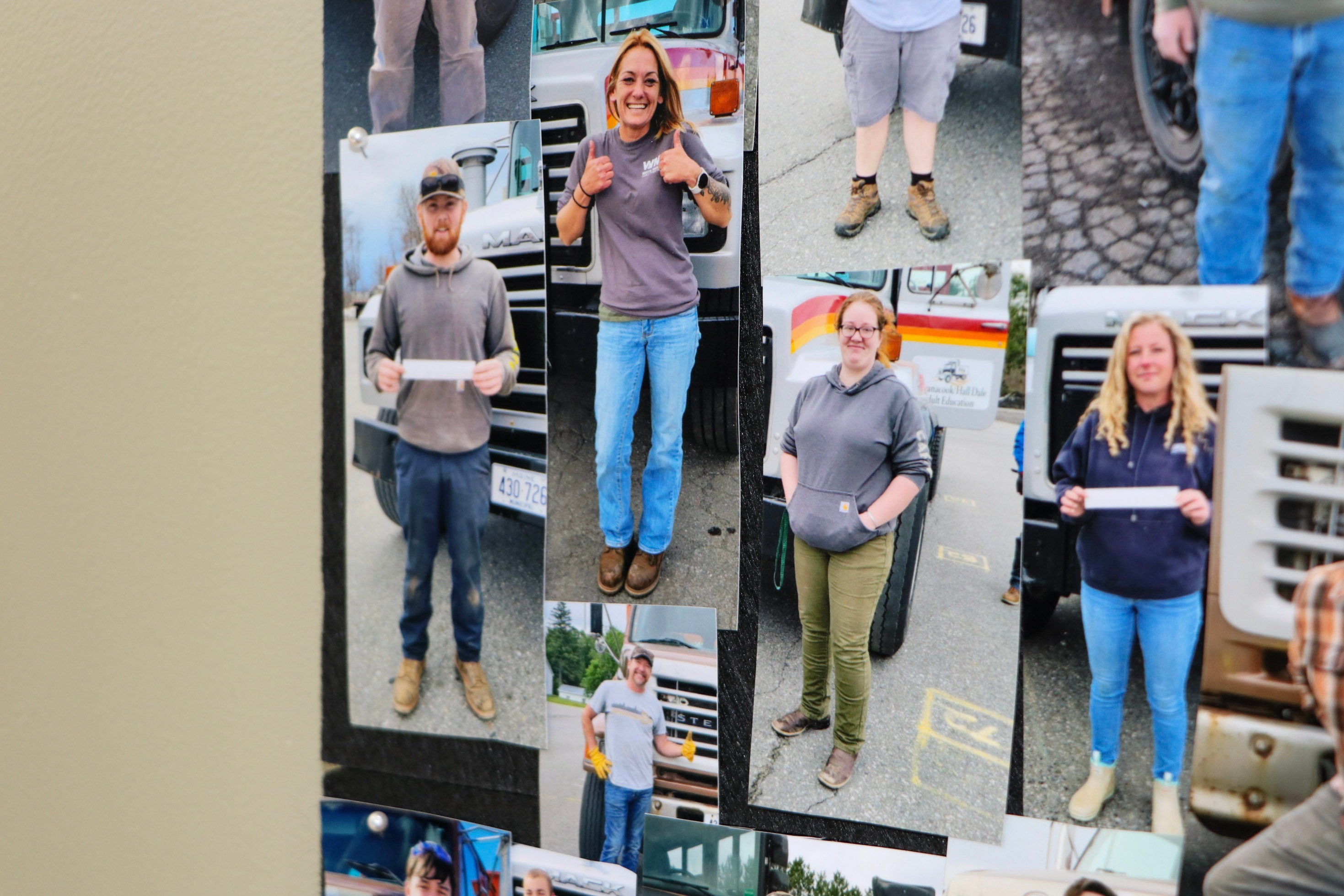
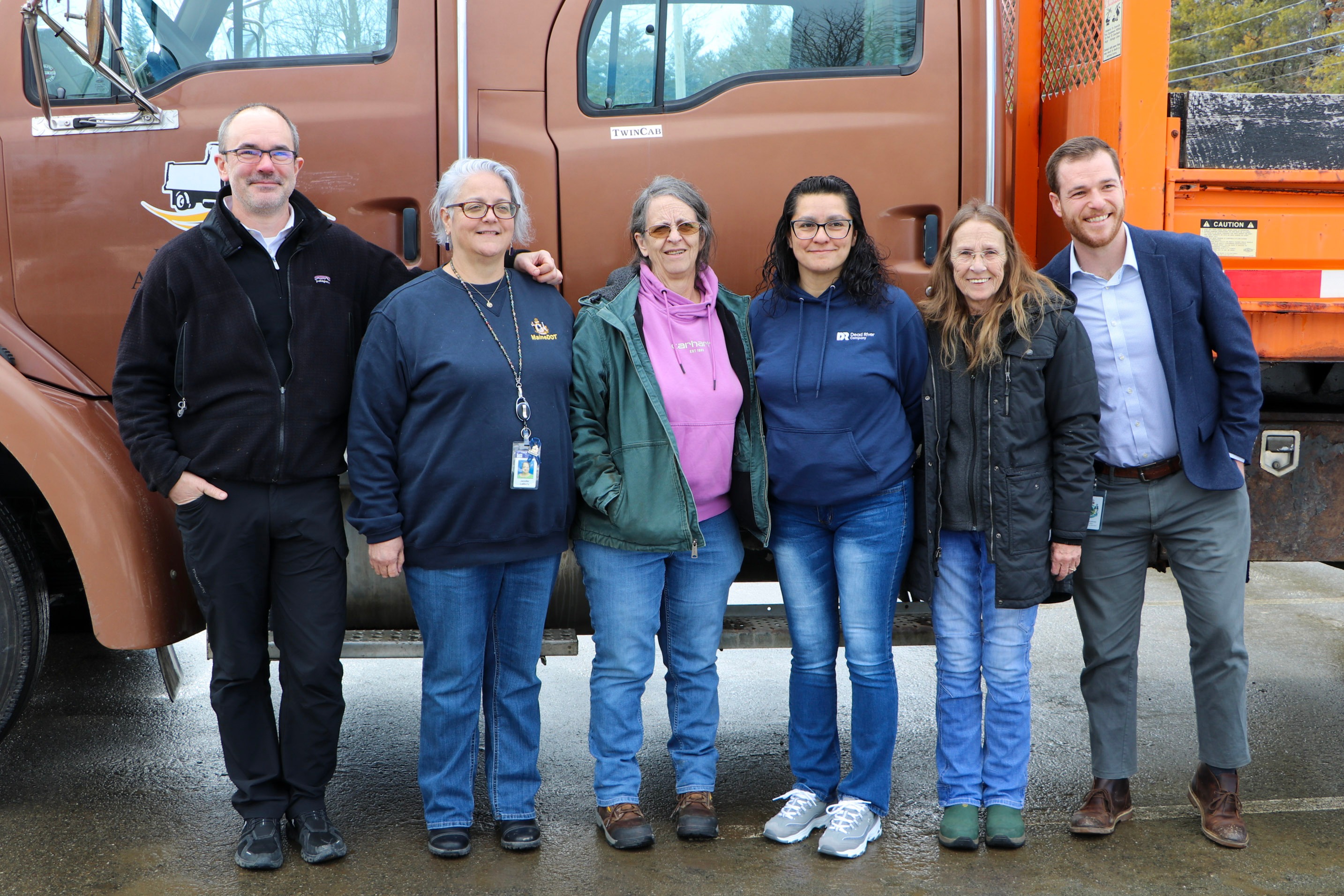
Pictured: Angela Mantha recently completed her CDL at Maranacook Adult Education.
In Maine, women from high school to adulthood are charting their paths into the state’s skilled trades workforce. By participating in hands-on experiences through career and technical education (CTE), Extended Learning Opportunities (ELO), and adult education, these students are mastering equipment, learning industry standards, and engaging in real-world problem-solving, gaining practical experience and marketable skills aligned with high-demand industries.
There is a greater trend at hand: More women are now entering career and technical programs with clear goals and a strong sense of direction, seeing the trades not as unconventional options but as viable, rewarding professions. The Maine Department of Education (DOE) is pleased to highlight some of stories from across the state for Women in the Trades Month in March.
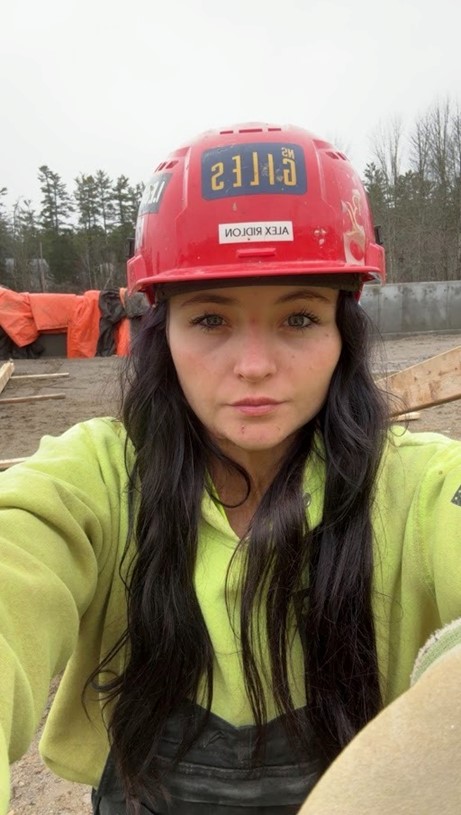
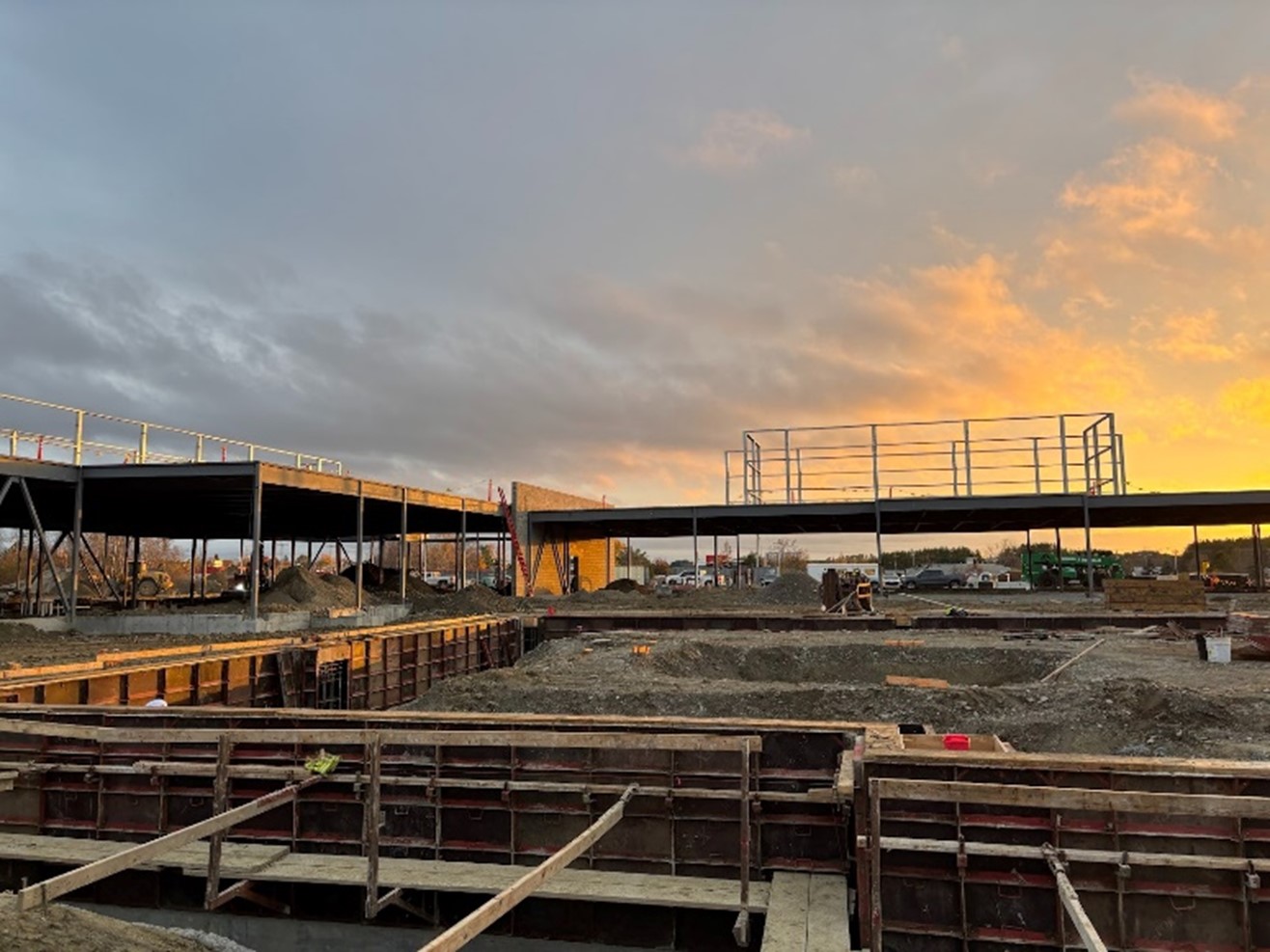
Alex Ridlon, Brewer High School
Back in 2020, when I was 12 years old, I was burned in a fire, and I lost my father; both are experiences that profoundly changed my perspective on life. Facing such a significant loss at a young age and the deforming of my skin forced me to mature quickly and shaped the direction I chose for my future.
From an early age, I enjoyed working outdoors and being active. As I entered Brewer High School, however, I often felt out of place.
My family was going through financial hardships, and I experienced bullying as a result. Rather than allow those challenges to define me, I made the decision to focus on building a future for myself. I chose to pursue a career in construction, both because I enjoy working outside and because it offered me a practical path toward independence and growth.
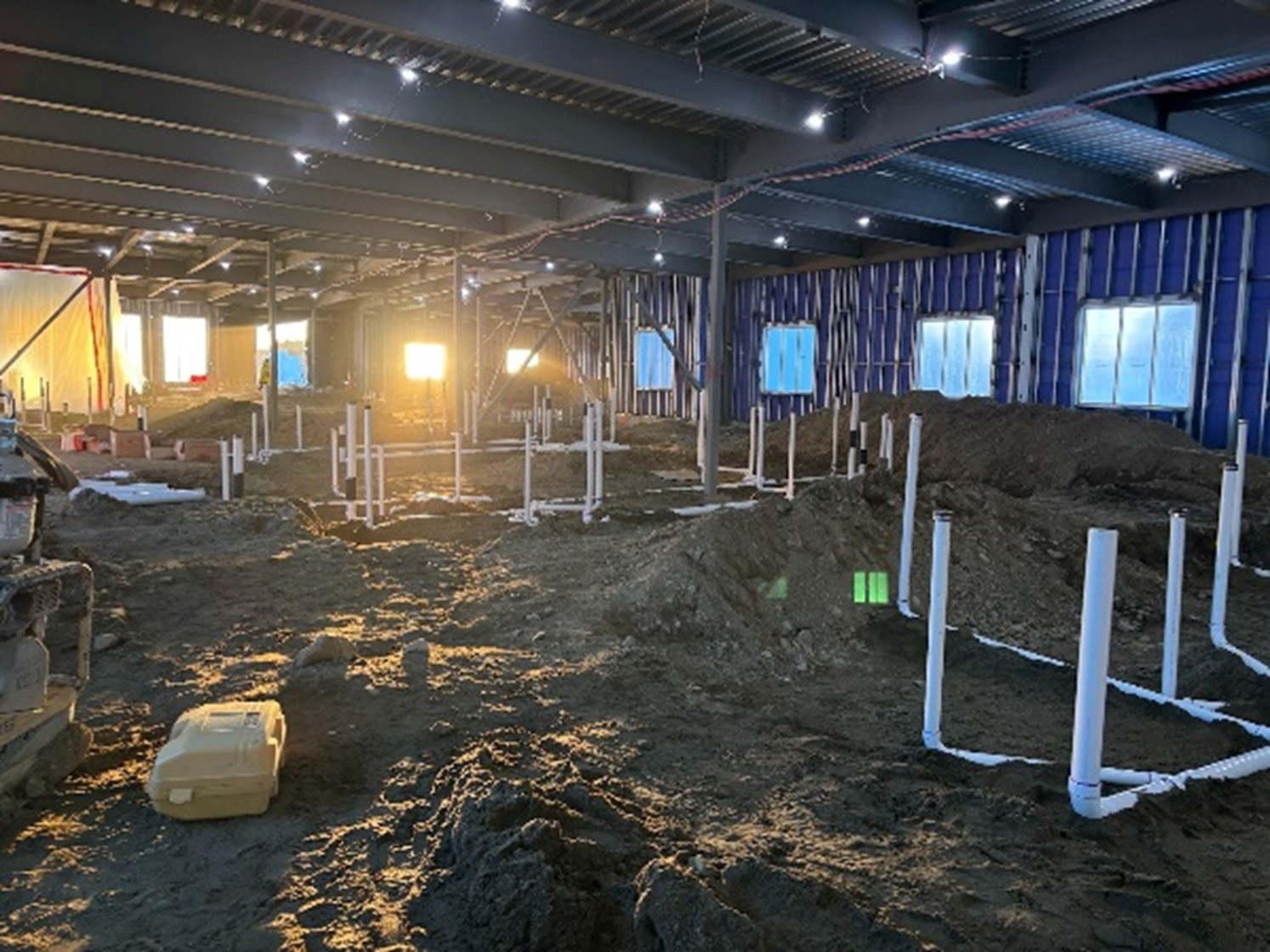
So far, I have primarily worked on medical facilities. It is especially meaningful to me to know that the buildings I help to construct will one day serve people in need. Contributing to projects that positively impact others gives my work a deeper purpose.
During that difficult time in high school, I sought guidance from one of the smartest, most helpful, easy-to-talk-to people, Mr. Kevin Napolillo, my ELO coordinator, who became an important source of support. He encouraged me to invest time in preparing for the real world. Over the course of four weeks during the summer, I dedicated myself to daily reading, learning, and hands-on preparation. That experience opened my eyes to what I was capable of achieving and helped me develop both confidence and direction.
I decided to begin working with concrete as a way to enter the field and start building toward my long-term goal of becoming a heavy-equipment operator. Throughout my journey, I have learned the importance of resilience and focus. I have found that the more determined you are to succeed, the more important it becomes to stay committed to your goals and not be discouraged by negativity.
As a young woman entering the construction industry at 17 and now 18 years old, I have gained valuable experience and perspective. I graduated earlier than the rest of my class—an accomplishment that strengthened my confidence and reaffirmed my determination. Working alongside experienced professionals has shown me the clear difference between classroom learning and real-world application. In many ways, I have learned more through hands-on experience in construction than I did in a traditional classroom setting. My journey has been shaped by hardship, perseverance, and a strong desire to build not only structures but also a meaningful and independent life for myself.
Isabella (Izzy) Moore, Brewer High School/Maine Construction Academy
During my junior year of high school, I knew it was nearly time to choose my career path post-graduation. I didn’t know what path I wanted to take, but I did know that I needed some hands-on work. I heard about the Maine Construction Academy, so I decided to check it out. I signed up and got approved for it but was still unsure; as it turns out, it was the best decision I ever made for myself, and I have no regrets.
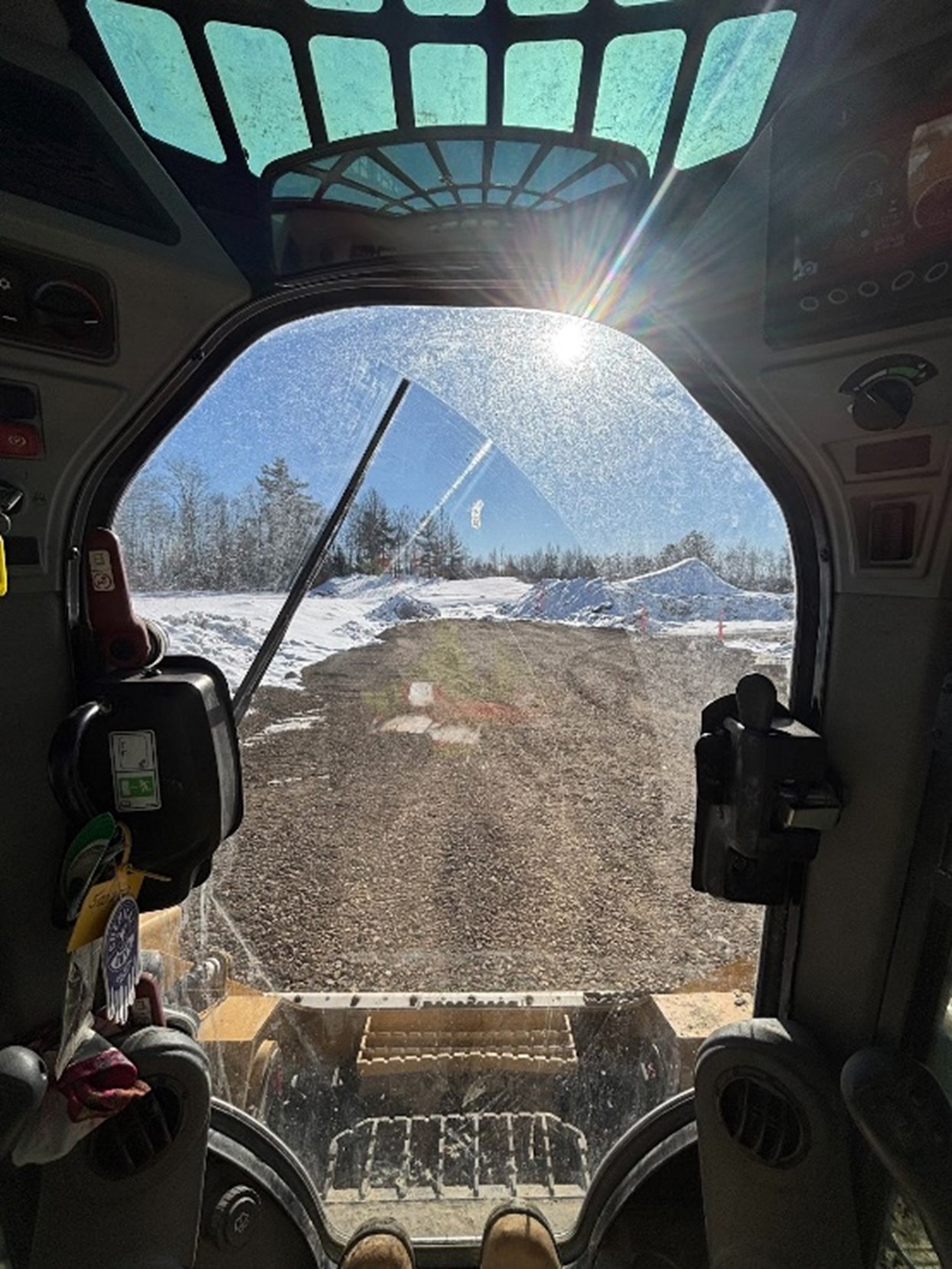
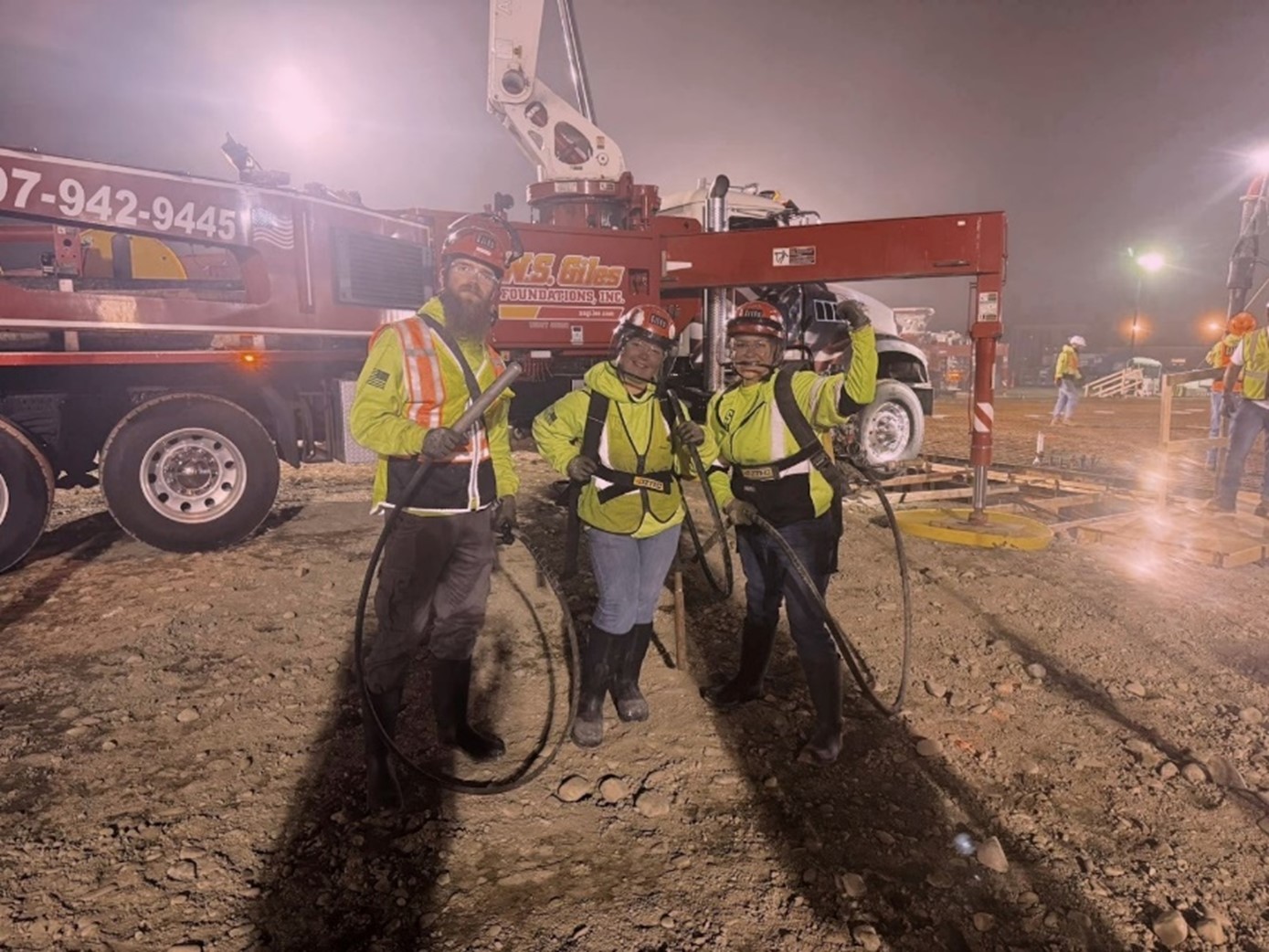
This program gave me the opportunity to do an apprenticeship during my senior year of high school through N.S. Giles Foundations, which transferred to Sargent, [my current place of employment], after graduation. It was here that I learned how to use heavy equipment. Both companies have welcomed me with open arms and given me amazing mentors and opportunities.
Without all of this, I would not be the woman I am today. I feel as though construction gave me more structure and discipline, along with a lot of confidence. I have been able to not only become more independent mentally but financially, as well. At just 19 years old, I have my own apartment, bought my first “big girl” car on my own, and have taken a few vacations. Now, that’s just the fun stuff—but you get what I’m saying. If it weren’t for this program, I wouldn’t be where I am today, nor would I have the life I have built for myself so far.
What started out as “I’m just going to test the waters and see what happens” turned into such a growing passion for this field. I can’t see myself doing anything else, and I look forward to doing this for the rest of my career. I am extremely grateful to all the people who have taken a chance on me during this path, along with all of the opportunities that have been given to me.
Lily Kick, Sacopee Valley High School
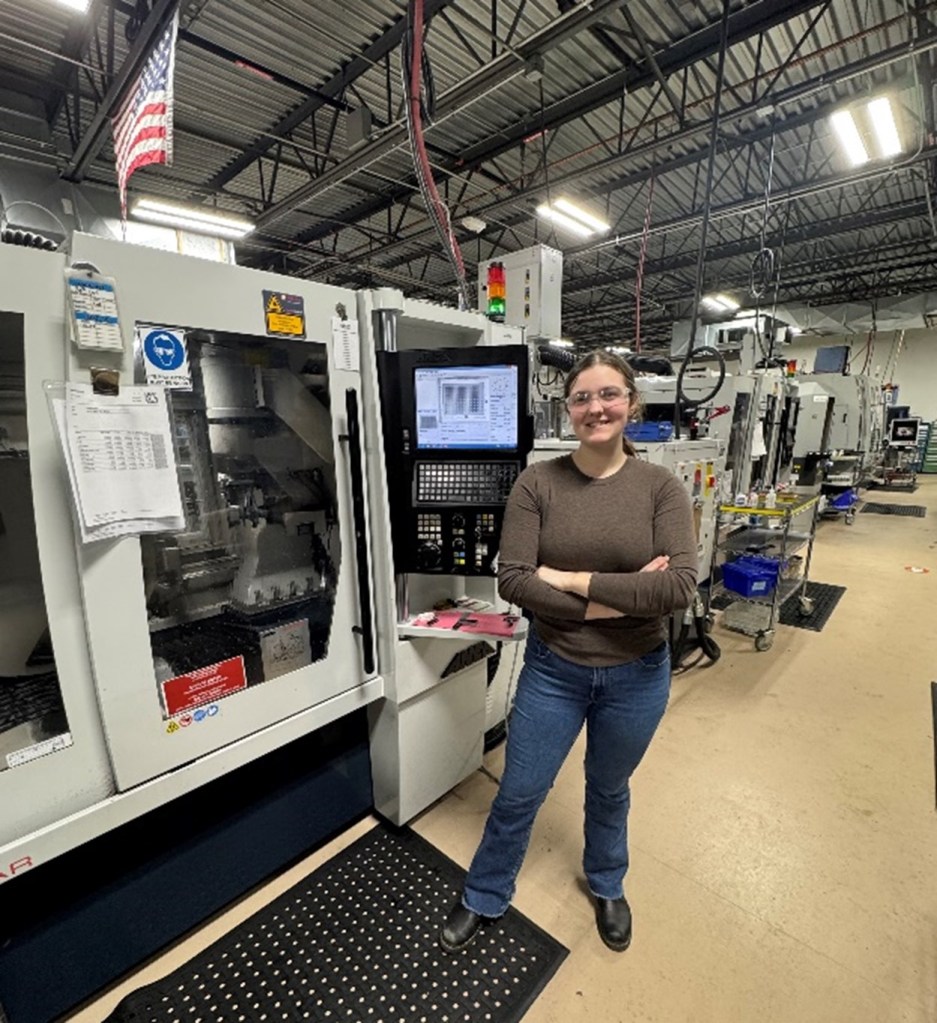
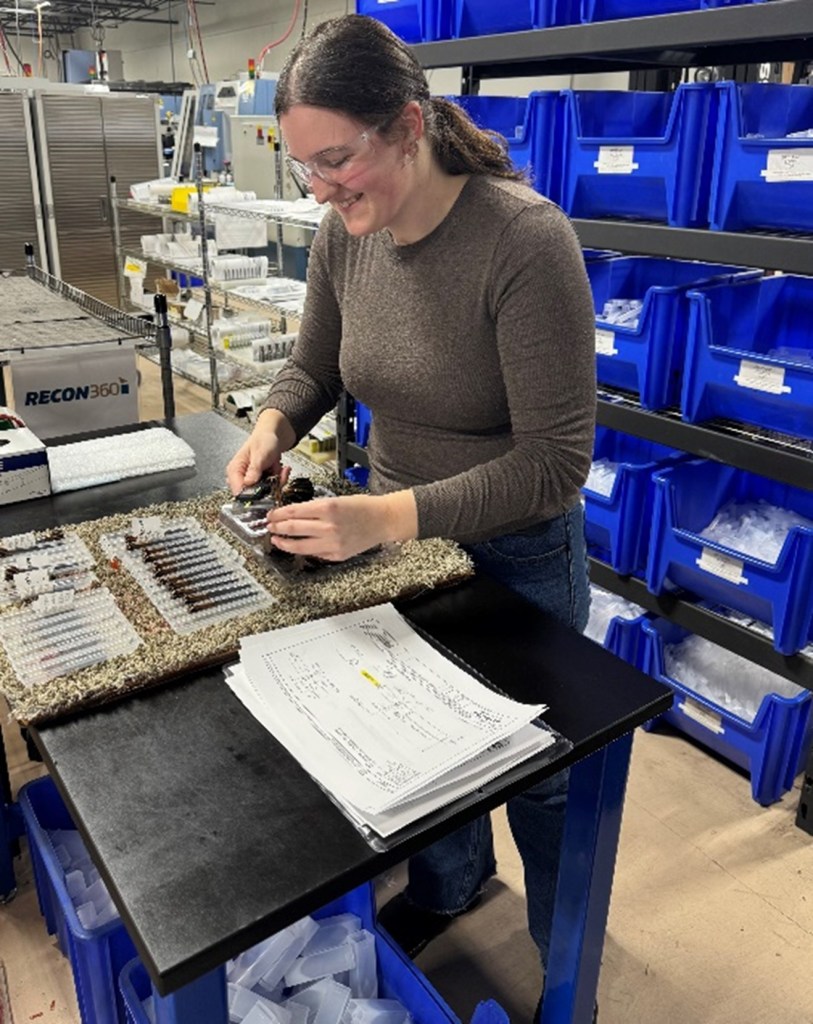
Lily Kick is a senior at Sacopee Valley High School who plans to pursue a career in the manufacturing industry.
“Manufacturing is a field full of innovation, and that is what I want to invest my future in,” Kick said. “Career surveys often pushed me toward architecture or actuary. Through some research and a few job shadows, I learned that these were not career pathways for me.”
As a junior, Kick interned at New England Castings in Standish, a local manufacturer of precision alloy castings using the lost-wax casting method. This year, she is participating in an internship at ARCH Cutting Tools in Cornish, a company that manufactures metal removal cutting tools for a variety of industries.
“My two internships have solidified my decision to obtain a mechanical engineering degree and hopefully contribute to the innovation in the manufacturing industry,” Kick said.
Kick explained that she does not think she would enjoy a predictable office job. Instead, she prefers the field’s constant new tasks and issues that require immediate attention, as well as its adaptability and unpredictability.
Kick credits the support of her ELO teacher, Dr. Elizabeth Sanborn, whom she says, “undoubtedly made the most impactful difference in my future pursuing engineering and manufacturing.”
Kick noted she also feels her ELO experiences have helped to strengthen her personally as a young woman.
“It is notorious that trades are a male-dominated field; however, my success has taught me there is always room for change,” Kick said.
Maranacook Adult Education
One of the programs offered at Maranacook Adult Education is aimed at addressing a critical need in the workforce: truck driving.
“Both nationally and here in Maine, we are facing a critical shortage of truck drivers. There simply are not enough qualified drivers to meet the needs of the industry,” Steve Vose, Director of Maranacook Adult Education, said.
Vose said part of the solution entails getting more women involved by demonstrating that truck driving is a safe, viable career path with good pay—typically above minimum wage. He said he was pleased when the Maine Department of Labor and Maine Department of Transportation announced a $96,000 Women in Trucking grant for Maranacook Adult Education to help more women afford to get their Commercial Driver’s License (CDL).
“I am extremely encouraged to see state governments, employers, and nonprofit organizations recognizing this challenge and beginning to provide truck-driving schools with the financial support and resources necessary to help address these staffing shortages,” Vose said. “For far too long, the trucking industry has overlooked a vital resource: women drivers. Women are the future of trucking and deserve to be recognized and valued as such.”
Vanessa Mercado recently received her CDL from Maranacook Adult Education and is now driving for Dead River Company—an experience that she has called “life changing.” Mercado said the Maranacook Adult Education program helped her to gain confidence in her skills, allowing her to now do this job that she finds meaningful.
“I know that I’m providing to the community as a delivery driver,” Mercado said. “I’m able to do something that gives back.”
Nancy Frost, one of two female truck-driving instructors at Maranacook Adult Education, said that she is pleased to see more female representation in the truck-driving industry.
“I think it’s a lot easier for women now,” Frost said. “I think that this grant is going to be wonderful.”
Vose shared that all Women in Truck Driving scholarships are spoken for in the July program, but Maranacook Adult Education is currently accepting scholarship applications for November. Those interested should please contact Vose at 207-242-8795.
Please visit the Maine DOE website to learn more about ELOs, adult education, and CTE across the state.
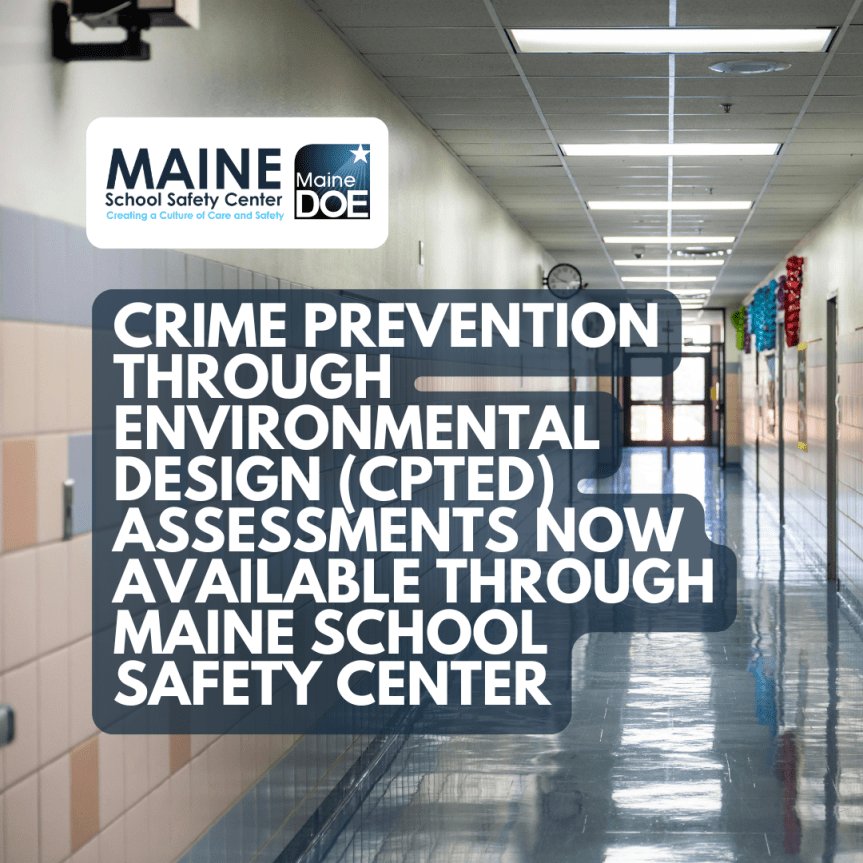
The Maine Department of Education (DOE) is pleased to announce a safety resource now available to schools through the Maine School Safety Center (MSSC). Chief Jack D. Peck, Jr. (Retired), MSSC School Emergency Management Coordinator, has earned professional certification in Crime Prevention Through Environmental Design (CPTED) and is offering free, on-site CPTED assessments to Maine schools.
CPTED is a proactive approach to school safety that focuses on how thoughtful design and effective use of indoor and outdoor spaces can help reduce risk, support positive behavior, and create safer and more welcoming learning environments. By evaluating building layout, visibility, lighting, access points, and the overall flow of spaces, CPTED assessments help identify practical strategies schools can use to strengthen safety and security.
This resource provides school administrators, educators, and facilities teams with actionable recommendations tailored to each school’s unique environment. The goal is to support safer schools through practical, cost-effective improvements that can be implemented over time.
School administrators and district leaders interested in scheduling a free on-site CPTED assessment or learning more about this resource are encouraged to contact Jack Peck at Jack.Peck@maine.gov or 207-458-5438.
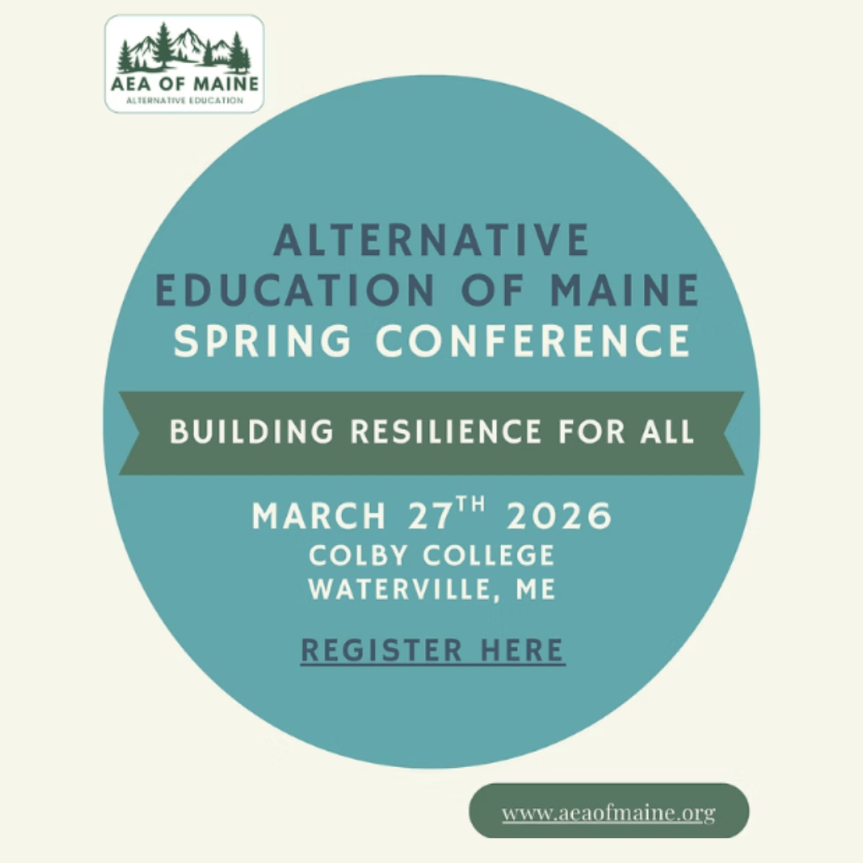
The Alternative Education Association (AEA) of Maine has announced that its spring conference will be held on Friday, March 27, 2026, at Colby College in Waterville from 8 a.m. to 3 p.m., with the theme “Building Resilience for All.”
This event represents an opportunity to learn, share, and connect with fellow educators committed to student success through alternative pathways. The 2026 Spring AEA Conference will have presentations including, but not limited to:
Artificial Intelligence (AI) and Alternative Education
Resonance Language (Empathy for Everyone)
Restorative Practices
From Awareness to Action: Strengthening Trauma-Informed Practice in Your Classroom
Substance Abuse (Peer Support) from SEED (Students Empowered to End Dependence)
Sustaining the Helpers: Practical Tools for Burnout and Compassion Fatigue
Beyond the High School Model: Redefining Middle School Alternative Education
In anticipation of this event, the AEA Conference committee shared: “We are beyond excited to host our Spring AEA conference! This is a special time for alternative educators and school staff to come together, build meaningful connections, and learn from one another’s experiences. Our goal is for you to leave feeling rejuvenated, inspired, and equipped to finish the school year strong. We have incredible presenters and a dedicated focus on supporting your wellness. We can’t wait to learn, grow, and recharge together!”
2026 Spring AEA Conference Information
Cost: $75 per person (which includes a provided lunch). Please note: If more than two members from your school administrative unit (SAU) attend the conference, the cost is reduced to $50 per person. Additionally, if you attended the 2025 Fall AEA Conference and submitted payment for both the Fall 2025 and Spring 2026 conferences, please contact an AEA Conference committee member (listed below) to verify your payment.
Date/Time: Friday, March 27, 2026, from 8 a.m. to 3 p.m.
Location: Colby College Diamond Building (4000 Mayflower Hill Drive, Waterville, ME, 04901). Parking is in the Lunder House parking lot. This is a campus map.
Continuing Education Units (CEUs): AEA will provide CEUs for those attending with full-day participation.
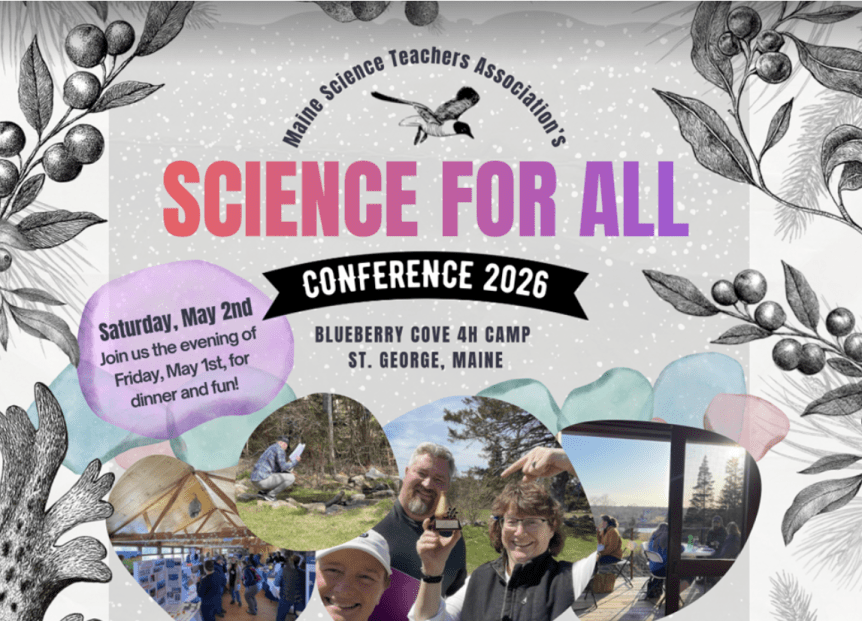
The Maine Science Teachers Association will host its biannual conference, “Science for All,” the weekend of May 1 and 2, 2026, bringing together science educators from across the state for collaboration, professional learning, and inspiration.
The conference will kick off Friday evening, May 1, 2026, at 5 p.m. at Blueberry Cove 4H Camp and Learning Centers in St. George with dinner, networking, and activities. The full-day program on Saturday, May 2, 2026, from 8 a.m.-4 p.m. includes an array of interactive breakout sessions catered to Maine educators.
With more than 25 sessions scheduled, the conference offers a diverse range of topics designed to support high-quality, inclusive science instruction for all students. Featured sessions include:
3D Printed Smart Greenhouses with Lynn Hanna, science teacher at Conners Emerson School.
Integrating Machine Learning with the Study of Puffins in Maine with Dr. Jacob Sagrans and Dr. Jan Mokros of Tumblehome, Inc., alongside Presidential Awards for Excellence in Mathematics and Science Teaching (PAEMST) awardees Diana Allen and Tonya Prentice.
Weaving in Climate and Data through Connected Learning Ecosystems with Robin Lea, learning specialist with the Gulf of Maine Research Institute, and Alexandra Ryan, science teacher at Boothbay Regiol High School.
Sessions will highlight innovative classroom strategies, emerging technologies, environmental research, and interdisciplinary approaches that engage students in meaningful scientific inquiry.
Participants can earn eight contact hours for attending the conference. Educators are encouraged to register by March 15, 2026, to take advantage of early-bird rates available for both individuals and districts.
The Maine Department of Education (DOE) is sharing resources and guidance to support school administrative units (SAUs) that are interested in establishing a school-based condom availability program.
In lieu of legislation, the Committee requested that the Maine DOE inform SAUs of their authority to adopt a protocol that allows for free condom access and distribution in schools.
To support schools in this work, Maine Family Planning, a Maine-based nonprofit organization specializing in reproductive health care and education, has developed a resource to assist with planning and implementation: Maine Family Planning – Condom Availability Tip Sheet (PDF).
The Maine Department of Education (DOE) is now accepting applications from individuals interested in learning more about the competitive grant process. Selected applicants will be trained to serve as peer reviewers who assist the Maine DOE in reviewing, assessing, and scoring competitive grant proposals for the 21st Century Community Learning Centers (CCLC) program.
The 21st CCLC program is a federally funded education program that helps schools and communities develop before-school, after-school, and summer educational programs that support students and their families. This year’s Request for Proposals (RFP) for the 21st CCLC program was released to the public on January 6, 2026, and is available online. The Maine DOE anticipates receiving proposals from local education agencies/school administrative units (SAUs), community-based organizations, and other eligible entities seeking awards under this RFP.
Peer Reviewer Qualifications:
Peer reviewer applicants will be selected based on their experience in providing effective academic support, enrichment, youth development, and related support services for children and youth. The most qualified applicants will be individuals with experience in the administration of high-quality youth development programs within schools and communities. Examples of the experienced individuals sought include, but are not limited to:
21st CCLC program directors and site coordinators
Teachers and principals
College and university staff
Youth development workers
Community resource providers
Required Tasks:
Selected applicants must be able to participate in online training and review grant proposals through a web-based system. Applicants will work individually to read each assigned proposal and create detailed, objective, constructive, and well-written comments on approximately 10 proposals based on the criteria established in the RFP. These comments will be submitted to the Maine DOE prior to participating in the scheduled consensus scoring sessions. It is anticipated that peer reviewers will have a three week window to complete their individual review of assigned proposals.
Following the individual review of proposals, each successful applicant will be required to participate in a series of two online/virtual consensus scoring sessions hosted by the Maine DOE. It is during these consensus scoring sessions that the peer review team will score each grant proposal.
Selected applicants must complete the following tasks during the following dates:
Task
Dates
Times
Participate in an online training webinar
April 2, 2026
1-2:30 p.m.
Review grant applications through a web-based system and provide individual, written comments on each application (to be submitted to the Maine DOE)
April 10, 2026 – April 30, 2026
any time
Participate in online/virtual consensus scoring sessions with other members of the peer review team (Applicants MUST be available on all four scoring days but will only be selected to participate for two days.)
May 4, 2026 – May 5, 2026; or May 7, 2026 – May 8, 2026
9 a.m.-4 p.m.
Compensation for Services:
Selected applicants who complete the required tasks will be provided an honorarium of $100 per assigned proposal. Previous participants have also found that serving as a member of the peer review team is an excellent opportunity for professional development and growth. It is likely that, if selected, applicants will be exposed to new program models, strategies, and practices. These new concepts may provide ideas and support for ongoing work as well as future grant writing efforts. Most importantly, the time given to this effort will help ensure the funding of quality education programs for the children and families of Maine.
How to Apply:
Interested applicants must contact Travis Doughty, Maine DOE Title IV State Coordinator, at travis.w.doughty@maine.gov to obtain a copy of the 2026 peer reviewer application. Please return the completed application, along with a current resume or curriculum vitae (CV), by March 17, 2026.
Pursuant to Title IV, Part B of the Elementary and Secondary Education Act, as amended by the Every Student Succeeds Act of 2015, peer reviewers may not include any applicant, or representative of an applicant, who has or will submit a proposal in response to the current RFP grant competition.
Deadline:
The Maine DOE will accept peer reviewer applications through March 17, 2026, or until the needed positions are filled. Interested applicants are encouraged to apply as soon as possible.For more information, please contact Travis Doughty at travis.w.doughty@maine.gov or 207-624-6709.
The work of the Maine School Transportation Safety Commission is officially underway following the first meeting of the Commission on Friday, February 27, 2026.
The Commission was established via Executive Order in January 2026 following the tragic deaths of two Maine students in transportation-related incidents. Ten Commission members, including representatives from the Maine Department of Education (DOE), Maine Department of Public Safety, and Maine Department of the Secretary of State, will review current school transportation protocols in Maine in an effort to identify changes and/or improvements.
Per the Executive Order, the Commission is tasked with:
Reviewing current statutes and regulations related to safety standards, protocols, and school bus driver training and ensuring clear communication of these requirements to all school districts.
Producing an updated set of best practices for school bus safety and disseminating it to all school districts.
Identifying changes or improvements needed in school transportation rules to ensure the safety and well-being of all students, staff, and drivers.
Identifying school bus safety features that can be installed, upgraded, or replaced, including door anti-pinch sensors and control (crossing) arms.
Encouraging and assisting school districts in the effective communication of school bus safety information to students and families.
Confirming that school districts have a process to complete, on a semi-annual basis, school bus safety training checklists.
Identifying training needs for bus drivers and a mechanism for this training to be provided to all school transportation units.
The Maine DOE has established a webpage for the Maine School Transportation Safety Commission where the Commission’s meeting schedule, as well as related materials, will be posted. The Commission is currently scheduled to meet on March 13, 19, and 27, 2026—with options for both in-person (Fallen Heroes Meeting Room, 45 Commerce Drive, Augusta, ME 04330) and via Zoom (links to come) attendance for members of the public.
Members of the public may also submit questions/comments for the Commission’s consideration at transportationsafety.gov@maine.gov or through the form available on the webpage.
A final report by the Commission is due to the Governor and Maine State Legislature by April 30, 2026.



 Maine DOE Newsroom