Back-to-Back Kennebec County Teachers of the Year Highlight the Power of Multilingual Learning Through the Maine Seal of Biliteracy

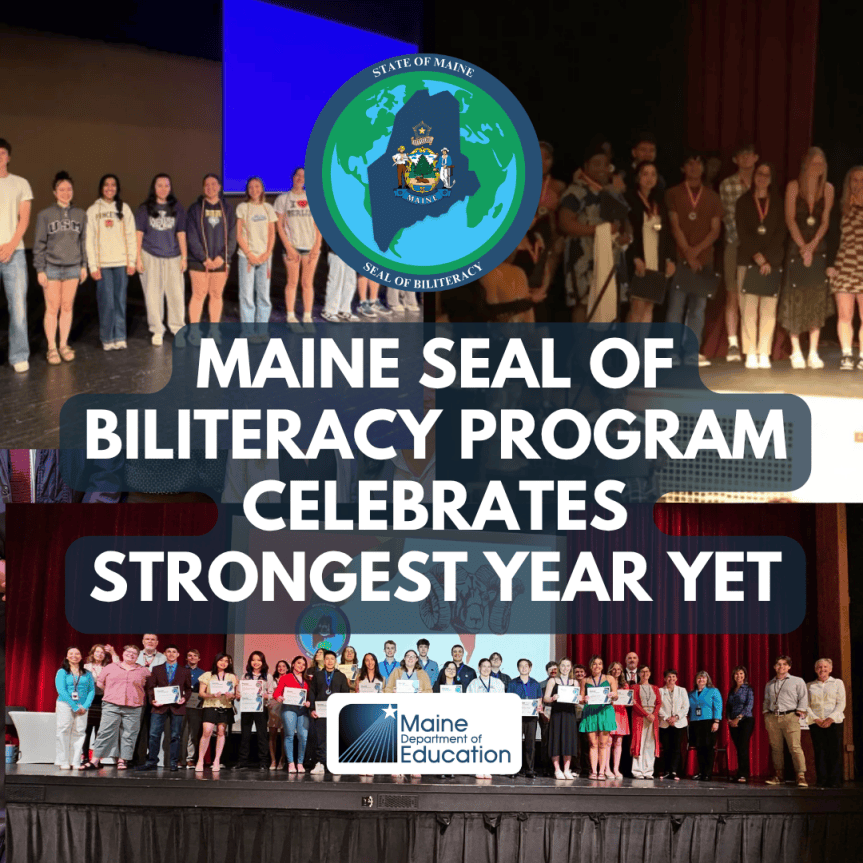
Twelve of the 19 Cony High School students who received the State of Maine Seal of Biliteracy gathered for a group photo at the recognition assembly held May 26, 2026.

Nineteen members of Cony High School’s Class of 2026 were recently recognized for earning the State of Maine Seal of Biliteracy, a distinction that honors students who have demonstrated proficiency in English and at least one additional language.

This year’s recipients earned the Seal in four languages: Spanish (11 students), German (4 students), Arabic (3 students), and French (1 student), reflecting both the diversity of Cony’s student body and the strength of its World Languages program.

The Seal of Biliteracy is a statewide initiative supported by the Maine Department of Education (DOE) that recognizes students who have attained high levels of proficiency in multiple languages. The Seal is added to a student’s transcript and can provide significant advantages in college admissions, opportunities for college credit, career readiness, and participation in global learning experiences.

Since Maine launched the Seal of Biliteracy program in 2018, participation has continued to grow. This year, 52 schools across Maine participated, with 517 students working toward earning the Seal in 33 different languages. Since the 2021-2022 school year, approximately 1,741 Maine students have earned the distinction.

At Cony, the Seal of Biliteracy represents more than language proficiency; it reflects a school culture that values global citizenship, cultural understanding, and meaningful opportunities for students to connect with the wider world. This is especially notable, as Cony’s World Languages department is led by two educators who have recently been recognized as being among the state’s best. Spanish teacher and department head Gretchen Livingston was named the 2026 Kennebec County Teacher of the Year, and German teacher Deborah Backman earned the same honor in 2025.

“Cony Middle and High School is so fortunate to have a World Languages department with two Kennebec County Teachers of the Year—Gretchen Livingston this year and Deb Backman last year,” Cony Principal Kimberly Liscomb said. “The teachers create amazing opportunities for students, like the Maine Seal of Biliteracy and Global Seal of Biliteracy. The Augusta School Department has supported our students and staff with these important endeavors, and with our growing population of multilingual learners, opportunities have expanded to include Arabic.”

Livingston says her passion for language education is rooted in helping students build meaningful, cross-cultural connections.

“I began teaching to share my love of language learning and to help people connect across cultures, opening doors to new perspectives and opportunities,” Livingston said. “I take my role as department head of World Languages at Cony Middle and High School very seriously because I believe that one of our main goals is to foster cultural empathy and awareness. When we open our minds to different cultures, we enrich our daily lives through new ways of thinking and connecting.”

Backman emphasized the transformative impact that international experiences can have on students.

“Living and studying in Germany and Austria gave me a perspective on American culture and history that I couldn’t have gained at home,” Backman said. “Many Americans don’t have the opportunity to look at their country from an outside perspective. In teaching German, I share the insights that I have gained through my experiences abroad, while inspiring students to seek out their own international experiences. These experiences foster a deeper appreciation of other cultures and, in turn, a greater understanding of their own.”

Cony’s World Languages program is successful because of its cohesive team, which, in addition to Livingston and Backman, includes Spanish teacher Rocio Carey and French teacher Sarah Moore, who has also taught Latin in the Augusta School Department. 

Cony’s World Languages program initially introduces all seventh-grade students to language learning through a Unified Arts course that explores French, German, and Spanish. Eighth-grade students may then choose a language to study for high school credit, with students able to continue through advanced levels in high school.

Beyond the classroom, students have access to language clubs, international travel opportunities, cultural exchanges, and service-learning experiences. Cony’s German program, for example, has been part of the prestigious PASCH global network since 2017, making it one of only 14 schools in the United States with that designation. Through the partnership, students can earn full scholarships to participate in German immersion programs in Germany. Cony also offers opportunities to volunteer in Guatemala, travel to France and Italy, and participate in the German American Partnership Program (GAPP) exchange.

These experiences have had a lasting impact on students and graduates.

“Having the Seal of Biliteracy has been really helpful in continuing my language learning journey post high school,” Savier Littlejohn, a 2023 Cony graduate who now studies Political Science and International Affairs at the University of Southern Maine (USM), said. “At USM, I was able to get eight college credits, allowing me to skip directly to advanced courses instead of starting again from scratch. It has also been helpful on numerous applications and study abroad programs, as proficiency in a second language is something well looked upon.”

Similarly, 2021 graduate Kiara Henry said her Seal of Biliteracy translated directly into college savings. She explained that she didn’t have to take a language class in college because her Seal counted for eight college credits. She was able to take other classes instead, which allowed her to save time and money.

For many current Cony students, earning the Seal represents both a culmination of years of hard work and a pathway to future opportunities.

“Getting the Seal of Biliteracy, to me, feels like the one, all-encompassing award of recognition for all the work I’ve put into language learning. It also highlights all of the amazing opportunities offered by our World Languages department,” 2026 Cony graduate JohnPeter Caruso said. “Our German program provided me with an opportunity to spend a summer in Germany, speaking German with people from all over the world. Not only was this an amazing experience, but it helped me feel confident about enjoying all opportunities, even if they initially seemed intimidating.”

In addition to the World Languages department, Cony provides a comprehensive ESOL (English for Speakers of Other Languages) program for students. The Seal of Biliteracy program, coordinated by Livingston, gives ESOL students the opportunity to earn the Seal in their native language, recognizing the diverse linguistic skills they bring to the school. 

Bayan Salamhi and Sham Alsaleh graduated from Cony this year and received the Seal of Biliteracy in Arabic and English.

“For me, receiving the Seal of Biliteracy is more than just an award,” Salamhi said. “It represents an important part of who I am and the journey I have taken to grow academically and personally. Knowing more than one language has allowed me to appreciate different cultures, communicate with more people, and feel proud of an ability that will stay valuable throughout my entire life.” 

“Receiving the Seal of Biliteracy means a lot to me because it represents the hard work, dedication, and perseverance it took to become confident in two languages,” Alsaleh said. “As someone who learned English while maintaining my native language, this recognition reminds me that being bilingual is a strength that allows me to connect with different people, cultures, and opportunities. I am honored to receive this recognition and proud to celebrate the value of multilingualism.”

Classmate Allyson Dumont said she now sees multilingualism as an important part of her future career.

“Having my Seal of Biliteracy is important to me as someone pursuing a career in health care,” Dumont said. “I’m glad I had this opportunity in high school because it means being able to communicate with a larger group of people.”

Students noted that the impact of language learning also extends past academics and career preparation.

“Being a multilingual student goes beyond speech and into my jazz improvisation, so I find a home in learning languages while at the same time expressing myself through music,” 2026 Cony graduate Arlo Shargo said.

Batool AlBraihi, who earned the Seal after studying Spanish at Cony for five years, praised the educators who helped make the achievement possible.

“Having studied Spanish at Cony for the past five years, I have experienced firsthand the commitment and encouragement our language teachers provide,” she said. “Their recognition as County Teachers of the Year reflects not only their excellence as educators but also the strong and supportive language program they have built.”

For 2025 Cony graduate Luca Hardy, language learning became life changing.

“Learning Spanish has been one of the greatest opportunities of my life,” Hardy said. “What started as a single Spanish class at Cony ended up changing the trajectory of my future. Spanish has opened doors to new opportunities, experiences, cultures, and people I never would have met otherwise. It is one of the main reasons I am now at Princeton University.”

As Maine schools continue expanding multilingual learning opportunities, Cony’s Seal of Biliteracy recipients demonstrate how language education can help students develop academic skills, cultural competence, and global perspectives that prepare them for success far beyond graduation.

Additional information about the Maine Seal of Biliteracy, including statewide participation data and resources, is available on the Maine Seal of Biliteracy Dashboard. For more information, resources, and tools to help students earn a Seal of Biliteracy, visit the Maine DOE website.

This article was written in collaboration with Cony Middle and High School (Augusta School Department). To submit a good news story to the Maine DOE, please fill out the good news submission form.

Back-to-School Grants Available for School Employees Through LifeChanger of the Year

LifeChanger of the Year, an annual national recognition program for educators and school employees, is excited to announce a back-to-school grant opportunity for teachers as they prepare for the 2026-2027 school year.

This summer, LifeChanger of the Year will be awarding 10 Back-to-School Supply Grants of $750 to K-12 public, private, and charter school employees nationwide. These grants are designed to help cover the out-of-pocket costs educators often face for school supplies.

Applications are open from July 1 through August 15, 2026. All strong applicants will automatically be considered for the 2026-2027 LifeChanger of the Year program, with a chance to win up to $20,000 to share with their school.

Please fill out this form to apply for this grant opportunity.

LifeChanger of the Year is sponsored by the National Life Group and the National Life Group Foundation. Since its inception in 2006, the goal of the National Life Group Foundation has been to do good in the communities in which we live and work by supporting nonprofit and educational organizations.

For questions about this grant opportunity, please contact the National Life Group.

RSU 14’s Katahdin Program Supports Student Success Through Experiential and Relationship-Based Learning

Katahdin Program students boil sap they collected.

Located within Windham High School, RSU 14’s Katahdin Program provides students from Windham and Raymond with an alternative learning environment centered on hands-on instruction, outdoor learning, community partnerships, and strong relationships with staff. Through individualized support and experiential learning opportunities, the program helps students reconnect with school, complete graduation requirements, and build pathways toward future success.

“Alternative education deserves recognition,” Katahdin Program Director Rich Meserve said. “Education has to be different for some students. Relationships, trust, and flexibility are often what help students reconnect.”

Meserve started working in alternative education unexpectedly after a career in the business world. While living in Massachusetts, he began tutoring students who were struggling in traditional school settings and quickly found himself drawn to the work. He accepted a position in an alternative education program and later returned to school to pursue teaching professionally.

Originally from Maine, Meserve moved back to the state in 2004 to work at the REAL School before helping to launch the Katahdin Program in 2016. Many of the staff members who helped build the REAL School program transitioned to the Katahdin Program, bringing more than 120 years of combined experience in alternative and experiential education.

“That consistency matters,” Meserve said. “Students and families get to know the people here, and those relationships build over time.”

A School Within a School

The Katahdin Program operates as a “school within a school” at Windham High School, with its own entrance and dedicated learning spaces designed to create a smaller, more personalized environment. Approximately 23 students in grades 9-12 attend the program each year.

Many students come to the Katahdin Program after experiencing challenges in traditional school settings, including lack of attendance, anxiety, academic disengagement, or struggles finding a sense of belonging in larger school environments. The Katahdin Program is intentionally structured to provide individualized support while helping students rebuild confidence and connection to school.

Katahdin Program students attend a five-hour school day from 8:40 a.m. to 1:40 p.m. and are transported by district vans, with transportation staff viewed as an important part of the overall support system. They are often the first and last people students interact with each day. The daily structure emphasizes consistency, communication, and community. Students and staff eat lunch together each day, using that time to strengthen relationships and practice communication and social skills.

“We really focus on the soft skills and relationship-building,” Meserve said. “The more we get to know our students, their situations, and their needs, the more successful they become.”

Katahdin Program students stack wood for a local senior citizen.

Academics Connected to Real-World Learning

Students complete graduation requirements and earn credits aligned with district and state standards while participating in interdisciplinary and experiential learning opportunities. Academic instruction emphasizes STEM (science, technology, engineering, and mathematics) and humanities while integrating outdoor education, practical skills, and community engagement.

Students often work in multi-grade classrooms with individualized supports tailored to their learning goals and academic needs.

“We try to make experiences part of the academics,” Meserve explained. “Whether it’s going to the Museum of Fine Arts in Boston as part of a humanities unit on Ancient Egypt or interviewing veterans for the Library of Congress, those experiences are directly tied to learning.”

Project-based and community-based learning opportunities are embedded throughout the program. Students regularly participate in service projects across the region, including volunteering with local schools and food pantries, supporting older community members by stacking wood and delivering sand buckets in the winter, and partnering with organizations on environmental and outdoor stewardship projects.

The program also emphasizes practical and career-connected learning. Students have built picnic tables, birdhouses, trail infrastructure, and outdoor structures while developing teamwork, communication, and problem-solving skills.

Staff expertise helps expand these opportunities. Team members bring experience and certifications in wilderness first response, outdoor leadership, climbing, paddling, skiing, backpacking, and adventure-based counseling. Students participate in activities ranging from indoor and ice climbing to trail maintenance and outdoor leadership experiences.

“In the grand scheme of things, those experiences are just as important as what happens in the classroom,” Meserve said. “We want students learning through experiences as much as possible.”

A Katahdin Program student wins first place in a blueberry pie competition at the Fryeburg Fair.

Prioritizing Social-Emotional Support

The Katahdin Program places a strong emphasis on social-emotional support and restorative practices. The staffing team includes regular and special education teachers, counselors, educational support staff, a social work intern, and an administrator who work collaboratively to support students as whole individuals.

Counselors are embedded within the program and available throughout the day to support students with challenges both inside and outside of school. Staff maintain regular communication with families and work to build trust and partnership with caregivers.

“Many students and families come to us after difficult experiences in school,” Meserve said. “We work hard to build trust and create a true partnership with families.”

The program uses restorative practices as its primary approach to conflict resolution and accountability. Rather than focusing primarily on punishment, staff work with students to repair harm, reflect on situations, and rebuild relationships when challenges arise.

“Growth is a big piece of what we do here,” Meserve said. “Restoring harm and helping students move forward is important.”

Community Partnerships Strengthen Opportunities

Community partnerships have played a major role in expanding opportunities for students while helping reduce barriers to participation. Meserve credits years of relationship-building, grant writing, and community support for helping sustain many of the program’s experiential learning opportunities.

Students participate in partnerships and projects with local organizations, outdoor programs, food pantries, and community groups throughout the region. The program also relies on community donations, fundraising, and partnerships to expand access to outdoor equipment and learning experiences.

“We’ve been fortunate to have incredible support from our district, school board, and community,” Meserve said. “That support allows us to provide opportunities students may not otherwise have.”

Katahdin Program students build a bow shed for use as an outdoor classroom.

Supporting Student Success Beyond Graduation

Meserve said attendance, engagement, and confidence often improve significantly after students join the program, with most graduates moving on to employment, college, military service, or other postsecondary pathways.

This year, the program will celebrate seven graduates, all of whom are currently employed, with several also pursuing college opportunities.

For Meserve, the success of the Katahdin Program reflects a broader commitment within RSU 14 to support students through flexible and innovative approaches to learning.

“I’m continually amazed by the foresight and commitment of district leadership and the school board,” Meserve said. “This program exists because people believe all students deserve opportunities to succeed.”

As schools across Maine continue to explore ways to support students with diverse strengths and needs, programs like the Katahdin Program demonstrate the important role alternative education can play in helping students build confidence, develop meaningful connections, and experience success in school and beyond.

This story was written in collaboration with Windham High School (RSU 14) as part of an ongoing series to highlight alternative education programs across Maine. For more information about alternative education, please visit the Maine DOE Alternative Education webpage. To submit a good news story to the Maine DOE, please fill out the good news submission form.

SUN Meals Site Finder is Now Live: Find Free Meals for Youth at Locations Across Maine This Summer

In the summer months, children lose access to the school meal services they may rely on during the academic year. The U.S. Department of Agriculture’s (USDA) SUN Meals program provides children ages 18 and younger with access to healthy, nutritious food at neighborhood locations across the United States (including in Maine) throughout the summer months when school meals and snacks are unavailable.

Many schools in Maine that offer SUN Meals have already communicated the details within their school communities. Additionally, the USDA Summer Meals Site Finder, an online tool available to the public, provides a listing of all SUN Meals locations in Maine. These sites include schools, nonprofit organizations, and government agencies. Some providers in approved rural locations may also offer free meals for pick-up or delivery through the SUN Meals To-Go program. (This information is noted on the Site Finder as “Eat On-Site” vs. “Meals To-Go.”)

Access the USDA Summer Meals Site Finder here. Use the search feature to enter an address and find the closest location.

For more information about SUN Meals, please visit the USDA’s Summer Food Service Program webpage. With further questions, contact Maine Department of Education (DOE) Child Nutrition Supervisor Adriane Ackroyd at adriane.ackroyd@maine.gov or call 207-620-6017.

In accordance with federal civil rights law and U.S. Department of Agriculture (USDA) civil rights regulations and policies, this institution is prohibited from discriminating on the basis of race, color, national origin, sex (including gender identity and sexual orientation), disability, age, or reprisal or retaliation for prior civil rights activity.

Program information may be made available in languages other than English.  Persons with disabilities who require alternative means of communication to obtain program information (e.g., Braille, large print, audiotape, American Sign Language), should contact the responsible State or local Agency that administers the program or USDA’s TARGET Center at (202) 720-2600 (voice and TTY) or contact USDA through the Federal Relay Service at (800) 877-8339.

To file a program discrimination complaint, a Complainant should complete a Form AD-3027, USDA Program Discrimination Complaint Form which can be obtained online at: https://www.usda.gov/sites/default/files/documents/USDA-OASCR%20P-Complaint-Form-0508-0002-508-11-28-17Fax2Mail.pdf, from any USDA office, by calling (866) 632-9992, or by writing a letter addressed to USDA. The letter must contain the complainant’s name, address, telephone number, and a written description of the alleged discriminatory action in sufficient detail to inform the Assistant Secretary for Civil Rights (ASCR) about the nature and date of an alleged civil rights violation. The completed AD-3027 form or letter must be submitted to USDA by:

(1)       mail:

            U.S. Department of Agriculture
            Office of the Assistant Secretary for Civil Rights
            1400 Independence Avenue, SW
            Washington, D.C. 20250-9410; or

(2)       fax:

            (833) 256-1665 or (202) 690-7442; or

(3)       email:
            program.intake@usda.gov

This institution is an equal opportunity provider.

The Maine Human Rights Act prohibits discrimination because of race, color, sex, sexual orientation, age, physical or mental disability, genetic information, religion, ancestry or national origin.

Complaints of discrimination must be filed at the office of the Maine Human Rights Commission, 51 State House Station, Augusta, Maine 04333-0051. If you wish to file a discrimination complaint electronically, visit the Human Rights Commission website at https://www.maine.gov/mhrc/file/instructions and complete an intake questionnaire. Maine is an equal opportunity provider and employer.

BARR Spotlight: How Indian Township School is Honoring Culture, Building Relationships, and Driving Student Success

On the Passamaquoddy Indian Township Reservation in Princeton, Indian Township School is embracing a powerful model for student success that honors culture, strengthens relationships, and supports the whole child.

Serving approximately 115 students in pre-K through grade 8, Indian Township School began implementing the BARR (Building Assets, Reducing Risks) model in May 2024. BARR is a research-backed approach focused on strengthening relationships, improving academic outcomes, and reducing high-risk student behaviors. The Maine Department of Education (DOE) began funding BARR implementation in 2023, investing $18 million in federal funds to support schools recovering from the impact of the pandemic on academics, student well-being, student engagement, and school climate. Since then, more than 100 Maine schools have implemented, or are in the process of implementing, BARR.

Through a grant from the Maine DOE’s second round of BARR funding, Indian Township School began using the BARR model with grades 4-6 during the 2024-2025 school year. That work has since expanded to include grades 7 and 8, with plans underway to bring elements of BARR into pre-K through grade 3, too.

At the heart of BARR at Indian Township School is a deep alignment between the model’s focus on relationships and the Passamaquoddy community’s cultural values.


“BARR seems to be a natural fit for us and our culture,” Principal Dolly Barnes said. “As a community, we take care of our members. When something is going wrong, we all step in and try to help. The BARR approach is about relationships, and as Passamaquoddy people, that’s who we are. We are in a relationship with our community and our environment.”

Barnes noted that while these values have always been present at Indian Township School, BARR has provided a meaningful framework and structure to bring them into sharper focus.

A cornerstone of the BARR model at Indian Township School is “I-Time” (also known as “U-Time” in grades K-5), a dedicated weekly block of class time when students and staff participate in an activity designed specifically to help them build relationships, develop social-emotional skills, and strengthen their sense of community.

In one classroom session this past school year, students played a charades game focused on identifying emotions. As one student acted out a feeling, others worked together to interpret it. This was followed by a thoughtful discussion about how emotions are expressed—and how they can sometimes be misunderstood.


These activities are designed to help students better understand themselves and their peers, creating a safe and supportive environment for learning.

In educator Michaelene Spencer’s classroom, that sense of care extends even further. Her students help care for three class guinea pigs—Callie, Nalla, and Tillie—learning responsibility, empathy, and compassion through daily interactions.

Students help care for three class guinea pigs—Callie, Nalla, and Tillie—learning responsibility, empathy, and compassion through daily interactions.
Students help care for three class guinea pigs—Callie, Nalla, and Tilli.

Reflecting on Indian Township School’s experience with BARR, Spencer emphasized its role in supporting the whole child.

“I find that many of the basic needs that are often missing for children are addressed,” Spencer said.

In addition to I-Time/U-Time, educators at Indian Township School participate in weekly BARR “Block” meetings, where teachers and administrators come together to discuss each student’s progress, strengths, and needs. These meetings, held in different grade-level pods, allow staff who work most closely with the students in each pod to coordinate support, plan interventions, and celebrate successes. Teachers for grades 7 and 8 are in one pod, and 4th-, 5th-, and 6th-grade teachers are in another pod.

Educators at Indian Township School participate in weekly BARR “Block” meetings, where teachers and administrators come together to discuss each student’s progress, strengths, and needs.

BARR was initially implemented at Indian Township School because of its relationship-building strategies. The school’s administration wanted to help non-native staff better understand the situations and struggles of the native student population.

“A surprise was how those relationships were forged between the staff—and how that has made them a more cohesive team,” Barnes said.

Block meetings also align closely with Indian Township School’s Positive Behavioral Interventions and Supports (PBIS) framework, reinforcing positive behavior and creating consistent expectations across the school.

“What we see every day is students smiling and their needs being met,” Emma Soctomah, PBIS and BARR Coordinator, said. “We see strong relationships, good conversations, and real connection between students and teachers. BARR makes sure we’re focusing not just on academics but on the whole child.”

BARR has created a system within Indian Township School that helps ensure students are ready to learn. The support it provides has contributed to significant academic growth at the school. Since implementing the BARR model, the school has documented improved attendance, fewer behavioral issues, and rising academic achievement—results that stand among the most notable multi-year gains for a tribally controlled school.

Attendance has shown a dramatic turnaround. Drawing on the Maine DOE Chronic Absenteeism Detail Extract, Indian Township School reduced chronic absenteeism to 27 percent in the 2024-2025 school year—down from an estimated peak of 58-68 percent just three years earlier. Nearly three-quarters of students now meet the attendance goal, and the school’s progress has helped drive Maine Indian Education’s systemwide chronic absenteeism rate down to 19.6 percent, an improvement of roughly 37 percentage points from the 2021-2022 peak.

Academic achievement has also climbed:

  • 63.6% of eighth graders are meeting state reading expectations, which means nearly two-thirds of students are prepared for high school success, with the strongest reading performance district-wide.
  • 61.5% of fifth graders are meeting or exceeding reading standards, including one student who is achieving “Above State Expectations.”
  • Half of seventh graders are meeting state reading standards, demonstrating strong academic momentum.
  • Grade 8 science scores improved by 5.48 points over three years (from 28.33 to 33.82), with students performing at or near proficiency rising from 20% to 36% and students in the “Well Below” category dropping from 80% to 36%.
  • Grade 5 science scores improved by 2.16 points, with the school’s first students reaching proficiency level.


“These achievements represent more than test scores; they reflect growing confidence, critical thinking skills, and a school culture where every student knows they can succeed,” Dr. Reza Namin, Superintendent of Maine Indian Education, said.

Principal Barnes credits this success with a shared commitment among Indian Township School staff.

“Our teachers have embraced innovation and worked together to share best practices,” she said. “We’ve implemented research-based strategies like the BARR model while maintaining our commitment to culturally responsive education.”

For Indian Township School, success is measured not only in academic gains but in the strength of its community and the pride its students carry.

“I think focusing on students as whole children is really preparing them for the future,” Soctomah said. “We also make sure to include our culture every day—whether it’s speaking our language or helping students feel proud of who they are and where they come from.”

That sense of pride is especially meaningful for students who now see themselves reflected in Indian Township School leadership.

“We have Native leadership here—our principal, vice principal, coordinators—we are community members,” Barnes said. “Our students can look at us and see that this could be them someday. That creates a strong sense of pride in being Passamaquoddy.”

As Indian Township School continues to grow its BARR implementation, its story stands as a powerful example of what’s possible when schools center relationships, honor culture, and work together to support every student. Through BARR, Indian Township isn’t just improving outcomes; it’s strengthening a community and building a future grounded in connection, care, and opportunity.

This story is part of a series highlighting positive outcomes from Maine schools implementing the Building Assets, Reducing Risks (BARR) model—a research-backed school improvement framework that strengthens relationships, uses real-time student data, and builds intentional systems to support academic achievement, engagement, and student well-being for all learners. BARR aligns with the Maine Department of Education’s (DOE) whole-student approach, which emphasizes that all students should be healthy, safe, engaged, supported, challenged, and prepared.

Through $18 million in federal emergency relief funds, 120 schools across 50 school administrative units in Maine have implemented—or are in the process of implementing—BARR strategies. These efforts have strengthened educator collaboration, reduced student behavioral issues, and improved student attendance and academic outcomes.

To submit a good news story to the Maine DOE, please fill out the good news submission form.

Maine Celebrates First Recipients of the Seal of Climate Literacy

Freeport High School seniors, Class of 2026, receive their 2026 Maine Seals of Climate Literacy.

A new generation of Maine students is demonstrating a commitment to understanding and addressing environmental challenges through the Maine Department of Education’s (DOE) newest diploma endorsement, the Maine Seal of Climate Literacy.

The Seal of Climate Literacy is awarded to students who complete two high school courses focused on climate and environmental literacy concepts and standards, as well as an experiential project that demonstrates and publicly communicates their understanding of environmental literacy, green career exploration, and/or place-based climate action. In its pilot phase in the spring of 2026, the Seal was awarded to 57 students from nine schools across the state, recognizing their knowledge, skills, and dedication to creating a more sustainable future. The program will officially launch statewide in September for the 2026-2027 school year. 

Students working to earn the Seal took a wide range of classes to apply to it, including AP Human Geography, Earth Science, and Early College U.S. History. Students completed projects, allowing them to explore their interests and delve deeper into community-based solutions.

For example, at Mount Desert Island High School, a senior earned the Seal by taking Biology and Honors Environmental Science. She was also the Student Representative of the Bar Harbor Climate Task Force. The mission of her project was to reduce Bar Harbor’s carbon footprint and make the town more sustainable.

Geoffrey Beane (left) and Annabel Curry (right), seniors at Mount Desert Island High School, receive their 2026 Maine Seal of Climate Literacy certificates and medals from their Science Educator Ruth Poland (middle) at an awards ceremony.

“Having the Seal has given me a chance to show my community that I am well educated around environmental topics and that it is super important to me,” the student said.

Another student from Orono High School found the most accurate way to predict basal area, enabling foresters to make accurate tree-harvesting plans. A few students from Bangor High School evaluated the effects of fast fashion, spread awareness of the environmental impact, and encouraged sustainable clothing habits through a research poster.

“The Seal of Climate Literacy allowed students to be honored for participating in something that I hold to be of the most critical importance in education: authentic learning that benefits our community and our planet,” a science educator from Poland Regional High School shared.

Pheober Kibler, senior at Cheverus High School, receives the 2026 Maine Seal of Climate Literacy certificate and medal.            

This summer, the Maine DOE will launch a website to provide resources to guide students and teachers in implementing the Seal and determining classes and project guidelines. Included in these resources will be example projects, the Maine Learning Results that schools use to award the Seal, and a database of community-based organizations and partners for student projects.

If your school administrative unit (SAU) is interested in getting involved with the Maine Seal of Climate Literacy, please complete this form.

With questions about the Maine Seal of Climate Literacy, please contact Maine DOE Climate Education Specialist Teddy Lyman at Theodore.Lyman@maine.gov


Finding Growth Through Flexibility: Inside the Zenith Alternative Education Program

Zenith Alternative Education Program students carve pumpkins.

At Camden Hills Regional High School, part of Five Town Community School District (CSD), an off-site alternative education learning community is redefining what high school can look like for students seeking a more personalized, project-based path.

Located at Rose Hall in Camden, the Zenith Alternative Education Program serves students in grades 10-12 through a model rooted in flexibility, relationships, and experiential learning. While the setting differs from a traditional high school, students at Zenith earn the same diploma and meet the same graduation requirements as their peers at Camden Hills Regional High School.

What differs is the approach.

“Traditional high school experiences can feel like conveyor belts in many ways,” Zenith teacher and coordinator Mae Applegate said. “It’s already mapped out, and it’s your job as a student to stay on it. Alternative education is responsive. It’s flexible. It’s built around the students who are actually in front of you.”

Applegate joined public alternative education during the 2025-2026 school year after years of approaching education through a nontraditional lens.

“One of the first questions in my interview was, ‘What brings you to alternative education?’” Applegate said. “My answer was that I’ve always been alternative. It’s the way I approach education and learning.”

Zenith currently serves approximately 20 students, with enrollment fluctuating throughout the year as students transition in and out of the program. Students attend by choice and complete a multi-step application process that includes shadow days, reflective activities, and interviews with staff and family members.

The intentional admissions process reflects the program’s philosophy: Students are active participants in shaping their own educational experience.

Learning Through Experience

At the Zenith Alternative Education Program, courses are organized into interdisciplinary nine-week units that combine academic standards with hands-on learning and real-world experiences.

A senior in the Zenith Alternative Education Program shows off her latticed apple pie.

In a recent history course exploring the cultural and historical significance of food, students brainstormed topics of interest, voted on areas to study, and helped shape the direction of the class. One particular unit in this class included apple dissections, pie baking for community donations during Thanksgiving, and learning about apple preservation methods.

“We’re always asking how we can connect learning to authentic experiences,” Applegate said. “Students are meeting graduation standards, but they’re doing it through projects and collaboration.”

Cross-curricular learning is also central to the program’s design. During one interdisciplinary unit, students explored the physics of sound in science and math classes, led by Zenith’s science and math teacher John Van Dis, by designing and building their own speakers and instruments. At the same time, students participated in an English songwriting course that blended scientific inquiry with creative expression. At the end of their coursework, students visited the local elementary school to share their instruments and creative processes with younger students while demonstrating the science behind sound and vibration.

Zenith Alternative Education Program students visit Camden Rockport Elementary School.

“The elementary students loved having the high schoolers come in,” Applegate said. “It became a meaningful experience where our students were seen as leaders and mentors.”

Another recent course, “Star Wars: Physics Strikes Back,” expanded upon student interest to explore scientific concepts. As part of this class, students visited the planetarium at the University of Maine, combining academic content with exposure to a college campus and future pathways.

“It was both a science experience and a life experience,” Applegate said. “For some students, it was also an opportunity to imagine themselves in a four-year college environment.”

Building Community Through Leadership

Relationships are a foundational part of the Zenith Alternative Education Program, and students are encouraged to contribute actively to the community around them. Every day starts and ends with a community circle, including gratitude and reflective exercises. On Wednesdays, students participate in a dedicated “Community Day” focused on leadership, collaboration, and culinary programming. Students help plan and prepare meals, manage grocery budgets, lead lunch preparation, and support cleanup responsibilities.

This year, students have also spent time revisiting and redefining the program’s community agreements—the shared values that guide how students and staff interact.

“When I arrived, there were 10 community agreements,” Applegate said. “Some students could explain some of them clearly, and others couldn’t name more than three. We realized we needed to better define who we are as a community.”

Through discussions, writing exercises, debates, and collaborative activities, students distilled the program’s values into a single guiding acronym: GROWTH.

“We knew that if students are coming to Zenith, they’re committing to growth,” Applegate said.

Students are now collaboratively determining what each letter in GROWTH represents through structured discussions and community voting. Two values that quickly emerged were “gratitude” and “welcoming.”

“When students come for shadow days, we want to clearly articulate what being here is all about,” Applegate said. “How do we, as students and staff, live our collective values every day?”

A Different Path, the Same Diploma

Students in the Zenith Alternative Education Program can participate in hybrid schedules, attending classes at Camden Hills Regional High School or programs through the Mid-Coast School of Technology, while remaining enrolled in Zenith.

Some students attend Zenith full-time, while others begin on alternating-day schedules. The flexibility allows staff to individualize supports, while helping students maintain connections to broader school opportunities.

Weekly social work services, close collaboration with counselors, and strong staff relationships also help students navigate challenges both inside and outside the classroom.

“Relationship is really the core pillar of this work,” Applegate said.

The program, funded through Five Town CSD, has existed for more than two decades. Staff members continue working to increase awareness about and understanding of the program among families, faculty, and the broader school community through newsletters, outreach, and presentations.

“There are more than 700 students at the high school, and many stakeholders do not fully understand what happens here,” Applegate said. “We want people to know that what we do here is highly engaged learning. Our students are doing important academic and character work.”

For staff and students alike, Zenith represents more than an alternative education setting. The community is like an extended family, with its own quirks and inside jokes.

“It’s a different way of doing things,” Applegate said. “It’s cool; it’s interesting; and I love it.”

This story was written in collaboration with Camden Hills Regional High School (Five Town CSD) as part of an ongoing series to highlight alternative education programs across Maine. For more information about alternative education, please visit the Maine DOE Alternative Education webpage. To submit a good news story to the Maine DOE, please fill out the good news submission form.

Maine DOE Update – June 26, 2026

From the Maine Department of Education


News & Updates

Three Maine Educators Honored as 2026 Alternative Education Educator of the Year Awardees

The Maine Department of Education (DOE) is pleased to join the Alternative Education Association of Maine (AEA) in celebrating three outstanding educators as the recipients of the 2026 Alternative Education Educator of the Year Award. This annual award honors alternative educators who make a meaningful and lasting impact on students, create innovative learning opportunities, and demonstrate a strong commitment to advocating for students and the field of alternative education. |  More

Maine Middle and High School Students Invited to Join the 2026-2027 NASA TechRise Student Challenge

The national education platform Future Engineers has invited Maine middle and high school students to join the 2026-2027 NASA TechRise Student Challenge. This nationwide contest invites students in grades 6 through 12 to team up with their classmates to design an experiment under the guidance of an educator. |  More


Maine Schools Sharing Success Stories

How Mountain Valley Middle School Built an Alternative Education Program from the Ground Up

At Mountain Valley Middle School, students in the alternative education program begin each day with breakfast before heading to the gym to reset, move, and prepare for learning. They then gather in a morning circle to review schedules, discuss upcoming activities, reflect on current events, and practice strategies for managing stress and conflict. Co-alternative education teachers Shane Smith and Anthony Mazza use these routines to create consistency, strengthen relationships, and set a positive tone for the day. |  More

Submit good news to the Maine Department of Education here.


Professional Learning/Training Opportunities

Schedule for the 2026-2027 Transformational Leaders’ Network Opportunity for Principals

The Transformational Leaders’ Network (TLN) is a practical, relationship-centered professional learning opportunity for principals to enhance their leadership practice and strengthen outcomes for schools and communities. The TLN occurs through a series of in-person and remote/regional meetings offered across the state during the school year. All principals, from the novice to the veteran, from large suburban schools to small rural schools, are invited to participate. |  More

Leading Early Learning Fellowship: A Professional Learning Series for Elementary School Administrators

As more Maine elementary schools expand their preschool offerings and implement whole-student approaches across the pre-K through grade 3 span, elementary administrators have expressed a need for professional learning tailored to early learning leadership. In response, the Maine DOE created the Leading Early Learning Fellowship, a dynamic professional learning series designed to meet these needs and support leadership development. Since its launch in 2021, the Fellowship has served five cohorts of elementary school leaders. The next Leading Early Learning Fellowship cohort will launch during the 2026-2027 school year. Applications will be accepted through July 10, 2026. |  More

REMINDER: Registration Open for ElevatED 2026: Maine DOE Annual Summit and Every Teacher a Leader Conference

Registration is now open for ElevatED 2026, a dynamic summer professional learning experience designed to inspire, connect, and support Maine’s education workforce through meaningful collaboration and practical learning opportunities. |  More

Teach Maine Center to Host Maine Educators Summer Camp for Integrating the Arts

The Teach Maine Center is hosting the first annual Maine Educators Summer Camp for Integrating the Arts on Tuesday, August 18, through Wednesday, August 19, 2026, at Camp Encore/Coda in the town of Sweden. This two-day visual and performance arts summer conference will bring educators together to explore the power of arts integration and its impact on teaching and learning. |  More

View the Maine Department of Education’s Events Calendar here.


Career/Project Opportunities:

Find education-related jobs in Maine.

Schedule for the 2026-2027 Transformational Leaders’ Network Opportunity for Principals

The Transformational Leaders’ Network (TLN) is a practical, relationship-centered professional learning opportunity for principals to enhance their leadership practice and strengthen outcomes for schools and communities. The TLN occurs through a series of in-person and remote/regional meetings offered across the state during the school year. All principals, from the novice to the veteran, from large suburban schools to small rural schools, are invited to participate.

The 2026-2027 TLN theme is “The Principal Effect and the Power of Mattering.” This opportunity will reflect current research regarding principal effectiveness, professional learning, leadership sustainability, emotional intelligence, systems thinking, and school climate, while honoring the realities of increasingly complex school leadership.

Principals who participate can expect:

  • Continuous job-embedded professional development for an increasingly complex role.
  • A collaborative learning community, as participants tackle authentic leadership challenges together.
  • To learn about what emotional intelligence, mattering, and leadership presence look like in practice.
  • Strategies for strengthening school climate and culture by building trust, establishing stronger connections, communicating openly, and supporting and engaging staff more effectively.
  • To learn about creating steadier school environments during periods of challenge and change through sustainable and systems-oriented leadership.
  • To learn about navigating conflict, pressure, and complexity.
  • To learn about staff ownership, increasing collective efficacy, supporting leadership succession, and strengthening the workforce.

The 2026-2027 TLN schedule is as follows (specific locations to be determined):

  • Full-day, in-person meetings (8:30 a.m.-2:30 p.m.):
    • September 18, 2026 – Lewiston
    • October 23, 2026 – Bangor
    • December 4, 2026 – Augusta
    • January 22, 2027 – Brunswick
    • April 30, 2027 – Bangor
  • Remote and/or regional meetings:
    • Week of November 15, 2026
    • Week of March 1, 2027
  • A virtual extension session will also be offered the week after each in-person meeting as an opportunity for a deeper dive into discussion topics or for those unable to attend the in-person session. 

Former TLN participants have shared the following testimonials:
 
It (TLN) really changed how I support teachers, how I build a more positive school culture.” – TLN Principal, 2024-2025

“It’s easier to stay and fight the daily battles, but leaving for this (TLN) makes me better when I come back.” – TLN Principal, 2025-2026

I see it (TLN) as kind of a ‘boots on the ground’ experience that you don’t get until you’re in it. … It’s about recognizing the leader as a whole person, understanding that emotional well-being is a key component of strong leadership.” – TLN Principal, 2024-2025

“Every time I leave, I have something I can use right away.” – TLN Principal, 2025-2026

“We dream together about what education can be and walk out the door refreshed and ready to take on the next day.” – TLN Principal, 2023-2024

The cost of the TLN remains at $295 per participant for the full year of professional learning. This includes all TLN content, materials, and meals for in-person meetings. Participants will be responsible for covering their own travel. Please note that if you are the leader of an identified school under Maine’s Model of School Supports (MMSS) (TSI-Targeted School Improvement, ATSI-Additional Targeted School Improvement, CSI-Comprehensive School Improvement), you are eligible to have registration fees covered.

The Maine Department of Education (DOE) will share information about registration and further details in July.

With questions, please contact Christina O’Neal, Maine DOE Educator Excellence Coordinator, at christina.l.oneal@maine.gov.

ESEA Title IIA funds received from the U.S. Department of Education (ED) support the implementation of this project. The project has an award totaling $136,809.40, of which 80% is federally funded and directly attributed to project implementation. The contents are those of the author(s) and do not necessarily represent the official views of, nor an endorsement by, ED or the U.S. government.

Maine Middle and High School Students Invited to Join the 2026-2027 NASA TechRise Student Challenge

A team of students from the William S. Cohen School in Bangor submitted a winning experiment during the 2025-2026 NASA TechRise Challenge.

The national education platform Future Engineers has invited Maine middle and high school students to join the 2026-2027 NASA TechRise Student Challenge.

This nationwide contest invites students in grades 6 through 12 to team up with their classmates to design an experiment under the guidance of an educator. Teams submit ideas for experiments to fly on a NASA-sponsored suborbital commercial flight test. No experience is necessary to join the Challenge, which is expected to open in September. Entries will be due later this fall.

In the 2025-2026 NASA TechRise Student Challenge, a team of students from Bangor’s William S. Cohen School submitted a winning experiment to test how the stratosphere affects yeast. Read more about their experiment here, and watch a video of students describing the experiment below:

The Challenge includes information sessions for participants (upon request), free educational resources to support classroom learning, and an exciting virtual student field trip in the fall. Sixty winning teams will receive $1,500 to build their experiment, a spot to test it on a NASA-sponsored flight, and technical support from NASA TechRise advisors.

The Challenge is a great way for students to get hands-on learning with a NASA project. Updated challenge resources (including videos, slide decks, and educator pacing guides) will be available on the Challenge website when the Challenge opens in September. 

For more information or with questions, please contact TechRise at techrise@futureengineers.org.