MEDIA RELEASE: Mills Administration Updates COVID-19 School Health Advisory System 12-4-20

Oxford joins Androscoggin, Somerset, and York counties in yellow designation; Penobscot County closely monitored in green

AUGUSTA — The Mills Administration today released an update to its color-coded Health Advisory System that classifies counties’ relative risk of COVID-19 transmission by color and is provided to assist schools as they continue with their plans to deliver instruction and support students safely this fall. The Maine Department of Health and Human Services (DHHS) and Maine Center for Disease Control and Prevention (Maine CDC) assessed the data and trends for all counties.

Based on this assessment, Oxford County is now categorized as yellow, joining Androscoggin, Somerset and York counties, which were designated previously. Franklin and Washington Counties are now designated as green, along with all other counties.

  • NOW YELLOW: Oxford County’s positivity rate has risen to 6.1 percent.
  • REMAIN YELLOW: Androscoggin, Somerset and York counties each have a two-week positivity rate that is greater than 4 percent.
  • NOW GREEN: Franklin and Washington counties’ new case rates per 10,000 people have fallen below the state average of 41.1 cases per 10,000.
  • CLOSELY MONITORED: Penobscot County’s new case rate per 10,000 people is increasing, and will continue to be closely monitored.

Maine DHHS and Maine CDC continue to review evidence that indicates lower transmission of COVID-19 in schools compared to the general population. Over the last 30 days, the new case rate in Maine schools, including both students and staff, was 15.5 cases per 10,000 people. That compares to, as noted above, 41.1 cases per 10,000 in Maine overall. COVID-19 cases and outbreaks associated with Maine schools are publicly reported on the Maine DOE website. This dashboard is updated every Tuesday and Thursday, and provides a snapshot of cases reported in the past thirty days.

Under the “yellow” designation, which indicates an increased (moderate) level of community risk, schools may consider additional precautions, such as limiting numbers of people in school buildings at the same time, suspending extracurricular or co-curricular activities including competitions between schools, limiting interaction through cohorting, or other measures based on the unique needs of each school community.

These designations are made out of an abundance of caution and for the consideration of school administrative units in their decisions to deliver instruction.

It is essential that school districts across the State of Maine continue to implement plans that adhere to the six requirements for returning to in-person instruction, regardless of their county’s designation.

The Health Advisory System categorizations are defined as follows:

  • RED: Categorization as “red” suggests that the county has a high risk of COVID-19 spread and that in-person instruction is not advisable.
  • YELLOW: Categorization as “yellow” suggests that that the county has an elevated risk of COVID-19 spread and that schools may consider additional precautions and/or hybrid instructional models to reduce the number of people in schools and classrooms at any one time.
  • GREEN: Categorization as “green” suggests that the county has a relatively low risk of COVID-19 spread and that schools may consider in-person instruction, as long as they are able to implement the required health and safety measures.  Schools in a “green” county may need to use hybrid instruction models if there is insufficient capacity or other factors (facilities, staffing, geography/transportation, etc.) that may prevent full implementation of the health and safety requirements.

The county-level assessments are based on both quantitative and qualitative data, including but not limited to recent case rates, positivity rates, and syndromic data (e.g., symptoms of influenza or COVID-19). Those data are publicly posted every week on the Maine CDC website. DHHS and Maine CDC also consider qualitative factors, such as the presence of outbreaks that may potentially affect school-age children.

The Health Advisory System reflects ongoing analysis of evolving data, and serves as one piece of information that school and district leaders can use to make decisions about how to deliver education during the school year. The qualitative and quantitative considerations and data used by the CDC in determining community transmission risk levels for schools can be located here: How County Risk Levels for Maine Schools are Determined

The Health Advisory System can be found on the Maine DOE website in Part I of the Framework for Reopening Schools and Returning to In-Person Classroom Instructionhttps://www.maine.gov/doe/framework/part-I.

The next update is scheduled for Dec. 11, 2020.

###
Student Learning Opportunity: Thomas Cup Competition for High School Students

This free online learning opportunity is being hosted by Thomas College for high school students statewide.

It has been a tough year for many students and Thomas College (and partnering sponsors) want to help by providing a fun and engaging opportunity for students that can be done from the safety of their own homes. The 6th Annual Thomas Cup will include several chances to participate from December 7th, 2020 through January 30th, 2021. It will feature five (5) FREE virtual competitions where students will engage in coding, innovation, esports, robotics, crime scene investigation, and cyber defense. Additionally, each member of the winning team from the Thomas Cup in a Box event can take home up to $10,000 in scholarships to Thomas College.

We hope that you will help us get the word out to students!

Poster with information about each event

Website (includes registration links)

One important note: We recognize the extraordinary load educators have this year, and will do everything we can to reduce the ask of educators in order for students to participate. At minimum, we do require that students have some connection to a school/chaperone — this is for safety purposes. We want to be sure all the students who are involved are truly high school students and that we have a trusted-adult we can reach out to in case something comes up beyond our reach.

Technology Requirements: Students will need access to a laptop/tablet with internet access, a Gmail account that can access our Google Classroom, and the Chrome browser. For some of the challenges, Thomas College also will provide access to Hopin, Minecraft Education Edition, and CoderZ Robotics. Students should review the device requirements for these on the registration page.

For answers to questions or more information, please reach out to Jim Delorie (James.Delorie@thomas.edu) or Amanda Nguyen (Amanda.Nguyen@thomas.edu).

Sponsors: Central Maine Power, Educate Maine, UNUM, Project Login, At&T, Thomas College Sports, Microsoft, WEX, Thomas College. These organizations have made it possible for your students to participate in this year’s Thomas Cup at no cost and have shared their time and talent to help make the competitions a success. 

Educator Learning Opportunity: Creating Circles of Wellness for Ourselves and Our Communities

Gulf of Maine Research Institute (GMRI) and the organizations of the STEM Collaborative are partnering with Partnerships in Education and Resilience (PEAR) to facilitate an event focused on celebrating wellness for educators in Maine.

About this Event

Date and Time: Sat, December 12, 2020, 10:00 AM – 4:00 PM EST

Location: Online Event

We know that wellness is paramount, especially in this moment.

Join us for a collaborative endeavor where PEAR (Partnerships in Education and Resilience), out of Harvard University, will facilitate an online event focused on celebrating individual and community wellness — and it’s 100% free and open to all educators across Maine.

Our program will feature Exploration Stations — moments filled with choices of activities that bring balance, fun, distraction, and decadence. For example, some of our organizing team offered things like walking in nature, showing off our four-legged friends, sharing what’s going well in your classroom, and a hot cup of tea. To help us create stations, tell us what brings YOU balance in these times.

We hope you’ll join GMRI, the organizations of the STEM Collaborative, and educators from across Maine as we build community, gain strategies to support wellness, and practice these strategies together now and into the future.

Are you attending with others from your organization/school? (For some small group work it makes sense for colleagues to be together.) Are you willing to lead an Exploration Station around that thing that brings you balance?

Registration can be found here: https://www.eventbrite.com/e/creating-circles-of-wellness-for-ourselves-and-our-communities-tickets-128889663453

Questions?

Email Jamaal Williams from PEAR at jwilliams@pearinc.org

Gulf of Maine Research Institute education programs provide thousands of Maine students with free, world-class learning opportunities — at our lab, in the field, and online.

‘Operation Panda Drop’ Warms the Hearts of Prescott Memorial School Community

Since the start of the school year, an anonymous group of community members have been arranging a special surprise for the teachers, staff, and students at Prescott Memorial School to feel a sense of connection and care at school on Friday mornings. The group operates in the early morning hours to arrange a special surprise ahead of time and keep themselves anonymous.

With a surprise coming every week, the community has come to expect something wonderful when they come to school every Friday. Recently, 3rd Grade Teacher BJ Kopishke (Mrs. K) captured her reaction to Operation Panda Drop on video, just before the Thanksgiving break.

“I just wanted to show you what Operation Panda Drop did for us this week. This is probably the sweetest surprise and gift that they have done. Um, it made me cry. So, I just wanted to share with you how wonderful this group of people, who are anonymous and will remain anonymous, are but they are spreading cheer here in our community and the kids and the teachers, and the staff, we look forward to this every single Friday.”

You can check out Mrs. K’s full video on Facebook to see what the surprise is and her reaction.

In a time of uncertainty and never-ending challenges for school communities across the globe, this gesture of kindness and caring sends a powerful message of hope for students, teachers, and staff.

“It is the sweetest thing and we are so very blessed with this wonderful group of people,” said Nancy Stover, the principal of Prescott Memorial School.

MEDIA RELEASE: Maine DOE Farm to School Cook-off Takes on New Format

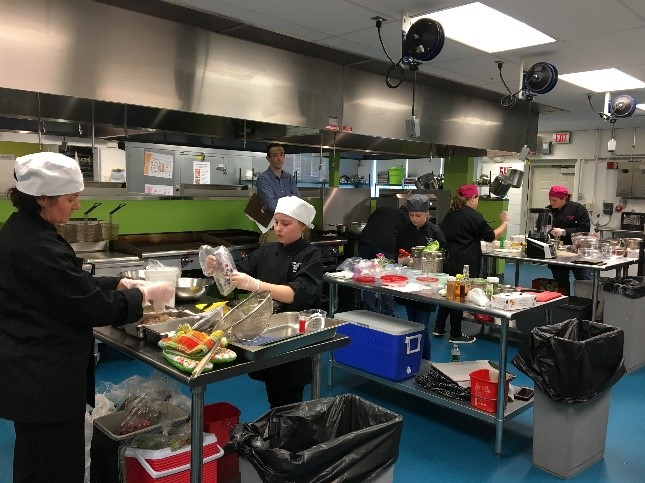
people cooking in industrial kitchen
Competitors cooking the 2019/2020 Cook-off.

AUGUSTA –The Maine Department of Education, Child Nutrition team is holding its annual Farm to School Cook-off in SY 2021 as usual, except this year it will look a bit differently. The cook-off is a statewide culinary competition for teams of school nutrition professionals and students to promote local foods in school meals. This voluntary competition is made available to all school districts in the state.

On a “typical” year, the cook-off would involve three regional competitions that take place in locations across the state (including CTE culinary arts centers), and a finals competition in the Child Nutrition Culinary Classroom. To adapt to these ever-changing times, the format for the 2021 cook-off will be as follows:

Round 1– virtual cook-off (March 2021). Teams will submit videos of their breakfast and lunch meals to be posted on the Child Nutrition website, where voting will take place. The top three teams will advance to round 2.

The video presentation will include details on local ingredients, techniques used, feasibility, and anything else the team would like to share.

Round 2– final cook-off (May 2021). The top teams will compete in the Child Nutrition Culinary Classroom in Augusta! The 2021 Farm to School Cook-off champion will be awarded a plaque and the opportunity to be spokespeople in the 2022 cookbook. Please note all necessary precautions will be taken, including face coverings and social distancing of teams in the culinary classroom. The Child Nutrition team will be monitoring any changes needed to this format to ensure the safety of all participants.

Each team will prepare a breakfast and lunch meal within a specific time frame using at least three ingredients that are grown, raised, caught, or manufactured in the State of Maine and meet Summer Food Service Program meal requirements as well as one USDA food. Local eggs and local parsnips will be used as “challenge” ingredients in the competition. All recipes will later be shared in a Maine farm to school cookbook to be used in future summer meals programs.

Interested school districts can find more information and the link to register on the Maine Child Nutrition website. The registration deadline is December 18, 2020. For more information on Maine’s Farm and Sea to School program, visit https://www.maine.gov/doe/farmtoschool.

Middle School Career and Technical Education: New Grant Information and Resources

The Career and Technical Education (CTE) Team recently released information regarding Pilot C for implementing Middle School CTE programs. Middle School CTE provides an opportunity for Maine middle school students to experience hands on learning, workplace skills, and career exploration. CTE empowers students to explore interests and discover activities that are inspiring, experience potential career pathways, and gives them an awareness of the many options that are available.

In June of 2017, the legislature enacted law to expand CTE opportunities by requiring Maine schools to provide access to developmentally appropriate CTE for middle school students (grades 6-8). Along with this legislation, there was an opportunity for CTE schools to apply for grant funding to pilot a Middle School CTE program. In the fall of 2019, Maine Department of Education (DOE) opened the first round (Pilot A) of grants and 14 CTE schools applied and received funding. The second round (Pilot B) application had 14 grantees as well, and now Pilot C is available.

The MS-CTE Pilot C Grant applications are available and must be submitted to the MDOE by December 15, 2020. The grant must be expended or encumbered by June 30, 2021. Funds may be used in school year 20-21 and/or during school year 21-22 with proper obligation. (Obligation means amount representing orders placed, contracts awarded, services received, and similar transactions during an accounting period that will require payment during the same, or a future, period.) Through the current pilots, middle school students are discovering the many opportunities that are available to them in CTE. These pilots have included CTE camps, in school MS-CTE experiences, professional development opportunities for teachers at both the middle school and CTE school, hands on CTE tours, as well as after school CTE programming.

The Middle School CTE programs thrive with collaboration between the CTE schools and the middle schools. The middle schools and CTE schools work together to design a program that will meet the needs of the students and provide an engaging learning experience. Alignment with the middle school CTE standards is required for all programs. These standards are in draft form and are being reviewed through the implementation of the current pilot programs. The current draft standards can be found here.

For additional information please visit the Middle School CTE web site at https://www.maine.gov/doe/learning/cte/schools/middleschool or contact Margaret Harvey at margaret.harvey@maine.gov

Get to Know the DOE Team: Meet Maryalice Crofton

Maine DOE Team member Maryalice Crofton from Volunteer Maine is being highlighted this week as part of the Get to Know the Maine DOE Campaign. Learn a little more about Maryalice in the brief question and answer below.

What are your roles with DOE?

My job for the last 26 years has been with the Maine Commission for Community Service – 25 years as Executive Director. In July 2012, the Commission’s fiscal agent changed to the Department of Education so that’s the start of my internal connection to the business people. As one might expect, the role of Executive Director is multi-faceted. There are 24 Commissioners who are very involved in our work – we couldn’t do as much without them. Then there is the facet that is managing federal and state legislative as well as intergovernmental relationships. Our oversight committee is State and Local Government but our budget flows through DOE so we have a new relationship with education and cultural services. Then, there are the partnerships, public education, keeping everyone focused on our strategic plan, and supporting the team. I serve on the national public policy committee as well as a couple of work groups.

What do you like best about your job?

I’ve always said I would leave when I got bored. That hasn’t happened yet and it’s what keeps me engaged in the work. That, plus knowing the important role of service in community health and resiliency. It’s been such a relief to have more and more research published for our field.

How or why did you decide on this career?

That presumes I decided! I have to say that my career path has not been deliberate but accidental and it’s been an adventure. I came to the Commission after 15 years of leading mentoring nonprofits and before that I worked in youth development for UConn Cooperative Extension. Here I was the Grants Officer first – I told folks I didn’t want to be in charge for a while. Well, that lasted 4 months! Then the Exec Director retired and had me appointed interim. From there, it’s history.

What do you like to do outside of work for fun?

I’m an avid gardener, landscaper, singer, and thinker. If I say “I’ve been thinking” to either my husband or my work colleagues, they all get this pained expression that goes with “Oh, no. Now what?” Then they laugh and say how shocked they are.

Priority Notice: Input Sought for Teacher Shortage Areas

As part of a federal requirement, the Maine Department of Education submits to the U.S. Department of Education teacher shortage areas for designation, based on collected data and public input.  The U.S. DOE annually designates teacher shortage areas for purposes of deferment of loan repayments or reductions of teaching obligation.

The Department intends to propose the following as K-12 teacher shortage areas during the 2021-2022 school year:

  • Early Elementary (K-3)
  • Early Childhood (Pre-K)
  • English/Language Arts (7-12)
  • Social Studies (7-12)
  • Teacher of Students with Disabilities (all grade levels)
  • Mathematics (7-12)
  • Physical Science (7-12)
  • Spanish (PK-12)
  • Physical Education (PK-12)
  • Health (PK-12)
  • Visual Arts (PK-12)
  • English – Second Language (PK-12)

The Maine Department of Education is committed to working with our schools to most accurately represent the needs and shortage areas across our state. We recognize the diverse geographic regions and varying conditions that comprise our public education system and strive for equitable and accurate representation.

To provide input regarding a specific shortage area, or to propose additional shortage areas, please submit correspondence to Stephanie Fyfe at stephanie.fyfe@maine.gov within 10 days of this notice.

Honoring RISE Award Finalist Debra Baldacci From Bangor

Deb Baldacci is a devoted Lunch Accountability Clerk at Fruit Street School in the Bangor School Department. She was recently nominated for the RISE Award and honored by the Maine Department of Education (DOE). The RISE Award (Recognizing Inspirational School Employees ) honors classified school employees who provide exemplary service.

“Mrs B, as she’s affectionately known as, commits to memory the names of each student, their sibling, teacher and preferences for food choice. She gently encourages students to do their best and make healthy choices. She notices everything and seeks out counsel when wondering about one of her students changes in behavior.”

“As a specialist in the school, I know that if I have a student who comes to my office saying they had no time for breakfast, I can take that student to her office to work out how to solve that problem. She will without hesitation stop what she’s doing to show care and concern for any child, whether that be asking if they need more breakfast, or notice something special about a student.”

“She looks to fill any needed training for her staff by sharing with them information within the school day process that they might to need know. She takes it upon herself to see that tasks are completed even if they are not specifically assigned to her or her staff.”

“Everyone knows Ms. B. I have students that years later, I might see, and they will ask about Ms. B. She has put everyone as a priority so that they consider her to be the safe harbor when times are difficult, and they seek out to share good news. She’s our rock.”

 When asked about her job, this is what Deb had to say:

“I feel very fortunate to work at Fruit Street with such a wonderful staff and students.”

RISE Award nominations were submitted from across the state by local educational agencies, school administrators, educators, professional associations, nonprofits, parents and community members this fall. More information on the Maine RISE Award can be found here the national RISE Award can be found here.

MEDIA RELEASE: Commissioner Makin Sends Special Message of Gratitude to Maine Schools

As Maine people and schools prepare for the season and time with loved ones, and as the Maine Department of Education (DOE) reflects on what we are thankful for through the ongoing challenges of the COVID-19 pandemic, Maine DOE Commissioner Pender Makin sends a special message of gratitude to Maine schools, including staff, teachers, specialists, school and district administrators, nurses, custodians, support staff, substitute educators, child nutrition workers, transportation drivers, volunteers, caregivers and all of those who support our schools- for their tireless work to ensure children around the state have access to education and essential support services through one of the most challenging years we have ever experienced.

“Hi friends my name is Pender Makin and I’m Commissioner of Education for the State of Maine. Like all of you, I’ve had to reinvent my role, scrap my carefully developed plans, and adjust my approach to pretty much everything throughout these past eight months. Together Maine’s educators school staff building and district leadership and your support team here at the Department of Education have shouldered the heavy responsibilities of safely reopening schools for in-person classes recognizing that so much of our society’s eventual recovery from this pandemic depends upon a strong healthy school system.

I wanted to take a minute today to thank you for your extraordinary efforts and deep commitment to the education of Maine’s children. Because of your courage and hard work, 100 % of Maine public school administrative units were able to safely open up this fall and because of your diligent attention to the six requirements for health and safety at school, Maine schools are significantly safer than other settings in the greater community. Data provided to me this morning indicates that our public school students and staff members are less than half as likely to be positive with COVID-19. As the general population, specifically those who attend or work in Maine public schools currently have only 40 percent the positivity rate that we’re seeing across other sectors of our state. Please know that your efforts and contributions are making all the difference for the students and communities you serve and for our state as a whole as we remain in a state of civil emergency and everyone has had to be hyper vigilant for such a long time now.

We’ve been asking more of our schools than we’ve ever had to ask before and yet as we enter what seems like it might be the epicenter of the pandemic and with our daylight diminishing into the solstice ahead I’m asking something more of you – please take care of yourselves. Be gentle with your expectations, and give yourselves the grace that educators and others who keep schools running tend to offer so generously to others. Acknowledge that this has all been extremely difficult and own the fact that collectively you’ve been knocking it out of the park in terms of supporting students and in terms of providing your entire communities with steadfast assurance in a time of uncertainty.

You see, local public schools have always been far more than buildings where academic learning occurs. The schools give shape and identity to our communities the schools hold us together in shared purpose and in a shared promise that we all make to the better future that awaits us.

Thank you for your heroic work throughout this extraordinary time.”