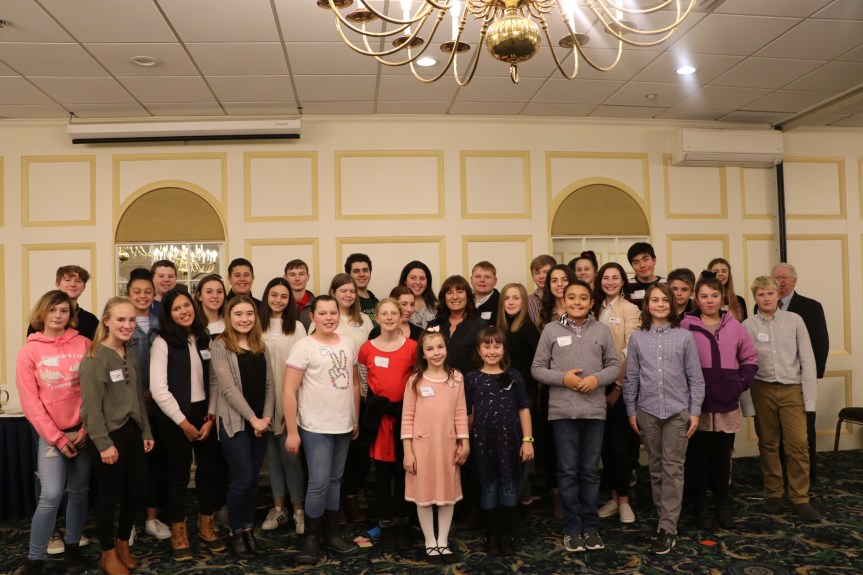
Student Cabinet Meets with Commissioner Makin to Discuss Education in Maine

Students from across Maine met with Maine Department of Education (DOE) Commissioner Pender Makin in Augusta for an all-day summit on December 20th. The students were each selected from a pool of nearly 300 applicants to be part of the Maine Department of Education’s first Student Cabinet. The 12/20 meeting was the first of four meetings to take place this school year.

The Maine DOE and the Maine State Board of Education, with special help from the Board’s two student representatives, Jaylee Rice and Casey Maddock put together the Student Cabinet as a way to include student voice in decision making at the state level. The Cabinet is made up of students from all 16 counties in Maine in grades 4th through 1st year of college, who were selected based on their thoughtful responses on the application distributed to the public by the Maine DOE this past fall.

During the day-long meeting, students had the opportunity to connect with one another through team-building activities, along with values-based activities to help them identify the importance of their own values and that of others, including the populations they represent. The bulk of the work was done in the second half of the day, as students worked in like-age groups to categorize important topics in education for the Commissioner to be aware of, topics for discussion, and topics to act on.

The day ended with a round table discussion about the topics discussed within each of the groups. From the master list of topics, the students each got the opportunity to vote on the topics they felt were the most important to explore further as a group. Addressing issues of mental health and trauma for students, ensuring inclusive and welcoming schools for all, and ensuring equitable opportunities for all Maine students were goals the group identified as most important.

Three additional follow up meetings are being planned for the winter and spring, in addition to an online discussion board where student cabinet members will have the opportunity to engage with one another and invite other students from their region to join in county level discussions.

Maine DOE Student Cabinet Members: 

Name  County 
Klara Androscoggin
Cadence Androscoggin
Nicholas Aroostook
Damon Aroostook
Fiona Cumberland
Leela Cumberland
Katelyn Cumberland
Josh Cumberland
Monica Franklin
Mackenzie Franklin
Sarah Hancock
Avahnnah Hancock
Rhayna Kennebec
Cecilia Kennebec
Emmett Knox
Isaiah Knox
Emma Lincoln
Zaid Lincoln
Alexi Oxford
Connor Oxford
Maya Penobscot
Sam Penobscot
Brooke Piscataquis
Isabel Sagadahoc
Madison Sagadahoc
Savea Somerset
Annabelle Somerset
Gaby Waldo
Stephanie Waldo
Matthew Washington
Sarah York
William York


Get to know the DOE Team: Meet Pam Ford-Taylor

What are your roles with DOE?

I am the DOE School Enrollment Specialist for K-12.  This includes approving public and private schools, managing home instruction, coordinating Commissioner waivers and Superintendent agreement appeals, and conducting policy and analysis work related to student enrollment and eligibility.

What do you like best about your job?

Everything! I was a university system employee for years (I loved that too). It’s great to be part of the executive branch of government where we get to share the privilege of shaping education for all of our children and youth. I also appreciate so much all of the excellent, dedicated and collaborative colleagues in the Department.

How or why did you decide on this career?  

I’ll answer by sharing a favorite statute, from § 5001-A(7):  “Compulsory education is essential to the preservation of the rights and liberties of the people and the continued prosperity of our society and our nation. Maintaining regular student attendance is necessary to achieve the goal of an educated citizenry.”

What do you like to do outside of work for fun?

Hike the woods and fields with my cattle dog, Nancy; spend time with my husband and children camping (or doing anything); global travel; read; cook. I have a first grandchild too, very sweet!

Maine DOE Update – December 26, 2019

From the Maine Department of Education


Reporting Items

MaineCare Seed adjustments to be made, review Q1-20 reports by January 15, 2020

The recovery of Q1-20 MaineCare Seed will occur in the January 2020 subsidy payment, and the Maine Department of Education (MDOE) is asking School Administrative Units (SAUs) to review their reports by January 15, 2020 to ensure accurate adjustments to subsidy. SAU staff must review student by student claims on both the public and private MaineCare reports for Q1-20 by January 15, 2020. | More

| Visit the DC&R Reporting Calendar |


News & Updates

CDS Seeks Public Input on the Revised Part C System of Payments Policy

Child Development Services (CDS) seeking public input on its recently revised System of Payments policy for Part C services. The revised policy reflects the feedback that CDS received from stakeholders and the State Interagency Coordinating Council regarding the implementation of a family fee for receipt of Part C services for families who meet income guidelines. | More

ECTA’s Executive Summary of CDS Regional Stakeholder Meetings

In October of 2019, at  the request of Maine Department of Education (MDOE), technical assistance personnel from the IDEA Early Child Technical Assistance Center (ECTA) facilitated seven regional stakeholder groups to gain additional understanding of SAUs’ perspectives on the proposed transition of the transfer of responsibility for special education services for children, ages 3 to 5, to the public schools. ECTA’s Executive Summary of those meetings provides regional and statewide detail regarding both the opportunities and challenges that the proposed transition presents. | More


Maine Schools Sharing Success Stories

| Submit your Maine School Success Story |


Professional Development & Training Opportunities

WIDA Early Years Online Learning Modules (to Support Multilingual Children) Available at No Cost to Teachers and Administrators

The Maine Department of Education would like to remind Maine’s early care and education community that they are able to access to the WIDA Early Years online learning modules. These modules focus on supporting young multilingual children, ages 2.5 to 5.5 years and are available at no cost to teachers and administrators. Multilingual children, commonly referred to as dual language learners, are children who are developing more than one language. | More

| Visit the Professional Development Calendar |


Latest DOE Career/Project Opportunities

WIDA Early Years Online Learning Modules (to Support Multilingual Children) Available at No Cost to Teachers and Administrators

The Maine Department of Education would like to remind Maine’s early care and education community that they are able to access to the WIDA Early Years online learning modules. These modules focus on supporting young multilingual children, ages 2.5 to 5.5 years and are available at no cost to teachers and administrators. Multilingual children, commonly referred to as dual language learners, are children who are developing more than one language.

Each self-paced, interactive module provides opportunities for reflection and offers suggestions for applying content to local practice. The following modules are available:

  • Dual Language Learners and their Families
  • WIDA Early English Language Development Standards Framework
  • Dual Language Learners with Disabilities
  • Scaffolding Language Learning
  • Promising Practices

A description of each module, frequently asked questions, and instructions for creating a user account and registering for the modules can be found in the documents listed below:

Access the modules: WIDA Early Years online modules (visit and create your user account)

If you are a program leader, administrator, trainer, or coach, we hope you will utilize these modules as a resource to support the professional learning needs of those serving multilingual children. The modules can be used in staff development sessions and/or shared with individual educators or teams of educators, such as professional learning communities.

Contact hours are available upon completion of a module. To receive a contact hours certificate, please download the certificate of completion generated by the WIDA Early Years online system and email it to april.perkins@maine.gov.

Additionally, the Department has purchased a set of WIDA Early Years Promising Practices Implementation Kits to assist districts in refining their programs for young multilingual children. These kits serve as a program self-evaluation tool, highlighting several evidence-based, highly effective strategies for supporting children’s development of multiple languages. Several districts with a significant number of dual language learners will receive these kits. A district that does not receive its own kit may request to borrow one from the Maine Department of Education.

WIDA Early Years resources have been provided to Maine educators through Title III, CDS, Head Start and public pre-k funds.

If you have any questions about these resources, or to request to borrow a WIDA Early Years Promising Practices Implementation Kit, please contact Maine DOE Director of ESOL/Bilingual Programs & Title III April Perkins at april.perkins@maine.gov or (207)624-6627.

ECTA’s Executive Summary of CDS Regional Stakeholder Meetings

In October of 2019, at  the request of Maine Department of Education (MDOE), technical assistance personnel from the IDEA Early Child Technical Assistance Center (ECTA) facilitated seven regional stakeholder groups to gain additional understanding of SAUs’ perspectives on the proposed transition of the transfer of responsibility for special education services for children, ages 3 to 5, to the public schools. ECTA’s Executive Summary of those meetings provides regional and statewide detail regarding both the opportunities and challenges that the proposed transition presents.

By design and necessity, the size of the regional groups was limited and primarily consisted of SAU representatives. However, MDOE and CDS acknowledge that the input of stakeholders, other than SAU representatives who participated in the regional meetings, is exceptionally valuable in developing a comprehensive understanding of complex variables that must be considered.

The Executive Summary can be found at https://www.maine.gov/doe/learning/cds/laws. Interested parties are encouraged to email their input to CDSStateDirector@maine.gov  using “Stakeholder Feedback” as the subject line. A synthesis of input received will be posted to this site prior to the January Legislative session, and will be provided to the Joint Standing Committee on Education and Cultural Affairs for their consideration.

CDS Seeks Public Input on the Revised Part C System of Payments Policy

Child Development Services (CDS) seeking public input on its recently revised System of Payments policy for Part C services. The revised policy reflects the feedback that CDS received from stakeholders and the State Interagency Coordinating Council regarding the implementation of a family fee for receipt of Part C services for families who meet income guidelines. That feedback overwhelmingly expressed concern that the use of a family fee would decrease the number of families accessing Part C services, necessitate the addition of at least one position to the State Office team, require increased expenditures in postage and for the tracking of payments, and that the revenue generated from a family fee would be minimal and fail to justify the anticipated challenges and costs. The revised policy can be found at https://www.maine.gov/doe/learning/cds . Feedback will be accepted until January 31, 2020 and can be submitted to CDSStateDirector@maine.gov, using“SoP input” the subject line.

MaineCare Seed adjustments to be made, review Q1-20 reports by January 15, 2020

The recovery of Q1-20 MaineCare Seed will occur in the January 2020 subsidy payment, and the Maine Department of Education (MDOE) is asking School Administrative Units (SAUs) to review their reports by January 15, 2020 to ensure accurate adjustments to subsidy. SAU staff must review student by student claims on both the public and private MaineCare reports for Q1-20 by January 15, 2020.

To access the MaineCare Seed reports, please follow the instructions below.

  1. Log into NEO using the link below

https://neo.maine.gov/DOE/neo/Dashboard

Anyone who currently has Special Education Director permissions to the Special Education module will automatically have permissions to access MaineCare reports.

As in the past, if a new staff member needs permission to access this module, a request from the Superintendent to the Maine DOE helpdesk will be necessary. The helpdesk contact information is medms.helpdesk@maine.gov or 207-624-6896.

  1. Click on the Student Data tab
  2. Click on the Student Report tab
  3. Select MaineCare in the Reporting Area drop-down
  4. Choose the quarterly Seed report and the report type (private/public)
  5. Click view report button
  6. Once the report appears on the screen, choose the export button.

You may export the reports to Excel, but please be aware that there may be multiple worksheet tabs within the workbook. Save the file to your computer.

If you disagree that a particular student or time period should be on the report, please provide the reason that you disagree, along with the following, to Denise.towers@maine.gov.

  • Identify the type of report (public or private) and the quarter in which the claims are located.
  • State Student ID
  • Service provided dates (From and To)
  • Total amount of Seed being disputed

Summer services: Students must be enrolled for the time period they are receiving educational services. This means that students that are receiving extended school year services in district, or extended school year services in an out of district placement, must have a primary enrollment for that time period in order for the MDOE to have the most accurate enrollment data to determine SAU responsibility for MaineCare Seed.

For more information or technical assistance related to MaineCare Seed, please contact Denise.towers@maine.gov.

Free eWorkshops to Assist with Teaching Students who are English Learners

Educators in Maine now have the opportunity to participate in six, self-paced, on-demand eWorkshops developed by WIDA, a trusted name in the field of multilingual learner education and assessment. WIDA eWorkshops cover a range of topics intended for a variety of audiences, from K-12 classroom teachers, to ESL specialists, to district and school administrators. All eWorkshops are free and available when and where it is convenient to you!

The following eWorkshops are available in the eLearning Center of the WIDA Secure Portal:

  • Using the WIDA Writing Rubric
  • Leading for Equity: Classroom Walkthrough
  • Classroom Educators: Engaging Newcomer Multilingual Learners
  • Language for Learning in Mathematics
  • Doing and Talking STEM
  • Foundational Concepts for K-12 Educators

To access the eLearning Center, you will need a WIDA Secure Portal account. Contact WIDA customer service at help@wida.us or 1-866-276-7735 to set up your account. If you have any questions about this notice, please contact April Perkins at april.perkins@maine.gov or (207)624-6627.

Maine DOE Update – December 20, 2019

From the Maine Department of Education


Reporting Items

Important Reminder: Due Date Approaches for Quarter 2 (Q2) Attendance, Behavior, Bullying, and Truancy Data Review

The Department of Education offers quarterly windows for districts to review, for accuracy and comprehensiveness, the data that has been entered and reported to us. It is our hope that review of this data on a more regular basis will save district personnel time and work at the end of the year, and that it will provide time for analysis and to make any necessary corrections. | More

| Visit the DC&R Reporting Calendar |


News & Updates

Keep Kids Moving, Keep Kids Learning!

During these cold winter days of cabin fever in the classroom, we want to support educators with resources to keep kids moving and engaged.  Evidence suggests a positive impact of physical activity on academic achievement and in reducing behavioral challenges. Active recess time, physical education classes, and utilizing action-based learning strategies in the classroom can all be part of the regular school day. | More

School-Based Services Training Survey, Due December 31.

 In partnership with our colleagues at Department of Health and Human Services(DHHS), we are asking special education directors to complete a brief survey regarding MaineCare, so we can better tailor professional development for special education providers.  | More

CTE Programs- Input Request!

In an effort to enhance Maine’s high quality Career and Technical Education (CTE) programs, the Department of Education is seeking your input. | More

Get to know the DOE Team: Meet Morgan Dunton

Maine DOE team member Morgan Dunton is being highlighted this week as the part of a Get to know the DOE Team campaign! Learn a little more about Morgan in the brief question and answer below. | More


Maine Schools Sharing Success Stories

| Submit your Maine School Success Story |


Professional Development & Training Opportunities

Reminder: Register for Maine School Winter Wellness Summit on Jan 31

To assist those who are responsible for the important task of reporting quarterly attendance data to the Maine Department of Education, the DOE Data Team will be holding a webinar on Monday January 6th, from 11am to 12pm. | More

| Visit the Professional Development Calendar |


Latest DOE Career/Project Opportunities

MEDIA ADVISORY: STUDENT CABINET MEETING TODAY

FOR IMMEDIATE RELEASE

Media Contact:
Kelli Deveaux, DOE Director of Communications, (207) 592-3907

Maine Department of Education to Host Student Cabinet Meeting December 20th

The Maine Department of Education (DOE) has selected 32 Maine students to serve on its new Student Cabinet. The group of students is scheduled to meet quarterly with Commissioner Pender Makin to discuss educational opportunities, improvements, and policy. The group will convene for its first meeting on Friday, December 20, 2019, having been previously postponed due to weather. The Maine DOE would like to invite the media to come to the end of the Dec. 20th meeting from 2:45 pm – 3:00 pm to talk with Commissioner Makin and members of the Student Cabinet. The meeting will be at the Senator Inn in Augusta.

  • Who: Commissioner Makin and Student Cabinet members from all 16 counties in Maine.
  • What: An opportunity to talk with students and the commissioner about the Student Cabinet.
  • When: Friday, December 20, 2019, 2:45 pm – 3:00 pm
  • Where: Senator Inn, 284 Western Ave, Augusta, ME 04330

More information: The Student Cabinet is comprised of students from all 16 counties in Maine, grades 4 through 1st year of college, from diverse educational experiences. The students were selected through a rigorous team selection process by a committee of students, Maine State Board of Education Representatives, and Maine DOE staff, including experienced Maine educators.

Student Cabinet meetings are intended to allow students from different grade levels, backgrounds, and areas of Maine to share their opinions and offer advice about Maine’s education system with Maine’s Commissioner of Education and other leaders from the Maine Department of Education. The purpose of the Student Cabinet is to provide a forum for Maine students’ voices to be heard.

The Student Cabinet will be co-chaired by Maine State Board of Education Student Representatives, Casey Maddock and Jaylee Rice, who were both instrumental in the formation of the Student Cabinet.

Media questions should be directed to Maine DOE Director of Communications Kelli Deveaux at (207) 592-3907or kelli.deveaux@maine.govlarge group of kids in a circle