Throughout the 2018- 2019 school year, the Maine Department of Education, State Fire Marshal’s Office, Department of Health and Human Services, Maine State Police, Maine Sheriffs Association, Maine Chiefs of Police Association, and the Maine Emergency Management Agency will provide tips and resource information to Maine schools to help provide some guidance for identifying signs and preventing school violence.
Further questions and inquiries can be send to Pat Hinckley, Maine DOE Transportation and Facilities Administrator at 207-624-6886 or pat.hinckley@maine.gov.
Administrative Letter: #25 Policy Code: BGE To: Public School Administrators, Teachers From: Pender Makin, Commissioner Date: 11 June 2019 Subject: Amendments to Title 20-A, Chapter 508, Educator Effectiveness
On April 11, 2019, Governor Mills signed a law that makes important changes to Performance Evaluation and Professional Growth (PEPG) systems. The new law will go into effect 90 days after the current legislative session ends. Chapter 27, An Act to Amend Educator Evaluation Requirements, includes a number of changes.
Under the new law, school administrative units may choose to identify and include student learning and growth measures that they deem valuable in summative effectiveness ratings, but they are no longer required to do so.
SAUs must ensure or reconfigure their steering committee membership, such that a majority are teachers who are chosen by a representative of the applicable collective bargaining unit.
The law states that, “revisions to the performance evaluation and professional growth system made by the steering committee must be reached by consensus.”
Implementation Guidance
The steering committee composition required in Chapter 27 will go into effect 90 days after the current legislative session comes to an end, likely near the start of the 2019-2020 school year.
The Department of Education is committed to a transparent and inclusive rule-making process for Chapter 180 that will begin in early fall of 2019, in preparation for the submission of the draft rules for consideration to the Committee for Education and Cultural Affairs in January, 2020.
Current law requires that student learning and growth measures must be a factor in a summative effectiveness rating until September 1, 2021. PEPG steering committees are encouraged to review their current PEPG systems, and the vision, mission, and goals of the district, to determine the measures of effectiveness they will implement beginning with the 2021-2022 school year. In addition, the committee should develop reasonable transition plans and timelines for any changes to the PEPG system, as determined by the steering committee, taking into consideration the existing evaluation cycle, and when summative evaluations will be completed.
Submitted by Peter Harrison, Principal at Young School, Saco Schools. Text Written by Ken Studtmann, Wokka Wokka Coordinator. Photos by Dr. Peter Harrison and Ken Studtmann.
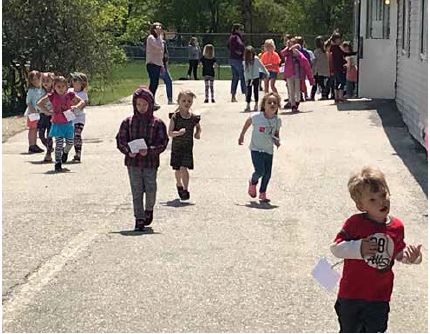
For several years the Young School students have participated in a much beloved walking program during their Wednesday’s lunch time recess. The students fondly named it “Walking Wednesday”.
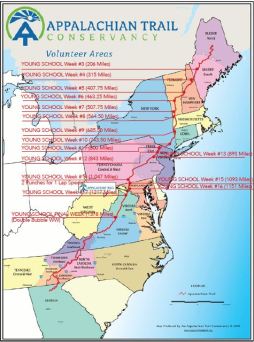
Appalachian Trail Comparison
During Walking Wednesday, the students walk, skip, hop or move in creative movements 1/8-mile laps around the school while parent and adult volunteers track and tally the number of laps each student completes. The number of laps completed are recorded for individual students and collectively tallied for classroom, and the entire school. For every 2.5 miles the student walks they receive an incentivizing award of a “toe token”. At the end of the year, the classroom from each grade level with the highest number of laps receives an extra recess.
Geography Lesson
For the past two years, a lesson in geography has been integrated into the program. Last year, the laps walked by the students represented a unit of distance along the Appalachian Trail. The students successfully completed 1,378 miles of the Appalachian Trail; Maine to Virginia. The student’s progress was tracked on a large map displayed in the school’s front entry hallway for students, teachers and staff, and visitors to watch the progress. This year the laps represented the number of times the students crossed the Penobscot bridge; 3,541 times and growing.
Language
As a means to further enhance the program, a language component was introduced in the beginning of this current school year with the reading of “HOW DO YOU WOKKA-WOKKA”, c 2009 by Elizabeth Bluemle, art by Randy Cecil. The book was a great inspiration to the students, staff, and adult volunteers of the program. The book’s premise of finding your own walking style was embraced by the students with lots of styles emerging. The students even changed the program’s name into “Wokka Wokka Wednesday”. The Wokka Wokka Wednesday is a much-loved program at Young School.
Fun Fact #1: The Appalachian Trail is among the longest continuously marked trails through 14 states; Maine to Georgia. The trail is marked with approximately 165,000 white blazes along the trail guiding hikers all 2,186 miles.
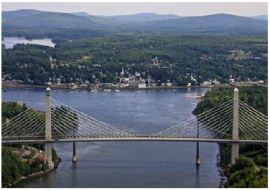
Penobscot bridge
Fun Fact #2: The Penobscot bridge spans 2,120 feet from the east shore to the west shore of the Penobscot river. The design of the bridge’s two towers was inspired by the Washington Monument.
Fun Fact #3: Young School Students love to Walk! Last year, the Young School students collectively walked fictitiously from Maine to Virginia on the Appalachian Trail and this year they walked 3,541 times across the Penobscot the bridge.
For additional information to learn how to implement a walking program at your school, please contact Dr. Peter Harrison, Young School Principal.
Maine Department of Education is proud to share that our certification team continues to process a number of new certificates for those joining the education profession or who are seeking new endorsements. In addition, they have processed and issued renewed certificates to 48% of those whose certification is set to expire July 1, 2019. While their turnaround time is currently, and amazingly, around three weeks, we are concerned that there are still 2,869 certificate holders who have not yet submitted the required documentation and payment, and whose certification will lapse July 1! Please note that anyone renewing certification MUST fill out an online form and provide payment. Information on how to create an account or for instructions on how to submit the renewal application is provided here for your convenience.
FMI or for any questions, please contact our Certification Team at cert.doe@maine.gov.
Submitted by Heidi McGinley, Executive Director, Maine Curriculum Leaders’ Association.
Julie Meltzer, Director of Curriculum, Assessment, and Instruction for the Mount Desert Island Regional School System (AOS #91) is Maine’s 2019 Curriculum Leader of the Year. “I’m truly honored to join the group of curriculum leaders recognized in Maine. I’m honored to have them as my colleagues. I don’t know another group of people so focused on teaching and learning practices,” Julie said.
Julie is a passionate advocate for the learning and development of all students, leading the development of common standards the staff will “go to the mat” for across the district. She has developed community partnerships, found necessary resources, and introduced evidence-based instructional practices. But she credits widespread staff engagement in decision making for what superintendent Marc Gousse calls “marked improvement in learning and achievement and increased student success” across the district.
When she joined the district six years ago, Julie wanted all staff to have a voice in decision making and be engaged in professional learning opportunities so they would have the tools they needed to “do the best job they can for kids”. She wanted to maintain the strengths and uniqueness of each school and honor the professional autonomy of teachers while increasing student learning. The innovative professional learning and decision making structures she created made a difference.
“I’m proud of how everyone is starting to play a similar rhythm,” Julie says, “although the melodies are different, as they should be.” This year, 110 teachers and education technicians voluntarily served on a “collaboratory” – a temporary task force formed around a problem of practice, working to identify solutions, make decisions, and develop all the learning, strategies and tools needed to implement those solutions. In the process, staff and administrators became partners in professional development both in and outside the district. 100 teachers, education technicians and administrators led internal professional development sessions and 30 presented their work at state or national conferences. “Good things are happening for kids,” she said. “We’re getting to the ground of student learning and walking the talk in more ways.”
Julie’s journey to Mt. Desert began when her work at the Regional Laboratory led to a three-year content literacy consulting project in Washington County. She fell in love with Maine and with Acadia, eventually buying an old farmhouse in the area, which she and her husband started renovating on weekends. Her consulting work took her all over the country, so she ended up with two homes — a Portland rental to be closer to the jetport and a close-to-Acadia farmhouse. Her daughter started high school at Mount Desert and encouraged her to apply when the curriculum position opened. “I was lucky to be hired,” Julie said, “and I’ve been honored to have this position. I’ve learned much more in the last six years than I did earning my doctorate.”
The recovery of Q3’19 MaineCare Seed will occur in the July 2019 subsidy payment, and the Maine Department of Education is asking SAUs to review their reports by July 8, 2019 to ensure accurate adjustments to subsidy. SAU staff must review student by student claims on both the public and private MaineCare reports for Q3’19 by July 8, 2019.
To access the MaineCare Seed reports, please follow the instructions below.
Log into NEO using the link, https://neo.maine.gov/DOE/neo/Dashboard Anyone who currently has Special Education Director permissions to the Special Education module will automatically have permissions to access MaineCare reports. For security purposes, if a new staff member needs permission to access this module, a request from the Superintendent to the Maine DOE helpdesk will be necessary. The helpdesk contact information is medms.helpdesk@maine.gov or 207-624-6896.
Click on the Student Data tab
Click on the Student Report tab
Select MaineCare in the Reporting Area drop-down
Choose the quarterly Seed report and the report type (private/public)
Click view report button
Once the report appears on the screen, choose the export button.
Export Button
You may export the reports to Excel, but please be aware that there may be multiple worksheet tabs within the workbook. Save the file to your computer.
If you disagree that a particular student or time period should be on the report, please provide the reason that you disagree along with the following to Denise.towers@maine.gov.
Identify the type of report (public or private) and the quarter in which the claims are located
State Student ID
Service provided dates (From and To)
Total amount of Seed being disputed
Summer services: Students must be enrolled for the time period they are receiving educational services. This means that students that are receiving extended school year services in district, or extended school year services in an out of district placement, must have a primary enrollment for that time period in order for the MDOE to have the most accurate enrollment data, to determine SAU responsibility for MaineCare Seed.
For more information or technical assistance related to MaineCare Seed, please contact Denise.towers@maine.gov.
During the transition of a new leadership team to the Department of Education, Commissioner Makin has actively sought input and guidance from the expert staff at the department, and from education professionals and other stakeholder groups, to inform our Vision, Mission and Strategic Priorities.
In hearing the hopes and dreams of so many, and understanding the immensely important work that is being done in classrooms across our state, our Vision, Mission and Strategic Priorities will serve as a continually evolving guide for the work of the Department of Education.
The Strategic Priorities have been used to set action steps for the various teams within the department, and we look forward to reporting back to the field periodically on our successes, and to seek input as we refine and align our work.
Vision:
The people of Maine are lifelong learners served by an innovative, equitable, and learner-centered public education system that supports students – early childhood throughout adulthood – in achieving healthy, successful, and fulfilling lives that allow them to shape the future.
Mission:
To promote the best learning opportunities for all Maine students by providing information, guidance, and support to our schools, educators, and leaders and by providing adequate and equitable school funding and resources.
Strategic Priorities for 2019-2021
Inspire TRUST in our organization, and in our public education system
Develop, support, and sustain a robust EDUCATOR WORKFORCE
Promote EDUCATIONAL EXCELLENCE and EQUITY for all Maine learners
Ensure STUDENT and SCHOOL SAFETY, HEALTH, and WELL-BEING
Support a CULTURE of INNOVATION and CONTINUOUS IMPROVEMENT, led by all of the experts in the field
Maine DOE Child Nutrition Consultant, Michele Bisbee is being highlighted this week as the Maine DOE’s Employee of the Week! Learn a little more about Michele in this brief question and answer:
What are your roles with DOE?
I am the culinary specialist within the Department of Education Child Nutrition. Along with my team members I help to monitor multiple USDA Nutrition programs across our state. I also help to facilitate culinary trainings for school nutrition employees.
What do you like best about your job?
I enjoy being able to help nutrition professionals across the state.
How or why did you decide on this career?
I worked in high volume food service for about 10 years before someone brought up the idea of school nutrition to me. I had never really thought of this as a career path but the opportunity to not only help children but to be able to spend more time with my own child really appealed to me. I am very happy that I made the decision.
What do you like to do outside of work for fun?
Outside of work I enjoy spending time with my family. I help to coach my daughters cheerleading team and her softball team, so we are constantly on the move from one sport to the next.
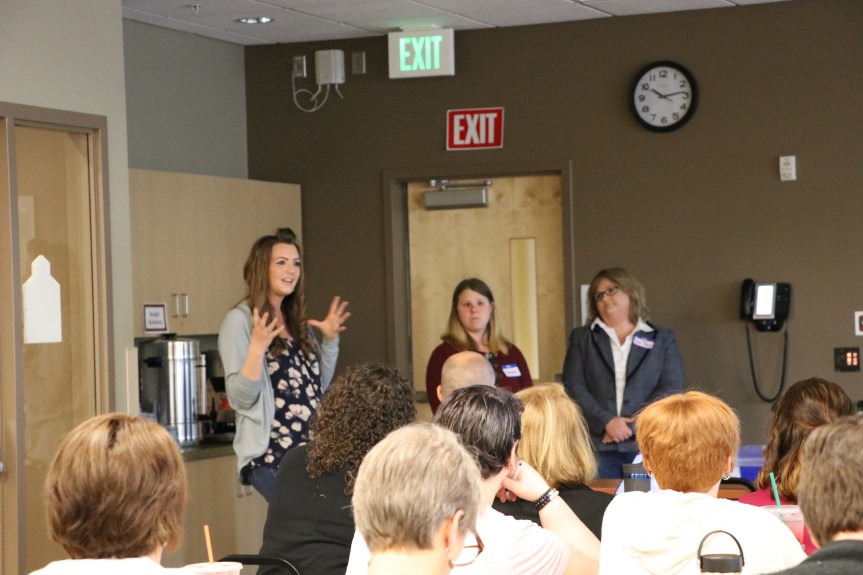
(Pictured: Kindergarten teacher Heidi Sturgeon, pre-k teacher Olesia Pazdro, and Curriculum Director Suzanne Day from MSAD 55- Sacopee Valley, talk to the audience about their goals for their Birth – Third Grade Action Plan.)
The Maine Department of Education hosted a closing event of the 4-year Preschool Expansion Grant (PEG) that was awarded to Maine DOE in December 2014 by the US Department of Education. Eighteen states were awarded grants to support local school districts in the development of new preschool classrooms, and to expand access to high-quality, full-day pre-k programs for children whose families were at or below 200% Federal Poverty Level.
Maine used the grant to launch and expand pre-k programs for 13 districts in Maine, 8 of which used the opportunity to partner with local Head Start programs. The districts included RSU 12, RSU 13, MSAD 17, RSU 23, SAD 37, SAD 44, RSU 55, RSU 74, Cornville Regional Charter School, Cherryfield, Lewiston (Longley Elementary), Millinocket, Vassalboro. The 13 districts were chosen for their percentage of students with an economic disadvantage and willingness and availability to embark on the effort.
The grant allowed these districts to add or expand their pre-k classroom spaces and resources, hire and train needed teachers in using evidence based curricula and instructional practices, align appropriate assessment of pre-k students with kindergarten assessments, develop a plan for kindergarten transition, and form a community literacy team, all as part of a long-term “Birth to Third Grade plan” that aligns with the districts’ strategic goals. The grant implementation was supported by grant coordinators at each of the participating districts, and trained coaches, all of whom were former Maine educators.
A cross-section of state employees from Maine DOE, Department of Health and Human Services (DHHS) and Child Development Services (CDS) worked collaboratively on this project, with facilitation provided by the Education Development Center (EDC).
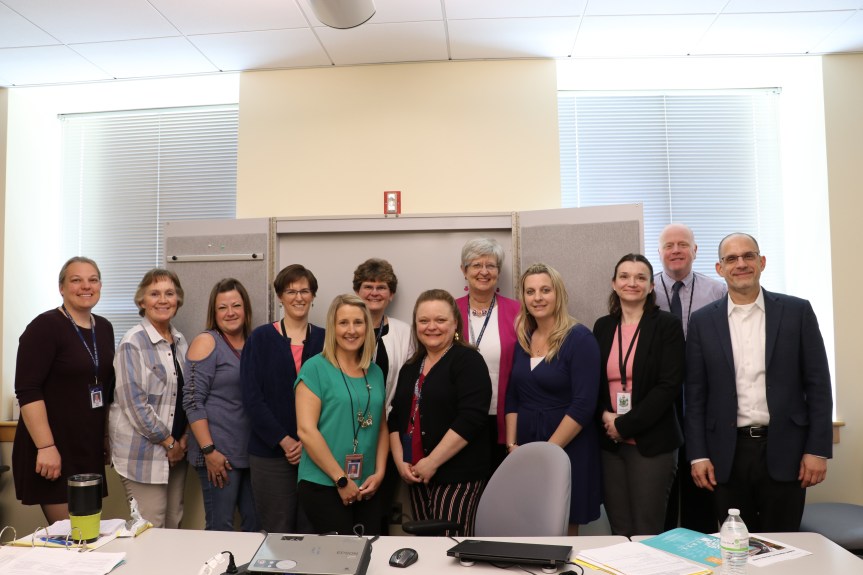
(Left to right) Sarah Adkins, Kathryn Zwicker, Nena Cunningham, Karen Bergeron, Nicole Madore, Lee Anne Larsen, Dee Saucier, Sue Reed, Crystal Arbour, Jessica Nixon, Rich Meserve, David Jacobson.
Three years into the 4-year grant, tremendous improvements in child outcomes were celebrated, including:
76%-86% of children moved out of the high-risk identification in all developmental domains
76%-96% of children moved out of high-risk identification in literacy skills (predictive of kindergarten success)
53% of children moved out of high-risk identification in the Peabody Picture Vocabulary Test, which assesses receptive language and is a predictor of later reading success
The end of the year event was an opportunity for each of the participating districts to present their Birth to Third plans to their peers and to reflect on their successes, lessons learned, and plans moving forward.
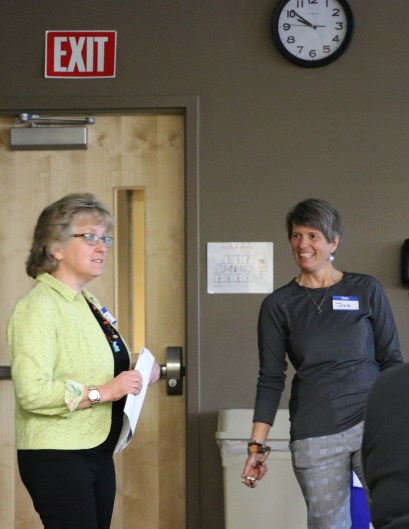
RSU 12 Curriculum Coordinator, Deb Taylor (right) and Southern Kennebec Child Development Center Head Start Director Cristina Salois (left) shared details of their action plan with the full audience which included a “ghost walk” to each pre-k classroom across the district’s 4 elementary schools. This was an opportunity for pre-k teachers to share and collaborate on environmental design and instructional practices and learn from one another.
The gathering included presentations by each participating district, who all began by sharing varied and often-times unique community challenges. For example, while some experienced a lack of licensed child care providers to connect with and engage families early on, another had migrant families with students in and out of school frequently. There were many other unique community characteristics shared, yet all of the districts had the common challenge of a high percentage of families facing economic disadvantage.
The common areas of focus for each Birth to Third Grade action plan included a focus on quality, shared teaching and learning practices, family engagement starting before children enter pre-k, a focus on positive transitions from pre-k to kindergarten, social emotional learning and trauma informed teaching.
The closing event was a successful day of presenting, idea sharing, and collaboration by early childhood educators from across the state who will now be able to continue their research based, and collaborative birth to third grade plans for district-wide success and beyond.
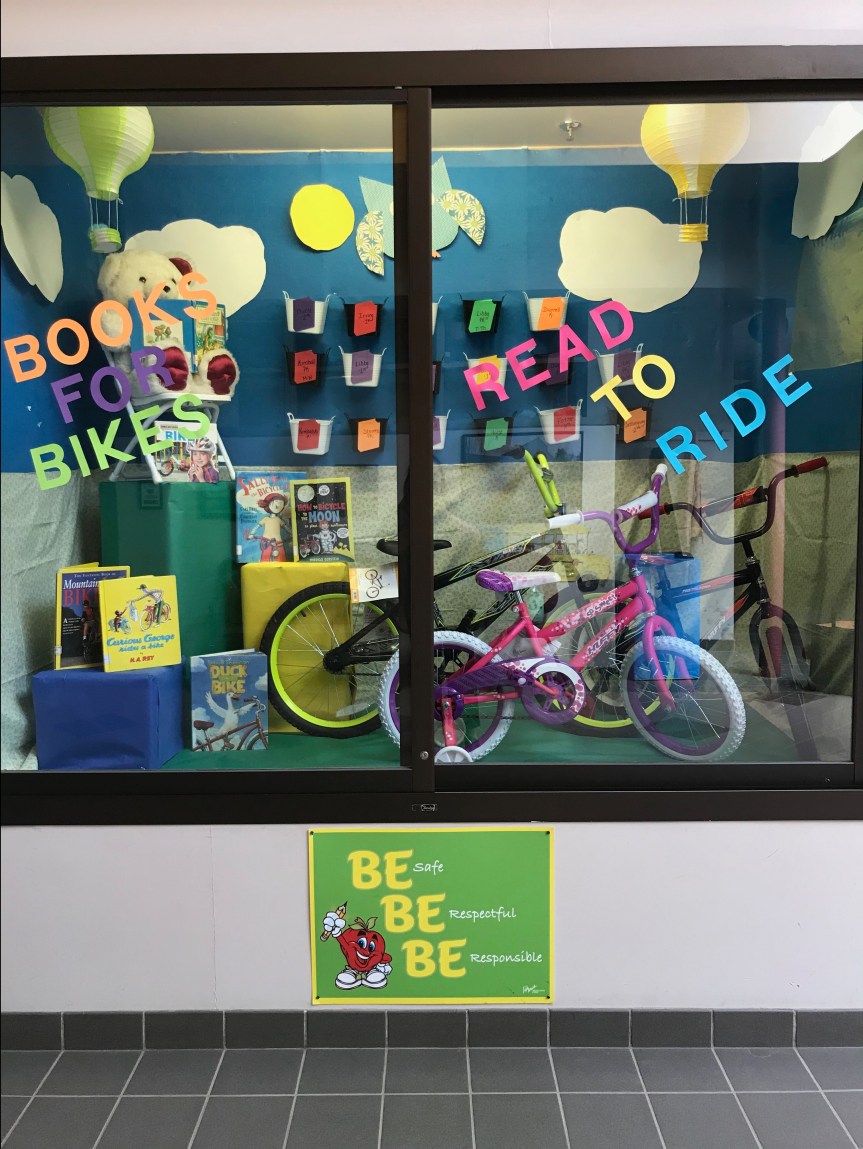
(Pictured: Display from Turner Primary for Read to Ride)
Summer vacation is a welcome break from the daily school routine for children and parents alike, but the summer months can be detrimental to students’ learning if young minds do not remain active. Summer learning loss is a well-documented phenomenon, particularly with respect to reading achievement. Students can lose up to three months of reading progress during the summer if they don’t keep reading. When combined across a child’s PK-8 school career, this can result in 1-2 years of lost reading progress.
Fortunately, the summer slide can be prevented or greatly reduced when students continue to read on a regular basis. By encouraging children to read for enjoyment from a variety of resources and to explore topics of interest, they continue to practice applying the skills they have learned, build their vocabulary, and widen their knowledge of the world. For students who are not yet reading independently, or just beginning to read, reading to and with parents is equally beneficial.
Once again this year, the Maine Department of Education is collaborating with the Freemasons of Maine to sponsor the Read to Ride Summer Reading Challenge for students in grades PK-8. The Maine Freemasons have generously donated 48 bikes with helmets as prizes for the Read to Ride Summer Reading Challenge. During the first three years of this initiative, thousands of Maine children completed the challenge of reading 500 minutes during the summer vacation. Maine DOE hopes to see this number grow even higher during the summer of 2019.
Any school with students in the PK-8 grade span may register to participate. Participating schools will collect documentation from students who have completed the challenge. They will hold school level drawings to select two students (one boy and one girl) whose names will be entered into the state level drawing to be held on September 25, 2019. Schools are encouraged to participate in this challenge, to coordinate it with any other summer reading challenges/programs they offer, and to consider soliciting their own local level prizes for students who complete the challenge. Find details and the link to register your school at the Read to Ride Challenge website.
Questions may be directed to Maine DOE’s Elementary Literacy Specialist, Danielle Saucier at danielle.m.saucier@maine.gov.






 Maine DOE Newsroom