Students Honored at Annual MACTE Student of the Year Event

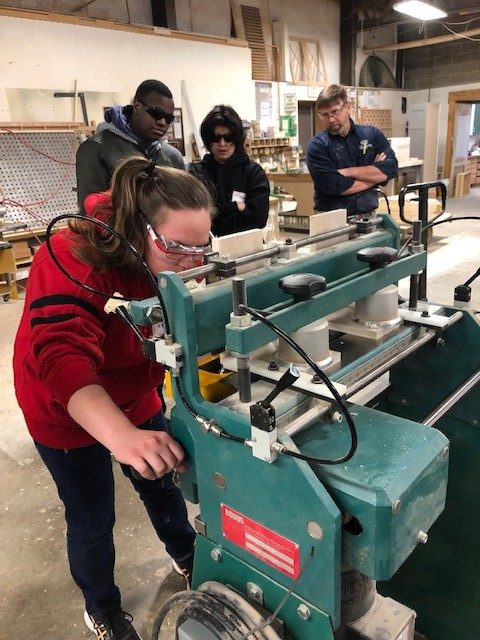
Hannah Paige, Student of the Year from Waldo County Technical Center (WCTC) – Photo was provided by Kevin Michaud, Director of WCTC

On April 27 The Green Ladle at Lewiston Regional Technical Center (LRTC) hosted the annual Maine Administrators of Career and Technical Education (MACTE) Student of the Year event. It was an opportunity for each Career and Technical Education (CTE) site and center across the state to recognize their respective student of the year. Maine Department of Labor Commissioner Laura Fortman served as guest speaker and shared with the students the increased need of skilled workers.

Students who were recognized participated in a multitude of programs including electrical, culinary arts, multimedia, heavy equipment operations, advanced communications, certified nursing assistants, early childhood education, fire science, pre-engineering and criminal justice. Students shared their stories and what the impact of CTE has had on their overall educational experience.

Many of the students are continuing their education at one of Maine’s community colleges, Husson University, Thomas College, Wentworth Institute of Technology, Rochester Institute of Technology, University of New England, Beal College, University of Maine at Presque Isle and Maine Maritime Academy.

Professional Learning Opportunity: Learning Design Lab at Bucksport Middle School

Bucksport Middle School is proud to host a Maine Department of Education Learning Design Lab on Wednesday, June 5th, 2019. The Learning Design Lab will focus on technologies used for project-based learning. Participants will learn from students and teachers in four different classes, spanning grades 5-8.

  • The school’s Digital Media Club will share how they have created a digital newspaper, video announcements, and event recordings;
  • The Gifted and Talented Art program will model ways iPhoto can be used for photo manipulation;
  • 7th grade social studies students will show how they are using several technologies for their Greek mythology project; and
  • Several 5th & 6th graders will introduce participants to their TinkerCAD projects that were used to create bubble wands and boats with 3D printers.

After visiting classrooms, educators will have time to debrief the experience with lead teachers and to be supported as they plan ways to bring what they’ve learned back to their schools. Bucksport Middle School students and teachers are looking forward to leading a day of learning, as well as an afternoon work session where they and participants can develop new ideas together!

  • Date: Wednesday, June 5th, 2019
  • Time: 8:30am – 2pm (arrival begins at 8:00am with light refreshments)
  • Location: 100 Miles Lane, Bucksport, ME 04416
  • Open to all Maine educators who have completed the fingerprinting and background check process through the Maine DOE as part of your employment in your local district.
  • Free to attend
  • Contact Hours: Educators can earn 5.5 contact hours
  • Registration (please complete by Thursday, May 30th at 5pm):

Agenda

8:00am: Arrival (light refreshments will be provided)
8:30am: Welcome and Introductions
9:00am:  Student-led presentations
Digital Media Club (Grades 5-8)
Digital Photo Manipulation (Grades 7-8)
10:00am: Break
10:15am:  Student-led presentations
Greek Mythology Project (Grade 7)
-3D Printing (Grades 5-6)
11:15am: Lunch (will be provided)
11:45am: Conversations with lead educators
12:45pm: Supported planning time
1:45pm: Closing and Reflections
2:00pm: End

For answers to questions or more information, please contact: Amanda Nguyen, Digital Learning Specialist at Amanda.Nguyen@maine.gov

Tips for Supporting Muslim Students During Ramadan and Eid-al-Fitr

Maine is home to many Muslim families, and the Maine Department of Education would like to provide some general information about Ramadan and Eid-al-Fitr to schools, so they can support their schools’ Muslim community members as they enjoy this very special time of year.

Ramadan is a month-long fast observed by Muslims around the world. Fasting during Ramadan is one of the five pillars of Islam. To wish someone a happy Ramadan, you can say “Ramadan Kareem” or “Ramadan Mubarak.”

This year, in the United States Ramadan will start around May 5th and end around June 4th. The official beginning and end of the month of Ramadan will not be announced until the sighting of the new moon. Since the Islamic lunar calendar year is about 11 days shorter than the Gregorian calendar, Ramadan happens about 11 days earlier each year.

During Ramadan, most Muslims fast (i.e., consume no food or water) from dawn to dusk. Many Muslims also pray more frequently and make special efforts to be kind, generous, and compassionate. This is a joyous time of year, and each Iftar (post-sunset meal to break the fast) is a celebrated opportunity to gather with friends and family. Muslims may also wake before dawn to eat Suhoor (a pre-dawn meal), which helps give them energy to endure the day’s fast. (Iftar and Suhoor timings can be found here.) For some Muslims, the typical patterns of sleep are shifted so that more waking hours occur during the night, which can make it difficult to wake up early and stay alert during the day.

Typically, very young children do not fast or may fast only part of the day. Some Muslims may not fast when they are travelling, ill, pregnant, breastfeeding, or menstruating. In these cases, fasting days can be made up for at a later time. Elderly and chronically ill people who are not well enough to fast may give charitably instead.

After Ramadan, Eid-al-Fitr (the festival of breaking the fast) is a three-day celebration with feasts and gatherings of families. This is an extremely important and cheerful time of year for Muslims, and students will likely be absent for all or part of the three days. Children often receive a new outfit or a small amount of money as a gift from their family for the holiday. To wish someone a happy Eid, you can say, “Eid Saeed” or “Eid Mubarak.”

Here are a few tips for supporting students during Ramadan and Eid-al-Fitr.

  1. Learn about Ramadan and Eid-al-Fitr.

There are many resources available online that can help you understand how and why Ramadan is observed. Keep in mind that practices may vary depending on culture, so your students and their families are the best sources of information about their Ramadan traditions. Here are a couple of articles that give a general overview.

https://www.nbcnews.com/news/religion/what-ramadan-six-things-know-about-muslim-holy-month-n586426

https://www.history.com/topics/holidays/ramadan

https://www.britannica.com/topic/Eid-al-Fitr

  1. Encourage cultural sensitivity for all school community members.

Fasting can have many physical and mental effects, such as fatigue, lack of concentration, and irritability. For your students, your understanding and support can help ensure that they continue to learn and make the most out of their time at school while fasting. Teachers, school nurses, sports coaches, bus drivers, cafeteria staff, and all other staff who interact with students will need to know how fasting can affect students.

Talking with staff and students about Ramadan and Eid-al-Fitr helps encourage an atmosphere of cultural awareness and sensitivity for the whole school community. Sensitivity towards fasting students includes avoiding consuming food and beverages in front of them whenever possible. Consider holding any celebrations that include food, such as awards banquets, after Iftar (sunset).

  1. Ask students and their families how you can best support them.

Some schools may choose to offer a place for students to go during lunchtime, alternative options for physical education, or dedicated prayer spaces. Schools may also avoid scheduling assessments or other required activities during Eid-al-Fitr, when students are likely to be absent. The best way to ensure that your school is a supportive, culturally-aware learning environment is to involve students, families, and other community members in planning and policy creation. Check out these two articles for some practical ideas that may benefit fasting students.

https://www.pbs.org/newshour/education/column-teachers-can-support-students-ramadan

http://www.isre.org.au/wp-content/uploads/2014/07/Schools-Guide-to-Ramadan-2.pdf

  1. Have a clear, well-communicated policy on tardies and absences.

Maine’s statute on excused absences is Title 20-A, Section §3272. It states that an absence is excused when it is for “observance of a recognized religious holiday when the observance is required during the regular school day and the absence has prior approval.” Fasting during Ramadan is a required religious observance, and the physical and mental demands of fasting may cause students’ tardies and absences to increase. Eid-al-Fitr celebrations are also religious observances. Districts will need to share clear expectations for attendance with students and families. It is highly recommended to develop these expectations in collaboration with your community members, recognizing that interpretation and translation may be necessary to ensure meaningful communication.


Social Studies Standards Revision- LD 283

On April 19, 2019  Governor Mills signed LD 283, which contained the revised Maine Learning Results for Social Studies. While personal finance has always been included in the standards, this bill and the subsequent revision of the standards were designed to make explicit the importance of this content area.

The signed bill is currently going through the Maine Administrative Procedure Act to officially become law through the Secretary of State’s office. It is anticipated that the law will go into effect near the end of this school year. This timeline allows schools to begin planning for implementation during the summer of 2019. Planning is underway for a series of professional development opportunities around the state in 2019 and 2020, as well as online resources, to help support schools as they transition to use of the revised standards.

In the meantime, a new Social Studies: Standards & Instruction website has been created, along with links to related pages and resources, to help educators and districts begin planning for any curricular changes that are deemed necessary in light of the revised standards.

Input Sought for Teacher Shortage Areas

As part of a federal requirement, the Maine Department of Education submits to the U.S. Department of Education teacher shortage areas for designation, based on collected data and public input.  The U.S. DOE annually designates teacher shortage areas for purposes of deferment of loan repayments or reductions of teaching obligation.

The Department intends to propose the following as K-12 teacher shortage areas during the 2019-2020 school year:

  • Early Childhood (0-5)
  • Early Elementary (K-3)
  • English as a Second Language
  • Gifted/Talented
  • World Languages (French, Spanish, Italian, Chinese, German)
  • Special Education (Teacher of Students with Disabilities, Teacher of Severely Impaired Students)
  • Science (Grades 5-8, Physical Sciences 7-12)
  • Theater
  • CTE (Automotive Mechanic, Carpentry, Computer Information Services, Machine Tool Operator, Weld Braze Solder, Plumbing, Law Enforcement, Co-Op Industrial Training, Agricultural Production, Forestry Products and Processing, Food Production Management, Business Administration, Child Care-Guidance)

The Maine Department of Education is committed to working with our schools to most accurately represent the needs and shortage areas across our state. We recognize the diverse geographic regions and varying conditions that comprise our public education system, and strive for equitable and accurate representation.

To provide input regarding a specific shortage area, or to propose additional shortage areas, please contact Emily Gribben with supporting materials by May 10, 2019.

Employee of the Week: Ida Batista

Maine DOE School Finance Coordinator Ida Batista is this week’s Employee of the Week! Learn a little bit more about Ida in this brief question and answer:

What are your roles with DOE?

My role here at the DOE is School Finance Coordinator, which means I have a variety of tasks related to school finance, such as answering questions on school funding; running some of the “fun” parts of the funding model; keeping abreast of policy/ legislation regarding school funding; and producing federal reports.

What do you like best about your job?

I like helping people and figuring out how to effectively and efficiently implement the many laws and rules that govern the Maine school funding formula, Essential, Programs, and Services (EPS).

How or why did you decide on this career?

I completely believe public education is a common good. It needs to be invested in in a way that allows our children to aspire while enhancing the quality of local communities and therefore the state as a whole.  Prior to working here, I spent a decade doing public education policy research, so this is just another facet of doing the work I love!

What do you like to do outside of work for fun?

For fun, I like to spend time with family and friends. I also enjoy reading, cooking, volunteering, hiking, being outside in nature!!! Oh and getting friends and colleagues to do various races with me!!!

Portland High School Sophomore Class Participates in Job Shadows

Submitted by Andrea Levinsky, Extended Learning Opportunities Coordinator, Portland High School. 

Over 150 students from Portland High School recently participated in the annual job shadow day. Students chose where they would spend the day. Once there, students toured the companies, learned about the kinds of jobs available, the training and education required to get the jobs, did an activity, and had lunch.

A student who went to Maine Medical Research Lab said “The labs, presentation, and speakers were all very interesting and helpful, and was an overall fun experience. The visuals and actually exploring the labs were the best parts.”

One Employer said” The students were a pleasure to work with: very motivated and engaged.”

One business was so impressed by one of their students, they invited the student back to have continued mentorship and engagement with the business!

Participating businesses and organizations included:
Baird Financial Group, Bernstein Shur, Casco Bay Engineering, Colby Engineering, The District Attorney’s Office, iBeCretive, IDEXX, Immigrant Welcome Center, Kepware, Key Bank, King Middle School, LiveVital Physical Therapy, Lincoln Middle School, Maine Medical Center Research Lab, MR Brewer Construction, North Deering Veterinary Hospital, Portland Downtown, Portland Jetport, Portland Museum of Art, Portland Water District, SMRT Architects and Engineers, Tyler Karu Interior Designs, Tyler Technology, Unum, Youth and Family Outreach, and Verrill Dana.

If your business or organization would like to get involved for next year, please contact Andrea Levinsky, Extended Learning Opportunities Coordinator at levina@portlandschools.org.

Rural Schools Tackle Attendance Issues at Spring Summit in Bangor

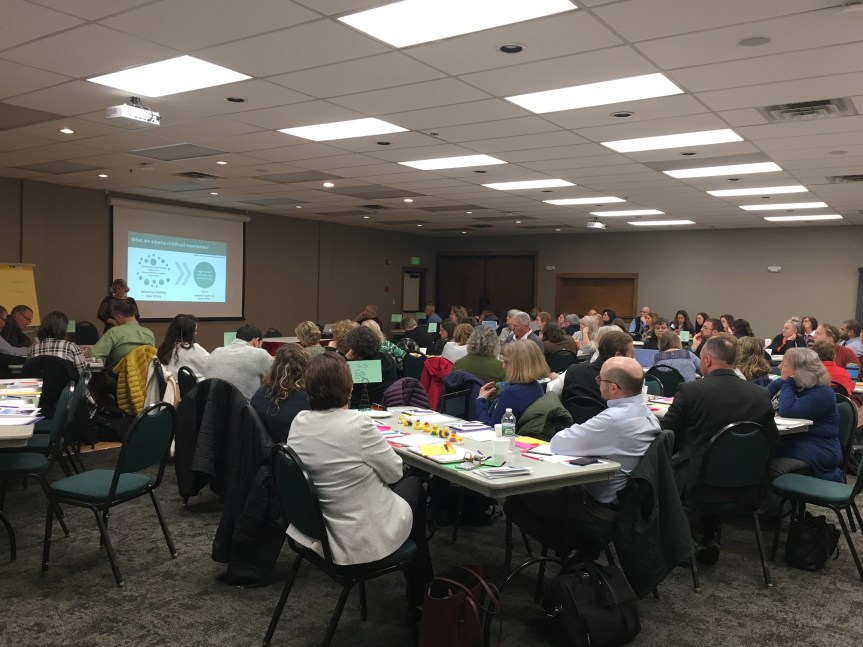
District and school administrators and educators from thirty-six districts and education entities in rural Maine convened at Jeff’s Catering in Bangor recently for the first ever Rural Maine Attendance Summit organized by RSU 74 Superintendent Mike Tracy. After looking at his own data submitted to the Maine Department of Education last spring, he found that some of the students in his district were out of school enough to be defined as chronically absent. In his efforts to be proactive about the issue, Tracy looked to available resources only to find that they were mostly geared towards urban school districts. That’s when he began working on plans for the rural attendance summit.
With the collective understanding that small rural school districts must approach things differently than bigger urban school districts, the summit aimed to help generate more tools, and allow for the exchanging of ideas regarding the growing issues that are keeping kids from accessing school in rural Maine.

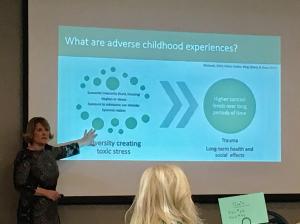
The day long summit provided participants with the opportunity to hear from key note speakers, Emanuel Pariser from the MeANS school, and Britney Ray from Washington County’s TREE program – Transforming Rural Experiences in Education. Each speaker provided information and expertise about working with students and parents who may be experiencing Adverse Childhood Experiences (ACEs) and/or childhood trauma. In addition, district officials could share specific issues in their own communities, collaborate on solutions that were working, and pose specific questions to a panel of experts.
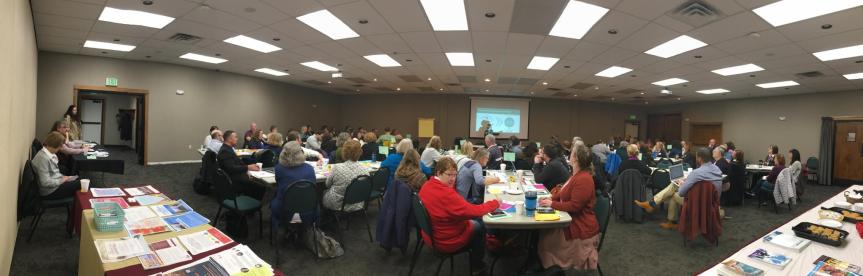
Rural Maine School Districts with less than 1,000 students and other stakeholders were invited to attend. In addition to host district RSU 74, others in attendance were Goodwill Hinckley, MSAD 54, RSU 68, Otis School Department, RSU 93, RSU 89, AOS 94, RSU 73, MSAD 41, Snow Pond, RSU 84/MSAD 14, MSAD 37, Union 69, RSU 26, RSU 19, Medway, MSAD 20, RSU 25, Cornville, RSU 10, MSSA, Sunrise Country School, RSU 67, AOS 91, MSAD 59, MSAD 46, CSD 13, Athens, MSAD 70, ME Charter School, UMF, AOS 96, MSAD 30, AOS 90, and Calais.

Panelists included Martha Kempe, Head of Schools at Wayfinder Schools; Sue Reed, Maine DOE Early Childhood Specialist; Ashley Cirone and Laura Thomas, TREE Program Coaches; Catharine Biddle, Assistant Professor of Educational Leadership at UMaine and researcher for the TREE Program; and Susan Lieberman with Count ME. They fielded audience questions about strategies that involve parent and student voice, treatment options that may not typically be found schools, and ways to make school a priority for students and their families. Members of Maine DOE’s Data team were also on hand to answer questions about reporting requirements and to learn more about the needs of rural schools when reporting attendance data to the state.

The day included workshop time for attendees to meet with other districts and share ideas that were working in their schools, and closed with an opportunity for attendees to work with the people from their own district to work on a plan moving forward.

School officials left with various action plans that included strategies involving better outreach and partnerships with parents, home visits, team approaches and/or committee groups to research and take action, attendance awards and incentives, hiring on social workers and school resource officers, early-day or before school programing that kids won’t want to miss, and working more closely with the Department of Health and Human Services (DHHS).

For more information and resources visit https://www.ruralmaineattendance.com/.

2019-2020 Maine Education Financial System (MEFS) Budget Upload now open

It is school budget time of year again for each school administrative unit (SAU) and Career & Technical Regions. School district budget uploads are due within 30 days of the school budget passing, or by August 2, whichever comes later. This is in accordance with 20-A M.R.S. Chapter 606-B.

Municipal school units and Charter Schools must upload the budget expenditure and revenue files to MEFS, submit the school budgets warrant articles, budget meeting minutes, and vote declaration of the referendum (if required) to the department.

Regional School Units, School Administrative Districts, Community School Districts must upload the budget expenditure and revenue files to MEFS, submit the school budget warrant articles, budget meeting minutes, vote declaration of the referendum (if required), and fill out the EF-M-46 in NEO.

Career & Technical Regions must upload the budget expenditure and revenue files to MEFS along with meeting minutes of the meeting where the budget was approved and fill out the EF-M-46V in NEO.

Budget uploads to MEFS must reconcile to the budget warrant articles and other supporting documents.

For more information or assistance please contact Denise Towers, 624-6863 or Tyler Backus, 624-6635.

#DigCit4ME Challenge Highlights Top-finishers and Concludes with Webinar Opportunity on May 9th, 2019.

Since January 2019, educators across the state of Maine have been participating in a blended learning experience designed to support schools as they integrate Digital Citizenship concepts into various student learning opportunities. In particular, participants learned how the Health Education and Physical Education Standards intersected with the Common Sense Media Framework, as well as opportunities to explore these concepts within other content areas.

The #DigCit4ME Challenge featured in-person workshops (agenda and resources)  and an online game designed collaboratively between the Maine Department of Education and Alludo Learning.

Several educators asked questions about the process of designing a blended learning opportunity, so the Department will co-host a webinar where the team from Alludo Learning will discuss the pedagogy behind their design (including gamified learning, evidence-based learning, choice-based learning, and digital badging) and the Department will talk more about our process of designing this blended learning opportunity. Educators will have the opportunity to ask questions at the end of the presentation.

Webinar Details:

Additionally, the Department would like to celebrate the participation and success of educators who joined the #DigCit4ME Challenge. Educators and districts competed in the online game, and the results are in:

Districts:

  • First Place: RSU18
  • Second Place: MSAD 17
  • Third Place: Boothbay Region Schools
  • Fourth Place: Falmouth Schools
  • Fifth Place (tie): RSU 10 and Yarmouth School System

Educators: *There were some educators who would have placed with high scores, but we didn’t have permission to print their names!

  • First place: Tim Hebda (Wayneflete School)
  • Second place: Matthew Drewette-Card (MSAD 46)
  • Third place: Maria Reinstein (RSU 10)
  • Fourth place (tie): Kelly Fraser (MSAD 44) and Carisa Hammer (MSAD 17),
  • Fifth place (tie): Allison Braley (RSU 25), Chris Kierstead (RSU 18), Ryan Palmer (MSAD 75), and Nick Shuman (York School Department)

Congratulations and thank you for everything you did to provide evidence of your learning!

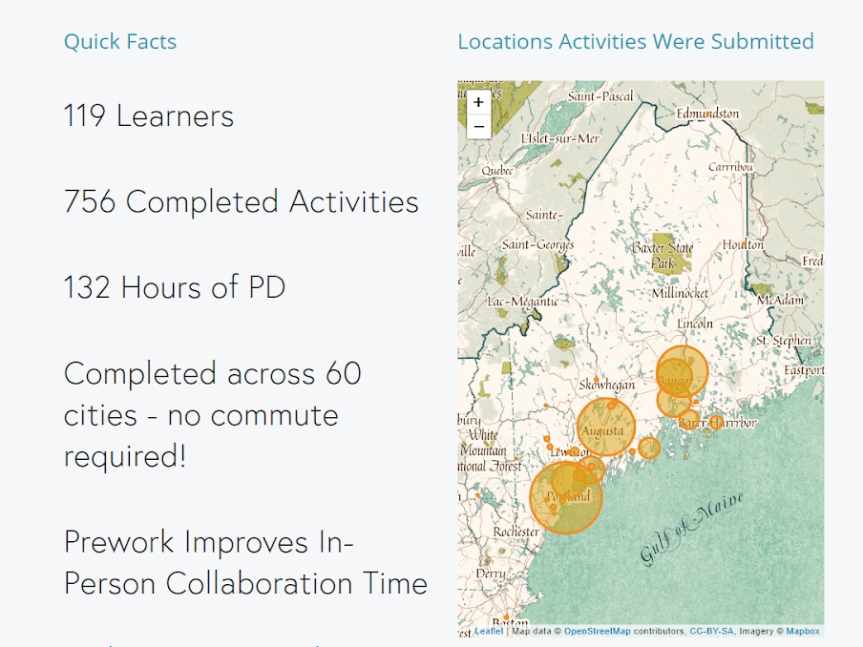
Overall participation:

Credit: https://www.alludolearning.com/maine-doe-pilot?rq=digcit

For answers to questions or more information, please contact:

Amanda Nguyen
Digital Learning Specialist
Maine Department of Education
Amanda.Nguyen@maine.gov
Office: 207-624-6656
Cell: 207-441-5757