MEDIA ADVISORY: Maine DOE to Host Presentation About ESSA & School Report Cards

The School Report Cards are scheduled to be released to the public at the end of December.

WHAT:
The Maine Department of Education (DOE) would like to invite the media to attend a presentation about the details of Maine’s Model of School Support under the Every Student Succeeds Act (ESSA) which includes the release of the new, user-friendly, public Report Cards later this month.

WHEN:
Monday, December 10, 2018 from 9:00am – 12:00pm

WHERE:
Cross Office Building, 111 Sewell Street, Augusta, Maine, Room 500
Live Stream Link: https://zoom.us/j/867836618 (this will be recorded)

AGENDA:

  • Opening comments from Commissioner Robert G. Hasson Jr.
  • Overview of Maine’s Model of School Support (1 hour)
    • Overview of Indicators
    • Overview of School Support
    • Questions & Answer session
  • Overview of Maine’s Report Cards*  (1 hour)
    • New format for report card
    • Walk through of the Report Cards
    • Questions & Answer session

*For the 12/10/18 presentations, the Report Cards will be displayed with sample data. The public Report Cards, with school data for each public school in Maine, will not be released until the end of December.

For further information please contact Maine DOE Director of Communications, Rachel Paling at rachel.paling@maine.gov.

Regional School Calendars Due May 3, 2019

School administrative units and private schools approved for tuition purposes are expected to establish regional school calendars, in coordination with their local secondary career and technical education school, by May 3, 2019.

The Legislature enacted that requirement as part of Public Law 2011, Chapter 686, which expands access to career and technical education in Maine and ensures that students completing career and technical education (CTE) coursework have greater access to post-secondary opportunities. Specifically, the law addresses scheduling conflicts that pose barriers to students by requiring that those school districts and private schools approved for tuition purposes that share a CTE school adopt a regional school calendar with no more than five dissimilar days. Furthermore, implementation of the law is intended to promote collaboration among local school administrative units that may benefit other forms of inter-administrative unit collaboration beyond CTE.  The law became effective Aug. 30, 2012, and establishing the regional calendar is a condition for eligibility for state subsidy.

For school year 2019-20, both regional school calendars and individual calendars for each school administrative unit must be submitted by the director of the local CTE Center/Region to the Department of Education no later than May 3, 2019 for a decision on approval by June 7, 2019. Guidance and templates can be accessed electronically at www.maine.gov/doe/regionalcalendar/.

Given the coordination required for fulfillment of this law, the Maine DOE recommends that school districts initiate discussions as soon as possible, including representatives from all affected secondary schools and their associated career and technical education center or region.

For more information including guidance, instructions, templates, a waiver process, and a link to the complete law, please visit www.maine.gov/doe/regionalcalendar/.  Further questions should be directed to Doug Robertson doug.robertson@maine.gov / 624-6744 or Dwight Littlefield dwight.a.littlefield@maine.gov / 624-6721.

Maine Education Assessments Released Items Now Available

The Maine Department of Education is excited to announce the availability of released items from Maine’s 2017/18 state assessment. As educators begin to explore the released items for MEA spring 2018, we want to clarify a few inconsistencies within English Language Arts(ELA)/Literacy and Mathematics and provide some information about released items moving forward.

ELA/Literacy:

In grade 3 eMPowerME reading, the passage students read while completing the assessment is not available for reference. Unfortunately, the assessment vendor, Measured Progress, was unable to obtain the necessary permissions to release the passage for public use. Fortunately, the passage used is a commonly known text, Corduroy, (Freeman, D. (1987). Corduroy. Harmondsworth: Puffin Books.). Educators should pay close attention to the information contained within the released item to guide use of the materials. Moving forward, the Maine DOE has taken steps to ensure that all passages utilized in any future released items will have the necessary permissions obtained for both confidential and public release.

Additionally, when the released items first became available on 11/12/18, there was a misalignment in the numbering of the ELA/Literacy released items in the Confidential MAARS portal versus the Released Item Documents found in the Measured Progress’ WordPress site. In the MAARS released item chart, the Essay item, indicated by “Item Type” WP (writing prompt), was originally reported as Released Item #01 in all grades, followed by Reading, then Writing & Language released items.

This is an example of the way ELA/Literacy Grade 3 released items chart first appeared in the confidential MAARS portal:

releasedItems1

In the Educator Support Materials for the eMPowerME Released Item Documents (pdf), the last 2 pages are Math and ELA/Literacy released item information charts. In the ELA/Literacy chart (Grade 3 example below), the Essay is presented last, and the numbers for Reading and Writing & Language correspond to the item numbers in the released item booklets, but not to the released item numbering in the MAARS chart above.releaseditems2
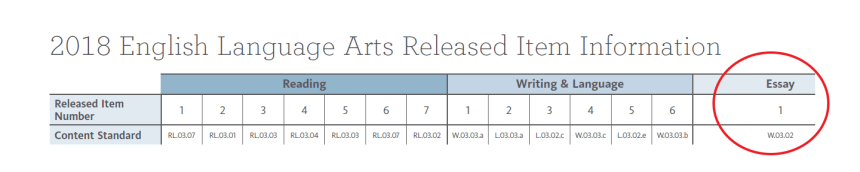
The placement of the Essay score (Writing Prompt/WP) has been corrected in MAARS Confidential to appear as the last item in ELA, as shown below in the sample snapshot for Grade 3:

releaseditems3

The new, correct placement of the WP/Essay score for each grade is as follows: Grade 3=#14, Grade 4=#17, Grade 5=#14, Grades 6, 7, and 8=#16.

Mathematics:

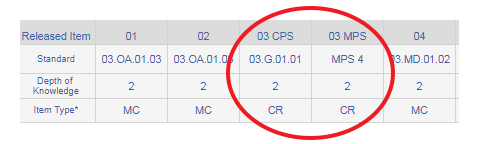
When the released items became available on 11/12/18, there was a constructed response (CR) item in math omitted from the MAARS confidential reports in every grade 3-8. eMPowerME math released items include multiple choice items (MC), multi-select items (MS), and one (1) constructed response item (CR) per grade level. The math CR items have now been added to MAARS Confidential and are slotted in the tables according to the placement of the CR in the released items. The Math CRs are scored in 2 parts: Concepts & Procedures Standard (CPS) and Mathematical Process Standard (MPS) as shown below in the sample snapshot for Grade 3:
releaseditems4

NOTE: ELA/Literacy & Mathematics – The best way to align the released item numbering from the charts in MAARS to the released item PDFs is to follow the Tables on the last 2 pages of each grade level’s pdf titled “2018 Mathematics Released Item Information” and “2018 English Language Arts Released Item Information”.

Future eMPowerME Released Items:

The Maine DOE is committed to providing as many resources as possible to support instructional practice. One such support is the availability of released items. Unfortunately, the frequency in which the Maine DOE is able to release items is currently limited to 2017/2018 and 2019/2020. We will be unable to release items from the 2018/2019 test administration. There are many factors that have impacted this decision and the Maine DOE is exploring how to increase the frequency of releasing items while not increasing the amount of testing time for students. It should be noted that although released items will not be provided from the 2018/19 test administration, educators will still have access to the released items from the 2017/18 test administration in addition to the already available sample items.

Further questions can be directed to Lee Anne Larsen, Acting Deputy Director, Office of Learning Systems at 624-6628 or Leeann.Larsen@maine.gov

MEA Alternate Science – PAAP Opens First Week of December

The PAAP Task Bank is now open. All teachers assessing students using the MEA Alternate assessment for science in grades 5, 8, and third year high school may now log in.

Measured Progress Log In

Teachers must go to the registration page tab to create a new password.  Please refer to the User Guide for assistance.

Please contact Sue Nay at sue.nay@maine.gov or telephone 624-6774 for assistance.


Guidance Regarding Storm-Kit Days (a.k.a. Blizzard Bags) for Students

The Department has had a number of inquiries about the use of Anytime-Anywhere school days and learning (a.k.a. e-learning, storm kits, blizzard bags, snow packs). This communication is to clarify the current status of requirements regarding makeup days for cancellations due to weather or other unforeseen circumstances as it relates to Anytime-Anywhere or home-based instructional days.  Please know that the Department is currently in conversations and exploring data and best practices around this topic, and anticipates further information and guidance to be forthcoming in the winter and spring of 2019.

Anytime-Anywhere Learning school days are not currently on the list of approved options for calendar revision due to snow day make-up in Maine pursuant to 20-A M.R.S. §4801 and Maine Department of Education Rule Chapter 125(6.02)(C). Thus, electronic school days or other types of home-based instructional time will not be approved toward the 175 required instructional day requirement, except as provided below.

The Department has responded to previous inquiries indicating that school administrative units could consider building such a plan into a future school year, as long as certain guidelines were followed. This email outlines those guidelines, and stipulates the extenuating circumstances under which an Anytime-Anywhere day may be helpful to districts.

A local school board must anticipate the probability of snow cancellations and build extra instructional days into its calendar. The Department recommends that units build at least 5 days into the school calendar for this contingency, as they may not use home-based, or Anytime-Anywhere learning, as an un-planned response to excessive weather-related cancellations, or as a means to revise an established calendar.  Incorporating the idea during yearly district calendar planning allows the methodology to be researched and planned well in advance and perhaps piloted to see how well it works in the curricula continuum, as opposed to implementing something new without building it into the overall district plan.

After the 5 day snow day contingency is established in the calendar, if the local school board contemplates an Anytime-Anywhere learning option as part of the calendar planning process prior to the start of the school year, and none of the days supplant the required 175 days or the 5 extra planned makeup days, then the option may be implemented. If implemented, the board must include these storm pack days as part of any waiver request to the Commissioner in the spring.  Thus, they would not be considered instructional days, but if implemented following the guidelines herewith in paragraph 6, a waiver for those days may be granted by the Commissioner.

School board calendar planning regarding Anytime-Anywhere days should take into account the following guidelines:

  1. School board must vote on the specific use of Anytime-Anywhere days within the regional calendar planning process prior to the current school year, and after 5 days of regular makeup days have been established.
  2. Parents must be notified of the provisions of Anytime-Anywhere school days.
  3. Anytime-Anywhere days must be included as part of a waiver in relation to school cancellation days; and the waiver request must include the original school board statement of plan regarding makeup contingency days and Anytime Anywhere days.
  4. Anytime-Anywhere learning must be age appropriate and timely within the curriculum being delivered, and must include an accountability expectation.
  5. Anytime-Anywhere learning must include the ability to speak to one or more educators during the hours when school would normally be in session.
  6. If Anytime-Anywhere learning includes an electronic component, the SAU must provide an alternative method by which the work may be accomplished, to ensure universal access to the material.

Please contact Pamela Ford-Taylor, Maine DOE School Enrollment Specialist at 207-624-6617 or Pamela.Ford-Taylor@maine.gov with questions.

PRIORITY NOTICE: Information for Schools About National Day of Mourning

As part of the National Day of Mourning that has been declared for Wednesday, December 5, 2018 in honor of President George H.W. Bush, who passed away Friday, November 30, Governor Paul R. LePage has directed that all executive branch State of Maine offices will be closed on Wednesday, December 5, 2018. Please be aware that public schools are not covered by this directive.

In a public statement released yesterday, Governor LePage stated, “I encourage our schools to use the National Day of Mourning as an important opportunity to learn about the life and legacy of President Bush, including such potential topics as the American Presidency, World War II and the Cold War. Schools should exercise their judgement as to age-appropriateness regarding watching the State Funeral.”

If schools opt to recognize the National Day of Mourning by closing school, they may use extra days built into their school calendar, the same as for a storm closure or other unexpected closures. A closure on the December 5, 2018 National Day of Mourning will not reduce the minimum requirement of 180 school days and 175 instructional days, pursuant to Title 20-A, Chapter 209.

PRESS RELEASE: Maine DOE Awarded $2.88M Grant to Support School Emergency Operations Plan Initiative

Update: Schools will receive an invitation from the Department to participate in grant activities this spring. 

The Maine Department of Education has been awarded a 5-year grant from the Office of Elementary and Secondary Education, U.S. Department of Education. The funding will go towards an initiative called Maine Grant for School Emergency Management aimed at helping Maine schools by providing training and technical assistance in the development and implementation of high-quality school emergency operations plans (EOPS).

This project is grounded in the belief that multihazard emergency planning for schools helps schools and communities prepare for, respond to, and recover from critical incidents. The Maine Grant for School Emergency Management project is the next step of work that began with a Maine School Security Report that was initiated by the Maine Legislature.

The primary goals of the Maine Grant for School Emergency Management project are to:

  1. Provide schools, especially those identified as high need in rural areas, with high-quality EOP training at no cost.
  2. Ensure that local educational agencies have access at no cost to a new customizable EOP template that can be easily updated and includes technical guidance.
  3. Provide high-quality EOP technical assistance clinics at no cost that will be delivered to develop a team of education sector professionals who are committed to work with schools.

The grant allocation is over five years:

Year 1: $614,773
Year 2: $567,920
Year 3: $567,920
Year 4: $567,920
Year 5: $567,920
Grant Total:  $2,886,453

The grant activities, as awarded, are one hundred percent federally funded. No project costs will be financed by non-governmental sources.

The Department of Education takes school safety, security, emergency management, and preparedness seriously and is continually taking steps to improve it.

Further questions and inquiries can be send to Pat Hinckley, Maine DOE Transportation and Facilities Administrator at pat.hinckley@maine.gov.

Learning Through Technology Survey

The Maine Department of Education is seeking input to inform the work of leveraging technology to improve student learning. The survey should take no more than 5 minutes to complete. Maine DOE leadership will be reviewing the results as it plans for continued support of technology integration in Maine schools.  The survey will remain open until December 21, 2018.

Learning Through Technology Survey

For additional information, please contact Lee Anne Larsen (leeann.larsen@maine.gov) or Beth Lambert (beth.lambert@maine.gov) on the Standards and Instructional Support Team.

Using Assessment to Strengthen Instruction in English Language Arts, Mathematics, and Science, K-8

As part of its 2018-19 Assessment Literacy series, the Maine Department of Education will present full-day workshops to continue supporting educators in examining eMPower ELA and math, and MEA science assessment data, connecting that data with locally generated assessment information, and identifying high impact instructional strategies that foster student engagement and achievement of learning standards.

State level assessment provides school systems with a useful lens through which educators can evaluate the effectiveness of curricula and instructional practices. This information can help educators improve programming to increase the number of students meeting expectations for learning standards in English language arts (ELA), mathematics, and science. The availability of released item data and sample state assessment items, coupled with local level assessment information, enables educators to dig more deeply into what instructional practices are benefiting student learning as well as where adjustments could be made to result in greater positive impact.

Join Maine DOE ELA, Math, and Science specialists as they provide professional learning and resources that:

  • Connect state eMPower and science assessment to instructional practices
  • Delve into the roles cognitive demand and stamina play in instruction and assessment
  • Explore protocols for linking state level data analysis with local level data analysis

Participants will select one of 3 content areas in which to focus their learning during the day: English language arts, mathematics or science.  Schools are strongly encouraged to register teams of 3 so that they will have representation in each of the 3 featured content areas. An alternate option is for educators to come as a team representing one content area (e.g. science teachers from a middle school).  Time will be provided during the day for teams to share their learning across content areas and to collaboratively plan for how to disseminate the day’s content back in their respective schools. Lunch will be provided during each full day session which will run 8:30 am – 3:30 pm. Contact hours will be provided.

Cost is $40 per individual or $100 per 3-person team. Registration requires a credit card.  

Workshop Locations/Registration Links Workshop Dates
Keeley’s Banquet Center, Portland January 15, 2019
Snow Date: February 1, 2019
Jeff’s Catering, Brewer January 24, 2019
Snow Date: January 31, 2019
University of Maine at Presque Isle January 29, 2019
Snow Date: January 30, 2019

For further information, please contact Lee Anne Larsen, Acting Deputy Director of the Office of Learning Systems at 207-624-6628 or leeann.larsen@maine.gov.

Maine DOE to Provide Complimentary 2018-19 Law Books to Superintendents

The Maine Department of Education (DOE) acquired enough copies of the Maine Education and School Statutes 2018-2019 Edition law book from the publisher, Swan Island Press, to distribute one, at no charge, to each superintendent of schools in Maine.

The law books are in the mail and should be received soon. To purchase additional copies of this law book directly from Swan Island Press, please contact Aaron Chase of Swan Island Press at info@swanislandpress.me.