What do you get when you combine adult education students, a tour of Kennebec Valley Community College (KVCC), and a variety of delicious pies? The answer is Brighter Futures!
A successful, immersive event occurred earlier this spring when 18 students from four local adult education programs spent two hours on the KVCC campus. In addition to touring the campus, students met the dean of students, key student success support staff, and a Maine Educational Opportunity Center advisor. After the tour, they enjoyed pie and ended the day with a fun activity led by a faculty member. The event was so successful that there are plans to offer it at least once a year.
Carolyn Haskell, the College and Career Success Coordinator (CCSC) at KVCC, a position funded through the Maine Jobs and Recovery Plan, played an integral part in planning the event and worked closely with Teresa Smith, KVCC Director of Enrollment, to make it a success. Area adult education directors and staff marketed the event and accompanied students to the campus.
Part of Haskell’s role is to be the on campus contact for adult education students interested in attending KVCC. Haskell is a resource for students navigating the college process and adult education. Being on campus gives her a unique perspective and informs how she advises students. She helps ease the transition from adult education to college and supports students along their college journey to help them succeed. She also connects current KVCC students to adult education for services to help them while they are in college.
Haskell has seen the power of getting adult learners to college campuses and believes that allowing them to see themselves as college students is monumental. She said, “Once they tour the campus, it is much easier for them to think of college as a goal to be accomplished rather than a dream.”
This story was submitted by Kennebec Valley Community College (KVCC). To submit good news about your school to the Maine Department of Education, complete our Good News Submission form.
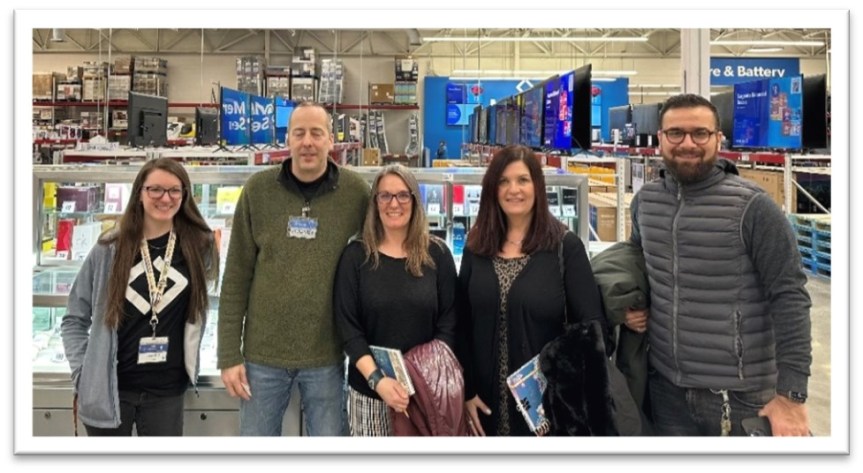
(Pictured: Karen and Adult Education colleagues work with Sam’s Club to develop a workforce program.)
Karen Morin, a long-time resident of Kennebec County, has worked in crisis services, corrections, and risk reduction for the military. For a little over a year now, she’s been a Career Advancement and Navigation Specialist employed by the Adult Ed hub in Kennebec County. She is one of four “Career Navigators” funded by the Maine Jobs Recovery Plan (MJRP).
MJRP has committed $6 million to Adult Education in Maine to address the workforce development needs of those disproportionately impacted by COVID-19. The Maine DOE Adult Education Team has been helping eligible adults and employment sectors recover from the pandemic’s stresses through various academic and job training supports, including Career Advancement Navigator Specialists.
In Karen’s first year as a Career Navigator, she has worked with more than 220 people in Kennebec County to help them move forward in their careers, whatever that may be. Her clients are getting employed, participating in workforce training, improving their resumes and interviewing skills, acquiring English language skills, transitioning fields, and more. She’s worked with local unemployed and underemployed people, new Mainers, people coming out of the criminal justice system, and unhoused individuals, among others. She also works with employers and supports them in their hiring needs.
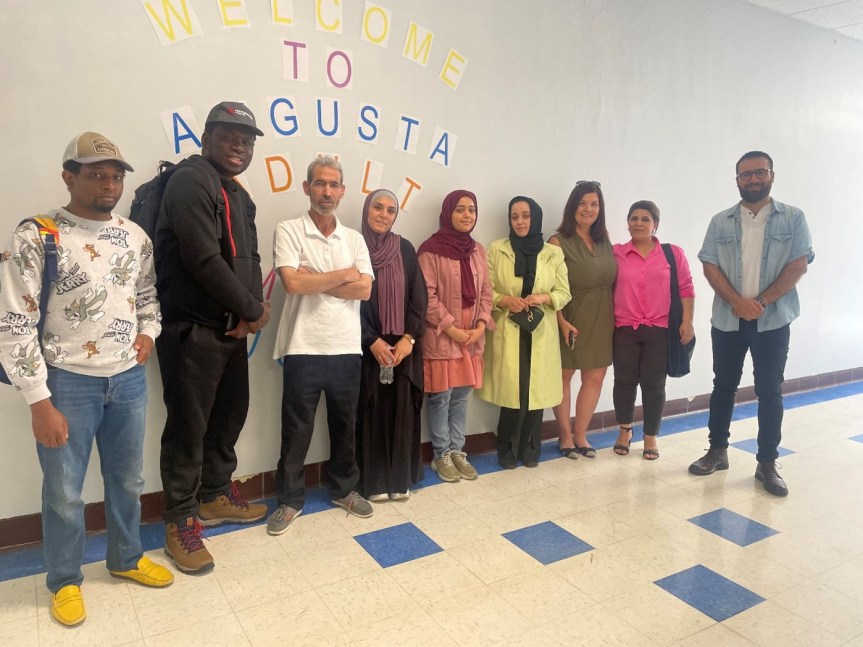
In this photo, Morin and colleagues prepare learners for the process of applying and working at Maine General in their Strengthening Maine Workforce program that provides English classes onsite at Maine General as a part of the employee’s work day as well as opportunities for advancement.
“Take the time to listen to someone’s story—you can learn a lot about someone from a short conversation. Often, if you can’t make a connection with someone in the first ten minutes, you’ve lost them,” said Morin.
She also shared that “talking with people and businesses together reduces the hiring process time between the application and the hiring.”
She provides a direct connection to individuals looking for work and businesses looking for employees. Karen meets people where they are in their career journey through her low barrier and personalized services, including meeting up with them at a convenient location. Though she’s based in multiple local Adult Education programs (Mid Maine Adult Education, Augusta Adult Education, and Winthrop Adult Education), she meets people virtually, at various community agencies or businesses, at the shelter, or even for support at interviews.
She posts on the website What’s Up Waterville, walks into businesses to see what their hiring needs are, and follows job postings on the chamber’s website to make qualified candidates more aware of opportunities. COVID-19 exacerbated problems in Maine that have long existed: transportation barriers, childcare availability and affordability, and housing. Having community-embedded, low-barrier services is deeply necessary. Also of great importance is the collaboration of agencies. Karen collaborates with critical partner agencies and organizations such as CareerCenter, Jewish Community Alliance, Catholic Charities, Capitol Area New Mainers Project, and the local Chambers of Commerce.
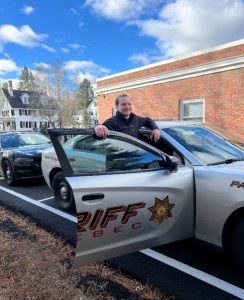
In this photo a new Mainer participates in a ride along and information interview with local law enforcement.
There are currently only three other Career Navigators in this role in Maine. Karen’s colleagues include Kate Points, who serves York County; Frank Spurr, in Androscoggin and Oxford Counties; and Cassie Robichaux, who serves multiple counties, including Sagadahoc, Lincoln, Knox, and Waldo Counties.
At a listening session for the sustainability of these positions, one community member said, “There should be a Career Navigator in each county in Maine.” Collectively they’ve connected with over 1101 people in their communities. However, funding is currently provided by the Maine Jobs Recovery Program, and the future of this program is uncertain.
The Maine Department of Education (DOE) is pleased to announce the release of two requests for proposals (RFP) as required by the Workforce Innovation and Opportunity Act (WIOA), to award multi-year funding to eligible agencies for the provision of WIOA Title II Adult Education and Family Literacy Act (AEFLA) 231 services and the provision of WIOA Title II Adult Education and Family Literacy Act (AEFLA) Section 243, Integrated English Literacy and Civics Education/Integrated Education and Training (IELCE).
It is the purpose of Maine Adult Education under WIOA to provide adult education and literacy services that align with the goals in the State of Maine Unified Plan and encourage the growth of educational opportunities and, where applicable, to ensure career, citizenship, and college readiness for all Maine adults (Maine Education and School Statutes 20-A, 8601).
Signed into law in 2014, the Workforce Innovation and Opportunity Act (WIOA) requires the alignment of workforce, education, and economic development systems to support access to high-quality, comprehensive, and accessible workforce services for all individuals, including those with significant barriers to employment. Title II of WIOA retains and expands the purposes of the Adult Education and Family Literacy Act (AEFLA), which aims to help adults, including immigrants, acquire the skills and knowledge necessary to obtain employment, become full partners in the educational development of their children, improve economic opportunities for their family, and aid in the transition to postsecondary education and training.
The request for proposal (RFP), which includes information regarding eligibility, program requirements, and more, is available here.
Below is the anticipated timeline for the Department’s current AEFLA grant competitions:
Deadline for Submission of Questions in Response to RFP
February 9, 2024
January 25, 2024
Proposal Deadline
March 7, 2024
February 29, 2024
Grant Award Notifications
May 2024
May 2024
Grant Award Start Date
July 2024
July 2024
Please be advised that the dates above are subject to change. Interested organizations must consult the RFP document for the most accurate dates and deadlines regarding this opportunity.
For more information on AEFLA 231 and 243 , contact State Adult Education Director Megan Dichter at megan.dichter@maine.gov.
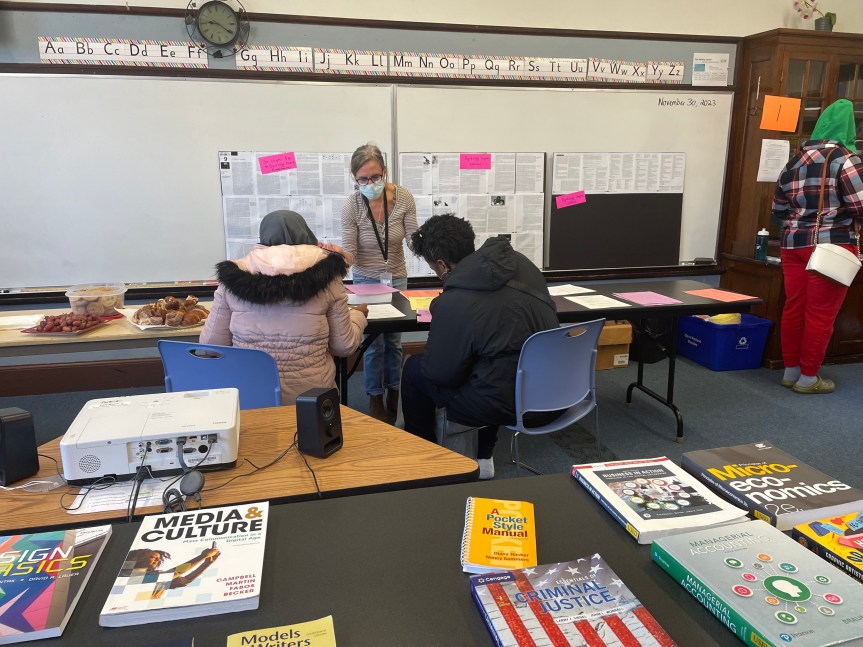
(Pictured: Heather Wood, Dean of Instruction at Portland Adult Ed helping students at a reading and writing station during a recent “Curious About College” workshop.)
Portland Adult Education recently launched a new program, “Curious About College,” that aims to empower adult learners interested in embarking on their higher education journey. Adult Education in Maine has offered Maine College and Career Access (MCCA) programming since 2001 (formerly called College Transitions) to provide readiness for pathways to postsecondary education and careers. With increased enrollments in community colleges across the state and the opportunity of “free college,” student preparedness programs and collaborative partnerships are needed now more than ever.
Anja Hanson, Academic Advisor at Portland Adult Education shares some history and context about “Curious About College”:
We started meeting last year because we felt that prior orientations, meetings, and classes didn’t fully communicate to students what we wanted learners to understand about college in the U.S. This is true for both first-generation and multilingual students. Why should they understand? Preparing for college is so abstract, complicated, and baffling.
Simulated College Experience
We wanted to find a way to make it more concrete. This is how “Curious About College” came to be. We wanted students to do all of the following:
Handle current college textbooks
See the pages of a single psychology textbook chapter spread out on a wall
Listen to a lecture and take notes
Find information on a syllabus
Figure out which math class their degree program would require at SMCC
Plan a week’s schedule that includes all the obligations that work and family demand of adult students
Know what fees they would have to anticipate
Since most of our students are planning on attending SMCC, we used materials in current use there, and we set up 6 stations so that students could engage in activities and ask questions. We gave them checklists to take notes on what they noticed or learned. What we observed last spring and during our recent fall session is that students at various levels of English proficiency and sophistication about college can all get something from this event.
Hanson shared that as they moved about the room, students helped each other. They looked overwhelmed. They looked intrigued. It’s not as though they could learn everything they needed to know in this brief event, but they could discover that they had more to learn, which is precisely what they must understand if they want to go to college.
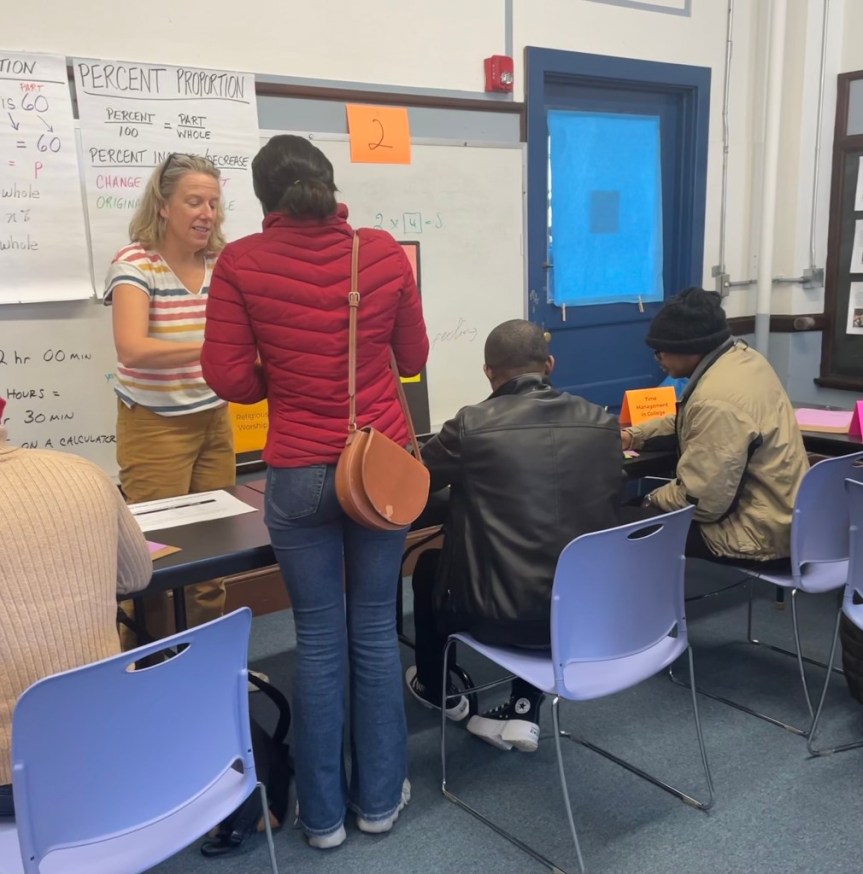
This photo is from a Time Management station 15 minutes after the event officially ended. Hanson shared that, “it suggests something about how much students need opportunities like these to grapple with what their dreams and goals will demand. We’d love to see other high schools and adult education programs offering Curious About College events.”
Alice Shea (College and Career Success Coordinator) at a time management station.
Feedback from Learners
Students observed how fast the English lectures were when they had to take notes while translating mentally. They noted the amount of time they’d need to commit for reading, planning and completing assignments, the costs of textbooks, how all the programs require math, and the heavy amount of writing. One learner noted that every [degree] program at SMCC requires math. After the event, some learners reflected that it would not be easy, but with practice, they can succeed while others decided they were not ready yet. All learners left the event more aware of college requirements and what it would require to be successful.
Empowering Adult Learners
“Curious About College provides a strong foundation where I can discuss the realities of college and the college system with students, said Alice Shea, College and Career Success Coordinator at SMCC. “I would love it if all students entering college had the opportunity to experience Curious About College. The event empowers students to understand their strengths and limitations and make decisions that will help them be successful in the college system. It takes me out of the role of ‘advising’ students and moves me into the role of a professional colleague engaging in a guided conversation with a student where they decide what works best for them.”
Shea is one of seven College and Career Success Coordinators (CCSC) located at each Maine community college and employed by local Adult Education programs funded by the Maine Jobs Recovery Plan. These roles serve prospective and current community college students as they work toward their goals at the college. Priorities for the CCSCs are Adult Education learners and enhancing the collaboration between Adult Education and their respective community colleges.
Heather Wood (Dean of Instruction at Portland Adult Education) and learners at a Reading and Writing station.
Alice Shea (College and Career Success Coordinator) at a time management station.
Carmen Moreno-Diaz (Intercultural Center Director at SMCC) at a What is Free with Free College Station.
Current and Future Endeavors
Portland Adult Education, Hanson, and Shea seek to expand this opportunity for learners in their community and are demonstrating a mock event for other Adult Education programs in Cumberland County to see the model in action. Shila Cook, ABE/ELL Coordinator at Westbrook Adult Education, and colleagues are holding a Curious about College event for Westbrook High School students and Adult Education learners in late January. Shea’s College and Career Success Coordinator colleagues across the state are working on similar programming to support their adult learners in their college endeavors. At Eastern Maine Community College, Brian Loring, the Success Coordinator there, will offer monthly sessions to interested Adult Education learners, especially HiSET graduates at EMCC. At Kennebec Valley Community College, Carolyn Haskell and colleagues are preparing a “Brighter Futures Day” for March. This is an event for Adult Education learners to come to campus and learn more about what being a student there requires as well as their opportunities and resources. This semester, Adult Education’s MCCA through Turner Adult Education, will hold their class at Central Maine Community College to immerse learners in the college environment.
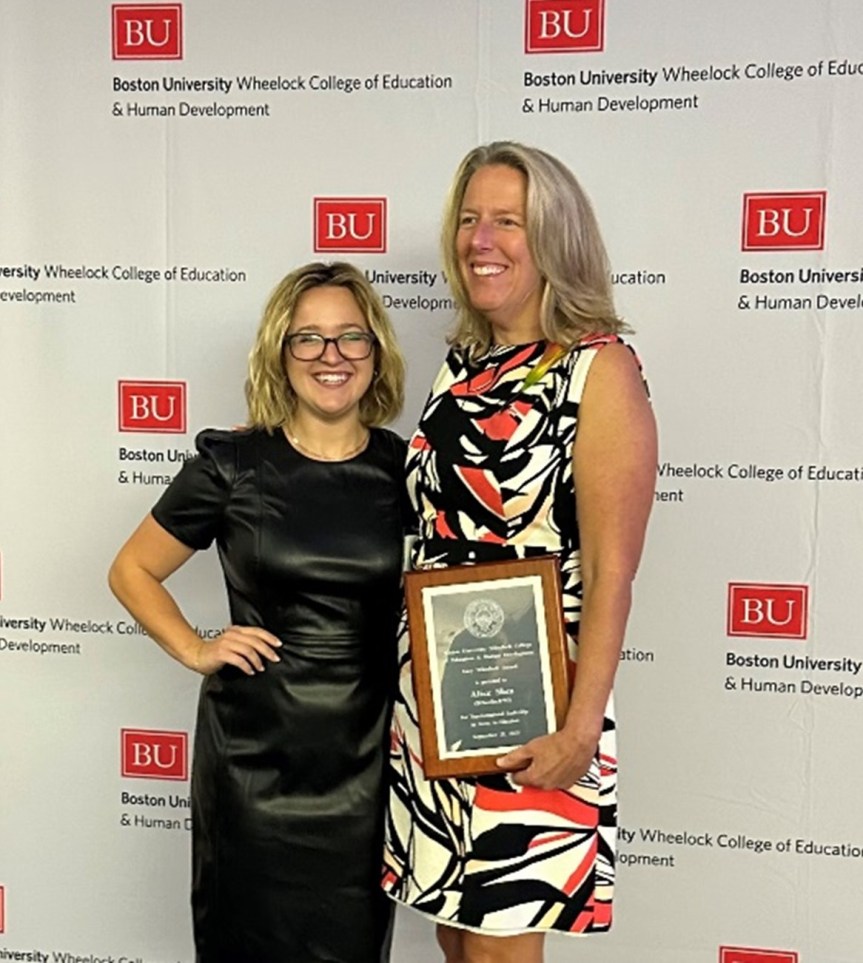
(Pictured [left] Addie Laroche who nominated Alice for the award and [right] Alice Shea, Maine College and Career Success Coordinator)
Alice Shea, College and Career Success Coordinator for Adult Education Hub 8 and Southern Maine Community College (SMCC) was recognized with a 2023 Alumni Award from Boston University Wheelock College of Education & Human Development. Alice received the 2023 Lucy Wheelock Award in recognition of her work and advocacy on behalf of asylum seekers in Maine. Alice’s work to promote access to education and high-quality employment will have an impact on the New Mainer population her students, their families, and Maine’s workforce for generations to come.
College and Career Success Coordinators are part of the Maine Jobs and Recovery Plan (MJRP) which has committed $6 million dollars to address the workforce development needs of those disproportionately impacted by COVID-19. Maine’s Department of Education, Adult Education team is using these funds to help eligible adults and employment sectors recover from the stresses of the pandemic through a variety of academic and job training supports.
Addie Laroche, the Director of Maine Partnerships, nominated Alice Shea. Addie previously held the position of the Director of Career and Transfer Services at SMCC. Laroche introduced Shea at the award ceremony and spoke about why they had chosen Alice as the recipient of this year’s award. She shared the following:
“The Lucy Wheelock Award recognizes someone who has shown incredible dedication to their community, advocating for social justice and systemic change. When Alice Shea began her work at Maine’s largest community college, she quickly understood that there was a community that was facing significant challenges in terms of access to educational resources, housing, food security, and many other necessities that so many people take for granted. The state’s New Mainer population, those who have been forced out of their home countries and are seeking asylum in Maine, quickly identified Alice as a key resource on campus.
She has been instrumental in developing remedial preparation classes for students entering high-demand fields, securing access to English Language Acquisition support, education, technology, and extending the resources in our campus’s food bank. Not only has she served this community with a passion, but she’s ignited that passion within her colleagues. Alice had shared with the college’s executive team that she had helped secure housing for a student, but the student didn’t have a single piece of furniture. That Friday afternoon, the college’s highest level of staff banded together to tap into their networks, ensuring that the student had furniture to call their own that weekend. The President of the College showed up with a truck on Saturday morning to deliver it himself.
The work that Alice does with the New Mainer and greater SMCC and Portland community, as well as the drive that she shares with the rest of the community, cannot go unnoticed. Creating systemic change for new Mainers is not only instrumental in helping to improve the opportunity and security for themselves and their families, but is a key factor to sustaining the workforce in fields like healthcare and technology across the entire state. Behind all of that is Alice’s support, advisement, and passionate advocacy.”
In Shea’s acceptance speech, she thanked the Mills administration for Maine’s free college initiative and Maine Jobs Recovery Plan for funding positions and projects that support marginalized people in Maine’s communities.
Since the Maine Jobs and Recovery Plan took effect in October 2021, the Mills Administration has delivered direct economic relief to nearly 1,000 Maine small businesses, supported more than 100 infrastructure projects around the state to create jobs and revitalize communities, and invested in workforce programs estimated to offer apprenticeship, career and education advancement, and job training opportunities to 22,000 Maine people.
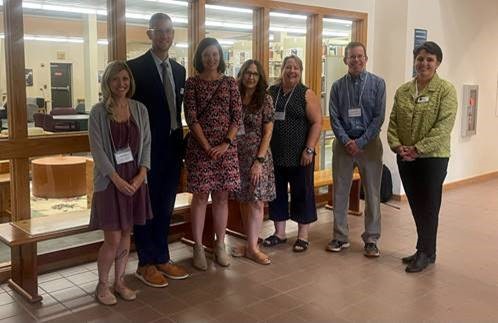
(Pictured Left to Right: Dr. Kayla Sikora, Director of Augusta Adult and Community Education; Daniel Chuhta, Deputy Commissioner at the Maine Department of Education (DOE); Erica Carley Harris, Policy Analyst for the Maine Jobs & Recovery Plan; Megan Dichter Maine State Director for Adult Education; Lisa Robertson, Director of York Adult Education; Jeremy Lehan, Director of RSU 54 Adult Education; and Megan Welter, Associate Commissioner of Public Education at Maine DOE)
The leaders of Maine’s adult education community convened in Lewiston for their annual directors meeting. The meeting brought together key figures in the Maine education landscape, emphasizing the collaborative efforts that drive adult education across the state. Daniel Chuhta, Deputy Commissioner at the Maine Department of Education, and Megan Welter, Associate Commissioner of Public Education were both in attendance, highlighting the State’s commitment to adult education. Erica Carley Harris, Policy Analyst for the Maine Jobs & Recovery Plan, provided valuable insights into policies that shape adult education initiatives in Maine.
Megan Dichter, the Maine State Director for Adult Education, played a pivotal role in coordinating the event and facilitating productive dialogues among the participants. Dr. Kayla Sikora, Director of Augusta Adult and Community Education and President-Elect of the Maine Adult Education Association (MAEA), Jeremy Lehan, Director of RSU 54 Adult Education, and Lisa Robertson, MAEA President and Director of York Adult Education, attended this significant gathering.
The annual directors meeting served as a platform for sharing best practices, addressing challenges, and charting a course for the continued growth and enhancement of adult education programs in Maine. Participants engaged in thoughtful discussions on program development, funding, and strategies to meet the evolving needs of adult learners.
(Pictured: Gerda Tuffour, left, and Gisele Linyonga, right, are the first students to successfully complete the three modules of the Apprenticeship healthcare pathway)
Lewiston Adult Education Healthcare Apprenticeship Pathway, a 6-month series of courses designed for Multilingual Learners, resulting in multiple certificates for employment in the healthcare industry, is proud to announce the graduation and employment of its first CNA Apprenticeship students. The pathway includes a heavy emphasis on the English language of healthcare, covering reading technical text and case notes, writing incident reports, and workplace verbal communication, including extensive healthcare vocabulary.
Students also earn multiple certifications to support employment, beginning with Bloodborne Pathogens, teaching Pre-Apprentices how bloodborne pathogens are spread, how to avoid exposure, and what to do if exposed to infectious material. The next level in the Pathway is Personal Support Specialist (PSS), which includes effective language skills for work, and WorkReady (a state certificate that shows the students can understand and demonstrate 7 work skills competencies). Thirteen participants successfully passed these exams, and five of them are currently employed. Students can then become participants in the Certified Nursing Assistant pathway.
Partners in this employment pathway are the Lewiston CareerCenter which supports students eligible for training funds from the Dept. of Labor, Eastern Maine Development Corporation, and Clover Healthcare. Clover Healthcare offers the use of its facility as a clinical site for the required clinical hours of the course and is also a registered apprenticeship site for the students completing the course. Clover Healthcare has now hired these students and will be working with them as apprentices for the next year continuing training and support in the healthcare field. The Maine Apprenticeship Program assists in setting up structured yet flexible training programs designed to meet the specific needs of Maine employers through on-the-job learning and related classroom instruction.
The graduation ceremony was held at Lewiston Adult Education Learning Center on September 7, 2023. Family members, staff, and guests were in attendance to celebrate Gisele and Gerda’s success. A second cohort is scheduled to complete the program in early October, and a third just began in August. The next session will begin in March 2024.
For more information on the upcoming Apprenticeship healthcare pathway, please contact Josee Castonguay (207) 795-4100 x4136 or email jcastonguay@lewistonpublicschools.org.
The Maine Department of Education (DOE)’s Adult Education team recently launched a Career Advancement and Navigation Specialist initiative to build workforce skills across Maine. The four state Career Advancement and Navigation Specialists work in different regions of Maine and serve people with the next steps in their careers. They help people explore career options, create impactful resumes, apply for positions, seek further career and skills training, obtain translator services, and connect them with community support resources.
Through Maine Jobs and Recovery Plan (MJRP) funding, Career Navigators have already helped more than 450 workers across the state with their career goals, including a new Mainer who sought a second shift position to support his family. The Career Navigator was able to help him find a position that fit his experience and needs and supported him in the process of getting translation services, applying, interviewing, onboarding, and orientation. Another worker was able transition from a food delivery position to a new job in the court system through his work with a Career Navigator.
Maine’s Career Navigators support workers in their communities, at Adult Education sites and through community-based organizations, by partnering with other agencies including the Career Center and FedCAP Rehabilitations Services, and through a network of relationships with employers in manufacturing, retail, healthcare, and hospitality. To learn more about the Career Navigators, click here.
Career Navigators share their experiences:
“I spoke with a local recovery group about the ways I can help them when they’re ready for employment. At the end of the conversation, the facilitator said, ‘Normally when we talk about employment, the conversation feels stressful and difficult. This is the first time it feels hopeful.’ The best part of this job is being able to help people see hope and help them work towards a different future,” said Kate Points, Career Navigator for York County.
“The work of the Career Navigator in local communities means being able to meet people where they’re at, personally and sometimes even physically. Many of our potential clients have access barriers, both physical and mental. They lack transportation, communication skills, technology access, or not only the knowledge, but the tools or the executive function required to access those resources. Many have experienced shame in asking for help previously and they need an advocate who can provide the kind of high touch service and support that puts them and their needs first when it comes to accessing education and employment. In this way, the impact of Career Navigator services are immeasurable,” said Cassie Robichaux, a Career Navigator for Waldo, Knox, Sagadahoc and Lincoln counties.
“The diversity of the people coupled with how resilient they are in my community amazes me. Although the amount of people I serve is high, I’m driven to help more people because getting to know more wonderful people in my community has been so meaningful,” said Karen Morin, a Career Navigator for Kennebec County.
“Sometimes things get in the way and what was once a clear track becomes riddled with obstacles. Career Navigators help people overcome the obstacles encountered when they are looking for employment and the next step in their career journey. That, to me, has always been a great distinction and huge benefit of career navigation through adult education: we can still support you, even after you’ve graduated and whether you’re affiliated with an educational institution or not,” said Frank Spurr, a Career Navigator for Androscoggin and Oxford Counties.
Since the Maine Jobs and Recovery Plan took effect in October 2021, the Mills Administration has delivered direct economic relief to nearly 1,000 Maine small businesses, supported more than 100 infrastructure projects around the state to create jobs and revitalize communities, and invested in workforce programs estimated to offer apprenticeship, career and education advancement, and job training opportunities to 22,000 Maine people. For more about Maine Jobs & Recovery Plan, visit maine.gov/jobsplan.
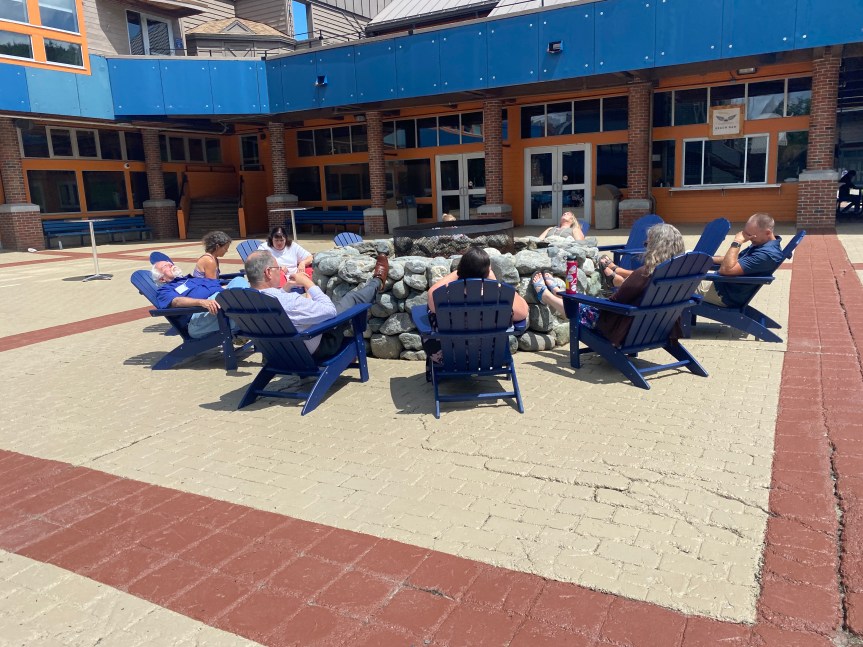
The annual “Supporting Adult Multilingual Learners with their Educational and Career Pathways Summer Institute” was held at Sugarloaf from July 10th – 12th and brought together adult multilingual educators, directors, advisors, and other interested stakeholders from across the State of Maine. This year’s theme was “Building Bridges” and encouraged participants to seek connection across programs and inside the classroom.
This is the second year Maine DOE’s Adult Education Team has hosted the Summer Institute, also affectionately known as “Camp Sugarloaf.” Leaders of the institute worked to empower adult education professionals to support their students by increasing empathy and efficiency in four areas of growth: 1) Cultural Competence and Humility; 2) Overcoming Barriers to Education and Employment; 3) Teaching Practices that Reach All Learners; and 4) Workforce Development. Over the course of three days, participants were able to increase network connections and resources and focus on implementing best practices back into their own programs and community organizations.
This year, around 80 participants attended – nearly doubling in size from the previous year – and included 17 presentations, two whole group workshops, a workforce development panel, and a series of networking activities such as learning Kinyarwanda during breakfast, yoga, board game night, movie night, arts and craft night, and more.
The event was kicked off by Kelli Park, University of Southern Maine/Merrymeeting Adult Education teacher, who encouraged participants to consider best practices to increase Cultural Competence and Humility in the classroom. Other sessions included, “Integrating Technology at Every Level” by Lewiston Adult Education Instructors Melanie North and Jen Brown, “Understanding Immigration Law Challenges that Affect Multilingual Learners and Immigrants” by Michelle Gentry (Immigrant Legal Advocacy Project Senior Asylum Program), “Language and Identity Connections Across Cultures and Contexts” by Sarah Wagner (Frederick Community College Academic Advisor), “Mapping Resources in Your Community: MLL Edition” by Jeanne MacDonald-Johnson (Noble Adult & Community Education Assistant Director, Hub 9 MCCA Coordinator), and more.
Participants (or rather, Campers) were encouraged to embrace the spirit of personal growth, learning, and development during the three-day long event. Participant and Workforce Development Panel member Jennifer Tiner commented that Camp Sugarloaf helped her “make connections with other programs and staff to improve and refine [her] own practices.” “It’s an opportunity,” said Joseph Catalano, Workforce Development Panel member, “to think outside the box to solve problems.”
Presenter Jen Brown remarked that “the amount of fun stuff to process and connect, to be creative and have fun together” was one of the highlights of the institute. It allowed a structure to meet people and to ignite similar passions and, as presenter Briana Bizier later commented, understand that, as educators, “we’re all facing the same challenges. You feel like you’re alone sometimes.” Camp Sugarloaf gave educators a sense of community and a way to bring some of the most passionate educators across the state together to solve challenges creatively and collaboratively. “It feels like connecting together as people – authentically – rather than professionals” observed participant, Tekia Cox.
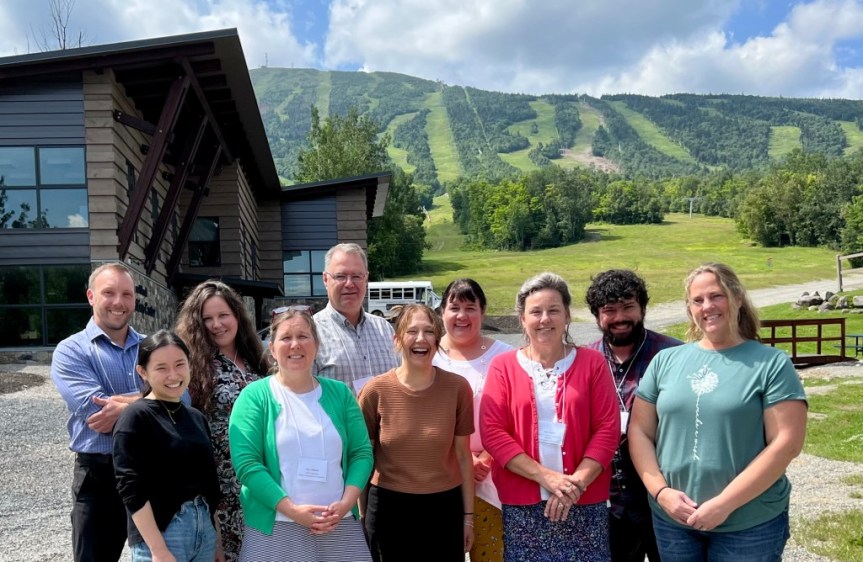
Meet the Maine DOE Adult Ed Team – Back Row: Steven Airoldi, Lana Sawyer, David McDonough, Kelley Heath, Mike Emery and Front Row: Cora Saddler, Amy Poland, Megan Dichter, Amy Hatch, Christy Le
Kennebec County Career Navigator Karen Morin supports job seekers getting hired at Maine General Hospital in Augusta. Three people have had job offers thus far while the rest are in the process of getting hired.
Career Navigators are part of the Maine Jobs and Recovery Plan (MJRP) which has committed $6 million dollars to address the workforce development needs of those disproportionately impacted by COVID-19. Maine’s Department of Education, Adult Education team is using these funds to help eligible adults and employment sectors recover from the stresses of the pandemic through a variety of academic and job training supports including Career Advancement Navigators and College and Career Success Coordinators.
Augusta Adult and Community Education is partnering with Maine General Health to provide English as a Second Language classes to Maine General Health multilingual employees as well as the addition of a new pre-health class. The program will reduce barriers that may affect their employees from participating in programming by funding transportation, childcare, and technology costs for employees in environmental services and grounds keeping for career advancement and life skills.
To learn more about Career Navigators and Maine Strengthening workforce please click here.








 Maine DOE Newsroom