Lewiston Adult Education Computer Training Prepares Students For Future Careers

Computer Support Specialist student Santo Panzo took a moment during November mock interviews for a photo outside the Adult Learning Center at the Longley Multipurpose Center.

Lewiston Adult Education students have completed the first part of Computer Support Specialist training for technology sector jobs. The combination of in-person and distance learning lessons in the fall focused on digital literacy, English skills and work readiness. Successful completion of the program results in a level one Computer Specialist microbadge that can be accepted for college credit and is recognized by employers around the state.

“The students were very motivated and showed a great work ethic. All of them work full time yet were able to participate in and successfully complete this intense program,” English teacher Irina Petranek said.

Student Santo Panzo thanked computer teacher Greg Yates in an email.

“We are more than proud of the opportunity Lewiston Adult Education provided to us,” Panzo said.

On Nov. 20, Panzo and his classmates participated in mock interviews with staff and community members as another preparation for the workforce. Local partners in the interviews included Carbonite, Bates College and RoundTable Technology. Some of the interviews were remote while others were in person with social distancing and mask-wearing.

Computer Support Specialist student Ester Bassa sat for an outdoor photo during November mock interviews at the Adult Learning Center at the Longley Multipurpose Center.

“Lewiston Adult Education is proud to have pioneered in this innovative work. The opportunity to invest in training that results in badges that are recognized for college credit and by local employers is of tremendous benefit to our adult learners,” Lewiston Adult Education Assistant Director Jen Tiner said. “We admire the initiative and persistence that our students demonstrated throughout this program.”

The students’ next step will be taking the National Retail Federation Customer Service and Sales program in collaboration with RSU 16 Adult Education. It will include English classes with a focus on technical writing and speaking skills.

“This class of students reminds us all of the importance of embracing the new ‘global language’ – Information Technology.  A diverse set of students in age, background and origin, they were eager to master the skills of today’s explosion in computer technology,” Yates said.

The Computer Support Specialist Program is funded by the Lumina Foundation and developed in partnership with the University of Maine System, the Maine Department of Labor and the Maine Department of Education.

This story was provided by Lewiston Adult Education Center as part of the Maine Schools Sharing Success Campaign. To submit a story or an idea, email it to Rachel at rachel.paling@maine.gov.

Everyone Has a Story: Lewiston Mom Finds a New Passion and Career Through Local Adult Education Program

A podcast called “We All Have a Story” features standup comedian Dawn Hartill, who got her start by taking a Lewiston Adult Education class called “Standup Comedy Workshop.” Check out her story and how she got stated on We All Have a Story – A podcast about people @WAHASpodcast. Here is a link to where you can listen to her story (She mentions adult education at 4:13 during her interview).

Now teaching the standup class at Lewiston Adult Education, Dawn’s story exemplifies how important education can be at any age, and how trying something new through a wonderful local resource can change your life in so many positive ways.

To learn more about the Lewiston Adult Education Program, check out their website, or you can contact your local school system to learn more about the Adult Education classes available near you.

Maine Career Development Association Hosts Art & Poetry Contest for Maine Students

In celebration of National Career Development Month in November, the Maine Career Development Association is sponsoring a statewide Poetry & Art contest, that is open to students and adults state-wide.

The Contest is held annually on a national level in celebration of the importance of life-long career development and the personal empowerment of all people. Events and activities in celebration of National Career Month help examine lives, careers, and the alternatives available to increase everyone’s personal success and happiness.

Contest Eligibility

Adults and students enrolled in public, private schools in Maine, and students who are homeschooled in Maine are eligible to participate.

Contest division areas include:

  • Primary Grades: K – 2
  • Intermediate Grades 3 – 5
  • Middle Grades 6 – 8
  • Senior Grades 9 – 12
  • Adult Student 18 and older enrolled in school
  • Open Adult 18 and older (teachers, parents, professionals, etc.)

Each entry should celebrate and inspire career development with a positive tone while emphasizing the national theme.

For further information on how to participate in the contest including eligibility requirements for both poetry and art submissions and how make submissions, please view the Maine Career Development Association’s Art & Poetry Contest Flyer and Entry Form.

Winners in each category will be posted to the MCDA website (https://www.mainecda.org/) as well as included in the MCDA newsletter! Winners will then be sent on to the NCDA to be judged nationally. National winning entries will be recognized on the NCDA website, as well as on display at the annual conference in Atlanta in 2021. The school coordinator of each state winner will receive a free year’s membership to the Maine Career Development Association!

DEADLINE: All submissions must include the official entry form, be postmarked by November 23rd, and mailed to Tara Kierstead, MCDA K-12 Representative, at the address on the entry form.

Please email Tara Kierstead at tkierstead@kidsrsu.org with any questions.


RSU 16 Gets Creative to Offer In-Person Adult Ed Graduation

Maine Adult Education programs are working hard through the COVID-19 Pandemic to help students meet their goals. That’s why RSU 16 planned an end of summer graduation ceremony to celebrate the accomplishments of their Adult Education students. In a short, in-person, socially distanced graduation on August 6th the program was able to honor 8 out of 13 of their graduates.

While a group picture is not necessarily easy to accomplish, the staff at RSU 16 made a picture collage to memorialize the event for years to come.

This story was submitted by Jenny Rose, RSU 16 Adult Education Director and McKinney Vento Homeless Liaison as part of the Maine Schools Sharing Success Campaign. To submit a story or an idea please email Rachel rachel.paling@maine.gov.

PRIORITY NOTICE:  Unified Guidance Regarding Executive Orders and School Personnel:  All School Services and Employees are Essential

As our state and nation face unprecedented challenges due to the COVID-19 state of emergency, it is more critical than ever that Maine schools and school employees work together to provide the deeply needed services of continuity of education, communications, connectivity, payroll, other administrative activities, custodial services, transportation/deliveries,  and student nutrition. The Governor has directed SAUs to pay hourly employees for their previously contracted hours throughout the remainder of this school year, and this decision was predicated on the understanding that all school employees would continue to have important roles in limited, alternative, ongoing operations. The Department of Education has also stated that all school employees are essential.  The Priority Notice from the Dept of Education on 3/27/20 says: “All school employees are considered to be ‘essential’ under the Governor’s Executive Order #19 and should be expected to complete all duties and tasks assigned to them.”

On March 31st, Governor Mills instituted Executive Order 28 further restricting public contact and movement, schools, vehicle travel and retail business operations.  In addition, cities and towns are also putting new provisions in place, which restrict operations of non-essential businesses, new questions have arisen about the definition and what it means for public-school employees to be essential.

Although school employees are essential, their physical presence at school is not always necessary during this emergency, as there are many tasks and trainings that could be completed remotely.  In light of the Governor’s “Stay Healthy At Home” order at this critical juncture to flatten the curve, physical presence in schools should be restricted to a bare minimum in order to provide essential functions – such as providing educational and nutritional services to students, payroll, certain cleaning and maintenance staff, certain administrative assistant staff where communications cannot occur remotely, IT staff to support remote learning functions, transportation staff  – and only as long as social distancing and other CDC recommendations (including hand washing protocols) are being implemented. The fewest numbers of employees possible should be on premises, and only during the necessary time frame required for conducting such services. All functions that do not require in-person staff in schools should be done remotely.

It is possible that some hourly staff members will not have enough immediately purposeful work to do (either on site or remotely) to fill the contracted hours for which they are paid. In that case, these employees should be considered to be “on standby”, ready to assist as work does become available for them. Administrators and supervisors should determine when/if certain positions are needed to perform tasks.  While on standby, employees will continue to receive hourly wages as contracted prior to the COVID emergency.

Given the Governor’s most recent Executive Order, the Department of Education (DOE), Maine School Board Association/Maine School Superintendents Association (MSBA/MSSA), Maine Principals Association (MPA), Maine Education Association (MEA), Maine Administrators of Services for Children with Disabilities (MADSEC) and Maine Curriculum Leaders Association (MCLA), would like to clarify the roles and responsibilities of public-school employees during this time.

  • Employees who are able and assigned by supervisors to work remotely should continue to do so, and raise any concerns they may have with their local district leadership.  Administrators and staff are encouraged to collaborate and problem-solve to foster telework options during this crisis.

  •  School employees should continue to go to work if they  must be there to perform essential functions. CDC guidelines should be strictly followed including social distancing of at least 6 feet from all other people.  School employees working onsite should be kept to the bare minimum necessary to execute the functions that require their physical presence.

  • Employees  whose services are not immediately needed, as determined by supervisors, or whose work cannot be done remotely, should continue to receive their regular wages and should remain ready to perform tasks as they become necessary and assigned by supervisors.    Employees on standby leave should be ready to help schools meet their basic needs, and may be assigned to participate in a rotation of duties during this time.

  • Any  school employees who are sick, in a high risk group, or feel unsafe for any reason, should have access to their own sick leave, the new federal leave program, a district sick leave bank, if applicable, or any other paid leave that a district may be providing.

We can all take common sense steps to ensure that only staff whose physical presence is required  to provide services and who are engaged in immediately necessary services are in our schools, and that those who are in our schools are being protected by following the most current CDC guidelines for social distancing, cleaning, hand washing, and ventilation.

We so appreciate all the work being done to help students during these challenging times.  We know our public schools are wonderful places filled with amazing, hard-working and dedicated staff.  Please be sure to take care of each other during this crisis.

PRIORITY NOTICE: Update and Guidance From Commissioner Makin: April 1, 2020

Dear Champions of Education, 

Yesterday, Governor Mills issued a “stay at home” order, offering specific guidance around curtailing non-essential activities, gatherings, and travel. She also ordered schools to refrain from in-person, classroom instruction practices until after May 1st (or until further orders are issued).  

As we close in on the third week of remote instruction, please know that your resilient leadership and ongoing efforts are making a huge difference for Maine students and families. While everything is so suddenly chaotic and unfamiliar to everyone, our schools continue to shine like a beacon of hope. I have received countless emails and messages from legislators, parents, community members, and students sharing their gratitude for the steady support, the nutritional services, and the deeply human connections that are provided by educators, counselors, and school administrators. I’ve heard anecdotes from teachers who have noticed increased participation and engagement from students who had previously been among the most disconnected and apathetic. The lesson in this phenomenon is an important one… they’re counting on you even when their outward behaviors disguise this fact. 

Updates and information: 

  • Essential employees:   PreK-12 educational and. Child nutrition staff are all considered essential during this crisis. We are currently working with our educational organizations’ leadership to develop clarified and unified guidance in light of the Governor’s most recent Executive Order.  
  • Nutrition programs and April vacation: Maine DOE’s Child Nutrition team continues to seek flexibilities and waivers for our SAUs and communities. We are thrilled to share that there have been waivers granted for schools with fewer than 50% free/reduced meal students and bulk service provisions. Read more here.  We have applied for a waiver that will allow meal programs to be Reimbursed For the meals served during April vacation- currently not reimbursable. We will provide an update as soon as we hear from USDA. 
  • The CARES Act federal relief package will provide schools/SAU’s with funding to mitigate some of the financial impacts of the COVID-related disruption. Much more on this coming very soon! 
  • Remote Learning Plans/Sharing: Although we’re not requiring districts to share their remote learning plans, some have shared theirs with us and offered them as a resource to others that are still developing their plans! We will be happy to collect and share in a protected way with colleagues. Thank you to all who have shared their well-developed plans! If you’d like to offer your districts plan as a guide for others, please email Chief Innovation Officer, Page Nichols at page.nichols@maine.gov. 
  • Home Instruction: The Department recognizes that disruption due to COVID-19 may impact a home instruction family’s ability to maintain the required number of instructional days, and is therefore including home instruction in the statewide waiver granted for the minimum of 175 days of instruction for 2019-2020 school year.  Demonstration of satisfactory academic progress is still required to be submitted to superintendents by September 1st.  
  • School Budget, voting, etc:  We have been working with MSMA, the AG’s office, and the Governor’s office to develop an executive order that will provide the various flexibilities that have been requested. Please stay tuned – solutions are imminent.  (The Legislature did vote our GPA budget IN and intact, so your ED279 printouts provide an accurate basis for what you’ll receive in state subsidy).  
  • DOE is open for business – including CERTIFICATION office!  The system is up and running, the phones are being monitored by our knowledgeable and helpful team of experts, and we are eager to get your completed applications for renewal or initial certification processed as soon as possible! We have had some state level issues with phone system overload, so don’t hesitate to use email also!  As mentioned in an earlier notice, we do intend to provide extensions for those who have had education, testing, fingerprinting, or practicum/internship disruptions due to the COVID emergency – but for those of you who have completed the necessary steps, please submit necessary documentation and move ahead with your renewal application!   

Silver Linings: 

  • It’s possible that we’re demonstrating capacity for never having to make up “snow days” in the future!  
  • We have a perfect opportunity to redesign our state assessment system! 
  • Every time we do something kind or selfless to benefit someone else, we get a bump of serotonin … It even works when we simply observe someone being kind to someone else!  
  • Amid the fear and loss and physical disconnection, watch empathy, compassion, and humanity shining like the North Star – far above the fray.  
  • We will emerge from this better than we’ve ever been. 

Thank you for all you are doing on behalf of your students, staff, and communities.  

 Pender

SMCC, Cumberland County Adult Education Programs Form Partnership to Help Students Overcome Obstacles to College

Southern Maine Community College (SMCC) and Cumberland County Adult Education programs have entered into a partnership to help Mainers overcome barriers to earning a college education.

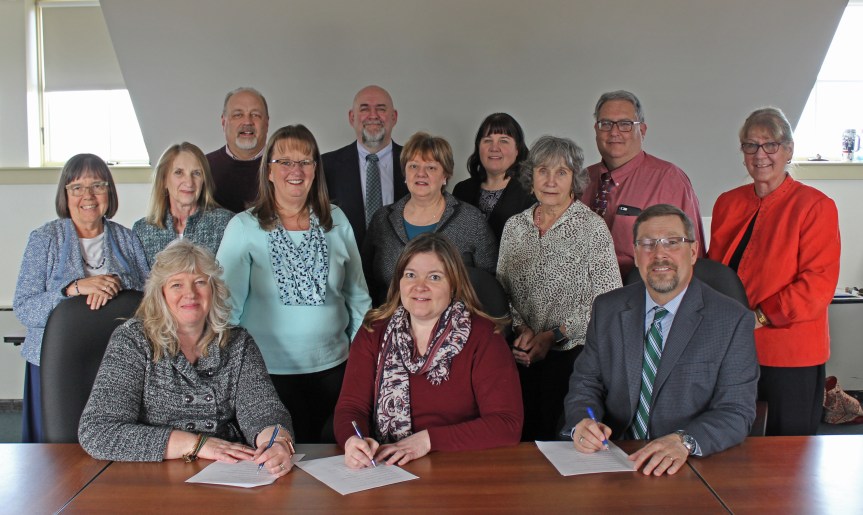
SMCC and Cumberland County Adult Education program directors signed a memorandum of understanding on Wednesday for Adult Education to have office space on the SMCC South Portland Campus to provide adult learners free assistance with reading, writing and math skill development to prepare for college-level courses. Adult Education staff will also provide support and guidance with exploring academic programs, applying to SMCC and navigating the college entry process.

The services, funded through a Maine College and Career Access (MCCA) grant, are available to any student wanting to improve placement test scores or needing assistance with skills development or the college application and financial aid application process.

“By having an office on our South Portland Campus, MCCA is able to provide the guidance and services that adult learners need to enter college,” said Paul Charpentier, SMCC Vice President and Academic Dean. “Once they are in college, SMCC will provide the support they need to succeed academically, achieve their goals and position themselves for bright futures.”

The Maine College and Career Access program is part of Maine Adult Education, a statewide system of local adult education programs. MCCA supports adult learners who are transitioning into college and career training programs by providing access to instruction and advising services to establish a solid foundation for success in furthering their education.

Adult education programs in Cumberland County helped drive the effort to establish an MCCA office at SMCC, said Stephanie Haskins, director of Gray-New Gloucester Adult and Community Education.

“For many years, students have been paying college tuition rates for noncredit classes when they could have accessed them through their local Adult Education,” she said. “This agreement signifies a new era in not only preparing learners for the rigors of college and career training, but doing so on the campus where they will access these programs.”

Pictured:

Front: Shelli Pride of Gorham Adult Education and Westbrook Adult Education; Stephanie Haskins of Gray-New Gloucester Adult & Community Education; and SMCC President Joe Cassidy. Middle: Anita St. Onge of Portland Adult Education; Gail Senese of the Maine Department of Education-Adult Education; Lisa Knedler of Maine Department of Education-Adult Education; Linda Winton of Bonny Eagle Adult Education; Joan Tremberth of Scarborough Adult Learning Center; and Madelyn Litz of Lake Region & Fryeburg Area Adult Education. Back: Tom Nash of Windham-Raymond Adult Education; SMCC Vice President and Academic Dean Paul Charpentier; Kelley Heath of Maine Department of Education-Adult Education; and David Brenner of South Portland Adult Education.

Lewiston Adult Ed Class Sparks New Life In Clown Car

Submitted by Mike Reagan, Education and Marketing Coordinator, Lewiston Adult Education.

Small Engine & Power Equipment Repair students at Lewiston Adult Education bring in chainsaws and snowblowers with seasonal regularity.

When the weather gets warm again, instructor Richard Hussey will see the return of lawnmowers. But this fall, he had a student bring in a repair job that would not fit in with the others, though it did have a small engine.

Patrick Penley is a member of the Kora Temple Shrine, a Kora clown and the owner of a multicolored jalopy that had several owners before him.

“My goal was to get that running,” he said.

The clown car had a three-horsepower engine and during the semester, it was removed and replaced by a power washer engine.

“We had to modify the engine. We had to modify the framework. We had to modify the drive system. And this was done primarily by the student. I just gave the guidance,” Hussey said.

He said that students can bring in gasoline engines at the start of the semester but are responsible for bringing them in and taking them home at the end of class. Penley brought the clown car in the back of his pickup truck.

“It has to come and go. That’s your size reference,” Hussey said.

The Small Engine class is finishing up for the fall semester but is scheduled to return for Winter-Spring 2020. The class listing will appear in the combined Lewiston Adult Education-Auburn Adult & Community Education brochure, which is set to come out in early January.

In addition to the clown car, Penley worked on a leaf blower and chainsaw in the class.

He hopes to have the car off and running in a 2020 parade. For those interested in seeing it run a little sooner, here is a link to a video of a test run on Tuesday night at Lewiston High School’s main entrance.

Get to know the DOE Team: Meet Megan Dichter

Maine DOE team member Megan Dichter is being highlighted this week as the part of a Get to know the DOE Team campaign! Learn a little more about Megan in the brief question and answer below.

What are your roles with DOE?

I am the Workforce Development Coordinator for Adult Education, so I support adult education programs in offering industry recognized credentials and workforce training to adult education participants. I am also the CASAS (the math and reading assessment used by Adult Education programs) state trainer.  Additionally, I have a background in teaching English to non-native speakers and also support adult education programs working with students learning to speak English.

What do you like best about your job?

I enjoy the variety of my work and that it allows me to continue to teach (in the form of training,) and learn daily. And of course, I would be remiss if I didn’t mention the amazing Adult Education team with whom I work.

How or why did you decide on this career?

After college I volunteered with an organization called WorldTeach and spent two years in Thailand teaching at a University. That experience helped shape my career path and I returned to the U.S and enrolled in an M.Ed program- the rest is history.

What do you like to do outside of work for fun?

I am an avid photographer and spend a lot of my free time doing documentary photography. I love the challenge of visual storytelling.