BackPack Team at Gorham School District Receives $25,000 Neighborhood Assist Grant

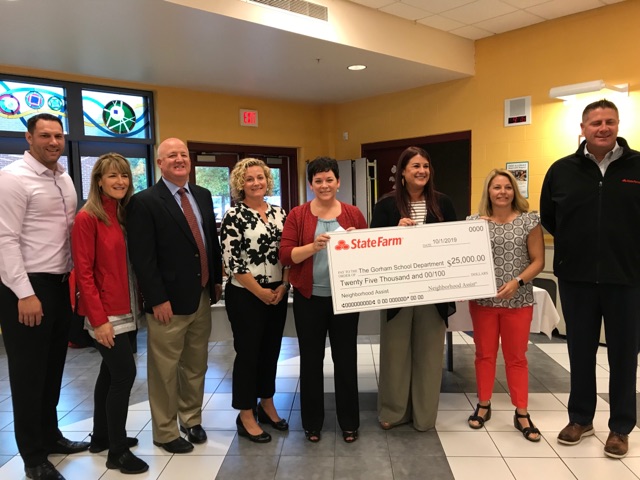
Gorham School District was one of 40 recipients nationwide to receive a $25,000 Neighborhood Assist Grant. They received the award for the efforts with their BackPack Program and School Garden, an initiative that provides food for students and families experiencing food insecurity in the community.

This past June, State Farm accepted 2,000 applications for their Neighborhood Assist grant program.  Submissions represented causes from throughout the country which focused on education, safety, and community development initiatives.  A review committee narrowed down the submissions to the top 200 finalists which were posted online and voted on by the public.  The 40 causes with the most votes each won a $25,000 grant.

Gorham’s BackPack Team Administers weekend food and snack bags to students, offering a school food pantry at the high school, and by growing a school garden which provides fresh produce to the local food pantry during the growing season. The BackPack Program sends food home every weekend with students who would otherwise not have enough food to last through the weekend. Learn more here.

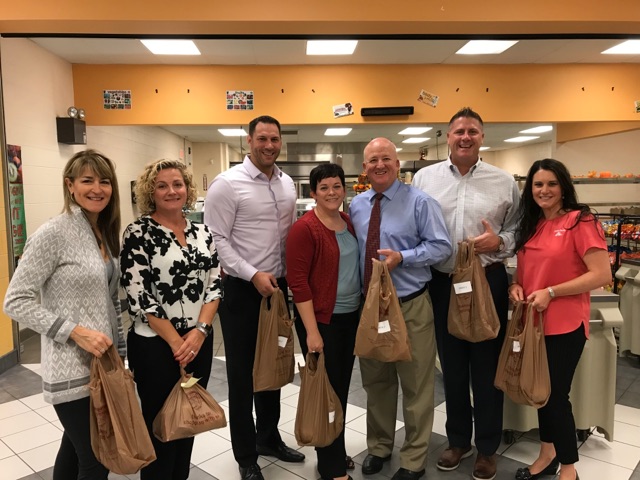
School Administrators holding shopping bags of food.

LD 577- An Act To Increase Access to Nutritious Foods in Schools by Implementing an After-school Food Program for At-risk Students

LD 577, Public Law 2019, Chapter 428 An Act To Increase Access to Nutritious Foods in Schools by Implementing an After-school Food Program for At-risk Students, will become law on September 19, 2019. We have received questions from district leaders, asking for clarification.

The law states that, beginning in the 2019-20 school year, a school administrative unit with at least one public school in which at least 50% of students qualified for a free or reduced-price lunch during the preceding school year, shall participate in the federal Child and Adult Care Food Program (CACFP). A report listing all districts/schools that meet that 50% or more criteria can be found here.  We have also provided a link for those who wish to read LD 577 in its entirety.  Please note that a school administrative unit that is required to operate a federal Child and Adult Care Food Program may choose not to operate such a program if it determines, by a vote of the governing body of the school administrative unit, and after notice and a public hearing, that operating such a program would be financially or logistically impracticable.  A program, or the public hearing and vote to not host a program, can occur at any point in a school year.

TO ASSIST OUR SCHOOL DISTRICT AND NUTRITION LEADERS

  • Child Nutrition has created a “Frequently Asked Questions” document regarding LD 577, and it is posted on our webpage.
  • A FREE Webinar on the basics of the requirements and program is being offered. Register NOW!

CACFP At Risk 101 Webinar
September 18, 2019 at 1:30-2:30pm
Topics:

    • Briefly discuss LD 577 and requirements
    • CACFP meal pattern
    • Record keeping requirements
    • Filing claims
    • CACFP review process
    • CNPweb agreement

If you have any questions regarding the CACFP At Risk Afterschool Program, please contact the Child Nutrition Office at 624-6843.


Maine Farm to School Network, in Conjunction with the Maine Department of Education, Child Nutrition, Offers Engaging Local Foods Trainings in October  

We are excited to announce that the Maine Farm to School Network has received a $25,000 USDA Farm to School Training Grant to build local food procurement capacity in Maine schools. Designed to increase the availability of local foods in schools, USDA Farm to School grants can help farm to school programs get started or expand existing efforts. “This award will develop the capacity of Maine school food directors to purchase from and support Maine farmers,” comments Stephanie Cesario, Maine Farm to School Network Coordinator. “The funds will support local foods procurement training for food service directors across the state as well as network building,” she added.

The Maine Farm to School Network, in collaboration with other state farm to school advocates, will offer local procurement and network building trainings at the 2019 Maine Farm to School Conference being held at the Kennebec Valley Community College, Alfond Campus in Clinton, ME on October 3-4, 2019. The combined trainings count towards 7.25 contact hours for school nutrition professionals.

Maine schools are ramping up their local food purchasing to support local farms and the local economy, while making school meals fresher and more appealing! The pre-conference local procurement training on October 3rd will join Martine Cherry, USDA Team Lead and Procurement Specialist, and Abbie Nelson, Farm to School Program Director from Vermont Food Education Every Day (VT FEED) and NOFA-VT for a fun, interactive afternoon of digging into local food procurement rules and guidelines so schools can get the local foods they want! This hands-on workshop is designed for school nutrition directors, kitchen managers, business managers, and others responsible for school food purchasing.

This free, 3-hour training will explore topics such as micro purchasing, informal bid process, Buy American provision, purchasing thresholds, values-based buying, and the importance of relationship building with food producers. Participants will learn how to apply strategies to make the most of marketing tools like Maine Harvest of the Month, and reimbursement opportunities like the Local Produce Fund, to either start a local purchasing strategy or take it to the next level.

To register for the training and to learn more about the 2019 Maine Farm to School Conference and Maine’s Farm to School initiatives visit www.mainefarmtoschool.org/conference. A limited number of scholarships are available to support costs associated with attending the local procurement training.

Maine DOE Launches Culinary Classroom to Support School Meal Programs; EUT to Share Office Space

The Maine Department of Education (DOE) recently held an open house to showcase a new culinary classroom based in its Augusta offices. Located just across the river from the Capitol complex, the new space also houses offices for the Child Nutrition Team and the Education in Unorganized Territories (EUT) team as well.

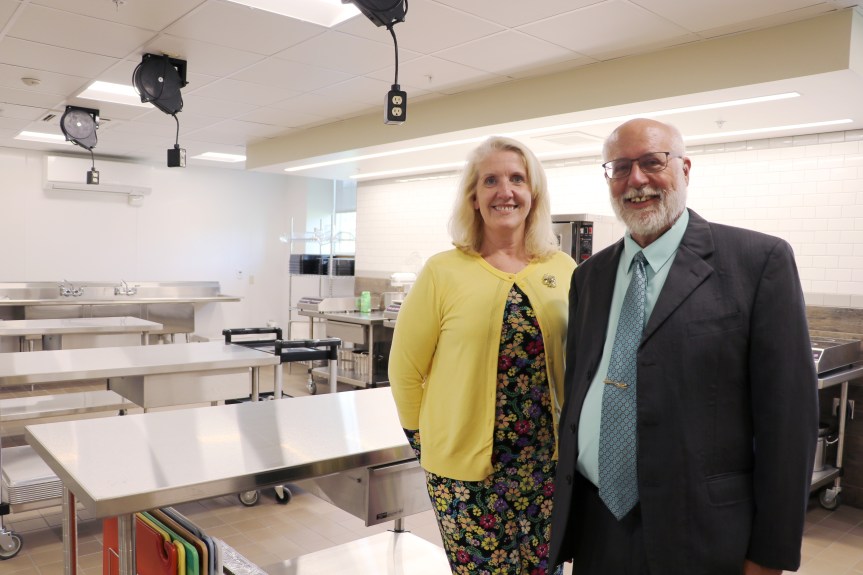
The new kitchen is supplied with industrial stoves, appliances, sinks, counter space, ventilation, and tools that will allow the child nutrition team to host professional learning opportunities for school nutrition staff that are working in schools throughout the state. Pending the final touches on some cameras and tv monitors, the DOE will be planning some upcoming webinars, with tips and information about how to utilize and cook with USDA approved foods in school kitchens, including cooking from scratch, with vegan options, and keeping up with trends in the food service industry, among other topics.

Just down the hall from the kitchen there is ample office space for the staff who work on the Child Nutrition teams including two chefs and several other nutrition specialists. Maine DOE’s Child Nutrition team is a federally funded function of the Department that works to support federal programs that help fight hunger and obesity, by reimbursing organizations such as schools, child care centers, and after-school programs for providing healthy meals to children. They also help run the Summer Food Service Program and oversee several United States Department of Agriculture (USDA) Food and Nutrition Services programs and initiatives that provide healthy food to children.

Child Nutrition Chefs, April Taylor and Michele Bisbee.

While the Child Nutrition Team is working hard to ensure Maine kids have healthy meals, their neighbors, the EUT team, are next door providing State-run administrative services for Maine schools that enroll students from unorganized territories throughout the State, ensuring students who do not have a school near their home have access to elementary and secondary education. The EUT places and supports 900 students from unorganized territories all over the state with tuition, special education services, transportation, and advocacy. They also help run EUT schools, Connor Consolidated School in Connor Township; Edmunds Consolidated School in Edmunds Township; and Kingman Elementary School in Kingman. Maine has 421 (and growing) unorganized territories with students from north to south, inland and islands, mountain areas in the west, and farms areas in the northeast.

In addition to the day-to-day flow of files that pass through the EUT offices during regular business, they also house some unique historical documents with a rich history dating back before the 1920s. Some of which are now on display for visitors to see in their new space, including black and white pictures, hand-drawn floor plans from old school houses, and even some old tuition bills.

The open house drew colleagues and news stations alike and ended with an announcement that the new kitchen space will be dedicated to Child Nutrition Director Walter Beesley who was instrumental in launching the culinary classroom in hopes of providing more hands-on, advanced support to Maine school kitchen staff.

For more information about Maine DOE’s Child Nutrition Team, please visit their website or contact their offices, and for more information about Education in Unorganized Territories, please visit this webpage for contact information.

MAINE HARVEST OF THE MONTH

ABOUT

The Maine Department of Education Child Nutrition Program is excited to announce the official launch of Maine’s Harvest of the Month (HOM) Program. The program was piloted in schools in Spring 2019, with participation from over 165 schools state-wide. The full roll out of the program begins this fall for School Year 2020.

PROGRAM BACKGROUND

Harvest of the Month (HOM) is a nationwide marketing campaign, promoting the use of seasonally available, local products in schools, institutions, and communities. Each month a different local product is highlighted, and participating entities pledge to serve the product and promote it through educational materials and activities. The program launched in California, and has been replicated by dozens of other states across the country. With Maine’s participation, all New England states now have Harvest of the Month programs.

MAINE HARVEST OF THE MONTH

Participating School Food Service Directors are asked to take a pledge to serve the monthly HOM product at least two times per month in their cafeterias. In addition to this, they pledge to display HOM promotional materials, such as posters, fun facts, and stickers for students who have tried the HOM product. Featured recipes are also provided each month. In taking the pledge, schools agree to participate in evaluations so that local food procurement can be tracked and to analyze the success of the program. Local products may be sourced directly from farms, farmer cooperatives, and distributors. When buying produce directly from a farm or farmer cooperative, School Food Service Directors may take advantage of the Local Produce Fund, which reimburses $1 for every $3 spent on local produce (up to $1,000 per district for SY 2020).

To sign up for the Harvest of the Month Program, please sign the pledge at https://forms.gle/M3av147TXBHBjGPh9. Interested school districts have until October 1, 2019 to sign up.

FOR MORE INFORMATION, CONTACT: Stephanie Stambach, Child Nutrition Consultant at Stephanie.stambach@maine.gov or 207-624-6732, or visit www.maine.gov/doe/harvestofthemonth/

CDC Releases New Resources: Talking to Youth About the Risks of E-Cigarettes

The Office on Smoking and Health, CDC released a new feature for a new school year, aimed at helping people who work with youth to open a discussion about the risks of e-cigarettes.

E-cigarettes are now the most common type of tobacco product used by youth in the United States. More and more youth report trying and regularly using e-cigarettes. The rising numbers threaten decades of progress in controlling youth tobacco product use.

Nicotine in e-cigarettes can harm developing brains, and may make it more likely that young people will start using regular cigarettes. This feature gives important facts about the risks of e-cigarettes, plus tips for talking to young people and resources for both adults and youth.

Everyone—teachers, coaches, health care providers, and parents—has a part to play in educating youth about the risks of e-cigarettes.

Be sure to follow CDC Tobacco Free on Facebook and Twitter for social media posts to share with partners, friends, and family.

For more information and resources in Maine go to Prevention for ME.

MEDIA ADVISORY: Open House of NEW Maine Department of Education Culinary Classroom

What: Open House and Introduction to NEW Child Nutrition Culinary Classroom
When: Sept 10, 2019 1pm – 4pm
Where: 90 Blossom Lane, 1st floor Deering Building

We are excited to announce and to show off the Maine Department of Education Child Nutrition Team’s first culinary classroom for the School Lunch and Breakfast program, and invite members of the child nutrition/school communities and media outlets to an open house of our new kitchen.  The classroom replicates the kitchens found in our schools, with commercial ovens,  cook tops and other commercial equipment used in school meal preparation.  The modern classroom will have the ability to stream, record and host live audiences for demonstrations, and the Child Nutrition program will use resident chefs to provide additional training to local food service staff.  The kitchen will be able to rotate 30 cooks at time, with both hands-on experience and paperwork management.  Some examples of upcoming classes are: knife skills and maintenance, preparing summer squash, measuring techniques, using USDA foods effectively, and vegan options.  The kitchen will be the host of the annual school cook off contest as well. We are excited by the possibilities and grateful for the amazing space in which we can support our school nutrition programs as they provide healthy meals to Maine’s students.

More information, please contact Walter Beesley at walter.beesley@maine.gov

Kittery School Department Hosts Kick-off Celebration to Promote Free Summer Lunch Program

Kittery School Department hosted a kick-off pizza party this week welcoming children in their community to enjoy free lunch all summer long.  At the event they served pizza, watermelon, chocolate hummus with strawberries, snacks, and milk. This event is hosted annually to let the community know about the Summer Food Service Program that provides free lunch to all kids Monday through Friday throughout the summer months, completely free, no questions asked.

Kaitlin Beach, Shapleigh School Assistant Principal and Alli Gamache, Mitchell Primary School Principal

Funded by the U. S. Department of Agriculture and administered by the Maine Department of Education in partnership with local sponsors throughout the state, the Summer Food Service Program is an extension of the Federal Child Nutrition program found in schools across the nation which provides free or reduced priced meals to families who qualify. The Kittery School Department is one of 463 sites located in Maine this summer who offer the Summer Food Service Program.

Traip Academy Assistant Principal/Athletic Director, Kittery School Department Superintendent, Eric Waddell, and Michael Roberge, Traip Academy Principal John Drisko serving pizza at the event

The strong connections between the Kittery School Department and their community allow them to not only host the summer meal program at the Kittery Community Center where kids are in and out all day participating in summer activities through the recreational department, but also provides the kids with other opportunities and activities available through community partnerships. For example, at the event this week, each student received a free backpack with school supplies tucked inside. The backpacks and the supplies are donated with the help of United Way and the Portsmouth Naval Shipyard. Each time kids come back for a meal this summer they will get an additional item for their backpack. Wendy Collins, Kittery School Department School Nutrition Director and the organizer of the Summer Food Service Program, hopes it will help get kids to come back and eat each day and spread the word about this wonderful service to the community.

IMG_1400
Sarah Perkins and Catherine Hoffmann, from the Maine Dairy & Nutrition Council

Also present at the event was the Maine Dairy & Nutrition Council who have helped support the Kittery School Department through grant funding. During the event they helped serve the milk for lunch that day and promoted their Fuel Up to Play 60 initiative. In addition, there were representatives from Let’s Go! promoting their statewide initiative 5-2-1-0 Goes to Child Care to help communities maintain and improve upon their healthy food choices and physical activity opportunities. They provided activities and games for kids to enjoy after lunch, along with the many other fun things available including face painting and a large Thomas & Friends themed bounce house.

The event served 193 kids who all got to enjoy a delicious and nutritious meal provided by a school department and its community who care so very much about the children and families who live in their community.

To find summer meal sites near you, visit http://www.fns.usda.gov/summerfoodrocks, and type in your address. The map will be populated with the sites nearest to you. You can also text “Summer Meals” to 97779 or call Maine 211.

Questions & Answers regarding An Act to Prevent Food Shaming in Maine’s Public Schools

In an effort to support schools and districts as they align their practices and policies in response to the passing of Public Law 2019, Chapter 54, please see the Question and Answer document and resources, below.  

 Food Shaming

  1. What constitutes food shaming?  The law prevents public schools from:
  • denying a reimbursable meal to an otherwise eligible student who requests it;
  • requiring a student to throw away their meal after it has been served to them;
  • requiring a student to perform chores or work as a means of paying for one or more meals or as punishment for not paying for one or more meals;
  • refusing a meal as a form of or as part of a disciplinary action; or
  • openly identifying or otherwise stigmatizing a student who cannot pay for a meal or has payments due for a meal.

Grades

  1. What grade levels are impacted by this new law?

The law applies to all grade levels in a public school that provides students meals eligible for reimbursement under a program administered by the United States Department of Agriculture, therefore any grade enrolled in the public school.  The law does not apply to private schools.

Seniors

  1. Can schools prohibit seniors from participating in graduation functions/activities if the student has meal debt?
  2. When Seniors have balances at the end of the year, whether it is for meals, books, or computers, we do not pass out the cap and gown until the balance is paid.  Can we still do that?
  3. Our district charging policy has been that to receive graduation tickets or their cap and gown, seniors must have their lunch balance cleared up. Additionally, we have withheld open campus privileges or a superintendent’s agreement if there is an outstanding lunch balance. Will this still be allowable?

The law prevents openly identifying or otherwise stigmatizing a student with a meal debt.  If the only reason a student is being prohibited from an activity is because of a meal debt, it would constitute identifying or stigmatizing a student.  If the prohibition is potentially based on one of a list of factors (owed books, uniforms, other debt) including a meal debt, it might not constitute identifying or stigmatizing a student, since there are multiple reasons for which a student is denied.  School administrative units are encouraged to consult with legal counsel about their specific policies.

Communication

  1. Are the cashiers allowed to tell the students when they are charging or close to charging?

A public school’s communications about a student’s meal debts (charging) must be made to the parent or guardian of the student rather than to the student directly except that, if a student inquires about that student’s meal debt, the school may answer the student’s inquiry.  A public school may ask a student to carry to the student’s parent or guardian a letter regarding the student’s meal debt.  A student with a low balance still has funds on their account and is not in debt, therefore it is allowable to communicate with a student about their low balance.

  1. Are we allowed to let the children know that they are getting low on their account?

A student with a low balance still has funds on their account and is not in debt, therefore it is allowable to communicate with a student about their low balance.

  1. Most software schools are using automatically say “Please wait, low balance,” when a student uses their PIN. which is identifying the student, where others can hear it. Would that still be acceptable?

A student with a low balance still has funds on their account and is not in debt, therefore it is allowable to communicate with a student about their low balance.

  1. If a student directly asks about balance information what is our answer? What if they are 18 years old?

If the student inquires about his/her meal debt, the school may answer the student’s inquiry. This applies to a student enrolled at the public school, regardless of age. A student may be asked to deliver a notice to parents/guardians about the debt, but should not be approached unsolicited about the debt.

  1. Can we post a sign at the register telling students they can ask what their account balance is?

Yes. If the student inquires about their meal debt, the staff may answer their inquiry. Otherwise communication must be made directly to the parent/guardian, regardless of the age of the student.

A La Carte

  1. Our school policy says that if you owe money you cannot purchase a la carte items and there is no charging of a la carte items.  This policy has helped to keep our lunch debt down some. Are we still going to be able to say no to the extra items if they don’t have money?

Yes. This law applies to reimbursable meals only. If your local policy does not allow a student to charge a la carte items, a public school may discreetly notify a student that they do not have funds on their account to purchase the a la carte item(s).

  1. Charging for ala carte is not allowed so when the student is told that in line in front of other students, is that considered lunch shaming?

No. This law applies to reimbursable meals only. If your local policy does not allow a student to charge a la carte items, a public school may notify a student discreetly that they do not have funds on their account to purchase the a la carte item(s).  Efforts to make this policy known and well publicized should be made to avoid the situation and potential for embarrassment.

Alternate Meals

  1. Can Schools implement an alternative meal (with all components) until the debt is paid?

No, the student must receive the same reimbursable meal as the other students. Provision of an alternative meal could openly identify or stigmatize a student.

  1. Our school provides a bag lunch to students with a negative balance before the lunch period so that it looks like a lunch brought from home. Can we keep doing this?

No, the student must receive the same reimbursable meal as the other students.

Outstanding Debt

  1. What are we to do with the outstanding lunch balances? How do we encourage parents to be responsible?

Public schools should follow their policy or procedure for collecting payments from families. This policy/procedure should be shared publicly so parents are informed of the process.

  1. Can we send outstanding debts to a collection agency?

Yes.

  1. What happens when everyone owes and refuses to pay because they know they do not have to, in order to get a meal?

The school nutrition program should make efforts to collect meal payments as identified in their local policy.

  1. Who will pay for the unpaid balances?

The school nutrition program should make efforts to collect meal payments as identified in their local policy. Once the debt is determined to be uncollectable, such as after a student leaves the district or graduates, it is considered bad debt and is not an allowable expense of the Federal school foodservice program or any other Federal program. The debt would need to be paid by non-Federal funds, such as the general fund and the debt would become the responsibility of the public school at this point.

OTHER

  1. What is the State’s plan to provide funding for the lunch bills that won’t get paid?

The law was identified as an unfunded mandate and passed by a 2/3 vote by the Legislature.  Funding will need to be addressed at the local level.

  1. Does this apply to all meals, breakfast, lunch and snack?

This law applies to all programs that provide student meals eligible for reimbursement under a program administered by the United States Department of Agriculture. This includes the School Breakfast Program, National School Lunch Program and Afterschool Snack Service.

  1. Is there guidance available on how to handle unpaid meals?

The law requires the Department of Education to develop guidance for school administrative units relating to the collection of student meal debt, including, but not limited to, best practices and information on how to create an online system for the payment of student meal debt.

The Maine DOE has guidance available online, and  The USDA has guidance and resources available online, including a guide book.


NOTICE: Maine School Wellness Summit POSTPONED, New Dates TBD

Regretfully, due to low registration, the 2019 Maine School Wellness Summit planned for June 25 & 26 has been postponed. The Maine Schoolsite Health Promotion Program (MSHPP) Planning Committee is committed to hosting the planned two-day agenda in the 2019-20 school year. We are thankful to the scheduled presenters, who have indicated that they are very willing to work with us to deliver their presentations at a future date.

Registrants should have received an email from the planning committee via Cristina.stade@maine.gov. If you have additional questions, please email either Cristina or susan.berry@maine.gov.

Please know that the decision to postpone was made with great thought and consideration of presenter cost, time and efforts, as well as the desire for participants to have a robust and collaborative experience.

The MSHPP Planning Committee wishes everyone a restful, rejuvenating, and well-deserved summer break.