Public Pre-K Expansion Distinguished Educator Opportunity

As part of Maine’s Jobs and Recovery Plan (MJRP), the Maine Department of Education (DOE) was awarded $10 million in American Rescue Plan funding to support the expansion of public pre-k opportunities in Maine.  To assist with the provision of technical assistance and professional learning for the new and expanding pre-k programs being funding through this opportunity, the Maine DOE is seeking a Distinguished Educator to be part of its Early Learning Team.  Under the Distinguished Educator program, the Maine DOE contracts with a public school system or community agency to borrow an educator for a designated period, in this case the 2023-24 school year.  Following service in the program, the Distinguished Educator returns to their sending school system/community agency.

Maine educators who meet the qualifications described below are strongly encouraged to consider applying for this opportunity. Distinguished educators share their expertise with the Maine DOE and other Maine educators while also growing as professionals through a range of new and exciting experiences. The application period for this position will remain open until April 25, 2023.  Interested applicants should submit a letter of interest and resume to Lee Anne Larsen, Director of Early Learning (leeann.larsen@maine.gov).  Candidates selected for interviews will be notified by May 5, 2023.

Questions may be directed to Leeann.Larsen@maine.gov.

Maine Department of Education Distinguished Educator Public Pre-K Expansion Technical Assistance Provider

POSITION DESCRIPTION

The Public Pre-K Technical Assistance Provider engages in professional work related to planning and providing technical assistance and professional learning for public preschool programs, including programs in partnership with Head Start and private providers.  The position conducts technical assistance visits, including observations of classrooms, and reviews data to help support program improvement.  The position is part of the Early Learning Team within the Maine Department of Education’s Office of Innovation.  The position coordinates regularly with the DOE’s Early Childhood Specialist and Public Pre-K Consultant.  Statewide travel is required.

REPRESENTATIVE TASKS of this position include but are not limited to:

  • Delivering appropriate technical assistance and professional learning to enhance program implementation — may specifically address evidence-based early childhood curriculum, learner-centered instruction, differential learning, assessment, developmental education and/or experiential learning, developing and implementing MOUs with community providers, etc.
  • Providing interpretation and explanations of statutory provisions to local school authorities, CDS contracted providers, and the public.
  • Supporting SAU compliance with the Chapter 124 Public Preschool Program Standards and providing technical assistance related to program improvement.
  • Analyzing data contained in SAU annual reports of pre-k programming.
  • Other duties applicable to support of public pre-k expansion efforts, as assigned.

KNOWLEDGE, SKILLS, AND ABILITIES REQUIRED to successfully perform the work assigned:

  • Experience with the early childhood general education and special education communities in Maine and with public school education in Maine.
  • Knowledge of current learning research and exemplary early childhood educational instructional strategies in all early learning domains.
  • Knowledge of current and emerging state and federal legislation, rules and regulations impacting early childhood education, including Department of Health and Human Services (DHHS) childcare licensing and Child Development Services (CDS).
  • Knowledge of exemplary evidence-based early childhood curriculum, learner-centered instruction, differential learning, assessment, developmental education, and experiential learning, and understanding of the relationships among these areas.
  • Knowledge of and experience with Maine’s College and career Ready Learning Results and Maine’s Early Learning and Development Standards.
  • Knowledge and experience with developing and implementing public pre-k programs in partnership with community providers (e.g. Head Start, Child Care, etc.).
  • Knowledge of community involvement issues in education policy decisions and operations.
  • Ability to interpret and explain statutory provisions to local school authorities, community providers, and the public.
  • Ability to effectively provide information, technical assistance, professional development and program development support and expertise.
  • Ability to use technology-based communications (i.e., Internet, Web) and e-mail systems and both laptop and desktop computer systems, word processing and data applications.
  • Ability to communicate effectively orally and in writing.
  • Ability to effectively facilitate meetings, organize and manage multiple projects.
  • Ability to apply and facilitate group dynamics and to use exemplary interpersonal skills in order to work collaboratively, develop positive working relationships, and involve stakeholders at the local and state level.

MINIMUM QUALIFICATIONS:  A Bachelor’s Degree in Early Childhood Education or a related field and two (2) years of professional level experience in public pre-k programming is required.  A Master’s Degree in Early Childhood Education and five years of early childhood teaching and/or administrative experience is preferred. CLASS Observer certification at the pre-k level is also preferred.

Reminder: Pre-K for ME, K for ME, and 1st Grade for ME Program Overviews and Summer Training Opportunities

Since 2018, the Maine Department of Education (DOE) has adapted and piloted open-source Pre-k and Kindergarten instructional programs based on the Boston Public School’s evidence-based Focus on K1 and Focus on K2 curricula.  Pre-K for ME was launched in 2019.  K for ME was launched in 2021.  1st Grade for ME is being piloted in Maine classrooms this year and will be made available for the 2023-2024 school year. These programs focus on the whole child, are interdisciplinary, and are developmentally appropriate.  They are also aligned to Maine’s learning standards.  While Maine schools are responsible for the purchase of the materials that support use of the programs, the programs can be accessed at no cost via the Maine DOE’s website. 

Informational overviews of each of program will be provided in the coming weeks.  The overview sessions will be recorded and posted for anyone unable to attend the live sessions. The overview sessions will share the basic program structure and review the materials needed to implement the program.  If unfamiliar with the programs, attending the overview (or watching the recording) is highly recommended. 

Overview Session Registration Links: 

Educators/schools/programs interested in utilizing Pre-K for ME, K for ME and/or 1st Grade for ME in the coming year may take advantage of 2-day initial trainings scheduled for this summer.  These trainings are provided at no cost to promote understanding of program design and to support successful program implementation.  School administrators are strongly encouraged to attend the trainings with their Pre-K, Kindergarten and/or first grade teachers.  Special educators, education technicians, and instructional coaches/curriculum leaders who work with pre-k, kindergarten and first grade teachers are also encouraged to attend. 

This year’s training opportunities will be held in person from 8:30 a.m. to 3:30 p.m. during the week of July 31st-August 4th. The locations and break down of dates for the specific programs are being finalized and will be available soon. For teachers learning the K for ME and 1st Grade for ME programs, an additional training day will occur on June 28 from 8:30-3:30 (location TBD).  Registration for these trainings should be completed by principals/educators with one registration on behalf of their school/program.  Details about how to prepare for the trainings and the training locations will be provided via email after registrations are received. Registrations for the 2-day training for each instructional program should be received by May 26, 2023. 

Summer Training Registration Links: 

For additional information about Pre-K for ME, contact Nicole.Madore@maine.gov, and for K for ME and 1st Grade for ME, contact Leeann.Larsen@maine.gov. 

Calling all Maine Early Childcare Educators: Celebrate the Week of the Young Child with Maine DOE and MAEYC

The Week of the Young Child is a national event promoting the importance of high-quality early learning sponsored by the National Association for the Education of Young Children (NAEYC).  This year the Maine Department of Education and Maine’s local NAEYC affiliate, Maine AEYC, are teaming up to support early childhood educators across the state to join the celebration and promote the vital work they do every day in their early childhood programs and Pre-K through third grade classrooms.

The event takes place the Week of April 1st – 7th with a Kickoff on Saturday and interdisciplinary daily themes for the following week:

We hope that you will join us in celebrating the Week of the Young Child! Today more than ever we need to help our communities understand the importance and value of high-quality early care and learning.  To spread the word and highlight the critical role that early childhood educators play, please share photos through social media to show how you celebrate the Week of the Young Child.   Tag the Maine DOE @MaineDepartmentofEducation1 Facebook, @mdoenews on Twitter, and @mainedepted on Twitter. Be sure to use the hashtags: #WOYCMaine and #WOYC23.
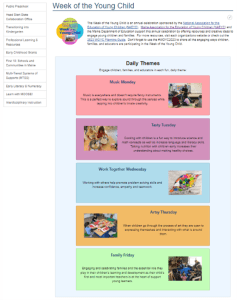
There are many ways to promote the event and celebrate the daily themes in your program, school, or classroom. To support your planning, we have put together a collection of resources which can be found on the DOE’s Week of the Young Child web page.  Be sure to explore the many ideas for interdisciplinary activities included there.  You will also find links to NAEYC’s and MAEYC’s websites with information about the daily themes, sponsored events, and a planning guide.  We have also included videos related to each daily theme that share ways to incorporate the theme into your celebration and daily practice.

We can’t wait to see the creative way Maine’s early childcare educators celebrate the themes with the children and families in your program or classroom! To celebrate your efforts, we will be offering the opportunity to earn a free registration to Maine’s Statewide Early Childhood Education Conference which will be held October 27th & 28th at the Holiday Inn by the Bay in Portland.  To enter the drawing please send an email that includes photos of your celebration with the name of your program to Nicole Madore at nicole.madore@maine.gov. Please use WOYC followed by the daily theme in the subject line.

Don’t forget to mark your calendar for ECE Day at the State House on Wednesday, April 5, 2023.  This is an opportunity for early childhood educators, families, and supporters to work together to call attention to the need for high-quality early care and education opportunities, and support for the ECE workforce.  Join us to celebrate the successes and call attention to the ongoing needs.  For more information visit the events section of the MAEYC website.

The Maine DOE plans on celebrating the week by highlighting the many career roles in the early childhood field through daily videos.  Each day we will present videos on our YouTube channel that highlight Maine professionals who make a difference in the lives of young children in roles relate to that day’s theme.  If you know an individual who works with young children and/or their families who you feel deserves the spotlight, please reach out to Sue Gallant, Pre-K Expansion Consultant at sue.gallant@maine.gov. Please check out the videos on our YouTube channel during the week of April 3rd through 7th.

If you have questions or would like more information on the Week of the Young Child, please reach out to one of the members of the Early Learning Team listed below.

If you have questions or would like more information on the Week of the Young Child, please reach out to one of the members of the Early Learning Team listed below.  
 

Register Now for Public Pre-K Technical Assistance Sessions Available March – July 2023 

Members of the Early Learning Team will be providing an opportunity for new and expanding Pre-K programs to come together to learn about and discuss the components of high-quality programming. 

These sessions will be offered virtually on the 2nd and 4th Thursday of each month, March 30th through July 13th, 2023, from 3:30-4:30 pm. You may register once to have access to all sessions. Each session will be recorded and links to the recordings will be shared. 

Please feel free to share the registration linkwith others in your school system who may be interested. 

The sessions are scheduled as follows: 

  • March 30, 2023: Rule Chapter 124, Pre-K Guidebook & the Technical Assistance Process 
  • April 13, 2023: Public School & Community Partnerships 
  • April 27, 2023: Student Recruitment, Enrollment & Screening 
  • May 11, 2023: High-Quality Environments, Curriculum & Assessment 
  • May 25, 2023: Early Childhood Teacher Training & Maine Roads to Quality 
  • June 8, 2023: Child Development Services: Working Relationships 
  • June 22, 2023: Student Inclusion, SEL & Challenging Behaviors  
  • July 13, 2023: Family Engagement & Transitions 

Register here.For questions and clarifications, please contact Early Childhood Specialist Nicole Madore at nicole.madore@maine.gov. 

Pre-K for ME, K for ME, and 1st Grade for ME Program Overviews and Summer Training Opportunities

Since 2018, the Maine Department of Education (DOE) has adapted and piloted open-source Pre-k and Kindergarten instructional programs based on the Boston Public School’s evidence-based Focus on K1 and Focus on K2 curricula.  Pre-K for ME was launched in 2019.  K for ME was launched in 2021.  1st Grade for ME is being piloted in Maine classrooms this year and will be made available for the 2023-2024 school year. These programs focus on the whole child, are interdisciplinary, and are developmentally appropriate.  They are also aligned to Maine’s learning standards.  While Maine schools are responsible for the purchase of the materials that support use of the programs, the programs can be accessed at no cost via the Maine DOE’s website. 

Informational overviews of each of program will be provided in the coming weeks.  The overview sessions will be recorded and posted for anyone unable to attend the live sessions. The overview sessions will share the basic program structure and review the materials needed to implement the program.  If unfamiliar with the programs, attending the overview (or watching the recording) is highly recommended. 

Overview Session Registration Links: 

Educators/schools/programs interested in utilizing Pre-K for ME, K for ME and/or 1st Grade for ME in the coming year may take advantage of 2-day initial trainings scheduled for this summer.  These trainings are provided at no cost to promote understanding of program design and to support successful program implementation.  School administrators are strongly encouraged to attend the trainings with their Pre-K, Kindergarten and/or first grade teachers.  Special educators, education technicians, and instructional coaches/curriculum leaders who work with pre-k, kindergarten and first grade teachers are also encouraged to attend. 

This year’s training opportunities will be held in person from 8:30 a.m. to 3:30 p.m. during the week of July 31st-August 4th. The locations and break down of dates for the specific programs are being finalized and will be available soon. For teachers learning the K for ME and 1st Grade for ME programs, an additional training day will occur on June 28 from 8:30-3:30 (location TBD).  Registration for these trainings should be completed by principals/educators with one registration on behalf of their school/program.  Details about how to prepare for the trainings and the training locations will be provided via email after registrations are received. Registrations for the 2-day training for each instructional program should be received by May 26, 2023. 

Summer Training Registration Links: 

For additional information about Pre-K for ME, contact Nicole.Madore@maine.gov, and for K for ME and 1st Grade for ME, contact Leeann.Larsen@maine.gov. 


Transition to Kindergarten Train the Trainer Opportunity 

The Maine Department of Education’s Early Learning Team is happy to announce the next step in the Transition to Kindergarten training series.  In 2022, the Transition to Kindergarten module series and facilitator guide focused on building community-wide understanding of kindergarten readiness and the impact of high-quality transition practices on children, families, schools, and communities was released.  This 4-part series, as well as several other useful resources related to kindergarten transitions, can be found on the Transitioning to Kindergarten webpages 

The next installment in the Transitions to Kindergarten series is a Train the Trainer opportunity built to support and guide individuals who can facilitate community-based kindergarten transition teams to use the tools and activities within the Transition to Kindergarten module series.  The goal of the series modules is to build understanding and implementation of high-quality, year-round transition practices for all stakeholders to ensure children’s successful transition into their Kindergarten year.   

If you, or someone you know, could benefit from participating in this training which will prepare participants to guide communities in forming Kindergarten transition teams and transitions plans, please register for this exciting and free two-session training. 

  • Session #1 will be held on Wednesday, March 15, 2023, from 2:00 p.m. to 4:00 pm. 
  • Session #2 will be held on Tuesday, March 21, 2023, from 2:00 p.m. to 4:00 p.m. 
  • Once you register, a link will be sent to your email; this will be the same link for both sessions 

Click here to Register for both sessions. 

For more information and any questions, please reach to Marcy Whitcomb, Public Pre-K Consultant at Marcy.r.whitcomb@maine.gov. 


Education Commissioner Pender Makin Kicks Off Annual Read to ME Challenge by Reading to Sanford Pre-K Students 

Maine Education Commissioner Pender Makin kicked off the state’s Read to ME Challenge at Sanford Regional Technical Center by reading If Only… to a group of spirited pre-k students. This is the eighth year that the Maine Department of Education is collaborating with schools, parents and communities on this month-long public awareness campaign to promote the importance of literacy for all of Maine’s students, regardless of age. You can watch video of Makin kicking off the challenge here.

The Read to ME Challenge encourages adults to read to children for 15 minutes, capture that moment via a photo or a video, and then post it to social media and challenge others to do the same using the hashtag #ReadtoME.

Makin also spent time talking with students who are part of Sanford Regional Technical Center’s early childhood education program. Students in the program split their time between their own classroom and interacting with children in the pre-k classroom. Sanford was also able to expand to full day pre-k this year after receiving a grant through the Maine Jobs and Recovery Plan.

“The Read to ME Challenge is about creating a love of reading with children and promoting literacy across our state—and it’s fun,” said Maine Education Commissioner Pender Makin. “Not only did I get to read to an amazing group of pre-k students today, but I had the wonderful opportunity to talk with high school students who are working hard to become future educators through this amazing early childhood education program at Sanford Regional Technical Center.”

The simple act of reading aloud to a child 15 minutes a day for five years results in 27,375 minutes of language exposure, which can put children on the path to high literacy achievement and helps them build knowledge and vocabulary. Research demonstrates a number of benefits to reading to children, from birth through their childhoods and even teenage years, including modeling reading as an enjoyable lifelong activity, stimulating brain development, reducing stress and anxiety, building knowledge of the world, and helping develop the skills necessary to succeed in their lives.

Schools and community organizations can find a toolkit and resources on the Department of Education website and the Department will be sharing videos, photos, and updates from the challenge all month long on social media.

Participants in the challenge are reminded to use the hashtag #ReadtoME and to tag the Maine DOE at @mdoenews on Twitter, @MaineDepartmentofEducation1 on Facebook, and @mainedepted on Instagram.

See who Commissioner Makin Challenged!

Seeking Writing Teams and Targeted Reviewers for Update of the Maine Early Learning and Development Standards

The Maine Early Learning and Development Standards (MELDS) are the state’s learning standards for children ages three-five. Building from the Infant Toddler MELDS (IT MELDS) and bridging developmental expectations to the Maine Learning Results (MLRs), the MELDS inform all early childhood professionals about the typically developing expectations of young children as well as curriculum and assessment practices.

The MELDS Steering Committee is now accepting applications from individuals interested in being part of the review process to serve as participants on one of the writing teams, or as a targeted reviewer.  The Steering Committee is seeking professionals in the field of Early Care and Education that work or have worked with or on behalf of children. Prospective participants must apply  no later than February 21, 2023.

To understand the details of participation, please read the following Frequently Asked Questions (FAQ):

Q: What are the Maine Early Learning Development Standards (MELDS)?

A: Early Learning and Development Standards describe the concepts and skills children develop and learn along the developmental continuum from birth to kindergarten entry. Their purpose is to support the development and well-being of young children and to foster their learning.

The standards promote the understanding of early learning and development, provide a comprehensive and coherent set of early childhood educational expectations for children’s development and learning, and guide the design and implementation of curriculum, assessment, and instructional practices with young children.

Maine’s Early Learning and Development Standards (MELDS) serve as a guide for state and local early childhood educators’ efforts to improve practice and programs for young children during their preschool years.  The Infant/Toddler MELDS is a companion tool for ages birth-36 months.

Q: Who should consider participating?

A: In order to develop an evidence-based set of standards, we are seeking a diverse population of professionals from the Early Care and Education (ECE) field:

  • Child Care and School Administrators
  • Child Care Health Consultants
  • Child Care Providers and staff of all licensed programs (family, small facility, facility, nursery school, out of school time programs)
  • Child Care Providers and staff from licensed exempt programs
  • Early educators within the school setting (Pre-K through 3rd grade)
  • Ed Techs
  • English to Speakers of Other Languages (ESOL) Professionals
  • Head Start staff
  • Higher education professionals and their students within or specializing in the ECE/ECS field
  • Individuals that provide professional development to the Early Care and Education field
  • Parents, Guardians, Caregivers, or Family Members
  • Special Education Teachers / Specialists
  • Student and School Support Specialists: Speech, Occupational and Physical Therapists, School Counselors, School Social Workers, Interventionists, Title I staff
  • Other professionals serving families of young children

Q: What are writing teams and what is the time commitment?

A: Each of the domains of development will need a team of professionals to review content for relevance and alignment to current research in order for the MELDS to provide early childhood educators with guidance as they design inclusive environments, shape curriculum, lead professional development initiatives, build intentionality into teaching practice, engage families, and support children’s learning at home.  The domains include:

  • Social and Emotional Development
    • Goal Areas: Trust and emotional security, self-regulation; sense of self, self-awareness, and self-concept, relationships with adults, relationships with children
  • Approaches to Learning
    • Goal Areas: Engagement and persistence, initiative and curiosity, creativity
  • Early Language and Literacy
    • Goal Areas: Language comprehension (receptive language), language expression (Expressive/productive communication), emergent literacy
  • Physical Development and Health
    • Goal Areas: Perceptual development, gross motor (large muscle), fine motor (small muscle), self-help and adaptive skills
  • Cognitive Development
    • Goal Areas: exploration and inquiry, concept development and working memory, reflection and problem-solving, mathematical thinking, scientific reasoning, social studies learning

In addition to the domains of development, there are additional sections of the document that will need review.  Those sections include:

  • Introduction, History, Key Components of Early Learning Standards,
  • Purpose Statement and Potential Users, Guiding Principles and Universal Design for Learning
  • Introduction to the Stages of Development Ages 3-5

Time Commitment: The facilitator(s) for each writing team will determine the time necessary for both whole group and individual review. Participants should expect this to be no more than two hours per week. Writing teams will convene in March and work through June.

Q: What are targeted reviewers and what is the time commitment?

A:  Targeted reviewers will review the updated sections provided to them and offer structured feedback. Targeted reviewers will begin review once the initial updates have been made to provide feedback to the Steering Committee.

The time commitment will be less for targeted reviewers than writing team participants, however the  window for review and feedback will be shorter and more time sensitive (approximate document turnaround time of two weeks).

Q: What will I earn in exchange for my time and expertise?

A: Not only will individuals be afforded an opportunity to participate in furthering the field of Early Care and Education, but each participant will also be awarded contact hours at the completion of the writing team cycle based on attendance and at the discretion of the team leader.

Contact hours may be used for furthering education, documentation of professional development experiences, or for continuing education credits (CEUs) and/or training hour conversion.

Q: Why is periodic updating of learning and development standards important?

A: Research in the field of early care and education is constantly evolving.  A regular process of updating early learning and development standards helps to ensure their validity and alignment with other sets of standards across the birth to grade 12 spans.  The updated MELDS will result in a child-centered tool that will inform program development, instruction, assessment, policy decisions, and professional learning for early care and education efforts across Maine.

Q: What is the overall timeline for the MELDS revision?

A: MELDS revision began in the Fall of 2022 with the creation of the Steering Committee. This group has been meeting regularly to discuss the current format of Maine’s MELDS as well as to review feedback from the field, other states’ Early Learning and Development Standards and national research trends/findings. The remaining work is set to unfold on the following timeline:

  • January-February 2023: Recruit writing team members and targeted reviewers
  • February 2023: Assign Steering Committee members and teams to review the current standards
  • March-June 2023: Teams will work to review terminology, assure alignment to Maine’s Infant/Toddler MELDS and to the Maine Learning Results, and review for readability, diversity, inclusion and ease of use
  • July-August 2023: A final version will be translated and introduced to the field for further use

Thank you for time and consideration. If you have any questions, please contact the Department of Education’s Early Childhood Specialist, Nicole.Madore@maine.gov or the Office of Child and Family Services First4ME Program Manager, Megan.Swanson@maine.gov

Read to ME Challenge Kicks Off This Week

The Maine Department of Education (DOE) is pleased to announce that Commissioner Pender Makin will kick off the 8th annual Read to ME Challenge on Wednesday, February 1, 2023. You can watch a live stream of the event on the Maine DOE YouTube Channel.

The Read to ME Challenge is a month-long public awareness campaign held in February to promote childhood literacy in Maine. The challenge is an opportunity to promote children’s literacy growth by reading aloud to one or more children for at least 15 minutes. Part of the challenge is capturing the moment via a photo or video and then posting it on social media (with the hashtag #ReadtoME and tag the Maine DOE at @mdoenews on Twitter and @MaineDepartmentofEducation1 on Facebook! Keep watching the Maine DOE social media sites to see who has accepted the challenge of sharing the joy of reading with a child.

The Read to ME Challenge will run for the month of February, leading up to Read Across America Day on March 2, 2023. Learn more about the Read to ME Challenge on the Maine DOE Website. If you have a school or community organization that plans on participating in this challenge, please let us know by signing up at this link.

Download a promotional flyer here (PDF).

For more information, contact Dee Saucier (danielle.m.saucier@maine.gov), Inclusive Education Literacy Specialist for the Maine DOE Office of Special Services and Inclusive Education.

Third Round of Grant Funds Available to Support the Expansion of Public Pre-Ks 

As part of the Maine Jobs and Recovery Plan, Governor Mills allocated $10 million of the federal American Rescue Plan Act (ARPA) funds appropriated for Maine for public pre-k infrastructure to increase the number of 4-year-olds enrolled in public pre-k across the state. For 2022-24 school years, 28 School Administrative Units (SAUs) were awarded funding to expand or start new Pre-K programs.

The Maine DOE is excited to add an additional round of public pre-k expansion funding for school year 2023-24.

Currently, public Pre-K in Maine is not universally available for all 4-year-olds. While the cognitive and social-emotional benefits of high-quality pre-k are well documented, there are a variety of factors that contribute to the ability of SAUs to offer public pre-k and the extent to which they can enroll all eligible 4-year-olds from interested families. This funding will help expand pre-k opportunities across Maine.

Maine SAUs interested in starting or expanding public pre-k are encouraged to apply for funding through the Pre-K Expansion Request for Applications (RFA). SAUs will be able to use the funding, in combination with Essential Programs and Services allocations, to start new pre-k programs, add additional pre-k classrooms to already existing programming, and/or expand existing programs from part-day/part-week to full-day/full-week programs. Funding may also support public pre-k programming through partnerships between SAUs and community providers.

A timeline for the RFA process is provided below.

  • January 5, 2023–RFA released
  • January 20, 2023—RFA submission deadline

All questions about the Pre-K Expansion RFA should be submitted to the Pre-K Expansion Grant Coordinator identified on the Grant RFPs and RFAs webpage.

Additional questions regarding this announcement should be directed to:
Pre-K RFA Coordinator, jane.kirsling@maine.gov.