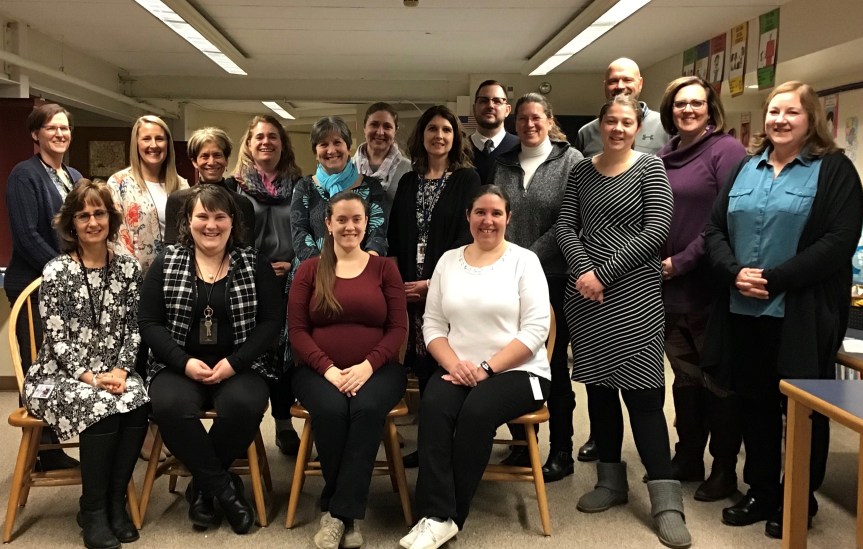
Free Adverse Childhood Experiences and Resilience Building Training for Childcare and PreK Teachers

The Preschool Development Grant (PDG), B-5, a collaboration between the Departments of Education and Health and Human Services, will be providing free trainings on Adverse Childhood Experiences (ACES) and resilience building. The PDG is a one-year planning grant to study and improve the birth-5 early care, education and service system in our state, and has 5 goals:

  1. Conduct a statewide needs assessment plan
  2. Develop statewide Birth to 5 Strategic Plan
  3. Maximize parental knowledge and choice
  4. Share best practices
  5. Improve overall quality of programming for children birth-age five.

To address goal 4, the PDG is providing funds to team up with Maine Resilience Building Network (MRBN) and offer a free training around Adverse Childhood Experiences (ACES) and resilience building. Strong Kids, Strong Families, Strong Communities: The Impact of ACES and Resilience Building will cover Adverse Childhood Experiences research, early brain development science, and protective factors such as positive relationships. Strategies to promote resilience building in classrooms and to support families and their children, birth-5, will be offered.

This training is intended for child care and preschool/prek staff, and will be offered in 12 sites throughout the state from 6:00-8:30 PM on the following days:

Tuesday, 9/24/19, Brunswick

Tuesday, 10/1/19, Caribou

Wednesday, 10/2/19, Houlton

Tuesday, 10/8/19, Owls Head

Tuesday, 10/15/19, Mexico

Wednesday, 10/16/19, Westbrook

Thursday, 10/17/19, Belfast

Monday, 10/21/19, Bangor

Wednesday, 10/23/19, Auburn

Tuesday, 10/29/19, Calais

Monday, 11/4/19, Augusta

Tuesday, 11/5/19, York

To find out more and to register, visit the “Upcoming MRBN Events” at  https://maineresilience.org/ or contact Karen.J.Bergeron@maine.gov


Funding Available for New or Expanding Pre-K Programs in 2020-2021!

Are you opening a new PreK program or expanding an existing program in FY21? – Maine Department of Education will provide funding for FY21 for new or expanded PreK programs!

If your SAU is opening or expanding a PreK program in the 2020-2021 school year, you are eligible to receive funding on your FY21 ED279 for children you enroll in these new or expanding PreK programs in 2020. This means you will receive the funding for enrollment in the same year that you enroll the PreK children, without a year delay.

Beginning in FY19, the Essential Programs and Services (EPS) funding formula added an allocation for PreK programs’ estimate student count. The PreK program estimate count allocation is intended to provide funding for PreK programming in advance of actual student enrollment, helping to offset the upfront costs associated with expanding or starting PreK programs. This PreK program allocation was first authorized into law on July 1, 2018 to begin in FY19 and continue indefinitely.

If you are expanding and would like to receive an FY21 estimate PreK allocation, please notify the Maine DOE by completing the FY21 Estimate PreK Count Data Form before October 15, 2019. There are 3 questions to be answered:

  1. Choose your SAU from a list
  2. Do you have an existing PreK program (FY20) – Yes/No
  3. Provide your SAU’s PreK Estimated Increase Count (new slots available in new or expanding program)

SAUs completing the form must also complete the PreK Program Application with DOE’s Early Childhood Team by April 30, 2020 and obtain program approval.

The FY21 Estimate PreK Count Data Collection form is meant to capture the FY21 estimate for new and expanding PreK program enrollment. The estimate student count data, in addition to the current (FY20) enrollment in an existing PreK program, will be used to provide funding on the FY21 ED279. SAUs’ PreK total enrollment number, as reported and verified October 1, 2020, should match the combined existing and estimated increase total that was used to calculate funds in the ED279. After October 1, 2020 an audit adjustment, based on actual enrollment reported in NEO on October 1, 2020, will be made to the PreK allocation assigned on the FY21 ED279. Please note that this may increase or decrease funding.

For more information about establishing or expanding a Pre-K program, please check out our webpage on the topic, or please contact Deb Lajoie at 624-6613 or deborah.j.lajoie@maine.gov.


Pre-K for ME: Open-Source Curriculum

Maine DOE is proud to announce the release of Prek for ME, an open-source curriculum for preschoolers.  Developed in response to public prek teachers looking for an evidence-based, whole child, content integrated curriculum that is low cost, Prek for ME builds on the Boston Public Schools preschool curriculum and contains a comprehensive program, including outdoor learning and technology activities appropriate for young children.

This is only one of many curriculum options from which school districts can choose as Maine DOE does not dictate curriculum.

Prek for ME can be found at: https://www.maine.gov/doe/learning/earlychildhood/PreK4ME.  Educators should read the guidance documents included with the curriculum materials to support successful implementation of the curriculum.

For more information contact Nicole Madore at nicole.madore@maine.gov.

Regional Conversations Regarding Serving Children with Disabilities from Birth to 5 Years of Age

As most of you are aware, L.D. 1715, “An Act to Reorganize the Provision of Services for Children with Disabilities from Birth to 5 Years of Age” has been carried over to the next Legislative session. This bill proposes the transition of responsibility for special education services for preschool-age children from Child Development Services to the public schools.

The Department recognizes that there are many questions and issues involved with the proposed transition, and that they may vary significantly by region. Because of this, and in preparation for the Committee for Education and Cultural Affairs’ continued consideration of L.D. 1715, the Department of Education feels that it is critical to receive input from regional stakeholders. We have established regional stakeholder meetings, based on the established Superintendent Regions.

Each of these regional stakeholder meetings will include all Superintendents and Directors of Special Education who are available to attend, and the department will be inviting representatives who meet the following criteria:

  • A designee of the Commissioner of Education
  • A representative of a Special Purpose Preschool who is contracted with CDS to provide services
  • An individual who, as a sole proprietor, is contacted with CDS to provide services
  • A representative of a Head Start agency or program
  • An early childhood teacher from a public 4-year old program that includes eligible children
  • A principal of a public elementary school that includes eligible children in its public 4-year-old program
  • A representative of a statewide association of speech, language and hearing therapists
  • A representative of a statewide association of occupational therapists
  • A representative of a statewide association of physical therapists
  • A parent of a child with a disability between 3 and 5 years of age who is currently receiving services from CDS
  • A representative of a childcare program

Due to the limited space available, additional representatives from the above list may be accommodated depending on the response received from Superintendents and Directors of Special Education.

Regional Stakeholder meetings are scheduled for the following dates and locations. All meetings will be from 10:00 to 3:00:

Midcoast
September 16th at the Senator Inn, Augusta

Western
September 16th at the Senator Inn, Augusta

Kennebec
September 17th at the Senator Inn, Augusta

Washington and Hancock
September 17th at the Black Bear Lodge, Orono

Penquis
September 18th at Jeff’s Catering, Brewer

Aroostook
September 18th at Caribou Inn and Convention Center, Caribou

Cumberland and York
September 19th at the Westbrook Armory, Westbrook

Please respond to Jonathan.Madden@maine.gov with your availability to attend as soon as possible.

Thank you and we look forward to hearing your valuable input.

Growth Celebrated and Knowledge Shared as MoMEntum Literacy Pilot Wraps Up

Kindergarten through 3rd grade teachers from across the state gathered this month for a final event that served as the culmination of two and a half years of work by 1500 students, 100 teachers, 9 schools, and 6 literacy coaches. Momentum, a K-3 literacy pilot program designed to improve the literacy achievement of students, came to a close with a professional learning event and an opportunity to reflect on the knowledge and growth experienced by its participants.

Deployed in January 2018, the MoMEntum pilot program provided 9 schools with iPad devices from Apple, Inc. and research-based curriculum resources along with targeted professional learning and coaching to help them improve not only the reading levels of their young students, but also to engage them in a meaningful integration of literacy across other content areas using technology. Additionally, and somewhat uniquely, the pilot also provided schools with the tools to measure how well students were responding to the new learning style.

Teachers received intensive professional learning on specific software applications that individualized student learning, and provided a platform to share student progress with their parents or guardians. Trained literacy coaches worked within each school along with locally grown professional learning communities (PLC) that met monthly (or more) to share practices, evaluate their work and progress, and seek ways to improve.

room of educators sitting at tables listening to speakerAt the closing event were an array of teacher-lead professional learning sessions about classroom management and curriculum practice. For example, Lindsey Davis, a 1st Grade Teacher from Leroy H. Smith School in RSU 22, lead a session about how to engage students in Close Reading lessons that utilize integrated and relevant content. Heather Gray and Danielle Afari, teachers from Dirigo Elementary School in RSU 56, lead an informative and entertaining session about ways to glean student progress based on data and assessment in the classroom.

Teachers and administrators also had the opportunity to work on sustainability plans to keep their work from the MoMEntum pilot going in their schools by establishing school level and individual goals to help continue their integrated literacy work.

Kathy Jacobs, a 1st grade teacher who is moving into a special education role at China Primary School, a participating school from the pilot, said that she has definitely, “seen growth in the students” during the pilot program and that no matter what happens now that the program has come to a close, she will apply some of the things she has learned into her teaching practices going forward.

Wonders & wows posterThere was also an opportunity for teachers and administrators to share their “Wonders & Wows” as a way to evaluate the work and progress and highlight areas for future collaborative work.

“I learned as much from the teachers as I hope they learned from me,” said Literacy Coach Heidi Goodwin, a Distinguished Educator on loan from MSAD 54 who worked directly with the Maine DOE on the pilot program. “They [teachers] were great thinking partners,” she reflected. There were 6 educators total that served as coaches for the program. Along with Heidi were, Kayanne Nadeau, on loan from MSAD 27; Liz Wakem, on loan from RSU 71; Lisa Sleight, a retired Maine educator; Li Gowell, a retired Maine educator; and Dee Saucier, a Maine DOE staff member.

“This was not just a great learning opportunity for the schools involved but for the Department as well,” said Lee Anne Larsen, Maine DOE Early Learning Team Coordinator who has been involved in the administration of the MoMEntum pilot from its inception.  Reflecting on the valuable lessons learned during the pilot, Lee Anne remarked that the most notable were about ways to effectively use technology in the classroom, and methods of meaningfully integrating literacy into other content areas. “It will definitely inform our future work at the Department,” she added.

While the full pilot program and everything that came along with it was only deployed in 9 schools initially, the professional learning resources are available, completely free, to all schools on the Maine DOE Website, along with help and support from Maine DOE staff members Lee Anne Larson and Dee Saucier who both helped administer the pilot program. For further information please reach out to them at Leeann.Larsen@maine.gov and/or Danielle.M.Saucier@maine.gov.


Maine Teachers Engage in “K for ME” Curriculum Pilot Training

In Augusta, kindergarten teachers and their administrators from five Maine school districts participated in three days of training for the K for ME pilot, a research-based, discipline integrated, whole child curriculum for kindergarten.

Principals and teachers volunteered to implement this curriculum, based on the Boston Public Schools kindergarten program, to help tailor it for Maine’s children and school communities. Melissa Luc, consultant from the Boston Public Schools, facilitated the training and is working with participants from schools and Department to oversee the revisions.

During the 2018-19 school year, the Maine DOE piloted the PreK for ME curriculum in 14 preschool classrooms – the curriculum will soon be posted as an open source on the DOE website. K for ME expands upon this work by creating a vertical alignment for students building on concepts and content they learned in prek. K for ME will also be an open-source curriculum available on the Maine DOE website as a resource for districts after the pilot year.

For more information ,contact Lee Anne Larsen at leeann.larsen@maine.gov or 624-6628.

Maine Teachers Learn About the Benefits of Technology in Elementary School Classrooms

This article was written by Simon Handelman, a Maine DOE Intern from the Margaret Chase Smith Policy Institute.

Imagine how surprising it was seeing my own mother sitting in a classroom at Casco Bay High School, on a Friday morning in August. Allow me to clarify, I was not surprised to see her attending the professional learning class there; she is an extremely dedicated teacher. All I mean is it was serendipitous to see her on a day I might have otherwise stayed in Augusta at the Department of Education. My mother, Ellen Handelman, is the art teacher at Harrison Lyseth Elementary School in Portland. She, like so many other enthusiastic Maine teachers, is spending her last weeks of  summer vacation attending professional learning classes, one after another. I do not believe she has had so much homework since college. 

We were at Casco Bay High School that day for the same reasons. A session was being taught by former Cushing Community School teacher Beth Heidemann, and philanthropist David Perloff. They were underscoring the benefits of technology in elementary school classrooms. For my mother, the highlight of that day was a winning a 3D printer for her very own classroom. When I asked her to express her excitement about the printer, she said “my students can witness (in real time) how science, technology, engineering, and math combine with art to create usable objects which pair form and function.” 

Casco Bay PL Session1
Teachers at Casco Bay PL Session use downtime to network and catch up with friends.

My mother is constantly developing methods to display for her students the foundational importance of art education. She firmly believes “everyone is an artist,” and I agree. In fact, that same mantra of was repeated again and again at Casco Bay that day. Heidemann’s company Go2Science, which she founded with scientist Curtis Bentley, allows kindergarten through second grade students to travel virtually around the world, investigating hypotheses for a representative group of scientists. Heidemann’s message: “everyone is a scientist.”  

Casco Bay PL Session2
Teachers at Casco Bay PL Session Listening to a Presenter

Perloff’s Perloff Family Foundation, which donated the printer my mother won, believes all young students are equipped to learn about complicated technology, if given the chance. His foundation provided three hundred fifty 3D printers to Maine public schools, and the Maine Medical Center Children’s Hospital. Perloff believes “everyone is an engineer.” 

Other elementary school teachers in attendance raved about occasions in their own classrooms when young students expressed high level critical thinking. In one case a teacher told the group that her kindergarten class was able to fix the internet for a substitute teacher, using only verbal directions (for safety reasons).  

As the summer months come to a close, teachers across the state are eager to return to their students. There are many fantastic professional learning opportunities available in Maine, and many more dedicated teachers prepared to become the best they can possibly be.   

RSU 57 Prek Teachers Train Fellow Educators on Research-based Prek Practice

Prek teachers Melissa Brown, Jessie Carlson, Morgan Gallagher and Sarah Smith from RSU 57 provided training recently for new teachers ready to implement the PreK for ME program in the coming school year.

Prek for ME is a curriculum program based on the Boston Public School’s open source curriculum. Last year, 14 prek classroom teachers, including the 4 from RSU 57, were part of the pilot program that was successfully conducted last year assisting participants in improving their prek classroom instruction. RSU 57 saw great results in this research-based, whole child/multi-domain program.

Excited and eager to help bring their experience and expertise to others, the four RSU 57 teachers co-trained with some assistance from Sue Reed, Early Childhood Specialist from Maine DOE who is leading the efforts to adapt the Prek for ME curriculum for Maine.

The evaluations from the program help to illustrate its success:

“This was a super training!  I appreciated the balance between presentation and hands on with the teachers.” 

“Teachers who have used the program are very helpful!” 

The prek teachers from RSU 57 invited participants to visit their classrooms and to contact them with any questions.  The Prek for ME program will be available on the Maine DOE website by the end of August.

Reduced Rate Access and Training for Pk-3rd Grade Teachers Using Teaching Strategies Gold®

The Maine Department of Education (DOE) has finalized a contract with Teaching Strategies to support the use of their Gold® assessment tool in elementary grade (Pk-3) classrooms.

Teaching Strategies Gold® is an authentic formative assessment tool that aligns to Maine’s Early Learning and Development Standards for PreK and Maine’s College and Career Ready Standards for kindergarten through 3rd grade. Teachers observe and document evidence of student skills as part of authentic instruction.  Data collected through this assessment is captured in an online platform.

Public schools will be able to access a reduced per student rate of $15.95 for the 2019-20 school year. Schools may apply for this reduced rate here. Use of Teaching Strategies Gold® is an option for use as part of a school or district’s local assessment system.  It is not a state required assessment.

In addition to the reduced rate, the Maine DOE is hosting a two-day training on August 19th and 20th for teachers and administrators who are new to using this assessment.  The training will be held at the Maine State Library located at 230 State St. Augusta, Maine. Training will cover the research behind Gold® and how to access the online platform. Educators will also have time to navigate the tool and practice observation skills of individual student development. Administrators new to the tool are encouraged to attend day one (8/19/2019). Training is limited to 30 participants and will be offered on a first come, first served basis. Registration will automatically close once it has reached 30 participants.

Registration for all participants is now open through August 16, 2019.

Click here for more information about Teaching Strategies Gold®,

For questions, contact Nicole Madore at 624-6677 or  Nicole.madore@maine.gov


Lincoln Elementary School Goes Above and Beyond to Keep Students Engaged in Reading During the Summer

This spring, Augusta School Department’s Lincoln Elementary School recorded videos of each of their teachers and staff members reading a book out loud and then posted it to their school Facebook page for students, parents, and families to enjoy. This effort was part of a read-a-thon initiative to keep kids engaged with reading and literacy activities over their week-long vacation in April.

With 25 videos posted over April break and hundreds of views by students and their families, they decided to expand the effort into the summer months and include community members as guest readers. “We have made an effort to post at least one video every day this summer,” said Lincoln Elementary School Principal Heather Gauthier. “Between June 14th and August 28th when school is back in session, we will have done over 75 videos, many of them with 200+ views on Facebook and YouTube, and positive engagement from parents and community members.”

Their guest readers include everyone from teachers, school administrators, staff, and education technicians to police officers, school board members, local authors, former students, local government officials, and even Maine DOE’s very own Lee Anne Larson, Early Learning Team Coordinator.

“We have received a lot of great feedback from community members who have been engaged and parents who have benefited from the videos,” said Heather. “One parent told us that she puts the videos on while she cooks dinner so that the kids can watch and listen to books while she is busy cooking.”

What started as an effort to keep students reading over the summer months has turned into a summer reading activity that has been successful in engaging students, parents, and community members alike.

Heather says that they plan to keep the guest reading videos going for as long as they can and hopes that people keep enjoying and watching them. Check out the Lincoln Elementary School Department’s videos on YouTube. Find Lincoln Elementary School Department on Facebook.

This article was written by Rachel Paling, Maine DOE Communications and Outreach Manager in collaboration with Lincoln Elementary School Principal, Heather Gauthier. If you have story ideas for the Maine DOE’s Maine Schools Sharing Success campaign, contact Rachel at rachel.paling@maine.gov.