Dyslexia Resources for Schools: Screener Reimbursement Project & Free Dyslexia Awareness Kit

Dr. Sally Shaywitz states in Overcoming Dyslexia, “The human brain is resilient, but there is no question that early intervention and treatment bring about more positive change at a faster pace than an intervention provided to an older child. The sooner a diagnosis is made, the quicker your child can get help, and the more likely you are to prevent secondary blows to her self-esteem.”

Dyslexia is a specific learning disability that is neurological in origin. It is characterized by difficulties with accurate and/or fluent word recognition and by poor spelling and decoding abilities. These difficulties typically result from a deficit in the phonological component of language that is often unexpected in relation to other cognitive abilities and the provision of effective classroom instruction. A secondary consequence may include problems in reading comprehension and reduced reading experience that can impede the growth of vocabulary and background knowledge.

In 2016 the Maine Dyslexia Screening Statute went into effect. In this statute it is stated that each school administrative unit shall screen for dyslexia all students from kindergarten to grade 2 who are identified as having difficulty in phonological awareness, phonemic awareness, sound-symbol relationships (phonics), alphabet knowledge, decoding, rapid naming or encoding. If a student in kindergarten through grade 2 has a weakness in any one of these areas the student screening must include an examination of the student’s:

  1. Phonological and phonemic awareness
  2. Sound-symbol recognition
  3. Alphabet knowledge
  4. Decoding skills
  5. Rapid naming skills and
  6. Encoding skills

To support the work of early screening and early intervention the Maine Department of Education Office of Special Services and Inclusive Education is pleased to announce a second year of the Maine Dyslexia Screening Project. This project is designed to support schools in a one-time reimbursement opportunity of up to $4,500 towards a high-quality screener for the 2023-2024 school year. For more information about the evidence needed for reimbursement and the video overview please visit the 2023-2024 screening page here.

If you have additional questions please contact Dee Saucier at danielle.m.saucier@maine.gov or Anne-Marie Adamson at anne-marie.adamson@maine.gov.

Sign Up for a Free Dyslexia Awareness Kit

As part of our expanded efforts to improve communication and deepen understanding about dyslexia screening and supporting struggling readers we are offering one free dyslexia awareness kit to each school in Maine. The kit includes a copy of Conquering Dyslexia: A Guide to Early Detection and Intervention for Teachers and Families by Dr. Jan Hasbrouck, IDA information sheets and informational articles and links.

To request a kit for your school please complete this request form. If you have additional questions, please contact Dee Saucier at danielle.m.saucier@maine.gov.

Join the Maine Association for Improving Literacy (MAIL)

The Cambridge Dictionary simply defines literacy as the ability to read and write. The National Assessment of Adult Literacy (NAAL) defines literacy as the ability to use printed and written information to function in society, to achieve one’s goals, and to develop one’s knowledge and potential. The International Literacy Association defines literacy as the ability to identify, understand, interpret, create, compute, and communicate using visual, audible, and digital materials across disciplines and in any context. Over time, literacy has been applied to a wide range of activities and appears as computer literacy, math literacy, or dietary literacy; in such contexts, it refers to basic knowledge rather than to anything specific to reading and writing. No matter the definition, we know that high-quality access to literacy instruction is a key component of equity of access to student success and access to the world.

In the fall of 2022, the Maine Department of Education brought together the first group of individuals who were interested in the inaugural network called the Maine Association for Improving Literacy. More than 100 educators came together to discuss literacy education across the State. Through monthly meetings, text studies, and regular email communication educators started the process of connecting a collaborating to improve literacy education across the state.

The mission of this network is to support children as they learn to read and love reading, address the diverse literacy needs of all Maine students, and discover a common ground of a supportive literacy community across the state. We welcome all people with a passion to learn and take action to increase literacy access to every person in the state. We encourage the participation of classroom teachers, administrators, special services educators, school support staff, educational specialists, and all of you who have a passion for literacy.

If you are interested in joining the MAIL network to attend monthly meetings, join text and article studies, or to simply be on the MAIL email list please consider completing the 2023-2024 membership form on the link below:

Register for the 2023-2024 Maine Association for Improving Literacy (MAIL) Network

If you have additional questions about the MAIL network, please do not hesitate to contact Dee Saucier, Inclusive Education Literacy Specialist and Dyslexia Coordinator, (danielle.m.saucier@maine.gov).

Education Commissioner Pender Makin Kicks Off Annual Read to ME Challenge by Reading to Sanford Pre-K Students 

Maine Education Commissioner Pender Makin kicked off the state’s Read to ME Challenge at Sanford Regional Technical Center by reading If Only… to a group of spirited pre-k students. This is the eighth year that the Maine Department of Education is collaborating with schools, parents and communities on this month-long public awareness campaign to promote the importance of literacy for all of Maine’s students, regardless of age. You can watch video of Makin kicking off the challenge here.

The Read to ME Challenge encourages adults to read to children for 15 minutes, capture that moment via a photo or a video, and then post it to social media and challenge others to do the same using the hashtag #ReadtoME.

Makin also spent time talking with students who are part of Sanford Regional Technical Center’s early childhood education program. Students in the program split their time between their own classroom and interacting with children in the pre-k classroom. Sanford was also able to expand to full day pre-k this year after receiving a grant through the Maine Jobs and Recovery Plan.

“The Read to ME Challenge is about creating a love of reading with children and promoting literacy across our state—and it’s fun,” said Maine Education Commissioner Pender Makin. “Not only did I get to read to an amazing group of pre-k students today, but I had the wonderful opportunity to talk with high school students who are working hard to become future educators through this amazing early childhood education program at Sanford Regional Technical Center.”

The simple act of reading aloud to a child 15 minutes a day for five years results in 27,375 minutes of language exposure, which can put children on the path to high literacy achievement and helps them build knowledge and vocabulary. Research demonstrates a number of benefits to reading to children, from birth through their childhoods and even teenage years, including modeling reading as an enjoyable lifelong activity, stimulating brain development, reducing stress and anxiety, building knowledge of the world, and helping develop the skills necessary to succeed in their lives.
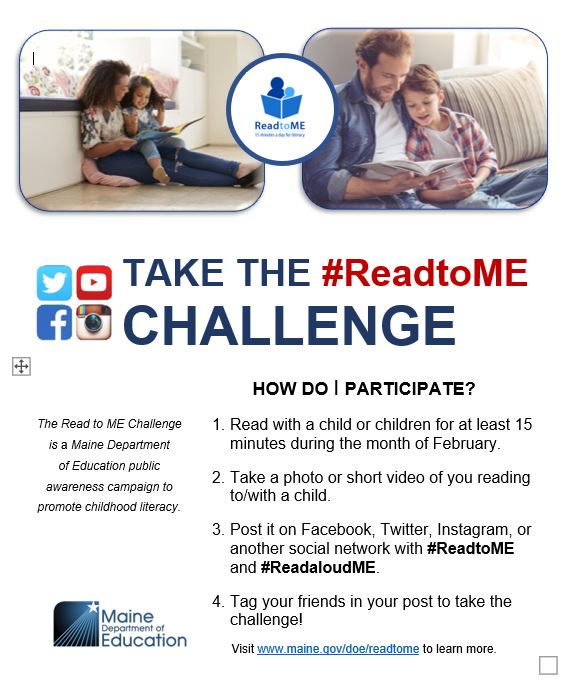
Schools and community organizations can find a toolkit and resources on the Department of Education website and the Department will be sharing videos, photos, and updates from the challenge all month long on social media.

Participants in the challenge are reminded to use the hashtag #ReadtoME and to tag the Maine DOE at @mdoenews on Twitter, @MaineDepartmentofEducation1 on Facebook, and @mainedepted on Instagram.

See who Commissioner Makin Challenged!

Read to ME Challenge Kicks Off This Week

The Maine Department of Education (DOE) is pleased to announce that Commissioner Pender Makin will kick off the 8th annual Read to ME Challenge on Wednesday, February 1, 2023. You can watch a live stream of the event on the Maine DOE YouTube Channel.

The Read to ME Challenge is a month-long public awareness campaign held in February to promote childhood literacy in Maine. The challenge is an opportunity to promote children’s literacy growth by reading aloud to one or more children for at least 15 minutes. Part of the challenge is capturing the moment via a photo or video and then posting it on social media (with the hashtag #ReadtoME and tag the Maine DOE at @mdoenews on Twitter and @MaineDepartmentofEducation1 on Facebook! Keep watching the Maine DOE social media sites to see who has accepted the challenge of sharing the joy of reading with a child.

The Read to ME Challenge will run for the month of February, leading up to Read Across America Day on March 2, 2023. Learn more about the Read to ME Challenge on the Maine DOE Website. If you have a school or community organization that plans on participating in this challenge, please let us know by signing up at this link.

Download a promotional flyer here (PDF).

For more information, contact Dee Saucier (danielle.m.saucier@maine.gov), Inclusive Education Literacy Specialist for the Maine DOE Office of Special Services and Inclusive Education.

Tenets of High-Quality, Evidence-Based Literacy Instruction for Pre-K to Grade 3 Students Released by Maine Department of Education

The success of Maine’s future requires an approach to education that fully prepares students for college, careers, and citizenship by focusing on their physical, emotional, and academic growth. The Maine DOE’s Whole Student Approach is a framework that invests in structures, people, and practices to develop educational systems that support healthy, safe, engaged, supported, challenged and prepared students. To accomplish this, the Maine DOE studies the science of learning and promotes evidence-based practices that support whole student development.  A critical component of a whole student approach is to ensure intentionally planned foundational literacy instruction is available for all students in Pre-K to Grade 3. Strong literacy skills are essential for ensuring equitable academic, social, and emotional learning opportunities.

Recognizing the vital importance of foundational literacy development and in response to school system inquiries related to early literacy program development, a team of Maine DOE specialists, with feedback from Maine educators and educational partners, has developed guidance to support School Administrative Units in designing and implementing systematic and explicit early literacy instruction. The guidance outlines essential literacy content as well as core instructional and assessment practices research indicates should be present in Pre-K to Grade 3 classrooms. A table depicting the changing emphasis on essential components across the Pre-K to Grade 3 span is included in the document.

This guidance is designed as a supportive tool for early elementary educators, administrators, and literacy leadership teams to reflect on current practices and to potentially adjust educational design to support high-quality and evidence-based early literacy learning for all Pre-K to Grade 3 students. The recently revised state literacy plan, Literacy for ME 2.0, offers SAUs additional structures to develop reliable systems of literacy supports from birth to adult in communities and schools.

Access the guidance document: High-Quality, Evidence-Based Literacy Instruction for All Maine Pre-K to Grade 3 Students

If you have questions or would like additional information, please contact Dee Saucier (danielle.m.saucier@maine.gov), Inclusive Education Literacy Specialist, or Lee Anne Larsen (leeann.larsen@maine.gov), Director of Early Learning.

Get Ready to Celebrate the Read to ME Challenge

For the 8th consecutive year, the Maine Department of Education will collaborate with community organizations and schools to promote the Read to ME Challenge, a month-long public awareness campaign held during February across Maine.

The Read to ME Challenge is intended to bolster enjoyment in reading and to support children’s literacy growth by challenging adults to read to and/or with children for at least 15 minutes during the month of February. Challenge readers are invited to capture the moment via a photo or a video to post on social media platforms such as Facebook, Instagram, and Twitter with the hashtag #ReadtoME.  They are also encouraged to continue the impact by challenging social media friends to read to children and spread the impact across the state. Maine DOE hopes that social media posts include Twitter tag at @mdoenews and/or a  Facebook tag @MaineDepartmentofEducation1!

While anyone can participate in the Read to ME Challenge, this initiative offers a wonderful opportunity for schools, child cares, libraries, and many other community organizations to plan engaging strategies for completing the challenge and demonstrating commitment to reading to children. In the past there have been a variety of student and adult groups that have organized impactful reading events. These include college and high school sports teams, civic organizations, library programs, recreation departments and educational organizations. If you have a school or community organization that plans on participating in this challenge, please let us know by signing up at this link.

The Read to ME Challenge will run for the month of February, leading up to Read Across America Day on March 2, 2023. Learn more about the Read to ME Challenge on the Maine DOE Website and be looking for more details about the kick-off soon.

For additional information, contact Dee Saucier (danielle.m.saucier@maine.gov), Maine DOE Inclusive Education Literacy Specialist.


Introducing the Maine Association for Improving Literacy (MAIL) – a Statewide Literacy Network

Literacy, as defined by the Maine Department of Education, is the ability to construct and convey meaning for a variety of purposes through an array of contextual forms and symbols, including reading, writing, speaking, listening, and viewing.

Literacy advocate and expert Pam Allyn says, “Reading is like breathing in and writing is like breathing out.”

We can blend these thoughts to substantiate literacy as the overarching key to educational equity which enables communication and comprehension. Literacy achievement is pivotal for ensuring students have access to the world of today and tomorrow, The Maine DOE has launched a Literacy Network to strengthen statewide literacy educational practices.

During the Spring of 2022, an introductory meeting began the process of envisioning the possibilities, priorities, and efforts of the Maine Association for Improving Literacy (MAIL). This network, open to all educators and those interested in improving literacy education efforts to benefit students, is being developed to strengthen statewide literacy practices. The Maine DOE plans to facilitate this group through:

  • professional text and article studies,
  • opportunities to share problems of practice,
  • conversations across the state,
  • sharing resources,
  • state updates, and
  • development of professional presentations for the benefit of all of Maine’s educators, schools, districts, and communities.

The attendees at the introductory meeting began the process of visioning what a literacy network might set for goals and products. The hopes of this group included:

  • Ensuring children can read and love to read.
  • Developing outcomes to address the needs and diversity of Maine’s current population.
  • Supporting districts, teachers, specialists, etc. to build common ground, common language, common knowledge that leads to greater continuity of practice across the state of Maine.

As the new school year begins, MAIL will move forward, continuing to build vision and purpose. Plans for this year include:

  1. Holding monthly meetings, beginning in October. The tentative schedule for 2022-2023 School Year is as follows.
    Second Thursday of each month from 3:30 pm-4:30 pm:

    • October 13, 2022
    • November 10, 2022
    • December 8, 2022
    • January 12, 2023
    • February 9, 2023
    • March 9, 2023
    • April 13, 2023
    • May 11, 2023
    • June 8, 2023
  2. Offering 2 text study opportunities to spark discussion.
  3. Identifying the needs across the state and developing strategies to support and strengthen instructional literacy knowledge, messaging, and practices.
  4. Beginning to develop a toolkit of resources and information.

If you are interested in joining this literacy network and helping to develop the vision for a statewide effort to improve literacy, please register at the link below. There is no commitment, but your registration will ensure that you receive information and mailings.

Register for the Maine Association for Improving Literacy

If you have additional questions about MAIL, please do not hesitate to contact Dee Saucier, Inclusive Education Literacy Specialist, (danielle.m.saucier@maine.gov) or Lee Anne Larsen, Coordinator of Early Learning (leeann.larsen@maine.gov).


WEBINAR: Screening for Early Literacy Milestones, Dyslexia, and other Reading Disabilities

Dr. Nadine Gaab will host a webinar, “Screening for Early Literacy Milestones, Dyslexia, and other Reading Disabilities: The WHY, WHEN, WHO, HOW and WHERE on  September 28, 2022 from 3:30-4:30 pm

Audience: General & Special Educators, Administrators, Parents, Caregivers and Community Members Interested in Early Literacy, Dyslexia & Reading Disabilities

Cost: FREE please register for ZOOM Link here

This session will address:

  • Screening for literacy milestones and reading disabilities, including developmental dyslexia in early grades (pre-K-2nd)
  • The WHY behind the screening movement with a strong focus on the neurobiology of reading development and reading disabilities.
  • The ‘Dyslexia Paradox’
  • Important constructs to screen for with a developmental lens
  • Practical steps for implementing a screening protocol in various educational or clinical settings.
  • Different screening instruments and criteria for picking the right screener
  • Educational and clinical implications of screening and early identification in young children.

About the Presenter: Dr. Nadine Gaab is an Associate Professor of Education at the Harvard Graduate School of Education. Nadine’s work focuses on developmental cognitive neuroscience, particularly in language-based learning disabilities. Her research in the GaabLab examines the development of typical and atypical language and literacy skills in the pediatric brain and pre-markers of learning disabilities and the development of screening tools for screening literacy milestones and dyslexia.

She is the 2019 recipient of the LDA Award (Learning Disabilities Association America) for her work on learning disabilities. In 2018, Nadine was presented with the Allan C. Crocker Award for her advocacy on behalf of children with dyslexia and reading disabilities and efforts around the recent passage of the Massachusetts screening legislation (under the guidance of Decoding Dyslexia MA). She has also been recognized by the International Dyslexia Association in her receipt of the Norman Geschwind Memorial lecture 2020 and the Alice H. Garside Award for outstanding leadership in advancing the science and advocacy of dyslexia. She is an international speaker, frequently presenting to teachers on the brain science of typical and atypical literacy development.

If there are additional questions please email Tracy (Tracy.W.Whitlock@maine.gov), Anne-Marie Adamson (Anne-Marie.Adamson@maine.gov_) or Dee Saucier (danielle.m.saucier@maine.gov).

Governor Mills Announces Statewide Expansion of Dolly Parton’s Imagination Library in Maine

During a virtual discussion with iconic singer-songwriter Dolly Parton at the National Governor’s Association today, Governor Janet Mills announced that the State of Maine is launching a statewide expansion of Dolly Parton’s Imagination Library in 2023.

The Imagination Library of Maine will mail high-quality, age appropriate books to children from birth until age five every month, no matter their family’s income. The program is dedicated to improving the lives of children by inspiring a love of reading with books, and is free to enrolled children and families.

As part of the recent bipartisan budget, Governor Mills proposed, and the Legislature approved, a $200,000 investment to implement the program, which will be administered by the Maine State Library. Together, The Dollywood Foundation and the Maine State Library will develop an implementation strategy this year with local libraries, community non-profits, the Maine Department of Education, and school systems – to establish and expand the program in the coming years. By the end of 2023, the State of Maine and the Imagination Library hope to have sent an initial 106,000 books to more than 14,000 children across Maine.

Maine is the 13th state to commit to achieving statewide coverage of the program.

“We know the simple act of reading to a child stimulates brain development, reduces stress and anxiety, builds vocabulary, and develops the literacy skills they’ll need to succeed in school and beyond,” said Governor Janet Mills. “Today, we are taking another step forward to help make that happen by delivering books free of charge to Maine kids. Maine is proud to join the family of states that participate in the Imagination Library. On behalf of all Maine children who will be served by this program in the years to come, I thank the one-and-only Dolly Parton.”

“The Maine State Library is excited to be able to administer this program that will eventually connect tens of thousands of families and Maine children with wonderful books sent right to their homes,” said State Librarian James Ritter. “Working with Maine’s libraries and other organizations, we will have the opportunity to foster and grow generations of young readers through the Imagination Library, and for every child that learns to read, we know we are helping to build a community of lifelong learners.”

The Imagination Library builds on the Mills Administration’s commitment to increasing childhood literacy in Maine, including investing $10 million through the Governor’s Maine Jobs and Recovery Plan to create and expand pre-school programs across Maine.

The Administration is also creating “Literacy for ME 2.0” to revamp its statewide literacy plan and the Maine Association for Improving Literacy to mobilize a network of educators who are committed to supporting statewide literacy efforts.

This summer, the Maine Department of Education will also be hosting its first ever Educator Summit to train our teachers in the most effective, evidence-based practices for increasing childhood literacy. Every year, the Department also sponsors the statewide “Read to Me” challenge to encourage adults to read to their children.

In 2019, about 57 percent of fourth grade students who are eligible for free or reduced lunch scored below proficiency reading levels while 33 percent of students who are not eligible for free or reduced lunch scored below proficiency reading levels. However, Maine is ranked fifth in the nation for the percentage of parents with children aged 0 to 5 who read to their children every day (46.9 percent).

Dolly Parton founded the Imagination Library in 1995 as a way to distribute books to the impoverished Tennessee county where she grew up. The State of Tennessee quickly adopted the program statewide, and, since then, the nonprofit program has expanded into five countries. As of June 2022, the Imagination Library has gifted 184,615,046 books with over 2 million kids currently registered.

According to The Dollywood Foundation, 90 percent of a child’s brain is developed by the age of five, making that time period critically important for their development that can be enhanced by reading books. The Foundation notes that daily readings by parents or caregivers provide the greatest opportunity to prepare their child for school and that literacy is a major social determinant of health and economic impact in the long-term.

About Dolly Parton’s Imagination Library

Since launching in 1995, Dolly Parton’s Imagination Library has become the preeminent early childhood book-gifting program in the world. The flagship program of The Dollywood Foundation, a 501(c)(3) non-profit organization, has gifted well over 182 million free books in the United States, Canada, United Kingdom, Australia, and The Republic of Ireland. The Imagination Library mails more than 2 million high-quality, age-appropriate books each month to enrolled children from birth to age five. Dolly envisioned creating a lifelong love of reading, inspiring children to dream more, learn more, care more and be more. The impact of the program has been widely researched and results suggest positive increases in key early childhood literacy metrics. Penguin Random House is the exclusive publisher for Dolly Parton’s Imagination Library. For more information, please visit imaginationlibrary.com

Maine Council for English Language Arts Presents 4th Annual Brassil Award

The Maine Council for English Language Arts (MCELA) awarded its 4th annual Claudette and John Brassil Distinguished Educator Award, in honor of the contributions of the two long-time educators who have inspired students and mentored teachers for over eighty combined years in Maine public schools. MCELA is an affiliate of the National Council of Teachers of English (NCTE). The Brassil Distinguished Educator award is usually presented annually at the MCELA Conference in March (tentatively scheduled to be an in-person conference in Portland), but the award has been delayed since 2020 due to the pandemic. 

The Brassil Award recognizes exceptional English language arts and literacy teachers who have demonstrated excellence in teaching, contributed to the profession, and shown a commitment to the community. In the past, this distinguished educator award was given to one high school teacher each year (2020 Patti Forster of Camden Hills Regional High School, 2019 Stephanie Hendrix of Bangor High School, and 2018 Johnna Stanton of Morse High school). This year the Executive Board decided to award and celebrate both a middle and a high school teacher.

The finalists for the high school Claudette and John Brassil Distinguished Educator Award for 2022 include Beth Carlson of Kennebunk High School, Sara Cole of Camden Hills Regional High School, and Audrey Ennamorati of Medomak Valley High School. 

woman in glasses smiling
Audrey Ennamorati, Medomak Valley High School, 2022 Brassil Distinguished Educator Award Winner (high school)

The distinguished high school English educator award for 2022 goes to Audrey Ennamorati, a 23-year educator at MVHS who currently teaches AP English Literature & Composition, AP English Language & Composition British & American Literature, Freshman English, College Composition dual enrollment with Thomas College, Writing Center, Literary Magazine, and Creative Writing. Ennamorati also developed numerous independent study courses to meet the academic needs of both advanced and struggling students, such as Literary Masterpieces, Social Justice Through Literature, Advanced Writing and English Language and Literature.  Additionally, Ennamorati has taught writing-intensive courses part-time at the University of Southern Maine for 12 years and is currently an adjunct for the University of Maine-August (in Rockland) teaching College Writing, and occasionally Creative Writing and Creative Nonfiction. Ennamorati claims she has a special formula for inspiring students of all backgrounds and abilities: “(1) tapping into students’ needs/interests and (2) challenging them beyond their expectations.  I learned early on in my high school teaching career that part of exercising these strengths with students means being genuine and creative at the same time.” Ennamorati’s nominator, Principal Linda Pease shared respect for Ennamorati’s “thoughtful and logical contributions” and her “positive influence on the climate of the school.” 

The finalists for the middle school Claudette and John Brassil Distinguished Educator Award for 2022 include Todd McKinley of J.A. Leonard Middle School, Nicole Matthews of Windsor Elementary School, Meghan Rounds of Gorham Middle School, and Margaret “Maggie” Adams of Kingfield Elementary School. 

woman with dark hair in glasses smiling
Maggie Adams, Kingfield Elementary School, 2022 Brassil Distinguished Educator Award Winner (middle school)

The distinguished middle school English educator award for 2022 goes to Maggie Adams, an 18-year educator who currently teaches grades 5-8 English at Kingfield Elementary School. Adams coordinated and developed the Girls Talk/Teen Voices mentor program bringing community women together with female students for literary discussions and activities for Phillips and then Kingfield Elementary School. She is also a public speaking coach for the Kingfield school (2012-present) and has provided enriching extracurricular opportunities such as Poetry Slams, One Book/ One School/ One Community events, organizing visits from authors, storytellers, and illustrators, and advising various clubs. In addition, Adams served as the Mt. Abram Teacher’s Association during the pandemic. Beyond her school, Adams has been a 3-time speaker for the Holocaust and Human Rights Center (HHRC) representing the perspective of a Mi’kmaq teacher and former Maine student, explaining the integration of the Social Justice curriculum in the classroom, and describing the impact the HHRC has had on her own school district and teaching. 

The MCELA is will be accepting nominations through December 31, 2022, for the March 2023 in-person conference recognition. Nominees should be full-time English language arts or literacy teachers of students in grades 6-12 and have taught for at least five years in public or independent schools in Maine. Nominees do not have to be a member of the Maine Council for English Language Arts. ELA educators who demonstrate the same qualities as the Brassils themselves: a commitment to student-centered learning, inspiration of all students, leadership in school, district, state, and national levels, development and sharing of effective practices, and involvement in the community and school beyond the classroom. More information on nominations available here: https://www.mainecela.org/nominate-an-educator.html

Please join us in congratulating Audrey Ennamorati and Maggie Adams!