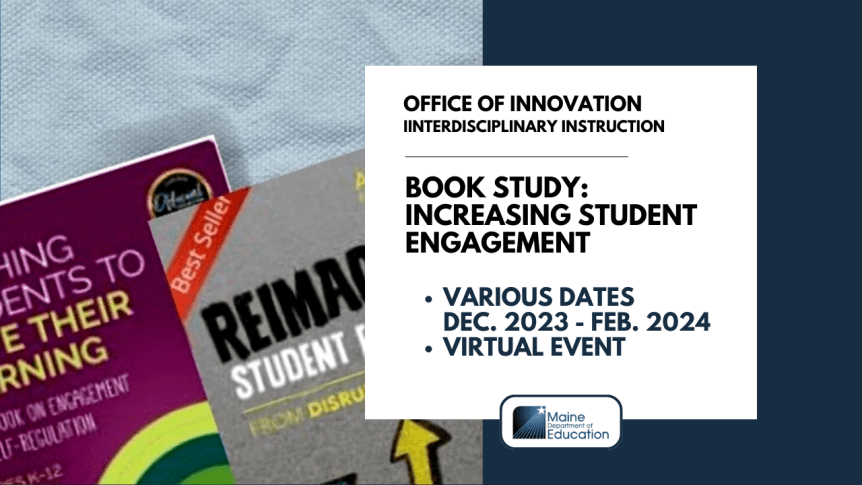
Book Study: Increasing Student Engagement

Starting in December, the Maine Department of Education (DOE) is hosting an asynchronous book study on student engagement based on two books: Reimagining Student Engagement and Teaching Students to Drive Their Learning. Educators will receive a free copy of each book.  In this 8-week online book study, educators will: 

  • Examine what research says about student engagement  
  • Reflect on their students’ engagement and classroom management 
  • Design strategies to increase engagement that works for them and their students 
  • Collect data on how the changes have impacted their students’ engagement 
  • Opportunity to collaborate with teachers statewide  

During this book study, educators will be assigned weekly readings, post a response, and comment on other teachers’ responses.  Teachers will also need to implement one or more engagement strategies and share their resources and/or reflections. Educators completing the book study will receive 10 contact hours. The book study is perfect for individual teachers, as well as teams of teachers, who want to examine research-based practices that can increase and improve student engagement.   

Books: Teachers participating in the book study will receive copies of: 

  • Reimagining Student Engagement by Amy Berry 
  • Teaching Students to Drive Their Learning: A Playbook on Engagement & Self-Regulation, K-12 by Fisher, Frey, Ortega & Hattie 

Intended Audience: PK-12 Teachers & Administrators
When: December 1-February 2 
Where: Maine DOE EnGiNE Platform (There will be optional Zoom sessions to further our discussions and collaboration.)
Contact Hours: 10 contact hours available upon completion
How: Register here 

This book study can be done in conjunction with the Maine DoE ConCEPT pilot.  Click here to learn more about ConCEPT.

For more information on this book study, please contact Jaime Beal, Interdisciplinary Instruction Specialist at jaime.beal@maine.gov 

The Maine DOE encourages all schools and districts across the State of Maine to learn more about interdisciplinary instruction on our website or by contacting the Interdisciplinary Instruction Team Coordinator at Kathy.bertini@maine.gov 
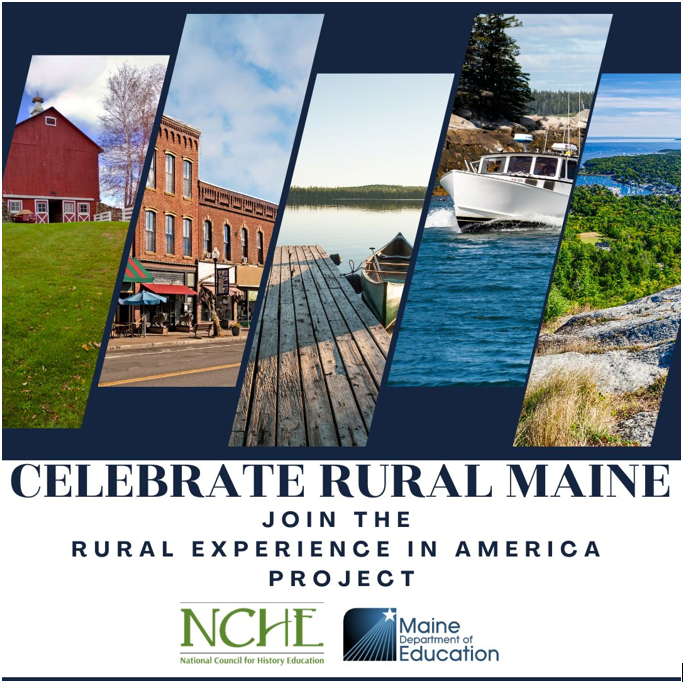
Professional Learning: The Rural Experience in America Project

Community Civics through Historical Inquiry (K-12 grade educators)

Funded by a grant from the Library of Congress Teaching with Primary Sources program, NCHE is proud to announce a 3-part colloquium for teachers focusing on Rural America. These free professional learning opportunities will help teachers develop place-based interdisciplinary units that connect students to their rural communities.  Additionally, the Maine Department of Education will be hosting a bi-weekly professional learning community to support educators through these NCHE modules.  The PLC will incorporate the work developed by the MDOE interdisciplinary instruction specialists.

The program is designed to:

  • connect teachers with the Library Congress’s collections on rural history and with local rural historical societies so they can situate local history in the larger human experience
  • support teachers in the design and implementation of works of public value that connect rural students to their community’s history
  • engage rural teachers in a deep examination of rural history and the impact of change on children, families, and communities
  • The Right Question Institute will be leading a 4-week session on the Question Formulation Technique (QFT) with a focus on working with rural students

Educators may complete all or part of the 3-part colloquium.

  • Part A – Self-paced online courses:  the Library of Congress’ 6-week module course: Teaching with Primary Sources Basics; the Right Question Institute 4-week module course: Teaching Students to Ask Their Own Primary Source Questions (Dec 1-March 31)
  • Part B – Participate in three online synchronous Saturday professional development sessions led by historians, educational specialists, and master teachers (March 23, April 20, May 11)
  • Part C – Apply for a Summer Colloquium. Teachers and community partners will learn from historians and build civic connections to develop a plan for implementing a public history project in their community.
    • July 24-26 Washington, DC Travel reimbursement available

Register here for these NCHE events.

When you register with NCHE, you will receive a follow-up from the Maine DOE to register into our Maine PLC.

For more information, please contact Jaime Beal, Interdisciplinary Instruction Specialist, at  jaime.beal@maine.gov.

New Learning Cohort Opportunity to Equip Principals in Leading Equity-Based MTSS for Student Supports; Info Session on 10/23

The Maine Department of Education (DOE) is thrilled to announce the launch of an innovative training program aimed at empowering school principals to champion equity-based Multi-Tiered Systems of Support (MTSS) for comprehensive student success.

Implementation of a Multi-Tiered System of Support is a requirement in Maine schools.  The purpose of this learning cohort is to provide training and support to Maine school principals and related personnel with design and implementation of MTSS frameworks that provide them with the knowledge and tools necessary for addressing the diverse needs of students and to promote school and student success effectively.  By adopting a schoolwide MTSS, schools can foster a culture of academic, behavior, social/mental health, and attendance support, early intervention, and data-driven decision-making, ultimately leading to improved growth and achievement rates and better outcomes for all students.

Participants in this cohort will:

  • Build capacity to design and effectively lead schoolwide MTSS across grades PK-12
  • Develop knowledge and skills to make MTSS a part of the school culture to ensure valuable work in high-leverage student supports can be blended and braided into a cohesive system of school supports that leads to long-time positive impact
  • Convene relevant stakeholders into MTSS leadership teams that are prepared to utilize research-based strategies for identifying areas of concern/need, assessing identified problems, selecting solutions, create targeted plans, and monitor outcomes that crosses all school domains (reading, mathematics, behavior, social and emotional/mental health, and attendance)
  • Explore and learn how to use a variety of MTSS implementation tools and resources that are used to assess and build readiness for MTSS implementation, assist principals in aligning initiatives and layering support for maximum impact and long-term sustainability, and facilitate the identification of existing or future barriers that may have a negative impact on the implementation of MTSS and provide action steps for removing barriers to aid in successful MTSS implementation

The MTSS cohort will take place through a hybrid of synchronous and asynchronous learning sessions from November 2023 through June 2024 utilizing both live in-person and virtual sessions including (3) in- person team-based workshop events at a centralized location to be determined and taking place on the approximate timeline of end of November 2023, mid-January 2024, and mid-March 2024.  Weekly 1-hour online learning sessions will begin November 12.

For more detailed information regarding the timeline, commitment requirements, and in-person meeting location(s), please attend an online information session on Monday, October 23rd from 3:30 to 4:30.

Applications for participation will open following the informational session and will be reviewed on a rolling basis through November 1st until all slots are filled.  All schools will be notified of their application status no later than November 3rd with virtual learning sessions to begin the week of November 12.

The program is open to PK-12 principals and any of their designated MTSS Team members.  To register for the informational webinar, you can visit the Maine DOE Professional Learning Calendar, or click this link to register.

For further questions, you can reach out to Andrea Logan, MTSS Specialist, via email (andrea.logan@maine.gov) or by phone (207-592-2011) Monday through Friday from 8:00 AM through 4:30 PM.

Maine DOE and BMV to Offer Joint Open Office Hours on School Bus Transportation and Licensing

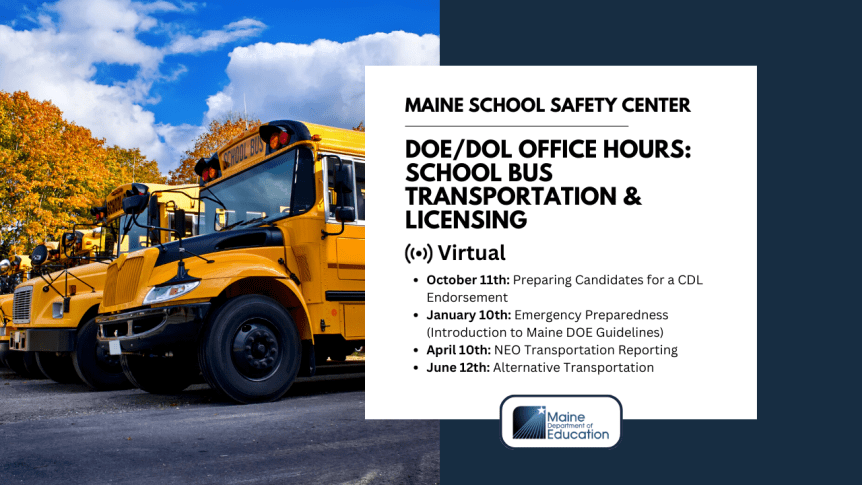
The Maine Department of Education (DOE) and Maine Bureau of Motor Vehicles (BMV) are pleased to offer joint Open Office Hours focused on school bus transportation and licensing. Information on how a school administrative unit (SAU) can train new bus drivers will be reviewed. The shortage of school bus drivers is at a critical point. Being able to train in-house is an advantage in recruiting candidates.

The first Office Hours on October 11 will feature Cheryl Brackett, Maine DOE Transportation Coordinator, as well as Christopher Ireland, Maine BMV Director of License Services. Sessions are meant to be a time for transportation directors to come together to ask questions, work together to problem solve, share best practices, and network.

Office hours are offered as part of the Maine DOE’s School Safety Center and are intended to meaningfully support addressing questions and needs. Participants can join for the full hour, for just a part, or only to obtain an answer to a question.

Transportation Office Hour Sessions will be held the second Wednesday quarterly, from 12:00 to 1:00 p.m., on the following schedule:

Month Day Topic
October 11th Preparing Candidates for a CDL Endorsement
January 10th Emergency Preparedness – Introduction to Maine DOE Guidelines
April 10th NEO Transportation Reporting
June 12th Alternative Transportation

Please use the following Microsoft Teams link to join the meeting on October 11:

Click here to join the October 11th Meeting via Microsoft Teams

Meeting ID: 267 027 044 018
Passcode: sA7sbW

Download Teams | Join on the web

To submit a topic or question prior to a session and/or for more information please email Cheryl Brackett at 207-446-3019: cheryl.brackett@maine.gov.

Resources for Indigenous Peoples’ Day

Many have learned the phrase, “In 1492, Columbus sailed the ocean blue”. But Columbus was not the first foreign explorer to land in the Americas, and neither he nor those who came before him discovered America—because Indigenous Peoples have populated the Western Hemisphere for tens of thousands of years. 

Celebrating Columbus and other explorers like him dismisses the devastating losses experienced by Indigenous Peoples of the Western Hemisphere in the past and the ongoing effects of colonialism today.

In 2019, joined by Wabanaki tribal leaders and representatives, Governor Janet Mills signed legislation to establish Indigenous Peoples’ Day in Maine. It is now celebrated on the second Monday of October recognizing the resilience and diversity of Indigenous Peoples instead of honoring Columbus.

Now we ask ourselves, what does it mean to honor Indigenous People?  See below for resources for educators, parents, and those in the education community.

Local Impact (Dawnland specific)

Resource Type Title/Link  
Statement Maine Memo — The importance of Indigenous People’s Day (Office of the UMO President)
Statement Indigenous Peoples’ Day statement (City of Lewiston)
Statement/article Celebrating Indigenous Peoples’ Day (Maine Audubon)
Article Indigenous Peoples’ Day in the Dawnland (Freeport Historical Society)
Statement/article Indigenous Peoples’ Day/Native American Day Eradicate Columbus Day October 9, 2023 (USET)  
Article Multiple Events Planned in Celebration of Indigenous Peoples’ Day (Healthy Acadia)


Global Impact (all Indigenous)

Resource Type Title/Link  
Fact sheet/article Who are indigenous peoples?
Statement/declaration United Nations Declaration on the Rights of Indigenous Peoples
Publication The Role of Indigenous Peoples in Biodiversity Conservation
Lesson Plan Indigenous Peoples’ Day (IllumiNative)  
Article Indigenous storytellers share scary stories and the wisdom they hold (CBC)  
Video Indigenous Peoples’ Day | All About the Holidays (PBS)  
Video The word Indigenous — explained l CBC Kids News  
Sample lesson plans Lesson Plans (Whose Land) 3 lesson plans: k-5, middle, high school
Article Cultural Appropriation: What’s an Educator’s Role? (PBS Teachers Lounge)  

Why not Columbus Day?

Resource Type Title/Link  
Collection/case study Abolish Columbus Day: Solidarity with Indigenous Peoples (Zinn Education Project)
Article/lesson preview The People vs.

Columbus, et al. (Zinn Education Project)

 
Handout Unlearning Columbus Day Myths: Celebrating Indigenous Peoples’ Day
Article Why more people are celebrating Indigenous Peoples Day | PBS NewsHour


Maine Association of School Libraries (MASL) to Host New Library Staff Affinity Session on 10/5

School librarians are leaving the profession, nationwide and in Maine. Yet we know the impact of school librarians on student learning and growth, particularly during the pandemic — and how a certified school librarian prepares students for their post-secondary success.

The Maine Association of School Libraries (MASL) is a professional community for all school library staff whose members access free, ongoing professional development, scholarship opportunities for continued learning, members-only resources, mentoring, and support. With a modest annual membership fee of $25, MASL connects, uplifts, and supports school library staff across our state.

MASL is hosting a “Newbie” Affinity Session on October 5th at 7:00 pm via Zoom, suitable for new hires in libraries, new school librarians or library ed techs, anyone who has transitioned from the classroom to a library, or a staff member who is juggling multiple roles (including a library assignment), or just anyone who still feels “new” at their job in a Maine school library!

“Send all the new school library folks our way,” says Iris Eichenlaub, chair of MASL’s Mentoring Committee, “as the lonely-onlies in our buildings (or district), connecting with the Maine school librarian professional community is how we keep more librarians in Maine schools.”

Register here for the “Newbie” Affinity Session on October 5th.

For more information or further questions, reach out to maslibraries@gmail.com.

13th Annual Maine PBIS Conference

Join us to celebrate, learn, and network with PBIS (Positive Behavior Interventions and Supports) leaders and implementers from across Maine and beyond to enhance the quality of life of students by promoting evidence-based and effective positive behavior supports to realize socially valid and equitable outcomes for people, families, schools, agencies, and communities.

Thursday, November 9, 2023
Augusta Civic Center
9:00 AM until 3:45 PM

Registration Cost:

  • General (individual)- $195
  • Group (groups of 3 or more attendees)- $165
  • Student (full-time undergraduate or graduate student enrolled in 6 credits per semester for at minimum 2 semesters per year)- $85
  • Lead Presenter (those accepted to present; only lead presenters are at no charge; co-presenters will be charged the individual rate)- $0

Keynote Speaker:

Lindsay Fallon, Ph.D., BCBA-D is an Associate Professor and Director of the School Psychology Ph.D. Program in the College of Education and Human Development at University of Massachusetts Boston. She is a former New York City special education teacher and special education faculty member. She is a licensed psychologist and a doctoral-level Board Certified Behavior Analyst. She has authored over 70 peer-reviewed journal articles and book chapters and has presented her work nearly 150 times at international, national and regional conferences. Her work focuses on multi-tiered systems of support, behavioral interventions, implementation science, as well as culturally responsive practice. She works extensively with school districts to design and implement positive behavioral interventions and supports (PBIS) in and around Boston.

Register here.

Questions regarding the conference or proposal submissions may be directed to: Courtney Angelosante  (courtney.angelosante@maine.edu) and Sarah Wilkinson (sarah.wilkinson@maine.edu)

Application Deadline Extended for ConCEPT Asynchronous Professional Learning Opportunity

The Maine Department of Education (DOE) is piloting a program designed to support educators throughout the state with professional learning that is practical and flexible. 

Conceptual Classroom and Educational Programs for Teachers (ConCEPT) is focused on providing professional learning to educators across Maine through asynchronous evidence-based modules, topic-driven office hours, asynchronous book studies, and customized support from the Maine DOE Interdisciplinary Instruction team. ConCEPT offers a menu of choices for educators to choose from that can be tailored to your team’s goals. ConCEPT is completely free to Maine educators. Contact hours and reimbursement for planning purposes outside the regular contracted day are available. 

Set up a time to have a conversation by making a request through this link.

To learn more about ConCEPT, you can watch the prerecorded webinar below or visit the ConCEPT webpage.

You can also reach out to Kathy Bertini at Kathy.Bertini@maine.gov for further questions.

Professional Learning Community: Explore 2nd Grade for ME

Between 2018-2023, the Maine Department of Education has engaged in the development of interdisciplinary, open-source instructional programs for Pre-K, Kindergarten, and Grade 1.  These programs, Pre-K for ME and K for ME, and 1st Grade for ME, are housed on the Maine DOE’s website. Many schools across the state have implemented these instructional programs and the Maine DOE is planning to extend its work related to interdisciplinary, open-source instructional programming into grade two during the 2024-25 school year by adapting the Boston Public Schools’ Focus on Second program to become 2nd Grade for ME.

For grade two teachers interested in exploring the Focus on Second instructional program that will serve as the foundation for Maine’s development of 2nd Grade for ME, a professional learning community (PLC) experience is being planned for the 2023-24 school year.  There is no obligation to implement the program, but this PLC will provide time to learn about the program design, its components, and how the program connects to Pre-K for ME, K for ME, and 1st Grade for ME.

Teachers, instructional coaches, and administrators interested in this instructional program are encouraged to participate.  Grade two teachers who participate may have the opportunity to pilot the program during the 2024-25 school year.

To preview the program, visit Focus on Second. An outline of the PLC series and a registration link is included below.

Professional Learning Community: Exploring 2nd Grade for ME

3:30-4:30 p.m.

Registration Link

Date Topics/Component Focus
October 24th Goals for the PLC, Structure of Focus on Second (2nd Grade for ME)
November 15th Read Alouds, Routines, Vocabulary
January 16th Play, Studios, Projects
February 27th Science and Engineering, Math
March 26th Phonics, Literacy Stations, Small Groups, Writing, Closing

If you have questions, please contact Lee Anne Larsen, Director of Early Learning, at Leeann.Larsen@maine.gov.

Maine Department of Education Releases Climate Education Professional Development Grant to Promote Climate Education in Maine Schools

The Maine Department of Education (DOE) is excited to launch a new climate education professional development pilot grant opportunity to support the growth of climate education throughout the state and most especially in underserved communities. This grant initiative was designed out of LD 1902 which passed in the spring of 2022. This grant initiative is designed first and foremost to support teachers and schools. Climate change content and pedagogy can be challenging to approach for many different reasons. It can be a new area for teachers, a subject matter that is challenging to navigate in a school’s community, and an area of education where teachers and schools just don’t know where to get started.  

This initiative asks that schools partner with a non-profit community-based organization because these organizations are integral to communities throughout Maine. They have created, sustained, and grown an incredible framework of outdoor and environmental education opportunities and programs that are tailored to their local regions traits and needs. This initiative will expand on their work to form new connections and expand partnerships between community organizations and schools. These partnerships will support teachers and schools to bring climate education to more of Maine’s students. 

The RFA can be found here, and applications are due on November 3, 2023.

The RFA grant will be phase 1 of 2 initial phases the Maine DOE plans for this effort. Phase 1 will have an application window from early September to October 20th. Phase 1 professional development programs will be awarded for a term from mid-November through the end of August 2024. Phase 2 will build on the successes and learnings of phase one. Phase 2 will have an application window in the winter of 2024 and be designed for programs leading up to and during the school year of 2024-2025. These phases are designed for a wide variety of applicants and programs that might vary in style, content, age, duration, and breadth or depth. 

Applicants should take the time to review the application and ask questions by September 29th (full instructions in the RFA). Just like the program itself, the application can be collaborative with community partners and other local education providers if desired. Applicants that hit priorities one and/or two and cannot connect with a partner or do not know where to start are still encouraged to apply. If the timeline for phase 1 is too tight for applying or the award window does not make sense for this year, phase 2 is a great option with additional time to plan and connect with a partner. 

This program is overseen by Teddy Lyman, the Maine DOE’s new Climate Education Specialist. Teddy will coordinate this program including the application, awards, and deliverables. During the RFA application window, Teddy cannot communicate directly with anyone that might benefit from direct communication that is not publicly available.  

Questions about the RFA should be emailed to Teddy at: Theodore.Lyman@maine.gov by 11:59 pm on September 29th, 2023. Questions and answers will be posted publicly at the link below.  The Climate Education Specialist will also set and execute a wider range of climate education initiatives throughout the state. This will include working with grant recipients, stakeholders, and youth to design, encourage, and build the future of climate education around Maine. 

For more information and updates, check out the DOE climate education webpage.  

A copy of the RFA, as well as the Question & Answer Summary and all amendments related to the RFA, can be obtained at: https://www.maine.gov/dafs/bbm/procurementservices/vendors/grants.