Maine educators learn techniques in identifying and teaching children with dyslexia

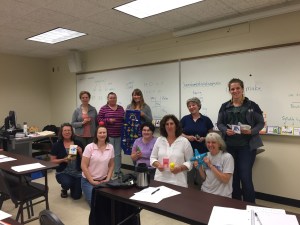
IMG_0656 (2)Earlier this month, educators from around the state completed the six week graduate course, Introduction to Dyslexia. The course was offered through a partnership between the Maine Department of Education’s (DOE) Office of Special Services and the University of Maine at Farmington (UMF).

The online and in-class course introduced educators to current research in cognitive neuroscience and evidence- based teaching practices and how the two may interact to help children with dyslexia.

The class learned the benefits of early identification of students at-risk for reading failure. Through early screening, dyslexia can be predicted and the severity can be reduced using evidence-based intervention. Appropriate intervention brings the majority of at-risk children to grade-level reading levels. Presently, it cannot be predicted which children will respond to intervention. Additionally, early intervention reduces the risk of the difficult-to-remediate fluency deficit that often emerges in 4th grade.

After being introduced to concepts regarding the neuroscience of reading, the class took part in 3 full-day workshops to learn practical classroom techniques that work well for all learners.

The course was taught by Lisa Whitis, MEd, JD who serves as the Dyslexia Coordinator at the Maine DOE. Contact Ms. Whitis at Lisa.Whitis@Maine.Gov to discuss professional development opportunities for your district or technical assistance for issues regarding dyslexia.

Purposeful Integration of Technology in Mathematics workshop for educators

The Maine Department of Education is sponsoring a workshop addressing Purposeful Integration of Technology in Mathematics for new and experienced math educators at Keeley’s Banquet Center on 178 Warren Ave in Portland on September 21, 8:30am – 3:30pm and at Jeff’s Catering, located at 15 Littlefield Rd. in Brewer on September 22, 8:30am – 3:30pm.

The workshop will consist of two all-day sessions, grades K-5 and grades 6-12. Pam Buffington, PhD, and Peter Tierney-Fife from Education Development Center (EDC) will present sessions for K-5 with Jenn Vadnais, a representative from Desmos presenting for the 6-12.

Registration to attend the above sessions closes September 6th, 2017. Please note, due to limited capacity, each district has the opportunity to register only ONE representative to a K-5 session and ONE representative to a 6-12 session. Educators interested in registering should utilize the appropriate registration link below:

Thursday, September 21, 2017

Keeley’s Banquet Center

178 Warren Ave,

Portland, ME 04103

Grades K-5 Registration

Grades 6-12Registration

Friday, September 22, 2017

Jeff’s Catering and Event Center

15 Littlefield Rd,

Brewer, ME 04401

Grades K-5 Registration

Grades 6-12 Registration

Further questions should be directed to Daniel Weeks, Title V Coordinator at Daniel.R.Weeks@maine.gov or (207) 624-6749.

Further information regarding session content and presenters is provided below.

Pam Buffington, PhD, is an education researcher and practitioner who specializes in technology integration in mathematics and science instruction. During a 35-year career, she has provided critical guidance to states, local education agencies, teachers, and administrators in investigating and implementing strategies to improve students’ learning outcomes.

Pam has been at the forefront of the classroom technology integration movement in New England and more broadly. She has led partnerships with both rural and urban school districts to improve student mathematics learning through the integration of interactive mobile technologies and has worked to expand access to high-quality virtual manipulatives and mathematics simulations. She also works to support researcher-practitioner partnerships, with an eye towards using evidence-based strategies to improve student outcomes in mathematics.

Peter Tierney-Fife works primarily on mathematics professional development and research projects. His expertise includes professional development materials creation and technical work such as applet and database development. He loves collaborating with teachers to improve student experiences with mathematics. His current projects focus on the areas of technology integration in mathematics and professional development for mathematics teachers with diverse student populations, including students who are English learners. Prior to working at EDC Peter taught middle school mathematics, was a Field Researcher for a technology-infused mathematics professional development research project, and was a carpenter and furniture maker.

Jenn Vadnais started out teaching in the Bath-Brunswick area. For her first year, she taught geometry at Morse High School in Bath and then spent 15 years teaching 8th grade at Brunswick Junior High School. In the summer of 2009, she relocated to Southern California with her family where she was hired as a 7th grade math teacher for Redlands Unified School District. In 2014, Jenn stepped out the classroom to become a Middle Level Math Coach for RedlandsUSD. During her time as a math coach, she was introduced to Desmos and was accepted into the first Desmos Fellow Cohort in 2016 and became a Desmos Certified Presenter in 2017. About the same time, Jenn switched positions to join her district’s brand new Instructional Technology Department as a k-12 Instructional Technology Coach.

K-5 Session Details:

During this session you will learn meaningful technology integration strategies and about digital tools for improving grades K-5 mathematics learning and teaching. Example tasks and related resources will concentrate on numeracy and the Standards for Mathematical Practices (particularly MP3, MP4, and MP5) aligned with the Maine’s College and Career Readiness Standards. We will focus on improving student mathematical communication and discourse while using digital devices in rich, open, problem-solving contexts. You will learn about interactive apps and Web sites with information and strategies, engage in the use of open tasks with the interactive apps, and reflect on and discuss the use of the digital tools and related resources. We will also discuss strategies and tools to manage student-created rich media artifacts such as screencasts and photos. You will leave with handouts and links to free digital resources suitable for use with students to enhance your classroom practice.

6-12 Session Details

Polygraph

Participants will experience how Desmos brings joy to vocabulary development through Polygraph. The focus of connecting informal and formal language will be discussed.

Level up your calculator skills

  1. Awesome Graphs. See what’s possible in the Desmos graphing calculator by exploring this collection of course-specific graphs for Grades 6-12.
  2. Desmos Calculator Scavenger Hunt. Level up your Desmos graphing skills by working through a series of beginner, intermediate, and advanced graphing challenges.

Activity Builder Lesson

The Activity Builder platform allows students to interact with, explore, reflect on and write about math. Participants will experience Desmos’ Activity Builder, including the Classroom Conversation Toolkit, as a student by diving into a rich mathematical situation. The Toolkit includes three features: Pause Activity, Anonymize and Teacher Pacing.

Marbleslides

Participants will explore the connections between equations and graphs with Desmos’ Marbleslides activities.

Getting Started

Participants will set up a teacher.desmos.com account, turn on the lab feature which activates the Marbleslides and Card Sort options as well as, learn how to search, bookmark and edit premade activities.

Depending on time …

Introduction to Creating an Activity Builder

Participants will learn the basics of creating their own Activity Builder.

New School Nurse Orientation registration is open

If you hired a new nurse for your school over the summer be sure to encourage them to attend the New School Nurse Orientation on September 29th in Augusta.

New School Nurse Orientation is a specialized program designed to help nurses transition into the educational setting. Some of the topics included in day one will be: professional requirements, resources, overview of the School Health Manual, data reporting requirements for nurses, screening requirements and procedures as well as educational rules and laws. There will be two more days covering different topics for new School Nurses scheduled later in the school year.

When: September 29, 2017 8am – 3pm
Where: Augusta, ME Burton Cross Office Building
Cost: FREE
How to register: https://www.surveymonkey.com/r/NewSchoolNurseOrientation1

If you have any questions please contact Emily Poland, RN, School Nurse Consultant for the Maine Department of Education at 207-624-6688 or Emily.poland@maine.gov.

Mentoring workshop for educators of gifted and talented program

The Maine Department of Education will sponsor a mentoring workshop for new and experienced gifted and talented (GT) educators at the Division of Transportation (DOT) Building on 66 Industrial Drive in Augusta on September 14, 9am-3pm.

Workshop topics include: reviewing this year’s renewal application process, exploring identification tools, discussing curriculum options aligned with regular education initiatives, organizing and managing GT programs, evaluating program effectiveness, and discussing budget concerns.

The morning will consist of a workshop designed for teachers and administrators who are looking for information regarding this year’s renewal application process. The workshop will also provide a forum to discuss GT programming.

Depending on the needs of the participants, in the afternoon, attendees will be broken into two groups. One group will be educators who are fairly new to the field. They will continue their in-depth discussions on the topics listed above. The second group will be educators who have been in the GT field for a longer period and may have farreaching concerns and challenges. The mediator of this group, Lee Worcester PhD, asks that the advanced GT educators suggest a topic for the afternoon session by September 7 at lee.worcester@yahoo.com or 943-8804.

To register by September 10th at: http://events.egov.com/eventreg/ME/event.htm?name=giftedtalentedmentoringworkshopfall2017. Due to the location, lunch and refreshments will not be provided.

For any questions regarding the workshop, contact Educational Consultants: Lee Worcester at lee.worcester@yahoo.com or Patti Drapeau at ptdrapeau@aol.com.

Fostering Artful Classrooms for Early Childhood Students a Great Success

Five school districts participated in a professional development pilot from the Maine Department of Education this year to learn how to improve visual art offerings to public preschool students. Visual art and early childhood teachers from RSU 10, Lewiston School District, Glenburn School Department, MSAD 58 (Phillips), and MSAD 53 (Pittsfield) attended in teams for training three times during the 2016-2017 schoolyear. Guided during these session by early childhood expert, Terri Petnov, and early childhood arts specialist, Judy Fricke, teachers built collaborative partnerships as they broadened their skills in 2-D, 3-D, and Fiber Arts, as well as developmentally appropriate teaching for preschoolers. Both teachers learned strategies to be used in both in the early childhood classroom and the art room. This program was sponsored by Early Childhood Specialist, Sue Reed, and Visual and Performing Arts Specialist, Beth Lambert.

The training was aligned to Maine’s Early Learning and Development Standards and supported by research on the importance of art education being available every day in the early childhood classroom. Over the course of the three workshop days, teams learned a variety of visual art techniques and became more comfortable integrating art education into the other learning domains to support knowledge and development.

Here are some of the comments teachers had at the end of the experience:

“Children have become more engaged and have developed stamina to create and finish a project. It has created a calming effect on my room,” Lori Fowler, Preschool Teacher, Montello Elementary School.

“The collaboration and teamwork I now have with my art teacher has brought about valuable changes in my planning and instruction awareness of how the arts can connect and strengthen student learning opportunities,” Vicky Grotton, Preschool Teacher, Glenburn Elementary School.

“The value of this training, for me, was in learning the true and genuine connection between the arts and achievement across the curriculum. The foundation of learning and whole-student enrichment are clearest in prek, but persist throughout the entire academic career,” Adam Masterman, Art Teacher, SAD 58.

“(The prek teacher and I) have worked together to create a new space in her classroom where students are completely independent and encourage exploring materials…. I have gone into their classroom and taught lessons and group projects that would not be possible in my space,“  Karen Thayer, Art Teacher, RSU 10.

Due to the tremendous success of this pilot, the Maine Department of Education is exploring funding options to expand this training statewide during the 2017-2018 schoolyear as well as develop and offer music and performing arts in the early childhood classroom training.

For more information on this pilot you can visit our website http://www.maine.gov/doe/arts/ecevpa.html.

For more information on Early Childhood Education contact, Sue Reed, susan.d.reed@maine.gov . For more information about Visual and Performing Arts Education, contact, Beth Lambert, beth.lambert@maine.gov.

New Online Certification System Training for Superintendents and Support Chairs

The Maine Department of Education (DOE) will be offering training sessions for superintendents and support system chairs to learn the new online certification system this spring and summer (online training for educators will also be available later this summer).

At each training session participants can expect to learn how to log in, navigate the system, approve educator certifications, and manage their own certification. Participants will need to bring a lap top.

Training dates, times and locations are as follows:

June 19, 2017
8:30am – 12:00pm
University of Maine at Augusta, Jewett Hall, RM 190

June 20, 2017
1:00pm – 4:30pm
University of Maine at Augusta, Jewett Hall, RM 190

July 26, 2017
8:30am – 12:00pm
University of Maine at Orono, Donald P. Corbett Business Building, RM 100

July 27, 2017
1:00pm – 4:30pm
University of Maine at Orono, Donald P. Corbett Business Building, RM 100

Please RSVP to Brenda Vigue at brenda.vigue@maine.gov or (207) 624-6852.

Maine DOE Summer Training Dates and Registration for NEO and Synergy

The Maine Department of Education is offering five half-day sessions for NEO updates and training and one half-day for Synergy Training. An additional full-day session will also be held for districts who manually enter information into the State level Student Information System.

During the NEO session, Maine DOE Helpdesk members will review changes to NEO, which include Maine State Reports previously located in Infinite Campus State Edition. Other changes to NEO include the new Data Collection and Reporting (DC&R) module, access to NEO, changes to NEO staff, and clarification of Staff and District Roles. There will also be a short session on Student Data Privacy. Attendees should include those who currently complete NEO Reports, those who previously worked with student reports in Infinite Campus State Edition, and those who will be doing these activities in the coming school year. Student data certifications will now be done in NEO, so Superintendents who certify reports may also want to attend.

A light lunch will be provided, and during this time, Maine DOE and Synergy staff will be available for questions.

For the Synergy session, participants will learn how to use Synergy DOE to upload student data required by the State of Maine. In addition, participants will learn how to use Synergy DOE to enter and validate student data that is not included in the upload process.

Upon completion of this session, participants will understand how to perform uploads and will be able to:

* Log in to Synergy and navigate the interface
* Use and understand Synergy concepts and terminology
* Change Focus to view other years/schools
* Create personal Navigation Menus
* View existing student information
* Find a single student or multiple students
* Enter and modify student data
* Truancy
* Discipline
* Use a Matrix to print student information or export student information to other desktop programs
* Create student filters
* Create Graph information
* Preview and Print common reports
* Save report settings

The August 1st, Manual Entry Session will be an all-day in-depth look at how to enter student information directly into the system. (NEO topics will not be covered at this session).

Dates and Registration

July 25
Houlton High School
7 Bird Street
Houlton, ME 04730
http://events.egov.com/eventreg/ME/event.htm?name=doeneosynergytraininghoulton

July 26
Ellsworth Elementary School/Middle School
20 Forest Avenue
Ellsworth, ME 04605
http://events.egov.com/eventreg/ME/event.htm?name=doeneosynergytrainingellsworth

July 27
Orion Performing Arts Center
50 Republic Avenue
Topsham, ME 04086
http://events.egov.com/eventreg/ME/event.htm?name=doeneosynergytrainingtopsham

July 31
Cony School
60 Pierce Drive
Augusta, ME 04330
http://events.egov.com/eventreg/ME/event.htm?name=doeneosynergytrainingaugusta

August 1
MANUAL UPLOAD Schools only please. NEO not presented
Cony School
60 Pierce Drive
Augusta, ME 04330
http://events.egov.com/eventreg/ME/event.htm?name=doeneosynergytrainingaugustamanualentry

August 2
Portland Arts & Technology High School
196 Allen Avenue
Portland, ME 04103
http://events.egov.com/eventreg/ME/event.htm?name=doeneosynergytrainingportland

If you have any questions please contact Maine’s Data Systems Helpdesk Manager Shannon Bartash at (207) 624-6799.


Maine DOE’s Early Childhood Education Conference

Registration is now open for the Maine DOE’s Early Childhood Education Conference. The conference will be held at the Augusta Civic Center on August 14-16, 2017 and is intended for PreK and Kindergarten early childhood staff and administrators.

There are two training tracks to choose from and space is limited:

1. Building Blocks PreK Curriculum Training Track ($250.00) 3 days – this training session is appropriate for PreK teachers and Ed Techs and also for Kindergarten teachers that may be interested in understanding the PreK math curriculum for building alignment.
2. STEAM Training Track ($50.00) 2 days – This track is appropriate for any PreK or Kindergarten teacher.

Continental breakfast and lunch are provided each day as part of the conference registration.

Financial Aid is available.

Register for Early Childhood Conference

For more information contact Maine DOE’s Early Childhood Specialist Sue Reed at susan.d.reed@maine.gov or 624-6632.

Webinar on ESEA equitable share participation of Maine’s SAUs and non-public schools

The Maine DOE will offer a WebEx session June 8, 2017 from 10 – 11 a.m. providing guidance to school administrative units (SAUs) and non-public schools in the delivery and agreement of equitable services under the Elementary and Secondary Education Act (ESEA) as amended by the Every Student Succeeds Act (ESSA).

The ESSA includes separate provisions governing equitable services for eligible private school students, teachers and other educational personnel, and families under Title I and programs covered under Title VIII, Part F, Subpart 1; as well as the Uniform Provisions Subpart 1—Private Schools: Equitable Services for Private School Students, Teachers, and Other Educational Personnel. Many of those requirements remain unchanged from requirements under the ESEA as amended by No Child Left Behind (NCLB). The ESSA, however, made a number of significant changes. Some of those changes are common to the equitable services requirements under both Title I and Title VIII; others are different.

The webinar will be conducted by Maine DOE’s Title I Consultant and Title II Coordinator, Jackie Godbout and Charles Lomonte, respectively. If you have questions prior to the event, please contact Charles Lomonte at 624-6723 or Charles.lomonte@maine.gov or Jackie Godbout at 624-6712 or Jackie.godbout@maine.gov.

Topics covered during the webinar include:

  • Consultation requirements between SAU and non-public schools
  • Deriving the proportionate share calculation
  • Allocation of funds
  • Eligibility
  • Types of equitable services
  • Evaluation of assessments

To participate in the webinar, please click here.  The conference phone number is 1-877-455-0244, followed by conference code: 8223978943.

The Maine DOE offers ESEA equitable services training for those Maine SAUs and non-public school leaders who must consult about participating in non-public school equitable share resources.

Virtual Reality Immersive Expo

Reality Immersive Expo
6/19/17 from 10:00am – 4:00pm
Maine State Library
#ImmerseME

Register for the Expo (free) »

There have been many advances in technology that can provide educators with the tools to facilitate deeper learning of complex concepts, and provide students with a more immersive learning experience.

To help facilitate a better understanding of these tools and to bring Maine educators to the forefront of innovative education delivery, the Maine Department of Education and the Maine Sate Library have invited organizations that are using virtual reality in education to come and demonstrate their education tools on June 19th from 10:00am to 4:00pm at the Maine State Library.

There will be booths located in the atrium of the Maine State Library, and 30 minute presentations throughout the day by organizations, higher education partners, and local schools that have already begun to integrate virtual reality into their classrooms.

The intent of the day is to provide Maine educators with an awareness of these tools and to start encouraging innovative ideas about how virtual reality can be integrated into more Maine classrooms.

Presenter Presentation Time Location
York School Department 10:00am archives
Bates College 10:00am museum
UNE – The Alfred Lab 10:45am archives
History View 10:45am museum
Nearpod 11:30am archives
HP Inc. 11:30am museum
zSpace 12:15pm archives
USM – CI2LAB 12:15pm museum
Mount Desert Island High School* 1:00pm archives
UMaine – IMRE Lab 1:00pm museum
Maine Math and Science Alliance 1:45pm archives
ThingLink 1:45pm museum
Thomas College* 2:30pm archives
Apple, Inc 2:30pm museum

*Participant will only be presenting during the 30 slot – they will not be present in a booth throughout the day.

Download a PDF of the schedule »

___________________________________________________________________

List of Participants: 

zSpace

  • Presenting: zSpace Learning Lab – zSpace combines AR and VR to create the ultimate learning experience. The zSpace Learning Lab includes a suite of educational software, hundreds of learning activities ready for integration into your curriculum, and zSpace all-in-one PCs.
  • Enhanced learning: Students racing to get to class? That was the scenario when Plainview-Old Bethpage Central School District in New York introduced zSpace, a virtual reality technology that allows students to create, test and experiment in an interactive, 3D world. For the 2014-15 school year, students learned science concepts using the zSpace STEM Lab, which consists of a set of virtual reality stations, each outfitted with an interactive stylus as well as a wide variety of educational software ranging from life science to physics and engineering. Now, at the tail end of their first year using the technology, teachers and administrators recognize that the excitement has led to more in-depth and engaged learning in STEM subjects than they have seen in the past.
  • Website: www.zspace.com

York School Department

  • Presenting: Google Expeditions – Bring Your Lessons To Life. Imagine exploring coral reefs or the surface of Mars in an afternoon. With Expeditions, teachers can take students on immersive, virtual journeys. From Machu Picchu to Antarctica to the International Space Station – where will you take your class?
  • Enhanced learning: York School Department has run over 50 Expeditions through the 16-17 school year. Every time one is run, students rave about how they gain a new perspective of what is being displayed. Expeditions not only engage students to learn more thoroughly, but is also teacher led to ensure they stay on task.
  • Website: https://edu.google.com/expeditions/

Bates College

  • Presenting: Oculus Rift setup and their current easy workflow for creating VR tours of historically reconstructed buildings designed by students in SketchUp.
  • Enhanced learning: In the last year several faculty in the humanities have become interested in having students work with the 3D modeling tool SketchUp Pro to create digital reconstructions of ancient cities and buildings. These projects require students to explore ancient structures through primary and secondary sources, and to use that knowledge to bring them to life in 3D with modern software tools, like SketchUp. Virtual reality improves upon this by allowing students to tour their 3D reconstructions in a much more immersive way, experiencing them as though they were really there.
  • Website: http://www.bates.edu/curricular-research-computing/technology-themes/virtual-reality/

University of New England (UNE) -The Alfred Lab

  • Presenting: NN/LM Technology Grant for Embodied Labs Virtual Reality Experience: “Empathy Learned Through an Extended Medical Education Virtual Reality Project”
  • Enhanced learning: Descriptive data from the post-assessments showed:
    92% agreed or strongly agreed that this experience helped them learn about empathy, 88% agreed or strongly agreed that the experience helped them learn about macular degeneration from the patient’s perspective, 89% agreed or strongly agreed that the experience helped them learn about hearing loss from the patient’s perspective, 93% agreed or strongly agreed that curriculum that includes empathy training is important for their future career.
  • Website: http://www.une.edu/news/2017/gaining-empathy-through-virtual-reality-une-college-osteopathic-medicine-featured-front-page
    Embodied Labs: http://www.embodiedlabs.com/
  • NN/LM NER Funding: https://nnlm.gov/ner/funding

Nearpod

  • Presenting: Imagine taking your students to the Taj Majal, The Pyramids of Giza, the Washington Monument or the Great Wall of China. All from the comfort of your classroom.  Whether you have iPads, Chromebooks, Macs or PCs in your classroom – Nearpod VR works on any device. And by using our VR headsets, you can make the experience more immersive.
  • Website: https://nearpod.com/nearpod-vr

HP Inc.

  • Presenting: Regardless of whether it’s in a classroom, lab or library, Sprout Pro prepares students for next-gen careers and elevates instructional techniques by engaging with immersive blended reality and STEAM experiences. With its dual touch interfaces, 2D and 3D scanning and digital inking, Sprout Pro enhances and improves the way educators and students interact with technology.
  • Enhanced learning: Sprout is not a VR solution, but it incorporates 3D imaging and there are many apps that work on the Windows 10 operating system, which Sprout runs on, that incorporate VR.  The following video showcases a school using Sprout, talking about how it has enhanced their learning experience: https://youtu.be/Rs3u50PYmyw
  • Website: hp.com/go/sproutforlearning

UMaine IMRE Lab

  • Presenting: HandWaver is a gesture-based virtual mathematical making environment where learners at all levels can use their hands to act on mathematical structures directly, without mediating their intuitions through equations, keyboards, or mouse movements. HandWaver allows learners to make, modify, measure, and explore mathematical objects in a virtual three dimensional space.  We developed HandWaver to increase access to meaningful mathematical experiences for all learners.
  • Enhanced Learning: HandWaver was developed by the Immersive Mathematics in Rendered Environments (IMRE) Research Lab at the University of Maine. HandWaver combines aspects of dynamic geometry in virtual reality with new modes of building mathematical objects, such as the ability to use one’s hands to stretch objects between dimensions or revolve objects to create surfaces and solids. Our mission is to explore how new modes of interacting with virtual objects can transform mathematics education.
  • Website: www.handwaver.org
  • Youtube: https://tinyurl.com/ltolk48

Thomas College

  • Presenting: The Center for Innovation in Education at Thomas College is working to design AR/VR learning experiences that involve the vibrant immersion and engagement factor found in educational game design. Two educational game design courses teaching these ideas and skills to future teachers have been added to the education major curriculum in the new School of Education at Thomas College.
  • Enhanced learning: How do great scientists, technologists, engineers, artists, and mathematicians often see the world? Through metaphor. One of the pieces that Ted Prawat, Assistant Professor of Education and Design Center Director at the CIE, has been experimenting with in this direction is using metaphor to look at the big ideas found in science and art by creating an idea card library for classroom teachers that utilizes AR.
  • Website: http://www.thomas.edu/cie/

Maine Math and Science Alliance

  • Presenting: MMSA will be showcasing a variety of augmented reality tools including ARIS and EcoMobile examples and discussing how these innovative tools are a magnificent fit for Maine’s rural schools, specifically pairing place-based pedagogy with student-led and designed AR and VR.
  • Enhanced Learning: When one thinks about rural schools, they may not necessarily think about innovative technology use in the classroom.  But throughout Maine, some of the most remote classrooms are forced to take a risk and build on the technology available to them to create fun, interactive, and meaningful learning experiences.   AR and VR are still finding their way into Maine’s classrooms, but in some classes and afterschool learning environments students are on the cutting edge of science communication as they use and design AR environments to share place-based knowledge about their community.

Mount Desert Island High School

  • Presenting: HTC Vive – Integrating the use of VR in high school. See how Mount Desert Island High School has been aligning and exploring the use of the Vive to enhance learning opportunities. We will cover existing applications in science, math, language arts, social studies, visual arts, and how coding and 3D design intersect with VR to inspire student design. We will also cover the costs and set up considerations for room-scale VR in the school setting.
  • Enhanced learning: MDI High School’s primary use of the Vive system has been to serve as a prototyping medium for their Intro. to Design Thinking course. Students in Computer Science courses are learning to use Unity to design custom VR environments which will provide a means for adapting the use of VR to align with specific learning objectives.
  • Websitehttp://islandinnovationslab.wixsite.com/islandinnovationslab

ThingLink

  • Presenting: Thinglink is a cross-platform tool that allows teachers and students to create interactive virtual reality lessons, field trips and student projects for teaching and learning. Users easily add tags with text, images, audio, video and Google Docs on top of any 360 image to add an interactive layer of learning that engages students like never before. ThingLink is a game-changer in education because it moves students from passive consumption to active engagement, allowing them to achieve the highest levels of deep learning.

Apple Inc.

  • Presenting: AR/VR sandbox environment that is already present in the hands of tens of thousands of K12 students and teachers across Maine today, Apple’s core technologies, both macOS and iOS, uniquely support engaging areas of interest.During their 30 minute presentation they will present, Apple’s ARKit -Possibilities for Learning. Recently announced at Apple’s World Wide Developers Conference, ARKit opens up a virtual world of possibilities. They will take a quick look at what is possible, and then engage with participants around the possibilities for education.
  • Enhanced learning: On May 25, 2017 Apple’s Maine and national teams supported the Maine DOE’s 14th Annual MLTI Student Conference where students had the opportunity to attend Apple workshops like “Your World in VR” and “Aerial Videography with Drones”. Students reported that the workshops were “though provoking” and “fascinating”.

HistoryView

  • Presenting: HistoryView VR is the educational platform for teachers & students to access 3D Virtual Reality Field Trips powered by Matterport.
  • Enhanced Learning: Working with museums and historical sites, HistoryView is able to share local historical experiences and bring history to life for classrooms worldwide. In connection with Matterport’s state of the art technology, HistoryView is able to create virtual reality field trips for education and digitally preserve anthropology. HistoryView VR is currently working on multiple virtual reality and augmented reality projects with Merge VR, VIAR360, Edorble, and Gener8.
  • Website: https://www.historyview.org/

USM – CI2LAB

  • Presenting: The CI2 Lab develops individual and group creativity in an open concept, experiential learning environment. They will be sharing two student projects, a VR Art Gallery and a Game and AR project.
  • Enhanced Learning: Participants develop creative problem solving, critical thinking and marketable skills that foster innovation and community engagement.
  • Website: https://usm.maine.edu/ci2