PRIORITY NOTICE: Widespread Influenza in Maine

The following message has been provided by the Maine Center for Disease Control and Prevention.

Influenza activity in Maine is widespread with laboratory confirmed influenza reported in all counties. Influenza A/H3, and influenza B have been confirmed in Maine indicating both strains are circulating.  Maine CDC has followed up on 52 outbreaks of influenza as of Thursday January 25, 2018. Influenza vaccination is still strongly encouraged and is widely available, especially to protect those persons at risk of severe disease.  The vaccine appears to be a good match to three strains (A/H1, B/Yamagata, B/Victoria) this year, and it is not too late to get vaccinated.  Nationally, the majority of the circulating A/H3 strains are not a good match to the vaccine.  Maine specific data is not available at this time, but it is assumed to be similar to the national picture.  Vaccination is still recommended as it will protect against the other three strains, and it may offer cross protection and decrease the severity of illness.

What can Maine schools do to prevent and control influenza?

  • Report outbreaks: Report outbreaks of any illness, defined as student absenteeism rates >15%, immediately to Maine CDC.  Submit > 15% absenteeism reports through the Department of Education NEO Dashboard Absenteeism Reporting application (for more information, see http://maine.gov/education/sh/contents/AbsenteeReportingNEOSHM.3.2017.pdf).  Field epidemiologists are available to provide consultation on infection control.  Reports may also be called to 1-800-821-5821.
  • Promote health among students and staff: Encourage students, parents, teachers and staff to be aware of their health and to identify early if they have influenza-like illness (defined as fever of 100 degrees or greater, plus sore throat and/or cough).  Promote four steps to prevent flu: wash hands, cover cough, stay home if sick, and get vaccinated.   Individuals should stay home until 24 hours after fever resolves without the use of fever reducing medications.
  • Increase environmental cleaning: Frequently clean high touch surfaces, like door knobs, desks, and light switches – this helps break down the presence of the virus in the environment.
  • Review school policy on sickness and health: Review with staff your school policy on illness among students and staff.  Invite the school nurse or physician to speak at a staff meeting or school board meeting to promote prevention of influenza.  Consider steps the school will take in the event of continued elevated absenteeism.

Where can I find more information? 

Reminder of Restraint and Seclusion Overview and Awareness Information Course

As mid-school year approaches, this is a reminder of The Restraint and Seclusion Overview and Awareness Information Course that is provided by the Maine DOE to districts at no cost.

In accordance with Chapter 33, “Annually, each covered entity shall provide overview and awareness information to all staff, including contracted providers, regarding the content of this rule and any local policies or procedures related to the use of physical restraint and seclusion” (Chapter 33, Section 4.2).

SafeSchools and Maine DOE collaborated to create this 25 minute, web based course specifically to address Chapter 33.

To register staff for the Restraint and Seclusion Overview and Awareness Information Course, contact Justin Moore at SafeSchools. He can be reached by calling 1-800-434-0154, ext 7028 or emailing at jmoore@safeschools.com.

School Based Health Center Survey

In an effort to learn more about what health services are available in School Based Health Centers (SBHC) around the State of Maine, the Department of Education requests any school unit that has one to complete a short survey.

The survey consists of 5 questions that ask about partnered agencies, services provided, clientele served, as well as some basic financial information. The purpose is only to gather information that may inform future Department guidance and resources.

Your participation is voluntary, but we hope that you will take a few minutes to help gather data. Please be sure that this request gets passed along to the appropriate person in your school unit so that it can be completed by December 21, 2017.

School Based Health Centers (SBHC) Survey

For more information contact Emily Poland, Maine DOE School Nurse Consultant at 207-624-6688.


MEDIA RELEASE: Maine DOE partnering in national study to evaluate the effectiveness of anti-bullying law in Maine

The Maine Department of Education (DOE) and the Maine Center for Disease Control are taking part in a study to evaluate the efficacy and implementation of anti-bullying laws in partnership with the University of Minnesota’s School of Public Health and with Columbia University, the University of Iowa and Temple University.

The study will evaluate the effectiveness of anti-bullying laws passed in the United States since 1999. In addition, researchers will study how the anti-bullying law is being implemented in the state of Maine to inform anti-bullying legislation that could affect educators, state and local agencies, legislators and students and families.

“This valuable partnership will help to ensure that Maine’s anti-bullying law is effective in promoting the safety of Maine’s students,” said Robert G. Hasson, Jr., Ed.D., Maine DOE Commissioner

In 2013, Maine passed a comprehensive anti-bullying law with new requirements for schools, including the implementation of a bullying incident-reporting system. Maine is one of only four states that require the state DOE to provide a model policy to schools. To maximize the effectiveness of this provision, Maine’s DOE will grant researchers a unique opportunity to conduct surveys with school administrators and school counselors across the state to learn how schools are adopting the state’s model policies and whether these implementation factors affect youth violence outcomes.

To understand both the challenges and the successes in bullying prevention, researchers want to hear the viewpoints of all types of school districts and staff with various levels of experience. Six schools representing rural and urban communities in Maine have been selected to participate in this opportunity. Confidential interviews will take place with a superintendent, principal and school counselor in charge of anti-bullying activities at each school (a total of 18 interviews). The information that the selected school leaders and staff share in the study will help identify supports needed for all schools.

The study group will use the results of the conversations, which will be kept confidential, to form an online survey that will be administered to all Maine schools in the spring of 2018 and the spring of 2019. Results will also be summarized in a research report that will be available to the public.

For more information contact Rachel Paling, Maine DOE Director of Communications at Rachel.paling@maine.gov or (207) 624-6747.


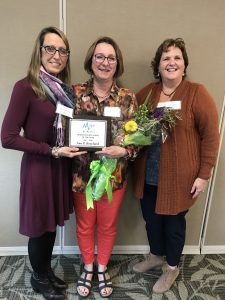
Waterville High School nurse named Maine School Nurse of the Year

Nurse of the Year 2017
Left- Deborah Braxton, Maine Association of School Nurses, SNOY Chair Center- Ann Bouchard, Maine School Nurse of the Year 2017-18 Right-Patricia Endsley, SNOY 2016-17

The Maine Association of School Nurses has named Ann Bouchard Maine’s 2017-2018 School Nurse of the Year. A registered nurse for 40 years, the last 17 of them as a school nurse at Waterville Senior High School in AOS 92, Bouchard received her Bachelor’s of Science in 1977 from Boston College where she majored in nursing and sociology. She was commissioned as a Captain in the United States Air Force in 1978 and completed trainings in USAF Air Command and Staff College, USAF Squadron Officers School, the Flight Nurse course, and the Nurse Oncologist Certification course.  Ann worked concomitantly as a flight nurse for the NY Air National Guard, nurse consultant for Albany Medical Center, and adjunct faculty lecturer for Russell Sage College.  She earned a Master’s of Science in Nursing in 1983 from Russell Sage College and a Master’s degree in Leadership Studies from the University of Southern Maine in 2010.

In addition to working full time, Bouchard is an active volunteer in her community, an experienced lecturer and has published some of her written work. She serves on several school committees, in addition to the Kennebec Valley Community Action, Hardy Girls, Healthy Women, Alfond Youth Center Board of Directors, docent for Colby College museum and has been a clinical supervisor for University of Maine Orono nursing students.

Bouchard has received numerous awards including awards from the Waterville Board of Education, Faculty Renaissance Award, Outstanding Educator, United States Air Force Air National Guard Nurse of the Year, Air Force Commendation Medals with Oak Leaf Cluster, as well as a Yearbook dedication from the Waterville HS Class of 2005.

Her colleagues frequently describe her as “dedicated, unselfish, committed to the needs of all students, and willing to help with anything at a moment’s notice.” According to the nurses who nominated her, “Her leadership style is transformational and defined by deep and authentic connections.”

As School Nurse of the Year, Bouchard receives a cash award of $500 and will be acknowledged as the Maine School Nurse of the Year at the National Association of School Nurses annual meeting in Baltimore, MD in June 2018. The program is administered by the Maine Association of School Nurses. Nominations for School Nurse of the Year are accepted each year beginning in March.

Health update: mosquito-borne illnesses and schools

Maine Department of Education in collaboration with Maine Center for Disease Control and Prevention (Maine CDC) is sharing this important guidance with schools regarding mosquito-borne illnesses. Maine CDC developed the information and guidance in this letter. Two mosquito-borne illnesses are considered a local risk in Maine: Eastern Equine Encephalitis (EEE) and West Nile virus (WNV).  Both are potentially serious viral infections transmitted to people from the bite of an infected mosquito.  The disease is especially severe in children (as well as adults over 50).  There is no vaccine or effective treatment for humans.  Therefore, prevention strategies are critical.

Maine saw the first human case of WNV in 2012 and the first human case of EEE in 2014. Maine did not identify any positive EEE or WNV mosquito pools, human cases, or animal cases in 2016 and to date in 2017. Massachusetts, New Hampshire, and Vermont identified mosquito pools positive for WNV in 2017 and Massachusetts identified a mosquito pool positive for EEE.

Maine also identified other mosquito-borne viruses including two cases of locally-acquired Jamestown Canyon virus and one case of travel-associated Zika virus to date in 2017. New Hampshire also identified one case of locally-acquired Jamestown Canyon virus.

The risk for contracting mosquito-borne diseases is highest from dusk to dawn and when temperatures are above 50 degrees (and especially above 60 degrees), since these are the conditions when mosquitoes are most actively biting.

Schools play an important role in preventing mosquito-borne illnesses.  Maine CDC and its consulting experts recommend:

  • Cover up outdoors. Children and others on outdoor field trips and participating in other outdoor activities for a significant amount of time when the temperature is above 50 degrees should be encouraged to cover up with long sleeve shirts, pants, and socks; and/or
  • Use repellent.   Use an EPA approved repellent containing DEET, picaridin, IR3535, or oil of lemon eucalyptus on exposed skin and/or clothing.  The repellent/insecticide permethrin can be used on clothing and can be effective through several washes.  Always follow the package directions.  For details on recommended repellents see: http://cfpub.epa.gov/oppref/insect/index.cfm

    • School employees and volunteers must have authorization from parents or guardians before applying repellants to minor children (CMR 01-026, Chapter 10, Section 2.I.4.iii): http://www.maine.gov/sos/cec/rules/01/026/026c010.doc

    • Schools that schedule practices or games at dusk or evening with temperatures above 50 degrees should encourage the use of repellant for all participants including coaches and observers.

Implement Integrated Pest Management strategies. Since we anticipate the risk from mosquito-borne illnesses to continue, schools should consult with their IPM Coordinator to review their IPM policy. Information on Maine’s School IPM Program can be found at http://www.maine.gov/dacf/php/integrated_pest_management/school/index.shtml

Please monitor Maine CDC’s arboviral website for the most up to date information on positives detected in the state. If mosquito-borne disease activity increases in your area, the following strategies should be implemented:

  1. Use EPA approved repellents. These should be available to both students and staff who are outdoors, particularly during dusk and dawn hours. If you have an outdoor event, repellent should be available to spectators as well to limit the risk of mosquito-borne diseases.
  2. Consult with your school IPM coordinator and implement a plan to reduce the number of mosquitoes and mosquito breeding sites on school grounds.
  3. Limit and/or reschedule evening outdoor activities. Unless the dusk temperature is forecast to be less than 50 degrees, limit or reschedule outdoor evening activities such as school athletic events so people are able to go indoors by one hour before sunset.

All these recommendations are especially true in those areas with previously-identified mosquito-borne illnesses. However, the lack of identified virus in an area of the state does not mean there is no risk.

Maine CDC has one-page fact sheets for EEE, WNV, and repellents which we encourage you to send home with students, share by email, and/or post on your school website(s), as you deem appropriate. You can access the facts sheet here: http://www.maine.gov/dhhs/mecdc/infectious-disease/epi/vector-borne/index.shtml.

Resources to learn more about mosquito-borne illness and mosquito control:

Maine Department of Education and Maine CDC continue to work very closely together and are greatly appreciative of your assistance in keeping Maine’s children and school communities healthy.

For further questions, contact Maine DOE School Nurse Consultant, Emily Poland at Emily.Poland@maine.gov

Important clarification for districts with public preschool and Head Start collaborations

Chapter 124: Basic Approval Standards for Public Preschool Programs is fully in effect as of July 1, 2017, and there is a need to clarify the roles and responsibilities of school nurses and Head Start health services staff in order to meet both Head Start program, and Maine Department of Education standards.

Specifically, public school nurses and teachers as well as Head Start health services staff must know that all of the health requirements for each party are being met while not duplicating services.

The Maine Department of Education has collaborated with State Head Start representatives and Child Development Services to create a sample Memorandum of Agreement (MOA) for public schools that collaborate with Head Start to deliver 4-year old programs. The MOA outlines what is required for each program and allows partners on the local level to decide who is will be responsible.

This “Health Services Memorandum of Agreement” may be used as an addendum to the SAU/Head Start Memorandum of Understanding that is required in partnerships.

The Health Services MOA includes all the requirements of both Head Start and Chapter 124; Head Start is responsible for the additional federal requirements. However, it is important to note who will take responsibility for the overlapping requirements. It also outlines who will create the individual health plan, train in medication management as well as how information will be shared.

If you have any questions please do not hesitate to contact one of the following:

Emily Poland, RN, School Nurse Consultant at emily.poland@maine.gov  or 207-624-6688, or Sue Reed, Early Childhood Specialist at susan.d.reed@maine.gov or 207-624-6632.

New School Absenteeism Reporting Form

When a potential outbreak, including those involving exposure to a communicable disease, toxic agent, environmental hazard, or a potential epidemic is identified, immediate notification to the Maine CDC should be made.  One of the ways these outbreaks can be identified is through elevated school absenteeism.  Schools have long partnered with the Maine Center for Disease Control (MeCDC) to report elevated absentee rates (>15%).  The Department of Education and MeCDC have collaborated to design this application in NEO to collect this information more efficiently. School nurses have be given access to the reporting tool.  If your school unit decides that it would be appropriate for another person to submit this report, you will need to fill out a NEO access request form located on the DOE Data Helpdesk page.  http://www.maine.gov/doe/data/helpdesk.html


Free webinar for schools on how to deal with the browntail moth

The browntail moth has spread across Maine from York to Millinocket. As a result, the Maine Department of Agriculture, Conservation, and Forestry is offering a free webinar to provide guidance to schools on dealing with issue of the browntail moth and related health concerns (dermatitis and respiratory effects) on school campuses.

The webinar will be held November 17, 2016 from 10-11 AM to help schools learn how to recognize this pest and what can be done to address it.

Presenters will be: Barbara Chisholm, School Nurse, Gardiner Area High School; Charlene Donahue, Entomologist, Maine Forest Service; Jon Stonier, Director of Operations, MSAD 11. No advance registration is required for this Adobe Connect webinar.

To participate, click here approximately ten minutes before the webinar is scheduled to begin, then log in as a guest. (Note: you may be prompted to download the Adobe Connect software if your computer does not have it already). Information about Adobe Connect (computer software and audio requirements) is available here.

For more information contact Kathy Murray at the Department of Agriculture, Conservation, and Forestry at kathy.murray@maine.gov or 287-7616.

Each SAU to file its bullying policy and procedures with Maine DOE by July 1, 2017

In an effort to address bullying behavior in our schools to ensure student safety and an inclusive learning environment, SAUs are required to file their bullying policies and procedures with the Maine Department of Education.  An Act To Prohibit Bullying and Cyberbullying in Schools, passed into law in 2012, asks for transparency and monitoring which in turn allows for accurate and timely technical assistance from the Department when school personnel, parents and guardians, and the public have questions related to bullying.  All superintendents will receive notification through email from the Department’s Student Assistance Coordinator about how to file their SAU’s bullying policy and procedures with the Department.  The deadline for filing is July 1, 2017.  Once these policies and procedures are filed with the Department, superintendents will receive confirmation and guidance as to whether or not their policies and procedures are consistent with the model policy (including procedures) revised by the commissioner.

For additional information or questions, please contact Sarah Ricker, Maine DOE’s Student Assistance Coordinator, at 624-6685 or sarah.ricker@maine.gov.