Language, Learning, and Leadership in Maine: Supporting Multilingual Learners with Disabilities through University and State Collaboration

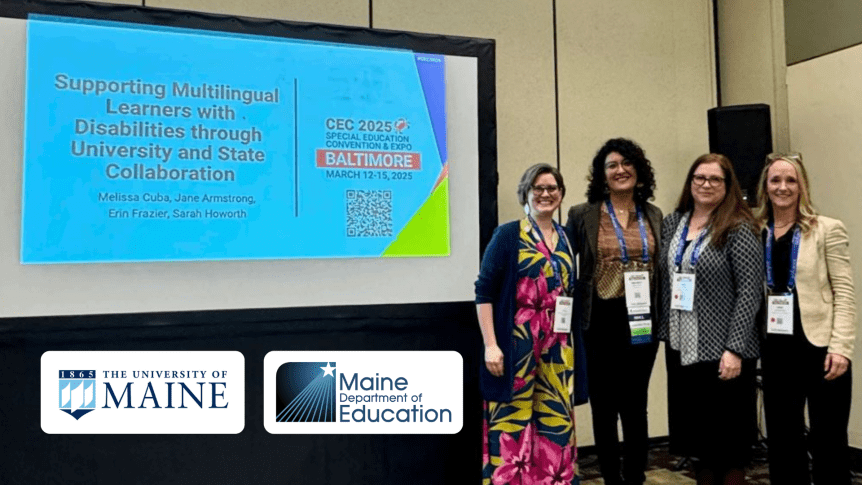
Pictured: From left to right: Associate Professor of Special Education Dr. Sarah Howorth, Assistant Professor of Special Education Dr. Melissa Cuba, Director of Maine DOE Office of Special Services and Inclusive Education Erin Frazier, and Maine DOE State ESOL Specialist Jane Armstrong presenting at the National Council for Exceptional Children (CEC) Conference in Baltimore, Maryland.

In a powerful display of statewide collaboration, representatives from the University of Maine (UMaine) and the Maine Department of Education (DOE) joined forces in March to present at the 2025 National Council for Exceptional Children (CEC) Conference. The session, Supporting Multilingual Learners with Disabilities through University and State Collaboration,spotlighted Maine’s groundbreaking efforts to support multilingual learners (MLs) with disabilities, showcasing the newly-updated Identifying and Serving Students Who Are Multilingual Learners with Disabilities: Policy and Resource Guide, alongside innovative university programming that prepares educators to support MLs with disabilities.

The presentation was led by Dr. Melissa Cuba, UMaine Assistant Professor of Special Education, and supported by Dr. Sarah Howorth, UMaine Associate Professor of Special Education, in partnership with Maine DOE Director of the Office of Special Services and Inclusive Education Erin Frazier and the English for Speakers of Other Languages State Specialist, Jane Armstrong.

Together, the group highlighted the unique context of the state, tracing the evolution of collaborative efforts, and showcased key contributions to address the dual needs of language acquisition and disability support, including UMaine’s Graduate Certificate in Multilingual Special Education, Maine Access to Inclusive Education Resources (MAIER), and the comprehensive policy and resource guide for educators on identifying and serving MLs with disabilities.  

UMaine’s Multilingual Special Education program is uniquely designed to prepare educators to effectively support MLs with disabilities through a blend of linguistic, cultural, and special education expertise. What sets this 15-credit online graduate program apart is its interdisciplinary curriculum, which includes courses that target language development, such as:

  • ERL 531: Linguistic Diversity, Multilingualism, and the Classroom
  • ELL 570: Methods of TESOL (Teaching English to Speakers of Other Languages)
  • ELL: 572: Second Language Acquisition

 It also offers specialized training through:

  • SED 502: Strategies for Culturally and Linguistically Diverse Students with Disabilities
  • SED 545: Intervention for Reading Difficulties

If working with children birth to five, SED 545 is combined with SED 529: Developmentally Appropriate Reading Instruction for Diverse Young Learners. Together, these courses provide a rich foundation in language development, culturally-responsive pedagogy, and targeted academic interventions, empowering educators to create inclusive and effective learning environments for diverse student populations.

The collaboration with the presentation and the co-construction of this iterative guidebook reflects Maine’s growing commitment to inclusive and equitable education, with a focus on multilingualism, disability inclusion, and culturally-responsive practices. The collaboration also underscores the valuable role of higher education institutions like UMaine in supporting these efforts, through research, educator preparation, and training informed by real classroom experiences.

The Maine guidebook serves as a vital resource for school administrative units (SAUs), offering practical tools, guidance, and examples to ensure that linguistic diversity and disability are not barriers to learning but rather opportunities to build inclusive, responsive educational environments.

“This work is a reflection of Maine’s commitment to inclusive education that sees and supports the whole child,” Frazier said. “By bridging the expertise of higher education and state systems, we are empowering educators to confidently identify, support, and celebrate multilingual students with disabilities.”

This work aligns with and strengthens Multi-Tiered Systems of Support by ensuring that academic, behavioral, and social-emotional supports are responsive to the diverse identities and experiences of all students.

As part of the Maine DOE’s commitment to inclusive and equitable education, Teacher Leader Fellow Melissa Frans, has played a vital role in co-facilitating a dynamic six-part professional learning series, designed to support educators working with MLs with disabilities. Through her leadership, Frans has further illuminated the critical intersection between language acquisition and disability services, emphasizing the importance of collaborative practices with linguistically-responsive IEP development. You can see the recordings of this webinar series on the Maine DOE Multilingual Learners with Disabilities webpage.

As Maine experiences growing linguistic and cultural diversity in its schools, this guidebook, along with the collaboration behind it, provides a model of proactive, inclusive, and research-informed practices that other states may consider replicating. Additionally, the Maine DOE Event Calendar has an array of opportunities available to support educators in fostering inclusive and effective learning environments.

For further information or questions about multilingual programming, please contact Maine DOE State ESOL Specialist Jane Armstrong at Jane.Armstrong@maine.gov. For further information or questions about the guidebook, please contact the Maine DOE Office of Special Services and Inclusive Education Director Erin Frazier at Erin.Frazier@maine.gov.
Aroostook County Early College Summit Brings Together High Schools Across Northern Maine

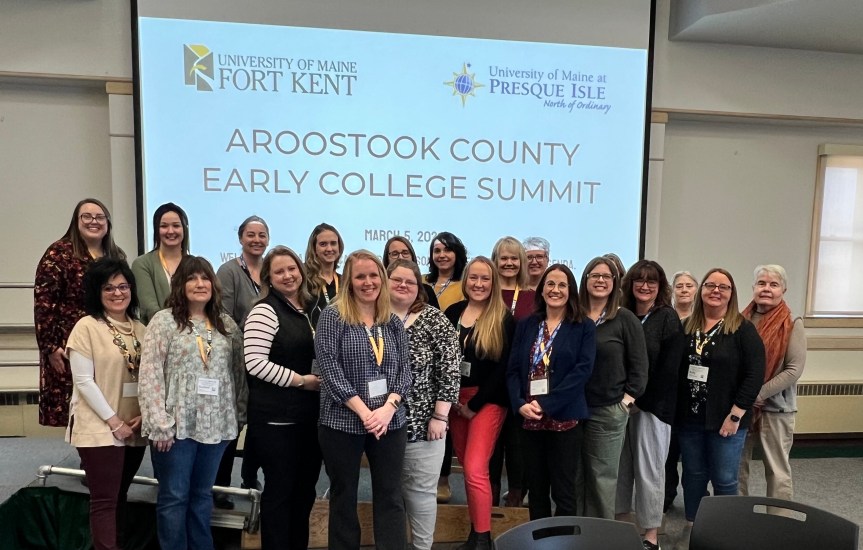
On Tuesday, March 5th, Early College leaders Margaret Guimond from the University of Maine at Fort Kent (UMFK) and Teri St. Pierre from the University of Maine at Presque Isle (UMPI) hosted the first Aroostook County Early College Summit.

The event had stakeholder representation from (almost) every high school in Aroostook County, representatives from Northern Maine Community College (NMCC), UMFK faculty, and early college staff members from the University of Maine System.

Topics included an overview of the application process and online application system, student support and resources, the accreditation process through the National Alliance of Concurrent Enrollment Partnerships (NACEP), and a historical overview of the program with program success data.

All stakeholders worked together to find areas of improvement and collaborated to brainstorm ways to help facilitate a seamless transition from secondary into post-secondary institutions for Maine students. High school and career and technical education stakeholders had an opportunity to provide input and feedback, and their responses to the event were overwhelmingly positive.

“Congratulations to Teri and Margaret for their hard work on this event!” said Amy Hubbard Executive Director of Early College for the University of Maine System.

“I’m really pleased that we were able to collaborate with so many schools, and pull this off up here,” said Guimond. “We are still hearing the buzz about it!”


USM Teacher Certification Program for Current School Employees

Do you have educators in your district with bachelor’s degrees who are seeking initial teacher certification? Consider directing them to the University of Southern Maine’s (USM) ETEP Program.

Here are a few highlights for the 2023-2024 academic year:

  • All classes will be held in the evening, Tuesday, Wednesday, and Thursday. This could be more convenient for ed techs, long-term substitute teachers, and/or teachers with conditional certificates who may want to continue employment while completing the program
  • Participation in the Maine Teacher Residency program
  • Enrollment in select courses (rather than entire program) may be an option (on a case-by-case basis).
  • All classes apply to a Master’s in Teaching & Learning

Applications need to be started by January 31, 2023 to guarantee consideration for this year, but there may also be rolling admissions.

Apply and get more info here.

All questions can be directed to Michael Katz (michael.katz@maine.edu). Mike would be willing to meet with educators individually or arrange a time to meet as a group at your school.


Early College High School Student First to Earn Required Credits for University of Maine at Augusta Degree while Attending High School

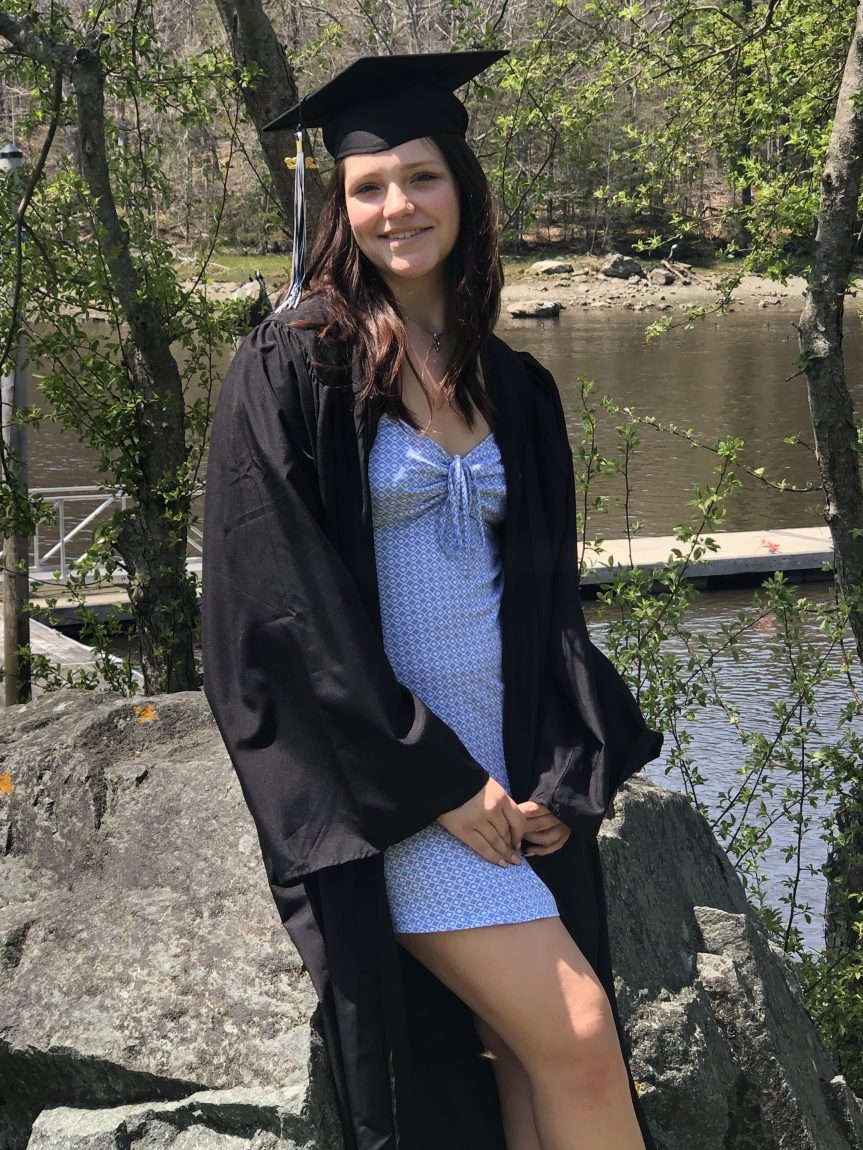
Amber-Rae Pesek, a senior graduating from Ellsworth High School in June of 2022, is the first student ever to complete the necessary credits to earn an Associate’s degree from the University of Maine at Augusta (UMA) while simultaneously completing her high school career. Pesek, who marched in the May 14th UMA Commencement Ceremony, will be officially awarded her degree in Liberal Studies in Summer 2022 following the completion of her high school career.

Pesek earned 74 credits college credits as a high school student in the UMA Early College Program and as a Bridge Academy of Maine student through Hancock County Technical Center. Credits were accumulated across the University of Maine System campuses with the majority of her credits earned through UMA. She also transferred credits for her UMA degree requirements from Eastern Maine Community College.

Christine Knight, UMA’s Director of Early College said, “(Amber-) Rae is one of the most extraordinarily driven students I have ever had the pleasure of working with in this program.  She put in countless hours in the coursework itself, while also being actively involved in the Bridge Academy of Maine Program as well as student life at Ellsworth High School.”

Sarah White, Ellsworth High School Counselor, said Pesek took full advantage of Early College opportunities. “She did this on top of balancing a regular high school course load, as well as co-curricular activities and athletics. Her diligence and perseverance paid off in spades and we are so proud of her! We are so excited to see what her future holds!”

Hancock County Technical Center Student Services Coordinator, Hope High, and Director, Amy Boles, also recognized Pesek’s efforts. “As a student in our Biomedical Sciences program and a member of our Bridge Academy, Amber-Rae has shown immense leadership and taken advantage of every opportunity she has been given.  We are so proud of her efforts in earning the necessary credits for her Associates Degree from the University of Maine at Augusta while also taking a full academic course load and being an active high school citizen.”

Mason Brewer, Program Director for Bridge Academy of Maine, agreed. “Especially during these unique and challenging times, she displayed an impressive ability to maintain a substantial course load. She is a shining example of what is possible with strong personal drive, advocacy, and planning. We are excited to follow where Rae goes from here!”

At the University of Maine System (UMS), Early College (or dual enrollment) refers to all programs in which high school students enroll in college courses. Students earn both college and high school credit when they successfully complete the course. High school students who enroll in early college courses are more likely to enroll in college, have higher grades, and have a better chance of earning a college degree. Courses are free (or at significantly reduced costs) to high school students.

The most recent data from the UMS Institutional Research and Planning Office (Spring 2022) reveals the outlook for all Early College programs is strong, with 457 high school students enrolled this spring just within UMA (2,501 system wide). This represents an 81% increase from 2018 for UMA, and a 55% increase overall for all seven institutions. Fall enrollments are typically stronger across all demographics, and data for Early College support that. The Fall 2021 statistics show that more than 3,600 students across Maine’s public universities were enrolled in Early College, with 1,056 enrolling in UMA courses.

Like her colleagues, UMA’s Knight is also very optimistic of Pesek’s future as she took advantage of Early College, and also recognized how much family support contributes to student success. “Rae is a remarkable student, and she had unending support and guidance from her family. I know she will go on to do incredible things. Once again, Rae demonstrates that with Early College, high school students can be not only college ready, but college proven!” Pesek is already exploring options for the fall at UMA and several other Maine public universities.

UMA transforms the lives of students of every age and background across the State of Maine and beyond through access to high-quality distance and on-site education, excellence in student support, civic engagement, and professional and liberal arts programs.  For more information, please visit https://www.uma.edu/. For information about UMA’s Early College Program, visit https://uma.edu/earlycollege.

PRIORITY NOTICE: Higher Education Workforce Grants Available for Work-based Learning Experiences. Application Deadline June 8

The Maine Department of Education is seeking applications for the distribution of higher education workforce grants as part of the Maine Jobs & Recovery Program (MJRP). The program will provide a total of $1 million to private higher education institutions in Maine to prepare students for employment in industries harmed by the COVID-19 pandemic.

Funding must be used to provide internships, registered apprenticeships, career mentoring, and other work experience support for students or graduates to connect them to careers in healthcare and social assistance; tourism, travel, and hospitality; education or the public sector; agriculture, fishing and forestry; construction; information; manufacturing; or clean energy. Those eligible for the grants include private colleges and universities in Maine, the Maine Maritime Academy, and industry partners related to the career fields listed above.

The number and size of awards will depend on the number of proposals received & available funds. The range of awards is up to $200,000 and eligible institutions may submit applications for up to two distinct projects.

Applications should be submitted by June 8, 2022 to the State of Maine Division of Procurement Services, via email, at Proposals@maine.gov.

For additional information, contact Ángel Martínez Loredo, Director of Higher Education & Educator Support Services, at angel.loredo@maine.gov.​

PRIORITY NOTICE: Higher Education Workforce Grants Available for New and Expanded Programs. Applications Due June 16

While the COVID-19 pandemic has had broad economic impacts, several Maine industries have suffered disproportionate negative economic consequences caused by the pandemic. As part of the Maine Jobs & Recovery Act, the Maine Department of Education is seeking applications to provide funding to higher education institutions in Maine to prepare students for employment in industries harmed by the COVID-19 pandemic.  

Funding will be used to develop a new or expanded certificate or degree program that addresses priority workforce needs in one of the following industries: tourism, travel & hospitality; healthcare and social assistance; education and public sector; agriculture, fishing & forestry; infrastructure (construction, trades, broadband, logistics); information; manufacturing; or clean energy.  

Those eligible for the grants include private colleges and universities in Maine and the Maine Maritime Academy. In their applications, higher education institutions should consider how their programs will:  

  • Address critical needs in Maine’s economy and workforce by advancing strategies identified in Maine’s 10-year economic development strategic plan; 
  • Prioritize supports for disadvantaged students, students with disabilities, and individuals such as new Mainers, people of color, low-income students, Indigenous communities, and students seeking work in rural communities; 
  • Demonstrate the likelihood of supporting the advancement of students and workers to achieve higher paying jobs in Maine; and  
  • Use funding for one-time investments that will produce lasting benefits or propose a feasible funding strategy for sustaining activities after grant funds have been exhausted. 

The number and size of awards will depend on the number of proposals received & available funds. The range of awards is up to $2 million and eligible institutions may submit applications for up to two distinct projects. 

Applications should be submitted by June 16, 2022 to the State of Maine Division of Procurement Services, via email, at Proposals@maine.gov 

For additional information, contact Ángel Martínez Loredo, Director of Higher Education & Educator Support Services, at angel.loredo@maine.gov.​ 

UPDATED PRIORITY NOTICE: Higher Education Workforce Grants Available for New and Expanded Programs

While the COVID-19 pandemic has had broad economic impacts, several Maine industries have suffered disproportionate negative economic consequences caused by the pandemic. As part of the Maine Jobs & Recovery Act, the Maine Department of Education is seeking applications to provide funding to higher education institutions in Maine to prepare students for employment in industries harmed by the COVID-19 pandemic.  

Funding will be used to develop a new or expanded certificate or degree program that addresses priority workforce needs in one of the following industries: tourism, travel & hospitality; healthcare and social assistance; education and public sector; agriculture, fishing & forestry; infrastructure (construction, trades, broadband, logistics); information; manufacturing; or clean energy.  

Those eligible for the grants include private colleges and universities in Maine and the Maine Maritime Academy. In their applications, higher education institutions should consider how their programs will:  

  • Address critical needs in Maine’s economy and workforce by advancing strategies identified in Maine’s 10-year economic development strategic plan; 
  • Prioritize supports for disadvantaged students, students with disabilities, and individuals such as new Mainers, people of color, low-income students, Indigenous communities, and students seeking work in rural communities; 
  • Demonstrate the likelihood of supporting the advancement of students and workers to achieve higher paying jobs in Maine; and  
  • Use funding for one-time investments that will produce lasting benefits or propose a feasible funding strategy for sustaining activities after grant funds have been exhausted. 

The number and size of awards will depend on the number of proposals received & available funds. The range of awards is up to $2 million and eligible institutions may submit applications for up to two distinct projects. 

Applications should be submitted by June 16, 2022 to the State of Maine Division of Procurement Services, via email, at Proposals@maine.gov 

For additional information, contact Ángel Martínez Loredo, Director of Higher Education & Educator Support Services, at angel.loredo@maine.gov.​ 

UPDATED PRIORITY NOTICE: Higher Education Workforce Grants Available for Work-based Learning Experiences

The Maine Department of Education is seeking applications for the distribution of higher education workforce grants as part of the Maine Jobs & Recovery Program (MJRP). The program will provide a total of $1 million to private higher education institutions in Maine to prepare students for employment in industries harmed by the COVID-19 pandemic.

Funding must be used to provide internships, registered apprenticeships, career mentoring, and other work experience support for students or graduates to connect them to careers in healthcare and social assistance; tourism, travel, and hospitality; education or the public sector; agriculture, fishing and forestry; construction; information; manufacturing; or clean energy. Those eligible for the grants include private colleges and universities in Maine, the Maine Maritime Academy, and industry partners related to the career fields listed above.

The number and size of awards will depend on the number of proposals received & available funds. The range of awards is up to $200,000 and eligible institutions may submit applications for up to two distinct projects.

Applications should be submitted by June 8, 2022 to the State of Maine Division of Procurement Services, via email, at Proposals@maine.gov.

For additional information, contact Ángel Martínez Loredo, Director of Higher Education & Educator Support Services, at angel.loredo@maine.gov.​

UMA Hosting Major & Career Exploration for High School Students

The University of Maine at Augusta (UMA) is hosting a Major & Career Exploration Webinar Series for high school students interested in Early College. The series will take place each Wednesday during the month of April from 6-7 PM on Zoom.

Join UMA’s Office of Early College and UMA Faculty during the webinars to learn more about the following majors: Aviation, Justice Studies, Mental Health and Human Services, and Nursing.

Attendees will receive a brief overview of the featured major, degree, and certificate offerings, as well as courses students can take now as Early College students, and a summary of career opportunities post college graduation.

For more detailed information, including the Zoom link for the webinars, please visit the website uma.edu/ecwebinars. Early College is a partnership between the University of Maine System and the Maine Department of Education, supported by the Maine State Legislature.

Maine $1,000 Pre-Service Teacher of the Year Award & FREE Conference

Applications are open for the Educators Rising Preservice teacher award which helps a future teacher get a jumpstart on setting up their classroom. The award of $1,000 will be presented to a senior at a teacher prep program in Maine and the award will be judged by Maine County and State Teachers of the Year.

Award applications can be submitted here. (DEADLINE: March 18th, 2022)

The winner will be announced at the Maine Pre-Service Teacher Conference on April 1.

This free conference is for aspiring teachers (high school seniors and pre-service teachers) and will be held April 1, 2022 in person at Thomas College.  Virtual programming will be available as well via Zoom.

Register Here for Conference (FREE OF CHARGE)

Presenters include principals and award-winning teachers of the year, and will cover topics pre-service teachers and other aspiring educators have expressed interest in, such as classroom management, getting a job, and the first year in the classroom. All in-person participants will be eligible for gift card door prizes throughout the day.   

Conference Informational flyer.

Pre-Service Teacher of the Year Award flyer

Please email Dr. Rybakova at rybakovae@thomas.edu if you have any questions.