MEDIA RELEASE: Maine DOE and MCCS Partner to Offer Free College Courses for Adult Education Students

MCCS_FMCC_logo_legMaine adults seeking to pursue college have a new option to jumpstart their education, with support from their local Maine adult education program. A new partnership between the Maine Community College System (MCCS) and the Maine Department of Education (DOE) will offer tuition-free college courses to Maine’s adult education students.

Maine adult education programs have supported adult students in their transition to college and career through the Maine College and Career Access program for almost twenty years. This new opportunity expands upon that idea by allowing adult education students to take a college course with the full support of their adult education program mentors so they can develop the habits, skills, and confidence to succeed in college.

“Maine’s adult education programs have assisted thousands of Maine adults in making a successful transition to college,” said Maine Education Commissioner Pender Makin. “This new partnership with the Maine community college system takes it to the next level by giving students the chance to try a college course with the support they need. We are excited to see the impact it makes for our adult education students.”

Adult education programs will work with adult students to select a course at the community college that is appropriate for their college and career goals, and then support the student as they complete the course. The goal is that they will continue their education once the course is completed.

“This is an opportunity for us to encourage and connect with adult students throughout Maine,” said MCCS President Dave Daigler. “The hope is that students can choose courses that align with their individual career goals and that we can help provide that motivation and support to continue on once they complete their adult education program.”

Tuition and fees for the courses are being generously provided by the Maine Community College System while the Maine Department of Education’s Office of Adult Education will provide textbooks and course materials for students.

Adult students interested in this program will need to be enrolled in a Maine Adult Education program to take advantage of the opportunity. Adults (with or without a high school diploma) who would like help achieving their educational and career goals can contact their local adult education program for next steps.
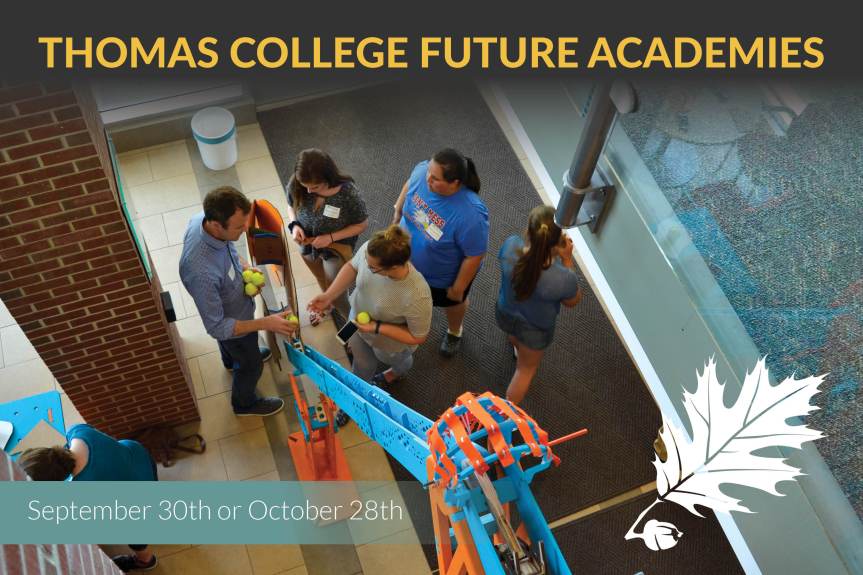
Student Career & Degree Exploration Event at Thomas College on 9/30 and 10/28  

Thomas College, in partnership with the Maine Department of Education and the Maine Teacher of the Year Association, is hosting two hands-on, experiential career exploration days led by professional faculty and college students.

These career and degree exploration events are open to high school sophomores, juniors, and seniors who will have the opportunity to select a track and work with Thomas College professors and students to tackle real-world challenges.

The day also includes campus tours, lunch, and Thomas College swag.  Space is limited, so reserve your spot today!

Choose one day to attend:

September 30th
9am – 1:30pm
Thomas College
October 28th
9am – 1:30pm
Thomas College

Students attending can choose from the following tracks:

  • Future Teachers
  • Future Business Leaders
  • Future Tech Innovators
  • Future Crime Scene Analysts

Note: Thomas College does have some limited funding available to help support transportation to and from campus. Please reach out if you/your school would need this! For more information, please contact admiss@thomas.edu or 207-859-1101.

Register now!

New Maine Initiative to Build Ag Literacy Through Immersive CTE Culinary Arts Programs

A new University of Maine initiative to build agricultural literacy through an immersive culinary experience for career and technical education (CTE) culinary arts instructors is one of 21 projects funded nationwide by the U.S. Department of Agriculture’s National Institute of Food and Agriculture (NIFA).

NIFA has invested $6.2 million in the Professional Development and Secondary School Teacher grants to increase the number of K–14 teachers and educational professionals trained in the food and agricultural sciences. The grants to prepare more educators in food and ag science, and support best teaching practices that enhance student learning outcomes, are part of NIFA’s Agriculture and Food Research Initiative.

UMaine’s Building Agriculture Literacy Through an Immersive Culinary Experience project, which received a $300,000, four-year grant, is led by Kathy Savoie, University of Maine Cooperative Extension educator and professor; Willie Grenier, executive director of Maine Agriculture in the Classroom; and Rob Dumas, UMaine food science pilot plant manager. CTE culinary arts instructors will receive professional development experiences to increase their agricultural literacy, and enhance the connectedness between agriculture and food service in their culinary arts curricula.

A goal of the project is to help create a skilled, educated workforce that will increase the use of Maine grown, processed and produced foods in their programs and careers by changing the way students — tomorrow’s food professionals — think about the importance and value of local food, according to the researchers.

“Providing professional development experiences for CTE instructors will help to shift culinary arts programs toward local food system education with the end goal to create a workforce that is proficient in Maine agriculture, and that will be poised to meet today’s consumer needs and ultimately boost our state agriculture” says Savoie, the principal investigator on the initiative.

The project provides a holistic approach to uniting community partners to identify the best practices for agriculture literacy education at CTE culinary arts programs in Maine. UMaine Cooperative Extension and Maine Agriculture in the Classroom will collaborate to provide experiential learning opportunities for CTE culinary arts instructors through a week-long Immersive Culinary Arts Summer Institute. Project activities will include hands-on experience in local food procurement practices, demonstrations of food system lessons, educational field trips, financial support for experiential activities through their existing school restaurants, participation in a UMaine Local Foods Competition and coaching during the school year.

The CTE instructors also will experience the educational power of job shadowing, flipped classrooms and working relationships with employers that could help students make career connections. Participating instructors will be eligible to receive mini-grants to support nontraditional learning experiences — on-site learning opportunities with farmers, food processors and butchers, for example, and at food hubs, food incubator labs, aquaculture facilities, food pantries and restaurants — to increase students’ understanding of local food systems. In addition, the UMaine Food Pilot Plant will host local food competitions for CTE culinary arts students, challenging them to use Maine foods in creative and innovative ways to meet the demands of today’s consumers.

Join Dr. Habib Dagher to learn about UMaine’s leading research in floating offshore wind

Tesday, May 11th, 9:00-10:00 am

There is an international race to develop floating wind turbine technologies.  Educators and students are cordially invited to learn about these technologies and how they can help Maine mitigate climate change and keep more energy dollars in the state.  Dr. Habib Dagher, executive director of the Advanced Structures and Composites Center at the University of Maine, will be leading a webinar about the pioneering research in floating offshore wind being conducted at UMaine.

Dr. Dagher will give a presentation geared towards middle school and high school audiences that will cover the engineering of floating wind turbines.  How does one design floating turbines that can survive 500-year storms?  How is the power brought back to shore?  How are these turbines anchored to the seabed?  How many turbines does one need to power Maine?

Register for the webinar today!

The event is free but limited to 1,000 participants. Please register ASAP!

  • Did you know that harnessing just 3% of the Gulf of Maine offshore wind resource can provide enough electricity to heat every home and drive every car in Maine?
  • The Gulf of Maine’s offshore wind capacity is equivalent to that of 156 nuclear power plants.
  • Researchers at UMaine are working with NASA to optimize the design of floating offshore wind platforms.

Learn this and more during Dr. Dagher’s presentation.

For more information contact Advanced Structures & Composites Center.


Early College Online: UMF Course Gives Mt. Blue Senior the Chance to Research and Share Family History

Early College student Sylvie Haslam, a senior at Mt Blue High School recently published the first part of a three part story on University of Maine at Farmington (UMF) Professor and Author Luann Yetter’s website as part of an Early College course she took this past summer at UMF.

“Sylvie was just one of many high school students, statewide, really, who took advantage of the opportunity to take classes last summer, when the pandemic hit and UMF moved their summer classes online,” said Clarissa Thompson, Early College Campus Coordinator and Associate Professor of Secondary and Middle Education at UMF.

Early college courses are available to Maine high school students at University of Maine System Schools and Maine’s Community Colleges as well through Maine’s Aspirations Program, which is administered by the Maine Department of Education. Students may now apply for early college opportunities at all of Maine’s colleges and universities using one common application portal, this new tool is a significant usability upgrade for students and families navigating early college options in Maine.

The UMF course that Sylvie took is called, Local Stories/Your Stories. Along with classmates from across Maine, she dove into her own local town and family history as material for creative nonfiction, engaging in personal interviews, genealogies, and looking through old newspapers (among other things) to create a vivid story of her personal history.

“This is a great example of the types of expanded opportunities our high school students have as part of the Aspirations program,” said Amy Hubbard, Executive Director of Early College at University of Maine System.

As an introduction to Sylvie’s story, Professor Yetter writes:

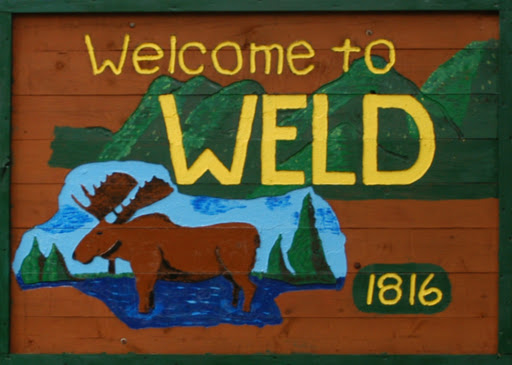
Last summer when I taught my class on writing local and family history I got to read some wonderful work. One of the projects I know will be of interest to my readers is this one by Mt. Blue High School senior Sylvie Haslam. Sylvie’s family history in Weld is interwoven with the Cushman family, prominent in the 1800s, and with artist Seavern Hilton who made his mark in the mid twentieth century. Join us as Sylvie explores Weld history, family history and the folk art that traveled far beyond the village of Weld. I have divided her fascinating account into three parts. In Part I, below, we are introduced to the Michael Graham farm and the Cushman family, whose ties to the land go back to the mid-eighteen hundreds. I’m sure you will agree that Sylvie is a talented writer. This high school student has a great future ahead of her!”

Read Part One of Sylvie’s story here: The Shop Land, Part I

UMF and the other University of Maine System campuses, as well as Maine’s Community College System campuses offer a wide range of classes that Maine high school students have continued to participate in online.

“Students have really jumped at the opportunity to take them,” adds Thompson. While participation had been growing steadily before the pandemic, early college programming helped provide additional options for students as high schools adjusted to online and hybrid schedules. Students who participate in early college are more likely to attend college, have higher grades in college, and are more likely to graduate on time.

For more information about early college options at UMF specifically, contact Clarissa Thompson at clarissa.thompson@maine.edu.

Information for this article was provided by the University of Maine System and the University of Maine at Farmington as part of the Maine DOE Maine Schools Sharing Success Campaign. The Maine Schools Sharing Success Campaign is an avenue for Maine schools to celebrate successes and share innovative ideas, practices, and models that can be adapted and easily implemented by other Maine schools. Stories are not an endorsement of specific materials, services, or practices and are not intended to promote learning programs that are of cost to students, families, or schools. To submit a story or an idea, email it to Rachel at rachel.paling@maine.gov.

Maine Community College Students Named to All-Maine Academic Team

Twenty-one Maine community college students have been named to the All-Maine Academic Team in recognition of their outstanding academic achievement, leadership, and service.

They were honored last night in a virtual ceremony. For a recording of the presentation go to: https://youtu.be/91_Vk9STdH8

The students receiving the award and a $500 scholarship from the MCCS Board of Trustees, are:

  • Nicholas Bennett, Gray, Central Maine Community College in Auburn
  • Emma Gay, Winthrop, Central Maine Community College;
  • Coleen Heiser, Canton, Central Maine Community College;
  • Jeffrey Palmer, Tamworth, NH, Central Maine Community College;
  • Britney Eberhardt, Prospect, Eastern Maine Community College in Bangor;
  • Jennifer Hodgins, Brewer, Eastern Maine Community College;
  • Joy Sharrow, Bowerbank, Eastern Maine Community College;
  • Adrian Hoyt, Benton, Kennebec Valley Community College in Fairfield/Hinckley;
  • Felecia Paradis, Fairfield, Kennebec Valley Community College;
  • Natacha Valley, Winslow, Kennebec Valley Community College;
  • Kristin Wallaker, New Portland, Kennebec Valley Community College;
  • Valerie Bilogue Minkala, Presque Isle, Northern Maine Community College in Presque Isle;
  • Leeann Kaiser, Easton, Northern Maine Community College;
  • John McNally, Patten, Northern Maine Community College;
  • Savannah Green, South Portland, Southern Maine Community College in South Portland/Brunswick;
  • Cortney Luce, Poland, Southern Maine Community College;
  • Rachel Ackley, Cooper, Washington County Community College in Calais;
  • Donna Mutty, Calais,  Washington County Community College;
  • Jessica Stevens, East Machias,  Washington County Community College;
  • Dana Comeau,  Kennebunkport,  York County Community College in Wells and
  • Travis Richards, Moody, York County Community College.

In addition, Jennifer Hodgins (EMCC) and Kristin Wallaker (KVCC) have been named Maine New Century Scholars for earning the highest scores in the state on their All-USA Academic Team applications.

Hodgins has been named the 2021 Maine New Century Transfer Pathway Scholar and will receive a $2,250 scholarship.

Wallaker is the 2021 Maine New Century Workforce Pathway Scholar and will receive a $1,250 scholarship.

KVCC’s Adrian Hoyt was one of only 50 students nationwide name a Coca-Cola Academic Team Silver Scholar and will receive a $1,250 scholarship.

The New Century Pathway Scholarship program is sponsored by The Coca-Cola Foundation, The Coca-Cola Scholars Foundation, the American Association of Community Colleges, and Phi Theta Kappa. Only one New Century Transfer and Workforce Scholar is selected from each state.

The All-Maine Academic Team is a program of Phi Theta Kappa, an international honor society for two-year colleges. Students are nominated and selected for the team by their college.

Information for this article was provided by Maine Community College System as part of the Maine Schools Sharing Success Campaign. The Maine Schools Sharing Success Campaign is an avenue for Maine schools to celebrate successes and share innovative ideas, practices, and models that can be adapted and easily implemented by other Maine schools. Stories are not an endorsement of specific materials, services, or practices and are not intended to promote learning programs that are of cost to students, families, or schools. To submit a story or an idea, email it to Rachel at rachel.paling@maine.gov. 

Learning Facilitator Program- Great Resource for Schools, Free for Trainees!

In order to be responsive to critical staff shortages in Maine schools as a result of the pandemic, Governor Mills created additional flexibilities and opportunities for educators in Executive Order #7. Based on the Executive Order, the Maine Department of Education, in collaboration with Maine Community College System and Eastern Maine Community College, has developed the Learning Facilitator Program, a fast-track training program for paraprofessional level educators to expand, strengthen and support a high quality educator workforce.

The program, which is offered at no cost to the participants, is completed in two phases in one academic year with the ongoing support of Eastern Maine Community College faculty.

  • A week-long 3-credit course “boot camp” with foundational elements of classroom management and school culture. Additionally, the core boot camp curriculum includes training in COVID readiness, bloodborne pathogens, suicide awareness and prevention, mandated reporter training, and fingerprint clearance in order to address both substitute teacher and long-term support staff preparedness.
  • The second phase of the program consists of a combination of online work, professional learning community meetings, and a structured teaching apprenticeship (315 hours).

Upon completion of the 3-credit course “boot camp,” participants will have the foundational skills necessary to fill short- and long-term substitute educator roles, as well as all paraprofessional positions. They can support instruction and provide guidance to learners in the classroom under the supervision of a mentor teacher or teaching team. Mentor teachers or teaching teams may be working remotely or in-person. Special coding for Learning Facilitators has been created within NEO for schools, so that subsidy will not be impacted.

Educators who complete all elements of the Learning Facilitator Program, as outlined above, will qualify for an Educational Technician III certification.

For more information related to the program, please visit the EMMC website, here.

Applications Open for Yale Young Global Scholars Summer Program

The  Yale Young Global Scholars (YYGS) application is now open. Students in grades 10 or 11 (or international equivalent) from all around the world are encouraged to apply!

YYGS invites eligible students to join them this coming July to experience life as a university student at Yale while attending an academic session of their choosing.

Here’s what students and families need to know:

  • Meet peers from over 130 countries around the world (including all 50 U.S. states), and join discussions where students offer global perspectives.
  • YYGS provides over $3 million USD in need-based financial aid equally to both domestic and international students, offered as discounts covering up to 100% of tuition costs.
  • Apply by their Early Action deadline and hear your decision back by late December. If the fee poses a financial burden, submit a fee waiver to make your application fee $0 USD.

YYGS is excited to host on-campus sessions, however, they will notify students by March 5, 2021, if that is not possible. More details are listed on their COVID-19 update page.

Early Action Deadline: November 10, 2020 at 11:59pm ET
Regular Decision Deadline: January 12, 2021 at 11:59pm ET

Apply Today: https://globalscholars.yale.edu/how-to-apply
Webinar Series: https://globalscholars.yale.edu/how-apply/info-sessions*

*Register to attend the webinar series either live and/or to view recordings on your own time.

For more information or questions, please contact YYGS.

UMFK and Region Two School of Applied Technology Partnering to Provide Students with First Year of a Nursing Degree

Imagine being a high school student enrolled in the Health Sciences Program at the Region Two School of Applied Technology knowing you can graduate from high school with the first year of a Bachelor of Science in Nursing Degree from the University of Maine at Fort Kent complete.  A new collaboration between the UMFK’s Nursing Program, Region Two School of Applied Technology in Houlton, and UMFK’s Rural U Early College and Concurrent Enrollment Program now makes that opportunity possible for these high school students.

The new program, called Rural U Nursing: Health Sciences Alliance Program brings together the strengths of the programs mentioned above and provides students the opportunity to earn 24 or more university credits, one full academic year of credits that serve as the first year of a Bachelor of Science Degree in Nursing at UMFK.  Students completing the program can come into UMFK’s Nursing program as 2nd year students.  UMFK’s Nursing program is also available at the University of Maine at Presque Isle adding yet another option after high school for these students.

“We are so pleased to partner with Region Two to bring freshman level college courses to high school students who are interested in pursuing a nursing degree,” states Dr. Erin Soucy, UMFK’s Dean of Undergraduate Nursing.  Dave Keaton, Director of the Region II School of Applied Technology adds, “What a tremendous opportunity for our Intro to Medical Professions students and for the workforce in Aroostook County!”

Credits earned in this program will include articulated credit UMFK grants for Maine CNA Certification earned at Region Two, credits from a concurrent enrollment NUR 200 Introduction to Professional Nursing to be taught at Region Two by Health Sciences Instructor Amber Sloat, credits for Anatomy and Physiology I and II classes taught at the Houlton Higher Education Center, and early college and concurrent enrollment classes earned through UMFK’s Rural U program.  While this program provides an accelerated pathway to a nursing degree, students will not be charged tuition for any of these credits; thus also providing a more affordable pathway to a BSN degree. Scott Voisine, UMFK’s Dean of Community Education adds, “All early college programs like Rural U give students a chance to experience college learning and earn credits more affordably, but this new collaboration takes it one step further provides a direct onboarding of students into a rigorous and rewarding career pathway at UMFK.”

Rural U Nursing is a direct response to the need to increase the number of nurses in Aroostook County, in Maine, and in the Region.  Students will be able to begin the program immediately this fall.

This story was submitted by Dave Keaton, Director of the Region Two School of Applied Technology as part of the Maine Schools Sharing Success Campaign. To submit a story or idea, email it to Rachel at rachel.paling@maine.gov.

MCCS Offering Flexible, Free Early College Options

As high school administrators grapple with the question of whether there are enough teachers or space to provide the usual range of courses, there is another option – supporting or encouraging students to sign up for free, online, community college courses through Maine’s Community College System (MCCS). Students get a great education, they have support through the community college, and schools can conserve building resources for the education only they can provide.

Because of COVID-19, all general education courses are offered online, so students can enroll in courses offered at any of the seven MCCS colleges across the state, not just one nearby. That means students have a wider range of courses available, at different times. The community colleges also offer late starts – convenient since most high schools are starting up later than usual. The community colleges’ late starts range from late September to early November, so there’s still time to sign up for courses this fall.

Each college has an early college specialist ready to help school administrators and students with picking out classes, making sure the credits transfer, or any questions that arise.

The benefit to your school and district is immediate.

  • FREE: Schools and districts do not pay anything for MCCS early college courses, unlike some remote learning programs offered by other higher education institutions, such as Brigham Young University.
  • COLLEGE CREDIT: Students earn college credit if they pass – without a high stakes test like the Advanced Placement test. (In 2018-19, 43 percent of the 15,056 Maine students who took an AP test did not get a 3 or higher, so they did not receive any college credit for their work.)
  • OPTIONS:  Algebra, English Comp, Intro to Psychology, Statistics, U.S. History, Economics, Biology, foreign languages – a very wide range of classes are available.
  • TIMING: There’s time to register for late start fall classes, or plan ahead for the spring semester.
  • OPPORTUNITY: Studies consistently show that students who take early college courses are more likely to go to college and succeed in college. For many students, early college courses are a great low-risk way for them and their families to realize they can be successful in college – removing one of the biggest barriers to college enrollment: self-doubt.
  • CREDITS TRANSFER: Maine’s community colleges have a block transfer agreement with the University of Maine System, so all general education credits will transfer there and to many other colleges.
  • SUPPORT: Finally, Maine’s community colleges are committed to their students succeeding. With COVID, tutoring has moved online along with early e navigators who can answer questions and help them pick out classes.

Find out more about the early college options at mccs.me.edu/college-course.