MCCS Offering Flexible, Free Early College Options

As high school administrators grapple with the question of whether there are enough teachers or space to provide the usual range of courses, there is another option – supporting or encouraging students to sign up for free, online, community college courses through Maine’s Community College System (MCCS). Students get a great education, they have support through the community college, and schools can conserve building resources for the education only they can provide.

Because of COVID-19, all general education courses are offered online, so students can enroll in courses offered at any of the seven MCCS colleges across the state, not just one nearby. That means students have a wider range of courses available, at different times. The community colleges also offer late starts – convenient since most high schools are starting up later than usual. The community colleges’ late starts range from late September to early November, so there’s still time to sign up for courses this fall.

Each college has an early college specialist ready to help school administrators and students with picking out classes, making sure the credits transfer, or any questions that arise.

The benefit to your school and district is immediate.

  • FREE: Schools and districts do not pay anything for MCCS early college courses, unlike some remote learning programs offered by other higher education institutions, such as Brigham Young University.
  • COLLEGE CREDIT: Students earn college credit if they pass – without a high stakes test like the Advanced Placement test. (In 2018-19, 43 percent of the 15,056 Maine students who took an AP test did not get a 3 or higher, so they did not receive any college credit for their work.)
  • OPTIONS:  Algebra, English Comp, Intro to Psychology, Statistics, U.S. History, Economics, Biology, foreign languages – a very wide range of classes are available.
  • TIMING: There’s time to register for late start fall classes, or plan ahead for the spring semester.
  • OPPORTUNITY: Studies consistently show that students who take early college courses are more likely to go to college and succeed in college. For many students, early college courses are a great low-risk way for them and their families to realize they can be successful in college – removing one of the biggest barriers to college enrollment: self-doubt.
  • CREDITS TRANSFER: Maine’s community colleges have a block transfer agreement with the University of Maine System, so all general education credits will transfer there and to many other colleges.
  • SUPPORT: Finally, Maine’s community colleges are committed to their students succeeding. With COVID, tutoring has moved online along with early e navigators who can answer questions and help them pick out classes.

Find out more about the early college options at mccs.me.edu/college-course.



Maine’s Community Colleges Offer Free Summer Courses for Maine’s High School Class of 2020

The members of Maine’s high school Class of 2020 are getting an early graduation gift  – access to free summer courses at Maine’s community colleges.

Maine students who graduate in 2019/2020 are invited to apply for the free online courses. A student taking two free college courses this summer at a Maine Community College can save between $2,000 and $7,000 in tuition at a four-year college or university.

“The Class of 2020 has lost a lot this spring, from missing out on proms and traditional graduation ceremonies to a disruption of their college and work plans,” said David Daigler, president of the Maine Community College System, in announcing the MCCS Gift to the Class of 2020. “Summer jobs are likely to be in short supply which makes it hard to earn money to help with college expenses and gain valuable work experience. We hope this can save the Class of 2020 significant time and money in reaching their college and career goals. We can’t replace what they have lost, but we can offer to help them keep moving forward.”

Students interested in getting a head start on their college career will be eligible to choose from online college-level classes in English, math, sciences, languages, psychology, history, digital photography, creative writing, and more.

More information is available at https://www.mccs.me.edu/class-gift-2020/, where students can connect with a college navigator to explore course options and get help registering for classes.

About 13,000 Maine students will graduate from high school this spring, and about 60 percent – or 8,000 students – are expected to enroll in college this fall. The MCCS Gift to the Class of 2020 is an invitation to all graduates to explore their interests and potential.

Maine’s seven community colleges provide education and training to over 27,000 individuals each year and offer nearly 300 degree and certificate options in over 140 occupational fields. More than 75 percent of those offerings are the only ones of their kind in the state.

MEDIA RELEASE: College Board Releases Free Parent Resources for Upcoming AP Exams

The College Board has released the new AP® Exam (Advanced Placement) schedule, which includes optional free, online AP classes and take-at-home AP Exams to support the challenges that students and families are facing because of the coronavirus pandemic. In addition, the Collage Board is also offering the opportunity for families to apply for help securing an internet connection and a device in order to take the exams.

Advanced Placement (AP), a program implemented by the College Board, allows high schoolers to take high school courses that can earn them college credit and/or qualify them for more advanced classes when they begin college. Many of Maine’s high schoolers were amid AP classes when they transitioned to remote learning. In a response to this drastic change in learning, the College Board has released additional resources for families and educators.

It is recommended by the College Board that parents and teachers whose students are planning on taking any of the AP exams take the weeks of April 13 and April 20th to help students work through the remaining course content and/or encourage them to participate in the live online classes and review sessions. Find them here: FREE AP Online Classes and Review Sessions

In addition, the College Board has also asked parents to let students know about the technology they’ll need to take the AP tests and to contact the College Board by April 24 if they need devices or connectivity. Here is where you can find information about getting internet connection and devices for AP exams: Information about getting Internet or a Device for AP Classes and Exams

You can find more information about the AP exams and the College Board’s response to the coronavirus on their website. In addition to the parent resources, College Board is also offering a listing of webinars among other resources for AP educators to help answer questions about the upcoming tests.

SMCC, Cumberland County Adult Education Programs Form Partnership to Help Students Overcome Obstacles to College

Southern Maine Community College (SMCC) and Cumberland County Adult Education programs have entered into a partnership to help Mainers overcome barriers to earning a college education.

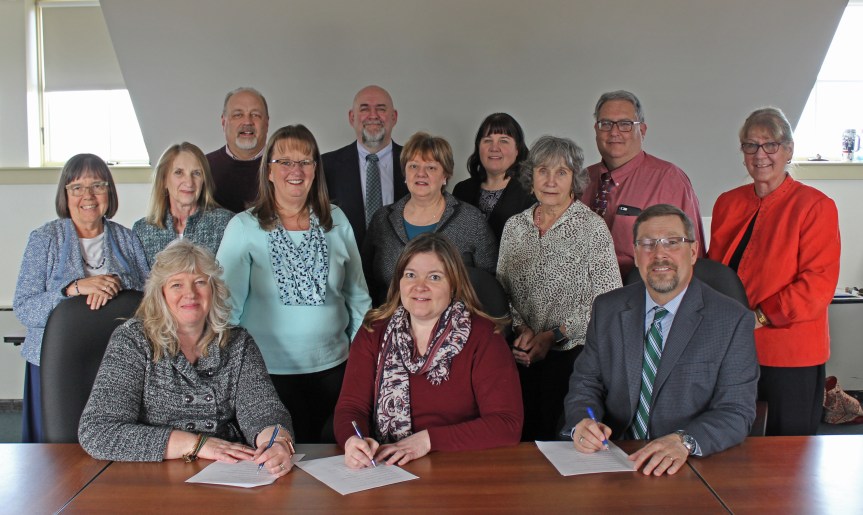
SMCC and Cumberland County Adult Education program directors signed a memorandum of understanding on Wednesday for Adult Education to have office space on the SMCC South Portland Campus to provide adult learners free assistance with reading, writing and math skill development to prepare for college-level courses. Adult Education staff will also provide support and guidance with exploring academic programs, applying to SMCC and navigating the college entry process.

The services, funded through a Maine College and Career Access (MCCA) grant, are available to any student wanting to improve placement test scores or needing assistance with skills development or the college application and financial aid application process.

“By having an office on our South Portland Campus, MCCA is able to provide the guidance and services that adult learners need to enter college,” said Paul Charpentier, SMCC Vice President and Academic Dean. “Once they are in college, SMCC will provide the support they need to succeed academically, achieve their goals and position themselves for bright futures.”

The Maine College and Career Access program is part of Maine Adult Education, a statewide system of local adult education programs. MCCA supports adult learners who are transitioning into college and career training programs by providing access to instruction and advising services to establish a solid foundation for success in furthering their education.

Adult education programs in Cumberland County helped drive the effort to establish an MCCA office at SMCC, said Stephanie Haskins, director of Gray-New Gloucester Adult and Community Education.

“For many years, students have been paying college tuition rates for noncredit classes when they could have accessed them through their local Adult Education,” she said. “This agreement signifies a new era in not only preparing learners for the rigors of college and career training, but doing so on the campus where they will access these programs.”

Pictured:

Front: Shelli Pride of Gorham Adult Education and Westbrook Adult Education; Stephanie Haskins of Gray-New Gloucester Adult & Community Education; and SMCC President Joe Cassidy. Middle: Anita St. Onge of Portland Adult Education; Gail Senese of the Maine Department of Education-Adult Education; Lisa Knedler of Maine Department of Education-Adult Education; Linda Winton of Bonny Eagle Adult Education; Joan Tremberth of Scarborough Adult Learning Center; and Madelyn Litz of Lake Region & Fryeburg Area Adult Education. Back: Tom Nash of Windham-Raymond Adult Education; SMCC Vice President and Academic Dean Paul Charpentier; Kelley Heath of Maine Department of Education-Adult Education; and David Brenner of South Portland Adult Education.

Presque Isle Regional CTE Provides Enhanced Dual Enrollment Pathway to Students

At the Presque Isle Regional Career & Technical Center (PIRCTC) we strive to provide our students with marketable skills which will translate to a career or educational path. Dual enrollment opportunities are a very powerful tool in this regard.

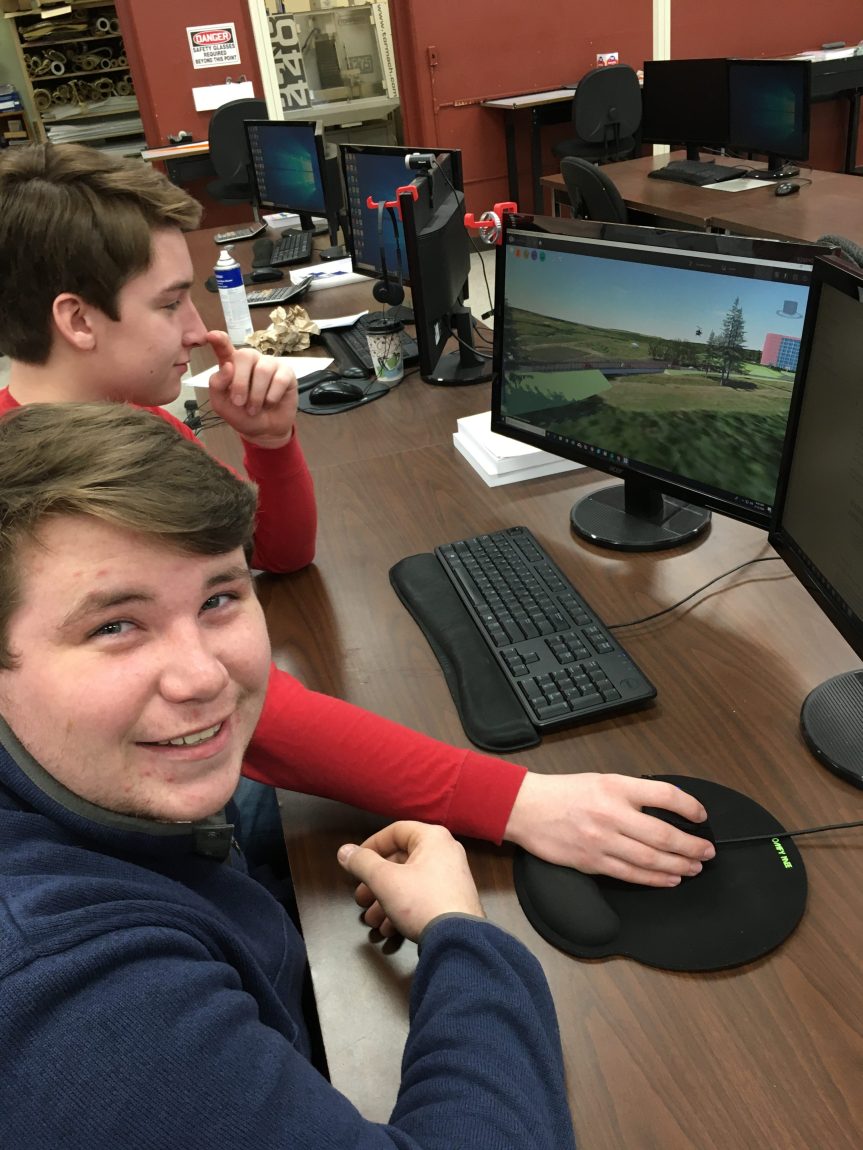
One example is the PIRCTC Drafting & Engineering program. Two unique and highly effective dual enrollment opportunities are available to the Drafting & Engineering Technology students.

As a result of a collaborative effort between The University of Maine College of Engineering, Bridge Year Educational Services, Inc. and the Presque Isle Regional Career & Technical Center (PIRCTC) Students enrolled in the PIRCTC Drafting & Engineering Technology program are able to earn college credit for the Maine College of Engineering course MEE-120 (Engineering Graphics & Computer Aided Design) and CIE-101 (Engineering Graphics for Civil engineers). During the current 2019-2020 school year, 14 students have taken advantage this unique opportunity.

Since 2014, eighteen graduates of the PIRCTC Drafting & Engineering Technology program have been accepted into the Maine College of Engineering, majoring in Mechanical Engineering Technology, Mechanical Engineering, and Chemical Engineering. Additional graduates of the PIRCTC Drafting & Engineering program are pursuing degrees in Marine engineering, Industrial Design, and Precision Machine at various post-secondary institutions.

These opportunities are the first such agreement between the University of Maine, College of Engineering and a high school level program and provide an enhanced pathway for those PIRCTC students desiring to pursue an engineering degree through the Maine College of Engineering.

The PIRCTC Drafting & Engineering Program is a two year program providing area high school students with computer aided design (CAD) and solid modeling skills using state-of-the art software and technology as well as introducing fundamentals of engineering and architecture, education and career paths, additive manufacturing (3D printing), and CNC technology through classroom, lab and applied learning opportunities.

This story was submitted by Timothy R. Prescott, PIRCTC Director and Terry Harper, PIRCTC Drafting & Engineering Technology Instructor in collaboration with Dwight A. Littlefield, Maine DOE Director for Career and Technical Education (CTE) as part of the Maine Schools Sharing Success Campaign and in celebration of CTE this month. To submit stories or ideas email them to Rachel Palling at rachel.paling@maine.gov.

Students Learn What it is Like to be an Educator at Thomas College Teacher Academy

With a steep teacher shortage facing many communities in Maine, Thomas College and the Maine Department of Education teamed up to offer a daylong experimental teaching environment to further engage Maine students who are interested in teaching as a profession.

Students from all over Maine spent the day at Thomas College to learn more about what it’s like to be a teacher. The aspiring educators were able to participate in college level education courses offered by Thomas College professors Richard Biffle, Katie Rybakova, and by Lawrence High School teacher, Eric Brown.

The courses covered lessons in social emotional learning, inclusion, STEAM (Science, Technology, Engineering, Art, Mathematics education, and an overview of lesson planning and implementation – what to expect (or not expect), how to think on your feet, and how make the content relevant to students. The event aimed to give students a better understanding of education as a career path, by providing hands-on experiences that can help solidify their career aspirations, and at the same time give them a taste of post-secondary education.

The unique event drew coverage from WABI and Central Maine among others who were eager to report on a collaborative effort that aims to tackle the workforce shortage of teachers in the state of Maine.


Enrollment up at Maine’s Community Colleges

The Maine Community College System announced last week that preliminary enrollment figures show a 6.3 percent increase in enrolled students this fall compared to the same time last year.

The increase is in sharp contrast to a nationwide trend of declining enrollments at two-year public colleges over the last several years. The strong showing is due in part to a number of new initiatives at the colleges aimed at attracting and retaining more students. The system also did not raise tuition for this academic year, maintaining the lowest tuition and fees in New England.

As of September 23, the system-wide headcount is up 6.3 percent (an additional 966 students) from the same date a year ago. All seven colleges report increases, the largest of which are at Eastern Maine Community College, up 10.4 percent with 2,141 students enrolled compared to 1,939 last year at this time, and at Southern Maine Community College up 8.2 percent, with 6,078 students enrolled compared to 5,618 a year ago.

At the same time, the system is also seeing a surge of participation in its short-term job training programs which are not included in the fall headcount enrollment numbers.

In the last year, the number of trainees who completed short-term training programs funded by the MCCS Maine Quality Centers (MQC) program has almost doubled to 1,602, up from 897 in the previous year. MQC works with Maine employers to provide customized training that is free to trainees and is focused on strengthening the skills of the Maine workforce.

“We’re seeing significant growth both in our programs that lead to one-year certificates and two-year degrees and in short-term training,” MCCS President David Daigler told the system’s Board of Trustees at a meeting Wednesday in Bangor. “Demand from both employers and individuals looking to gain the skills needed to compete in this new economy is exploding and stretching our ability to respond.”

The high demand for both degree programs and short-term training at Maine’s community colleges is particularly noteworthy given the state’s record low unemployment, aging demographics and widespread workforce shortages. Community college enrollment has historically been tied to the economy, going up during periods of high unemployment and declining when jobs are plentiful.

Fall enrollment increases have been driven in part by initiatives at campuses across the state. Among the new efforts are: doubling the number of visits to some high schools, replacing group orientations with one-on-one orientation sessions; reaching prospective students through texting instead of email; adding new high-demand programs including plumbing, HVAC and esports; and giving students new online tools to communicate with others to increase peer-to-peer connections.

Enrollment numbers for fall 2019 will be finalized in mid-October.

See the full release with graphics on the MCCS website.

Future Teachers Academy: Free Event for High School Students Interested in Exploring the Field of Education

Future Teachers Academy, an event for students who are interested in exploring the field of education, is being hosted by Thomas College and will be held on November 8th from 8:30 am to 1:30 pm on their campus at 180 West River Road in Waterville.

During the event students will be able to participate in a daylong, hands-on and experimental teaching environment, led by professional faculty from the Thomas College School of Education, as well as partners from the Maine Department of Education and Maine Teachers of the Year.

Future Teachers Academy

When: November 8, 2019, 8:00 am – 1:30 pm
Where:
Thomas College
Who:
Open to Maine high school sophomores, juniors, and seniors

Register here

For further information please call (207) 859-1111.


Meet the First Cohort of Maine’s Leadership Development Program 

The Maine Department of Education (DOE) recently launched a new leadership program called Maine’s Leadership Development Program (Maine LDP). The initiative aims to build and strengthen instructional leadership skills among Maine’s educational leaders at schools, districts, and across the state.  

A group of 18 education leaders in Maine, including superintendents, assistant superintendents, curriculum and instructional leaders, regional education leaders, Maine DOE staff, and other school and district level staff are among the first cohort of candidates on track to become certified trainers and facilitators of future cohorts. The names, pictures, and biographies of the group of Fellows in the 1st cohort of the Maine LPD can be found here. 

The Maine LDP is a partnership among the Maine DOE and its successful Transformation Leaders’ Network, along with the National Institute for School Leaders (NISL) and their nationally recognized Executive Development Program (EDP). NISL experts are delivering the Maine LDP curriculum and will provide additional training for Maine LDP facilitators. The cohort has already begun its trainings with a session about strategic thinking within systems, and high quality aligned instructional systems in classrooms, schools, and at the state level. The program is a full year commitment. 

LDP Fellow Al Pfeiffer, Superintendent of Vassalboro School Department, had this to say about the training so far, “ Some of the richest, most robust and rewarding professional learning that I have experienced in recent memory. Powerful readings, case studies reinforced with video snapshots, and engaging conversations have left me eager for the next session and future sessions over the coming year.” 

Paul Knowles, an educational leadership lecturer at the University of Maine and the UMaine Liaison to the Maine DOE for this initiative added that, “The University of Maine and the Educational Leadership Department are pleased to partner with the Department of Education for this important work. Personally, I am impressed with the caliber, diversity, passion, and commitment of the leaders participating in Maine’s Leadership Development Program.” 

Maine’s LDP is delivered through a blended learning model and includes study, inquiry, and hands-on activities with practical applications that meet the rigorous expectations for today’s educational leaders. Some graduates from this cohort will deliver the Maine LDP curriculum to future cohorts regionally.  The Department will be releasing an application for those interested in applying to be in the 2nd cohort of the LDP in March of 2020.

Maine High School Students Can Still Apply for Early College Courses 

The University of Maine System released the following message yesterday regarding applications for early college courses:

Maine students and their families still have one week to explore and apply for Early College courses at all of Maine’s Public Universities using the ExploreEC Portal.  The portal is new for the fall semester and classes start September 3rd.  UMaine President Joan Ferrini-Mundy welcomed students and their families to Orono today for an Early College Orientation and urged everyone to share the news that students throughout the state still have to apply now for fall Early College courses.

Apply Now with New ExploreEC Portal:  The University of Maine System launched the ExploreEC portal to allow high school students to explore and apply for Early College courses at all seven campuses with one streamlined application.  Students from 120 Maine high schools and homeschooled students have already used the ExploreEC portal to register for classes this fall and over 300 school counselors have received training and access to support students with the online application process.  Students still have a week to explore and apply at: ExploreEC.maine.edu

Earn $3,000 in Free College Credits with Early College Career Exploration Certificates:  High school students can now explore and begin preparing for careers with immediate opportunities in the Maine workforce.  The Early College Career Exploration Certificates guide high school students as they learn about majors and career options.  Upon completion, students earn a designation on their university transcript. The college credits they earn can save their families approximately $3,000 in tuition costs.  Visit  https://academics.maine.edu/early-college/pathways/ to learn more about the Early College Career Exploration Certificates being offered.

Read the entire media release from the University of Maine System here or visit: http://www.maine.edu/thousands-heading-back-school-early-college/