Blending Indigenous Knowledge and Modern Science: Maine DOE Releases “Maple Bytes” Interdisciplinary Instructional Program

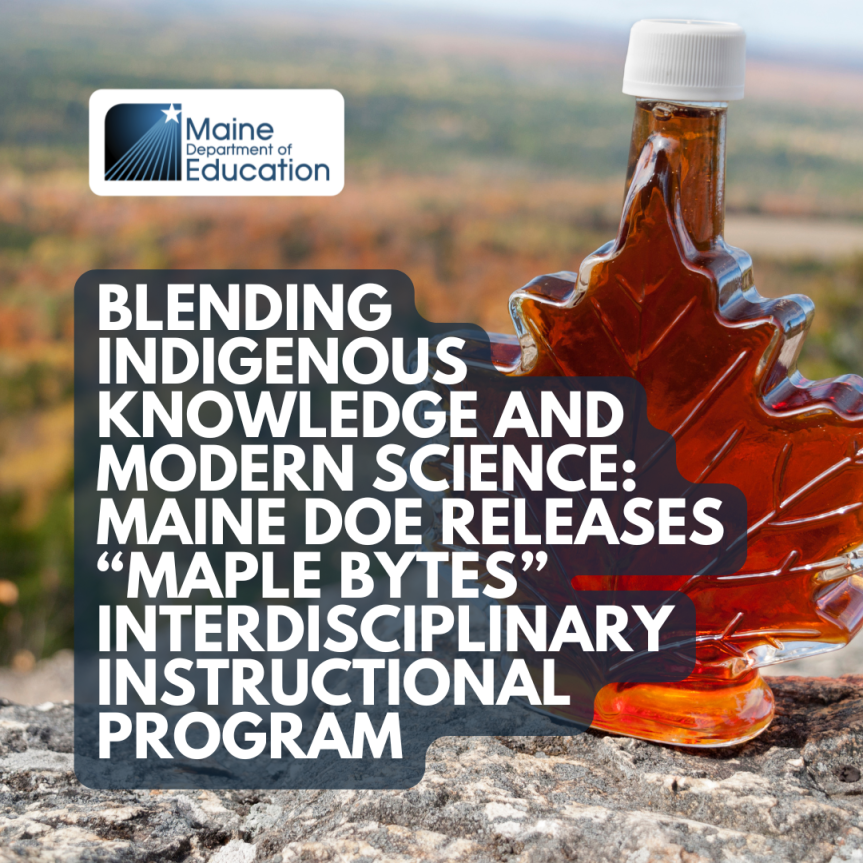
The Maine Department of Education (DOE) Office of Teaching and Learning has released a new, innovative interdisciplinary instructional program called “Maple Bytes,” which provides Maine educators with the opportunity to engage students in a unique, hands-on learning experience that blends computer science, Wabanaki studies, and earth sciences.

Developed by Maine DOE Computer Science Specialist Allison Braley, Interdisciplinary Instruction Specialist Erik Wade, and Wabanaki Studies Specialist Brianne Lolar, Maple Bytes invites students to explore the rich cultural, historical, and environmental story of maple syrup. Through this instructional program, students learn about the traditional significance of maple syrup to the Wabanaki people; examine historical methods of sap collection and processing; and apply modern computer science tools to gather and analyze Earth science data related to tree health, environmental conditions, and sap yields.

The learning experience culminates with students tapping maple trees and producing their own maple syrup, connecting classroom learning to real-world practice and deepening understanding of both Indigenous knowledge systems and scientific inquiry.

Maple Bytes offers an exciting way to integrate cultural heritage, environmental science, and computational thinking,” Braley explained. “Students don’t just learn about these subjects; they experience them, collect real data, and see the results of their efforts in a meaningful, hands-on project.”

Maple Bytes reflects the true spirit of interdisciplinary learning in Maine, offering students an authentic, community-rooted experience that weaves together tradition, science, and technology.

Educators interested in using Maple Bytes in their classroom can access it through the Maine DOE Learning Through Technology webpage: Technology & Learning: Maple Bytes.

For more information or with questions about Maple Bytes, please contact Allison Braley at allison.braley@maine.gov.

2026 For ME Instructional Programs Overview and Summer Training Opportunities; Informational Overview Rescheduled for February 9

The informational overview of the For ME programs, initially scheduled for January 26, has been rescheduled for Monday, February 9, from 3-4:30 p.m.

Since 2018, the Maine Department of Education (DOE) has adapted and piloted the For ME Instructional Programs for early elementary grades (pre-K to grade 2), based on the Boston Public Schools’ evidence-based Focus Curricula. These open-source, developmentally appropriate instructional programs are interdisciplinary and align with Maine’s learning standards.

While Maine schools are responsible for purchasing the materials needed to support the implementation of the For ME programs, lesson plans and other instructional resources are available at no cost through the Maine DOE website. The Maine DOE also provides initial professional learning to support effective use of the programs.

Informational Overview

An informational overview of the For ME programs will be held on Monday, February 9, from 3-4:30 p.m. This session will provide an introduction to the program structure and review the materials required for implementation. It will be recorded and posted for those unable to attend live.

Educators and school leaders who are unfamiliar with the For ME programs are strongly encouraged to attend the live overview or view the recording. Please join using this Zoom link. (There is no need to register in advance.)  

Summer Training

Educators, schools, and early learning programs interested in implementing the For ME programs during the 2026-2027 school year at any grade level from pre-K through grade 2 are encouraged to participate in the initial implementation trainings offered during the summer of 2026.

These trainings are designed to deepen understanding of program design and support successful implementation. School administrators are strongly encouraged to attend alongside their pre-K, kindergarten, first- and/or second-grade teachers. Special educators, education technicians, instructional coaches, and curriculum leaders who work with pre-K through grade 2 educators are also encouraged to participate.

There is no cost to attend these summer trainings.

Training Format and Schedule

All trainings will be held in person, from approximately 8:30 a.m. to 3:30 p.m.:

  • The Pre-K for ME training is a two-day training.
  • The K for ME, 1st Grade for ME, and 2nd Grade for ME trainings are three-day trainings with one day in June and two days in July.

Participants should plan to attend all required days for their respective grade-level training.

Training Dates (Locations TBD)

  • Pre-K for ME Initial Training:

Week of July 27-31, 2026 (exact dates and location[s] TBD)

  • K for ME Initial Training:

June 24 and July 27-28, 2026

Augusta/Waterville area (exact location TBD)

  • 1st Grade for ME Initial Training

June 24 and July 29-30, 2026

Augusta/Waterville area (exact location TBD)

  • 2nd Grade for ME Initial Training

June 24 and July 29-30, 2026

Augusta/Waterville area (exact location TBD)

Registration Information

Schools interested in registering educators for these trainings should have a principal or instructional leader complete the training registration on behalf of all participants by May 11, 2026. The registration form allows schools to enroll educators in the Pre-K, Kindergarten, 1st Grade, and/or 2nd Grade For ME trainings. After registration closes, all participants will receive confirmation of participation, along with training locations and preparation details.

For additional information regarding:

State Activities funds received from the U.S. Department of Education (ED) support the implementation of this project. The project has an award totaling $50,000 of which 50% is federally funded and directly attributed to project implementation. The contents are those of the author(s) and do not necessarily represent the official views of, nor an endorsement by, ED or the U.S. government.

Maine DOE Offers Variety of Literacy Learning Opportunities Aligned to Maine’s Statewide Action Plans

The Maine Department of Education (DOE) Office of Teaching and Learning invites educators from across the state to engage in literacy learning opportunities that are thoughtfully aligned to Maine’s statewide Action Plans.

The quieter winter season often offers a natural moment for reflection and growth. These literacy professional learning opportunities are designed to be supportive, practical, and inspiring—an invitation for educators to use the winter months to strengthen their practice, build shared understanding, and invest in the essential work of literacy.

Together, the below offerings form a menu of literacy learning opportunities available throughout the winter and spring of 2026. Educators are encouraged to engage in the experiences that best meet their interests, roles, and local contexts, whether that means participating in a cohort, attending a single workshop, joining virtual support hours, exploring modular professional learning, or taking part in statewide literacy initiatives.

Winter/Spring 2026 Literacy Professional Learning Opportunities:

Maine Solutionaries Project Literacy Cohort

This professional learning opportunity equips middle and high school teachers with training in four high-impact, interdisciplinary literacy practices that foster lifelong literacy and support successful Solutionary Inquiry-to-Action projects. Through engagement with complex texts, text-based discussion and writing, word study, and collaborative performance tasks, this cohort strengthens students’ reading, writing, speaking, listening, and language skills across content areas.

  • Audience: Grades 4-12 educators
  • Format:
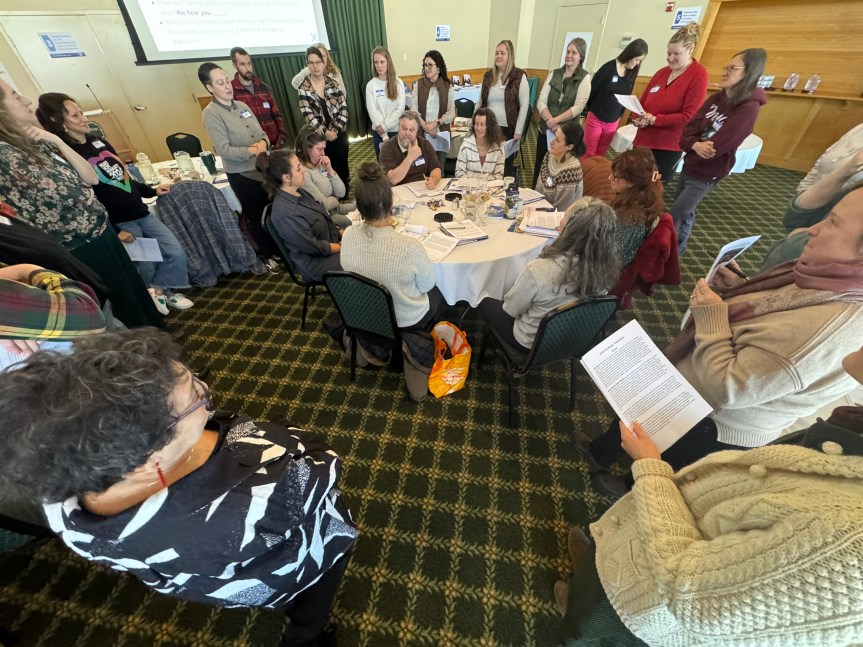
    • In-person kickoff session on January 27, 2026, from 8:30-3:30 p.m. at Maple Hill Farm in Hallowell
    • Weekly virtual learning sessions on Tuesdays from 4-5:30 p.m. from February 3 through March 31 (four weeks focused on Solutionary Learning and four weeks focused on literacy integration)

Participants may earn up to 45 contact hours. Educators are encouraged to attend these sessions in pairs. Please use this link to register.

Spring Integrated Literacy Workshops

Please use this link to register for any of the following integrated literacy workshops:

Integrating Literacy with Mapmaking: Renee Keul will explore the connection between literacy and mapmaking by engaging educators in analyzing and creating maps. This workshop models how spatial reasoning, data visualization, and critical thinking support reading, writing, and communication across content areas, reinforcing literacy as a shared responsibility. This workshop strengthens foundational literacy skills such as decoding symbols, building vocabulary, sequencing ideas, and making meaning across texts through hands-on, interdisciplinary learning.

  • Audience: Pk-12 Educators
  • Date: March 6, 2026, from 9 a.m.-4 p.m.
  • Location: Osher Map Library in Portland (or virtually via Zoom)
  • Contact Hours: seven hours available

Integrating Literacy with Objects and Writing: Deb Johnson and Ronni Blaisdell will share strategies for using real-world artifacts and natural materials to support foundational reading and writing skills. By modeling object-based learning grounded in authentic texts and materials, this workshop demonstrates how interdisciplinary, hands-on instruction strengthens literacy development across grade levels and content areas. This workshop builds vocabulary, comprehension, and writing stamina through close observation and inquiry.

  • Audience: pre-K-12 educators
  • Date: April 10, 2026, from 9 a.m.-4 p.m.
  • Location: Maine Mineral and Gem Museum in Bethel (or virtually via Zoom)
  • Contact Hours: seven hours available    

Reaching Reluctant Readers: Cris Tovani will explore why students disengage from reading and how educators can remove barriers to learning. Grounded in research-based strategies for knowledge building and comprehension, the session equips educators with practical tools to support confident, independent readers across content areas. This workshop addresses engagement, motivation, and access as essential components of effective literacy instruction, particularly for students who are reluctant or struggling readers.

  • Audience: pre-K-12 educators
  • Date: May 15, 2026, from 9 a.m.-4 p.m.
  • Location: Camp Chamberlain in Augusta (or virtually via Zoom)
  • Contact Hours: seven hours available          

Virtual Support Hours: Virtual support will be available on Thursdays following each workshop. These sessions are open to all educators, regardless of whether they attended the corresponding workshops, and are designed to support the application of learning through collaboration, reflection, and shared problem-solving.

  • Graphic Novels for Literacy (workshop already occurred)
    January 8 through February 19, 2026, from 3:30-4:30 p.m. – Zoom registration link

    This is an open, collaborative space to explore how graphic novels support comprehension, vocabulary development, and visual literacy across grade levels and content areas. Participants are encouraged to bring questions, classroom experiences, and ideas aligned with the statewide Action Plans’ interdisciplinary vision.   
  • Integrating Literacy with Mapmaking
    February 26 through April 9, 2026, from 3:30-4:30 p.m. – Zoom registration link
    This is an informal space to explore how map analysis and creation can strengthen vocabulary, comprehension, and meaning making across content areas, reinforcing literacy as a shared responsibility. 
  • Integrating Literacy with Objects and Writing
    April 16 through May 7, 2026, from 3:30-4:30 p.m. –Zoom registration link
    This is a supportive forum to reflect on and apply hands-on strategies that build engagement, motivation, and access to literacy through object-based learning and writing.
  • Reaching Reluctant Readers
    May 14 through June 4, 2026, from 3:30-4:30 p.m. – Zoom registration link
    This is an open forum to extend learning from Cris Tovani’s strategies for engagement and comprehension. Educators can share challenges and explore ways to remove barriers to reading and support confident, independent literacy development.

Additional Literacy Learning Opportunities

  • Literacy Modules for Professional Learning: School administrative units (SAUs) may purchase licenses for AIM Steps to Literacy modules or Keys to Literacy modules at reduced costs and then seek reimbursement once educators have successfully completed the modules. Find additional details here.
  • For ME Instructional Programs: An informational session will be held on January 26, 2026, from 3:30-4:30 p.m. for schools interested in adopting the For ME Instructional Programs (Pre-K for ME, K for ME, 1st Grade for ME, and/or 2nd Grade for ME). These programs are grounded in evidence-based literacy practices, are interdisciplinary and play-based, and are aligned with Maine’s learning standards. Additional details and the Zoom link will be shared in January 2026.
  • Read to ME Challenge 2026: Get ready for this year’s Read to ME Challenge, running throughout the month of February! Details will be shared in January 2026. 

For more information about these professional learning opportunities, please contact Maine DOE Interdisciplinary Instruction Team Coordinator Kathy Bertini at Kathy.Bertini@maine.gov.

Titles II-A and IV-A funds received from the U.S. Department of Education (ED) support the implementation of these projects. These projects have an award totaling $99,569.00 of which 38% is federally funded and directly attributed to project implementation. The contents are those of the author(s) and do not necessarily represent the official views of, nor an endorsement by, ED or the U.S. government.
Maine DOE Offers Variety of Numeracy Learning Opportunities Aligned to Maine’s Statewide Action Plans

The Maine Department of Education (DOE) Office of Teaching and Learning invites educators from across the state to engage in numeracy learning opportunities that are thoughtfully aligned to Maine’s statewide Action Plans.

The quieter winter season often offers a natural moment for reflection and growth. These numeracy professional learning opportunities are designed to be supportive, practical, and inspiring—an invitation for educators to use the winter months to strengthen their practice, build shared understanding, and invest in the essential work of numeracy.

Together, the below offerings form a menu of numeracy learning opportunities available throughout the winter and spring of 2026. Educators are encouraged to engage in the experiences that best meet their interests, roles, and local contexts, whether that means joining a professional learning community, participating in a book-based conversation series, applying as a school or school administrative unit (SAU) team, or engaging in interdisciplinary and STEAM (Science, Technology, Engineering, Arts, and Mathematics)-focused learning.

Winter/Spring 2026 Numeracy Professional Learning Opportunities:

Maine’s Statewide Mathematics Specialist Professional Learning Community

The Numeracy and Leadership Initiative, hosted by the Association of Teachers of Mathematics in Maine (ATOMIM), in collaboration with the Maine DOE, University of Southern Maine, and University of Maine at Farmington, offers multiple opportunities for educators to build capacity in both numeracy and leadership. One of these is Maine’s Statewide Mathematics Specialist Professional Learning Community (PLC).

  • Audience: Math coaches, lead teachers, interventionists, and department chairs
  • Dates: Participants may choose to attend all sessions or select those that best meet their needs. The Mathematics Specialist PLC will meet on the following dates:
    • January 28, 2026, from 3:30-4:45 p.m. (virtually via Zoom)
    • February 25, 2026, from 6:30-7:30 p.m. (virtually via Zoom)
    • March 23, 2026, from 1-5 p.m. (in-person at the University of Maine at Augusta—limited to 50 participants)
    • April 30, 2026, from 2-5 p.m. (in-person at the University of Southern Maine in Lewiston/Auburn)
    • May 21, 2026, from 6:30-7:30 p.m. (virtually via Zoom)

Please use this link to register.

Math Trauma to Math Triumph: Math Therapy Conversations and Supports

Educators are invited to participate in informal, supportive conversations centered on Math Therapy by Vanessa Vakharia. Participants will discuss the book and explore the implementation of the 5 “Ms” (Mythbust, Moderate, Motivate, Makeover, and Measure) in their classrooms. This series continues learning from the December 5, 2025, in-person event with Vakharia.

  • Audience: pre-K-12 educators
  • Dates: Participants may choose to attend one or multiple sessions. One-hour virtual meetings will take place on the following Wednesdays:
    • January 14, 21, and 28, 2026
    • February 4, 11, and 25, 2026
  • Time: 6:30-7:30 p.m.

To participate fully in this opportunity, educators should have attended the in-person workshop and have read—or be in the process of reading— Math Therapy. Please use this link to register.

2026 ATOMIM Spring Conference – Developing Mathematical Reasoning for ALL: Ensuring Everyone Is Counted In!

Join math educators for a full day of learning at the Association of Teachers of Mathematics in Maine (ATOMIM) Spring Conference. The conference will feature keynote speaker Vanessa Vakharia, “The Math Guru,” and a range of engaging sessions aligned to the strands of mathematical reasoning, math leadership, and differentiation, equity, and inclusion.

  • Audience: pre-K-12 educators
  • Date: March 24, 2026
  • Location: Augusta Civic Center (in-person)

Contact hours will be made available to attendees. Please use this link to register.

Unlocking Numeracy

School and SAU teams serving grades 3-5 are invited to apply for a series of five virtual workshops hosted by Dan Finkel, founder of Math for Love, in collaboration with the Maine DOE. This opportunity supports schoolwide efforts to unlock students’ numeracy potential.

  • Audience: Partner pairs or numeracy teams consisting of the principal, two math teachers, and one or two community numeracy/math liaisons.  A community liaison is someone from the school community—such as a teacher, staff member, or PTA/PTO member—who helps connect numeracy learning at school with numeracy in the home and the wider community.
  • Dates:
    • February 3, 2026, from 3:30 to 5:30 p.m. – Foundation of Numeracy
    • March 3, 2026, from 3:30 to 5:30 p.m. – Classroom Openers for Numeracy
    • April 7, 2026, from 3:30 to 5:30 p.m. – Building Numeracy with Games
    • May 5, 2026, from 3:30 to 5:30 p.m. – Communicating Numeracy to Families and Teachers
    • May 26, 2026, from 3:30 to 5:30 p.m. – Rich Tasks and Purposeful Fluency

Each team will receive a numeracy toolkit, exemplar lessons, and supplies to support a family math night. Participants may earn up to 15 contact hours.

Please use this link to register. Applications are due January 30, 2026.

Deepening Early Numeracy Through Rich Math Talk, Purposeful Games, and Outdoor Place-Based Learning

Teams of pre-K-2 educators will participate in a comprehensive early numeracy initiative hosted by the Maine Math and Science Alliance (MMSA) in collaboration with the Maine DOE. This initiative integrates research-based professional learning, instructional coaching, play- and nature-based approaches, and family engagement to support joyful, meaningful, and developmentally responsive mathematics learning.

  • Audience: pre-K-2 educators
  • Dates: In-person workshops will be taking place on the following dates. (Cohorts are determined by closest location.)
    • Cohort 1 – Portland area: February 9, March 9, and April 6, 2026
    • Cohort 2 – Bangor area: February 6, March 2, and April 3, 2026
    • Cohort 3 – Machias area: February 27, March 27, and April 13, 2026

Virtual coaching sessions will be available to support implementation. Participants may earn 20 contact hours, as well as a $250 honorarium.

Pairs of educators from the same school must apply together through a single joint application, which is due January 16, 2026. Please use this link to register.

STEAM PowerED Maine Professional Learning Cohort

Maine educators are invited to join a four-month STEAM professional learning cohort designed to support interdisciplinary teaching and learning across content areas. In partnership with Creative Generation and the Maine DOE, this cohort will focus on creativity, numeracy, instructional design, technology, and student-centered learning.

  • Audience: pre-K-12 educators
  • Format:
    • In-person kickoff on February 2, 2026, in Augusta
    • Virtual workshops to follow (in February, March, April, and May) 
    • Asynchronous learning in EnGiNE, the Maine DOE’s learning management system

Participants may earn 26 contact hours or a $500 stipend. Mileage reimbursement is available to all participants, and lodging is available upon request for anyone traveling more than 50 miles from Augusta. 

Please use this link to register. Registration closes on January 26, 2026.

For more information about any of these professional learning opportunities, please contact Maine DOE Interdisciplinary Instruction Team Coordinator Kathy Bertini at Kathy.Bertini@maine.gov.

Titles II-A and IV-A funds received from the U.S. Department of Education (ED) support the implementation of these projects. These projects have an award totaling $213,8333.62 of which 77% is federally funded and directly attributed to project implementation. The contents are those of the author(s) and do not necessarily represent the official views of, nor an endorsement by, ED or the U.S. government.
Maine DOE to Host Fourth Annual Computer Science Education Showcase During Education Symposium in December

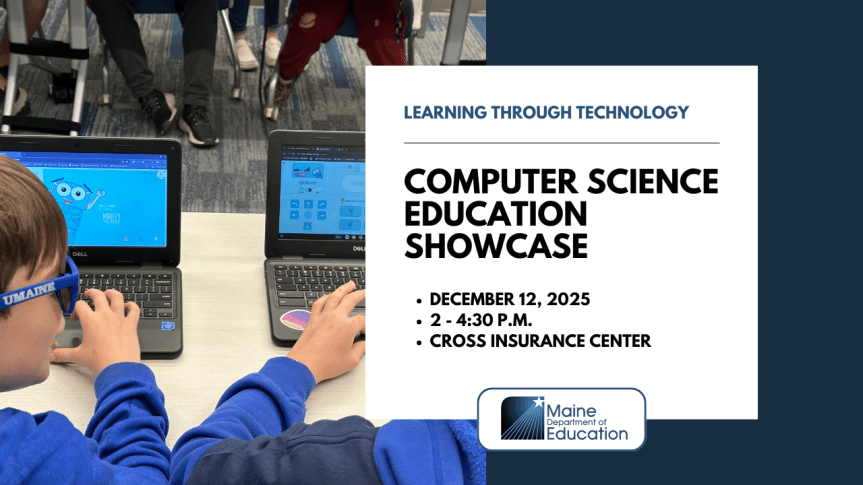
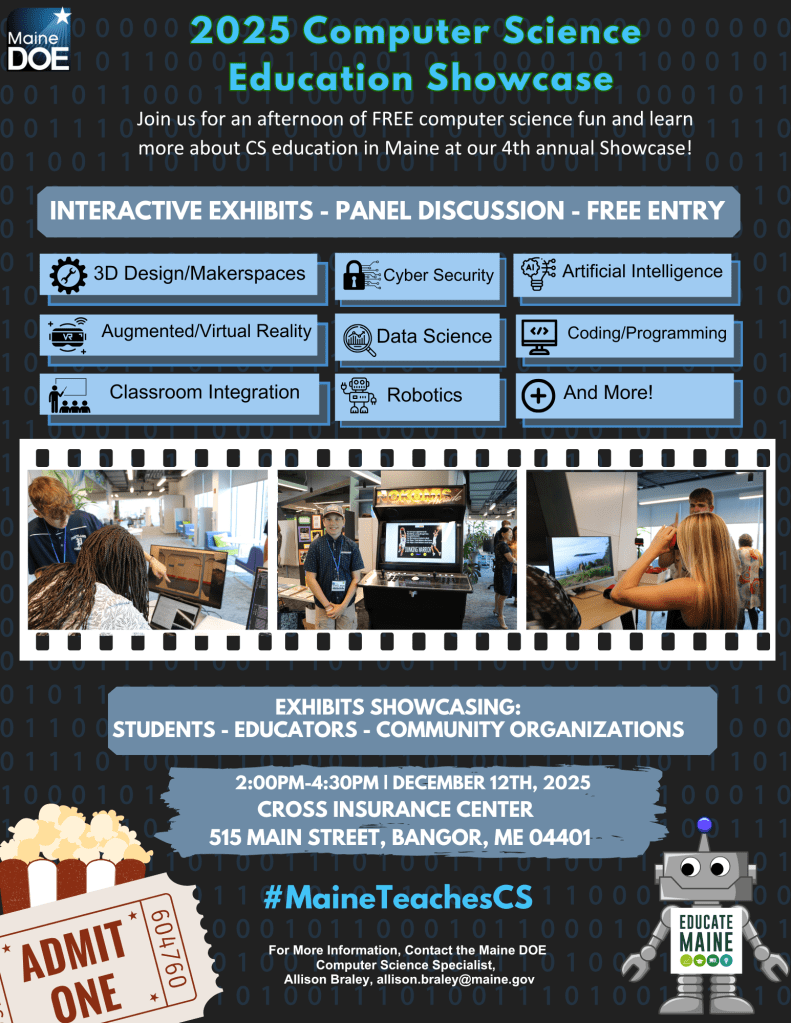
Join educators and students from across Maine for an afternoon of computer science fun at the Maine Department of Education’s (DOE) fourth annual Computer Science Education Showcase on December 12 at the Cross Insurance Center in Bangor. This event is hosted by the Maine DOE, in partnership with Educate Maine, as part of the 2025 Educate Maine Annual Education Symposium.

The 2025 Computer Science Education Showcase will celebrate the educators, students, community organizations, and partners who are expanding access to and participation in computer science across the state.

Whether you’re new to computer science, curious about how it’s taught, or looking to connect with others who share your interest in technology learning—this event is for you! Experience hands-on demonstrations, student projects, and inspiring stories from classrooms and communities around Maine.

Date: Friday, December 12, 2025
Time: 2-4:30 p.m.
Location: Cross Insurance Center (515 Main Street, Bangor, ME 04401)
Registration: This event is free! Click here to register for the 2025 Computer Science Education Showcase.

For a preview of what to expect, check out this article about the second annual Computer Science Education Showcase, which featured students and educators from 40 school administrative units (SAUs) who presented a variety of computer science education projects, including robotics, artificial intelligence (AI), 3D design, coding, augmented reality/virtual reality (AR/VR), data science, cybersecurity, and more.

For more information, please contact Maine DOE Computer Science Specialist Allison Braley at allison.braley@maine.gov.

Professional Learning Workshop: Integrating Literacy through Graphic Novels with Marek Bennett

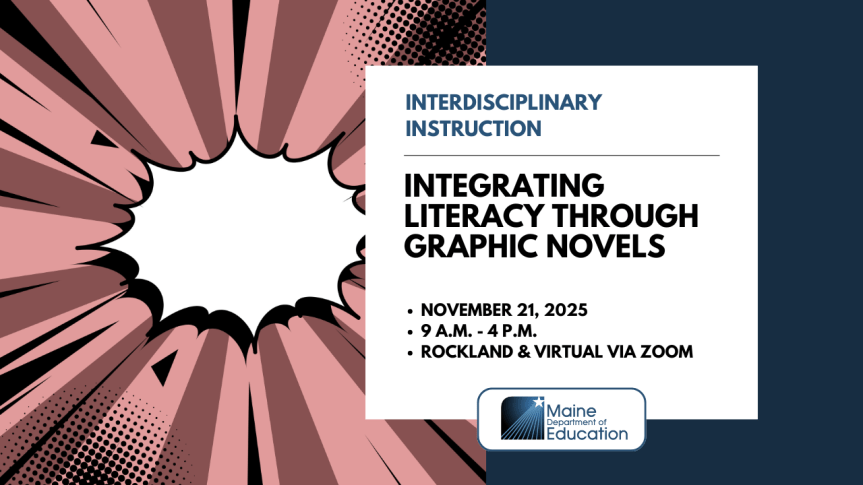
The Maine Department of Education (DOE) Office of Teaching and Learning is excited to kick off the return of the Integrating Literacy series with a full-day deep dive into graphic novels as powerful tools for literacy growth.

From fantasy and humor to history and science, graphic novels are among students’ favorite reads. They’re more than entertainment, though; research shows that the format can strengthen vocabulary, comprehension, and visual literacy.

Join educator and graphic novel author Marek Bennett for an inspiring, hands-on workshop. We’ll explore exemplary texts, unpack the science behind their impact on readers, and create our own graphics.

Educators will leave with:

  • A clear understanding of the research supporting graphic novels for literacy development across grade levels and disciplines.
  • Practical ideas to build a schoolwide culture of reading through graphic storytelling.
  • Concrete strategies to engage students in creating and publishing their own work.

When: Friday, November 21, 2025, from 9 a.m. to 4 p.m.

Where: The Steel House in Rockland (639 Main Street, Rockland, ME 04841)

This free workshop is happening in-person and will be streamed via Zoom for those unable to travel. Bring a lunch or order locally—there are plenty of spots to picnic and connect with fellow educators!

Space is limited! Register today.

This event marks the first in a four-part literacy workshop series offered by the Maine DOE. Other workshops in the Integrating Literacy series include:

  • “Mapmaking: Coding and Decoding” with Osher Map Library on Friday, March 6, 2026, from 9 a.m.-4 p.m. in Portland
  • “Objects (Rocks, Minerals and Gems – Oh My!) and Writing Process” with the Maine Mineral and Gem Museum and Ronni Blaisdell on Friday, April 10, 2026, from 9 a.m.-4 p.m. in Bethel
  • “Engaging Reluctant Readers” with Cris Tovani on Friday, May 15, 2026, from 9 a.m.-4 p.m. in Augusta

To register for any of these workshops, use this registration form.

With questions, please contact Maine DOE Interdisciplinary Instruction Specialist Heather Martin at Heather.Martin@maine.gov.

Asynchronous Professional Learning Opportunity: Exploring the Question Formulation Technique (QFT)

Starting October 21, 2025, the Maine Department of Education (DOE) Office of Teaching and Learning invites educators to explore the Question Formulation Technique (QFT), developed by the Right Question Institute.

In education, answers matter, but the ability to ask the right questions builds critical thinking and fosters deep learning. The QFT is a practical and structured method for generating, refining, and using questions to drive learning.

This free professional learning opportunity will be available through EnGiNE, the Maine DOE’s online learning platform. Participants will progress through two online modules per week for approximately four weeks, engaging with readings, asynchronous videos, and discussion prompts. The experience concludes with the design of a lesson using the QFT.

Educators who wish to delve further into the QFT can join an optional virtual learning community, with support available on Tuesdays and Thursdays from 3:30 to 4:30 p.m. These sessions provide opportunities to practice the QFT collaboratively, share ideas, and apply it in authentic contexts.

Please complete this form to register for the QFT EnGiNE course. Registration will close on October 20, 2025. Following registration, an email with instructions on how to set up an EnGiNE account will be sent to the email address submitted in the registration.

Together, we will connect the QFT with object-based learning and deep conceptual thinking, equipping educators with powerful strategies to spark curiosity and inquiry in their classrooms. Course participants can earn up to 12 contact hours.

For more information, please contact Maine DOE Interdisciplinary Instruction Specialist Heather Martin at Heather.Martin@maine.gov.

Maine Schools Strengthen Global Connections in the Fall of 2025

As a new season of learning unfolds, Maine classrooms are building on the strength of global connections. Through community celebrations, exchanges, and new language resources, students and educators are experiencing how language and culture are assets for learning.

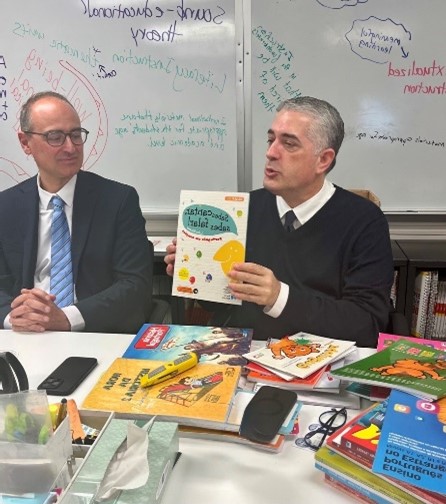
In Lewiston, Portuguese cultural brokers and educators are partnering with the Maine Department of Education (DOE) and Portugal’s education leaders to bring free, high-quality resources into classrooms—work extending from Maine’s international agreement with Portugal. Teachers are accessing digital materials from Porto Editora that support Portuguese as a foreign, second, and heritage language. Additionally, local feedback has provided a reminder that implementation support matters: Since few classrooms in Maine have Portuguese-speaking teachers, educators may need guidance about how to use these materials effectively. The Maine DOE continues to coordinate practical “how-to” supports and warm introductions, so resources are usable in everyday instruction.

Maine educators are also connecting through events that celebrate language and culture. The Taipei Economic and Cultural Office in Boston hosts Taiwan’s 114th National Day Celebration on October 3. A week later, teachers will gather at Husson University for the Maine Chinese Language Conference, an annual convening organized with the Bangor Chinese School/Chinese Language and Culture Center of Maine (CLCCM) that offers professional learning and continuing education units (CEUs).

Maine students continue to benefit from opportunities in German. At Cony High School—one of only 14 U.S. schools in PASCH (Schools: Partners for the Future), a global initiative of the German Federal Foreign Office via the Goethe-Institut—two students head to Estes Park, Colorado for an immersion weekend and competition with peers from across the Americas. Each summer, two Cony students also receive full scholarships for a three-week course in Germany, and this November, Goethe-Institut representatives will visit campus to share additional pathways, including study abroad.

deb backman

“As a PASCH school, Cony has access to unique global connections, cutting-edge teaching resources, and annual teacher training that elevate German instruction,” Deb Backman, German teacher at Cony Middle and High School in Augusta, and 2025 Kennebec County Teacher of the Year, said. “Students build real language fluency and cross-cultural understanding, with many chances to use their skills inside and outside the classroom.”

Maine’s collaboration with the Académie de Nantes (France) supports classroom-to-classroom exchanges and educator partnerships that give students real audiences for their language skills. Those supports exist today but are underutilized; the Académie is actively seeking conversations with Maine educators about how to increase participation and make these opportunities easier to access.

“The supports are in place, and we want to hear directly from Maine educators about what would make participation easier and more impactful for their students,” Maine DOE Director of Strategic Partnerships Ayesha Hall said. “Districts can connect with partner contacts on the Global Partners Network webpage, and I’m glad to make a warm introduction, when helpful.”

Together, these stories show that Maine schools are not just teaching languages; they are building bridges. By investing in multilingual pathways and international partnerships—and by listening to local feedback that improves access and use—schools across the state foster the curiosity, respect, and collaboration skills students need to thrive in a connected world.

A next step for educators and administrators: On October 20, 2025, from 3:30 to 4:30 p.m., the Maine DOE hosts the next session of the Multilingual/Multicultural Connections Webinar Series—a virtual session for educators and district leaders who want practical ways to translate international partnerships into classroom learning and schoolwide engagement. Please register here, if you are interested in attending.

For more information, please contact Ayesha Hall, Maine DOE Director of Strategic Partnerships, at Ayesha.Hall@maine.gov. Additionally, if this work is of interest to you, consider visiting the Maine DOE Global Partners Network webpage.

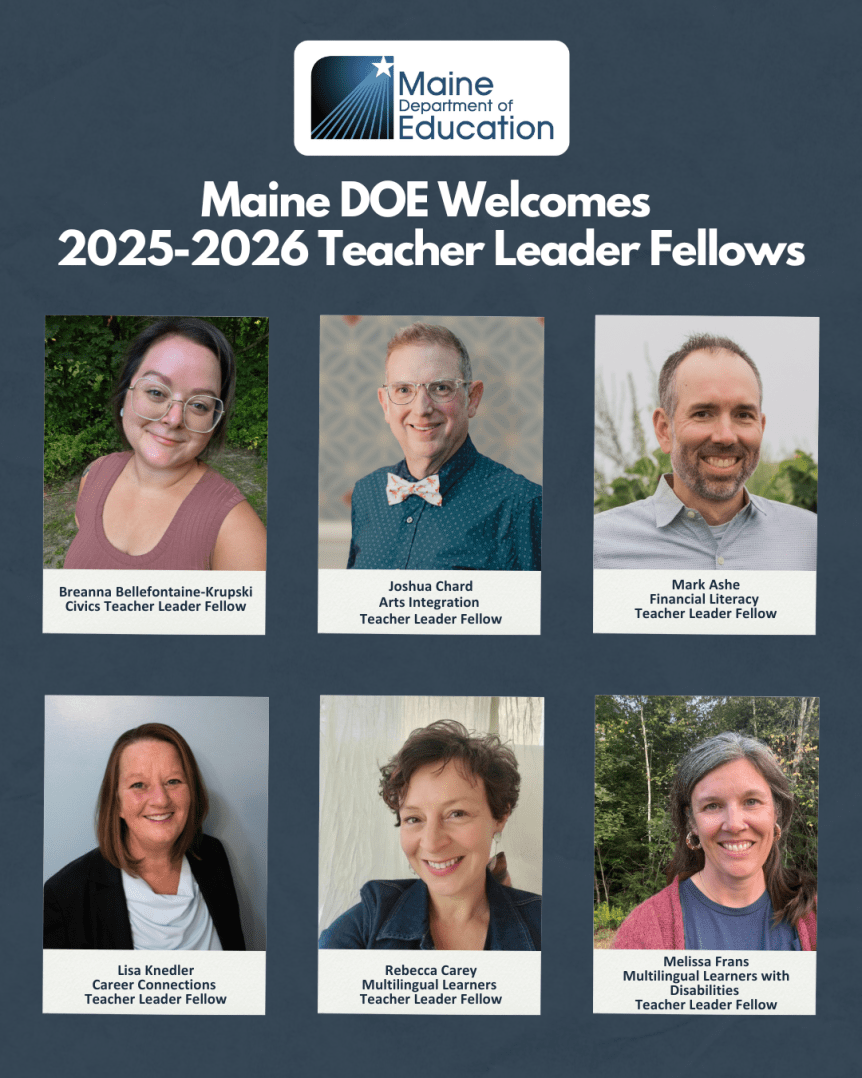
Maine DOE Welcomes 2025-2026 Teacher Leader Fellows

The Maine Department of Education (DOE) Office of Teaching and Learning is proud to welcome the 2025-2026 Teacher Leader Fellows. These exceptional educators bring diverse expertise and passion to their work, helping to strengthen teaching and learning across the state. Each Fellow will engage educators in their focus area, curate resources, and provide professional learning opportunities that expand access, equity, and excellence in Maine classrooms.

We are excited to introduce this year’s cohort:

Breanna Bellefontaine-Krupski
Civics Teacher Leader Fellow
Scarborough High School Teacher


Breanna Bellefontaine-Krupski, known to her students as Mrs. B-K, returns for a second year as the Civics Teacher Leader Fellow. A lifelong Mainer, she has spent 14 years teaching civics, including at Scarborough High School and in rural schools across the state. Along the way, she earned National Board Certification in Social Studies, participated in the 2019 Maine Teacher Leader Cohort, and collaborated with civic organizations nationwide.

Most recently, Bellefontaine-Krupski served as a Constitutional Fellow with the National Constitution Center and continues to serve on their Teacher Advisory Board while also working as a Teacher Ambassador for Retro Report Education.

In her second year as a Fellow, she plans to gather a monthly cohort of civics teachers, share a newsletter of resources and opportunities, and deepen connections across the Maine civics world.

Joshua Chard
Arts Integration Teacher Leader Fellow
East End Community School Teacher


Joshua Chard, the 2024 Maine Teacher of the Year, returns for a second year as the Arts Integration Teacher Leader Fellow. A second-grade teacher at East End Community School in Portland, Joshua has spent 33 years in education. His work is rooted in culturally responsive teaching and the belief that joyful relationships are at the heart of student learning.

Joshua’s classroom is very diverse, with students speaking more than a dozen home languages. He emphasizes equity, student voice, and the arts as tools to help students thrive and to anchor schools as vital parts of their communities.

Beyond the classroom, Joshua is an accomplished theater director who uses stories to build empathy and expand understanding. Above all, he describes himself as a joyful teacher who loves the fresh start each September and the chance to help children discover their voices.

Mark Ashe
Financial Literacy Teacher Leader Fellow
Cape Elizabeth High School Teacher


Mark Ashe, a social studies teacher at Cape Elizabeth High School, is the 2025-2026 Financial Literacy Teacher Leader Fellow. With 21 years in Maine classrooms and a background in Economics and Social Studies Education, Ashe connects personal finance to broader issues of justice and democracy. He helps students to see how topics like compound interest or student debt intersect with systemic inequities and national policy.

Ashe also runs a financial planning and investment advisory firm, bringing real-world expertise into his teaching on business, investing, and financial planning. He looks forward to continuing his mission of promoting financial literacy as a foundation for equity and civic engagement.

Outside of teaching, Ashe enjoys traveling and watching sports with his wife and two sons.

Lisa Knedler
Career Connections Teacher Leader Fellow
Gray-New Gloucester High School Teacher


Lisa Knedler, a Career Explorations Teacher and International Baccalaureate  Coordinator at Gray-New Gloucester High School, is the 2025-2026 Career Connections Teacher Leader Fellow. Knedler’s passion for student aspirations has shaped her career, from serving as Maine’s first College and Career Access Coordinator to designing career pathways and events like “Career Day” and “Curious about College.”

Currently teaching an Early College Career Exploration course through the University of Maine, Knedler equips students to align their interests and goals with career plans while earning transferable credit. She looks forward to creating resources grounded in Maine’s Life and Career Ready standards and collaborating with educators, career organizations, and employers to expand opportunities statewide.

Rebecca Carey
Multilingual Learners Teacher Leader Fellow
English Speakers of Other Languages (ESOL) Teacher/Coordinator, RSU 3


Rebecca Carey returns for a second year as a Teacher Leader Fellow, continuing her work with Early Learning educators and leaders. Last year, she focused on culturally and linguistically responsive programming and helped to develop tools to welcome families and guide instructional planning.

As the 2025-2026 Multilingual Learners Teacher Leader Fellow, Carey will collaborate with the Maine DOE’s ESOL team to support multitiered systems of support (MTSS) for multilingual learners. Her focus will include creating family-facing documents that educators can share with culturally and linguistically diverse families, as well as curating resources that help teachers to plan intentionally for their multilingual learners.

Melissa Frans
Multilingual Learners with Disabilities Teacher Leader Fellow
Special Education Multilingual Coordinator, Portland Public Schools


Melissa Frans returns for a second year, continuing her focus on supporting educators of dual-identified multilingual learners with disabilities. Through her leadership last year, a professional learning community explored strategies for integrating Individual Language Acquisition Plans (ILAP) with Individualized Education Programs (IEP).

This year as the 2025-2026 Multilingual Learners with Disabilities Teacher Leader Fellow, Frans will expand on that work by enhancing instructional practices and building interdisciplinary collaboration so that all students—especially those at the intersection of language acquisition and disability—have equitable access to learning.

Together, these six Fellows bring expertise, creativity, and passion to the Maine DOE’s work. Their leadership will provide educators with tools, resources, and opportunities to strengthen teaching and learning across our state.

Please join us in welcoming the 2025-2026 Teacher Leader Fellows!

Monthly Professional Learning Community for Civics Teachers Launching in October

Attention, Maine civics and government educators! Join Maine Department of Education (DOE) Teacher Leader Fellow Breanna Bellefontaine-Krupski for a monthly civics professional learning community (PLC) group that will launch in October.

The Civics PLC is open to all civics educators in Maine, from elementary through high school. Meetings will be held on the third Thursday of each month at 4 p.m. via Zoom.

Goals of the PLC:

  • Connect with civics educators across Maine to share ideas, feedback, and strategies.
  • Discuss the needs of civic education at all grade levels.
  • Partner with Maine civic organizations to build classroom-to-community connections.
  • Explore opportunities for professional development in civics-related fields.
  • Earn up to seven contact hours (one hour per meeting).

Please sign up here. Registration is limited to 30 teachers. Monthly attendance is encouraged but not required. Registration will close on Friday, October 10, 2025.

Meeting dates:

  • October 16, 2025
  • November 20, 2025
  • December 18, 2025
  • January 15, 2026
  • *no meeting in February*
  • March 12, 2026 *second Thursday of the month*
  • April 16, 2026
  • May 21, 2026

This is the second year that Breanna Bellefontaine-Krupski has served as the Maine DOE Civics Teacher Leader Fellow. Having participated in civics-focused PLCs in the past, she has gained some of the best professional development and classroom strategies from like-minded peers across the country. She looks forward to leading this group during the 2025-2026 school year!

For further information or questions, please contact Breanna Bellefontaine-Krupski at breanna.krupski@maine.gov.