Wabanaki Studies Website Revamped to Include Curriculum, Units, Lessons, Activities, and More!

After months of collaboration between Wabanaki advisors and educators from across the state, under the direction of the Wabanaki Studies Specialist, Brianne Lolar (Panawahpskek), the website has been revamped to include a plethora of new resources.

Some of the many features include:

  • Links to 7 Wabanaki Studies MOOSE (Maine Online Open-Source Education platform) modules with accompanying resources
  • Additional Wabanaki Studies curriculum, units, lessons, and resources
  • Traditional Knowledge Keepers Directory
  • Wabanaki Studies Specialist office hours sign up
  • Resource database
  • Monthly spotlight with new resources

This work is deliberately designed to be taught year-round. As with all great, meaningful teaching, it is interdisciplinary, connecting with topics that are already being taught, and strengthens learning. Spend some time with all of the resources and find ways to teach this in a deliberate way throughout the entire year. Reach out to the Wabanaki Studies Specialist, Brianne Lolar to share the great things you are already doing, things you have learned along the way, and ways you and your students have grown!

https://www.maine.gov/doe/innovation/wabanakistudies

Mt. View High School Educators are Leveraging Maine DOE’s ConCEPT Pilot Program to Help Meet their Academic Needs

The Maine Department of Education (DOE) Interdisciplinary Instruction Team is offering a pilot program developed by listening to educators’ needs and creating the opportunity for them to choose their professional learning adventure. In an effort to make this program available to more schools and educators across Maine, we are sharing some examples of the ways that Mt. View High School educators are using ConCEPT to meet their unique needs:

  • Using Executive Functioning for the SAT – SAT prep courses tend to focus on filling in gaps in learning and practicing how to take the test, but educators at Mt. View High School are taking a different approach. Along with filling in conceptual gaps in math and English, students will be working to understand how to take a test from an executive functioning perspective. By teaching students how to utilize working memory, plan and prioritize the test, organize their time, and reflect, educators can prepare students academically and cognitively for the test.
  • Developing Student Disposition – Another team will be working to support student engagement and social development through student dispositions. All students can use practice with dispositions like responsibility, communication, or self-reflection, but this program aims to create groups of students that can focus on dispositions that need improvement.
  • Ownership and Place-based Learning – A group of educators is looking to help students see a connection between taking ownership of their classroom space and the environment. By focusing on empathy, a sense of place, student voice, and reflection, these educators want to support students to see how the skills they use to take care of the small space they use every day can be transferred to the outside world, specifically Maine’s environment.
  • Applying Academic Concepts to Real-world Problems – A group of math, science, and English teachers are working to create an interdisciplinary, dual-credit engineering class. Through student-focused inquiry in the form of genius hours, students will apply academic concepts to real-world problems. This interdisciplinary class will be designed to cover high school credit requirements in multiple subject areas and as a college credit through the University of Maine.

These programs are supported through the ConCEPT pilot program through the Maine Department of Education. Mt. View educators are excited about this program because it allows them to meet with educators they rarely work with, the professional learning “caters to the needs of educators and students,” and they “feel the support of the DOE.”

If you are interested in learning more about ConCEPT, please visit the ConCEPT web page or e-mail Maine DOE Interdisciplinary Instruction Team Coordinator Kathy Bertini at Kathy.bertini@maine.org


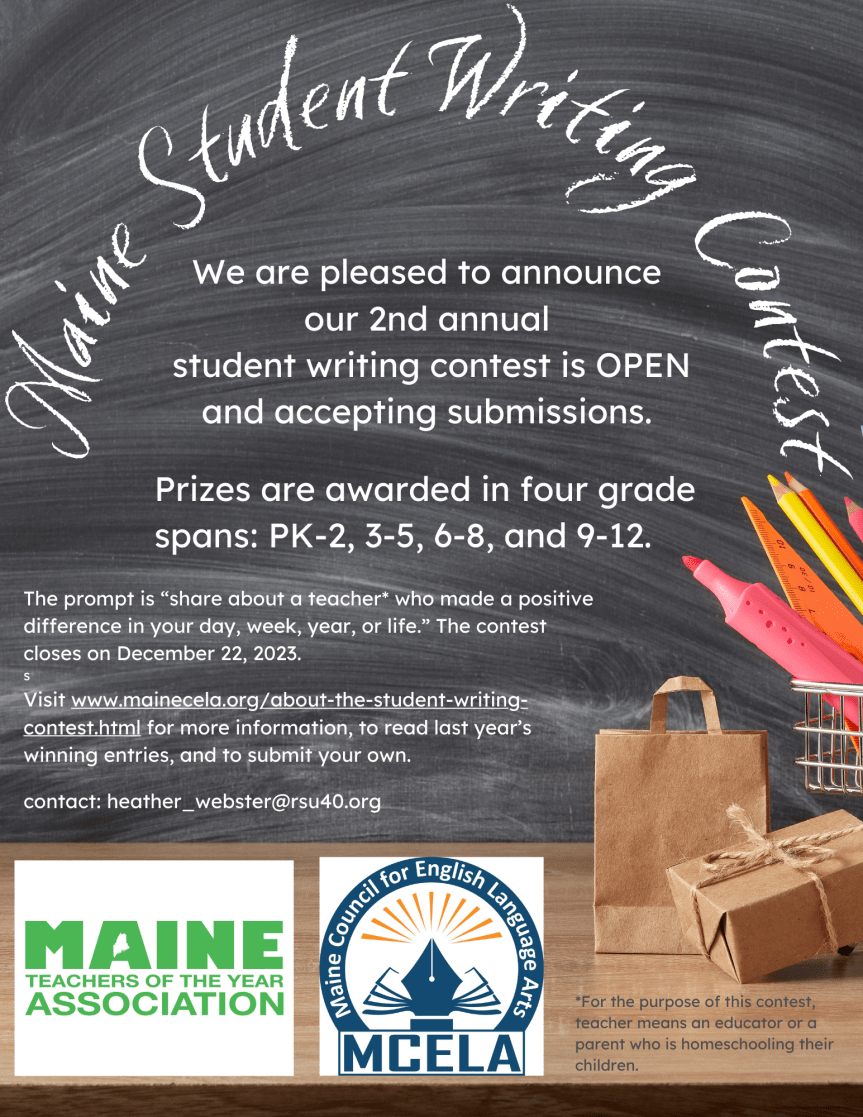
Maine Student Writing Contest: Share About a Teacher

Maine’s County and State Teacher of the Year Association (MCSTOYA) in partnership with the Maine Council for English Language Arts (MCELA) Association have announced their second annual student writing contest. The prompt is “share about a teacher who made a positive difference in your day, week, year, or life.”

To learn more about the writing prompts and rules for this contest, visit https://www.mainecela.org/student-writing-contest.html at MCELA’s website. The contest closes on December 22, 2023.

Download a flyer that you can print out.

For more information or questions, reach out to Maine County and State Teachers of the Year Association Board Member Heather Webster, heather_webster@msad40.org and/or Maine Council for English Language Arts President
Patti Forster, patti.forster@fivetowns.net.

The Telling Room’s Statewide Writing Context is Now Open

The Telling Room’s annual creative Writing Contest invites youth from all over Maine, ages 6 – 18, to show off their writing. This statewide contest runs from mid-October through November each year. A panel of professional writers and youth selects one grand prize winner, a winner from each of Maine’s 16 counties, and submissions are considered for publication in The Telling Room’s annual anthology. Click on the link below for more information about how to submit.

PRIZES

  • The Grand Prize Winner will receive a $250 award, will be published in our spring anthology, and may be published in other publications and media.
  • One County Winner will be selected from each of Maine’s 16 counties. Each County Winner will receive a $50 award, will be published in our spring anthology, and may be published in other publications and media.

Submissions close on November 30, 2022.

For more information and to make a submission visit The Telling Room website.


DOE Podcast Features Yarmouth High School Students Engaged in Hands-On, Real-World Extended Learning Opportunities

Commissioner Makin Talks with Sarah Hinson About Her Veterinary ELO and Liam Hannah About His Summer ELO Building a Robot that Serves Drinks. The Maine DOE Has Invested $5.6 Million to Expand ELOs Across Maine

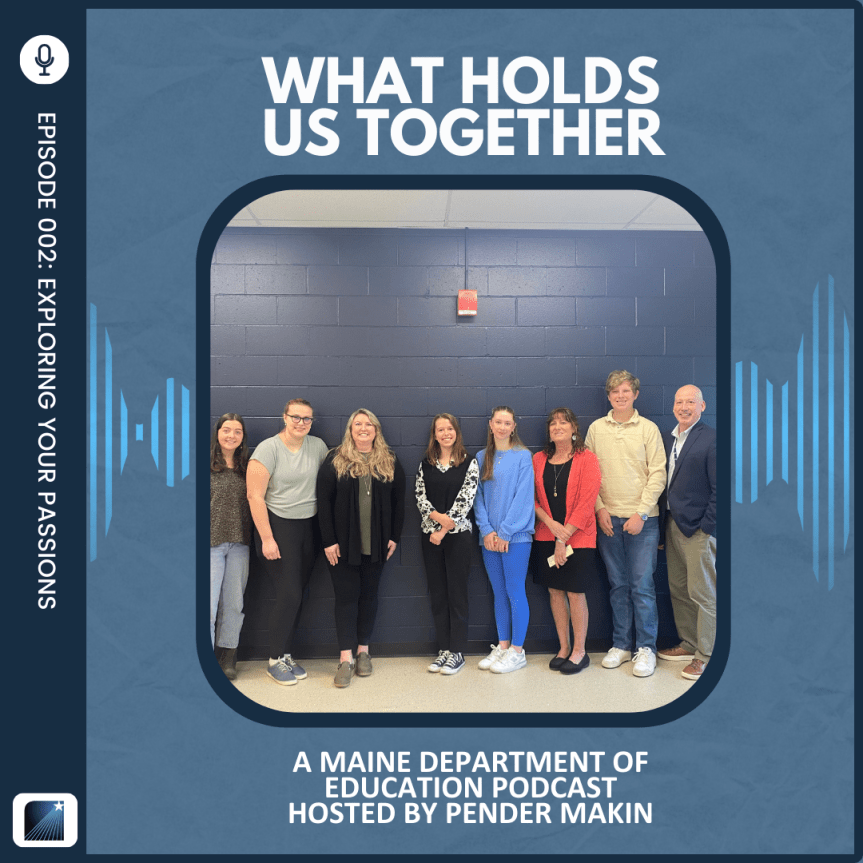
On the latest episode of her What Holds Us Together podcast, Maine Department of Education (DOE) Commissioner Pender Makin spoke with two Yarmouth High School students about their experiences pursuing what they are passionate about through their school’s Extended Learning Opportunities (ELO) program. Yarmouth senior Sarah Hinson gets school credit and paid work experience through her ELO at Portland Veterinary Hospital and junior Liam Hannah engaged in a summer ELO to program and build a drink serving robot which also earned him school credit.

Listen here.

Extended Learning Opportunities offer students creative and flexible opportunities to explore what they are passionate about and develop skills and knowledge that will set them up for success in school and life, all while gaining school credit and the option of paid work experience. The Maine DOE has awarded $5.6 million in Maine Jobs & Recovery Plan (MJRP) funding to 26 school administrative units and community-based organizations to create or expand ELOs across the state.

“We’re going to be discussing an exciting, innovative approach to interdisciplinary, hands-on, real-world learning called Extended Learning Opportunities,” said Makin in the podcast’s opening. “I met Sarah, Liam, and several of their classmates when I visited their school to hear more about these ELOs. What I heard was so impressive and inspirational that I wanted to have them on this podcast to share what they’ve been doing with everyone.”

Dozens of students participate in ELOs at Yarmouth High School. On her recent visit, Makin talked with students who were studying cognitive neuroscience and the science of wellbeing, civics, interning for non-profits, working on policy issues, building skills to have constructive conversations and debates about issues, promoting work opportunities for New Mainers, and so much more through their ELOs. Students meet with the school’s coordinator Brittany Brockelbank to design their ELO and meet regularly to discuss their progress and showcase what they’ve learned. Makin invited two students on the podcast to share more about their experiences.

“I’m doing a work study. I’m now on my fifth semester and I get credit for what I learn in the ER. It’s a very unique opportunity to learn about what I’m passionate about and what I’ll do after high school while getting school credit,” said Sarah Hinson describing her ELO on the podcast.

“It’s an incredibly flexible program. There are endless opportunities for what you can do and it’s very individualized with the learning that you do,” said Liam Hannah about what he liked about his ELO. He said he got his idea for his drink serving robot after seeing a similar one at a sushi restaurant. He had taken coding and machining classes at school and also had a student mentor to provide support for his ELO. Hannah also utilized ChatGPT to help him troubleshoot when we ran into coding or other obstacles.

Both students highlighted connections between what they’ve learned through their ELOs and how they’ve applied it to their other classes and in life. They also discussed how ELOs offer opportunities to engage students who may not find that same kind of engagement in traditional class settings.

“I remember sophomore year we were doing something in my biology class with sodium chloride bonding and I work with sodium chloride all the time. I use it every shift and I know a lot about it…so my job in certain situations has connected back to school but in many ways it’s very different. School does provide me with the knowledge that I need to get into the field—I can’t go into the field if I’m not good at math,” said Hinson. “In my job I’m learning something that I really am going to apply in my work on a farm with over 50 animals. It gives students that don’t fit the square box of what school and a student should look like [the opportunity to learn something we like].”

“This ELO, it really helped me develop a schedule and think really far out with my plans which I was never really great at and definitely helped me develop that,” said Hannah on how his ELO helped him build stronger time management skills.

The students were enthusiastic in what they would tell other students or school leaders about ELOs.

“It’s super fun—it’s the most fun I’ve ever had in a learning environment. I think every school should have the option for an ELO,” said Hannah.

“Do it! Find what works for you. There are so many ELOs available—group, individual, summer, learning ones, and working ones,” said Hinson.

Makin closed the podcast by highlighting the Maine DOE’s efforts to expand ELOs across the state.

“Our Department of Education is promoting ELOs across the state and anything that is hands-on, interdisciplinary, and applied learning. We’re really hopeful that Maine is going to lead the way nationally,” said Makin.

The Maine DOE website features highlights and stories from ELO programs across Maine.

What Holds Us Together is a monthly podcast hosted by Commissioner Makin that highlights the great things happening in public schools across Maine and how public education connects us through conversations with educators, school staff, and students. The podcast launched last month with a conversation between Makin, 2023 Maine Teacher of the Year Matt Bernstein, and the newly named 2024 Maine Teacher of the Year Joshua Chard.

What Holds Us Together can be listened to and subscribed to on all major podcast platforms, including Apple and Spotify. New episodes are released on the third Thursday of every month.

Book Study: Increasing Student Engagement

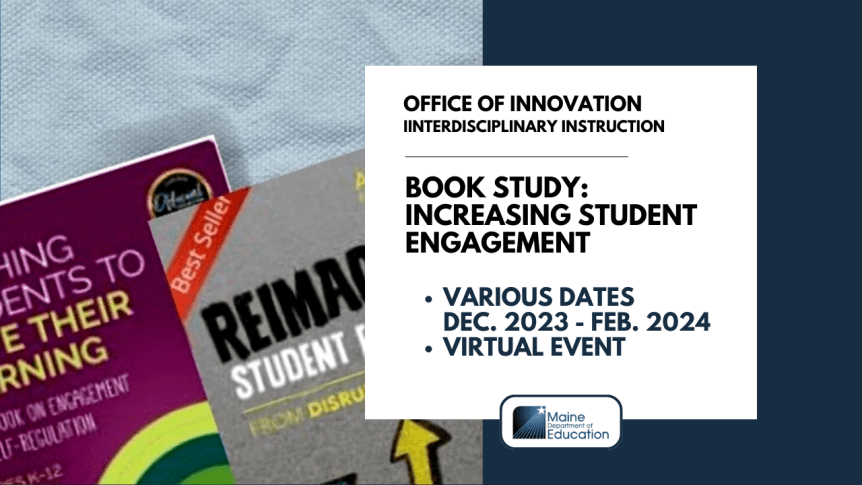
Starting in December, the Maine Department of Education (DOE) is hosting an asynchronous book study on student engagement based on two books: Reimagining Student Engagement and Teaching Students to Drive Their Learning. Educators will receive a free copy of each book.  In this 8-week online book study, educators will: 

  • Examine what research says about student engagement  
  • Reflect on their students’ engagement and classroom management 
  • Design strategies to increase engagement that works for them and their students 
  • Collect data on how the changes have impacted their students’ engagement 
  • Opportunity to collaborate with teachers statewide  

During this book study, educators will be assigned weekly readings, post a response, and comment on other teachers’ responses.  Teachers will also need to implement one or more engagement strategies and share their resources and/or reflections. Educators completing the book study will receive 10 contact hours. The book study is perfect for individual teachers, as well as teams of teachers, who want to examine research-based practices that can increase and improve student engagement.   

Books: Teachers participating in the book study will receive copies of: 

  • Reimagining Student Engagement by Amy Berry 
  • Teaching Students to Drive Their Learning: A Playbook on Engagement & Self-Regulation, K-12 by Fisher, Frey, Ortega & Hattie 

Intended Audience: PK-12 Teachers & Administrators
When: December 1-February 2 
Where: Maine DOE EnGiNE Platform (There will be optional Zoom sessions to further our discussions and collaboration.)
Contact Hours: 10 contact hours available upon completion
How: Register here 

This book study can be done in conjunction with the Maine DoE ConCEPT pilot.  Click here to learn more about ConCEPT.

For more information on this book study, please contact Jaime Beal, Interdisciplinary Instruction Specialist at jaime.beal@maine.gov 

The Maine DOE encourages all schools and districts across the State of Maine to learn more about interdisciplinary instruction on our website or by contacting the Interdisciplinary Instruction Team Coordinator at Kathy.bertini@maine.gov 

Professional Learning: The Rural Experience in America Project

Community Civics through Historical Inquiry (K-12 grade educators)

Funded by a grant from the Library of Congress Teaching with Primary Sources program, NCHE is proud to announce a 3-part colloquium for teachers focusing on Rural America. These free professional learning opportunities will help teachers develop place-based interdisciplinary units that connect students to their rural communities.  Additionally, the Maine Department of Education will be hosting a bi-weekly professional learning community to support educators through these NCHE modules.  The PLC will incorporate the work developed by the MDOE interdisciplinary instruction specialists.

The program is designed to:

  • connect teachers with the Library Congress’s collections on rural history and with local rural historical societies so they can situate local history in the larger human experience
  • support teachers in the design and implementation of works of public value that connect rural students to their community’s history
  • engage rural teachers in a deep examination of rural history and the impact of change on children, families, and communities
  • The Right Question Institute will be leading a 4-week session on the Question Formulation Technique (QFT) with a focus on working with rural students

Educators may complete all or part of the 3-part colloquium.

  • Part A – Self-paced online courses:  the Library of Congress’ 6-week module course: Teaching with Primary Sources Basics; the Right Question Institute 4-week module course: Teaching Students to Ask Their Own Primary Source Questions (Dec 1-March 31)
  • Part B – Participate in three online synchronous Saturday professional development sessions led by historians, educational specialists, and master teachers (March 23, April 20, May 11)
  • Part C – Apply for a Summer Colloquium. Teachers and community partners will learn from historians and build civic connections to develop a plan for implementing a public history project in their community.
    • July 24-26 Washington, DC Travel reimbursement available

Register here for these NCHE events.

When you register with NCHE, you will receive a follow-up from the Maine DOE to register into our Maine PLC.

For more information, please contact Jaime Beal, Interdisciplinary Instruction Specialist, at  jaime.beal@maine.gov.

Application Deadline Extended for ConCEPT Asynchronous Professional Learning Opportunity

The Maine Department of Education (DOE) is piloting a program designed to support educators throughout the state with professional learning that is practical and flexible. 

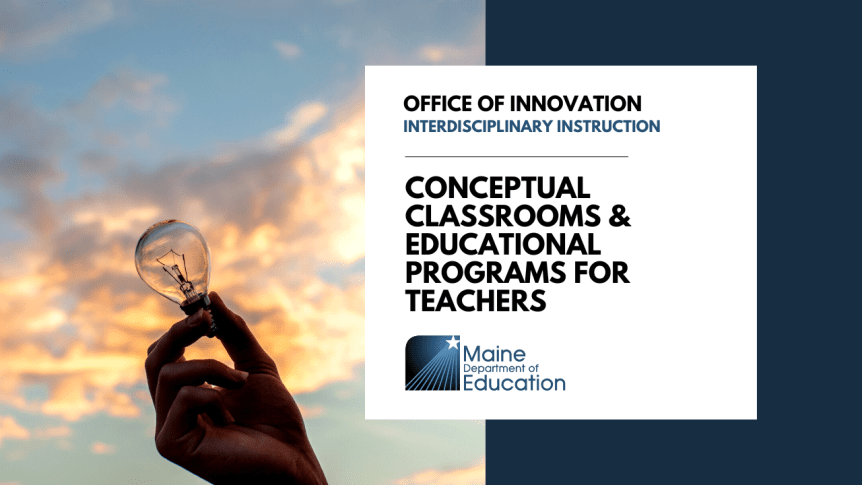
Conceptual Classroom and Educational Programs for Teachers (ConCEPT) is focused on providing professional learning to educators across Maine through asynchronous evidence-based modules, topic-driven office hours, asynchronous book studies, and customized support from the Maine DOE Interdisciplinary Instruction team. ConCEPT offers a menu of choices for educators to choose from that can be tailored to your team’s goals. ConCEPT is completely free to Maine educators. Contact hours and reimbursement for planning purposes outside the regular contracted day are available. 

Set up a time to have a conversation by making a request through this link.

To learn more about ConCEPT, you can watch the prerecorded webinar below or visit the ConCEPT webpage.

You can also reach out to Kathy Bertini at Kathy.Bertini@maine.gov for further questions.

Apply Now for Conceptual Classrooms & Educational Programs for Teachers (ConCEPT)

For the past few weeks, the Interdisciplinary Instruction team has been offering informational webinars on “Conceptual Classrooms & Educational Programs for Teachers” (ConCEPT), an innovative approach to enhance your teaching practices and student engagement through concept-based inquiry strategies. If you couldn’t attend the live webinars but would like to learn specifics about the ConCEPT pilot, you can watch the recording on our website. You will also find links to the application and the menu of professional learning opportunities offered in this pilot.

ConCEPT Application and Menu of Professional LearningThe application window is August 28, 2023 – September 29, 2023.

Webinar Recording:

What does ConCEPT offer?

  • Connection to Research: Discover evidence-based strategies and practices that support effective concept-based inquiry in the classroom.
  • Mapping and Planning: Learn how to design curriculum and instruction using concept-based frameworks, empowering your students’ learning journey.
  • Collaboration: Engage in collaborative activities and discussions with fellow educators, fostering a community of shared ideas and experiences.
  • Customization: Tailor your learning experience to suit your team’s unique pathway, ensuring maximum impact on your teaching practices.

Why should you participate in ConCEPT?

  • Enhanced Curriculum Design: Develop concept-based inquiry curriculum and instruction design skills that align with the latest educational standards.
  • Strengthened Pedagogical and Content Knowledge: Deepen your understanding of pedagogy and content across various subject areas.
  • Active Learning Strategies: Discover dynamic and engaging active learning strategies to invigorate your classroom environment.
  • Take Away Ideas and Materials: Gain valuable resources, ideas, and materials to enrich your teaching practices.
  • Integrated SEL Strategies: Learn how to integrate Social-Emotional Learning (SEL) effective strategies to create a nurturing and inclusive classroom atmosphere.
  • Learning from National Experts: Benefit from the expertise of renowned national educators who will guide and inspire you throughout the program.

Who is ConCEPT designed for?

ConCEPT is open to teams of 3-6 members from K-12 schools. Participants may include Classroom Teachers, Instructional Coaches, Curriculum Coordinators, and other Administrators (Superintendent/Principal). Teams must include at least one Classroom Teacher and at least one Administrator (e.g., Coach, Coordinator, building/district Supervisor, etc.). The rest of the team may be made up of any combination of participants.

Program Details:

  • Cost: Participation in ConCEPT is entirely free!
  • Contact Hours: You can earn up to 24 contact hours during the program.
  • Reimbursement: Districts/schools are eligible for reimbursement of costs associated with planning, such as substitutes or after-contract hours, up to $5000.

For further information, please contact Kathy Bertini, the Interdisciplinary Instruction Team Coordinator, at (207) 816-0294 or kathy.bertini@maine.gov.

Join us in this exciting educational journey that will empower you to create enriching concept-based learning experiences for your students. We look forward to seeing you continue to thrive as educators and positively impact your classrooms and school communities.

The ConCEPT program is supported as part of the Maine Online Open-Source Education (MOOSE) project. MOOSE is funded entirely (100%) through Federal money under the Coronavirus Response and Relief Supplemental Appropriations Act (CRRSA) and American Rescue Plan (ARP), totaling $4,598,000 for the current 2023-2024 funding cycle.


Info Sessions: Conceptual Classrooms & Educational Programs for Teachers (ConCEPT)

On August 31st and September 7th, the Interdisciplinary Instruction Team is offering informational webinars on “Conceptual Classrooms & Educational Programs for Teachers” (ConCEPT), an innovative approach aimed at enhancing your teaching practices and student engagement through concept-based inquiry strategies. This program offers a comprehensive learning experience grounded in evidence-based research that will equip you with valuable tools and knowledge to transform your classroom approach. 

What does ConCEPT offer? 

  • Connection to Research: Discover evidence-based strategies and practices that support effective concept-based inquiry in the classroom. 
  • Mapping and Planning: Learn how to design curriculum and instruction using concept-based frameworks, empowering your students’ learning journey. 
  • Collaboration: Engage in collaborative activities and discussions with fellow educators, fostering a community of shared ideas and experiences. 
  • Customization: Tailor your learning experience to suit your team’s unique pathway, ensuring maximum impact on your teaching practices. 

Why should you participate in ConCEPT? 

  • Enhanced Curriculum Design: Develop concept-based inquiry curriculum and instruction design skills that align with the latest educational standards. 
  • Strengthened Pedagogical and Content Knowledge: Deepen your understanding of pedagogy and content across various subject areas. 
  • Active Learning Strategies: Discover dynamic and engaging active learning strategies to invigorate your classroom environment. 
  • Take Away Ideas and Materials: Gain valuable resources, ideas, and materials to enrich your teaching practices. 
  • Integrated SEL Strategies: Learn how to integrate Social-Emotional Learning (SEL) effective strategies to create a nurturing and inclusive classroom atmosphere. 
  • Learning from National Experts: Benefit from the expertise of renowned national educators who will guide and inspire you throughout the program. 

 Who is ConCEPT designed for? 

ConCEPT is open to teams of 3-6 members from K-12 schools. Participants may include Classroom Teachers, Instructional Coaches, Curriculum Coordinators, and other Administrators (Superintendent/Principal). Teams must include at least one Classroom Teacher and at least one Administrator (e.g., Coach, Coordinator, building/district Supervisor, etc.). The rest of the team may be made up of any combination of participants. 

Program Details: 

  • Cost: Participation in ConCEPT is entirely free! 
  • Contact Hours: You can earn up to 24 contact hours during the program. 
  • Reimbursement: Districts/schools are eligible for reimbursement of costs associated with planning, such as substitutes or after-contract hours, up to $5000. 

To learn more and register for the informational webinar, please visit the ConCEPT web page. 

For further information, please contact Kathy Bertini, the Interdisciplinary Instruction Team Coordinator, at (207) 816-0294 or kathy.bertini@maine.gov. 

Join us in this exciting educational journey that will empower you to create enriching concept-based learning experiences for your students. We look forward to seeing you continue to thrive as educators and positively impact your classrooms and school communities.

The ConCEPT program is supported as part of the Maine Online Open-Source Education (MOOSE) project. MOOSE is funded entirely (100%) through Federal money under the Coronavirus Response and Relief Supplemental Appropriations Act (CRRSA) and American Rescue Plan (ARP), totaling $4,598,000 for the current 2023-2024 funding cycle.