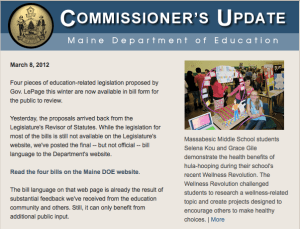
Click the image to view the fully formatted Commissioner's Update.Four pieces of education-related legislation proposed by Gov. LePage this winter are now available in bill form for the public to review.
Yesterday, the proposals arrived back from the Legislature’s Revisor of Statutes. While the legislation for most of the bills is still not available on the Legislature’s website, we’ve posted the final — but not official — bill language to the Department’s website.
The bill language on that web page is already the result of substantial feedback we’ve received from the education community and others. Still, it can only benefit from additional public input.
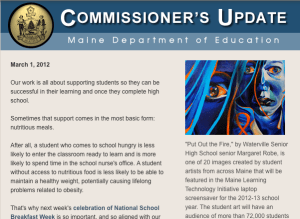
Click the image to view the fully formatted Commissioner's Update.Our work is all about supporting students so they can be successful in their learning and once they complete high school.
Sometimes that support comes in the most basic form: nutritious meals.
After all, a student who comes to school hungry is less likely to enter the classroom ready to learn and is more likely to spend time in the school nurse’s office. A student without access to nutritious food is less likely to be able to maintain a healthy weight, potentially causing lifelong problems related to obesity.
That’s why next week’s celebration of National School Breakfast Week is so important, and so aligned with our work of preparing all of our students for success in college, careers and civic life.
Every day in Maine, our schools serve breakfast to about 41,000 students who need it. As a result, those students can more easily focus on their school work, discover their passions and take charge of their learning so it’s relevant and engaging.
School Breakfast Week will bring attention to our schools that are giving students an extra nutritious boost in the morning, and help students learn about the importance and the advantages of a healthy breakfast.
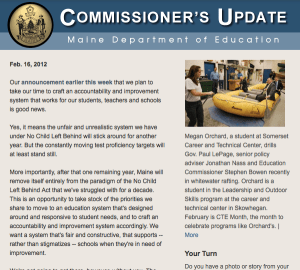
Click the image to view the fully formatted Commissioner's Update.Our announcement earlier this week that we plan to take our time to craft an accountability and improvement system that works for our students, teachers and schools is good news.
Yes, it means the unfair and unrealistic system we have under No Child Left Behind will stick around for another year. But the constantly moving test proficiency targets will at least stand still.
More importantly, after that one remaining year, Maine will remove itself entirely from the paradigm of the No Child Left Behind Act that we’ve struggled with for a decade. This is an opportunity to take stock of the priorities we share to move to an education system that’s designed around and responsive to student needs, and to craft an accountability and improvement system accordingly. We want a system that’s fair and constructive, that supports — rather than stigmatizes — schools when they’re in need of improvement.
We’re not going to get there, however, without you. The success of Maine’s new accountability and improvement system depends on involvement from teachers and administrators, school board members, students, parents, community members and others. What we heard loud and clear in December at community forums, during dinners with students, in online discussions, and from more than 1,500 survey responses was that you don’t want us simply to tinker or propose patchwork fixes to a broken system. So please lend your voice to this important process. Visit the Maine DOE’s accountability and improvement web page to find out how you can get involved.
In Maine, we’ll take the time we need to devise an accountability and improvement system that is flexible and that works for our schools.
Please note: There will be no Commissioner’s Update on Feb. 23. The next Update will be published on March 1. Have a pleasant vacation!
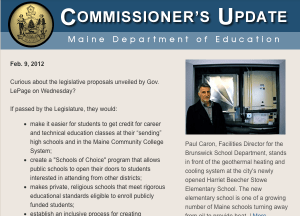
Click on the image to view the fully formatted Commissioner's Update.Curious about the legislative proposals unveiled by Gov. LePage on Wednesday?
If passed by the Legislature, they would:
make it easier for students to get credit for career and technical education classes at their “sending” high schools and in the Maine Community College System;
create a “Schools of Choice” program that allows public schools to open their doors to students interested in attending from other districts;
makes private, religious schools that meet rigorous educational standards eligible to enroll publicly funded students;
establish an inclusive process for creating standards that define effective teaching, and a timeline for local districts to implement locally developed teacher and principal evaluation systems; and
allocate $5 million in competitive funds that groups of school districts can use to provide services regionally and implement innovative educational programs.
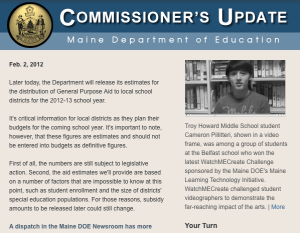
Click the image to view the fully formatted Commissioner's Update.Later today, the Department will release its estimates for the distribution of General Purpose Aid to local school districts for the 2012-13 school year.
It’s critical information for local districts as they plan their budgets for the coming school year. It’s important to note, however, that these figures are estimates and should not be entered into budgets as definitive figures.
First, the numbers are still subject to legislative action. Second, the aid estimates we’ll provide are based on a number of factors that are impossible to know at this point, such as student enrollment and the size of districts’ special education populations. For those reasons, subsidy amounts to be released later could still change.
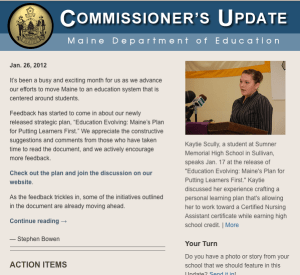
Click the image to view the fully formatted Commissioner's Update.It’s been a busy and exciting month for us as we advance our efforts to move Maine to an education system that is centered around students.
Feedback has started to come in about our newly released strategic plan, “Education Evolving: Maine’s Plan for Putting Learners First.” We appreciate the constructive suggestions and comments from those who have taken time to read the document, and we actively encourage more feedback.
Click on the image to view the fully formatted Commissioner's Update.
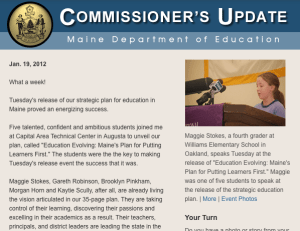
What a week!
Tuesday’s release of our strategic plan for education in Maine proved an energizing success.
Five talented, confident and ambitious students joined me at Capital Area Technical Center in Augusta to unveil our plan, called “Education Evolving: Maine’s Plan for Putting Learners First.” The students were the the key to making Tuesday’s release event the success that it was.
Maggie Stokes, Gareth Robinson, Brooklyn Pinkham, Morgan Horn and Kaytie Scully, after all, are already living the vision articulated in our 35-page plan. They are taking control of their learning, discovering their passions and excelling in their academics as a result. Their teachers, principals, and district leaders are leading the state in the move to an education system that puts students at the center and builds the system around their needs. It’s my hope that, by implementing the action steps detailed in our plan, all of Maine’s students will have the opportunities that the five students we saw on Tuesday have had in their education.
As I’ve noted previously, the strategic plan is a working document that could change in the coming months. I encourage you all to read it and join the discussion about it.
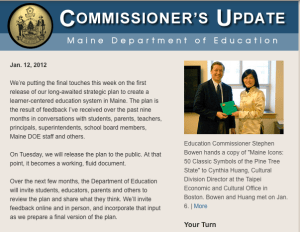
Click the image to view the fully formatted Commissioner's Update.We’re putting the final touches this week on the first release of our long-awaited strategic plan to create a learner-centered education system in Maine. The plan is the result of feedback I’ve received over the past nine months in conversations with students, parents, teachers, principals, superintendents, school board members, Maine DOE staff and others.
On Tuesday, we will release the plan to the public. At that point, it becomes a working, fluid document.
Over the next few months, the Department of Education will invite students, educators, parents and others to review the plan and share what they think. We’ll invite feedback online and in person, and incorporate that input as we prepare a final version of the plan.
I look forward to starting a conversation with this plan about the best ways to serve our learners, and prepare them to succeed in college, careers and civic life.
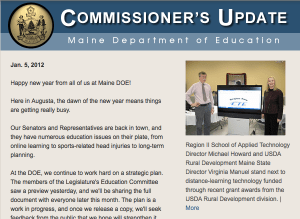
Click the image to view the fully formatted Commissioner's Update.Happy new year from all of us at Maine DOE!
Here in Augusta, the dawn of the new year means things are getting really busy.
Our Senators and Representatives are back in town, and they have numerous education issues on their plate, from online learning to sports-related head injuries to long-term planning.
At the DOE, we continue to work hard on a strategic plan. The members of the Legislature’s Education Committee saw a preview yesterday, and we’ll be sharing the full document with everyone later this month. The plan is a work in progress, and once we release a copy, we’ll seek feedback from the public that we hope will strengthen it.
Meanwhile, we’re also making progress on using all of your feedback to craft a request for Elementary and Secondary Education Act flexibility to submit to the federal government.
As if that weren’t enough, our most important work — the teaching and learning that happens each day in our schools — doesn’t stop.
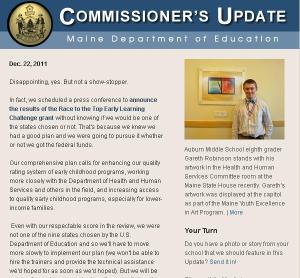
Click the image to view the fully formatted Commissioner’s Update.Disappointing, yes. But not a show-stopper.
In fact, we scheduled a press conference to announce the results of the Race to the Top Early Learning Challenge grant without knowing if we would be one of the states chosen or not. That’s because we knew we had a good plan and we were going to pursue it whether or not we got the federal funds.
Our comprehensive plan calls for enhancing our quality rating system of early childhood programs, working more closely with the Department of Health and Human Services and others in the field, and increasing access to quality early childhood programs, especially for lower-income families.

 Maine DOE Newsroom