UPDATED PRIORITY NOTICE: Higher Education Workforce Grants Available for Work-based Learning Experiences

The Maine Department of Education is seeking applications for the distribution of higher education workforce grants as part of the Maine Jobs & Recovery Program (MJRP). The program will provide a total of $1 million to private higher education institutions in Maine to prepare students for employment in industries harmed by the COVID-19 pandemic.

Funding must be used to provide internships, registered apprenticeships, career mentoring, and other work experience support for students or graduates to connect them to careers in healthcare and social assistance; tourism, travel, and hospitality; education or the public sector; agriculture, fishing and forestry; construction; information; manufacturing; or clean energy. Those eligible for the grants include private colleges and universities in Maine, the Maine Maritime Academy, and industry partners related to the career fields listed above.

The number and size of awards will depend on the number of proposals received & available funds. The range of awards is up to $200,000 and eligible institutions may submit applications for up to two distinct projects.

Applications should be submitted by June 8, 2022 to the State of Maine Division of Procurement Services, via email, at Proposals@maine.gov.

For additional information, contact Ángel Martínez Loredo, Director of Higher Education & Educator Support Services, at angel.loredo@maine.gov.​

MEDIA RELEASE: Maine Adult Education Launches HiSET Completion Campaign

The Maine Department of Education’s Office of Adult Education launched a campaign today to encourage adult learners to complete the HiSET, Maine’s high school equivalency test. Those who complete the HiSET are eligible for two years of free community college in Maine. As part of the campaign, ‘It’s time for HiSET’ yard signs will be displayed throughout Maine and local programs will use social media with hashtag #HiSET4ME, mail postcards, and sponsor community events to promote HiSET completion.

Students who live in Maine, graduate high school or receive a HiSET between 2020 and 2023, and enroll in a Maine community college full time are eligible for two years of free community college.

The HiSET has been Maine’s high school equivalency test since 2014, when it took the place of the GED. Adult learners without a high school credential can receive a Maine High School Equivalency Diploma by successfully completing HiSET’s five subject tests in Language Arts Reading, Language Arts Writing, Mathematics, Science, and Social Studies. There is no cost to Maine residents for HiSET testing or HiSET prep classes. In addition, past HiSET subject tests are still valid, and learners who have taken some of the HiSET subject tests in the past are encouraged to return to their local adult education program to complete their HiSET testing.

“We want adult learners to know that HiSET is a free, easily accessible pathway to get your high school credential, and that by completing your HiSET you can unlock the opportunity to attend two years of community college at no cost,” said Education Commissioner Pender Makin. “If you’ve taken one or more of the HiSET subject tests, but then life got in the way, now is the time to come back and complete your HiSET. If you’ve been thinking about HiSET, but just haven’t gotten around to making that appointment, now is the time to call your local adult education program. It’s time for HiSET!”

More than 60 adult education programs throughout Maine provide a range of instructional services to help adults develop the skills for further educational opportunities, job training, and better employment.

Brandon Codrey started his HiSET process in 2017, but work became a priority and he had to stop attending the program. After several years, he returned to his local adult education program and completed his HiSET in April. Brandon is now enrolled in an applied math class for the summer through On Course for College and looks to enroll in his local community college’s plumbing certification program in the fall. Blythe Gowen, a single mother, completed her HiSET in January and is now looking to enroll in college in the fall to study pharmacology. And Michael Sowards restarted his HiSET process after a several year pause and graduated last September. His local adult education program worked with him to enroll in a free computer applications college course, and this fall he will enter into an accounting program. They are just a handful of the 1,700 adult learners who have received their high school diploma through Maine adult education since 2020.

Celebrating National School Nurse Day!

Today is National School Nurse Day, and the Maine Department of Education thanks and celebrates all of Maine’s school nurses.

Maine’s school nurses do essential work providing the daily care and support students depend on. And throughout the pandemic, school nurses have been on the frontlines providing the leadership and care essential to keeping our schools safe, healthy, and open. 

The Sea Dogs recently held a special night honoring nurses and Education Commissioner Pender Makin provided a special message to school nurses that you can watch below. 

News Center Maine will also air a special conversation with Maine school nurses tonight at 5:30pm and 6pm as part of National School Nurse Day. The special will include shout outs from students across Maine thanking their school nurses.

Happy National School Nurse Day and thank you for everything that you do!

Education Commissioner Pender Makin Visits Kingman Elementary School

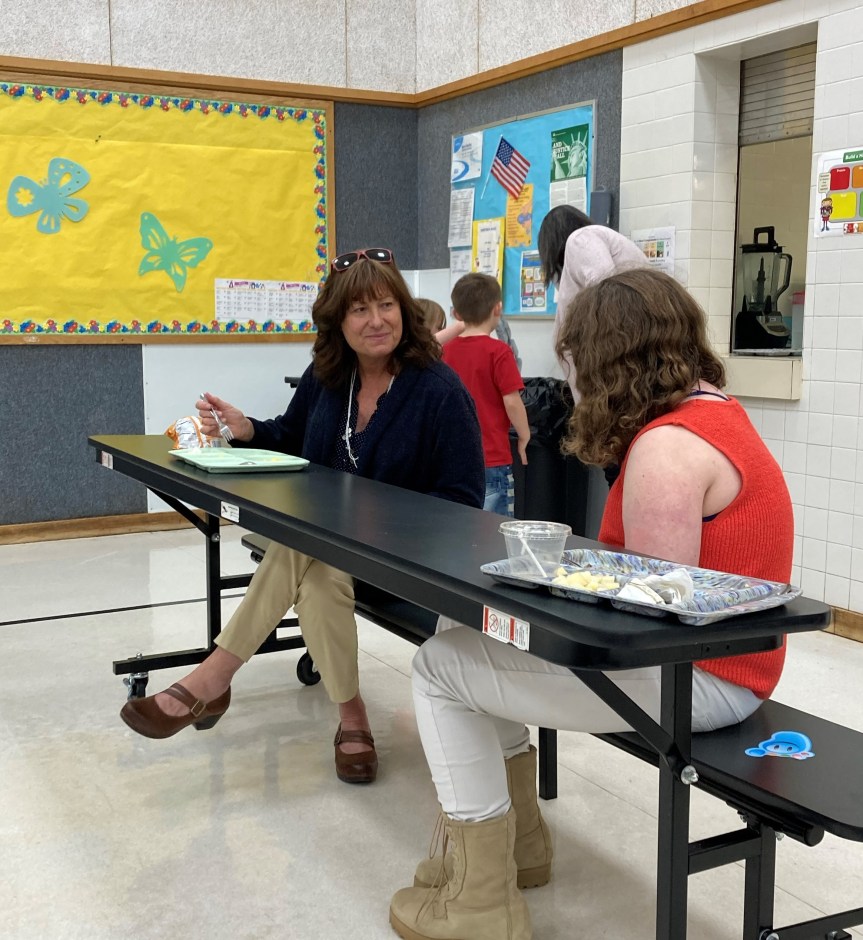
This week, Maine Education Commissioner Pender Makin visited Kingman Elementary School, one of Maine’s Education in Unorganized Territory (EUT) schools. Makin brought miniature rosebushes to the three educators at the school to celebrate Teacher Appreciation Week, observed in classrooms, met with students and with staff, joined recess, and enjoyed lunch with students.

Kingman implements a multi-age/multi-grade classroom model for students in grades pre-k through six who live in the townships of Kingman and Prentiss.

“This is truly a unique learning environment,” Makin said. “In a region where there are no businesses or establishments other than the school itself, and where families typically live significant distances from one another, the school creates the only community outside of individual families.”

Also, be sure to watch Commissioner Makin’s message to Maine’s educators for Teacher Appreciation Week.

MEDIA RELEASE: Maine Department of Education Releases Teach Maine Plan to Develop, Support, and Sustain a Robust Education Workforce

The Maine Department of Education released the Teach Maine Plan, a comprehensive roadmap to develop, support, and sustain a robust educator workforce in the state. Unveiled during Teacher Appreciation Week, the Teach Maine Plan and new website provide a set of strategies and actions to inspire a talented and diverse future educator workforce, and to support and develop Maine’s current educator workforce.

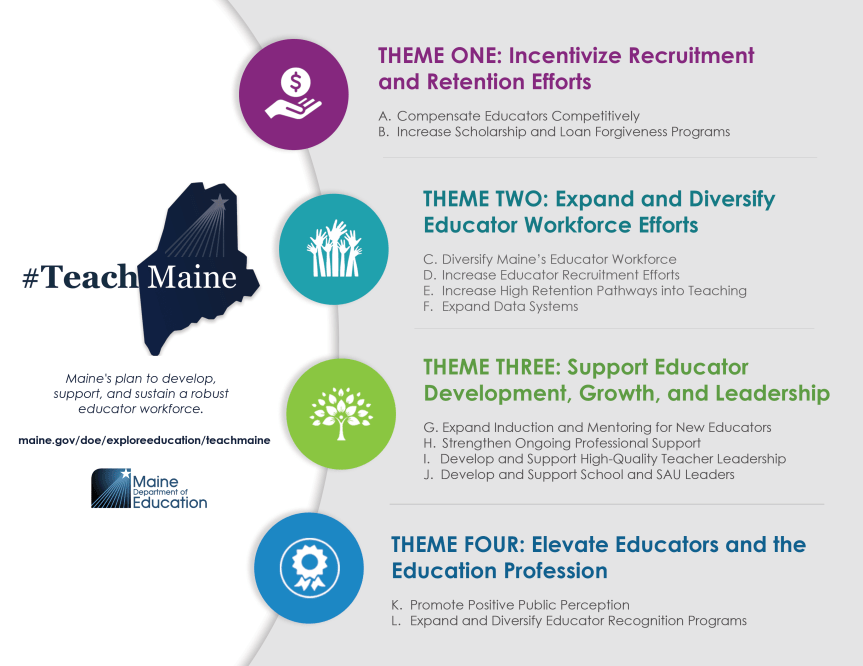
The Teach Maine Plan is organized around four key themes: incentivize recruitment and retention efforts; expand and diversify educator workforce efforts; support educator development, growth, and leadership; and elevate educators and the education profession. While the Teach Maine Plan has multiple themes, strategies, and actions, they are interdependent and not designed to be implemented in isolation.

“The Maine Department of Education is committed to developing, supporting, and sustaining a vibrant and diverse education workforce, and honoring the expertise and leadership of Maine’s education professionals,” said Maine Education Commissioner Pender Makin. “Maine’s educators give it their all each and every day to teach, inspire, and nurture their students, and the Teach Maine Plan provides the resources and supports they need to keep doing what they do best while also attracting more amazing educators into our schools. I want to thank the many educators and stakeholders who contributed to this effort and we look forward to collaborating on moving this plan into action.”

The report is the result of contributions by education stakeholders throughout Maine, who provided feedback via multiple channels, including regional Think Tanks, focus groups, surveys, organizational meetings, and informal conversations. Additionally, the Department of Education convened an Educator Talent Committee, a core group of internal and external stakeholders, to share their experiences, look at research and trends, and to make recommendations on how to address Maine’s educator shortage.

“Teach Maine provides a blueprint that will help to develop, attract, and retain quality educators that the children in Maine deserve. The future of Maine’s economy is grounded in providing our students with a diverse and rigorous educational experience. Teach Maine will provide the foundation to ensure that Maine students graduate with the passion, knowledge, and skills to be productive members of the world they will lead,” said Maine School Superintendents Association Executive Director Eileen King.

“The themes of the Teach Maine Plan hit upon key issues to ensure that our system of public education in Maine will continue to be strong. Recognizing, respecting, and rewarding our educators for the vital work they do every day is critical to providing the education our students deserve,” said Maine Education Association President Grace Leavitt.

“We are very excited to see the impact that Teach Maine will have on our profession. By having a stronger emphasis on recruitment, and then providing mentoring and ongoing support that educators and educational leaders need, will only help keep high quality professionals in education. This is what our students deserve,” said Maine Principals’ Association Executive Director Dr. Holly Blair.  

“Teachers are the most important element in ensuring Maine has a well-educated citizenry that is essential for our future workforce and democracy. These strategies will help strengthen the teaching profession in Maine,” said Educator Talent Committee member and University of Southern Maine Chair and Associate Professor of Teacher Education Dr. Flynn Ross. 
The first theme of the Teach Maine Plan, incentivize recruitment and retention efforts, focuses on compensating educators competitively; providing financial incentives for high-needs subjects and locations; providing financial incentives for teacher expertise and teacher leadership; encouraging alternative compensation strategies, including housing, transportation, childcare, creative use of time, and sabbaticals; increasing scholarship and loan forgiveness programs; expanding service loan forgiveness and tax incentive programs; and increasing awareness of funding sources.

Research shows that low salary scales continue to negatively impact the educator pipeline, as well as the retention of practicing teachers. Compared to college-educated professionals in other fields, beginning teachers earn about 20 percent less, with the gap widening to 30 percent by mid-career. While the Mills administration made a significant step in addressing overall teacher compensation to guarantee a minimum salary of $40,000, more must be done to make working in education a financially sustainable career.

The second theme, diversify and expand educator workforce efforts, includes strategies to recruit, prepare, and hire racially, ethnically, and linguistically diverse educators; retain diverse educators by addressing the policies and practices of structural racism; increase educator recruitment efforts; reduce costs; increase marketing for active recruitment of educators; increase high retention pathways into teaching such as teacher residencies, grow your own, and education career pathways starting in high school; promote teacher residencies for high-need School Administrative Units (SAUs) and content areas; promote additional dual certification programs for high-needs content areas; grow your own education technician and community college partnerships; and education career pathways in high school/CTE schools.

Building an educator workforce that reflects the racial, ethnic, and linguistic diversity of the student population has been shown to have positive impacts on student achievement. Research has shown that matching teacher racial identity with student identity can improve academic achievement, high school graduation rates, and college enrollment rates. And all students who have had teachers of diverse races or cultural backgrounds are better prepared for success in a global world.

The report finds that to make progress towards recruitment and retention initiatives, Maine needs a comprehensive and transparent data collection and management system. The strategy to expand data systems includes actions to characterize the current educator population in greater detail; determine educator needs geographically in Maine; create a statewide job board; and collect SAU-level data such as exit interviews and surveys.

Theme three, support educator development, growth, and leadership, includes strategies to expand induction and mentoring for new educators; strengthen state and SAU supports for mentoring and induction; scaffolded induction with time to learn, including not just orientation and access to mentors but also access to coaches, common planning time with mentors, and resource allocation to support success; establish a network of new educators for peer support; strengthen ongoing professional support through professional learning opportunities at the school, SAU, regional, and state level; develop and support high-quality teacher leadership; and develop and support well-qualified school and SAU leaders.

The support that new educators are given throughout their pre-service career and first few years of teaching has a direct impact on their retention as career educators. Key elements of high-quality induction strongly associated with reduced rates of teacher turnover include assigning mentors from the same field, common planning time and opportunities to collaborate with teachers in the same subject area, and being part of an external network of teachers.

Theme four, elevate educators and the education profession, includes strategies and actions to promote the positive public perception of public education and the education workforce, and expand and diversify educator recognition programs. To recruit and retain a vibrant educator workforce and make teaching an attractive profession also requires strengthening public perception and confidence in Maine schools and demonstrating appreciation for educators not just during teacher appreciation week, but every week of the year.


Maine Educators Embark on North Star Journey: FableVision Learning & Maine DOE Launch Year-Long Initiative to Foster Creativity with Educators and Students

Maine’s Department of Education’s State Agency Program Team set sail on a creativity journey to transform teaching practice and classroom outcomes through a unique partnership with Boston-based educational company FableVision Learning, founded by Peter H. Reynolds.

“We were eager to provide equitable access to quality instruction to Maine’s vulnerable youth in therapeutic education settings to enhance special education programming after the difficult times caused by the pandemic, when emotional and social issues have been heightened,” explained Dr. Mary Adley, Coordinator of State Agency Programs. “We wanted to provide staff and students a sense of excitement and creativity to view their world with optimism and we knew FableVision Learning would help us achieve that.”

Adley and her team provide oversight to educational programming for state wards and state agency clients. This includes the General Supervision System of Monitoring for Maine’s approved Special Purpose Private Schools. Her team also offers special education technical assistance, professional development, and support to Maine educators, students, and families for Maine children in the care or custody of the Department of Health and Human Services or the Department of Corrections, educated in all settings, both in public and private settings and within Maine and placed in out of state settings.

“Our team is delighted that FableVision is embedding the Department’s Maine MOOSE (Maine Online Opportunities for Sustained Education) modules as curricular/content to guide educators in developing creative and specially designed instruction needed to meet each student’s Individual Education Program,” shared Dr. Tracy Whitlock, Coordinator for Special Projects.

This multi-level program of support integrates evidence-based instructional strategies, such as elements of  Dr. John Medina’s “Brain Rules,” with intentional focus on social-emotional welfare for both staff and students. Every month, educators from 9 agencies representing 25 schools meet virtually for the Creative Maine workshop and the FableVision Learning team guides discussions and activities around creative instructional design and inspiration to enhance teaching practice. A community of practice is provided on FableVision’s collaborative learning platform The Creativity Circle.

“We are exploring with teachers ways to expand the pathways for students to demonstrate their knowledge and to engage in deep and creative thinking,” explained Sara Smith, FableVision Learning’s creative curriculum developer. “Creativity in the classroom empowers both teachers and students to maximize their talents and make meaning.”

In addition to student projects highlighted in the Creative Maine course, educators are utilizing the FableVision Learning’s The North Star Program to further develop student voice and creativity.

“The essential outcome of education is for students to know who they are and what they can give to the world,” Jane Reynolds, president of FableVision Learning said. “The classroom is where they should be able to explore their strengths, learn resilience, and discover their power to create in a safe and supportive environment.”

Based on the themes in the book “The North Star,” by FableVision founder and New York Times bestselling-author/illustrator Peter H. Reynolds, The North Star Program is a guide to creating a classroom where students uncover their true potential.

“I have found The North Star Program to be very adaptable. I can integrate it with the existing social skills curriculum as well as adjust lessons to fit the variety of learning levels in my classroom,” explained Teresa Dickson, participating educator from NFI Sidney River Bend.

The program includes best practices for setting up the classroom and establishing a positive, creative climate as well as 18+ weeks of activities and projects that help students develop their strengths, values, and goals that will start laying the path to the future selves they want to be. Activities include teamwork challenges, problem solving projects, social-emotional games and experiences, literature exploration and discussions, and personal reflection writing pieces.

“Since I have begun using The North Star Program, I have watched my students become more confident in their learning and more accepting of themselves and others,” Dickson said. “The lessons can be taught in sequence or be pulled out to target a specific concept or skill. I was able to easily integrate The North Star Program with the Common Core Standards. The North Star Program hits many content areas such as music, art, writing, reading, and poetry.”

In 2022, Maine Department of Education’s State Agency Programs and FableVision Learning will continue the Creative Maine journey as educators continue to explore creative problem solving and creative classroom management.

***

About FableVision Learning

FableVision Learning is a Boston-based company founded by Peter H. Reynolds, New York Times best-selling author/Illustrator who has been inspiring teachers for over three decades with his message books for all ages, animated films and creativity software. FableVision Learning’s tools, curricula and programs are informed by the philosophy in Reynolds’ books, which encourages teachers to create bravely on their own creative journeys as they lead the way for their students. Along with its award-winning suite of research-backed learning games and animation software, FableVision Learning also develops custom, in-class/hybrid remote programs for educator/leader PD, after school, CTE, and summer learning, with a focus on storytelling, creativity and SEL.

About Maine Department of Education Office of Special Services

The Maine Department of Education – Office of Special Education is dedicated to improving results for students with disabilities by providing leadership, support and oversight to local education agencies. The Office of Special Services is committed to ensuring the provision of a free appropriate public education in the least restrictive environment for children with disabilities (ages 3 to 22) as well as early intervention services to infants and toddlers (birth through age 2). Our work is accomplished through collaboration with families, school districts, public and private agencies, and other programs.

Supporting Interdisciplinary Instruction in Maine Schools  

The Maine Department of Education (DOE) is committed to a whole student approach to teaching and learning that develops healthy, safe, engaged, supported, challenged, and prepared students. Meaningful learning that is project-based, integrated, and has application to the real world is essential to the whole student approach, and the Department is enhancing our support to the field around interdisciplinary instructional practices and an educator-leader model.  A dynamic team of Interdisciplinary Instruction Specialists – formerly DOE content specialists – has been brought together at the Department to lead this exciting, transformational work that builds on their deep content knowledge.   

The Department’s Interdisciplinary Instruction team will support the field in exploring interdisciplinary and project-based approaches to teaching and learning.  By offering professional learning opportunities that support the quality teaching and learning already present in Maine’s schools, these specialists will support Maine schools’ targeted efforts to expand varied and innovative learning experiences and environments for all students, and to remove barriers. These opportunities, combined with targeted resources, will support schools across the state in exploring new and exciting ways of engaging the whole student and preparing each for success in their lives.   

Interdisciplinary instruction relies on multiple content areas working together to develop student knowledge, problem-solving skills, self-confidence, self-efficacy and a passion for learning, while supporting students’ various learning styles, diverse backgrounds, interests, talents, and values. By focusing on providing interdisciplinary and project-based learning opportunities, student engagement in learning increases, student-centered learning becomes the norm, and students build critical thinking skills and problem-solving strategies. 

The Department wants to honor and elevate the expertise in the field, and will be inviting educators and education organizations to share their expertise with one another to expand opportunities and collaborate statewide. To support this effort, the Department has a new suite of webpages with information and resources, and the Interdisciplinary Instruction Specialists have started hosting a series of office hours to collaborate and discuss how the Department can best support innovative teaching and learning practices.   

Check the Department’s Professional Development Calendar for the schedule of those office hours. Soon, the Specialists will begin offering professional learning opportunities related to interdisciplinary and project-based learning, and these offerings will be both synchronous and asynchronous. 

For more information, please contact Jason Anderson, Interdisciplinary Instruction Team Coordinator, at jason.anderson@maine.gov. 

Panelist Opportunities for Maine Science Educators

The Maine Department of Education (DOE) is currently recruiting educators to participate in an upcoming standard setting for the state’s science assessment, Maine (MEA) Science.

Maine educators and the DOE play a crucial role in the development of this assessment for students. No prior experience with standard setting or standard setting methodology is required, however panelists should be a science expert that teaches the students who participate in the Maine Science assessment and have a thorough understanding of the assessed Maine Learning Results (MLRs) Next Generation Science Standards (NGSS). Participants must be able to differentiate between student performances at different levels of achievement. Standard setting panels consist of ten (10) educators per grade band (grade 5, 8, and 3rd year of high school).  Panelists will have the opportunity to discuss and determine application thresholds for Maine.

The Assessment Team is currently recruiting educators with a general science background, however preference will be given to high school teachers with the following areas of science expertise to ensure broad representation of all science domains:

  • Chemistry
  • Physics
  • Life Science
  • Earth & Space

The standard setting is scheduled to take place from July 26th – 28th 2022 in Augusta. Travel, accommodations, and expenses will be covered with a daily stipend provided to selected panelists.

Please consider applying or sharing the upcoming opportunities with colleagues. The expertise and contributions of Maine educators are a critical element of the continued development cycle for these assessments.


Interested? Complete the panelist registration survey or use the QR code provided below.

Want more information? Please reach out to Janette Kirk, Director of Federal Programs, at Janette.Kirk@maine.gov.

MEDIA RELEASE: Mills Administration Announces Pooled Testing for COVID-19 in Maine Schools to Conclude in May 

The Mills Administration announced today that pooled testing for COVID-19 in Maine schools will conclude in May, given its reduced effectiveness in limiting the spread of the highly contagious BA.2 variant and the widespread availability of free and convenient at-home tests for students and school staff.

The BA.2 variant is significantly more contagious than previous strains of the virus, lowering the likelihood of detecting, identifying, and isolating an individual with COVID-19 through pooled testing before that individual has spread the virus to others. In this new phase of the pandemic, frequent use of over-the-counter rapid antigen tests has become a more effective way to protect the health of school communities. The Maine Departments of Education and Health and Human Services are supporting this strategy by making 1.1 million at-home test kits available to all K-12 schools in the state. This is enough for schools to supply every school student and staff member with a free rapid antigen test kit containing five to six tests.

The final week for schools to conduct pooled testing will be May 9-13, with the last set of results reported to schools by May 15.

During previous stages of the pandemic, when the virus was less transmissible, pooled testing effectively limited the spread of COVID-19 in Maine schools. Since the program’s launch in May 2021 through April 1, 2022, 488 schools across Maine have tested 128,990 pools, with 11,679 pools identifying positive individuals. The positivity rate has averaged 9.1 percent, reaching as high as 28 percent in January 2022.

Participation in pooled testing peaked in December 2021, with 40 percent of the population in 416 schools using the program. As of this week, 34 percent of the population in 440 schools are participating in pooled testing.

“As the COVID-19 virus changes, so must Maine’s testing strategy,” said Health and Human Services Commissioner Jeanne Lambrew and Maine Center for Disease Control and Prevention Director Nirav D. Shah. “Pooled testing successfully protected the health of our school communities during earlier stages of the pandemic, and frequent use of free and convenient at-home tests will continue to protect students and staff as we confront the BA.2 variant. We thank Maine schools for partnering with us in this important effort.”

“Maine schools have done a heroic job throughout the pandemic keeping schools open and ensuring the safety of students and staff. That has meant transitioning to new strategies to address new variants and phases of the pandemic,” said Maine Education Commissioner Pender Makin. “While pooled testing was an important tool for schools in an earlier phase of the pandemic, regular home testing is a more effective strategy given how contagious the BA.2 variant is. By providing schools and families with access to free tests, we can continue to ensure the health and safety of students and school staff.”

“The Maine School Superintendent Association appreciates the thoughtfulness with which we are moving forward, adapting as needed to ensure our schools can remain open and safe,” said MSSA Executive Director Eileen King. “We have been grateful with the DOE’s and Dr. Shah’s commitment to meeting with superintendents to gain insight and hear feedback on operationalizing the important and evolving safety protocols and protections.”

“School boards across Maine have been tasked with ensuring that safety protocols and resources have been provided to keep schools open and students and staff safe,” said Maine School Boards Association Executive Director Steve Bailey. “While pooled testing has been a welcome tool in the prevention of the spread of COVID-19, our schools now have the opportunity to provide additional resources in the form of at-home test kits directly to all staff and students. With the BA.2 variant, these home tests will be a more efficient and effective method of detecting and preventing the spread of COVID-19.”

“Throughout the pandemic, the Maine Education Association has urged districts to follow the guidance of the Maine CDC and decisions based on science,” said MEA President Grace Leavitt. “At-home tests for all staff and students will help to detect the virus and minimize its spread so staff and students can be as safe as possible while keeping schools open as we enter these last months of the academic year.”

“School nurses continue to work in our schools, promoting health and safety on behalf of families in Maine,” said Melinda Nadeau, President of the Maine Association of School Nurses. “This change will support families and allow school nurses to focus on the continuation of point-of-care testing of symptomatic students. We look forward to returning to a focus on the whole student and traditional school health program activities that are necessary for students to be safe, healthy, and in school, ready to learn. Collaboration between our public health system and our school nurses is vital to anticipating and implementing future pandemic response needs.”

The Mills Administration has supported schools in limiting the spread of COVID-19 since the start of the pandemic, with most Maine schools remaining open since the fall of 2020. The Maine Department of Health and Human Services has provided all K-12 public and private schools with access to pooled testing using federal funds from the U.S. Centers for Disease Control and Prevention. Pooled testing involves collecting swabs from small groups of consenting students and staff, such as from one classroom, combining the test samples into a “batch” or “pool,” and then testing the single pooled sample using a PCR test, with results taking several days. If pool results are positive, the individuals in that pool are retested using a BinaxNOW rapid antigen test.

As the pooled testing program concludes, the Department has transitioned to other federally funded initiatives to limit the spread of COVID-19 in schools and Maine communities by expanding access to at-home tests. Since DHHS launched the free at-home testing program for schools on April 7, 2022, 125 Maine schools have placed orders for 528,040 tests. DHHS and DOE continue to encourage schools to place their orders now through April 15, 2022. Test kits will be shipped to schools beginning the week of April 25. Participating schools and SAUs may distribute the at-home tests during this spring, summer, or fall, at their discretion.

In addition to this distribution of at-home COVID-19 antigen test kits to schools, DHHS encourages school staff and families to request free tests through the Federal Free COVID Tests Program and Project Access COVID tests (ACT). Through the successful Project ACT pilot, DHHS has made free tests available directly to Maine people by mail order. As of April 12, Maine households have ordered 266,140 tests through Project ACT. For more information, visit Maine’s COVID-19 Testing website.

This spring, summer, and fall, DHHS will continue to distribute point-of-care COVID-19 tests to PreK-12 schools. School nurses and health staff in school settings have used these tests for screening and diagnostic purposes. Since November 2020, DHHS has distributed 396,100 BinaxNOW point-of-care tests to schools.

DHHS has additionally distributed nearly 120,000 federally funded tests to child care facilities across the state to help limit the spread of COVID-19 while minimizing job disruptions for parents and employers.

Notifying the DOE on Changes to School Configurations

The Maine Department of Education (DOE) is asking that School Administrative Units (SAUs) who anticipate changes to school configurations for school year 2022-2023 to notify the DOE by May 1, 2022, or within 3 days of a School Board’s final approval of the change.  The Superintendent of the SAU can email MEDMS.Helpdesk@maine.gov to notify the Maine Department of Education of the circumstances that may warrant a new school ID.

Reasons to notify the DOE include, but are not limited to:

  • Lack of need school closure
  • Change in grade configuration
  • Split of school
  • Merging of schools
  • New Schools

When emailing, please include the school(s) that displaced students will attend in the next school year, if applicable.  The Data Reporting Coordinator and the Education Data Manager will analyze the data and documentation, and coordinate with the Superintendent of the SAU on next steps and if new school ID(s) will need to be created.

If you have any questions, please feel free to contact the Helpdesk at MEDMS.Helpdesk@Maine.gov or 207-624-6896.