Education Commissioner Makin Visits Katahdin Elementary School and Explores Outdoor Learning Spaces

Education Commissioner Pender Makin visited Katahdin Elementary School this week to meet with students and staff and experience the growing outdoor learning opportunities at the school.

Commissioner Makin was joined by Superintendent and Katahdin Elementary School Principal Dr. Marie Robinson, who proudly introduced her staff, many of whom are graduates of the Katahdin schools. The sense of pride and community was evident throughout the building, as well as the commitment to a supportive and fun learning environment. Ms. Jaide Berry joined on the tour of the school and talked about the ways in which she uses the outdoor spaces to connect with students as part of their social and emotional skill building activities. Katahdin Elementary School has created a space where students and staff learn about restorative justice practices, including understanding how the brain works, and how to communicate effectively as valued members of the school and classroom communities.

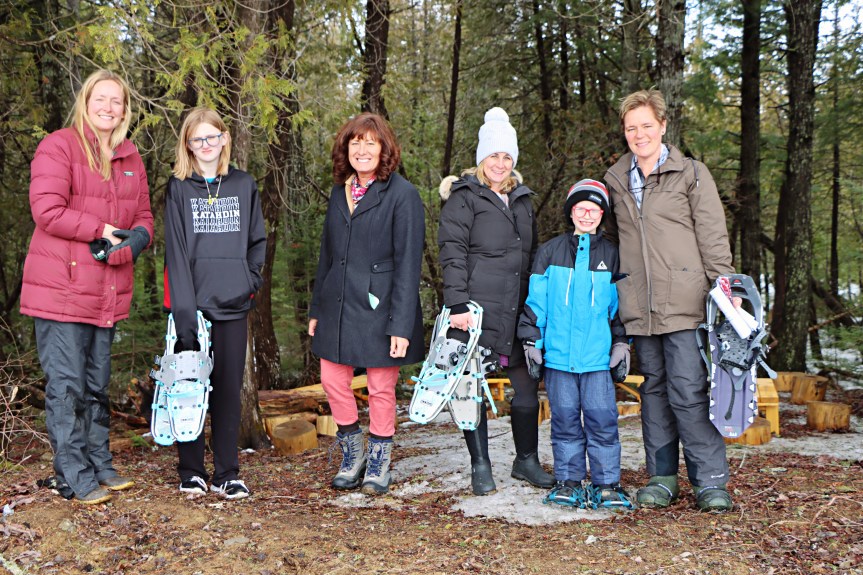
As she greeted pre-k students on their way into afternoon classes, and learned about another class’ outdoor investigation to find signs of spring, Commissioner Makin had the privilege to thank the teachers of Katahdin Elementary School for all of their hard work and dedication to their students. After a quick tour inside, it was time to put on snowshoes and head out to investigate the amazing learning spaces on campus. The school has snowshoes, skis, and a clothing supply closet that students can access, ensuring that with the right gear, all weather is good weather for learning!

Joined by grade 2 student Bentley and grade 5 student Abbie, Commissioner Makin got to check out outdoor learning spaces, including a shelter built by grade 5 students with the volunteer assistance of a school board member, who used his military training to design a cozy and dry space, and a pond where a game camera caught the exciting adventures of a beaver family and their hut.

With a commitment that began in 2016 to getting students outdoors more, Katahdin Elementary School has developed a campus with trails, a weather station, raised garden beds, and even their own apple orchard. As schools shifted to outdoor learning spaces over the past two years as a prevention method for the spread of COVID-19, the school expanded their own offerings, and used federal relief funds to build large outdoor learning pavilions, and RREV (Rethinking Responsive Education Ventures) funds received through the Maine Department of Education for other outdoor spaces.


Maine Department of Education and University of Southern Maine Partner to Increase School Psychology Supports in Maine

The Maine Department of Education (DOE) and the University of Southern Maine (USM) Department of Educational and School Psychology announced a new partnership to increase the number of school psychologists within the state and expand school psychology services for Maine’s students and schools.

With support from the Maine Department of Education, the University of Southern Maine has created a new, full-time clinical faculty position to expand internship programs within the state and prepare larger numbers of credentialed school psychologists to provide effective and comprehensive school-based services. School psychologists are trained and prepared to help schools improve academic achievement, promote positive behavior and mental health, create safe and supportive school environments, strengthen family-school partnerships, improve schoolwide assessment and accountability practices, and advance equitable practices for diverse populations.

“School psychologists play such an important role in supporting the mental health and wellbeing of students and creating safe, welcoming, and supportive environments for our young people,” said Education Commissioner Pender Makin. “The pandemic greatly increased the need for these supports in our schools and we’re excited to partner with the University of Southern Maine to provide a pathway to increase the number of school psychologists in Maine schools as well as offering additional supports and resources to current school psychologists.”

Dr. Samantha Blair has been selected to serve in this new role as a Clinical Assistant Faculty in the Department of Educational and School Psychology at the University of Southern Maine.

“I am excited to be a part of this collaboration with the University of Southern Maine and the Department of Education because I am committed to the professional development of school psychologists and working with stakeholders throughout Maine to support the work in the field,” said Dr. Blair. “I am looking forward to continuing to learn about the needs throughout the state, and through collaborative efforts increasing the number of school psychologists and expanding their role to increase access to high-quality comprehensive services to students throughout Maine.”

Blair will collaborate with school psychologists and schools across the state to design, coordinate, and supervise field-based training experiences in school psychology. She will assist with the development of comprehensive practicum and internship programs, support priority initiatives within partnering schools, provide supervision to school psychology trainees, and offer professional development in clinical supervision for school psychologists.

“The recently announced partnership between the Maine Department of Education and the University of Southern Maine is exciting news for the field of education, particularly special education. School psychologists play an integral role in supporting the educational and social emotional needs of students with disabilities,” said Gay McDonald, Executive Director of Maine Administrators of Services for Children with Disabilities (MADSEC). “As active members of the student’s educational team and as trained individuals to conduct the required comprehensive evaluations under the Individuals with Disabilities Education Act, school psychologists are greatly needed in our schools. This partnership shows the Department’s commitment to address the shortage of school psychologists across the state and to assist in meeting the individual needs of our students. Such a collaborative effort will have a high impact for Maine students, and we applaud the MDOE and USM on this partnership.”

DATA WEBINAR: April Enrollment Certification Report – April 5th

The April Enrollment Certification report opens on April 1 with a certification due date of April 15th. The Maine Department of Education’s Data Team will be hosting a webinar on Tuesday April 5th at 10am to go over the April Enrollment Details report and the April Enrollment Certification report.

Please follow the “Join Live” link at the time of the training to join us. Thank you.

For questions, contact the Maine DOE Helpdesk at medms.helpdesk@maine.gov.

MEDIA RELEASE: Maine Department of Education Announces $1.2 Million in Rethinking Responsive Education Ventures (RREV) Funding to Support Education Innovation

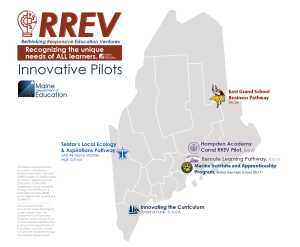
The Maine Department of Education (DOE) today awarded $1.2 million in Rethinking Responsive Education Ventures (RREV) funding to support education innovation in six School Administrative Units across Maine. These funds will be used to support projects focused on workforce development, environmental stewardship, outdoor education, a marine institute, and internship opportunities as well as supporting unique approaches to remote learning.
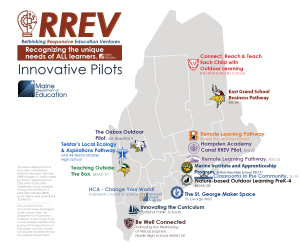
Awardees for this second round of RREV funding include East Grand School in Danforth, Belfast Area High School, Portland School Department, Telstar High School in Bethel, RSU 22 in Hampden, and RSU 25 in Bucksport.

“Education is changing in so many new and exciting ways, and we should be at the forefront, introducing our children to the great outdoors and offering them hands-on experiences outside the classroom that will spark new perspectives, engender new friendships, and deliver new skills,” said Governor Janet Mills. “Using these federal enrichment funds, creative Maine educators can get children outdoors this summer, exposing them to lived experiences that will get them ready for life and new careers.”

“Educators in Maine are constantly paving the way with their innovation and creativity, and RREV offers a way to supercharge these efforts,” said Education Commissioner Pender Makin. “We’re excited to invest in these educator-led projects to rethink teaching and learning in ways that deepen student engagement, expand beyond the traditional classroom, connect students with Maine’s bounty of natural resources, and allow them to explore career paths that fuel their passions.”

The Maine DOE was awarded $16.9 million from the U.S. Department of Education’s Rethink K-12 Education Models Funding. As one of 11 States to receive funding, Maine created RREV to support the work of visionary educators to develop innovative pilot programs around remote and outside of the classroom learning. RREV is flooding Maine with innovative practices, professional development, and pilot design classes. Courses in innovative design process are available through several of Maine’s public and private universities at no cost to Maine educators who wish to participate. In addition to the innovative pilot development classes, the Department is also offering asynchronous, innovative principles webinars which are available to all educators in self-paced, independent modules.

The first round of nine RREV pilots were announced last fall with an initial investment of more than $2 million to support projects including expanded outdoor learning, a makerspace, hiring an Outdoor Learning Coordinator, expanded internships, service learning, and work/study opportunities, and engaging remote learning pathways. MSAD 17, Brewer School Department, MSAD #28, RSU 89 Katahdin Schools, Mt Blue HS/ Foster Technology School, Harpswell Coastal Academy, Noble High School, MSAD 60, St. George Municipal School Unit, and School Union #76 were all part of the first round of pilots.

“At St. George School, we dare to dream big. For over 5 years, our school community has been working to bring the trades, technology, and innovation back to the heart of public education and allow all students, grades K-8, to engage in hands-on/minds-on projects,” said St. George MSU Superintendent Mike Felton, part of the first round of RREV pilots. “The RREV Program believes in the power of local schools and communities to shape their future and isn’t afraid when a small school dreams big. RREV’s support, assistance, and encouragement will help make our dream of a St. George K-8 Career Technical Education/Makerspace Building a reality and, in the process, stretch people’s imaginations as to what’s possible in rural education and economic development.”

For more information on how to get involved in RREV and to learn more about the pilots, visit https://www.maine.gov/doe/rrev. 

New Pilots:


All RREV Pilots:

MEDIA RELEASE: Maine Department of Education Resources on Helping Young People Safely Navigate the Internet

During his State of the Union address this week, President Biden called for increased measures to ensure young people are protected on the internet and while using social media. The Maine Department of Education offers parents, educators, and students a number of free resources, by grade level, to help young people safely navigate the internet and avoid dangers that can impact their physical and mental health.

The Maine Department of Education’s comprehensive web-based social emotional learning resource SEL4ME embeds specific lessons in interest safety at every grade level. For example, the second grade module Be Fine Online helps students learn ways to stay safe when online, including the importance of never revealing their personal information; sixth graders have lesson like Be Aware What You Share in which they gain a deeper understanding of internet safety and social media and on cyberbullying; the eighth grade lesson User Beware: The Scary Side of the Internet helps students understand that not everything on the internet is safe, including how to spot online predators and the dangers of sexting; and in 11th grade, students have access to Cyber Bullying and Digital Citizenship which goes into the effects of online bullying and the virtual footprint that can follow them into the work place.

SEL4ME is free to all Maine schools, families, and community partners and offers more than 450 PreK-12th grade learning modules. Each grade level hosts lessons within the five key elements of social emotional learning (SEL): self-awareness, self-management, social awareness, relationships, and responsible decision making. Educators, families, and students can learn more and sign up here.

The Maine Department of Education’s Digital Learning Specialists, in partnership with the MLTI Ambassadors, also provide professional learning, resources, and support for digital citizenship, social media use, online safety, and cyber security. MLTI also partners with Common Sense Education to share digital citizenship and online safety resources with educators. Educators can also reach out to specialists directly to explore ways to integrate these skillsets into their instruction to help students stay safe online.

“The internet is a tremendous resource for students to explore and activate their passions, develop skills and knowledge, build connections, and expand their digital literacy, and Maine educators and schools are constantly integrating technology into teaching and learning in innovative ways,” said Education Commissioner Pender Makin. “We’re also committed to making sure students have the tools and resources they need to navigate the internet safely and avoid the very real dangers that President Biden outlined in his State of the Union speech that pose a threat to the physical and mental health of our young people. We encourage educators and families to take advantage of our free resources.”

Paid Professional Learning Opportunity Provided by Maine DOE

The Maine Department of Education (DOE) is accepting applications from individuals interested in learning more about the competitive grant process. Selected applicants will be trained to serve as peer reviewers who assist the DOE in reviewing, assessing, and scoring competitive grant proposals for the 21st Century Community Learning Centers (21st CCLC) Program. The 21st CCLC program is a federally funded education program that helps schools and communities develop before-school, after-school, and summer educational programs that support students and their families.

This year’s Request for Proposals (RFP) for the 21st CCLC program was released to the public on January 5, 2022 and is available online at https://www.maine.gov/dafs/bbm/procurementservices/vendors/rfps. The DOE anticipates receiving proposals from local education agencies, community-based organizations, and other eligible entities seeking awards under this RFP.

Qualifications:
Peer Review applicants will be selected based on their experience in providing effective academic support, enrichment, youth development, and related support services for children and youth. The most qualified candidates will be individuals who have experience in the administration of high-quality youth development programs within schools and communities. Examples of the experienced individuals sought include, but are not limited to:

  • 21st CCLC program directors and site coordinators
  • Teachers and principals
  • College and university staff
  • Youth development workers
  • Community resource providers

Required Tasks:
Selected applicants must be able to participate in an online training and review grant proposals through a web-based system. Applicants will work individually to read each assigned proposal and create detailed, objective, constructive, and well-written comments on approximately 10 proposals based on the criteria established in the RFP.  These comments will be submitted to the DOE prior to participating in the scheduled consensus scoring sessions. It is anticipated that peer reviewers will have a three week window in which to complete their individual review of assigned proposals. Following the individual review of proposals, each successful applicant will be required to participate in a series of two online/virtual consensus scoring sessions hosted by the DOE. It is during these consensus scoring sessions that the peer review team will score each application.

Selected applicants must complete the following tasks during the following date(s):

Task Date(s) Time(s)
Participate in an online training webinar March 31, 2022 1:00 PM – 2:30 PM
Review grant applications through a web-based system and provide individual, written comments on each application (which must be submitted to the DOE) April 18, 2022 – May 6, 2022 Any Time
Participate in online/virtual consensus scoring sessions with other members of the peer review team (applicants MUST be available on all four scoring days, but will only be selected to participate for two days) May 10, 2022 – May 11, 2022; or
May 12, 2022 – May 13, 2022
9:00 AM – 4:00 PM

Compensation for Services:
Selected reviewers who complete the required tasks will be provided an honorarium of $85 per assigned application.

Previous participants have also found that serving as a member of the peer review team is an excellent opportunity for professional development and growth. It is likely that, if selected, applicants will be exposed to new program models, strategies, and practices. These new concepts may provide ideas and support for ongoing work as well as future grant writing efforts. Most importantly, the time given to this effort will help ensure the funding of quality education programs for the children and families of Maine.

How to Apply:
Interested parties should contact Travis Doughty at travis.w.doughty@maine.gov to obtain a copy of the 2022 peer reviewer application and then return the completed application along with a current resume or CV.

Pursuant to Title IV, Part B of the Elementary and Secondary Education Act, as amended by the Every Student Succeeds Act of 2015, peer reviewers may not include any applicant, or representative of an applicant, who has or will submit a proposal in response to the current grant competition.

Deadline:
The Maine Department of Education will continue accepting peer reviewer applications through March 17, 2022, or until the needed positions are filled. Interested parties are encouraged to apply as soon as possible.

Contact:
For more information, contact State Coordinator Travis Doughty at travis.w.doughty@maine.gov or 624-6709.

Robert G. Hasson, Jr. Confirmed as Maine Commissioner of Education

During a 10:00 AM vote of the Maine State Senate on Thursday, March 30th, Robert G. Hasson, Jr., Ed.D. was confirmed as Maine Commissioner of Education. The vote was the final step in Hasson’s confirmation following his nomination by Governor Paul R. LePage, an interview by the State Board of Education, and a vote of the Joint Standing Committee on Education and Cultural Affairs.

A long-time resident of South Portland, Dr. Hasson has spent the majority of his career working in education. He is a former principal, special ed. director and elementary school teacher, in addition to his 20 plus years of experience as a superintendent at MSAD 51, Cumberland/N. Yarmouth.

In a letter to Department staff shortly after confirmation, he wrote, “I intend to use my time as Commissioner to improve the experience of students, bridge the gap between teachers and administration, and provide support in as many ways possible to schools and districts throughout the state.”

Hasson has been Acting Commissioner for the Department since November of 2016 following his role as Director of Certification within the Department. Prior to that, he served in leadership roles at both the Maine School Management Association and the Maine School Superintendents Association.

In presenting Dr. Hasson for confirmation before the Education and Cultural Affairs Committee, Senior Policy Advisor to Governor LePage, Aaron Chadbourne said, “Bob Hasson is fervent about acting in the best interest of Maine students, which is the charge that Governor LePage believes is appropriate for all of us engaged in public education. Governor LePage has given Bob license not only to think outside the box but to disregard the box entirely in pursuit of supporting Maine students and teachers, serving their best interests.”

During the hearing, shortly before the committee voted to confirm Hasson in a 12-0 vote he said, “I am truly honored and humbled to have been given this opportunity.”

Media Advisory: 2nd Annual Farm to School Cook-Off

FOR IMMEDIATE RELEASE
CONTACT:  Rachel Paling (207) 624-6747 or rachel.paling@maine.edu

MEDIA ADVISORY

What:  2017 Maine Farm to School Cook-Off

Who: School food service staff creating breakfast and lunch meal.

Judges for the regional cook-offs include a Career and Technical Education culinary arts student, a school nutrition director and a professional chef.

Where/When: 

  • Monday, March 27 – Regional cook-off
    Westbrook Regional Vocational Center, Westbrook
    1:00pm start time (cooking begins at 1:30pm)
    Teams are representing Falmouth, Yarmouth and RSU 14
  • Friday, March 31 – Regional cook-off
    Capital Area Technical Center, Augusta
    2:00pm start time (cooking begins at 2:30pm)
    Teams are representing Lewiston, RSU 52 and RSU 54
  • Wednesday, April 26th – Final cook-off
    Freeport High School
    1:00pm start time (cooking begins at 1:30pm)

The Westbrook and Augusta CTE centers were chosen as cook-off sites for their well-equipped kitchens and individual cooking and presentation areas.

How:  Each volunteer team will prepare a breakfast and lunch meal within a specific time frame using at least two ingredients that are grown, raised, caught, or manufactured in the State of Maine and meet National School Breakfast and Lunch Program requirements as well as one USDA food. As an added twist Maine wild blueberries and Maine potatoes will be used as “challenge” ingredients in the competition.

RSVP: Members of the media are welcome to attend the competition but are asked to notify Maine DOE Director of Communications, Rachel Paling at rachel.paling@maine.gov or call 624-6747 ahead of time.

These competitions are NOT open to the public.


Media Advisory: Maine DOE welcomes new Director of Communications

FOR IMMEDIATE RELEASE

CONTACT:  Debra Plowman, DOE, 624-6620

(Augusta)  Acting Commissioner of the Department of Education Robert Hasson has announced that Rachel Paling joined the team in the Department of Education as the Director of Communications on Tuesday, February 21, 2017. Rachel previously worked as the Communications Manager at the University of Maine, Augusta where she held that position for 5 years.

“Rachel’s experience in communications, messaging, web management, and graphics and design makes her a great addition to our team and we look forward to her contributions to our mission at the Department.”

Rachel lives in New Sharon with her husband and two children. We are so pleased to welcome her.  You can reach Rachel at Rachel.Paling@maine.gov or by calling 624-6747.

Preliminary FY 2018 State subsidy printouts available

The Department is pleased to announce that the FY 2018 (2017-18 school year) preliminary State subsidy printouts, known as ED 279s, are now available here on our website:

http://www.maine.gov/doe/eps/

These preliminary amounts are based on Governor LePage’s proposed biennial budget. Governor LePage’s FY18 budget proposal includes $991.3 million for general purpose aid for Maine schools and $1,002.4 billion for FY19. The Governor’s budget does propose changes to the current funding law, which include repealing the adjustment for Title I revenues when calculating the per pupil rate, increasing the targeted funds weight for K-2 from 10% to 15%, with a proposal to add grade 3 in FY 2019, and increasing the adjustment for those school units receiving a minimum special education adjustment to 33%.

The subsidy amounts for FY 2018 (2017-18) reflected on these printouts are only preliminary and do not represent final action of the 128th Maine Legislature and should therefore only be used as “initial” guidance for your budget preparations. Some calculations included in these amounts are dependent upon enactment of statutory changes. Please review your ED 279 printouts in order to familiarize yourself with the full scope of changes proposed in the Governor’s budget.

The Department hopes this release of the preliminary ED 279s is informative to your local budgeting preparations. If you have any questions as you review these printouts, please contact our School Finance Team via email:  tyler.backus@maine.gov or paula.b.gravelle@maine.gov or ida.batista@maine.gov or at 624-6790.