Media Release: Maine Department of Education Awards $2.5 Million in RREV Funding to Support Education Innovation

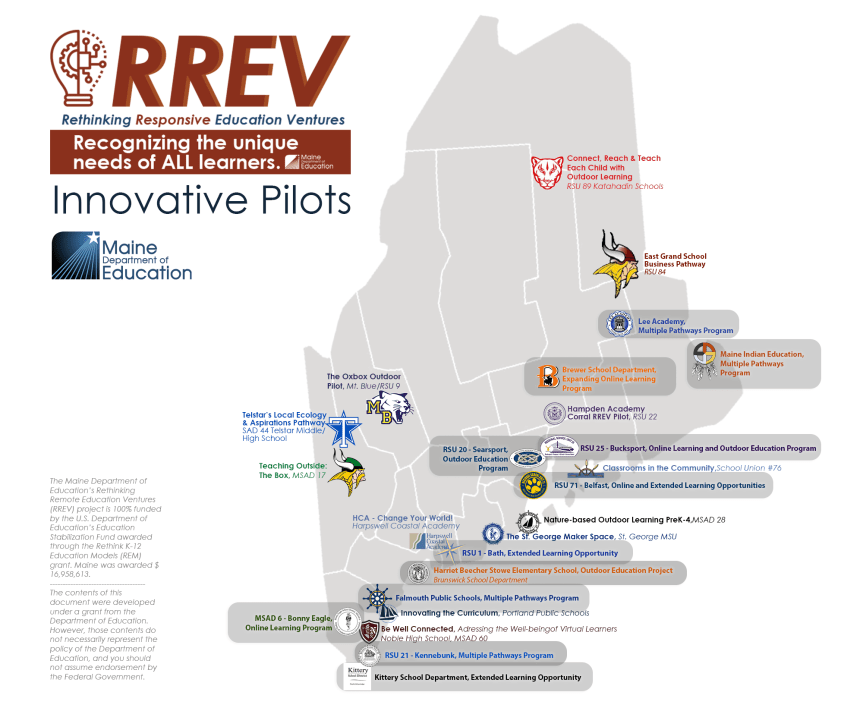
The Maine Department of Education (DOE) today awarded $2.5 million in Rethinking Responsive Education Ventures (RREV) funding to support education innovation in twelve school administrative units (SAUs) across Maine. These funds will be used to support educational research and design projects focused on alternative education strategies, interdisciplinary/experiential learning, environmental stewardship, Wabanaki culture and heritage, outdoor education, and internship opportunities, as well as supporting unique approaches to remote learning.

Awardees for this third round of RREV funding include Lee Academy, Brunswick, RSU 21 in Kennebunk, Maine Indian Education, RSU 1 in Bath, Brewer, RSU 71 in Belfast, MSAD 6 in Bonny Eagle, RSU 25 in Bucksport, Falmouth, RSU 20 in Searsport, and Kittery. The first round of RREV investments were made last fall, a second round in March, and total RREV investments now near $6 million.

“RREV investments help fuel educational research and design and the innovation and creativity of Maine educators,” said Education Commissioner Pender Makin. “We’re excited to invest in these educator-led efforts to deepen student engagement through interdisciplinary learning, expand learning beyond the traditional classroom to include the outdoors and environmental stewardship, explore Wabanaki culture and heritage, expand alternative education strategies, and allow students to explore career paths that fuel their passions.”

The Maine DOE was awarded $16.9 million from the U.S. Department of Education’s Rethink K-12 Education Models Funding. As one of 11 States to receive funding, Maine created RREV to support the work of visionary educators to develop innovative pilot programs around remote and outside of the classroom learning, including professional development and pilot design classes. Courses in innovative design process are available through several of Maine’s public and private universities at no cost to Maine educators who wish to participate. In addition to the innovative pilot development classes, the Department is also offering asynchronous, innovative principles webinars which are available to all educators in self-paced, independent modules.

“RREV has not only helped us to reinvent how we deliver instruction but how we look at changing education as a whole,” said Renita Ward-Downer, Director of Instruction in Brewer.

“Maine Indian Education’s RREV pilot project will allow us to build a connected and immersive, community-based middle school experience that empowers students to always put first their Wabanaki knowledge,” said Beth Clifford, Curriculum Coordinator for Maine Indian Education. “We are eager to develop place-based and project-based educational experiences that connect learning and communities to increase student engagement and academic outcomes, promote partnerships and collaboration, and deepen our understanding of the world around us. Wabanaki history, culture and life will be a core element of programming.”

For more information on how to get involved in RREV and to learn more about the pilots, visit https://www.maine.gov/doe/rrev.  View the map of all RREV recipients.
Media Release: Maine Child Nutrition Programs Continue Feeding Children Beyond School Year with Summer Food Service Program Hot Lunch Summer

As the school year comes to an end, Maine children can access nutritious meals through the U.S. Department of Agriculture’s Summer Food Service Program, administered by the Maine Department of Education (DOE). These meals are available at hundreds of sites across Maine and will be listed on the Maine DOE’s Hot Lunch Summer website.

“No child should worry about going hungry when the school year ends,” said Education Commissioner Pender Makin. “Hot Lunch Summer ensures that Maine children continue to receive the healthy, nutritious meals they rely on during the school year and we thank the schools and organizations that have stepped up to make the distribution of these meals possible.”

The Summer Food Service Program may be offered statewide in areas or at sites where more than 50 percent of the children are eligible for free or reduced meal benefits under the National School Lunch Program or where census track data supports the need. Eligible sponsoring organizations include schools, nonprofit residential summer camps, government agencies, and tax-exempt organizations including faith-based organizations.

The Maine DOE launched a statewide ad campaign to raise awareness that the Summer Food Service Program exists and clearly explain the logistics of where, when, and how Maine children and adolescents can access complementary meals. The multi-media campaign includes a fun, original song entitled ‘Hot Lunch Summer’ for broadcast radio, an accompanying sing-along video in several lengths including a 30-second broadcast and streaming television ad, a series of colorful shareable graphics for social media, and a series of printed materials for distribution at schools and meal sites. The campaign, which will run through July, is expected to generate more than 5.25 million impressions.

To find nearby Summer Meal sites, please visit www.hotlunchsummer.com, or text “Summer Meals” to (914)342-7744.  Information will be available mid-June.

For more information about the Maine DOE’s Summer Food Service Program, contact adriane.ackroyd@maine.gov, call 592-1722 or visit https://www.maine.gov/doe/schools/nutrition/programs/sfsp

###

In accordance with federal civil rights law and U.S. Department of Agriculture (USDA) civil rights regulations and policies, this institution is prohibited from discriminating on the basis of race, color, national origin, sex (including gender identity and sexual orientation), disability, age, or reprisal or retaliation for prior civil rights activity.

Program information may be made available in languages other than English.  Persons with disabilities who require alternative means of communication to obtain program information (e.g., Braille, large print, audiotape, American Sign Language), should contact the responsible State or local Agency that administers the program or USDA’s TARGET Center at (202) 720-2600 (voice and TTY) or contact USDA through the Federal Relay Service at (800) 877-8339.

To file a program discrimination complaint, a Complainant should complete a Form AD-3027, USDA Program Discrimination Complaint Form which can be obtained online at: https://www.usda.gov/sites/default/files/documents/USDA-OASCR%20P-Complaint-Form-0508-0002-508-11-28-17Fax2Mail.pdf, from any USDA office, by calling (866) 632-9992, or by writing a letter addressed to USDA. The letter must contain the complainant’s name, address, telephone number, and a written description of the alleged discriminatory action in sufficient detail to inform the Assistant Secretary for Civil Rights (ASCR) about the nature and date of an alleged civil rights violation. The completed AD-3027 form or letter must be submitted to USDA by:
(1)       mail:
U.S. Department of Agriculture
Office of the Assistant Secretary for Civil Rights
1400 Independence Avenue, SW
Washington, D.C. 20250-9410; or
(2)       fax:
(833) 256-1665 or (202) 690-7442; or
(3)       email:
program.intake@usda.gov

This institution is an equal opportunity provider.

The Maine Human Rights Act prohibits discrimination because of race, color, sex, sexual orientation, age, physical or mental disability, genetic information, religion, ancestry or national origin.

Complaints of discrimination must be filed at the office of the Maine Human Rights Commission, 51 State House Station, Augusta, Maine 04333-0051. If you wish to file a discrimination complaint electronically, visit the Human Rights Commission website at https://www.maine.gov/mhrc/file/instructions and complete an intake questionnaire. Maine is an equal opportunity provider and employer.

Updates on Implementation of New Chapter 115 Regulations

In an effort to keep the education field apprised of implementation progress on Chapter 115 regulations, the Maine DOE certification team wanted to provide the following updates.  Please remember the new regulations begin this Friday, June 10th.

  • Seventy-two different endorsements have already been created and tested and are ready for application submission beginning Friday.  Other endorsements have been created with new regulations and are in the testing phase, while even more are being created.  The plan is to hopefully have all endorsements prepped for application submission for Friday.
  • New PDF support documents that outline requirements for both conditional and professional certifications have been created for every endorsement and are currently undergoing review.  Those will begin being uploaded to the certification website on Thursday, June 9.
  • Enhancements to the website for clarity are currently underway.
  • Communications to the certification office have increased substantially and we have assisted roughly 3,000 educators each of the last two weeks through various channels.  Please be sure to take advantage of the supports we have and are enhancing on the website to help us process applications as quickly as possible.

Seeking Public Comments for a Tydings Amendment Waiver of FY21 ESEA funds and FY22 Carryover of Excess Title I, Part A Funds

Pursuant to the authority granted under section 8401(b) of the Elementary and Secondary Education Act (ESEA), the Maine Department of Education (DOE) intends to submit an application for waivers to the U.S. Department of Education (USDOE).  As required, the Maine DOE is seeking 15 days of public comment from June 7, 2022 – June 21, 2022, on the request to waive the period of availability for Elementary & Secondary Education Act funds and Title I, Part A carryover limitations.

Requirements from which Maine will be seeking a waiver include:

  • A Tydings amendment waiver from Section 421(b) of the General Provisions Act to the U.S. Department of Education (USDOE). The Tydings amendment waiver seeks an extension to the availability of Federal Fiscal Year 2020/State Fiscal Year 2021 Elementary and Secondary Education funds.  Programs affected by this waiver:
    • Title I, Part A of the ESEA (Improving Basic Programs Operated by LEAs), including the portions of the SEA’s Title I, Part A award used to carry out section 1003 school improvement, section 1003A direct student services, if applicable, and Title I, Part D, Subpart 2
    • Title I, Part B of the ESEA (State Assessment Formula Grants)
    • Title I, Part C of the ESEA (Education of Migratory Children)
    • Title I, Part D, Subpart 1 of the ESEA (Prevention and Intervention Programs for Children and Youth Who Are Neglected, Delinquent, or At Risk)
    • Title II, Part A of the ESEA (Supporting Effective Instruction)
    • Title III, Part A of the ESEA (English Language Acquisition, Language Enhancement, and Academic Achievement)
    • Title IV, Part A of the ESEA (Student Support and Academic Enrichment Grants)
    • Title IV, Part B of the ESEA (21st Century Community Learning Centers)
    • Title V, Part B, Subpart 2 of the ESEA (Rural and Low-Income School Program)
    • McKinney-Vento Education for Homeless Children and Youth Programs
  • A carryover limitation waiver from Section 1127(a) of the Elementary & Secondary Education Act of 1965, as amended for Federal Fiscal Year 2021/State Fiscal Year 2022 Title I, Part A funds. The carryover limitation waiver seeks to waive the requirement that limits the Maine DOE’s ability to grant to its local educational agencies (LEAs) a waiver of the 15 percent Title I, Part A carryover limitation of more than once every three years.

The Maine DOE must solicit and respond to public comment on its waiver request as well as provide evidence of the available comment period.  As the Maine DOE moves forward to provide as much flexibility as possible and continued support for expending ESEA federal funds, comments can be submitted to Rita Pello at Rita.Pello@maine.gov. 

MEDIA RELEASE: New Career Exploration Resource for Students Launches

The Maine Department of Labor (DOL) and Maine Department of Education (DOE) have launched a new student career discovery dashboard that presents data on in-demand jobs and wages in a manner that is accessible to students in grades 6-12.

Students can explore these data in a variety of ways, such as by geographic region, career clusters of occupations with similar features, and the typical educational requirement of the career. Students can find information about the role of each career cluster in Maine’s economy with a specific data point, like how many jobs there are today, what Maine workers earn in the career, and how many job openings are projected in the next ten years.

“It is exciting to see the Maine Departments of Labor and Education collaborate to bring the Center for Workforce Research and Information website online,” Maine Legislature Representative Paul Stearns said.  “The site features a wonderful exploration tool to give students, parents and educators the information that they need to make sound, data driven career decisions.”

MDOL’s Center for Workforce Research and Information (CWRI) collaborated with the Maine Department of Education and a group of Maine educators in the design of the student-friendly dashboard. The dashboard includes a video for help navigating the webpage and an introductory guide for counselors, teachers, and students with an overview of available data on jobs and wages in Maine.

“It is never too early to explore your career options and interests,” Labor Commissioner Laura Fortman said. “This new tool gives students and their teachers a user-friendly way to look at potential careers, which jobs are currently in-demand, and what steps they can take to foster the skills they would need to reach their goals.”

“Career exploration tools like this help students see what kinds of careers match their passions and interests, learn valuable insights and information about possible careers, and plan for their futures,” Education Commissioner Pender Makin said. “We’re excited to offer this interactive dashboard to students and teachers and to see the creative ways they utilize this data in their classrooms.”

The dashboard can be interacted with on the Maine Department of Labor’s Center for Workforce Research and Information (CWRI) website: https://www.maine.gov/labor/cwri/student_portal/

The Center for Workforce Research and Information produces data on jobs and wages in Maine, a ten-year job outlook, and a range of other data products pertaining to Maine’s economy and labor market. The student friendly resource has been designed to complement existing online resources such as Get My Future and My Next Move, available to help students find careers that align to their aspirations, interest, and personality.

The 2020 Maine Learning Results Life and Career Ready standards were designed to support the development of key elements of career readiness with career awareness expectations for students in grades K-5 and career exploration and planning expectations for students in grades 6-12.

###

Contacts for Educators/Schools for More Information:
For more information about the CWRI student dashboard, contact Mark McInerney, Director of the Maine Department of Labor’s Center for Workforce Research and Information, at
mark.mcinerney@maine.gov. 

For more information about learning experiences that support students’ career exploration, contact Rick Wilson, Maine Department of Education, Career Exploration Specialist at rick.wilson@maine.gov.  

For more information about the integration of the Maine Learning Results Life and Career Standards into the design of learning experiences for students, contact Jason Anderson, Interdisciplinary Instruction Team Coordinator at jason.anderson@maine.gov. 

Commissioner Makin, Senator King, Students Participate in a Robotics Competition to Launch 19th Annual MLTI Student Conference

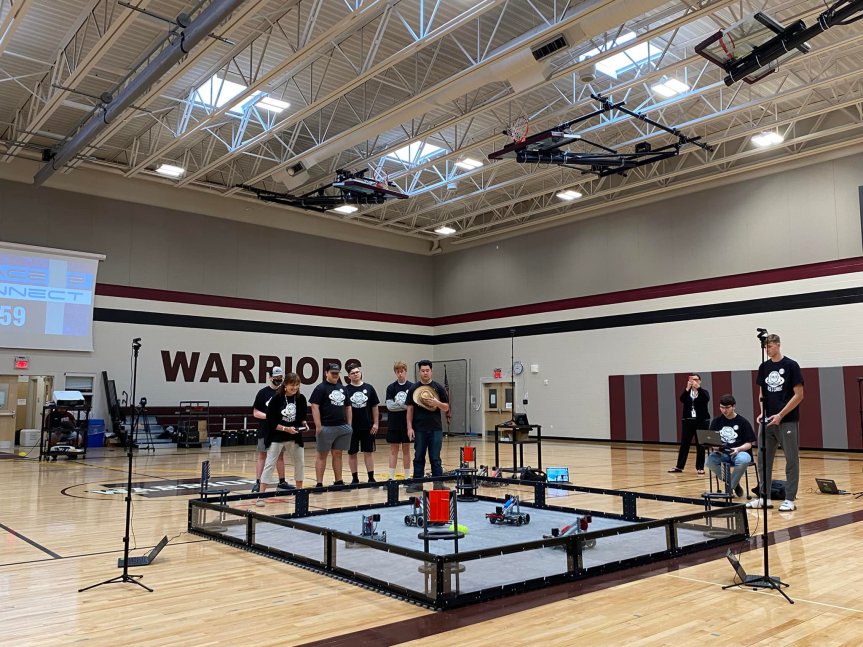
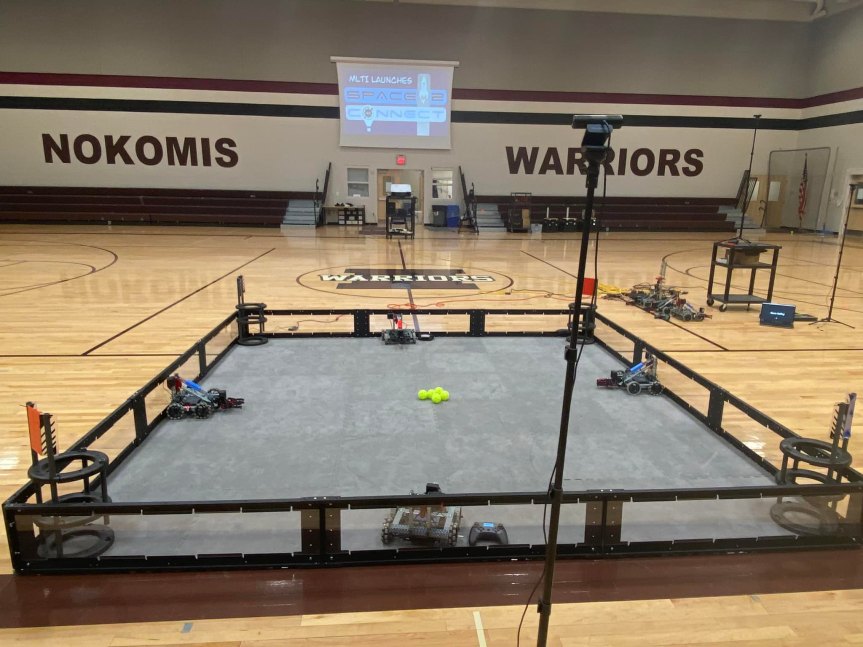
Maine Department of Education Commissioner Pender Makin and Senator Angus King kicked off the 19th annual MLTI (Maine Learning Technology Initiative) Student Conference today by participating in a live robotics competition with students at Nokomis Regional Middle High School.

Makin participated in person while King entered the competition remotely from his office in Washington, D.C. Student teams from schools across the state also competed to see who could get their robot to complete the skills tests the fastest, including nationally-ranked basketball phenom and Nokomis freshman, Copper Flagg. The morning launch session also included a welcome video from Governor Mills and a high-altitude balloon launch into space.

This year’s MLTI student conference was the highest attended in MLTI’s 19-year history with 55 schools, 5,672 students, and 696 educators participating. The theme of this year’s conference was MLTI Launches Space2Connect and included interpretations of space and connection as they relate to Maine students and their use of technology. The new virtual, classroom-based session style allowed students to attend in a classroom setting where they could learn, practice, and create.
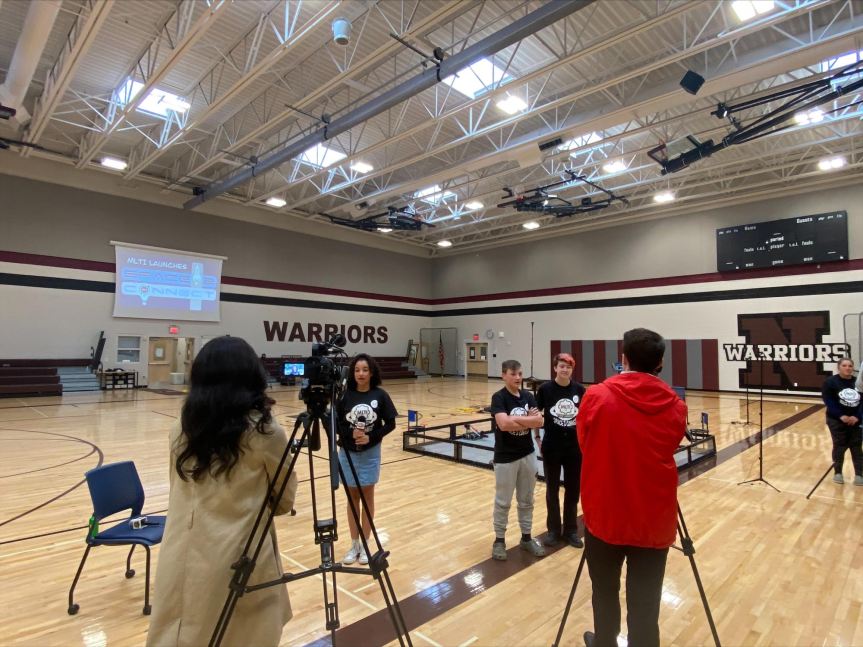
Following the morning launch event, workshop leaders taught the conference participants new skills, provided time for students to practice these new skills, and then supported them as they created something new with what they learned. This new design allowed students to work together as they explored new resources and applications, created with new digital mediums, and collaborated to complete tasks.
Every school also received shirts for all participants that were designed by an MLTI student, and a 3-D printed medallion that traveled to space and back.

Resources for Educators, Students, Parents, and Schools Following the Uvalde Texas School Shooting

Once again, our school leaders and teachers are tasked with helping our students and their families grapple with the senseless murder of young children and their educators inside a school, this time at Robb Elementary School in Uvalde, Texas. Our school staff are dealing with their own emotions, all while trying to assure themselves, their students, and parents that our schools are safe.  

We stand alongside the Uvalde community in their grief and our hearts go out to the entire Robb Elementary School community dealing with the trauma inflicted by this shooter. 

Supporting one another and responding to the needs of students becomes the primary focus during a time of tragedy such as this. The entire Maine Department of Education (DOE) stands ready to assist our Maine educators, students, and families as we focus on keeping our schools, students, and staff safe and supported. 

  • For questions or concerns, please reach out to your school-based mental health professionals such as the school counselor or social worker. Parents and students can also call 211 for additional community resources.  If you are a parent and believe your or your child’s mental well-being is in jeopardy, call or text 1-888-568-1112 or emergency responders.
  • If you are an educator in need of additional support, The FrontLine WarmLine is also available from 8am to 8pm, 7 days a week by calling 207-221-8196 or texting 898-211.
  • For resources on how best to talk with and support children as they process the latest school shooting, please see the National Child Traumatic Stress Network and Association of School Psychologists resource pages:  
  • The Maine DOE’s Office of School and Student Supports (OSSS) continues to provide additional resources and technical assistance to school personnel and school-based mental health specialists, and can be reached at DOEschoolandstudentsupports@maine.gov.
  • As schools are once again considering their own safety plans and protocols, please know that the Department of Education’s Maine School Safety Center (MSSC) is available to provide resources, technical assistance, and support to schools. For more information or to contact the MSSC, please see the MSSC webpage 

PRIORITY NOTICE: Higher Education Workforce Grants Available for Work-based Learning Experiences. Application Deadline June 8

The Maine Department of Education is seeking applications for the distribution of higher education workforce grants as part of the Maine Jobs & Recovery Program (MJRP). The program will provide a total of $1 million to private higher education institutions in Maine to prepare students for employment in industries harmed by the COVID-19 pandemic.

Funding must be used to provide internships, registered apprenticeships, career mentoring, and other work experience support for students or graduates to connect them to careers in healthcare and social assistance; tourism, travel, and hospitality; education or the public sector; agriculture, fishing and forestry; construction; information; manufacturing; or clean energy. Those eligible for the grants include private colleges and universities in Maine, the Maine Maritime Academy, and industry partners related to the career fields listed above.

The number and size of awards will depend on the number of proposals received & available funds. The range of awards is up to $200,000 and eligible institutions may submit applications for up to two distinct projects.

Applications should be submitted by June 8, 2022 to the State of Maine Division of Procurement Services, via email, at Proposals@maine.gov.

For additional information, contact Ángel Martínez Loredo, Director of Higher Education & Educator Support Services, at angel.loredo@maine.gov.​

PRIORITY NOTICE: Higher Education Workforce Grants Available for New and Expanded Programs. Applications Due June 16

While the COVID-19 pandemic has had broad economic impacts, several Maine industries have suffered disproportionate negative economic consequences caused by the pandemic. As part of the Maine Jobs & Recovery Act, the Maine Department of Education is seeking applications to provide funding to higher education institutions in Maine to prepare students for employment in industries harmed by the COVID-19 pandemic.  

Funding will be used to develop a new or expanded certificate or degree program that addresses priority workforce needs in one of the following industries: tourism, travel & hospitality; healthcare and social assistance; education and public sector; agriculture, fishing & forestry; infrastructure (construction, trades, broadband, logistics); information; manufacturing; or clean energy.  

Those eligible for the grants include private colleges and universities in Maine and the Maine Maritime Academy. In their applications, higher education institutions should consider how their programs will:  

  • Address critical needs in Maine’s economy and workforce by advancing strategies identified in Maine’s 10-year economic development strategic plan; 
  • Prioritize supports for disadvantaged students, students with disabilities, and individuals such as new Mainers, people of color, low-income students, Indigenous communities, and students seeking work in rural communities; 
  • Demonstrate the likelihood of supporting the advancement of students and workers to achieve higher paying jobs in Maine; and  
  • Use funding for one-time investments that will produce lasting benefits or propose a feasible funding strategy for sustaining activities after grant funds have been exhausted. 

The number and size of awards will depend on the number of proposals received & available funds. The range of awards is up to $2 million and eligible institutions may submit applications for up to two distinct projects. 

Applications should be submitted by June 16, 2022 to the State of Maine Division of Procurement Services, via email, at Proposals@maine.gov 

For additional information, contact Ángel Martínez Loredo, Director of Higher Education & Educator Support Services, at angel.loredo@maine.gov.​ 

UPDATED PRIORITY NOTICE: Higher Education Workforce Grants Available for New and Expanded Programs

While the COVID-19 pandemic has had broad economic impacts, several Maine industries have suffered disproportionate negative economic consequences caused by the pandemic. As part of the Maine Jobs & Recovery Act, the Maine Department of Education is seeking applications to provide funding to higher education institutions in Maine to prepare students for employment in industries harmed by the COVID-19 pandemic.  

Funding will be used to develop a new or expanded certificate or degree program that addresses priority workforce needs in one of the following industries: tourism, travel & hospitality; healthcare and social assistance; education and public sector; agriculture, fishing & forestry; infrastructure (construction, trades, broadband, logistics); information; manufacturing; or clean energy.  

Those eligible for the grants include private colleges and universities in Maine and the Maine Maritime Academy. In their applications, higher education institutions should consider how their programs will:  

  • Address critical needs in Maine’s economy and workforce by advancing strategies identified in Maine’s 10-year economic development strategic plan; 
  • Prioritize supports for disadvantaged students, students with disabilities, and individuals such as new Mainers, people of color, low-income students, Indigenous communities, and students seeking work in rural communities; 
  • Demonstrate the likelihood of supporting the advancement of students and workers to achieve higher paying jobs in Maine; and  
  • Use funding for one-time investments that will produce lasting benefits or propose a feasible funding strategy for sustaining activities after grant funds have been exhausted. 

The number and size of awards will depend on the number of proposals received & available funds. The range of awards is up to $2 million and eligible institutions may submit applications for up to two distinct projects. 

Applications should be submitted by June 16, 2022 to the State of Maine Division of Procurement Services, via email, at Proposals@maine.gov 

For additional information, contact Ángel Martínez Loredo, Director of Higher Education & Educator Support Services, at angel.loredo@maine.gov.​