Integrating Podcasting at Caribou Community School 

Creation and innovation are core elements to middle school learning, thanks to Kim Barnes and Heather Anderson, who both teach 8th grade English language arts (ELA) and social studies at Caribou Community School. In a recent unit of study about resiliency, Mrs. Barnes and Mrs. Anderson had the creative idea that podcasting would be a great way for students to demonstrate their knowledge on the topic. 

Mrs. Barnes said the idea was conceptualized from the work she did with the revised ELA Standards and thought that podcasting was a truly “authentic way to braid [the] standards into the work [they] were already doing.” 

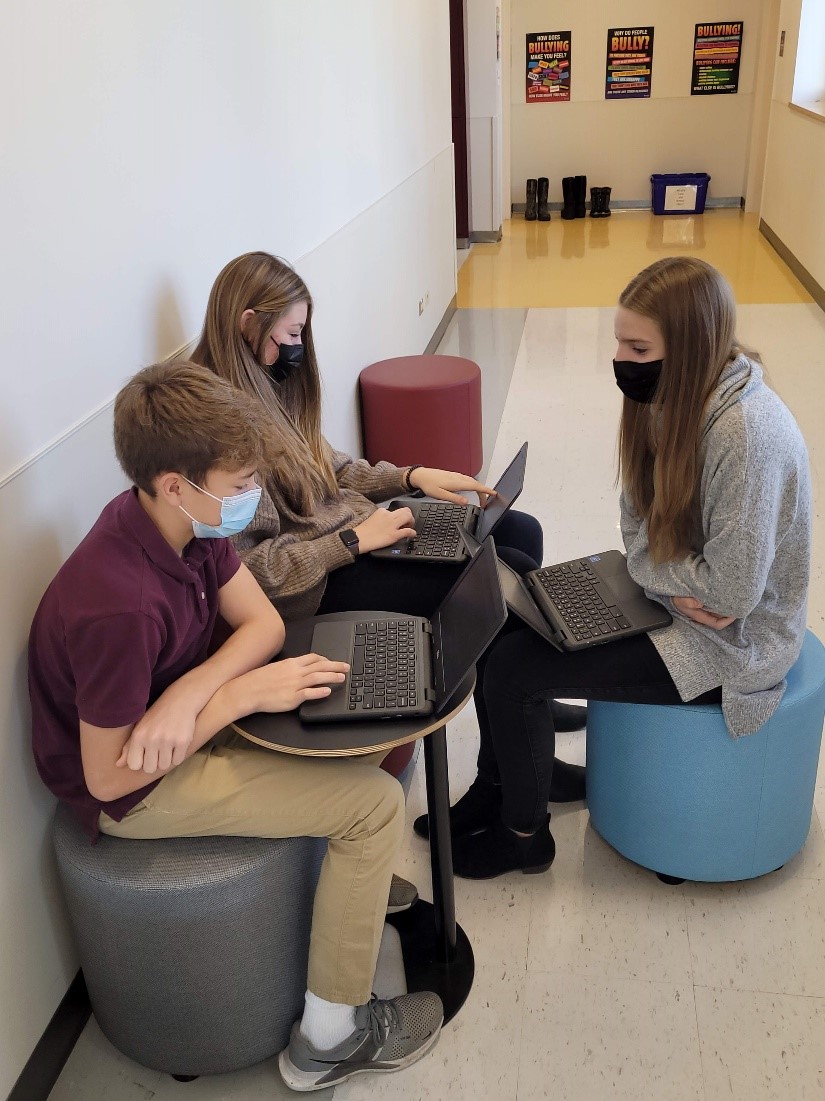
Though they knew they wanted to use podcasting in their unit, Mrs. Barnes and Mrs. Anderson also felt they needed some support with teaching their students the more technical aspects. They reached out to the Department of Education’s Maine Learning Technology Initiative (MLTI) Ambassadors who were able to create and present lessons to the Caribou 8th grade students. This all-day event focused on supporting the work Mrs. Barnes and Mrs. Anderson were doing in the classroom, as well as leading the students through the process of podcasting on their Chromebooks. The Ambassadors explained the value and possibilities of podcasting and then demonstrated how to create and edit podcasts using WeVideo. Students then practiced the process of podcasting in pairs or small groups by choosing a topic of their own, or just discussing a predetermined prompt. One group took the opportunity to begin a sports podcast, where they discussed recent events in sports and even planned out how often they should record the podcast in order to continue with it. 

From this experience, Mrs. Barnes noticed that the engagement of the students skyrocketed. Students reported that they really enjoyed the creative part of making podcasts and, immediately, many of them began listening to other podcasts outside of class for fun. Some students were also motivated to begin a school podcast.  

The busy day proved to be quite fruitful. Mrs. Anderson and Mrs. Barnes felt that the event not only helped the students, but it also really energized them, as teachers. One student shared that the work with podcasting “is changing [his] perspective about reading and writing to a more positive one as ELA has always been a struggle for [him].” 

This story was written and coordinated by MLTI Ambassador Rob Dominick as part of the Maine Schools Sharing the Success Campaign. To learn more, or to submit a story or an idea for a story, email rachel.paling@maine.gov. 

Maine Learning Technology Initiative (MLTI) Showcased on National Stage

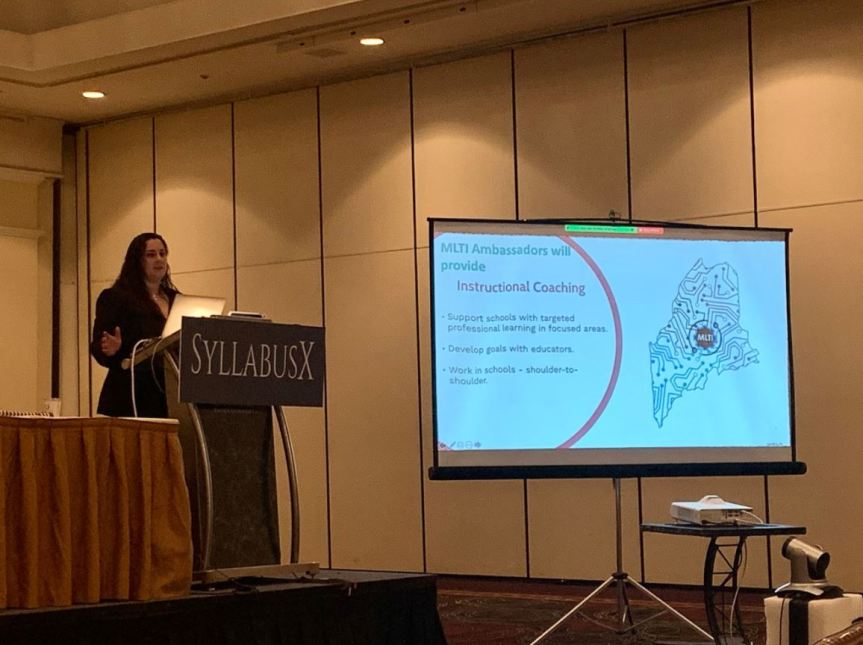
Maine Department of Education (DOE) Director of Innovative Teaching and Learning Beth Lambert, was invited to present at the 2021 National Edtech & Innovation Conference and Expo in Las Vegas, NV, this fall. The presentation showcased Maine’s MLTI (Maine Learning Through Technology Initiative) and its recent evolution from the nation’s first statewide 1:1 technology initiative in 2002 to its current iteration, MLTI 2.0.

The presentation featured Maine’s success in sustaining the 1:1 technology initiative for the past 20 years and the process for re-imagining the program to continue to be relevant in 2021, which included the creation of an advisory board of current Maine educators and stakeholders.

Participants got the chance to learn the details of how the newly designed program emphasizes individualized and local level support through the MLTI Ambassador program, which provides a technology integration coach in each school; providing a state infrastructure specialist to work with districts to update infrastructure for learning needs in 2021 and beyond; and, creating local, regional, and statewide professional learning communities, all while still providing 1:1 laptops for students.

Maine is incredibly proud of the work that has gone into sustaining and expanding the MLTI program, both within the Department and through the critical input we have received and partnerships we have made with educators, students, and stakeholders that have been working with us to make this program the very best it can be. Thank you!

To learn more about MLTI 2.0 visit the Maine Department of Education website or contact Brandi Cota MLTI Project Manager Brandi.M.Cota@Maine.Gov

Video Article: Teaching World History Through Gaming

In celebration of National Game Design Month, check out this video article that MLTI Ambassador Erik Wade created about how Piscataquis Community Secondary School Social Studies Teacher Ryan Botting and how he used the game civilization to revolutionize the teaching of his history class.

National Game Design Month started in 2010 to celebrate game designers and draw new people into game design.  For the past 11 years, people have celebrated National Game Design Month by creating digital and physical games and using games in unique ways.  It is a group of like-minded people who are “joined by a love of games and a desire to share their creativity with others.”

Start a Student Leadership Ambassadors of Maine (SLAM) Club

Are you looking for a way to engage with your students? And for ways for your students to engage safely with other students throughout the state?

Checkout this free, interactive, student leadership opportunity that requires no prior experience for students and staff.

Weekly chances for students to win prizes and opportunities to earn tech tools (mics, webcams, 3D printers) for your school!

The newly imagined MLTI 2.0 (Maine Learning Technology Initiative) invites interested educators and students to join others from around the state and start a SLAM, Student Leadership Ambassadors of Maine, club in their school. This initiative will be guided by Kern Kelley, who, along with his trailblazing Tech Sherpas, has been a national leader in student agency. Once a week, each SLAM group will virtually join other SLAMmers from across the state. During these meet-ups, students will learn presentation and tech skills and will produce a livestream tech help show on our youtube channel.

MLTI 2.0 hopes to have SLAM clubs in every school in Maine. To help you get started, MLTI will provide your club with either a live-stream webcam or recording microphone. There will be more opportunities to earn additional equipment for continued participation.

We hope you will consider starting a SLAM club at your school or that you will forward this to someone in your school who might be interested. To register your SLAM club please complete this form.

To check out our weekly SLAM show, visit our youtube channel, or watch our introductory video here.

To learn more about MLTI 2.0 SLAM visit our webpage.

For more information on SLAM or other MLTI 2.0 initiatives, contact Beth Lambert, Director of Innovative Teaching and Learning at beth.lambert@maine.gov.

Maine DOE MLTI Team Presents at ACTEM 21 Annual Conference

The 34th annual ACTEM Conference was a virtual event for the second year in a row and offered over fifty sessions from a variety of Maine educators, educational consultants, and edtech vendors. The Maine Department of Education’s MLTI team offered eleven sessions that showcased their diversity of knowledge and experience.

On Thursday afternoon, Digital Learning Specialists, Jon Graham and Emma Banks, led a “Meet the MLTI Ambassadors” session, which provided an overview of professional learning under MLTI 2.0. The Ambassadors (Rob Dominick, Holly Graffam, Kate Meyer, Erik Wade and Jonathan R. Werner) were able to introduce themselves, discuss what drew them to the position, and each shared some aspects of their role within MLTI. The recording of the session has been made publicly available by ACTEM and is available here for viewing:

The ten sessions hosted by the Ambassadors were largely developed from their classroom experiences and several drew heavily from the realities of the past two school years. Kate Meyer’s, “Let’s Talk: Using Parlay Ideas to Practice Civil Discourse,” and Holly Graffam’s, “EdPuzzle, FlipGrid & HyperDocs to Build a Video/Audio Library,” spoke to apps that they used regularly in both in-person and hybrid education settings. Holly also tapped a Technology Engineering teacher, Scott Daigle, to co-present, “Add a Little Fruit to Your Tech Diet with Pear Deck.” Erik Wade, the only Minecraft certified Educator in the state of Maine, brought his expertise to his offering, “Engage, Explore, and Create with Minecraft Education Edition.” Rob Dominick, a Google certified educator and trainer, presented sessions on two popular Google tools in, “Making G Sheets FUNCTIONal,” and, “Powering Up Google Slides.” Aside from the exploration of specific tools, Erik Wade blended science and outdoor education in his sessions, “Engaging Students through Citizen Science” and, “Authentic Integration of Technology and the Outdoors.”

Two additional sessions, facilitated by Jonathan R. Werner, arose from his experience with a pair of concepts that have proven highly successful in shaping educators’ practice both during the pandemic and going forward. The first, “Ready to LAUNCH: Bringing Design Thinking to Your Classroom,” offered educators a glimpse of how Jon Spencer and A.J. Juliani’s, LAUNCH Cycle, with its reliance on iterative thinking and prototyping practices, might apply to a range of classrooms and disciplines. His second session, “Irresistible: Fighting Back Against Addictive Tech,” focused on ways educators can help address the tensions that emerge when our reliance on tech to facilitate teaching and learning bumps up against the tech industry’s aggressive efforts to distract and entertain its consumers.

All of the MLTI Ambassadors’ sessions, as well as dozens of other sessions from ACTEM `21, (plus over a hundred sessions from previous conferences) are available through the ACTEM website for members.

ACTEM’s Vendor Expo Hall provided another opportunity for the MLTI team to connect with some educators from across the state. The MLTI “table” featured a Bitmoji classroom inspired space that offered links to some of the key programs tied to the team. During the afternoon expo time, a rotating group of Ambassadors joined in-person. Some educators joined and made introductions in the chat, while others came right in with their cameras on for some face-to-face discussion. It was a relaxed and welcoming environment. This proved to be another vital step in making contact to educators, especially those at the MLTI Ambassadors’ respective schools, as the MLTI 2.0 professional learning program comes together.

The MLTI Ambassadors are available to provide professional learning to all MLTI schools.  If you are not sure which Ambassador has been assigned your school, check out our interactive map.  If you are interested in connecting with an MLTI Ambassador, contact information is here.  If you are looking to learn more about MLTI 2.0, please check out our website.

Woodland Consolidated School Awarded Technology Grant 

Woodland Consolidated School, a kindergarten through 8th grade school in Northern Maine, is about to be the beneficiary of a major technology upgrade in its classrooms!

Technology Director Lisa Milliard applied for a Rural Utilities Services grant to acquire much needed technology for her school. The Rural Utilities Service is part of the Rural Development division of the US Department of Agriculture (USDA). Through the Distance Learning and Telemedicine Grant that Ms. Millard applied for, Woodlands Consolidated School will be receiving 65-inch interactive displays for every classroom at the school. 

Principal Gillian Laird-Sleeper said that the driving force for the upgrade came from Milliard because she “felt that the school needed some updated technology both in implementation and delivery of lessons, as well as student use of technology.” 

Sixth-grade teacher Sandy Swan, and 7th-grade teacher Cody Tompkins, will be just two of the many beneficiaries of this technology upgrade. They are both thrilled about what the interactive displays will do for their classrooms.

Swan mentioned that she’s hoping the tools that come with the new displays will allow for more creativity for her and her students. While her current board allows her to write, save, and erase, she said, “I cannot manipulate what I put on the board whatsoever.” She hopes this new technology will allow her “to complete lessons more effectively.”  

Tompkins agrees and described the impact of the interactive display as a “true game changer” for his classroom. “A smart board would allow for home to school access for the students who are remote either due to quarantine or exposure to COVID-19,” he says. He also noted that the interactive features would allow more manipulation of materials like graphing in math, diagramming sentence structure in English, and highlighting vocabulary in reading.  

The application of the interactive displays will certainly serve the Woodland Consolidated School staff and students well. As Swan put it, “I cannot wait to see what the tools, gallery and multi-touch options hold in store for us.” 

For more information (requirements, terms, application process) about USDA Rural Utilities Service grants visit: https://www.rd.usda.gov/programs-services/telecommunications-programs/distance-learning-telemedicine-grants. Grant applications are accepted through grants.gov.

MEDIA RELEASE: Maine Launches MLTI 2.0 by Welcoming 5 Regional MLTI Ambassadors to Support Professional Learning Plan

As part of the official launch of the Maine Department of Education’s (DOE) Maine Learning Technology Initiative (MLTI) 2.0, a team of distinguished educators – “MLTI Ambassadors” – have joined the DOE to help bring technology integration in Maine schools to the next level through comprehensive professional learning and consistent, ongoing support for educators.

Distinguished educators are Maine educators hired as DOE staff, on loan from Maine schools for a period of two years, to bring their expertise and experience as a resource and partner in initiatives of the Maine Department of Education.

With a long history of technology integration in education in Maine schools, MLTI is now in its 19th year and has evolved into a 2.0 version designed by an MLTI Advisory Board comprised of local educators and experts with experience working in schools. The board worked diligently this past year, along-side Department staff, to develop MLTI 2.0 with the goal of increasing Maine’s digital learning by supporting the acquisition of the latest equipment and software, providing rigorous professional learning resources, delivering state-level technology support, and enhancing local management efforts through systematic monitoring and support grounded in continuous process improvement.

As part of MLTI 2.0, the Ambassadors have joined the initiative to provide instructional coaching and deliver professional learning experiences to MLTI-participating schools and are now a part of the Maine DOE Team! They each have a list of schools in an MLTI Ambassador Region where they have begun working directly with teachers to provide instructional coaching and professional learning.

Meet the MLTI Ambassadors!

Rob Dominick
Contact: robert.dominick@maine.gov

Rob Dominick comes to the MLTI Team from Brewer Community School, where he served as a seventh-grade math teacher.  He has been teaching for more than fifteen years, starting his career at Sebasticook Middle School and later Nokomis High School in RSU19.  While he has primarily taught mathematics at the middle level, Rob has taught multiple subjects and taught at grades ranging from fifth to twelfth.  His interest in technology integration lead him to pursue a Masters in Learning & Technology from Western Governor’s University as well as Google certifications as an educator and a trainer.  He is also a member of Kappa Delta Pi, the International Honors Society in Education, and has shown a dedication to innovating the landscape of education in Maine through his involvement in MEVLC (Maine Virtual Learning Consortium), Introduction to Experiential Teaching through Technology and MOOSE (Maine Online Opportunities for Sustained Education) in addition to presenting at conferences both in Maine and Illinois.  Rob also has extensive basketball and baseball coaching experience at Nokomis, Hampden Academy and Brewer High School.  He lives in Brewer with his wife, Sarah, who is a high school math teacher, and their two young sons.

Holly Graffam
Contact: holly.graffam@maine.gov

Holly Graffam comes to the MLTI Team from Scarborough Middle School, where she served as a technology instructional coach.  She has fourteen years of experience at the middle level and has taught every core subject.  Holly has taught digital literacy and is a Common Sense Media educator.  She also has extensive training and experience in computer science and served on the Maine Department of Education’s Computer Science Work Group which developed a statewide plan in 2019.  Holly received her Masters in Teaching Methodology from the University of New England and a Certificate of Advanced Study in Educational Leadership from the University of Southern Maine.  She has participated in Educate Maine’s Education Leadership Experience and completed a Curriculum Director internship.  She lives in Falmouth.

Kathryn Meyer
Contact: kathryn.meyer@maine.gov

Kate Meyer comes to the MLTI Team from Mt. Desert High School, where she served as an English Language Arts and Design Thinking teacher.  She has been teaching for more than twenty years.  She was named the 2020 Hancock County Teacher of the Year.  Kate has earned Masters in both Educational Leadership and Literacy Education from the University of Maine at Orono and she is a National Board Certified teacher.  Kate has extensive training and experience in design thinking, adventure education and student-centered coaching. During her time at MDI, Kate served as an advisor for Operation Breaking Stereotypes, spearheaded the innovative Island Pathways alternative education program and has been the co-teacher of the Eastern Maine Skippers Program.  She lives in Ellsworth.

Erik Wade
Contact: erik.wade@maine.gov

Erik Wade comes to the MLTI Team from Warsaw Middle School, where he served as a seventh and eighth grade science teacher.  He has been teaching for twenty years and has taught math and science at Hope Elementary, Windsor Elementary and Spurwink prior to coming to MSAD53.  He has worked with fifth grade through eighth grade.  He holds a Masters in Instructional Technology from the University of Maine at Orono and is a Apple Certified Teacher.  Erik has always looked to be part of innovative technology cohorts like the MARTLs (MLTI Apple Refresh Teacher Leader) and the Introduction to Experiential Teaching through Technology.  He has collaborated with a number of organizations such as Maine Math & Science Alliance, the Gulf of Maine Research Institute, Maine Lakes Conservancy and Institute and Sebasticook Valley Health.  His other educational passion is agriculture education and he has won the National Excellence in Teaching about Agriculture Award, Knox County Soil and Water Teacher of the Year and the Maine State Agriculture Teacher of the Year.  Erik has also served as a baseball, basketball and soccer coach in the past.  He lives in Troy with his wife, Kimberly, who is a teacher at Nokomis Middle School.

Jonathan R. Werner
Contact: jonathan.werner@maine.gov

Jonathan R. Werner comes to the MLTI Team from Cape Elizabeth Middle School, where he served as the technology integrator.  He has fifteen years of experience in education and worked as a technology integrator and a Library and Instructional Technology Specialist at Cape Elizabeth Middle and High School.  Prior to that he taught English and Social Studies at Gorham High School and at Conestoga High School in Berwyn, PA.  Jonathan holds a master’s in social studies and English Language Education from the University of Pennsylvania.  Prior to working in schools, Jonathan received a J.D. from Columbia Law School and practiced for five years, focusing on education law.  He has also served as the ISTE Librarians Network President-Elect and President from 2016 to 2018.  Jonathan has presented at both large-scale events like ISTE, MassCue, NEISTE and EdTechTeacher events as well as events around Maine.  He is both passionate and has extensive experience in areas such as rethinking professional learning, reimaging libraries and learning commons, digital footprints, screen addiction, MakerSpaces and MakerEd.  He lives in Portland with his wife, Rebecca, and three children.

The Maine DOE MLTI team works hand-in-hand with the MLTI Ambassadors to support the MLTI professional learning plan in addition to the many other components MLTI 2.0. For more information about MLTI 2.0 and its evolution visit the Maine DOE Website or contact Beth Lambert, Director of Innovative Teaching and Learning.

MEDIA RELEASE: Maine DOE Hosts Students Statewide for Virtual MLTI Student Conference

Maine students and teachers came together yesterday for a day of learning, collaboration, and innovative thinking at the 18th Annual Maine Learning Through Technology (MLTI) Student Conference.

Student Project: Maine Moose

Hosted by the Maine Department of Education (DOE) in partnership with CATES, the Conference was one of the largest synchronous student learning tech conference in the history of the world, with students from across Maine tuning in virtually to gain insights into the challenges facing Mainers during remote learning, how to develop innovations through peer collaboration to solve complex problems, and begin to develop the mindset of the social entrepreneur.

Student Project: You are important

In addition to participating in a number of innovative synchronous Block Sessions and asynchronous activities using Gathertown as a virtual conference platform to learn new skills and deepen knowledge, conference participants also had the opportunity to work in teams to develop a product or innovation that addresses their chosen challenge (Mental Health Support; Equity in Education; Peer Collaboration; New Ways to Learn).

“Get ready to be REALLY creative today! Be bold with your ideas and be guided by your wildest imagination,” said Education Commissioner Pender Makin in her opening remarks. “Design and innovate as if the future depends upon in. Because in so many ways, it truly does.”

“[The pandemic] has given you a front row seat that will inform your experience with this year’s innovation challenge,” added Maine CDC Director Dr. Nirav Shah in his remarks during the conference.

Students’ groups “pitched” their product to conference participants, who voted for their favorite in each challenge category – 38 hours of innovative pitches were created on flipgrid!

“Your pitches demonstrate what amazing thinkers, problem solvers, designers, and engineers, you all are,” said Maine DOE Director of Innovative Teaching and Learning Beth Lambert. “Your work today and in the innovation challenge will lead the way for our state and the entire nation when it comes to redesigning remote learning and the shape of our public education system!”

Pre-Conference students got the opportunity to learn about the different challenges related to remote learning during the pandemic and their implications for Maine DECD’s 2030 Vision + Goals so they could research interesting reports, design frameworks, innovation protocols, videos, and other information related to their challenge.

After the Conference each team of students that wishes to continue on to Part II of the $10,000 Challenge is matched with a mentor to further develop their innovation or venture and submit “a demo”, “pitch deck”, and/or executive summary for their product. Challenge Grand Prize winners will be announced at special online awards ceremony featuring UMaine innovation leaders, and invited to continue developing their innovation through the CATES Center for Social Innovation Summer Incubator program in prep for a fall launch.

For more information about the conference and the Innovation Challenge visit the MLTI website: https://mlticonference.com/

Maine Learning Technology Initiative (MLTI) 2.0 Seeks Distinguished Educators

Are you passionate about professional growth and technology? Do you want to make a difference in Maine schools? Are you currently teaching in a Maine public school?

The Maine Department of Education is hiring five distinguished educators to join our team in supporting MLTI 2.0 professional learning. These are full-time, two-year, contracted, remote positions. The MLTI 2.0 distinguished educators will provide instructional technology coaching directly to MLTI 2.0 participating educators and work closely with the MLTI 2.0 team to implement the MLTI 2.0 program.

Ideal candidates will be excited about instructional coaching and innovative technology practices in education, eager to work with other teachers, have outstanding communication skills, and experience with middle and/or high school pedagogy.

Distinguished educator positions are set up as an exchange agreement between the Department of Education and your local school district. Through the agreement, the Department pays your local school for the duration of your contract as a distinguished educator, allowing your school to temporarily fill your vacant position and continue to pay you your current rate while you work as a distinguished educator. Once the two-year contract is complete, you will be able to return to your position within that district.

To learn more about the MLTI distinguished educator position, click here to access the full job description.

If you’re interested in applying to be an MLTI 2.0 distinguished educator, click here to access the application form. The application closes April 30th.

If you have questions about the position or the exchange process, check out the FAQ.

Still have questions? Contact the Digital Learning Specialists at the Maine Department of Education to learn more.

Jonathan Graham, Elementary, Digital Learning Specialist, jonathan.m.graham@maine.gov

Emma-Marie Banks, Computer Science and Secondary Digital Learning Specialist, emma-marie.banks@maine.gov

Registration is Now Open for the 18th Annual MLTI Student Conference

The Maine Department of Education is excited to share that registration for the 18th Annual MLTI student conference is open!

The conference will be held on May 20th, in virtual format, and it is FREE to Maine students in grades 4-12! The virtual student conference will be online on Thursday, May 20th from 9:00 AM – 2:00 PM. The morning will be filled with interactive workshop sessions where students will be able to explore, engage, and create with exciting educational technology. The afternoon UBER session will be a collaborative design experience.

Since this is during a school day student registration must be coordinated by a teacher. Teachers are encouraged to organize student groups to attend the conference. Registration forms must include a teacher’s contact information, school, and student names.
For more information or to register please visit: https://www.maine.gov/doe/learning/ltt/conference

Registrations completed by Friday, May 7th will receive an early registration conference gift.

For questions please reach out Jordan Dean, Jordan.Dean@maine.gov.