Professional Learning Opportunity: Deepen Your Knowledge and Skills to Better Support Students who are Multilingual Learners

The Maine Department of Education is excited to announce an excellent opportunity for all Maine educators to deepen their knowledge and skills for supporting students who are English learners (ELs) (also referred to as multilingual learners [MLs]).

Organized by UCLA Center X Northeast Region, the ExcEL Leadership Academy provides teachers with free professional learning through a program of micro-credentialing. Through a project called ExcEL 2026: Improving Outcomes for EL Students in Rural Areas there are two micro-credential pathways: Essential Support for Working with Multi-Lingual Learners and Advanced Support for Working with Multi-Lingual Learners.

ExcEL 2026 makes professional learning accessible to teachers wherever they are located, and ‘the work’ is embedded in their teaching so it aligns with their immediate learning needs. Teachers also become part of the ExcEL network and substantially improve outcomes for students who are ELs. There is NO cost to participate. Participants receive stipends for successfully completing micro-credentials as well as support for classroom materials and supplies.

Visit the ExcEL Leadership Academy website to learn more and apply.  Maine educators are also invited to join project director Laureen Avery on December 13th from 3-4pm for more information! Contact Laureen Avery at avery@gseis.ucla.edu if you have any questions about how ExcEL 2026 can support you and your colleagues in improving programs for ELs.

Topic: Maine ExcEL 2026 Info Session
Time: Dec 13, 2021 03:00 PM Eastern Time (US and Canada)
Join Zoom Meeting: https://ucla.zoom.us/j/3300361098
Meeting ID: 330 036 1098

WEBINAR: The Maine Seal of Biliteracy

On November 16th at 3pm, April Perkins, World Languages & ESOL/Bilingual Programs Specialist, is hosting a webinar on the Maine Seal of Biliteracy.

Teachers, school counselors, and principals are welcome to attend. The webinar will describe the eligibility criteria and application process, as well as the benefits for students who earn the Seal of Biliteracy.

Register here, and contact April at april.perkins@maine.gov with any questions.

Two-Part Webinar Series on Nurturing Speaking Growth for English Learners

The Maine Department of Education invites all educators, Kindergarten to Grade 12, to participate in a two-part webinar series on Nurturing Speaking Growth for students who are English learners. Facilitated by Terri Mosgrove of WIDA, this webinar series is designed to support all educators who would like to explore the connection between the ACCESS Speaking Test and classroom practices that promote oral language development.

Participants will explore the underpinnings of the Speaking Test in a self-paced module that allows for choice and control. In each webinar, participants will engage in meaning making activities that provide ways to nurture students’ speaking growth. Participants will be asked to speak and share ideas with colleagues within the virtual event.

By engaging in the eWorkshop, participants will:

  • Apply the underpinnings of the Speaking Assessment to classroom practice
  • Connect the Key Language Uses to instructional practices in speaking
  • Explore the impact of holding the floor for extended classroom discourse
  • Choose Teacher Moves to support student voice
  • Develop an ear for language to support precision decisions.

Dates: 10.19.21 and 10.26.21

Times: 2-3:30pm

Register here – closes on 10.11.21.

Note that these webinars will not be recorded, per WIDA policy, and alternate tasks will be provided for registered participants who are unable to attend. If you have any questions, please contact April Perkins, World Languages & ESOL/Bilingual Programs Specialist, at april.perkins@maine.gov.

Administrative Letter: Legal Requirements to Provide English Language Acquisition Services to Students who are English Learners (Revised 9.15.2021)

Administrative Letter: #27
Policy Code: IHBEA
TO: Public School Administrators
FROM: Pender Makin, Commissioner
DATE: August 22, 2019, Revised September 15, 2021

SUBJECT: The legal requirements for providing English for Speakers of Other Languages (ESOL) services to students who are English learners

Topics included in this letter:

  • Identification of students who are English learners
  • Exit criteria from ESOL services
  • Delivery of ESOL services
  • Administration of ACCESS for ELLs®
  • Enrollment of students who are immigrants and international students
  • Rights of students who are English learners to education
  • Students who are English learners and Special Education

Identification of Students Who are English Learners (EL)

Revision:

It is a federal requirement that all students who are English learners be identified within 30 days of enrollment from the beginning of the school year. For students enrolling at the start of the school year, parents/guardians must be notified of their child’s English learner status within the same 30-day period. After the start of the school year, SAUs must notify parents/guardians within two weeks of their child’s identification.

Each School Administrative Unit (SAU) must administer the Maine Department of Education’s Language Use Survey to the parent/guardian of every student, pre-kindergarten through 12th grade, enrolling in the SAU for the first time. The Language Use Survey must be included in the SAU’s enrollment packet or online enrollment system. If a student changes schools within a SAU, a new Language Use Survey is not required.

The Language Use Survey is available for download on the Maine Department of Education website   in English and 25 of Maine’s most commonly spoken languages. Parents/guardians are entitled to complete the Language Use Survey in their preferred language. SAUs must provide translation/interpretation services upon request.

The purpose of the Language Use Survey is to identify potential students who are English learners. The Language Use Survey decision tree provides guidance on its use. If any question is answered with a language other than English, the student should be administered an English language proficiency screener. (Note that Sign Language is not a qualifying language for English learner status. However, if a student uses Sign Language and an additional language other than English, the student may be eligible for English learner status.) See the resource and policy guide, Serving Maine’s Students who are English Learners, for information about the required screeners and identification thresholds, by grade level.

Students who were screened for EL status but did not initially qualify may be rescreened at any time if a potential need for ESOL support becomes apparent.

Exit Criteria from ESOL Services

In order to exit from ESOL services, a student must demonstrate English language proficiency. The Maine Department of Education defines English language proficiency as an overall composite proficiency level of 4.5 on ACCESS for ELLs®. No other measure qualifies a student who is an English learner for exit. While a district may choose to continue to provide language support services to students who have demonstrated English language proficiency, such students are no longer classified as English learners and are no longer administered ACCESS for ELLs® (or Alternate ACCESS, if applicable).

Students who are English learners with an IEP exemption from a domain or domains on ACCESS for ELLs/Alternate ACCESS are eligible to exit based on their performance on the non-exempt domains. The Maine Department of Education calculates an overall composite proficiency level for such students, utilizing a score of 4.5 on the exempt domain(s) and weighting domains according to WIDA’s overall composite score weighted formula.

Monitoring and Reentry into EL Status

Per federal guidance, SAUs are to monitor the performance of former students who are English learners for at least two years after exiting. If, during the two years of monitoring, or at any time thereafter, a former student who is an English learner shows a potential need for continued ESOL support, the student must be rescreened with the WIDA Screener Online to determine English learner status. If a student scores below the state-defined identification threshold, he/she must be reentered into English learner status, must receive ESOL services, and must take ACCESS for ELLs (or Alternate ACCESS, if applicable) until exiting.

Delivery of ESOL Services

An SAU is required to determine the components of an effective English language acquisition program tailored to the needs of each student, which may include, but is not limited to, tutoring, additional classroom support, materials, sheltered instruction, professional development for content area teachers, or other strategies (Office for Civil Rights December 1985 Title VI policy memorandum, Title VI Language Minority Compliance Procedures).

The Maine Department of Education requires the English language support program for a student who is an English learner to be provided or overseen by a 660 ESOL-endorsed teacher. (See 34 Code of Federal Regulations C.F.R. Section 100.3 (b)(ii)). All students who are English learners must be provided with English language support services that enable them to meaningfully access the curriculum in order to meet grade-level standards. English language development and content area knowledge are to be acquired simultaneously, rather than consecutively. In other words, English language proficiency is not a prerequisite to participate in mainstream classes. If students who are English learners receive services that remove them from content area classes (such as a newcomer program or pull-out services), any academic deficits that result must be remedied so the student remains on track with his/her non-EL peers academically.

English language support services are to be provided in a way that minimizes the isolation of students who are English learners from the general student population and encourages students who are English learners to participate in all aspects of the school program, including advanced coursework, career and technical education, gifted and talented programs, and extracurricular activities. Students who are English learners are entitled to ESOL services until exiting by demonstrating English language proficiency on ACCESS for ELLs® (or Alternate ACCESS, if applicable).

Administration of ACCESS for ELLs® or Alternate ACCESS

Federal and State laws require that the English language proficiency of all students who are English learners be measured annually as a component of accountability under the Elementary and Secondary Education Act (ESEA). If a student is identified as an English learner, that student must be administered ACCESS for ELLs (or Alternate ACCESS, if applicable) annually until the student demonstrates English language proficiency. The Maine Department of Education defines English language proficiency as a composite proficiency level of 4.5 on ACCESS for ELLs or level P2 on Alternate ACCESS. Failure of all students who are English learners to participate in the annual administration of ACCESS for ELLs/Alternate ACCESS may affect ESEA Title IA funding.

State law requires that ACCESS for ELLs/Alternate ACCESS be administered only by an individual trained it its administration. It is not required that this individual be an ESOL-endorsed teacher. However, only an ESOL-endorsed teacher is qualified to design, oversee, and implement an English language support program, which includes the interpretation of ACCESS for ELLs/Alternate ACCESS results.

If parents/guardians have questions about the purpose of ACCESS for ELLs/Alternate ACCESS, direct them to ACCESS for ELLs: FAQs for Parents/Guardians.

Enrollment of Immigrants and International Students

Title VI of the Civil Rights Act of 1964 prohibits discrimination based on race, color, or national origin, among other factors, by public schools. SAUs are required under federal law to enroll children regardless of citizenship or immigration status (Plyler vs. Doe). This applies  equally to students who are immigrants and international students attending a Maine public school as an exchange student or tuition-paying student. All students, including those who are immigrants and international students, must be screened for English learner status. Any student who is identified as an English learner, regardless of citizenship or immigration status, is entitled to ESOL services and must be administered ACCESS for ELLs (or Alternate ACCESS, if applicable) annually. International/exchange students are not exempt from Title I required state academic assessments. In Maine, recently arrived English learners who have been enrolled in a U.S. school for less than 12 months are exempt from one administration of the state’s English language arts assessment only. See the

SAUs are not permitted to discourage the enrollment of children who are undocumented immigrants by asking about their immigration status, denying enrollment to those with international birth certificates, or denying enrollment to children whose parents decline to provide their social security numbers or race and ethnicity information. Federal regulations allow schools to ask for children’s social security numbers to be used as student identifiers. However, they should inform parents of the purpose and that disclosure of such numbers is voluntary. Schools may not deny enrollment if parents refuse to provide a child’s social security number. SAUs may require proof that a child lives within SAU boundaries, which may include lease agreements, utility bills, or other documents. However, schools may not ask parents about a child’s immigration status to establish residency. SAUs may require proof of a child’s age, but they may not bar enrollment because a child has an international birth certificate or no birth certificate. See this fact sheet from the Departments of Justice and Education for more details about acceptable documentation requests.

Rights of Students who are English Learners to Education

The Civil Rights Act of 1964 remains the foundation of the legal rights of aa student who is an English learner. Lau v. Nichols confirms that all students who are English learners are entitled to meaningful access to the curriculum. If a parent refuses ESOL services this must be documented, but parental refusal does not release the school or SAU from its responsibility to provide meaningful education to students who are English learners. If a student who is an English learner cannot make academic progress without ESOL services, the student has a right to ESOL services, even if a parent refuses. Parental consent is not required to administer an English language proficiency screener or ACCESS for ELLs/Alternate ACCESS. Under State law SAUs are responsible for administering ACCESS for ELLs® to all students who are English learners, regardless of parental consent (20-A M.R.S. §6209(1-A)).

Students who are English Learners and Special Education

Students may qualify for, and have legal entitlement to, both ESOL and special education services. Appropriate screening is required to determine students’ eligibility for each type of service. Depending on a student’s learning disability and Individual Education Plan (IEP), universal testing tools or accommodations may be needed in order to measure English language proficiency. When evaluating a student who is an English learner for learning disabilities, screening must be linguistically and culturally appropriate. It is advisable to measure a student’s skills in the student’s primary language in order to clarify whether challenges are due to a learning disability or English language development.

Students who are English learners should not be placed in a special education program unless their exceptionality is well-documented, and appropriate procedures for special education services have been followed. English learner status is not a disability and is not covered by the Individuals with Disabilities Education Act (IDEA) or Maine Unified Special Education Regulations (MUSER).

For students who are English learners with IEP teams, the United States Department of Education has provided the following guidance:

“It is important that IEP Teams for ELs with disabilities include persons with expertise in second language acquisition and other professionals, such as speech-language pathologists, who understand how to differentiate between limited English proficiency and a disability. The participation of these individuals on the IEP Team is essential in order to develop appropriate academic and functional goals for the child and provide specially designed instruction and the necessary related services to meet these goals.”

Students who are English learners with learning disabilities are eligible for exit from ESOL services when they demonstrate English language proficiency by achieving an overall composite proficiency level of 4.5 on ACCESS for ELLs (or level P2 on Alternate ACCESS, if applicable).

If you have questions, or would like further information regarding serving students who are English learners, please contact April Perkins, ESOL/Bilingual Programs, at april.perkins@maine.gov or (207)624-6627.

Virtual Workshop Series for New English for Speakers of Other Languages (ESOL) Teachers

The Maine Department of Education (DOE) invites teachers to participate in a series of virtual workshops on topics related to serving English learners and managing an English Speakers of Other Languages (ESOL) program. While the sessions will be targeted to the needs of new ESOL teachers, all are welcome! More experienced ESOL teachers and others whose work relates to the topics listed will also find information of value and benefit from connecting with colleagues across Maine.

See the list of sessions below for dates and topics of focus each month. Each session will be held from 3:00-4:00pm. Participants should plan to attend all sessions in the series, to the extent possible. Contact hours will be available for participation in the sessions. Ideally participants, as a cohort of learners, will develop and sustain a professional connection beyond the monthly sessions.

Note that this series of workshops for new teachers will touch upon the 2020 Edition of the WIDA English Language Development (ELD) Standards Framework, but for those who are looking for in-depth work on the ELD Standards, please take advantage of the other professional learning opportunities centered around that topic.

The workshops will be facilitated by Robin Fleck, Maine DOE ESOL Consultant, and will feature guest speakers during some sessions. If you have any questions, contact Robin at robin.fleck@maine.gov.

Register HERE to receive the Zoom links.

Date Topics
Session 1 Monday, September 13, 2021
  • identifying English learners
  • reviewing state expectations
  • identifying available resources
  • working with classroom/content teachers
  • getting to know your students and families
  • working with newcomers
Session 2 Thursday, October 7, 2021
  • how to effectively use the LAC meeting/ILAP, how to manage parent conferences/communications
  • strategies for monitoring progress in and outside your classroom
  • and ordering ACCESS materials
Session 3 Monday, November 15, 2021
  • ACCESS testing and strategies to help prepare students to be comfortable during testing
Session 4 Thursday, January 13, 2022
  • ACCESS testing and responding to the needs of the group, with a focus on strategies and culturally responsive teaching
Session 5 Thursday, February 17, 2022
  • completing ACCESS testing
  • “It’s the middle of the year, what do I do now?”
Session 6 Thursday, April 7, 2022
  • wrapping up the school year
  • planning for next year
Session 7 Thursday, June 2, 2022
  • celebrating the accomplishments of the year and all that you have learned
  • addressing any questions
  • sharing what’s next


New Memorandum of Understanding will Promote German Language and Cultural Education in Maine

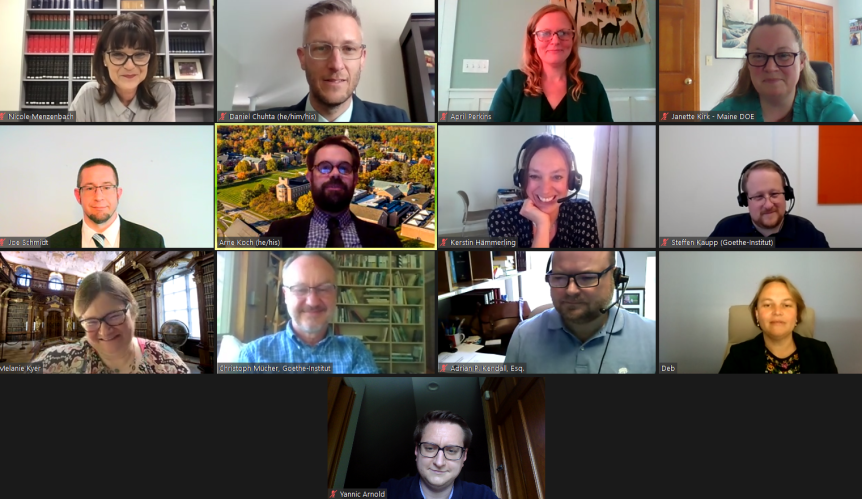
On May 27th the Maine Department of Education hosted a virtual signing ceremony to celebrate a new memorandum of understanding (MOU) with the Goethe-Institut Boston. Deputy Commissioner of Education, Dan Chuhta, and World Languages & ESOL/Bilingual Programs Specialist, April Perkins, welcomed guests from the German Consulate and the Goethe-Institut, as well as Maine educators, to mark the occasion by sharing their thoughts and reflections on German programs in Maine and the new partnership established under the MOU.

Through this MOU, the Department will collaborate with the Goethe-Institut to promote German language and cultural education across the state through a variety of resources, programs, and activities, including:

In her remarks, Consul General Nicole Menzenbach highlighted the global importance of the German language, which is spoken by 130 million people. “German-speaking countries are economic centers within Europe and can provide a wide range of economic opportunities to those who speak the language,” she said. “Language and cultural understanding serve as a means of communication between individuals and as a link between nations. In this sense, we can view this memorandum as an important component of the transatlantic friendship that exists between the US and Germany.”

There are currently German programs in 12 public and private schools across Maine, and the Goethe-Institut has been a long-time resource and partner to them. Deb Backman, German teacher at Cony Middle and High School, expressed her appreciation for their support. “Goethe does a great job bringing the world into the classroom, but also to bring the classroom into the world,” Backman said. Melanie Kyer, German teacher at York High School, and Dr. Arne Koch, professor of German at Colby College, also expressed their enthusiasm about the MOU and the potential of the new partnership between the Goethe-Institut and the Maine Department of Education.

The Department wishes to share its heartfelt thanks to its partners at the German Consulate and Goethe-Institut Boston, as well as the remarkable teachers and students of German across Maine.

If your school or district is interested in participating in any of the opportunities listed above, developing a new German program, or expanding an existing one, please contact April Perkins at april.perkins@maine.gov.

Lyseth Spanish Teacher Wins ‘Teacher of the Year’ Award

José Iván Sabau Torrelo, fifth-grade teacher in Lyseth Elementary School’s Spanish Immersion program, has been selected as Teacher of the Year 2021 by the Ministry of Education, Embassy of Spain. In recognizing Sabau Torrelo, the Ministry of Education cited an “outstanding” mystery-solving gaming project involving multicultural cooperation that he created for his students.

The project, titled Operación Museo, connected Lyseth fifth-graders with students in Spain at Colegio La Salle in Santiago de Compostela, and Colegio Montserrat Fuhem in Madrid. Sabau Torrelo “implemented gamification methodology to develop a mystery-solving story where students became detectives,” the Ministry of Education said. “Using a dynamic, cross-curricular and student-centered approach, students used their artistic and language skills and explored information about Spanish painters, like Miró and others, as well as geography, mathematics, physical education, and culture to solve the case.”

Sabau Torrelo explained that the two-month gaming project began with a message from a “police officer” asking students for help in dismantling a worldwide organization that was stealing famous paintings from museums. “First, they needed to go to the detective academy to get their licenses,” Sabau Torrelo said. “They needed to overcome many different challenges to do that. Once they graduated, they needed to crack codes, learn about painters and use logical thinking and skills to solve six different cases.”

The Ministry of Education praised the video Sabau Torrelo made about the project and also the project’s other aspects. “The visual and technical quality of Operación Museo’s materials is very high and demonstrates the great potential of numerous, valuable educational tools,” the Ministry of Education said. “The project’s elements combined to create a fun, creative, and engaging plot – full of humor and surprises to fuel students’ interest and attention. Mr. Sabau Torrelo’s students will remember Operación Museo forever and the Spanish teaching community will love the opportunity to learn more about this enriching project.”

“I feel honored,” Sabau Torrelo said, regarding the recognition.

Last year, Lyseth Elementary School won the Ministry of Education, Embassy of Spain’s School of the Year 2020 Award in the elementary school category. Lyseth, home of the only public Spanish immersion program in Maine, won for its “outstanding immersion program” and the school’s “enthusiasm and dedication to the Spanish language and culture.”

The immersion program was begun at Lyseth in 2014 with one kindergarten cohort. A new class was added each year. There is now an immersion classroom at each grade level from kindergarten through fifth grade.

Superintendent Xavier Botana said, “The Portland Public Schools is very proud of Iván for winning the Teacher of the Year 2021 award. His innovative Operación Museo project exemplifies his dedication to student learning.  Spanish is the second most-spoken language in the United States and biliteracy in Spanish and English makes students attractive to colleges and future employers. We are very grateful to Iván and other staff at Lyseth for making the Spanish Immersion program there such a success.”

Lyseth Principal Lenore Williams said, “Iván has been steadfast in his commitment to ensure learning for his students is both engaging and interactive and connected to real-life experiences. His students are immersed in the target language and culture and they have content taught to them through an integrated teaching approach that unifies the arts, math, science, writing, and geography. “Operacion Museo” embodies Iván’s approach and beliefs about what and how students should experience learning.”

Carlos Gomez, the district’s Director of Language Development, said, “Engaging students is ‘profesor’ Sabau’s superpower!  His creativity and energy help students to learn language while they learn content and culture, making for a rich, memorable and life-changing experience for his students and colleagues at Lyseth.”

Information for this article was provided by Portland Public Schools as part of the Maine Schools Sharing Success Campaign. To submit a story or an idea, email it to Rachel at rachel.paling@maine.gov.

Visiting Teachers from Spain Program

Is your school anticipating difficulty in securing a licensed Spanish teacher for the 2020-2021 school year or beyond? Do you want to expose your students to a native speaker and cultural expert? Are you trying to figure out how to staff a Spanish immersion program? Then the Visiting Teacher from Spain Program may be just the answer!

Maine’s Memorandum of Understanding with the Ministry of Education of Spain was created to promote strong cross-cultural ties between the citizens of Maine and the people of Spain and to help address the uneven distribution of qualified instructors of Spanish in our state. Under this agreement, educators from Spain can be brought to teach in Maine schools for a period of up to three years, (a two-year extension may be possible after the third year), depending on the availability of each individual teacher, his or her willingness to stay for an extended period, and the school districts’ interest in extending their visiting teachers’ contracts beyond the initial year.

Visiting International Teachers are licensed to teach in Maine while holding the cultural exchange status described above.

The process of securing a Visiting Teacher from Spain is comprised of a few simple steps. An interested school or public district must first determine that they have a guaranteed position. Teachers on J-1 visas cannot be procured for openings that are uncertain or subject to elimination or change. Next, a detailed application must be completed and signed. New schools or districts also must sign a program contract, indicating a commitment to abide by all of the program’s requirements.

Both documents must be submitted together to Maine DOE by April 15, 2021. Maine DOE representatives will conduct remote interviews with Spanish teachers and select a pool of highly qualified candidates whose skills and backgrounds may fit the needs of Maine schools. The next step is to put their visiting teachers under contract in accordance with any local bargaining unit agreements. Visiting teachers must receive the same salary and benefits that any other teacher would receive, based on their educational attainment and years of experience. Visiting teachers arrive in Maine in mid-August and undergo an intensive pre-service orientation provided by the Spanish Ministry of Education and Maine DOE prior to their arrival in their Maine communities.

Participation by the visiting educator in a strong, year-long novice teacher mentoring program in his or her school or district is a requirement for securing a teacher through this program. The school or district also should find a host family for the first one to two weeks that the visiting teacher is in the community and be willing to assist the teacher with all aspects of getting settled. Again, the application deadline is April 15, 2021. Please secure the approval of your local board of education/sponsor to hire a teacher from Spain before the April 15th deadline.

See the 2021 program brochure for more details.

If you have any questions, please contact April Perkins or Manuel Collazo:

April Perkins
World Languages & ESOL/Bilingual Programs Specialist
Maine Department of Education
23 State House Station, Augusta, ME 04333
Cell: (207)441-9043
Email: april.perkins@maine.gov

Manuel Collazo
Education Advisor
Embassy of Spain, Education Office
General Consulate of Spain in Boston
31 Saint James Avenue, Suite 905 Boston, MA 02116-3606
Email: manuel.collazo@educacion.gob..es
Phone: 617 678 5920
Skype: manuel.collazo_educacion

Opportunity for Partnerships with French Schools – Deadline 3/31/21

The Maine Department of Education is excited to announce an opportunity for middle and high school teachers to participate in cross-cultural partnerships with schools in France. This opportunity has been made possible through a Memorandum of Understanding (MOU) with the Académie de Nantes, the governmental body overseeing education in the Pays de la Loire region of France.

The MOU aims to strengthen connections between Maine and France and improve the teaching of English and French, allowing educators and students to benefit from increased understanding and cooperation between the two cultures. Teachers from all content areas, not only French teachers, are welcome to apply. Schools will be partnered based on shared objectives and interests.

Schools that engage in partnerships will participate in joint learning projects with their French-school colleagues. A group of students within one class, a whole class, or multiple classes of students may be involved. Projects can focus on virtually any topic related to the curricula of the two schools (for example: school life and daily routines, natural environment, celebrations, cooking and culinary traditions, sustainable development policies, etc.). Students will demonstrate their learning through artifacts such as letters, emails, drawing, blog posts, video/audio recordings, essays, articles, or other creative means.

Applications are due by 3/31/21. Click here to apply. Partnerships will be confirmed by 5/31/21 so that initial contact can be made and schools may begin planning their projects for the fall. Note that participating in a partnership is a commitment, and our partner schools in France are eager to be matched with Maine schools that are willing and able to actively engage in collaborative teaching and learning. Partnerships may last indefinitely, with the willingness of both schools.

If you have any questions, please contact April Perkins, World Languages & ESOL/Bilingual Programs Specialist, at april.perkins@maine.gov.


Maine Educator Selected by U.S. Department of State for Prestigious English Language Specialist Project

The U.S. Department of State announced the selection of Maine educator Karina Escajeda of Maine for a five-month English Language Specialist project focusing on K4/K5 curriculum design and materials development for a new English immersion initiative in Curacao. She is hosted by a partnership between the Regional English Language Office in Panama, the US Embassy in Curaçao, and the Curaçao Chamber of Commerce. This project will involve researching and drafting curriculum by incorporating local knowledge and curriculum understanding from other countries and best practices given the goals of Curaçao. Escajeda is part of a select group, as her project is one of 150 that the English Language Specialist Program supports each year.

Escajeda is a K-12 ESOL educational consultant with over 20 years of experience teaching, training, presenting, administrating, designing curriculum, and writing reports for K-12 public and private schools in domestic and international environments.  She earned a BA in formal linguistics and Spanish at the University of Southern Maine, TESOL at UCLA, K-12 teacher certification at CSU East Bay, and an MA and administrative credential in K-12 Educational Administration and Leadership at CSU Bakersfield.  She also holds certifications in K-12 ESOL, K-12 Literacy, and K-12 Spanish. She received a Fulbright Distinguished Award in Teaching fellowship to Greece in 2019-2020 to study community-based refugee integration initiatives. She is the program director for Capital Area New Mainers Project, a non-profit in central Maine that supports immigrants and provides educational resources to the broader community.

The English Language Specialist Program is the premier opportunity for leaders in the field of teaching English to speakers of other languages (TESOL) to enact meaningful and sustainable changes in the way that English is taught abroad. Through projects developed by U.S. Embassies in more than 80 countries, English Language Specialists work directly with local teacher trainers, educational leaders, and ministry of education officials to exchange knowledge, build capacity, and establish partnerships benefiting participants, institutions, and communities in the United States and overseas.

Since 1991, the English Language Specialist Program has supported in-country, virtual, and mixed projects in which hundreds of TESOL scholars and educators promote English language learning, enhance English teaching capacity, and foster mutual understanding between the U.S. and other countries through cultural exchange. During their projects, English Language Specialists may conduct intensive teacher training, advise ministries of education or participate in high-level educational consultations, and offer plenary presentations at regional, national or international TESOL conferences. These projects are challenging and those selected represent the best of the U.S. TESOL community. In return, the program provides professional development opportunities to help participants experience different cultures and build skills that can greatly enhance their TESOL careers at home.

English Language Specialists are counted among the more than 50,000 individuals participating in U.S. Department of State exchange programs each year. The Specialist Program is administered by the Center for Intercultural Education and Development at Georgetown University.

For further information about the English Language Specialist Program or the U.S. Department of State, please visit elprograms.org/specialist, contact us by telephone at 202-632-6452, or e-mail ECA-Press@state.gov.