MEDIA RELEASE: Maine Department of Education Partners With SPIRIT SERIES to Engage 12,500 Students In Story-Based Social Emotional Learning and Literacy Program

The Maine Department of Education has partnered with SPIRIT SERIES to bring its acclaimed interdisciplinary, story-based social-emotional learning and literacy programs to 12,500 students across Maine. This effort, made possible through federal relief funds, will provide a 100 percent scholarship to participating schools during the 2022-23 school year. Funding is also included for professional development opportunities, so that educators can further integrate the SERIES’ programming into their classrooms.

SPIRIT SERIES empowers students to strive for academic excellence as they learn and practice positive core values and develop leadership, critical thinking, and relationship skills while expressing themselves in highly engaging project-based learning. The program mentors students as they think deeply about their lives and experiences, organize those thoughts into a written personal story, and then record them as videos for classmates, family, and their school community.

The immersive learning opportunities offered by SPIRIT SERIES provide schools with a classroom-proven way to support the very real needs of students impacted by the pandemic, specifically in the realm of social and emotional learning and interpersonal and intrapersonal communication skills. Maine schools will have access to three SPIRIT SERIES programs: SpiritCorps—21st Century literacy and storytelling intensives for 7th to 10th graders; SpiritSeries—drama-based literacy and character education interventions for 4th to 7th graders; and SpiritWorks—professional development workshops for educators.

“We’re excited to partner with SPIRIT SERIES to offer this immersive, interdisciplinary experience to schools and students across Maine,” said Education Commissioner Pender Makin. “The SERIES provides students with the ability to develop and share their personal stories and build meaningful connections with one another and their communities. That’s really important given how the pandemic made that kind of connection difficult.”

SPIRIT SERIES has successfully delivered programming in Maine since 2014, already serving over 6,000 students in more than 20 partner schools statewide. “After working with schools in Maine for the past eight years, we are excited to partner with the Department of Education to bring our programming to all corners of the state,” said Kent Pierce, SPIRIT SERIES New England Executive Director. “Using the power of story, the SERIES inspires self-discovery and reflection around character attributes that are key to personal growth and civic-mindedness.”

“Every student, regardless of their writing proficiency level, was engaged and they were engaged from the onset. Because this age group is often inward looking, they’re very concerned about themselves—so right away they were hooked on the process,” said Aaron Filieo at Cape Elizabeth Middle School. “We have standards around writing development and writing structure. Writing and presenting these SpiritCorps stories checked those boxes and then some.”

For schools that would like to learn more about this exciting opportunity, please contact the Department of Education through this interest form.

MEDIA RELEASE: Mills Administration Announces Pooled Testing for COVID-19 in Maine Schools to Conclude in May 

The Mills Administration announced today that pooled testing for COVID-19 in Maine schools will conclude in May, given its reduced effectiveness in limiting the spread of the highly contagious BA.2 variant and the widespread availability of free and convenient at-home tests for students and school staff.

The BA.2 variant is significantly more contagious than previous strains of the virus, lowering the likelihood of detecting, identifying, and isolating an individual with COVID-19 through pooled testing before that individual has spread the virus to others. In this new phase of the pandemic, frequent use of over-the-counter rapid antigen tests has become a more effective way to protect the health of school communities. The Maine Departments of Education and Health and Human Services are supporting this strategy by making 1.1 million at-home test kits available to all K-12 schools in the state. This is enough for schools to supply every school student and staff member with a free rapid antigen test kit containing five to six tests.

The final week for schools to conduct pooled testing will be May 9-13, with the last set of results reported to schools by May 15.

During previous stages of the pandemic, when the virus was less transmissible, pooled testing effectively limited the spread of COVID-19 in Maine schools. Since the program’s launch in May 2021 through April 1, 2022, 488 schools across Maine have tested 128,990 pools, with 11,679 pools identifying positive individuals. The positivity rate has averaged 9.1 percent, reaching as high as 28 percent in January 2022.

Participation in pooled testing peaked in December 2021, with 40 percent of the population in 416 schools using the program. As of this week, 34 percent of the population in 440 schools are participating in pooled testing.

“As the COVID-19 virus changes, so must Maine’s testing strategy,” said Health and Human Services Commissioner Jeanne Lambrew and Maine Center for Disease Control and Prevention Director Nirav D. Shah. “Pooled testing successfully protected the health of our school communities during earlier stages of the pandemic, and frequent use of free and convenient at-home tests will continue to protect students and staff as we confront the BA.2 variant. We thank Maine schools for partnering with us in this important effort.”

“Maine schools have done a heroic job throughout the pandemic keeping schools open and ensuring the safety of students and staff. That has meant transitioning to new strategies to address new variants and phases of the pandemic,” said Maine Education Commissioner Pender Makin. “While pooled testing was an important tool for schools in an earlier phase of the pandemic, regular home testing is a more effective strategy given how contagious the BA.2 variant is. By providing schools and families with access to free tests, we can continue to ensure the health and safety of students and school staff.”

“The Maine School Superintendent Association appreciates the thoughtfulness with which we are moving forward, adapting as needed to ensure our schools can remain open and safe,” said MSSA Executive Director Eileen King. “We have been grateful with the DOE’s and Dr. Shah’s commitment to meeting with superintendents to gain insight and hear feedback on operationalizing the important and evolving safety protocols and protections.”

“School boards across Maine have been tasked with ensuring that safety protocols and resources have been provided to keep schools open and students and staff safe,” said Maine School Boards Association Executive Director Steve Bailey. “While pooled testing has been a welcome tool in the prevention of the spread of COVID-19, our schools now have the opportunity to provide additional resources in the form of at-home test kits directly to all staff and students. With the BA.2 variant, these home tests will be a more efficient and effective method of detecting and preventing the spread of COVID-19.”

“Throughout the pandemic, the Maine Education Association has urged districts to follow the guidance of the Maine CDC and decisions based on science,” said MEA President Grace Leavitt. “At-home tests for all staff and students will help to detect the virus and minimize its spread so staff and students can be as safe as possible while keeping schools open as we enter these last months of the academic year.”

“School nurses continue to work in our schools, promoting health and safety on behalf of families in Maine,” said Melinda Nadeau, President of the Maine Association of School Nurses. “This change will support families and allow school nurses to focus on the continuation of point-of-care testing of symptomatic students. We look forward to returning to a focus on the whole student and traditional school health program activities that are necessary for students to be safe, healthy, and in school, ready to learn. Collaboration between our public health system and our school nurses is vital to anticipating and implementing future pandemic response needs.”

The Mills Administration has supported schools in limiting the spread of COVID-19 since the start of the pandemic, with most Maine schools remaining open since the fall of 2020. The Maine Department of Health and Human Services has provided all K-12 public and private schools with access to pooled testing using federal funds from the U.S. Centers for Disease Control and Prevention. Pooled testing involves collecting swabs from small groups of consenting students and staff, such as from one classroom, combining the test samples into a “batch” or “pool,” and then testing the single pooled sample using a PCR test, with results taking several days. If pool results are positive, the individuals in that pool are retested using a BinaxNOW rapid antigen test.

As the pooled testing program concludes, the Department has transitioned to other federally funded initiatives to limit the spread of COVID-19 in schools and Maine communities by expanding access to at-home tests. Since DHHS launched the free at-home testing program for schools on April 7, 2022, 125 Maine schools have placed orders for 528,040 tests. DHHS and DOE continue to encourage schools to place their orders now through April 15, 2022. Test kits will be shipped to schools beginning the week of April 25. Participating schools and SAUs may distribute the at-home tests during this spring, summer, or fall, at their discretion.

In addition to this distribution of at-home COVID-19 antigen test kits to schools, DHHS encourages school staff and families to request free tests through the Federal Free COVID Tests Program and Project Access COVID tests (ACT). Through the successful Project ACT pilot, DHHS has made free tests available directly to Maine people by mail order. As of April 12, Maine households have ordered 266,140 tests through Project ACT. For more information, visit Maine’s COVID-19 Testing website.

This spring, summer, and fall, DHHS will continue to distribute point-of-care COVID-19 tests to PreK-12 schools. School nurses and health staff in school settings have used these tests for screening and diagnostic purposes. Since November 2020, DHHS has distributed 396,100 BinaxNOW point-of-care tests to schools.

DHHS has additionally distributed nearly 120,000 federally funded tests to child care facilities across the state to help limit the spread of COVID-19 while minimizing job disruptions for parents and employers.

Winterport Teacher Hillary Hoyt Receives Milken Educator Award at Surprise School Assembly

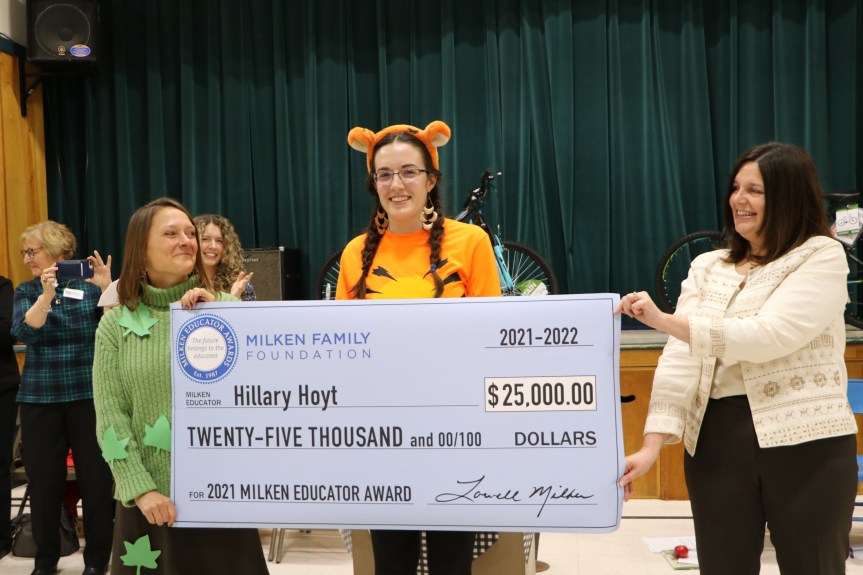
In a surprise assembly earlier today, Hillary Hoyt, a third grade teacher at Leroy H. Smith School, received a $25,000 Milken Educator Award for her commitment to creativity in the classroom, focus on prioritizing children’s individual needs to improve learning outcomes, and leadership both at her school and in her community.

Milken Educator Awards Vice President Stephanie Bishop and Maine Deputy Commissioner of Education Dan Chuhta surprised Hoyt with the honor before cheering students, colleagues, state and local officials, and the media. Hoyt is one of only two educators in Maine and among more than 60 nationwide to receive the recognition during the 2021-2022 school year. She is the first recipient awarded in the RSU 22 School District.

Hailed as the “Oscars of Teaching,” the Milken Educator Awards celebrate, elevate and activate the American teaching profession and inspire young, capable people to join it.

“Hillary Hoyt is a leader, both in her classroom and in her community, and she exemplifies the qualities of a Milken Educator: innovation, creativity and inspirational leadership,” said Bishop, who herself is a 2001 Milken Educator from Virginia. “Her innovative approach to education is creating a pathway to success for each student in her classroom, and for that, we celebrate her here today.”

The Milken Educator Award is not a lifetime achievement honor. Recipients are heralded while early to mid-career for what they have achieved — and for the promise of what they will accomplish given the resources and opportunities inherent in the Award.

“Hillary Hoyt’s passion and dedication to her students, school, and community is truly awe inspiring,” said Maine Education Commissioner Pender Makin. “Her interdisciplinary teaching approach engages and excites her students and fosters a love of learning. Hillary is a trusted mentor and a leader in sharing her innovation and creativity with other educators. She also finds ways to support students and families beyond her classroom, whether as a dance instructor or providing free books to children over the summer. The Maine Department of Education is so proud to join the Milken Family Foundation and the entire RSU 22 community in honoring Hillary with this well-deserved recognition.”

Oprah, a longtime education advocate, shared her congratulations to this year’s winners in a video message shared earlier this year thanking “the most incredible educators around the country” and acknowledging her deep appreciation for the “tireless work” they do.

Hoyt said she was honored and humbled to receive the award. Asked why she went into teaching, Hoyt said, “I wanted to be a teacher because I had some wonderful teachers who showed me what it means to have someone looking out for you every day and showing that I belonged and mattered. I wanted to do the same.”

More about Hillary Hoyt:

Commitment to Creativity: Hoyt’s unique lessons help her third graders build skills for their future success. During the “Million-Dollar Project,” students learned about financing and interest rates as they took out “loans” to buy a house and car, save for college, and fund their day-to-day expenses. Hoyt set up a section of her classroom as a winter wonderland where students could earn time in the ice rink, ice shack and snow mountain by demonstrating good citizenship, according to expectations the children developed together. Hoyt goes to great lengths to hold students’ interest, whether by dressing as a dinosaur when leading a unit on prehistoric life or transforming her room into the sea, with students as jellyfish.

Prioritizes Children’s Individual Needs: Hoyt’s lessons stress innovation, collaboration and independent thinking, encouraging students to tap their imaginations even as they learn important executive functioning skills. She does whatever is necessary to prioritize children’s learning needs. Hoyt digs through data to track student progress, making quick plans to differentiate and reteach those who need extra help, and adding enrichment for those who are ready for more. Since the beginning of the pandemic, Hoyt has flipped her classroom and incorporated new technology, including Flipgrid, Jamboard, Google Classroom and video production. Her students continuously demonstrate growth on state assessments and learn to love education.

Serves as Mentor, Leader: Hoyt is the district’s elementary science teacher leader and has served on district and school committees for math, writing and reading, as well as a state committee writing ELA standards. She mentors student teachers and worked with colleagues to make a series of math videos in preparation for the start of the 2020-21 school year. Hoyt has attended the summer teacher academy at Schoodic Institute, worked on science curriculum with the University of Maine’s RISE Center, and published lessons on the Maine Department of Education’s MOOSE platform, which offers asynchronous learning modules for educators, students and families. She delivered a lesson on weather and natural disasters for The Learning Space, a collaboration between educators and Maine Public Television aimed at students who lack internet access.

Enthusiasm for Extracurriculars: A leader in the Leroy H. Smith community, Hoyt provides free books to students each summer through a partnership with Literacy Volunteers of Maine and Darling’s Ice Cream for a Cause. Her class designs a table based on an author they are studying for the annual Literacy Tea of Bangor. Hoyt played an integral part in WinterKids, which promoted winter outdoor activities for families, and chaired the school’s Family Fun Night. Outside of school, she teaches cheer and dance to college students and children, including Girl Scouts working on their dance badges.

Education: Hoyt earned a bachelor’s in elementary education from the University of Maine Orono in 2013 and earned National Board Certification in 2018.

More information about Hoyt, plus links to photos and video from today’s assembly, can be found on the Milken Educator Awards website at: https://www.milkeneducatorawards.org/educators/view/hillary-hoyt.

More about the Milken Educator Awards: “The future belongs to the educated.”

Along with the financial prize, Milken Educator Award recipients join the national Milken Educator Network, a group of more than 2,800 top teachers, principals and specialists. The network serves as a rich resource for fellow educators, legislators, school boards and others dedicated to excellence in education.

  • In June, the honorees will also attend an all-expenses-paid Milken Educator Awards Forum in Los Angeles, where they will network with their new colleagues as well as veteran Milken Educators and other education leaders about how to increase their impact on K-12 education. In addition, they will learn about how to become involved in the Milken Friends Forever (MFFs) mentoring program, in which freshman Milken Educators receive personalized coaching and support from a Milken Educator veteran on ways to elevate their instructional practice and take an active role in educational leadership, policy and practice.
  • Over the years, more than $140 million in funding, including $70 million for the individual cash awards, has been devoted to the overall Milken Awards initiative, which includes powerful professional development opportunities throughout recipients’ careers.
  • Veteran Milken Educators frequently go on to serve in leadership roles at state, national and international levels.
  • “We find you. You don’t find us!” Unlike most teacher recognition programs, the Milken Educator Awards initiative has no formal nomination or application process. Candidates are sourced through a confidential selection process and then reviewed by blue ribbon panels in each state. The most exceptional candidates are recommended for the award, with final selection made by the Milken Family Foundation.
  • The $25,000 cash award is unrestricted. Recipients have used the money in diverse ways. For instance, some have spent the funds on their children’s or their own continuing education, financing dream field trips, establishing scholarships, and even adopting children.

Eighth Grade Social Studies Teacher Jamie Karaffa Surprised with Milken Educator Award

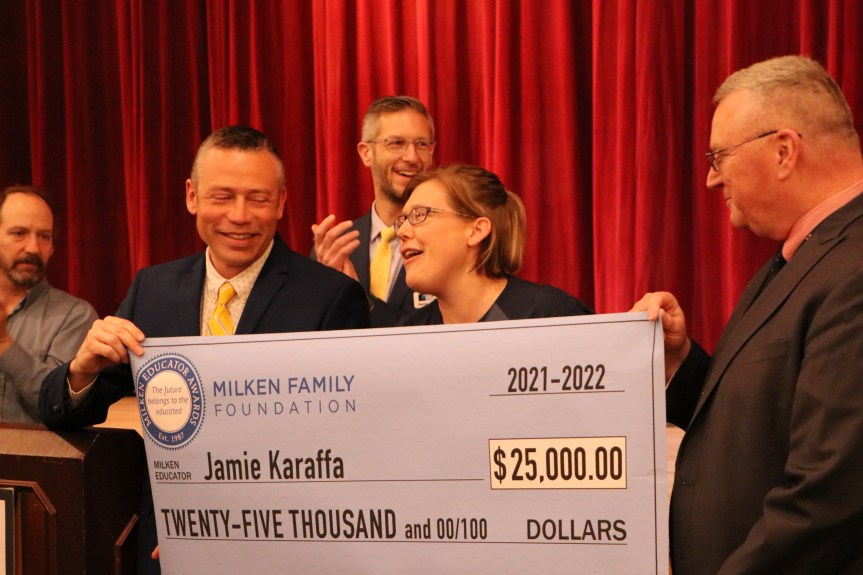
In a surprise assembly today, Jamie Karaffa, an eighth grade social studies teacher at Bruce M. Whittier Middle School in Poland, received a $25,000 Milken Educator Award for her service as a classroom and community leader, innovative approach to creating classroom-to-life connections that make history come alive for her students, and ability to challenge and inspire students to think critically about important historical issues and current events.

Milken Educator Awards Vice President Stephanie Bishop and Maine Deputy Commissioner of Education Dan Chuhta surprised Karaffa with the honor before cheering students, colleagues, state and local officials, and the media. Karaffa is one of only two educators in Maine and among more than 60 nationwide to be recognized with the Award during the 2021-2022 school year. She is the first recipient awarded in the RSU 16 School District. Earlier today, third grade teacher Hillary Hoyt received the Award at a surprise assembly at Leroy H. Smith School in Winterport.

Hailed as the “Oscars of Teaching,” the Milken Educator Awards celebrate, elevate and activate the American teaching profession and inspire young, capable people to join it.

“Jamie makes ancient history feel just as relevant to her students as today’s current affairs, and both come alive in her classroom,” said Bishop, who herself is a 2001 Milken Educator from Virginia. “She challenges her students to think critically and become engaged citizens of their community – and that is a learning outcome that can truly last a lifetime. For her excellent work in and out of the classroom, we are thrilled to present her with this Award today.”

The Milken Educator Award is not a lifetime achievement honor. Recipients are heralded while early to mid-career for what they have achieved — and for the promise of what they will accomplish given the resources and opportunities inherent in the Award.

“Jamie Karaffa makes history come alive for her students by creating immersive, project-based opportunities that build connections between the past and present day while also fostering the critical thinking and leadership skills needed to be engaged and empowered citizens,” said Maine Education Commissioner Pender Makin. “Her passion, creativity, and leadership extend to her role as soccer coach and as a curriculum leader in her district and beyond. The Maine Department of Education is so proud to join the Milken Family Foundation and the entire RSU 16 community in honoring Jamie with this well-deserved recognition.”

Oprah, a longtime education advocate, shared her congratulations to this year’s winners in a video message shared earlier this year thanking “the most incredible educators around the country” and acknowledging her deep appreciation for the “tireless work” they do.

Following the surprise announcement, Karaffa said she was shocked and stunned and she told the school audience, “This isn’t my award alone–this is because all of you as well.”

More about Jamie Karaffa:

Making Classroom Connections to Life: Karaffa helps students understand the connections between history and their own lives. She and her colleagues at Whittier Middle School organize Whittier History Day, when the entire school comes together to share long-term research projects for National History Day. Students learn the essentials of research, including locating sources and evaluating their reliability, forming thesis statements, finding evidence to support their ideas, and structuring their arguments in a clear, compelling way. Pupils learn to write with purpose, format citations, edit their work, and formally present their projects. Many of Karaffa’s eighth-graders have been recognized for their work at the state level, and one student’s project was displayed at the Smithsonian National Museum of Natural History in Washington, D.C.

Challenges Students’ Critical Thinking: Throughout the year, Karaffa engages students in units that encourage them to examine the past and think about how it relates to current events. Her curriculum integrates essential reading, writing and research skills into foundational elements of U.S. and world history, including Reconstruction, segregation, the civil rights movement, World War II and the Holocaust. Karaffa emphasizes working with primary documents as students learn through document-based questions, gallery walks, talk shows, historical sing-alongs and mock elections. She challenges students to become engaged citizens. During election seasons, the class debates local and state legislation, analyzes propaganda tools and candidates’ speeches, and writes essays supporting their chosen candidates, always providing evidence to support their choices. Students understand what is expected of them and regularly exceed those expectations, finding their own voices along the way.

Classroom and Community Leader: A leader in the building, district and beyond, Karaffa has helped develop district and state social studies curriculum, including remote learning units that proved essential during the pandemic. She is a James Madison Fellow, has led professional development at the district level, and has presented at the Maine Council for the Social Studies conference. In addition to her academic work, Karaffa coaches Whittier’s eight-grade girls’ soccer team.

Education: Karaffa earned a bachelor’s in elementary education from Elizabethtown College in 2005 and a master’s in American history and government from Ashland University in 2021.

More information about Karaffa, plus links to photos and video from today’s assembly, can be found on the Milken Educator Awards website at: https://www.milkeneducatorawards.org/educators/view/jamie-karaffa.

More about the Milken Educator Awards: “The future belongs to the educated.”
Along with the financial prize, Milken Educator Award recipients join the national Milken Educator Network, a group of more than 2,800 top teachers, principals and specialists. The network serves as a rich resource for fellow educators, legislators, school boards and others dedicated to excellence in education.

  • In June, the honorees will also attend an all-expenses-paid Milken Educator Awards Forum in Los Angeles, where they will network with their new colleagues as well as veteran Milken Educators and other education leaders about how to increase their impact on K-12 education. In addition, they will learn about how to become involved in the Milken Friends Forever (MFFs) mentoring program, in which freshman Milken Educators receive personalized coaching and support from a Milken Educator veteran on ways to elevate their instructional practice and take an active role in educational leadership, policy and practice.
  • Over the years, more than $140 million in funding, including $70 million for the individual cash awards, has been devoted to the overall Milken Awards initiative, which includes powerful professional development opportunities throughout recipients’ careers.
  • Veteran Milken Educators frequently go on to serve in leadership roles at state, national and international levels.
  • “We find you. You don’t find us!” Unlike most teacher recognition programs, the Milken Educator Awards initiative has no formal nomination or application process. Candidates are sourced through a confidential selection process and then reviewed by blue ribbon panels in each state. The most exceptional candidates are recommended for the award, with final selection made by the Milken Family Foundation.
  • The $25,000 cash award is unrestricted. Recipients have used the money in diverse ways. For instance, some have spent the funds on their children’s or their own continuing education, financing dream field trips, establishing scholarships, and even adopting children.

Honoring and Celebrating All Languages Spoken By Maine Students With the Shift to Multilingual Learners Terminology

Maine is home to students and families who speak a multitude of different languages in their homes and communities. Recognizing and celebrating the linguistic and cultural assets they bring starts with using asset-based language. That’s why the Maine Department of Education (DOE) is transitioning to the term “multilingual learners” (MLs) to describe bilingual and multilingual students who are in the process of learning English. Formerly referred to as “English learners,” MLs enrich their classrooms and communities in invaluable ways. This shift in terminology reflects the principle that all languages a student speaks are important and honored, as they strive towards acquiring English as an additional language – not as a replacement for their primary/home language(s).

Resources from the Maine DOE will begin to reflect this shift right away, and schools are encouraged to embrace this shift as well. Note that the U.S. Department of Education continues to refer to students as English learners, and this may still appear in resources related to federal programs. Programs that teach English to MLs are referred to as English for Speakers of Other Languages (ESOL) programs, and teachers are ESOL teachers or teachers of MLs.

If you have any questions, contact Jane Armstrong, State ESOL Specialist, at jane.armstrong@maine.gov.

MEDIA RELEASE: Maine Department of Education, Maine Department of Health and Human Services and Avel eCare Partner to Bring Virtual School Nurse Services to Maine Schools

The Maine Department of Education, Maine Department of Health and Human Services, and Avel eCare have partnered to deliver telehealth nursing services to school districts throughout the state, enabling access to nursing services in communities that are struggling with staffing and workload pressures caused by the COVID-19 pandemic and the nationwide school nursing shortage.

To expand these school nursing services, the state of Maine used a portion of its COVID-19 federal relief funding to pilot a program with Avel eCare. The eCare School Health program, which has been an Avel service line since 2015, delivers school nurse services virtually via a secure, two-way video mobile unit. The service is being offered at no cost to schools.

“Our school nurses have been on the frontlines throughout the COVID-19 pandemic, caring for students and providing critical support to keep students, staff and schools safe. They are absolute heroes,” said Education Commissioner Pender Makin. “We also know they are exhausted and stretched so thin, and that many schools have not been able to find the experienced school nurse staff they need. This partnership with Avel eCare, made possible with federal funds, offers additional nursing support to help fill shortages in our schools and expand the care we provide to our students.”

“We’re pleased to partner on this important effort to provide telehealth school nursing services to Maine schools as part of strengthening Maine’s school-based health programs,” said Health and Human Services Commissioner Jeanne Lambrew. “This model bridges gaps in school nursing coverage, helps schools maintain safe and healthy environments, and reduces barriers to learning by providing effective preventive care. School nurses have been invaluable during the COVID-19 pandemic and are a trusted resource for their students, school staffs, and communities.”

According to a recent U.S. CDC report, school nurses help students improve their academic outcomes and can also make a significant impact on the broader community. For example, every dollar invested into school nursing program results in society saving $2.20 because of a reduction in emergency room visits and parents taking time off of work to care for their sick children.

“Even before the pandemic, the lives of school nurses were busy. Now, their jobs have expanded to include public health, and that work is simply too big to do alone. We’re thankful to have the support of Avel eCare to help our nurse provide the daily health services that our children need,” said Tara McKechnie, Principal of Deer Isle-Stonington Elementary School, which was among the first schools to implement the virtual school nurse program.

The program is currently accepting applications and eligible schools are urged to apply today to take advantage of the available grant funding. K-12 schools, once they fill out an online application, will then receive direct support from the eCare School Health team, at no cost to the school, through June 2023.

Maine Department of Education and University of Southern Maine Partner to Increase School Psychology Supports in Maine

The Maine Department of Education (DOE) and the University of Southern Maine (USM) Department of Educational and School Psychology announced a new partnership to increase the number of school psychologists within the state and expand school psychology services for Maine’s students and schools.

With support from the Maine Department of Education, the University of Southern Maine has created a new, full-time clinical faculty position to expand internship programs within the state and prepare larger numbers of credentialed school psychologists to provide effective and comprehensive school-based services. School psychologists are trained and prepared to help schools improve academic achievement, promote positive behavior and mental health, create safe and supportive school environments, strengthen family-school partnerships, improve schoolwide assessment and accountability practices, and advance equitable practices for diverse populations.

“School psychologists play such an important role in supporting the mental health and wellbeing of students and creating safe, welcoming, and supportive environments for our young people,” said Education Commissioner Pender Makin. “The pandemic greatly increased the need for these supports in our schools and we’re excited to partner with the University of Southern Maine to provide a pathway to increase the number of school psychologists in Maine schools as well as offering additional supports and resources to current school psychologists.”

Dr. Samantha Blair has been selected to serve in this new role as a Clinical Assistant Faculty in the Department of Educational and School Psychology at the University of Southern Maine.

“I am excited to be a part of this collaboration with the University of Southern Maine and the Department of Education because I am committed to the professional development of school psychologists and working with stakeholders throughout Maine to support the work in the field,” said Dr. Blair. “I am looking forward to continuing to learn about the needs throughout the state, and through collaborative efforts increasing the number of school psychologists and expanding their role to increase access to high-quality comprehensive services to students throughout Maine.”

Blair will collaborate with school psychologists and schools across the state to design, coordinate, and supervise field-based training experiences in school psychology. She will assist with the development of comprehensive practicum and internship programs, support priority initiatives within partnering schools, provide supervision to school psychology trainees, and offer professional development in clinical supervision for school psychologists.

“The recently announced partnership between the Maine Department of Education and the University of Southern Maine is exciting news for the field of education, particularly special education. School psychologists play an integral role in supporting the educational and social emotional needs of students with disabilities,” said Gay McDonald, Executive Director of Maine Administrators of Services for Children with Disabilities (MADSEC). “As active members of the student’s educational team and as trained individuals to conduct the required comprehensive evaluations under the Individuals with Disabilities Education Act, school psychologists are greatly needed in our schools. This partnership shows the Department’s commitment to address the shortage of school psychologists across the state and to assist in meeting the individual needs of our students. Such a collaborative effort will have a high impact for Maine students, and we applaud the MDOE and USM on this partnership.”

MEDIA RELEASE: Maine Department of Education Announces $1.2 Million in Rethinking Responsive Education Ventures (RREV) Funding to Support Education Innovation

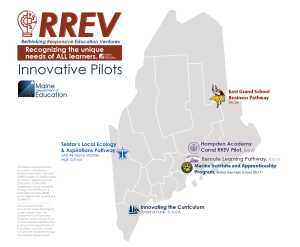
The Maine Department of Education (DOE) today awarded $1.2 million in Rethinking Responsive Education Ventures (RREV) funding to support education innovation in six School Administrative Units across Maine. These funds will be used to support projects focused on workforce development, environmental stewardship, outdoor education, a marine institute, and internship opportunities as well as supporting unique approaches to remote learning.
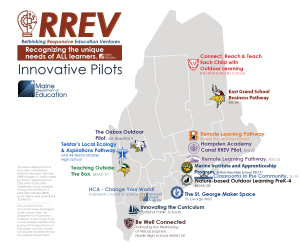
Awardees for this second round of RREV funding include East Grand School in Danforth, Belfast Area High School, Portland School Department, Telstar High School in Bethel, RSU 22 in Hampden, and RSU 25 in Bucksport.

“Education is changing in so many new and exciting ways, and we should be at the forefront, introducing our children to the great outdoors and offering them hands-on experiences outside the classroom that will spark new perspectives, engender new friendships, and deliver new skills,” said Governor Janet Mills. “Using these federal enrichment funds, creative Maine educators can get children outdoors this summer, exposing them to lived experiences that will get them ready for life and new careers.”

“Educators in Maine are constantly paving the way with their innovation and creativity, and RREV offers a way to supercharge these efforts,” said Education Commissioner Pender Makin. “We’re excited to invest in these educator-led projects to rethink teaching and learning in ways that deepen student engagement, expand beyond the traditional classroom, connect students with Maine’s bounty of natural resources, and allow them to explore career paths that fuel their passions.”

The Maine DOE was awarded $16.9 million from the U.S. Department of Education’s Rethink K-12 Education Models Funding. As one of 11 States to receive funding, Maine created RREV to support the work of visionary educators to develop innovative pilot programs around remote and outside of the classroom learning. RREV is flooding Maine with innovative practices, professional development, and pilot design classes. Courses in innovative design process are available through several of Maine’s public and private universities at no cost to Maine educators who wish to participate. In addition to the innovative pilot development classes, the Department is also offering asynchronous, innovative principles webinars which are available to all educators in self-paced, independent modules.

The first round of nine RREV pilots were announced last fall with an initial investment of more than $2 million to support projects including expanded outdoor learning, a makerspace, hiring an Outdoor Learning Coordinator, expanded internships, service learning, and work/study opportunities, and engaging remote learning pathways. MSAD 17, Brewer School Department, MSAD #28, RSU 89 Katahdin Schools, Mt Blue HS/ Foster Technology School, Harpswell Coastal Academy, Noble High School, MSAD 60, St. George Municipal School Unit, and School Union #76 were all part of the first round of pilots.

“At St. George School, we dare to dream big. For over 5 years, our school community has been working to bring the trades, technology, and innovation back to the heart of public education and allow all students, grades K-8, to engage in hands-on/minds-on projects,” said St. George MSU Superintendent Mike Felton, part of the first round of RREV pilots. “The RREV Program believes in the power of local schools and communities to shape their future and isn’t afraid when a small school dreams big. RREV’s support, assistance, and encouragement will help make our dream of a St. George K-8 Career Technical Education/Makerspace Building a reality and, in the process, stretch people’s imaginations as to what’s possible in rural education and economic development.”

For more information on how to get involved in RREV and to learn more about the pilots, visit https://www.maine.gov/doe/rrev. 

New Pilots:


All RREV Pilots:

MEDIA RELEASE: Maine Department of Education Resources on Helping Young People Safely Navigate the Internet

During his State of the Union address this week, President Biden called for increased measures to ensure young people are protected on the internet and while using social media. The Maine Department of Education offers parents, educators, and students a number of free resources, by grade level, to help young people safely navigate the internet and avoid dangers that can impact their physical and mental health.

The Maine Department of Education’s comprehensive web-based social emotional learning resource SEL4ME embeds specific lessons in interest safety at every grade level. For example, the second grade module Be Fine Online helps students learn ways to stay safe when online, including the importance of never revealing their personal information; sixth graders have lesson like Be Aware What You Share in which they gain a deeper understanding of internet safety and social media and on cyberbullying; the eighth grade lesson User Beware: The Scary Side of the Internet helps students understand that not everything on the internet is safe, including how to spot online predators and the dangers of sexting; and in 11th grade, students have access to Cyber Bullying and Digital Citizenship which goes into the effects of online bullying and the virtual footprint that can follow them into the work place.

SEL4ME is free to all Maine schools, families, and community partners and offers more than 450 PreK-12th grade learning modules. Each grade level hosts lessons within the five key elements of social emotional learning (SEL): self-awareness, self-management, social awareness, relationships, and responsible decision making. Educators, families, and students can learn more and sign up here.

The Maine Department of Education’s Digital Learning Specialists, in partnership with the MLTI Ambassadors, also provide professional learning, resources, and support for digital citizenship, social media use, online safety, and cyber security. MLTI also partners with Common Sense Education to share digital citizenship and online safety resources with educators. Educators can also reach out to specialists directly to explore ways to integrate these skillsets into their instruction to help students stay safe online.

“The internet is a tremendous resource for students to explore and activate their passions, develop skills and knowledge, build connections, and expand their digital literacy, and Maine educators and schools are constantly integrating technology into teaching and learning in innovative ways,” said Education Commissioner Pender Makin. “We’re also committed to making sure students have the tools and resources they need to navigate the internet safely and avoid the very real dangers that President Biden outlined in his State of the Union speech that pose a threat to the physical and mental health of our young people. We encourage educators and families to take advantage of our free resources.”

MEDIA RELEASE: Education Commissioner Makin Visits Mid-Coast School of Technology to Celebrate Career and Technical Education Month, Highlight the Value of CTE Programs

In honor of Career and Technical Education (CTE) Month, Maine Education Commissioner Pender Makin visited Mid-Coast School of Technology to highlight the importance of Career and Technical Education in providing high-quality career pathways, shine a light on the vast array of program offerings for students, and celebrate the powerful teaching and learning happening in CTE schools.
Enrollment in Maine CTE schools has increased by 9.4 percent between the 2018-2019 and 2021-2022 school years, with more than 9100 students now in Maine’s 27 CTE schools.

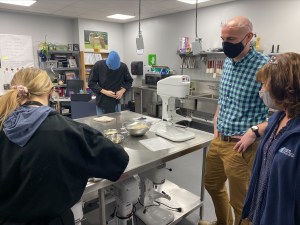
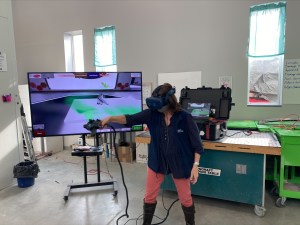
While at Mid-Coast, Commissioner Makin met with educators and students, visited several classes to see the wide range of programs offered at the school, and got hands on experience alongside students. She engaged with students and educators enrolled in programs focused on auto collision, bakery and pastry, welding, carpentry, design technology, marine technology, machine tool, outdoor leadership, EMT, certified nursing assistant, and small engines. Mid-Coast has seen its highest enrollment ever this school year and serves students from 21 towns. The school has 18 high school level programs plus adult education and college courses taught on site.

“It’s awe inspiring to experience the energy, engagement, and excitement of the students here at Mid-Coast and the passion these educators, who are leaders in their fields, bring to help enable student success both inside and well beyond the classroom,” said Education Commissioner Makin. “Everyone has a way to learn and everyone has a path to success and we want to make sure students and families know that Career and Technical Education is such a vital and vibrant pathway for young people. At schools like Mid-Coast, students use their hands and their minds to gain knowledge and skills in everything from technology and culinary arts to computer design and the skilled trades, while also learning how to collaborate with others, be self-directed, critically think, and find joy in what they do. And they can leave here, often with some level of certificate or credits that give them such a great head start in their careers or at college.”

In her meetings with students, many of them talked about how they had to break through the stigma that still exists around career and technical education and how they want more people to know about CTE as an option. They highlighted the opportunities they have to work toward real world goals, gain experience in their industries, have the safe space to make mistakes and learn from them, and learn life skills. Mid-Coast School of Technology Director Bobby Deetjen said that students “learn skills but also how to have confidence and become leaders.”

Photos from the visit are available upon request and will be featured on DOE social media.