Seeking Five Distinguished Educators for MLTI Ambassador Positions

Are you passionate about professional growth and technology? Do you want to make a difference in Maine schools? Are you currently teaching in a Maine public school? This might be the opportunity you’ve been looking for! 

The Maine Department of Education is hiring five distinguished educators to join our team in supporting MLTI 2.0 professional learning. These are full-time, two-year, contracted, remote positions. The MLTI distinguished educators will provide instructional technology coaching directly to MLTI participating schools and work closely with the MLTI team to implement the MLTI 2.0 program. Ideal candidates will be excited about instructional coaching and innovative technology practices in education, eager to work with other teachers, have outstanding communication skills, and experience with upper elementary, middle, and/or high school pedagogy. 

Distinguished educator positions are set up as an exchange agreement between the Department of Education and your local school district. Through the agreement, the Department pays your local school for the duration of your contract as a distinguished educator, allowing your school to temporarily fill your vacant position and continue to pay you your current rate while you work as a distinguished educator. Once the two-year contract is complete, you will be able to return to your position within that district. 

Still have questions? Contact the Digital Learning Specialists at the Maine Department of Education to learn more: Jonathan Graham, Elementary Digital Learning Specialist at jonathan.m.graham@maine.gov or Emma-Marie Banks, Computer Science and Secondary Digital Learning Specialist at emma-marie.banks@maine.gov.


Nominations Open for John Lewis Youth Leadership Award

The Maine Secretary of State’s Office will be accepting nominations for the John Lewis Youth Leadership Award. The award recognizes one Maine resident, age 25 or younger, who demonstrates leadership abilities, has a passion for social justice, and is improving the quality of life in their community.

The John Lewis Leadership Award is named for the late Congressman John Lewis, who was known for his courageous achievements during the Civil Rights Movement and his long tenure of public service. The National Association of Secretaries of State (NASS) established this award in February 2021, inviting Secretaries to recognize a gifted, civic-minded young person in their state each year.

Please consider nominating a student or community member. Visit the John Lewis Youth Leadership Award webpage for more information. Submissions are due Tuesday, May 31, 2022.

2021-2022 School Health Annual Reporting Window is Open

The Maine Department of Education (DOE) is announcing that the School Health Annual Report is now available through the Reporting Calendar. The reporting link is available through the DC&R Calendar and the superintendent will determine who will compile and submit the data from all schools within the SAU. The data does not need to be submitted by your health staff; it can be entered by whomever the Superintendent determines is appropriate. Please remember that these reports once submitted, are manually verified so it may take several weeks for your report to show up in DC&R as completed. This report is due by July 30, 2022.

You may download the reporting worksheet in order to aid data collection among your schools.

Now more than ever, being able to quantify the workload of your school health staff is of utmost importance as we continue in this unprecedented time. Advocating for the multiple needs of your students helps to inform evidence-based school nursing practice and improve overall youth health outcomes. Healthy students are better learners.  If you have questions about the School Health Annual Report, please contact the MDOE School Nurse Consultant, Emily.Poland@Maine.gov.

2022 Annual School Health Survey: https://mainedoe.co1.qualtrics.com/jfe/form/SV_8DhfRs2YjzA86I6

Exploring the History of Maine Through Robotics

In the fall of 2022, Ann McClellan asked Maxx Pillsbury, a student of the Sphero Bolt coding program at Mt. View Middle School, how he might use the Bolt to tell a story. Both interested in Maine history, Ms. McClellan and Maxx began exploring using the Bolt to tell the story of ten historically significant places in Maine.

Maxx coded his Bolt to be Samuel de Champlain, an explorer who traveled the coast of Maine. Maxx and Ms. McClellan used a rope to model the nooks and crannies of Maine’s rugged coastline and painted designs on paper to represent characteristics of the area being explored.

Once they planned the layout, Maxx programmed the Bolt. While working, Maxx decided he also wanted the Bolt to narrate the history locations. He wrote a script, chose sounds to enhance the audience’s experience, and found music to play.

You can view a video of the robot moving through the project here:

The final product is impressive and took perseverance and critical thinking to problem solve through challenges that presented themselves throughout the process. For instance, placing the Bolt just right was imperative to its success.

“If the angle was just slightly different when it was set down, then it could mess the whole thing up,” Maxx said.

Ms. McClellan agreed, “Directionals and movement controls were challenging. These had to do with speed, angles, and time. We maintained humor, flexibility, and perseverance, so we got through the programming!”

Maxx is eager to apply what he learned from this project to his other classes. “In my history classes, I will already know some history about early explorers in Maine, and in math class, I can use what I learned about ratios with distance, speed, and time.”

For more information about the Sphero Bolt coding program or other ways to integrate computer science into your curriculum, reach out our computer science specialist, Emma Banks at Emma-Marie.Banks@maine.gov or visit: https://www.maine.gov/doe/learning/ltt/computerscience.


Annual Audit Requirements: An Early Reminder

Annual Audit Reports Due December 30th

Annual audit reports are due within six months after the end of the audit period (e.g., reports for the fiscal year ending June 30th are due on or before December 30th). In accordance with Title 20-A, §6051:

  • The auditor is required to review the audit with the school board.
  • It is the school board’s responsibility to submit the annual audit document unless it is stated in the engagement letter that the audit firm will submit the audit to the Maine Department of Education (DOE) on behalf of the school board.
  • Municipal school units are required to submit either a combined annual audit or a school department audit and a municipal audit to the Maine DOE. The municipal annual report (a.k.a. town report) cannot be accepted in lieu of the complete municipal annual audit.
  • The Maine DOE must receive a Schedule of Expenditure of Federal Awards(SEFA), which includes federal award expenditures for all reporting entities, even if a Single Audit (formerly A-133 audit) is not required to be conducted. The SEFA provides information needed by Maine DOE to conduct sub-recipient monitoring as required by the US Department of Education and is due at the time of the annual audit.

In municipal school units where a combined audit is not conducted, Maine DOE should receive two audits: an audit with a SEFA for the school department, and an audit for the city/town including a SEFA.

  • If a management letter is prepared by the auditor, a copy must be submitted to Maine DOE with the annual audit, as this letter provides us with information needed to conduct sub-recipient monitoring, as required by US DOE.

Extensions and Subsidy Payments

If an extension or exception is needed for the deadline to submit either the municipal or school department audit, the superintendent must contact us to request the extension.

The forms are available on the Fiscal Review and Compliance webpage, under forms on the menu bar.

  • Initial extension requests will be for a period of 2 months, and 30 days thereafter.
  • Extension requests will be considered until June 30th (six months after due date); extensions will not be valid after June 30th and all municipalities and school administrative units with overdue audits which have not submitted an extension request before May 31th may have a delay in subsidy release. Those who have not submitted an extension request will have subsidy withheld until addressed.

Please submit all annual audit documents, reports, information requests, questions and other audit correspondence via email to DOE.Audit@Maine.gov.

Education Commissioner Pender Makin Visits Kingman Elementary School

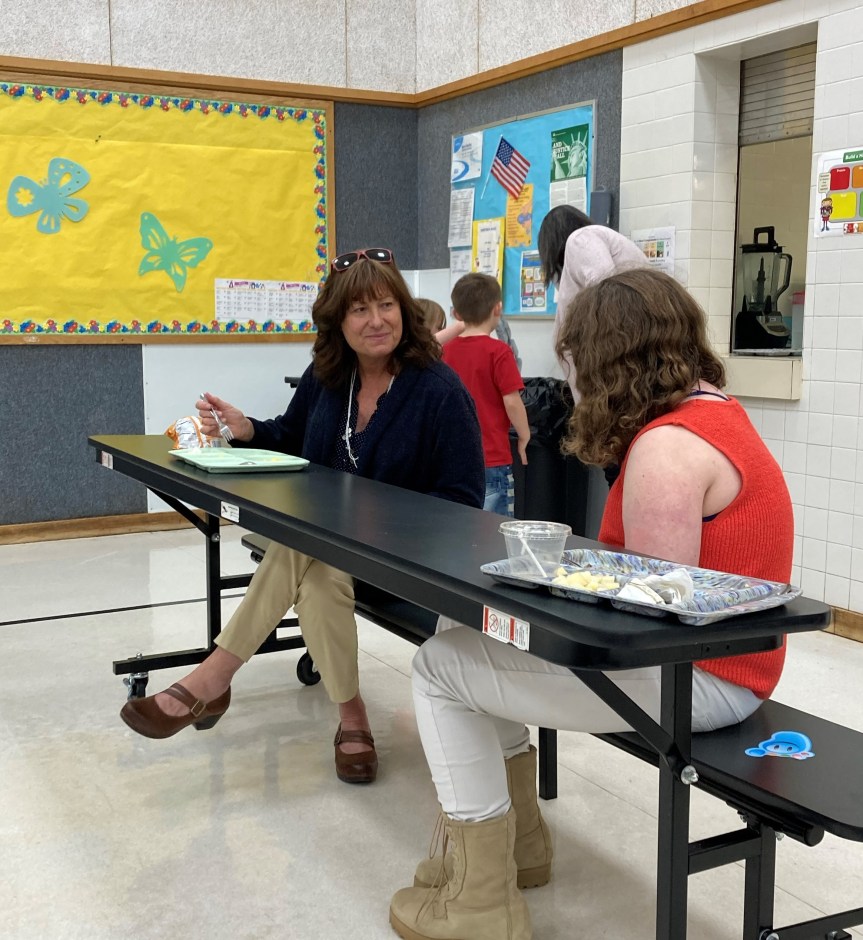
This week, Maine Education Commissioner Pender Makin visited Kingman Elementary School, one of Maine’s Education in Unorganized Territory (EUT) schools. Makin brought miniature rosebushes to the three educators at the school to celebrate Teacher Appreciation Week, observed in classrooms, met with students and with staff, joined recess, and enjoyed lunch with students.

Kingman implements a multi-age/multi-grade classroom model for students in grades pre-k through six who live in the townships of Kingman and Prentiss.

“This is truly a unique learning environment,” Makin said. “In a region where there are no businesses or establishments other than the school itself, and where families typically live significant distances from one another, the school creates the only community outside of individual families.”

Also, be sure to watch Commissioner Makin’s message to Maine’s educators for Teacher Appreciation Week.

Nominate an MLTI Educator for the End of Year Expo!

MLTI is launching an End of Year Expo event to celebrate educators and the work they do to support the use of technology in teaching and learning. Are you or someone you know an MLTI educator using technology in fun and innovative ways? Submit an entry to the expo and join us to share these achievements at our exhibition!

The exhibition will take place at the University of Maine in Orono, at the Collins Center for the Arts, on June 25, 2022. All entries will have the opportunity to present at the expo and share their work with other educators. The expo will be free and open to all MLTI educators. Exhibiters will be treated to a luncheon and an awards ceremony after the exhibition to celebrate their exciting use of technology in teaching and learning.

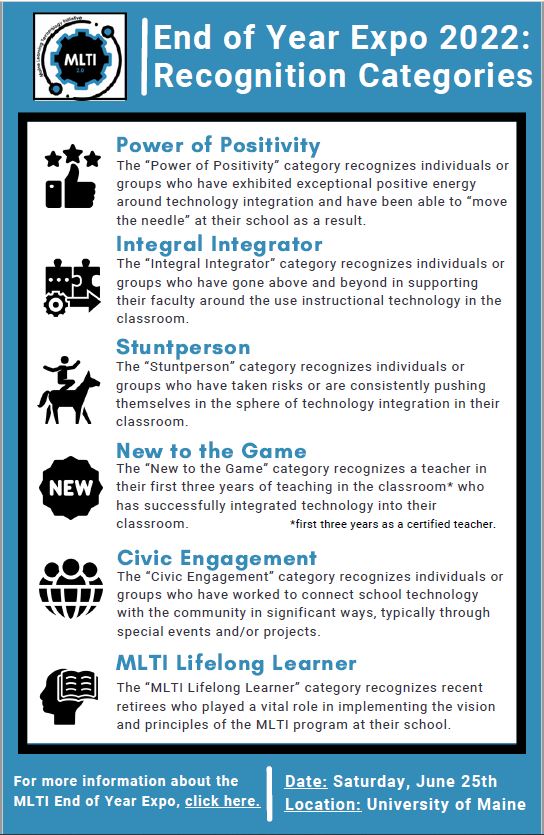
The MLTI End of Year Expo features six categories of recognition. To learn more about these categories, check out this infographic and nominate an educator using this form!

For more information about the MLTI End of Year Expo, check out our website.


Dedicated Maine State Board Member Peter Geiger Celebrated as Term Ends

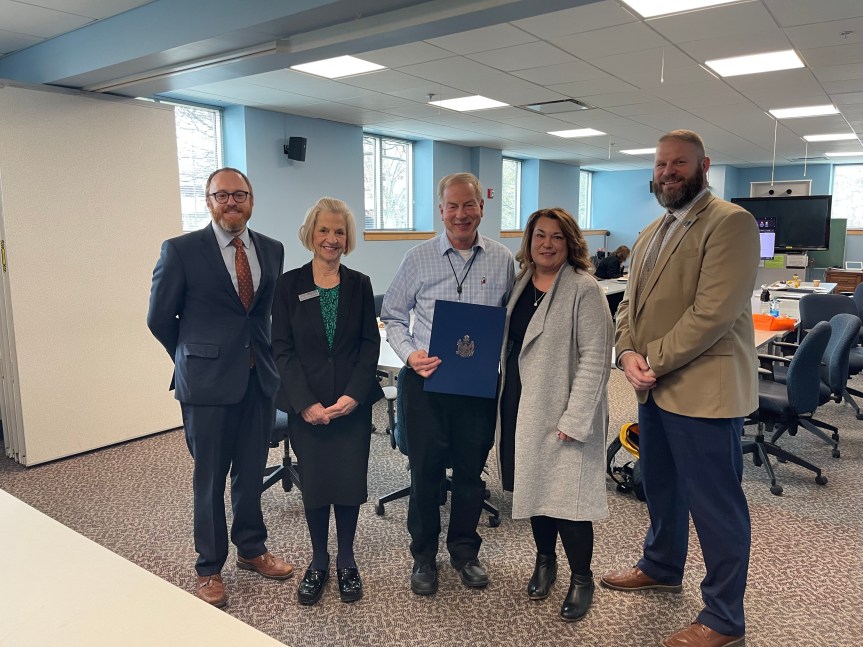
Pictured (L to R): Senator Nathan Libby, Representative Margaret Craven, Peter Geiger, Representative Kristen Cloutier, and Representative Jonathan Connor.

Peter Geiger, past Vice Chair for the Maine State Board of Education, was presented a Legislative Sentiment by Senator Nathan Libby at the Board’s April 13th business meeting prior to Geiger’s term ending at the end of April.

Geiger served almost 13 years on the State Board, including two years as Chair and over three years as Vice Chair.  He recently chaired the School Construction Committee and Legislative Action Committee of the Board, served on the Professional Standards Board, Maine Teacher of the Year Committee, and numerous other committees during his tenure on the State Board, 1992-1997, 2012-2017, and 2019-2022.

Fern Desjardins, Chair of the State Board of Education, stated, “Peter works tirelessly in support of policies and services to strengthen educational opportunities for Maine’s students and schools.  His strong advocacy for education has been a life-long passion that has benefited students and educators throughout Maine for many years.”

Geiger is the Editor of the Farmers’ Almanac and Executive Vice President of Geiger, a family owned business for four generations.  He has been active in numerous community and education organizations.  Geiger is a resident of Lewiston.

Replacing Geiger from District I is Kristin Bishop of Madison.  Bishop previously served on the Maine State Board of Education as a Student Representative in her junior and senior year at Madison Area Memorial High School.  She is a graduate of Bowdoin College in Brunswick and works in the Office of Civic Engagement and Community Partnerships at Colby College in Waterville.  Bishop will be joining the State Board for her first Business Meeting on May 11 at the Cross State Office Building in Augusta.

Portland Public Schools Developing Culturally Important School Lunch Menu

The Portland Public Schools Food Service Department, in partnership with local nonprofits and consultants, is working to introduce culturally important menu items to the school lunch options served at the district’s high schools.

This spring, students at Deering, Casco Bay, and Portland high schools are taste-testing food items adapted from traditional Central African cuisine and providing feedback that will help the district decide if the new food items will be incorporated onto the high school lunch menu for next school year. Another goal of the project is to encourage more student engagement and participation in school lunch.

This project is funded by Full Plates, Full Potential, and led by Food Service Director Jane McLucas and local food justice nonprofit Cultivating Community. It is being implemented by several community partners that include FoodCorps, Cumberland County Food Security Council (CCFSC), Good Shepherd Food Bank, and the University of Southern Maine (USM).

“We are Maine’s largest and most diverse school district, and this project is an important – and delicious – way to help us acknowledge and celebrate our diversity,” said Superintendent Xavier Botana. “All our students should have the opportunity to enjoy a wider variety of culturally diverse menu items, which could encourage more students to participate in our nutritious school lunch program. We are very grateful to the wide variety of community partners working with us on this and other projects to ensure food security for all our students.”

This initiative was born from Food Fuels Learning, a network of school and community partners working to build food security in the Portland Public Schools. It is made possible due to the recipe development work done by Khadija Ahmed and Chef Samantha Cowens-Gasbarro with Westbrook Public Schools’ Nutrition Director Mary Emerson.

Ahmed is the owner-operator of Food For All African Mobile Market and the Community Impact Manager for Equity, Diversity and Inclusion (EDI) at Good Shepherd Food Bank. Cowens-Gasbarro is the executive chef for Healthy School Recipes and a school nutrition consultant. These two adapted traditional Central African cuisine into meals that meet federal nutrition guidelines. Replicating the recipes developed in Westbrook, Ahmed and Cowens-Gasbarro are now working with district high school cafeteria staff to test similar recipes in Portland, while also educating staff about the importance of cultural representation in school food.

Food service staff are learning how to cook these new dishes this spring. Every high school student in the district will also have the opportunity to try and provide feedback on potential menu items. This work aims for students to see more familiar dishes offered at school and encourage higher participation in school meals – a proven strategy for increasing food security and reducing stigma around accessing these nutritious foods.

FoodCorps Service Member and Deering High School graduate Mercia Ckaba-Thomas created posters to educate students about the event: “We share a bond through food that creates better connections between cultures, and celebrates the many differences that exist in the Portland community.”

The first taste test took place on March 24. A meal of smashed kidney beans, spiced beef, and cabbage slaw was offered to students, with great success. Taste test coordinators Mercia Ckaba-Thomas (FoodCorps), Zoe Grodsky (CCFSC), Lily Chaleff (Cultivating Community) and Cowens-Gasbarro offered samples and collected feedback from over 250 students with the support of students from USM Professor Jamie Picardy’s “Food, Power, and Social Justice” class and Food Fuels Learning (FFL) high school interns, Anna Behuniak (Portland) and Leaticia Hannah (Deering).

“I would absolutely be more interested in school lunch, especially if this dish was served.” reported one Casco Bay student. Other recipes expected to be tested are chickpeas and chicken over jollof rice and a chicken and spinach stew. A second student taste test is slated for May 19.

In addition to voting and short-form feedback on the day of the taste tests, students are able to sign up to participate in one-hour focus groups. These sessions aim to gather more in-depth insights on cultural representation in school meals and how to better create an inclusive cafeteria environment that is reflective of the diverse student body here in Portland. The three focus groups are coordinated by Kristina Kalolo (CCFSC) along with facilitation training and support for the FFL interns so they can lead their peers in these conversations.

Professor Picardy’s USM students will conduct data analysis of the feedback to help inform the next stages of the project. Youth leadership and youth voice are centered in each step as an important part of the long-term success of this work. Last year, FFL interns conducted a survey on school meals that received feedback from over 800 students. A main takeaway was that there is a strong desire for more culturally representative and culturally important foods in school meals. This project is an extension of the findings that emerged from this student-led research.

Project members Chaleff, Kalolo, and Cowens-Gasbarro recently presented at a Maine Farm to School Network meeting about this work, with the hope that other districts across the state will be inspired and take on similar work to build more equitable and representative school meals. To learn more about how this work unfolds, you can subscribe to the FFL newsletter at foodfuelslearning.org and follow Food Fuels Learning on Facebook.

If the project is successful at the high school level, the district would consider adding culturally important menu items in the middle and elementary school lunch program in the future.

MEDIA RELEASE: Maine Department of Education Releases Teach Maine Plan to Develop, Support, and Sustain a Robust Education Workforce

The Maine Department of Education released the Teach Maine Plan, a comprehensive roadmap to develop, support, and sustain a robust educator workforce in the state. Unveiled during Teacher Appreciation Week, the Teach Maine Plan and new website provide a set of strategies and actions to inspire a talented and diverse future educator workforce, and to support and develop Maine’s current educator workforce.

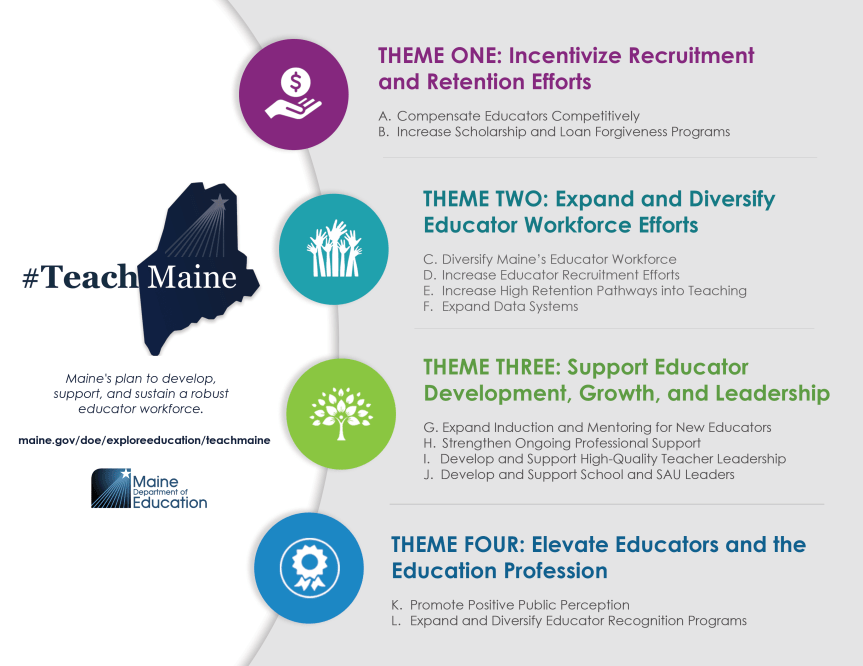
The Teach Maine Plan is organized around four key themes: incentivize recruitment and retention efforts; expand and diversify educator workforce efforts; support educator development, growth, and leadership; and elevate educators and the education profession. While the Teach Maine Plan has multiple themes, strategies, and actions, they are interdependent and not designed to be implemented in isolation.

“The Maine Department of Education is committed to developing, supporting, and sustaining a vibrant and diverse education workforce, and honoring the expertise and leadership of Maine’s education professionals,” said Maine Education Commissioner Pender Makin. “Maine’s educators give it their all each and every day to teach, inspire, and nurture their students, and the Teach Maine Plan provides the resources and supports they need to keep doing what they do best while also attracting more amazing educators into our schools. I want to thank the many educators and stakeholders who contributed to this effort and we look forward to collaborating on moving this plan into action.”

The report is the result of contributions by education stakeholders throughout Maine, who provided feedback via multiple channels, including regional Think Tanks, focus groups, surveys, organizational meetings, and informal conversations. Additionally, the Department of Education convened an Educator Talent Committee, a core group of internal and external stakeholders, to share their experiences, look at research and trends, and to make recommendations on how to address Maine’s educator shortage.

“Teach Maine provides a blueprint that will help to develop, attract, and retain quality educators that the children in Maine deserve. The future of Maine’s economy is grounded in providing our students with a diverse and rigorous educational experience. Teach Maine will provide the foundation to ensure that Maine students graduate with the passion, knowledge, and skills to be productive members of the world they will lead,” said Maine School Superintendents Association Executive Director Eileen King.

“The themes of the Teach Maine Plan hit upon key issues to ensure that our system of public education in Maine will continue to be strong. Recognizing, respecting, and rewarding our educators for the vital work they do every day is critical to providing the education our students deserve,” said Maine Education Association President Grace Leavitt.

“We are very excited to see the impact that Teach Maine will have on our profession. By having a stronger emphasis on recruitment, and then providing mentoring and ongoing support that educators and educational leaders need, will only help keep high quality professionals in education. This is what our students deserve,” said Maine Principals’ Association Executive Director Dr. Holly Blair.  

“Teachers are the most important element in ensuring Maine has a well-educated citizenry that is essential for our future workforce and democracy. These strategies will help strengthen the teaching profession in Maine,” said Educator Talent Committee member and University of Southern Maine Chair and Associate Professor of Teacher Education Dr. Flynn Ross. 
The first theme of the Teach Maine Plan, incentivize recruitment and retention efforts, focuses on compensating educators competitively; providing financial incentives for high-needs subjects and locations; providing financial incentives for teacher expertise and teacher leadership; encouraging alternative compensation strategies, including housing, transportation, childcare, creative use of time, and sabbaticals; increasing scholarship and loan forgiveness programs; expanding service loan forgiveness and tax incentive programs; and increasing awareness of funding sources.

Research shows that low salary scales continue to negatively impact the educator pipeline, as well as the retention of practicing teachers. Compared to college-educated professionals in other fields, beginning teachers earn about 20 percent less, with the gap widening to 30 percent by mid-career. While the Mills administration made a significant step in addressing overall teacher compensation to guarantee a minimum salary of $40,000, more must be done to make working in education a financially sustainable career.

The second theme, diversify and expand educator workforce efforts, includes strategies to recruit, prepare, and hire racially, ethnically, and linguistically diverse educators; retain diverse educators by addressing the policies and practices of structural racism; increase educator recruitment efforts; reduce costs; increase marketing for active recruitment of educators; increase high retention pathways into teaching such as teacher residencies, grow your own, and education career pathways starting in high school; promote teacher residencies for high-need School Administrative Units (SAUs) and content areas; promote additional dual certification programs for high-needs content areas; grow your own education technician and community college partnerships; and education career pathways in high school/CTE schools.

Building an educator workforce that reflects the racial, ethnic, and linguistic diversity of the student population has been shown to have positive impacts on student achievement. Research has shown that matching teacher racial identity with student identity can improve academic achievement, high school graduation rates, and college enrollment rates. And all students who have had teachers of diverse races or cultural backgrounds are better prepared for success in a global world.

The report finds that to make progress towards recruitment and retention initiatives, Maine needs a comprehensive and transparent data collection and management system. The strategy to expand data systems includes actions to characterize the current educator population in greater detail; determine educator needs geographically in Maine; create a statewide job board; and collect SAU-level data such as exit interviews and surveys.

Theme three, support educator development, growth, and leadership, includes strategies to expand induction and mentoring for new educators; strengthen state and SAU supports for mentoring and induction; scaffolded induction with time to learn, including not just orientation and access to mentors but also access to coaches, common planning time with mentors, and resource allocation to support success; establish a network of new educators for peer support; strengthen ongoing professional support through professional learning opportunities at the school, SAU, regional, and state level; develop and support high-quality teacher leadership; and develop and support well-qualified school and SAU leaders.

The support that new educators are given throughout their pre-service career and first few years of teaching has a direct impact on their retention as career educators. Key elements of high-quality induction strongly associated with reduced rates of teacher turnover include assigning mentors from the same field, common planning time and opportunities to collaborate with teachers in the same subject area, and being part of an external network of teachers.

Theme four, elevate educators and the education profession, includes strategies and actions to promote the positive public perception of public education and the education workforce, and expand and diversify educator recognition programs. To recruit and retain a vibrant educator workforce and make teaching an attractive profession also requires strengthening public perception and confidence in Maine schools and demonstrating appreciation for educators not just during teacher appreciation week, but every week of the year.