Maine’s 3rd Annual Opioid Response Summit Highlights Maine DOE’s Commitment to SEL in Schools

Governor Janet T. Mills’ 3rd Annual Opioid Response Summit was on held on July 15th this year and reminded the public of the importance of social emotional learning and trauma informed approaches in Maine schools, highlighting the work of the Maine Department of Education’s development of SEL4ME, a social emotional learning (SEL) platform for Maine educators and learners.

The summit featured numerous speakers and keynote addresses including those of Dr. Larry McCullough and Mark Lefebvre from the Pine Tree Institute who led a seminar called, “Preventing Substance Use Disorders by Mitigating Adverse Childhood Experiences.” This discussion showed the strong link between adverse childhood experiences (ACEs) and opioid addiction.

Dr. McCullough highlighted the importance of positive childhood experiences to combat the correlation between ACEs and opioid addiction. Further explaining that positive childhood experiences can be created for at-risk youth through feeling a sense of belonging in high school, having nonparent adults as role models for students, and community traditions. The seminar dug into the essential parts of community support, including a key component as social emotional and trauma informed learning, which has been shown to strongly correlate with less youth involvement in drugs.

Representatives Gabe O’Brien and Nina Misra from the Maine Youth Action Network corroborated Dr. McCullough’s presentation with their own, entitled: “Promoting Health Equity and Prevention through Youth Engagement Best Practices.” O’Brien and Misra focused on community and environmental conditions. Community conditions Misra defined as, “conditions in which people are born, grow, work, live, and age.” Educational environments in which social emotional learning occurs within the classroom were encouraged as a best practice. Misra and O’Brien described a classroom that utilizes SEL as, “creating a space where young people feel seen and heard.”

Social emotional learning has been a priority for the Maine Department of Education, championed through the SEL4ME curriculum. SEL4ME strives for students to learn, “skills for self-confidence, perseverance and academic success as well as [become] positive members in their communities.”

The Annual Opioid Response Summit confirmed the importance of Maine DOE’s commitment to SEL as a critical role in mitigating the crisis. Dr. Jessica Pollard, Director of the Maine Office of Behavioral Health stated at the summit that newly approved funds entering into the DOE for opioid crisis work (much of it heading towards SEL professional development and training) will mean “fewer Maine youth will ever start misusing substances.”

To watch the entirety of the Summit, please click here. For more information about the Maine DOE SEL4ME platform visit: www.maine.gov/doe/sel/sel4me or contact Kellie Bailey, Social Emotional Learning/ Restorative Practice Specialist at kellie.bailey@maine.gov
Maine DOE Office of Special Services Awarded a State Personnel Development Grant

Maine Department of Education (DOE) Office of Special Services has been awarded a State Personnel Development Grant (SPDG) by the U.S. Department of Education Office of Special Education Programs (OSEP). State Personnel Development Grants are awarded to state run agencies with the aim of improving and increasing professional development for “individuals providing early intervention, educational, and transition services to improve results for children with disabilities.”*

The Maine DOE has been awarded $3.39 million over five years for special educator, educational technician and administrator professional development.  The funds will be directed to two key areas of special education work- math interventions (Math4ME) and Positive Behavior Interventions and Supports (PBIS).

“The grant provides the resources to support the development of intensive remote math professional development for special educators in rural areas in Maine,” said Maine DOE Special Projects Coordinator Tracy Whitlock. “The funds will also be used to build state-wide capacity for PBIS training, coaching and the development of external coaches training. This grant will help the Office of Special Services continue to meet the diverse needs of Maine students.”

*U.S. Department of Education


Water Treatment Provides Opportunity for Adult Education Program

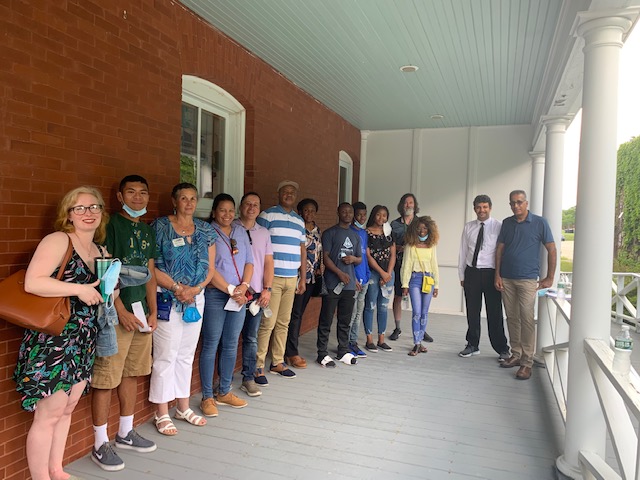
Maine Adult Education Hub 9 staff, Biddeford Adult Education students and some of their college aged children attended a professional Water Treatment forum at Southern Maine Community College recently.

Across the county, a growing need is present for trained water treatment professionals. As such, Southern Maine Community College has partnered with Northern Maine Community College to create a training program for the profession at the South Portland campus. Their lectures can be accessed remotely, however, hands-on laboratory exercises guided by trained faculty members are taking place on campus.

The Hub 9 group learned about scholarship and apprenticeship opportunities, and toured the learning lab. Industry professionals were available to discuss the great need for new water professionals and how dynamic and exciting this important work is, an exciting experience that the group intends to bring back to their learning community in Biddeford.

Visit Maine Rural Water Association and Maine Water to see current job postings. Anyone interested in discussing this as a potential pathway into the field, can contact their local adult education student advisor.

This article was written by Marci Dionne, student advisor at Biddeford Adult Education, in collaboration with Maine DOE Intern Clio Bersani as part of the Maine Schools Sharing Success Campaign. To submit a story or an idea email it to Rachel at rachel.paling@maine.gov.

Maine Agriculture Education PK-12 Grants Available – Deadline Approaching!

Maine Agriculture in the Classroom (MAITC) has earmarked $60K for education agriculture grants in 5 categories in 2021! This support of Maine agriculture education in grades Pre-Kindergarten through 12 is a direct result of the Maine Agricultural Specialty License Plate.

Grants are available in a number of categories such as Agriculture Awareness, School Garden & Greenhouse, Statewide Agricultural Education Organization, and Agriculture Leadership. Grants are up to $2,000 and the deadline to apply is 4:00pm on August 23rd.

To see the grants, get more information, and apply visit: https://me.agclassroom.org/programs/grants/ 

Maine Agriculture in the Classroom (MAITC) is a grassroots program coordinated by the United States Department of Agriculture, and housed at the Maine Department of Agriculture. Our goal is to help students gain a greater awareness of the role of agriculture in the economy and society so that they will become citizens who support wise agricultural policies and local agriculture endeavors.

If you have questions please email maitc@maine.gov

Summer Graduates/Exits Data Reminder

The Maine Department of Educations Data Team will be leaving Synergy open for the 2020-2021 school year data entry through August 15th, 2021 to allow organizations to change their summer graduates’ end statuses to “Graduated with regular, advanced, International Baccalaureate, or other type of diploma”.

  • Enrollments for students who were inaccurately coded as graduated, but did not, may also be corrected by updating Synergy with the correct exit status.
  • Enrollments for students who were exited as continuing, but who moved over the summer may also be corrected by updating Synergy with the correct exit status.
  • Students must be exited with an end date prior to July 1, 2021 – even if they met the requirements or left between July 1, 2021 and August 15, 2021.
  • Students who do not meet the an organization’s graduation requirements by August 15, 2021 will need to have a one day 2021-2022 enrollment with the organization for the new school year and given an end status of “Graduated with regular, advanced, International Baccalaureate, or other type of diploma” with the date that the student met the requirements. These students will be counted as 2021-2022 graduates.
  • The system will close August 15, 2021 at 11:59 pm. There will be no extensions to this date, as we need to prepare the data system to begin enrollment data collection for the 2021-2022 school year.
  • Graduation Certification in NEO Student Reports will open by August 9, 2021 with a due date of August 30, 2021.

For assistance, please contact MEDMS.Helpdesk@maine.gov by email or call (207) 624-6809

Calling all Maine School Principals: Join Maine’s Transformational Leaders’ Network 

The Maine Department of Education (DOE) invites school principals to apply for an inspiring professional learning opportunity. The Transformational Leaders’ Network (TLN) offers Maine principals an opportunity to deepen their leadership skills while they are leading transformational efforts in their schools. This “learner-centered” program has a ten-year history of success and is open to ALL Maine principals at no cost. The primary requirement for joining the TLN is the ambition to improve your leadership and your school! 

Who can apply? 

  • Maine School Principals (PreK-12)

What is the commitment? 

  • The program consists of three types of sessions throughout the year:  in-person full days, two-hour Network sessions, and 1.5-hour Learning Leader Team sessions.  The three full-day in-person sessions (aligned to CDC safety guidelines) will be in October, February, and mid-May at a site(s) to be determined based on participation.  The majority of your time will be in Zoom-based Learning Leader Teams(LLTs) of 5-8 principals, facilitated by experienced educators. Alternating with LLT sessions will be larger group Zoom-based Network sessions designed to assist your understanding of leadership and your own strengths and challenges. 

How is the program designed? 

  • The TLN experience revolves around each principal’s efforts to improve their school’s success with students. In Network sessions, principals examine the leadership challenges inherent in making progress on improvement goals.  In a small group led by a facilitator, each principal will design an action plan and an accompanying “learning plan.” 
  •  Colleagues and resources from facilitators provide on-going consultation and advice focused on the principal’s, “continuous improvement” as a leader for the, “continuous improvement” of the school.  In this fashion, each principal’s learning goal(s) drives the curriculum of the Network. 
  • Successful completion of the TLN will result in contact hours for re-certification purposes. 

I’m interested… what next? 

  • Applying now for this exciting opportunity is encouraged by the Maine DOE. 
  • An online application can be found here. 
  • Applicants are accepted on a rolling basis until the cohort is full or August 24,2021, whichever comes first. Please note, applications require the approval of the superintendent before submittal. 

Where can I find more information? 

  • For answers to questions or more details about TLN, please contact Fran Farr, TLN Facilitator, at franfarr522@gmail.com or (207) 439-9659 or (207) 752-2439. 
  • A June webinar featuring the TLN and Maine’s Leadership Development Program can be viewed here 
  • To access more information, hear from past participants, and download application materials please visit:  https://www.maine.gov/doe/educators/leader/tln 

What other opportunities are available to current or aspiring leaders? 


Special Education Maine Policies & Procedures Workshop for School Administrative Units

The Maine Department of Education Office of Special Services is pleased to host a two-day virtual workshop presented by Brustein & Manasevit.

School Administrative Unit (SAU) Policies and Procedures

Day One: covers the Uniform Administrative Requirements, Cost Principles and Audit Requirements (Uniform Grants Guidance)

Day Two: direct support for school administrative units on developing compliant policies and procedures.

Free EDGAR shipped to first 200 attendees to register! (If you do not require an EDGAR – do not complete the address portion of the registration.)

Registration link for Day One August 18th – Day One

Day Two Zoom link for August 19th Workshop (held via Zoom)  

DRAFT AGENDA

The two-day training covers all federal requirements for establishing strong SAU policies and procedures.  Attendees begin the workshop with a customizable template that is customized over the two-days to be district specific.

Day One: Training

Federal Financial Management

  • Overview of grants accounting system and fiscal controls
  • Cash management procedures, including period of availability and carryover
  • Budget development, amendment and reconciliation
  • Allowability procedures (FAQs, Food, Travel, etc.)

Procurement

  • Conflict of Interest policy
  • Methods of procurement, related procedures
  • Documentation
  • Noncompetitive procurements (sole source justification form)

Property Management

  • Definitions (Equipment, supplies, computing devices, capital equipment, inventoried supplies, etc.)
  • Inventory procedures
  • Lost or stolen items
  • Disposition procedures

Time and Effort

  • Payroll/ HR procedures (cross-reference)
  • Time and effort documentation requirements
  • Reconciliation of time and effort
  • Sample forms

Day Two: Workshop

Concurrent breakout session by topic – working sessions for Q&A

For further questions, contact the Maine DOE Office of Special Services at (207) 624-6713.

REGISTER NOW: School Resource Officer Summit 2021

The School Resource Officer summit will be taking place August 10th and and 11th at Windham High School from 9am to 4pm EST (both in person and virtual options available).

August 10th will feature a keynote address from the Restorative Justice Board titled “A Showcase of Options for Thinking about Restorative Justice and Community Impact.” August 11th will feature Lt. Carlos Camacho from the Nashua, New Hampshire Police Department.

The summit will also feature numerous breakout sessions:

• Racial & Implicit Bias; a History of Racism- Trooper Elgin Physic
• EOPs- Melissa Coden
• Social Emotional Learning- Bear Shea
• Behavioral Threat Assessment- Dr. Karen Barnes
• Adverse Childhood Experiences 101 & 102- Ruby Parker
• Trauma and Professional Resiliencey- Allegra Hirsch
• Effective Police Interactions with Youth /Mirror- Mirror Project

Light breakfast items will be available both days for in-person participants at 8:15 AM and lunch will be at 12 PM with vegetarian or protein choices.

Please register for both in person and virtual options. Virtual participants will be capped at 500 people. If you are attending virtually, this link will enable you to choose the breakout session you registered for.

Virtual Parent Town Hall with the US Department of Education

July 29th from 8pm-9pm EST the US Department of Education will be hosting a town hall for parents. After a year and a half of grappling with the challenges brought about by the COVID-19 pandemic, students across the country are slated to return to school in-person this fall. However, for many, especially parents, the return to in-person instruction has brought with it a variety of worries, hesitations, and questions:

  • Will my child(ren) be safe at school?
  • What COVID precautions should I look for in my child’s school?
  • How will schools take my child’s social and emotional well-being into account?
  • Is the vaccine safe?
  • Should I get the vaccine?
  • Should my child(ren) get the vaccine?

While one of Biden Administration’s top priorities is to have all students back in-person this fall, they recognize that this goal will not be met if parents’ voices are not heard, and their concerns taken into account. This Parent Town Hall is a unique opportunity for parents to share their ideas and concerns, and to get their questions answered.

Panelists from the US Department of Education and the Centers for Disease Control and Prevention (CDC) will answer parents’ questions and address concerns around the return to in-person instruction.

Parents are invited to submit questions about the return to in-person instruction on the registration form. Pre-submitted questions will help plan the content of the session. Time will also be reserved for live questions and answers at the end of the event. Please register here.

The intended audience for this virtual town hall is parents. We encourage you to share this session widely to your parent networks. Thank you!

Priority Notice: Public Comment Period for Rulemaking on State Board of Education Rule Chapter 115 Now Open, Public Hearing Scheduled

After a May 2020 convening of a consensus-based rulemaking committee which met for seven months, and additionally, the comprehensive review of the committee’s proposals by the State Board of Education’s Certification and Higher Education Committee, a revised version of Rule Chapter 115 is being proposed by the State Board.  This rule has substantial changes, which, in conjunction with new components in law as a result of successful passage of LD 1189, will positively benefit the educator workforce in Maine.

As required by law, a period of public comment opens today, July 28, 2021 through September 15, 2021.  Written comments may be submitted to DOE Legislative Affairs Team member Jaci Holmes, State House Station #23, Augusta, Maine 04333; 207-831-3168 or jaci.holmes@maine.gov until 5:00 pm September 15, 2021

In addition, a public hearing for the proposed rule will be held in person and virtually on August 16, 2021, 2:00-3:00PM at Cross Office Building, 111 Sewall St, Augusta, ME 04333, Room 500. As space will be limited, participants are encouraged to attend virtually through Zoom, using this link.

Proposed rule changes in their entirety can be reviewed, here.

Part I selection of changes:

  • Revised the reciprocity and other emergency certification provisions, which extend opportunities provided in a COVID related Executive Order
  • Add applicability to Charter Schools
  • Add “at least” a Bachelor’s degree, equivalent academic experience
  • Interstate School Leaders Licensure Consortium (ISLLC) Standards to be replaced with Professional Standards for Educational Leaders (PSEL)
  • Added Department-approved programs for Ed Tech as alternative to credit requirements
  • Other Teaching Assignments added: Add language immersion teacher as an example of international teacher, and added alternative education teacher

Part II selection of changes:

  • Administrators
  • The Interstate School Leaders Licensure Consortium (ISLCC) standards no longer exist and were replaced with the Professional Standards for Educational Leaders (PSEL), which were developed with guidance from the Council of Chief State School Officers (CCSSO) and the National Policy Board for Educational Administration (NPBEA).
  • Requirements for advancing a certificate by the second renewal were eliminated.
  • Career and Technical Education (CTE)
  • Provisions provided to enable a certified teacher to more easily become a CTE instructor
  • Removal of language regarding pedagogical assessment as all CTE certifications would require completion of 4 pedagogical courses, or their equivalent
  • Special Education
  • Grade levels changed to Pre-K to grade 12 in alignment of Part B IDEA
  • More specific course requirements in accordance with skills of special education identified in IDEA, High Leverage Practices from the Council for Exceptional Children and the CEEDAR Center, and trends in education
  • For conditional certificates, add language for a “mentor teaching program endorsed by the Maine Department of Education.”
  • Added an additional pathway to certification for a current Ed Tech III who (a) has a BA/BS, (b) experience as ET III for three years, (c) positive evaluations
  • Removal of:
    • – 515 Adapted PE Teacher
    • – 079 Special Ed Consultant
    • – 293 Speech and Language Consultant
  • Teachers
  • Replacing the requirement to pass a qualifying examination with options:
    • Pass basic skills test; or
    • 3.0 cumulative gpa in the courses required for the certificate/endorsement
    • Portfolio demonstrating competency in the Maine’s Initial Teaching Standards
  • Grade span recommendations, adding Pre-K to any spans starting with K: Pre-K – 3, Pre-K-8, 6-12, PK-12
  • Any “Social Studies” course requirements will be expanded to include “or Social Sciences” –would expand the eligible courses to include Psychology and Sociology
  • Addition of 6 credit hours for required coursework:
    • 3 hours of coursework in the area of diversity
    • 3 hours of course in one of the following areas: Human development, educational psychology, developmental psychology, adolescent psychology or child development.
  • 020 Elementary Teacher – Add 9 credits of literacy methods
  • World Language group: Extend down to Pre-K and Add: American Sign Language, Hebrew, Arabic
  • 660 English as a Second Language
    • “English for Speakers of Other Languages”
    • Specific course requirements
  • Ed Specialists
  • 071 – Library Media Specialist
    • Course specificity
    • Pathway for currently-certified teachers
  • 075 – School Counselor
    • Standards review by the Department
  • 093 – School Psychologist
    • Letters of reference
    • Flexible coursework requirements
    • Recognition of MDOE approved programs