MaineCare Seed Adjustments to be Made, Request for Review of Q3’21 Reports by July 15, 2021

The recovery of Q3’21 MaineCare Seed will occur in the July 2021 subsidy payment. The Maine Department Of Education (DOE) is asking School Administrative Units (SAUs) to review their reports by July 15, 2021 to ensure accurate adjustments to subsidy. SAU staff must review, and submit disputes, or student by student claims on both the public and private MaineCare reports for Q3’21 by July 15, 2021.

To access the MaineCare Seed reports, please follow the instructions below.

  1. Log into NEO using the link below

https://neo.maine.gov/DOE/neo/Dashboard

  1. Click on the Student Data tab
  2. Click on the Student Report tab
  3. Select MaineCare in the Reporting Area drop-down
  4. Choose the quarterly Seed report and the report type (private/public)
  5. Click view report button
  6. Export Button

    Once the report appears on the screen, choose the export button.

You may export the reports to Excel, but please be aware that there may be multiple worksheet tabs within the workbook. Save the file to your computer.

To dispute a claim:

If you disagree that a particular student or time period should not be on the report, please send an email with the following information for each State Student ID to stephanie.clark@maine.gov.

  • State Student ID
  • The reason that you disagree
  • Identify the type of report: public or private
  • Quarter in which the claims are located
  • Service provided dates (From and To)
  • Total amount of Seed being disputed

Summer services:

Students must be enrolled for the time period they are receiving educational services. This means that students that are receiving extended school year services in district, or extended school year services in an out of district placement, must have a primary enrollment for that time period. This will ensure that Maine DOE has the most accurate enrollment data to determine SAU responsibility for MaineCare Seed.

If you have difficulty logging into NEO:

Anyone who currently has Special Education Director permissions to the Special Education module will automatically have permissions to access MaineCare reports.

As in the past, if a new staff member needs permission to access this module, a request from the Superintendent to the Maine DOE helpdesk will be necessary. The helpdesk contact information is medms.helpdesk@maine.gov or 207-624-6896.

Please contact stephanie.clark@maine.gov for more information or technical assistance related to MaineCare Seed.

UMaine-led Grant Helps Maine Schools Implement Behavioral Support Framework

More than 4,000 students across Maine are now receiving Positive Behavioral Interventions and Supports (PBIS) thanks to intensive professional development provided by University of Maine College of Education and Human Development experts supported by a grant from the Maine Department of Education.

PBIS is a nationally recognized, multi-tiered framework providing a continuum of supports to all students, promoting positive academic and socio-behavioral outcomes. In 2018, educators from 15 Maine schools formed the PBIS Regional Professional Development Cohort, receiving instruction on how to implement the framework, and meeting regularly with UMaine experts to share their experiences and address ongoing challenges during the three-year grant period.

“When we first started this project, nobody knew we’d have to complete it during a global pandemic,” says Courtney Angelosante, UMaine lecturer in special education and one of the experts who provided professional development to teachers and school leaders.

“It really has been a wonderful experience that will have enduring benefits for years to come,” she says.

The grant included schools from several parts of Maine, including RSU 3/MSAD 3 (Brooks, Freedom, Jackson, Knox, Liberty, Monroe, Montville, Thorndike, Troy, Unity and Waldo); Brewer Community School; Indian Island School; Dr. Lewis S. Libby School (Milford); Appleton Village School; Vassalboro Community School; East End Community School (Portland); RSU 20 (Searsport and Stockton Springs); and Wiscasset Elementary School.

“We’re really proud of the work these schools have done,” says Karen Robbie, PBIS trainer and doctoral candidate in the College of Education and Human Development. “Thanks to their efforts, more children in Maine are now experiencing positive, predictable, effective and equitable school environments.”

Other members of the UMaine team included Jim Artesani, associate dean for graduate education, research and outreach, and Kristin Grant, a retired principal from RSU 14.

“It has impacted me tremendously and made me become a better and more effective teacher and person,” says Vincent Vannah, a teacher at Morse Elementary School.

He adds that the PBIS framework made school staff rethink their mindset around teaching about behavior, creating a more positive atmosphere.

“I am able to lead and support fellow teachers in my school with implementation and support of strategies to best help teachers that are experiencing difficult and hard behavior,” says Vannah, who served as a PBIS coach for Morse Elementary throughout the project.

Members of the PBIS Regional Professional Development Cohort will gather on Monday, June 21 at the Hutchinson Center in Belfast to celebrate their accomplishments. Maine Department of Education Commissioner Pender Makin and other MDOE officials will deliver remarks at the event. Jen Freeman of the National Center on PBIS is also scheduled to share a message with the cohort.


Saco Sixth Graders Re-Design School Entrance Through Art, Science, and Self Reflection

Saco Middle School art teacher Alison Crofton-Macdonald wanted to do something completely different with her students this year. After the pandemic completely changed the way she was able to engage students with art, she was looking for something beyond getting creative with digital art, or other simple materials like paper and pencil that can be found in most homes and are commonly used during remote learning.

Once students were back to school for the year in a hybrid situation, Mrs. Crofton-Macdonald also wanted to get them up, out of their chairs, and outside for her art classes.

“We are all sick of being inside,” said Crofton-Macdonald. “If I’m sick of being inside, then they are really sick of being inside.”

This year with a rearrangement for hybrid scheduling, Unified Arts teachers were linked with teams to prevent cohorts of students mixing. This made it so that Crofton-Macdonald and her colleague, Lindsay Wirsing were on the same team teaching the same students, which allowed them to collaborate on a project.

Crofton-Macdonald and Wirsing decided to create a project that brought together art, science, and social emotional learning for their 6th grade students by redesigning the entrance to the school with a mosaic garden.

Seeing that there was no evidence of students when visitors first enter the building at Saco Middle School, they decided that giving the students an opportunity to change that would be a win all around for the school, the students, and the goals of the educators.

Tying in her own knowledge of the mosaic process, Crofton-Macdonald had each student make a mosaic stepping stone for the entry way. They were all challenged to create an “I am statement” having to do with something they learned about themselves this past year. They each then turned that statement into a design for a mosaic tile that would eventually be placed with the other mosaic tiles of the other students to make a walkway.

The project also had an accompanying science unit, taught by Ms. Wirsing, that aimed to reconstruct the entrance to have a better impact on the environment.

“Students examined the increases in human population per-capita, consumption of natural resources and the impact on Earth’s systems,” said Wirsing. “They study how their usage of water and land impacts the earth. Typically, as human populations and consumption of natural resources increase, so do the negative impacts on the earth unless the activities and technologies are engineered otherwise.”

“So, our project’s goal was to use the land in front of our school to have a better human impact than grass by planting more diverse flowering perennial plants.”

Each project challenged the students (and educators) to work together, and to be constantly thinking about how each of them can have a positive impact on the world around them.

To embark on the project the teachers were able to obtain some grant funding from SACO Steam, in addition to getting plants donated by the PTO, and borrowing tools from Saco school staff. They also had to find a piece of land at the school that needed a re-design. After pitching their idea to local school leaders, they received full support of the plan that would both provide valuable intradisciplinary learning for the students and improved school property for the community.

In addition to the Mosaic Garden designed by the Saco Middle School 6th graders, Mrs. Crofton-Macdonald also worked with her Gifted and Talented students on an additional section of the entry way that features a pebble mosaic of the Saco Middle School paw prints, to compliment the school mascot.

The project proved to be hard work, but well worth it with many weeks of planning, digging, planting, placing and a whole lot of teamwork. Saco Middle School STEM teacher Sam Blunda even stepped in in the final stages of the project to help cut all the curved stone pieces, finishing the edges to perfection.

In the final stretch of the last days of school, the project was finally finished, providing the building with a beautifully sustainable school entrance that has the most wonderful evidence of students who have and will have a lasting positive human impact on the land and school for many years to come.

Information for this article was provided by Saco Middle School as part of the Maine Schools Sharing Success Campaign. To submit a story or an idea, email it to Rachel at rachel.paling@maine.gov.

MEDIA RELEASE: Maine DOE Welcomes Bowdoin Student for Summer Internship

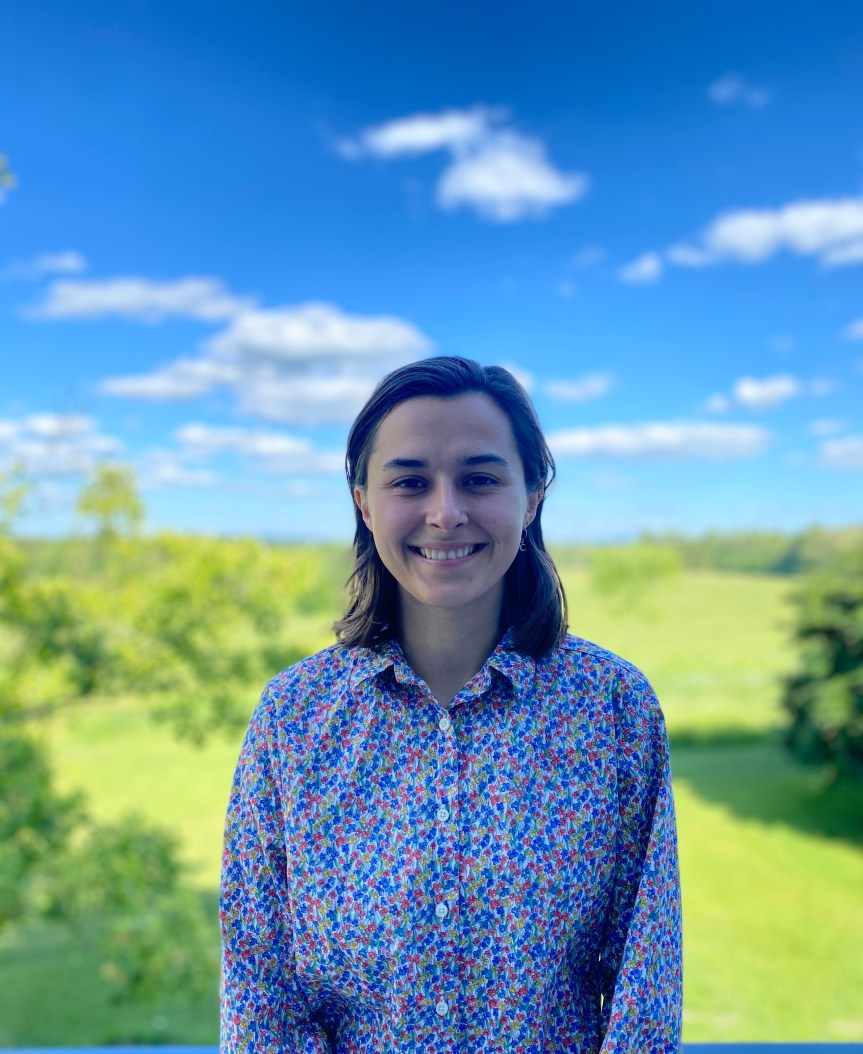
The Maine Department of Education (DOE) has welcomed Clio Bersani, a rising junior  at Bowdoin College, as an intern for the summer through the Margaret Chase Smith Policy Institute’s Summer Government Internship Program. Clio is a History and Education double major and hopes to complete the Teacher-Scholar program while at Bowdoin, which will certify her to teach in public school upon graduating.

Clio will be working with the Commissioner’s Office team through the summer months, writing articles for the Maine DOE Newsroom, editing and updating content on the Maine DOE website, as well as working on a summer long research project on internal communications at the Department. Clio is excited to learn more about the governmental side of education as she hopes to get into education reform on a policy level in the future.

As the only Maine DOE intern this summer, she is eager to work with as many teams and different facets as possible at the Department to gain knowledge and understanding of the governmental side of education. Besides her passion for education, Clio is interested in imperial Chinese history and enjoys hiking, tennis, and doing the New York Times crossword.


Westbrook Regional Vocational Center CDL Program Assists with Donated Supplies for Maine Schools

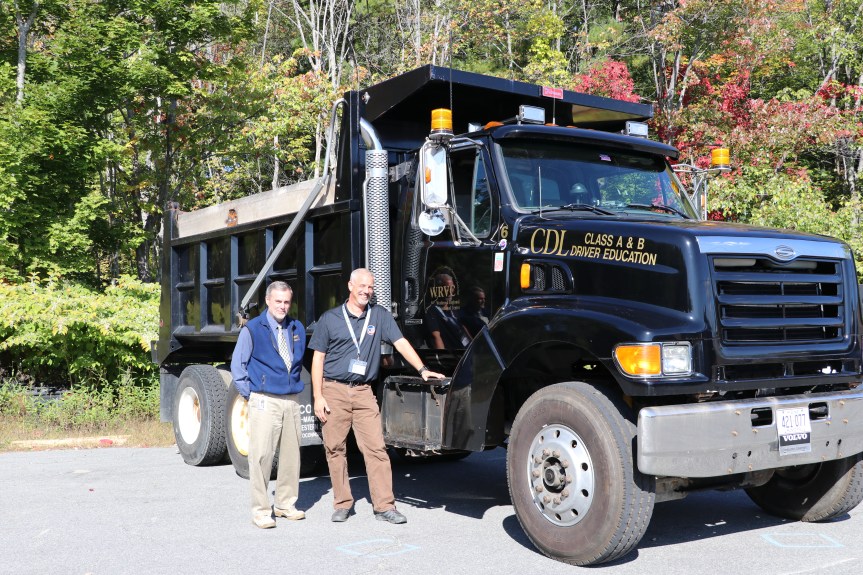
Image: 2019 image of WRVC Director Todd Fields and Jeremy Kendall standing next to one of their CDL Driving Trucks.

A company in California donated a large amount of 64-ounce disposable cups with lids to the Maine Department of Education (DOE) Child Nutrition Team. The Child Nutrition Team works on a regular basis with school nutrition teams state-wide that need supplies like the donated cups. With the intent of efficiently distributing the free cups to as many schools as possible, the team reached out to Maine DOE colleagues for creative solutions, and the Career and Technical Education (CTE) team, a group of DOE staff what work directly with CTE schools across Maine, stepped up to the challenge.

Maine DOE’s CTE staff reached out to the Westbrook Regional Vocational Center (WRVC), a center with a robust Commercial Driving License (CDL) program, in hopes of getting assistance from student drivers with delivering the items. With the supplies located in Portland, assistance was needed to deliver it to locations where school staff and/or Child Adult Care Food Programs (CACFP) could come and take as many as they wished for whatever reason they wanted to use them. WRVC was eager to help! The mission would give one of their students both driving time and experience.

The first drop was to the WRVC and the second was to Emergency Food Assistance Program warehouse in South Gardiner.  Many schools and CACFP groups came to pick up the donated items from both locations, and they all left with many cases of cups and lids to use for school projects, food distribution, and more!

Maine DOE’s Child Nutrition and CTE teams thank both WRVC and the Emergency Food Assistance programs for their quick collaboration and help in planning – their action steps ensured that these donated supplies were available to schools and programs across Maine, while at the same time provided a CDL student with valuable time and experience honing their skills.

This article is part of the Maine Schools Sharing Success Campaign. To submit a story or an idea, email it to Rachel at rachel.paling@maine.gov.

Letter for Families: Importance of Completing the Meal Benefit Application for SY 2022

The Maine Department of Education Child Nutrition team has created a letter geared to Maine parents and families to express the importance of completing the meal benefit application. The letter can be downloaded and sent out to your district’s family mailing list. This letter can serve as a first step to get families thinking about the meal benefit application as we go into summer and can be sent out along with any other end of school year materials/reminders.

School and district administrators are encouraged to utilize their avenues of communication with families to share this resource.

Here is the link to this letter: https://www.maine.gov/doe/sites/maine.gov.doe/files/inline-files/Meal%20Benefit%20Application%20Promotion%20Letter%20to%20Families.pdf

There will be many promotional efforts coming this summer to ensure higher application return rates and meal participation!

For further questions, please contact Caroline Bennett, Ending Hunger in Maine AmeriCorps VISTA, Maine Department of Education at Caroline.Bennett@maine.gov

Governor Mills Signs into Law a Bill Focused on Life and Career Readiness for All Students

Public Law, Chapter 190, An Act To Support Life and Career Readiness Education in Maine was signed by Governor Mills on June 14, 2021.

Public Law, Chapter 190 was born out of a deep commitment to ensure Maine students are taught the knowledge and skills needed to make informed career choices in a complex world where exponential increases in computing power, the agility and power of digital technologies, and the creativity of human beings to innovate are fueling rapid rates of change in the workplace and in daily life.

Recognizing that students will choose to enter the workforce in different ways, the newly enacted law preserves local control over curricula, courses of study, resources, materials, and multiple pathways for learning. It also honors the impact that well-designed work-based learning experiences can have in developing student aspirations and employability skills by encouraging direct exposure of adolescents to a variety of career options.

Aligned tightly with the 2020 Maine Learning Results Life and Career Ready Standards, the newly enacted law updates language in Maine’s Education Laws by replacing the former title of the standards (career and education development) with the new title (life and career readiness), thereby highlighting the developmental progression of learning from career awareness in elementary school to career exploration and planning in grades 6-12.

To support educators throughout the summer, the Maine DOE will continue to develop and collect resources aligned with the 2020 Maine Learning Results Life and Career Ready Standards and upload them to the Life and Career Ready Resources page.

For more information, please contact Maine DOE Life and Career Ready Education Specialist, Diana Doiron at diana.doiron@maine.gov.

Maine FFA Association Completes Project on Homelessness and Food Insecurity

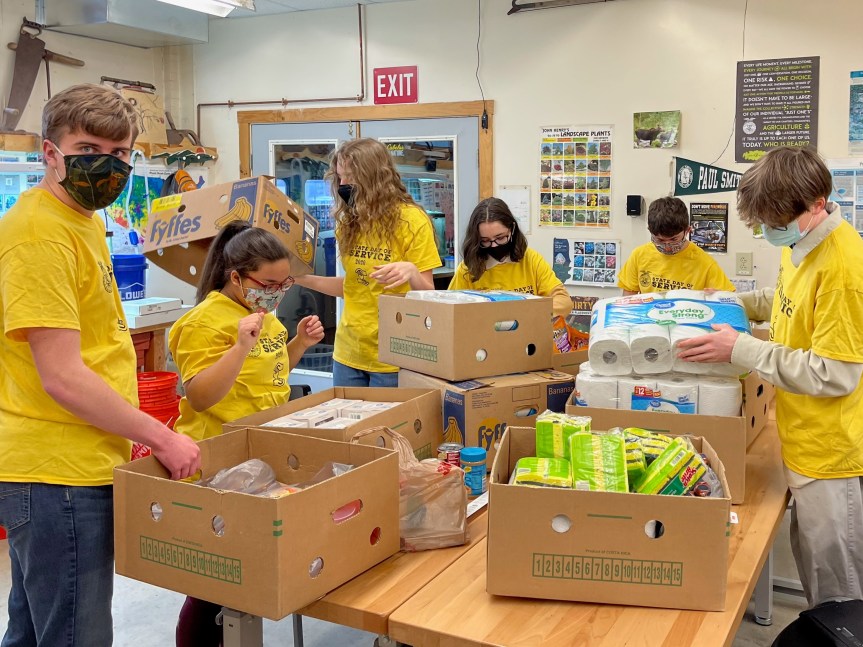
Maine FFA Association, representing nearly 400 students grades 7-12 enrolled in courses related to agriculture and natural resources, recently completed a valuable statewide community project addressing issues of homelessness and food insecurity in Maine. Four target areas, associated with nearby FFA chapters, were identified: Bangor (partnering with the Bangor Area Homeless Shelter), Waterville (partnering with the Mid-Maine Homeless Shelter), Cherryfield (partnering with Maine Seacoast Mission Food Pantry), and Presque Isle (partnering with the Aroostook County Action Program, the Sister Mary O’Donnell Homeless Shelter, Dahlgren Skidgel Farm of Hope in Caribou, Perham Food Cupboard and Washburn Food Pantry).

The goals of the project included purchasing materials to support the shelters and food pantry, sorting, packaging and distributing materials as well as learning more about the challenges and resources available to address homelessness and food insecurity. Highlights of the educational component of the project included FFA members at Narraguagus High School learning more about the services and volunteer needs of the food pantry in Cherryfield, the Aroostoock County Action Program (ACAP) preparing a YouTube video on homelessness and hosting a live Zoom panel on homelessness that included a question and answer session with FFA students.

The project was originally planned and funded in 2020, slated for implementation in March, which coincided with the onset of the coronavirus pandemic. As a result, many priority items, including some food staples and cleaning products were no longer available. Once items returned to store shelves, completion of the project became possible this spring, with items purchased, donated, sorted, packed and delivered to appreciative recipients. Project work was overseen by local FFA chapter advisors and students. As a result of the project, FFA student members came to a better understanding of social issues in their communities and outreach organizations gained many much-needed food, paper products, cleaning supplies and other staples for their facilities as well as clothing, toiletries, linens and other essentials to distribute directly to their clients.

We would like to thank the primary sponsor of this project, the National FFA Organization’s “State Day of Service” with their $8,000 contribution. We would also like to thank Wal-Mart Community Grants for their $3,000 in support with $2,000 coming from Wal-Mart Supercenter in Presque Isle and $1,000 coming from Wal-Mart Supercenter in Waterville. We would like to thank Willie Sawyer Grenier of Maine Agriculture in the Classroom for handling all shelter purchases in the Waterville area and for delivering items with her son, Jared.  Maine FFA Chapters of Ashland, Bangor, Caribou, Harrington, Mars Hill, Presque Isle and Washburn were particularly involved in the project and are all to be commended. There were also several additional local businesses and individuals in each community that contributed to this very rewarding project: thank you to all of them as well!

For more information on starting an FFA chapter in your community, please contact: Doug Robertson, State FFA Advisor, Maine Department of Education, doug.robertson@maine.gov, 207-62406744.

School Nutrition Staff Go Above and Beyond at Whitefield Elementary

Vicki Dill pictured with student Kiara Luce- 2021 Farm to School Cook-off Champions

What are the Whitefield Wildcats, 2021 Farm to School Cook-off Champions, up to right now? They are making an impact on students in their school. This school year has presented many challenges for all school staff and students. With challenges there are also opportunities. At Whitefield Elementary, the school nutrition staff Vicki Dill and Ashley Burdick went above and beyond to work with grades K-2 to make the end of school year experience a memorable one. The K-2 classrooms have been doing an “ABC Countdown to Summer”, and over the last 26 days of school used a theme based on the letter of the day.

On B day (Bubbles and Balls) their breakfast was served in bags with bubbles. On F day (Forest Day) students were provided lunches in bindles to eat in the forest. On S day (Scavenger Hunt Day) they took the time to create a scavenger hunt for students to find their lunches. According to Sarah Brewer, grade 2 teacher, “the kids absolutely loved everything they did. It’s been a very hard and stressful year for both teachers and students and these two lovely ladies went above and beyond what was expected of them to make the kid’s year a memorable one”.

Kudos to Vicki and Ashley for their partnership with the classrooms at Whitefield Elementary! This is one example of how school nutrition staff have made a positive impact in student’s lives during a challenging and ever-changing year. We thank all nutrition staff for their dedication and efforts over the past year and wish everyone a safe and healthy summer!

New Memorandum of Understanding will Promote German Language and Cultural Education in Maine

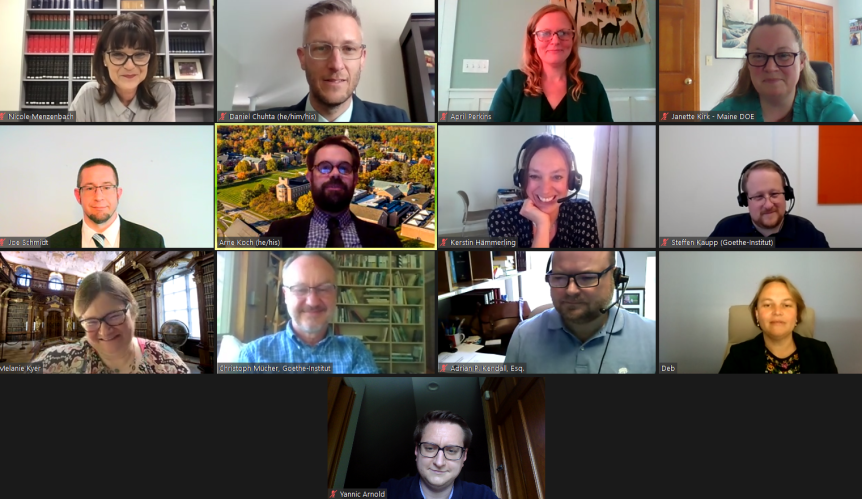
On May 27th the Maine Department of Education hosted a virtual signing ceremony to celebrate a new memorandum of understanding (MOU) with the Goethe-Institut Boston. Deputy Commissioner of Education, Dan Chuhta, and World Languages & ESOL/Bilingual Programs Specialist, April Perkins, welcomed guests from the German Consulate and the Goethe-Institut, as well as Maine educators, to mark the occasion by sharing their thoughts and reflections on German programs in Maine and the new partnership established under the MOU.

Through this MOU, the Department will collaborate with the Goethe-Institut to promote German language and cultural education across the state through a variety of resources, programs, and activities, including:

In her remarks, Consul General Nicole Menzenbach highlighted the global importance of the German language, which is spoken by 130 million people. “German-speaking countries are economic centers within Europe and can provide a wide range of economic opportunities to those who speak the language,” she said. “Language and cultural understanding serve as a means of communication between individuals and as a link between nations. In this sense, we can view this memorandum as an important component of the transatlantic friendship that exists between the US and Germany.”

There are currently German programs in 12 public and private schools across Maine, and the Goethe-Institut has been a long-time resource and partner to them. Deb Backman, German teacher at Cony Middle and High School, expressed her appreciation for their support. “Goethe does a great job bringing the world into the classroom, but also to bring the classroom into the world,” Backman said. Melanie Kyer, German teacher at York High School, and Dr. Arne Koch, professor of German at Colby College, also expressed their enthusiasm about the MOU and the potential of the new partnership between the Goethe-Institut and the Maine Department of Education.

The Department wishes to share its heartfelt thanks to its partners at the German Consulate and Goethe-Institut Boston, as well as the remarkable teachers and students of German across Maine.

If your school or district is interested in participating in any of the opportunities listed above, developing a new German program, or expanding an existing one, please contact April Perkins at april.perkins@maine.gov.