Get to Know the Maine DOE: Meet Pender Makin

Maine DOE Team member Pender Makin is being highlighted this week as part of the Get to Know the Maine DOE Team Campaign. Learn a little more about Pender in the question and answer below.

What are your roles with DOE? 

It’s my honor to be serving in the role of Commissioner of Education. My duties span all of the statutory requirements in Title 20-A, and our team members at DOE all contribute to this work.

What do you like best about your job?

What I like most is knowing that my efforts are on behalf of something so deeply important. I believe that public education is the most critical underpinning of democracy and that all students deserve equitable opportunities and access to high quality learning environments and educational programs.  This past year has been extremely difficult – but, even on my most discouraging day, when I’m feeling exhausted and depleted, I feel extremely blessed to be spending my energy, efforts, and time engaged in such meaningful work.

How or why did you decide on this career?

It was more of a 3-decade journey than a decision … When I was an Ed Tech III, I aspired to become a teacher so that I could really make a difference for students. Once I became a teacher, I wanted to make bigger changes and continued my education so that someday I could be a building principal. As a principal, I had the opportunity to better understand how certain practices, systems, and policies impact the experience of students in the classroom, and I did my best to influence these in a positive direction. Later, when I became a district leader, I worked within that scope of influence, and when this opportunity was presented to me, I saw it as a chance to really make a difference for Maine students and for public education in general.

What do you like to do outside of work for fun?

I love to play piano and/or ukulele and sing out loud with friends (I sure miss that in this pandemic!) I also love: to be at the beach during all seasons, in all weather; snuggling with my dogs; playing cribbage with my husband; and helping my parents with their gardening and other chores.

Troy Howard Middle School Expands Food Pantry with Community Caring Cart

Like many school districts across Maine, RSU 71 provides a school food pantry program to ensure there are free food options for families to take home with them as an added service to those in need.

“The District has been feeding families in need since, well, forever,” said Carrie Robinson, Front Desk Secretary at Troy Howard Middle School (THMS) in Belfast.

While there is no data point in Maine that details just how many schools offer this type of service, it is abundantly clear that there are a wide range of efforts on all levels throughout Maine and often times they can be found at the local school.

“When our school buildings were closed last spring at the onset of the pandemic, our school nurses partnered with food services and transportation to send home weekly boxed meals and produce,” said Shannon Robbins, School Nurse at A Ames – Gladys Weymouth Elementary Schools in RSU 71. “In fact, we sent home over 22,000 pounds! Families shared with us how much it meant to have these necessities delivered to their homes when it felt too scary to shop in town.”

It’s worth noting that school food pantries and backpack programs are a volunteer effort at most schools and go above and beyond the complimentary school meals that students receive while learning at school and remotely. With the help of several USDA waivers during the pandemic, school nutrition programs have been allowed to be flexible and adaptive in the way school meals are served and most have been able to offer these services at no charge to families.

Suffice it to say, pantry and backpack programs are becoming an important addition to many school communities across Maine and at Troy Howard Middle School they have recently undergone an expansion to reach more families.

Although the district’s nurses, administrators, and guidance staff usually have a good idea of who needs help, they have found that it is still difficult to know if they’ve provided the service equitably.

“We really just never know who is in need,” explained Robyn Mailloux, THMS Nurse.

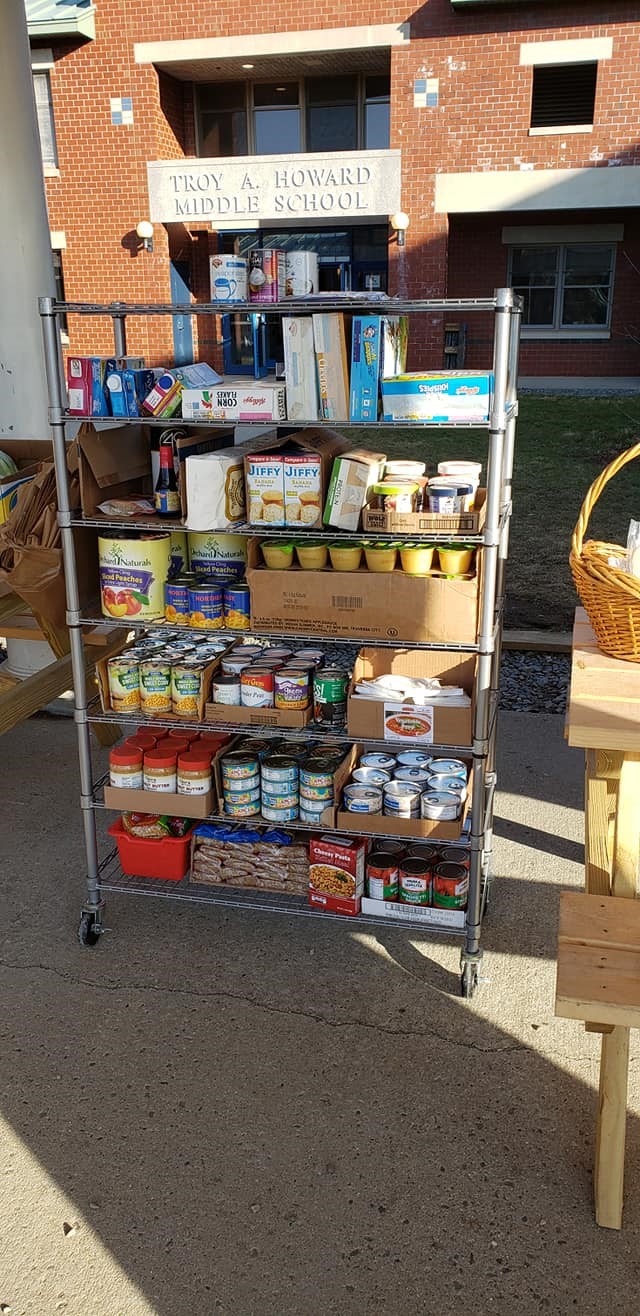
That is when they came up with the idea to offer the Community Caring Cart as a service to anyone who wants or needs something – they can just come pick it up. Instead of handing a backpack full of food and supplies to a specific student or families, now the cart is available in public areas at school that are easy for parents and students to just take what they need.

“Over the course of the year, I’ve been surprised at what has disappeared from the hallway shelf and who has been taking it,” said Mailloux. “You just don’t know what people’s stories are.”

In addition, there are bags available for people to donate items if they wish and the team is also working on some grab and go bags that are quick and easy to take.

“Anything taco related flies off the shelves, as does of course easy to make staples, mac and cheese and canned soups and fruits,” said Robinson. “Since we are at a middle school level many of our students have some basic cooking skills so they will grab things they can make for themselves. Any time we have fresh produce it goes well, the kids actually like fresh stuff!!!!”

“Lightweight, prepacked goods such as cereal, pasta or rice mixes, soups are very popular. We have also offered fresh produce from Maine farmers including potatoes, apples, carrots- families loved these,” adds Robbins.”

Knowing that food programs are a service provided in many community and schools throughout Maine, we asked the RSU 71 team if they have any advice for schools that are thinking about starting or expanding food pantry programs at their schools.

“I would remind any schools that are trying to do anything like this that you never really know who needs the help so get the word out every way you can,” offers Robinson.

“Partner with your community resources – we couldn’t do this without GBAM (Greater Belfast Area Ministerium Food Cupboard), GSFB (Good Shepard Food Bank), and our area boosters, such as Bell the Cat (a local restaurant) and individual donors,” said Robbins adding that when RSU 71 School Food Pantry began in 2019, they received a generous grant from the Sadie and Harry Davis Foundation that has enabled them to expand their support during the pandemic.

The Maine Department of Education would like to take a moment to thank the dedicated team at RSU 71 as well as the countless school staff members, volunteers, and community partners across Maine working tirelessly to provide services to the families in their communities through food programs and other similar efforts, especially throughout the past year. Your dedication and selflessness does not go unnoticed by the Department or the grateful people that benefit from your work.

Information for this article was provided by RSU 71 as part of the Maine DOE Maine Schools Sharing Success Campaign. The Maine Schools Sharing Success Campaign is an avenue for Maine schools to celebrate successes and share innovative ideas, practices, and models that can be adapted and easily implemented by other Maine schools. Stories are not an endorsement of specific materials, services, or practices and are not intended to promote learning programs that are of cost to students, families, or schools. To submit a story or an idea, email it to Rachel at rachel.paling@maine.gov.


Nominations Open for Governor’s Volunteerism Awards

There are many different types of positions that help our schools operate day to day, serving as a vital part of Maine’s communities, including our beloved school volunteers! Now is the time to recognize these wonderful human beings for all of the selfless things they do for their community. In addition, there are many youth across our state that take community service learning to a whole different level by taking an active role volunteering in their community and making a real difference.The Governor’s Awards for Service and Volunteerism have celebrated and recognized the role of citizen volunteers in the success and vitality of Maine communities since 1987.  The awards seek to inspire others to be active in civic life and follow in the footsteps of those recognized.Use one of the links below to access nomination instructions and additional information for each form of recognition. All nominations are due April 30 by 5 p.m.

Adult Roll of Honor

Youth Roll of Honor

Competitive awards: Individuals, teams and organizations 

Volunteers make the hearts of Maine communities beat!

Early College Online: UMF Course Gives Mt. Blue Senior the Chance to Research and Share Family History

Early College student Sylvie Haslam, a senior at Mt Blue High School recently published the first part of a three part story on University of Maine at Farmington (UMF) Professor and Author Luann Yetter’s website as part of an Early College course she took this past summer at UMF.

“Sylvie was just one of many high school students, statewide, really, who took advantage of the opportunity to take classes last summer, when the pandemic hit and UMF moved their summer classes online,” said Clarissa Thompson, Early College Campus Coordinator and Associate Professor of Secondary and Middle Education at UMF.

Early college courses are available to Maine high school students at University of Maine System Schools and Maine’s Community Colleges as well through Maine’s Aspirations Program, which is administered by the Maine Department of Education. Students may now apply for early college opportunities at all of Maine’s colleges and universities using one common application portal, this new tool is a significant usability upgrade for students and families navigating early college options in Maine.

The UMF course that Sylvie took is called, Local Stories/Your Stories. Along with classmates from across Maine, she dove into her own local town and family history as material for creative nonfiction, engaging in personal interviews, genealogies, and looking through old newspapers (among other things) to create a vivid story of her personal history.

“This is a great example of the types of expanded opportunities our high school students have as part of the Aspirations program,” said Amy Hubbard, Executive Director of Early College at University of Maine System.

As an introduction to Sylvie’s story, Professor Yetter writes:

Last summer when I taught my class on writing local and family history I got to read some wonderful work. One of the projects I know will be of interest to my readers is this one by Mt. Blue High School senior Sylvie Haslam. Sylvie’s family history in Weld is interwoven with the Cushman family, prominent in the 1800s, and with artist Seavern Hilton who made his mark in the mid twentieth century. Join us as Sylvie explores Weld history, family history and the folk art that traveled far beyond the village of Weld. I have divided her fascinating account into three parts. In Part I, below, we are introduced to the Michael Graham farm and the Cushman family, whose ties to the land go back to the mid-eighteen hundreds. I’m sure you will agree that Sylvie is a talented writer. This high school student has a great future ahead of her!”

Read Part One of Sylvie’s story here: The Shop Land, Part I

UMF and the other University of Maine System campuses, as well as Maine’s Community College System campuses offer a wide range of classes that Maine high school students have continued to participate in online.

“Students have really jumped at the opportunity to take them,” adds Thompson. While participation had been growing steadily before the pandemic, early college programming helped provide additional options for students as high schools adjusted to online and hybrid schedules. Students who participate in early college are more likely to attend college, have higher grades in college, and are more likely to graduate on time.

For more information about early college options at UMF specifically, contact Clarissa Thompson at clarissa.thompson@maine.edu.

Information for this article was provided by the University of Maine System and the University of Maine at Farmington as part of the Maine DOE Maine Schools Sharing Success Campaign. The Maine Schools Sharing Success Campaign is an avenue for Maine schools to celebrate successes and share innovative ideas, practices, and models that can be adapted and easily implemented by other Maine schools. Stories are not an endorsement of specific materials, services, or practices and are not intended to promote learning programs that are of cost to students, families, or schools. To submit a story or an idea, email it to Rachel at rachel.paling@maine.gov.

Maine Learning Technology Initiative (MLTI) 2.0 Seeks Distinguished Educators

Are you passionate about professional growth and technology? Do you want to make a difference in Maine schools? Are you currently teaching in a Maine public school?

The Maine Department of Education is hiring five distinguished educators to join our team in supporting MLTI 2.0 professional learning. These are full-time, two-year, contracted, remote positions. The MLTI 2.0 distinguished educators will provide instructional technology coaching directly to MLTI 2.0 participating educators and work closely with the MLTI 2.0 team to implement the MLTI 2.0 program.

Ideal candidates will be excited about instructional coaching and innovative technology practices in education, eager to work with other teachers, have outstanding communication skills, and experience with middle and/or high school pedagogy.

Distinguished educator positions are set up as an exchange agreement between the Department of Education and your local school district. Through the agreement, the Department pays your local school for the duration of your contract as a distinguished educator, allowing your school to temporarily fill your vacant position and continue to pay you your current rate while you work as a distinguished educator. Once the two-year contract is complete, you will be able to return to your position within that district.

To learn more about the MLTI distinguished educator position, click here to access the full job description.

If you’re interested in applying to be an MLTI 2.0 distinguished educator, click here to access the application form. The application closes April 30th.

If you have questions about the position or the exchange process, check out the FAQ.

Still have questions? Contact the Digital Learning Specialists at the Maine Department of Education to learn more.

Jonathan Graham, Elementary, Digital Learning Specialist, jonathan.m.graham@maine.gov

Emma-Marie Banks, Computer Science and Secondary Digital Learning Specialist, emma-marie.banks@maine.gov

Maine Celebrates 21 New and 5 Renewed National Board Certified Teachers in Virtual Ceremony

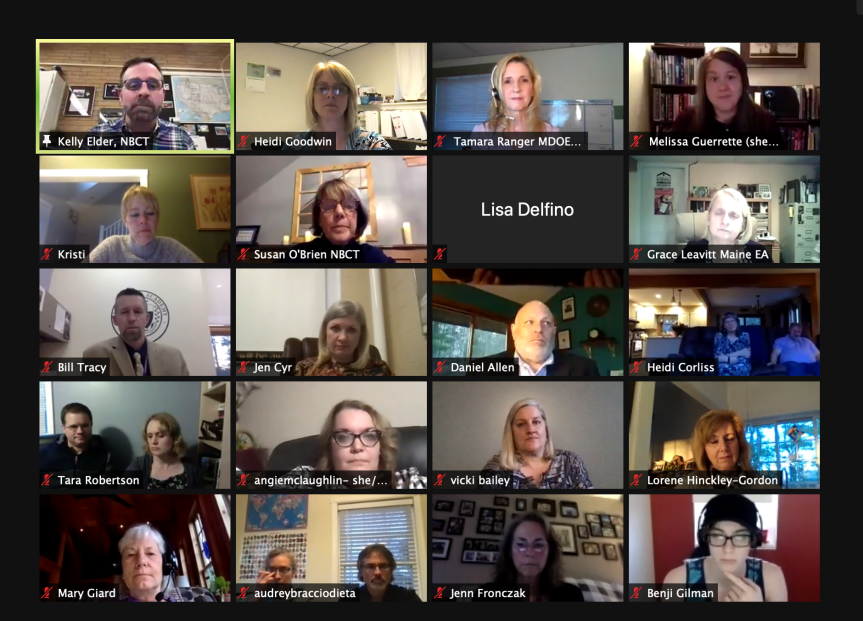
Maine recognized 21 teachers newly certified by the National Board for Professional Teaching Standards (NBPTS) during an April 8 virtual ceremony. These exemplary educators join more than 400 teachers across the state who have gone through this highly reflective and transformative professional development, including five of their colleagues who renewed their National Board Certification this year.
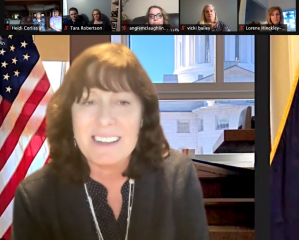
Friends, family, colleagues and administrators joined the celebration hosted by the Maine Education Association (MEA) and the National Board Certified Teachers Network of Maine (NBCTs of Maine). Offering congratulatory remarks were Education Commissioner Pender Makin, MEA President and NBCT Grace Leavitt, NBCTs of Maine Chair and NBCT, Melissa Guerrette, and Representative Rebecca Millett.

Featured speaker Kelly Elder, NBPTS, NBCT Board of Directors, 2017 Montana Teacher of the Year and 2018 NEA Foundation Fellow, shared a talk titled “What’s Next? Moving Forward from the Intersection of Emotional Health and Learning in a Post-pandemic World” Elder, a grade 6 geography teacher, acknowledged the challenges involved in teaching in a year unlike any other, and the disproportionate impact the pandemic had on our most vulnerable students. Elder noted that NBCTs, given their experience in such a highly reflective process as National Board Certification, are uniquely positioned to create, innovate, and lead the differentiated work (including rethinking assessment practices) in the coming years, in order to meet the needs of all of our students.

The event’s emcee, Heidi Goodwin, NBCT and NB Professional Learning Facilitator, was joined by Kristi Charette, NBCT and NB Professional Learning Facilitator, in leading this year’s unique pinning ceremony, with attendees being “pinned” by a family member at home. Dan Allen, MEA Professional Development Director, offered closing remarks, encouraging the NBCTs to engage in ongoing leadership opportunities, including offering support to candidates working on National Board Certification.

The journey to National Board Certification is a challenging one—the process, on average, requires nearly 400 hours of time and effort to achieve. Educators must submit a detailed portfolio that includes examples of student work and video recordings that show how they teach and interact with students. In addition, they must submit a reflective piece on student assessment and learning and demonstrate mastery of the content of their chosen certification area. This evidence must meet the Five Core Propositions and the National Board Standards, a body of knowledge that is maintained by teachers. Practicing teachers, through a peer-review process, assess the portfolios.

In pursuing and achieving National Board Certification, the following teachers have demonstrated an outstanding commitment to their students, schools, and districts. Please join us in congratulating them!

Maine 2020 New NBCTS

  Name National Board Certificate Position District/School
1. Heather Sinclair Science: Early Adolescence Middle School Science Teacher RSU 2 Hall-Dale Middle High School
2. Heidi Corliss Music: Early Adolescence/YA Fine & Performing Arts Teacher RSU 22 Hampden Academy
3. Alyce Delfino Exceptional Needs Specialist: Early Adolescence/ YA Special Education Teacher Five Town CSD

Camden Hills Regional High School

4. Christopher Driscoll Mathematics, Early Adolescence Middle School Math Teacher Falmouth Public Schools/ Falmouth Middle School
5. Sara Jones Mathematics: Early Adolescence Middle School Math Teacher Falmouth Public Schools/ Falmouth Middle School
6. Tara Robertson Literacy: Reading -Lang Arts: Early & Middle Childhood Title I Teacher Lisbon Public Schools

Lisbon Community School

7. Linda LaCasse Literacy: Reading -Language Arts: Early & Middle Childhood Title I Teacher Lisbon Public Schools

Lisbon Community School

8. Julia Bemis Science: Adolescence and Young Adulthood High School Science Teacher RSU 6 Bonny Eagle HS
9. Jennifer Fronczak- Math: Early Adolescence Middle School Math Teacher RSU 84 East Grand School
10. Vicki Bailey Generalist: Early Childhood Grade 1 Teacher RSU 22 Earl C McGraw Elementary School
11. Audrey Bracciodieta Exceptional Needs Specialist: Early Childhood through Young Adulthood Special Education Teacher RSU 22 George B Weatherbee School
12. Jennifer Brown Generalist: Early Childhood Kindergarten Teacher RSU 12 Chelsea Elementary School
13. Robin Tiller Science: Early Adolescence Middle School Science Teacher Biddeford Public Schools

Biddeford Middle School

14. Rachel Singh Generalist: Early Childhood Grade 1 Teacher Bar Harbor Public Schools

Conners-Emerson School

15. Rebecca Sanborn Generalist: Early Childhood Kindergarten Teacher RSU 60 North Berwick Elementary
16. Krista St. Cyr English as a New Language: Early Adolescence/YA English Language Learner Teacher Lewiston Public Schools

Lewiston Middle School

17. Lacey Todd Generalist: Middle Childhood Grade 5 Science Teacher RSU 10 Mountain Valley Middle School
18. Kaitlin Woodbury Literacy, Reading Language Arts: Early/Middle Childhood Grade 1 Teacher RSU 1 Phippsburg Elementary School
19. Lorene Hinkley – Gordon Literacy, Reading Language Arts: Early/Middle Childhood Title I Teacher RSU 49 Albion Elementary School
20. Jessica Archer English Language Arts: Early Adolescence Middle School: English, Science and Health Teacher RSU 26 Orono Middle School
21. Danielle Quimby Exceptional Needs Specialist: Early Childhood through Young Adulthood Gifted & Talented Teacher RSU 6 Buxton Center Elementary School

Maine 2020 Renewed NBCTS

  Name National Board Certificate Position District/ School
1. Laurie Alves Literacy, Reading Language Arts: Early/Middle Childhood Grade 5 Teacher Scarborough Public Schools Wentworth School
2. Brian Cote Science: Early Adolescence Middle School Science Teacher Bar Harbor Public School

Conners-Emerson School

3. David Doubleday Literacy, Reading Language Arts: Adolescence/YA High School English Language Arts Five Town CSD

Camden Hills Regional High School

4. Rachel Landry Exceptional Needs Specialist: Early Childhood/YA Special Education Teacher Portland Public Schools

Harrison Lyseth Elementary School

5. Joanne Powers Literacy, Reading Language Arts: Early Middle Childhood Elementary Literacy Teacher RSU 1 Dike-Newell School

National Board certification is voluntary and open to all teachers who have at least three years of classroom experience and a bachelor’s degree. Certification is available in 25 certificate areas, from preschool through 12th grade.

Maine offers an annual salary supplement for teachers who have achieved National Board Certification and scholarships to support up to 30 teachers, annually, in attaining National Board Certification.

Contact information for National Board Certification in Maine:

NBCTS of Maine:

Heidi Goodwin: nbct.heidi@gmail.com

Melissa Guerrette: nbct.melissa@gmail.com

Susan O’Brien: nbct.susan@gmail.com

Kristi Charette: nbct.kristi@gmail.com

Maine Education Association:

Dan Allen: DAllen@maineea.org

Maine Department of Education:

Tamara Ranger: tamara.ranger@Maine.Gov

Considerations for Schools Supporting Observances During School Year- Ramadan Begins

Other than the Christian observance of Christmas, Maine school calendars do not currently include days off from school for religious holidays. As a result, those of other faiths must navigate their observances around the expectations of schools – including expectations regarding attendance and participation – which may conflict with the traditions of the observance. To assist schools in understanding the timing, traditions, and possible impacts of some religious holidays, the Maine Department of Education has shared a calendar and considerations for major religious observances that may occur during the school year.

Islam is the second most populous religion in the world, and Maine is home to many Muslim families. Maine Department of Education would like to provide some general information about Ramadan and Eid-al-Fitr to schools, so they can support their Muslim students and community members as they enjoy this very special time of year.

Ramadan is a month-long fast observed by Muslims around the world. Fasting during Ramadan is one of the five pillars of Islam. To wish someone a happy Ramadan, you can say “Ramadan Kareem” or “Ramadan Mubarak.”

This year, in the United States Ramadan will start around April 12th and end around May 12th. The official beginning and end of the month of Ramadan will not be announced until the sighting of the new moon. Since the Islamic lunar calendar year is about 11 days shorter than the Gregorian calendar, Ramadan happens about 11 days earlier each year.

During Ramadan, most Muslims fast (i.e., consume no food or water) from dawn to dusk. Many Muslims also pray more frequently, recite the Quran (Islamic book) and make special efforts to be kind, generous, and compassionate. This is a joyous time of year, and each Iftar (post-sunset meal to break the fast) is a celebrated opportunity to gather with friends and family. Muslims may also wake before dawn to eat Suhoor (a pre-dawn meal), which helps give them energy to endure the day’s fast. (Iftar and Suhoor timings can be found here.) For some Muslims, the typical patterns of sleep are shifted so that more waking hours occur during the night, which can make it difficult to wake up early and stay alert during the day.

After Ramadan, Eid-al-Fitr (the festival of breaking the fast) is a three-day celebration with feasts and gatherings of families. This is an extremely important and cheerful time of year for Muslims, and students will likely be absent for all or part of the three days. Children often receive a new outfit or a small amount of money as a gift from their family for the holiday. To wish someone a happy Eid, you can say, “Eid Saeed” or “Eid Mubarak.”

Here are a few tips for supporting students during Ramadan and Eid-al-Fitr.

  1. Learn about Ramadan and Eid-al-Fitr.

There are many resources available online that can help you understand how and why Ramadan is observed. Keep in mind that practices may vary depending on culture, so your students and their families are the best sources of information about their Ramadan traditions. Here are a couple of articles that give a general overview.

https://www.nbcnews.com/news/religion/what-ramadan-six-things-know-about-muslim-holy-month-n586426

https://www.history.com/topics/holidays/ramadan

https://www.britannica.com/topic/Eid-al-Fitr

This video provides a brief and accessible explanation.

  1. Encourage cultural sensitivity for all school community members.

Fasting can have many physical and mental effects, such as fatigue, lack of concentration, and irritability. For your students, your understanding and support can help ensure that they continue to learn and make the most out of their time at school while fasting. Teachers, school nurses, sports coaches, bus drivers, cafeteria staff, and all other staff who interact with students will need to know how fasting can affect students.

Talking with staff and students about Ramadan and Eid-al-Fitr helps encourage an atmosphere of cultural awareness and sensitivity for the whole school community. Sensitivity towards fasting students includes avoiding consuming food and beverages in front of them whenever possible. Consider holding any celebrations that include food, such as awards banquets, after Iftar (breaking fast at sunset).

  1. Ask students and their families how you can best support them.

Some schools may choose to offer a place for students to go during lunchtime, alternative options for physical education, or dedicated prayer spaces. Schools may also avoid scheduling assessments or other required activities during Eid-al-Fitr, when students are likely to be absent. The best way to ensure that your school is a supportive, culturally-aware learning environment is to involve students, families, and other community members in planning and policy creation. Check out these two articles for some practical ideas that may benefit fasting students.

https://www.pbs.org/newshour/education/column-teachers-can-support-students-ramadan

http://www.isre.org.au/wp-content/uploads/2014/07/Schools-Guide-to-Ramadan-2.pdf

  1. Have a clear, well-communicated policy on tardies and absences.

Maine’s statute on excused absences is Title 20-A, Section §3272. It states that an absence is excused when it is for “observance of a recognized religious holiday when the observance is required during the regular school day and the absence has prior approval.” Fasting during Ramadan is a required religious observance, and the physical and mental demands of fasting may cause students’ tardies and absences to increase. Eid-al-Fitr celebrations are also religious observances. Districts will need to share clear expectations for attendance with students and families. It is highly recommended to develop these expectations in collaboration with your community members, recognizing that interpretation and translation may be necessary to ensure meaningful communication.

Approved Non-public School Data Needed by May 14 for Equitable Service Calculations

The Maine Department of Education (DOE) is seeking overall school enrollment and economically disadvantaged student count data from all approved non-public schools across the state.  The Department needs this important data to calculate equitable service levels for non-public schools under the Elementary and Secondary Education Act (ESEA).  Approved non-public schools are encouraged to provide this data as soon as possible, but no later than May 14, 2021. Any approved non-public school that does not provide the Department with this requested data by the May 14, 2021, deadline will not be eligible for equitable services during in the 2021-2022 school year.

The Maine DOE is collecting this data from approved non-public schools through an online survey.  As part of this survey, approved non-public schools will be asked for the following information:

  • Overall school enrollment as of October 1, 2020 (required)
  • Economically disadvantaged student information (optional for those seeking Title I services)

October 1, 2020, enrollment counts are used to calculate equitable service levels for both Titles II and IV of the ESEA.  Similarly, economically disadvantaged student information is used to calculate equitable service levels for the Title I program.

The economically disadvantaged student data needed for the survey includes each student’s:  (1) home address, (2) grade level, (3) eligibility criteria met (i.e. Free Lunch, Reduced Lunch, TANF, Medicare, or Tuition Assistance based on Free or Reduced Lunch Income Levels); and (4) the SAU District and School the student would have attended based on their residence.  Equitable service levels for Title I include those identified economically disadvantaged children who would have attended public schools that have Title I services.  Children who would not attend a public Title I school do not contribute to the equitable service levels.  Generally, children ages 5-17 can be counted for this data collection.  Please note that the low-income measure used for Title I for current students could be from the beginning of the 2020-2021 school year.

For more on the economically disadvantaged student data elements requested within the survey, as well as information about Title I program implementation, please review a snapshot of .

Approved non-public school officials are encouraged to review Equitable Services Guidelines as well as the non-regulatory guidance for Titles I, II, and IV when thinking about possible ways to support the needs of their students through ESEA programs.  Non-regulatory guidance for each program is provided below:

The information provided by each approved non-public school will be used to calculate the level of equitable services that school would be eligible for during the 2021-2022 school year.

For any questions regarding this data collection process or the survey itself, please contact Title IA Program Specialist, Jackie Godbout, at jackie.godbout@maine.gov

Priority Notice: Popular Multi-Tiered Systems of Support MicroPD Session Offered for Second Round

Beginning April 29th, the 6-week MicroPD LIVE MTSS training will be repeated. This professional learning session focuses on strategies for strengthening tier 1 supports for all students by exploring a 4-step problem solving process as it is applied at the tier 1 level.

The goal of the training is to develop both understanding and application strategies for improving supports for all students through tier 1 instruction. Participation in this MicroPD live training will prepare administrators, interventionists, and other support staff/teams with skills to evaluate the tier 1 setting in their school, application of a four-step problem solving process for addressing areas of need, and action planning for initiating the process to better support teachers and students as they round out the school year and begin planning summer and fall professional learning.

This live training will be held on Thursdays from 3:00-4:00 PM for 6 weeks. Unlike other MicroPD offerings, this is a live training and is being capped at 25 participants (or teams, when applicable) due to the highly interactive nature of the training. Individuals may register, but it is recommended that teams of at least 2 join together.

Session dates and topics:

· Session 1: April 29: Exploring effective four step problem solving models

· Session 2: May 6: Goal/Problem Identification

· Session 3: May 13: Problem Analysis

· Session 4: May 20: Instructional/Intervention Design

· Session 5: May 27: Response to Instruction/Intervention

· Session 6: June 3: Implications for leaders/action planning

You MUST register for this new PD series even if you have registered for MTSS MicroPD in the past. Registration for this PD will close on Wednesday, April 28th (or when it is at capacity, whichever comes first). To register for this new professional learning opportunity, click here.