The Maine Department of Education and the Foreign Language Association of Maine (FLAME) are now accepting nominations for the 2021 English for Speakers of Other Languages (ESOL) Teacher of the Year! Submit nominations by February 12th, 2021 through this online form.
This is the first time this award will be offered, co-sponsored by these two organizations. The award will be presented at the FLAME Conference, which is to be held virtually this year on March 12th and 13th.
The winner of the ESOL Teacher of the Year award will be recognized for excellence in leadership, advocacy, teaching methods, and family & community engagement.
If you have any questions, contact April Perkins, World Languages & ESOL Specialist at april.perkins@maine.gov.
Kyleigh Hyde, a Junior at Oak Hill High School of Wales has been nominated to be a Delegate to the Congress of Future Medical Leaders. The Congress is an honors-only program for high school students who want to become physicians or go into medical research fields and aims to honor, inspire, motivate and direct the top students in the country interested in these careers, to stay true to their dream and, after the event, to provide a path, plan and resources to help them reach their goal.
Kyleigh’s nomination was signed by Dr. Mario Capecchi, winner of the Nobel Prize in Medicine and the Science Director of the National Academy of Future Physicians and Medical Scientists to represent Maine based on her academic achievement, leadership potential and determination to serve humanity in the field of medicine.
Kyleigh is slated to join students from across the country for a two day event in March to hear Nobel Laureates and National Medal of Science Winners talk about leading medical research; be given advice from Ivy League and top medical school deans on what to expect in medical school; witness stories told by patients who are living medical miracles; be inspired by fellow teen medical science prodigies; and learn about cutting-edge advances and the future in medicine and medical technology.
Some of the services and programs the Academy offers are online social networks through which future doctors and medical scientists can communicate; opportunities for students to be guided and mentored by physicians and medical students; and communications for parents and students on college acceptance and finances, skills acquisition, internships, career guidance and much more.
The National Academy of Future Physicians and Medical Scientists was founded to identify prospective medical talent at the earliest possible age and help them acquire the necessary experience and skills to take them to the doorstep of this vital career by offering free services and programs to students who want to become physicians or go into medical science.. For more information visit http://www.FutureDocs.com or call 617-307-7425.
In its 6th year, “Manie Musicale” has spread nationally and internationally with 950 schools from 47 states and six countries (and counting) participating to select the best French song and music video of the year.
“Manie Musicale” is a yearly competition of songs modeled after the NCAA March Madness basketball tournament in the U.S. Students fill out brackets to try to predict which of sixteen songs will win the “championship.” Once the tournament starts, students vote for their favorite songs in daily matchups to see who wins. Songs include a variety of contemporary Francophone artists from around the world. “Manie Musicale” was inspired by a Spanish version that came first – Señor Ashby’s “Locura de Marzo.”
Stephanie Carbonneau, a middle school French teacher in York and Michelle Fournier, a middle school teacher in Falmouth, started with just their two schools in 2017. Once they realized there was not a national-level competition like this for French, they collaborated to bring one to life, at least on the state level. Carbonneau and Fournier presented at FLAME the following year and opened it up to other schools.
“Manie Musicale” has really exploded in the last 2-3 years especially with the help of Twitter, Instagram and Facebook. A website was also created by Carbonneau and Fournier to assist the voting process as well as to house resources to bring “Manie Musicale” to life in their classrooms. Teachers from around the country now collaborate in the Facebook group with over 1000 members and online to create activities to support using the songs in class as a linguistic and cultural teaching tool.
Students in Carbonneau and Fournier’s classes are encouraged to submit song nominations, but they also consult colleagues in the American Association for Teachers of French (AATF) and social media groups for input. Carbonneau and Fournier carefully screen song lyrics and videos for age- and school-appropriateness, with a focus on promote diversity, inclusion, and tolerance. Last year they partnered with FluentKey, an educational media company out of California, who created interactive quizzes and games based on the “Manie Musicale” video playlist to add even more fun and competition to the event. This year they added a logo designed by a fan and fellow French teacher who uses “Manie Musicale” in her own classes.
There are many teachers who do “Manie Musicale” on their own, but the impact made by this duo and the collaborative following is music to many students’ and teachers’ ears.
Nominations are now open for the 2021 County Teachers of the Year and 2022 Teacher of the Year. Members of the public are encouraged to nominate educators who demonstrate a commitment to excellence and who inspire the achievement of all students.
Nominations can be made through the Maine Teacher of the Year Website and will be open through 5:00 pm on Feb. 5, 2021. Nominations will be accepted from students, parents, school administrators, colleagues, college faculty members, and associations (self-nominations, and nominations from family members are not accepted).
To be considered for the County and Maine Teacher of the Year award, a person must:
Hold the appropriate professional certification for their position
Be employed by a Maine public school
Be actively teaching students at least 50% of full-time at the time of nomination and during the year of recognition
Have been teaching for a minimum of five years – three of which are in Maine
Remain teaching in the County for which they are selected during year of recognition
The 2021 County Teachers of the Year serve as advocates for teachers, students, and the efforts underway in Maine’s public schools to prepare students for success in college, career and civic life. They serve as advisors to the Department of Education and state-level education stakeholders across Maine. Additionally, the County Teachers of the Year join a of cohort of teacher leaders that actively work together for the betterment of education in Maine. County Teachers of the Year receive on-going professional learning and participate in many state and county leadership opportunities. The 2021 County Teacher of the Year cohort will be recognized in a special announcement in May and the Teacher of the Year Gala in the fall.
The 2022 Maine Teacher of the Year will be selected from the 16 county honorees. The field will be narrowed to eight semi-finalists, and then three state finalists before the Maine Teacher of the Year is announced by Maine’s Education Commissioner at a school assembly in the fall.
On behalf of, and in partnership with Maine Department of Education, the Maine Teacher of the Year program is administered by Educate Maine, a business-led organization whose mission is to champion college, career readiness, and increased education attainment. Funding is provided by Bangor Savings Bank, Dead River Co., Geiger, Hannaford, the Maine Lottery, the Silvernail Family, and Unum, with support from the State Board of Education and the Maine State Teacher of the Year Association.
The Maine Teacher of the Year program is committed to a nomination and selection process that ensures people of all backgrounds are represented. Educate Maine and the Maine Department of Education champion that commitment by encouraging the nomination of educators from all culturally diverse experiences and backgrounds.
Through the generous support of Maine businesses, there is no cost to the local district when the Teacher of the Year is out of the classroom on their official duties, which includes representing educators state-wide and nationally through safely distanced in-person and virtual events that highlight the important work of Maine schools, communities, and educators.
For more information about the Maine Teacher of the Year program, visit the Maine Teacher of the Year website.
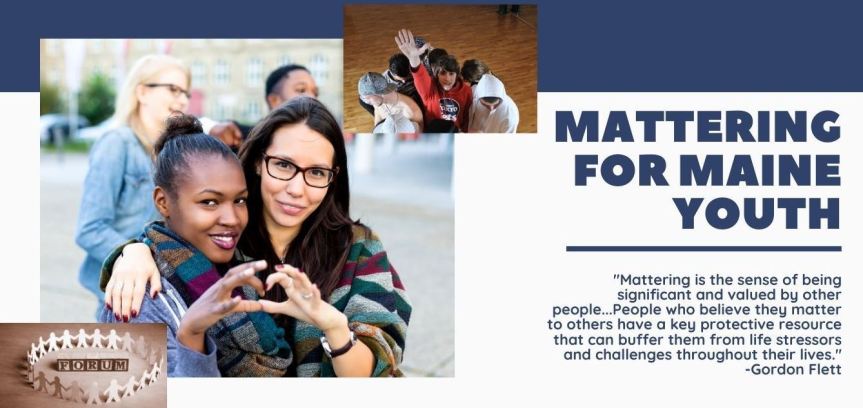
During this time of opportunity and challenge, together we must create a springboard for community driven change for Maine youth. Across Maine, too many youth are isolated. The rate of youth anxiety, depression and feelings of loneliness in Maine have reached crisis levels.
In the 2019 Maine Integrated Youth Survey almost 50% of youth feel they do not matter to their community. While a child may feel connected within their family or school, how can we create a culture in Maine where youth feel they matter in community?
Connectedness refers to a sense of being cared for, supported, and belonging, and can be centered on feeling connected to school, home, with other important people or organizations. Mattering and social connectedness are protective factors that reduce the likelihood of poor mental health and other risks such as suicide and substance use. A strong sense of mattering in the community helps provide a sense of connectedness with lasting effects on their health and well-being.
Thank you in advance for Joining the Conversation!
REGISTER FOR A VIRTUAL COMMUNITY FORUM
Facilitated by Carole Martin
January-March of 2021, The Maine Resilience Building Network-MRBN- is hosting facilitated Community Conversations to Cultivate Mattering for Maine Youth. Virtual Forums are schedule in all 9 Public Health Districts across every Maine County. Participation is Free to Attend. Together we will listen, learn and share. All community members are encouraged to attend.
Your voice matters.
If you cannot attend your health district/county zoom event, please attend another event. There are two evening events available. Please join the Community Conversations to learn how you can build positive connections for Maine Youth.
The Maine Department of Education has concluded that terminating eligibility to a free, appropriate public education at the end of the school year in which a student turns 20 pursuant to 20-A M.R.S. § 5201(1) years is inconsistent with the IDEA as interpreted by the First Circuit in K.L. v. Rhode Island Board of Education, 907 F.3d 639 (2018). It is certain that the First Circuit would draw the same conclusions if Maine’s statutes were challenged.
In 2018, The First Circuit Court in K.L. v. Rhode Island Board of Education concluded that students are entitled to FAPE until age 22. The decision requires ongoing eligibility for entitlements created by the Individuals with Disabilities Education Act (IDEA) for special education students who have not yet been conferred a diploma and have not yet obtained the age of 22 years old. According to this decision, special education and related services under the IDEA must remain available until the student’s 22nd birthday.
Effective immediately, Maine will implement the “federal standard” and provide FAPE to eligible students until their 22nd birthday. The Administrative Letter for this directive can be viewed, here.
All school administrative units must notify adult students who would have previously “aged out” of special education on June 30, 2021 of their right to receive a free, appropriate, public education until either they receive a regular high school diploma or their 22nd birthday, whichever comes first.
The Department will be providing technical assistance around FAPE beyond age 20. For more information, contact Erin Frazier, State Director of Special Education Birth to 22, at erin.frazier@maine.gov.
The Maine Department of Education is sponsoring a workshop by Amber Coleman-Mortley, Moving Beyond the Movement: Fostering Authentic Transformation for Sustainable Outcomes. Amber Coleman-Mortley brings a diverse voice into civic education, manages a large network of education influencers, and has built a successful youth fellowship of students fighting for equity in civic education. Amber’s advocacy and expertise have been featured in the New York Times on several occasions.
Syllabus:
Module 1 – Now is the Time: Using the past to inform the present
How do we apply anti-racism, anti-bias, and equity to civics and history classrooms?
Module 2 – Be bold. Be brave. Be inclusive: Engaging your stakeholders
How do we facilitate community engagement around anti-bias work?
Module 3 – Culturally relevant pedagogy for all
How can we leverage culturally relevant pedagogy to support all learners in our school community?
Module 4 – Practical applications and continued strategies for continued allyship
What small, and large, changes are required to ensure that our practices and policies are investments, not investigations?
Every Wednesday in February
February 3, 2021; 7:00-9:00 PM
February 10, 2021; 7:00-8:30 PM
February 17, 2021; 7:00-9:00 PM
February 24, 2021; 7:00-8:30 PM
Amber Coleman-Mortley is a talented creator and builder of digital and grassroots networks where she focuses on cultivating an engaged community of active participants through multimedia video and virtual spaces. In her current role as Director of Social Engagement, she brings diverse voices into civic education, manages a large network of education influencers, and has built a successful youth fellowship of students fighting for equity in civic education.
Amber’s equity and civic work is centered around building strong teams for improved community outcomes, which is inspired by her years as a three-sport varsity athlete at Oberlin College where she earned North Coast Athletic Conference (NCAC) all-conference honors for 8 out of the 11 seasons she competed. She also has a Division 3 , NCAA appearance in the 4×100 m. She currently serves as an alumni advisor to Oberlin College’s, Black Student-Athlete Guild.
Amber taught for nine years as a P.E/Health teacher and head varsity volley ball and head varsity track coach. She has experience building curriculum and leadership programs for student-athletes and team captains. Amber presented on Anti-Racist Coaching and Sports and Social Justice at the U.S. Soccer
Foundation’s Virtual National Training. At the center of her work are equity, critical thinking, and civic problem-solving. She has experience collaborating virtually with parents and educators around equity, anti-racism, and culturally relevant pedagogy, which includes work with the DuPage (Illinois) Regional Office Of Education.
Amber is a highly regarded social media influencer whose work brought her to the White House to meet former first lady Michelle Obama to discuss influencer campaigns that focus on family health and wellness. She is a parenting expert and author of Mom Of All Capes where she covers parenting strategies in civic education, education technology, parent-teacher partnerships, and social-emotional development. The podcast she co-created with her children, Lets K12 Better, discusses how to improve K12 education and family life through partnerships and communication.
Amber’s advocacy and expertise have been featured in the New York Times on several occasions which includes viral videos, a full-page spread in print media, and several online articles. Her insights have been cited in publications from the LA Times to the Smithsonian Magazine, The Washington Post to LAist. Coleman-Mortley has shared insights for parents through her work for Edutopia, civic education and parenting for TODAY Parenting, and even shared tips for weary travelers through Southwest Airlines. Amber’s voice has been amplified on countless podcasts including Edit Your Life about how to talk to children about race, EduTable about education a inequity, NPR affiliate KPC Conprocessing the state of the world with children. She’s presented live with New York Times Parenting and Sree Sreenivansan’s daily global show on talking to kids about race.
Additional information:
This workshop series will require participants to maintain a reflection journal. Participants should come motivated to create change and should be prepared to participate in group discussions based on readings and resources shared prior to the session.
Engaging in this cohort provides an opportunity for participants to earn credit hours. To receive credit, participants must attend all four sessions.
For more information contact Danielle Despins; a volunteer member of Maine DOE’s internal Diversity, Equity and Inclusion (DEI) sub-committee at (207) 592-1448.
The Maine School Safety Center and Dr. Karen Barnes (MSSC Threat Assessment Officer) are pleased to invite you to a presentation that will provide you with a brief overview of School Behavioral Threat Assessment as well as inform you of current efforts underway in our state to identify at-risk students and mitigate violence by providing timely and effective interventions. Additionally, we will provide you with details pertaining to free training opportunities to develop multidisciplinary threat assessment teams in your schools. We hope you will join us as we share our work with you thus far and our vision for the future to ensure safety in all Maine schools.
The training will be conversational with ample opportunity for questions. This training will be followed with a second training, at a later date, hosted by REMS addressing Behavioral Threat Assessment from a National perspective.
The target audience for this training are school administrators, school staff, mental health professional, law enforcement and other school safety stakeholders.
When: Jan 29, 2021 09:00 AM Eastern Time (US and Canada)
The U.S. Environmental Protection Agency (EPA) is excited to announce the availability of approximately $46 million in Diesel Emissions Reduction Act (DERA) grant funds to support projects aimed at reducing emissions from the nation’s existing fleet of older diesel engines. Under this competition, between 40 and 70 awards are anticipated.
Eligible applicants include regional, state, local or tribal agencies, or port authorities, with jurisdiction over transportation or air quality. Nonprofit organizations may apply if they provide pollution reduction or educational services to diesel fleet owners or have, as their principal purpose, the promotion of transportation or air quality.
For the 6th year, the Maine Department of Education will collaborate with community organizations and schools to support the Read to ME Challenge, a month-long public awareness campaign held in February to promote childhood literacy in Maine. This year we will celebrate the Read to ME Challenge with a series of recorded videos by students and adults. We will post the videos and share, but if you would like to request the videos be sent to you directly, please complete this form.
This simple but powerful campaign challenges adults to read to children for 15 minutes, capture that moment via a photo or a video, and then post it on social media and challenge others to do the same. Don’t forget to use the hashtag #ReadtoME and tag the Maine DOE at @mdoenews on Twitter and @MaineDepartmentofEducation1 on Facebook!
The Read to ME Challenge will run for the month of February, leading up to Read Across America Day on March 2, 2021. Learn more about the Read to ME Challenge on the Maine DOE Website, which includes a heat map of participants and an opportunity to submit your Read to ME story for the heat map!
For more information, contact Dee Saucier, Elementary Literacy Specialist for the Maine DOE.