Empowering Students with Diverse Abilities: Nominations Open for Executive Student Transition Committee

The Maine Department of Education (DOE) Transition Maine program invites educators to nominate Maine students with individualized education programs (IEPs) to apply for a leadership role on the Executive Student Transition (EST) Committee.

Established by the Maine DOE in early 2022, Transition Maine was created to provide equitable and inclusive post-secondary transition services for students with IEPs to help them ease into adulthood. Since then, the Maine DOE Transition team has been on a mission to amplify youth voices in Maine and beyond. The Executive Student Transition Committee is a big part of that mission.

The Committee is comprised of students with diverse abilities who work to champion their rights and actively shape inclusive transition experiences. As an Executive Student Transition Committee member, a student will engage in initiatives that forge pathways to promoting equitable access to education, employment, and independent living while building leadership and self-advocacy skills.

Committee members independently attend virtual weekly meetings and develop content related to transition topics, like self-advocacy and determination. They also engage in leadership opportunities in community-wide programming, such as taking part in the planning of the Maine DOE’s Annual Transition Maine Youth Summit and representing Transition Maine at local, statewide, or national events.

Along with the nomination form, student nominees will need to prepare a written, audio, or video response to a topical prompt around advocacy and transitions. This can be done independently or with the assistance of an educator.

Executive Student Transition Committee nominees should be students who are passionate about leadership and advocacy. Members

New committee members will help plan and run the 2025 Transition Maine youth Summit in Presque Isle.

of the Committee are compensated for up to 20 hours per month. By joining the Committee, students will be part of a team dedicated to driving positive change and creating opportunities for all Maine students with diverse needs.

Please submit your nomination using this link. If you are a student or want to provide a potential nominee with more information, you can download the file linked here. 

For more information, please reach out to the Maine DOE Transition Specialist Titus O’Rourke at titus.orourke@maine.gov.
Maine DOE Staff Contribute to Journal of School Nursing

Maine Department of Education (DOE) School Nurse Consultant Emily Poland, MPH, RN, NCSN, and School Nurse Specialist Sarah DeCato, MSN, RN, NCSN, in collaboration with nurse colleagues across the nation, recently co-authored an article titled, “Exploring Innovative U.S. School Health Delivery Models: A Narrative Review”. This literature review identifies several different school health delivery models that exist today, as well as a need for continued research and growth in innovation to best meet the ever-evolving health needs of students.

This article will be published in the Journal of School Nursing in February of 2025, and it has already been published online.

This partnership was part of a larger project completed in 2023, when the Maine DOE commissioned an environmental scan and state assessment of school health services to gain a deeper understanding of the state of these services. The purpose of this project is to describe school health services, examine innovative models and infrastructures that facilitate Medicaid billing, and provide recommendations for a three- to five–year plan to strengthen school health services.

To complete this project, the Maine DOE contracted with the Center for School Health Innovation & Quality, which is housed in the Public Health National Center for Innovations, a nonprofit organization that is part of the Public Health Accreditation Board.

The environmental scan and summary sheet can be viewed here:

Maine Educators Discover Connections Between Literacy and Mapmaking with Author David Sobel

Educators from across the state recently met at The Steel House in Rockland — and online via Zoom — for “Integrating Literacy through Mapmaking” with David Sobel, author of Mapmaking with Children, and Jennifer Kramer, Social Studies Coach for the Windham Southeast Supervisory Union in Brattleboro, Vermont.

During this full-day workshop, participants explored the concepts of place, belonging, and geographic representation. Sobel led the group through his research, showing that across the globe and across cultures, children develop perspectives on place and sense of area at roughly-identical age-related milestones. It’s insight that has proven to be particularly illuminating, as educators work on comprehension.

“This was one of the best workshops I have ever taken!” noted Laurie Chaisson, an art teacher at Narraganset Elementary School. “I particularly appreciated David’s developmental stages of mapmaking. This was the missing piece for me!”

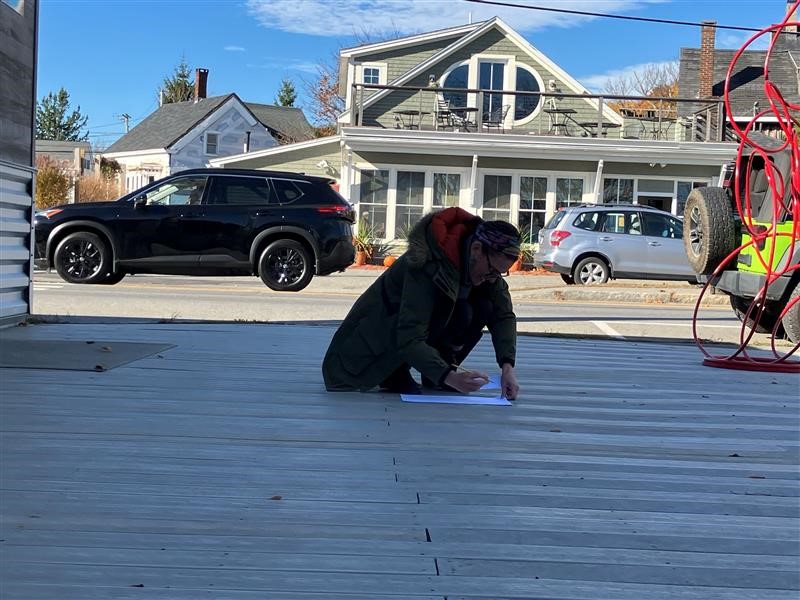
Workshop participants also reviewed projects on sound maps, smell maps, treasure maps, and other forms of depicting space. The group worked with and created rebus puzzles, as well as treasure maps, and then they were set loose upon the outside campus of The Steel House to hide their “treasures,” handing off their maps and key rebus to other teams to solve. The activity was both engaging and educational, and many commented on how it brought back the joy of learning.

“It wasn’t long before I became an enthusiastic participant! It was so much fun and really inspiring,” Susan Jones from RSU 40 said.

Kramer led the group through several projects she has completed with schools, both as a classroom teacher and as a curriculum coordinator. She brought forth deeper-thinking concepts while connecting them to practical, replicable classroom projects, including the creation of an “exploding map,” a type of map similar to a pop-up book. It unfolds three-dimensionally to show details and information on a place-in-history map.

“What kid wouldn’t want to make an ‘exploding map’? Bravo! This is what learning should be!” Chaisson said.

Central to the conversation were the concepts of play in learning, cross-curricular comprehension, and the alignment in the thinking process between mapmaking and literacy skills. Inherent in each is coding, vocabulary, navigation of materials (fluency), and making meaning. Just as with mastering the skill of reading, these elements in mapmaking are co-mingled and build upon each other.

“This was a really fun and useful session,” Mark Sparks, a social studies teacher at Winthrop Middle School said.

This workshop was the second in a series of four on the topic of Integrating Literacy hosted by the Maine Department of Education’s (DOE) Interdisciplinary Instruction team. All four workshops are offered both in-person and online.

During workshops, participants get the opportunity to ask questions, engage with material, and share their work. In addition to the “day of” experience, recordings of the workshops are made available for later viewing on the Maine DOE’s EnGiNE platform. Contact hours are available for all who participate.

Future events in this series include:

  • December 12, from 8 a.m. – noon: Integrating Literacy through Background Knowledge with Josie Cameron at the University of Maine at Orono. Use this link to register.
  • January 15, from 8 a.m. – noon: Integrating Literacy through Applied Science with Katie Coppens at Curtis Memorial Library in Brunswick. Use this link to register.

If you have any questions about this workshop series, please contact Kathy Bertini at Kathy.Bertini@maine.gov or Heather Martin at Heather.Martin@maine.gov.

RSU 16 Initiates Annual District-Wide Outdoor Learning Day in Maine

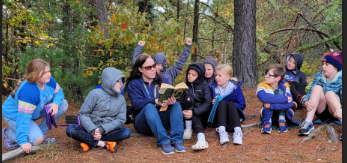
On October 16, students and teachers at all five Regional School Unit 16 (RSU 16) schools in Mechanic Falls, Minot, and Poland participated in the first annual “Drop Everything and Get Everyone Outside (GEO) Day.” The new initiative involves integrating an outdoor learning activity into nearly every content area for students’ daily lessons.

This effort comes as research continues to demonstrate the many benefits of outdoor learning, including improved focus and academics, increased cooperative learning and social interaction, better physical and mental health, and the fostering of an appreciation of and love for nature.

Jessica Harvey, a second-grade teacher at Elm Street School and the 2021 Androscoggin County Teacher of the Year, is one of the educators who has helped RSU 16 to realize its vision of outdoor learning. She and a team of other RSU 16 teachers participated in outdoor learning sessions through The Ecology School to develop a vision and progression of outdoor learning at RSU 16.

Following this professional learning opportunity, teachers held a casual lunch meeting to connect and share successes and challenges related to outdoor learning. That’s how they created the Get Everyone Outside (GEO) initiative, which they decided would be brought to life with a Drop Everything and Get Everyone Outside (GEO) Day across the district to promote outdoor learning.

“Great things happen when teachers have time together,” Harvey said.

The teachers worked with RSU 16 Curriculum Director Jill Mathieu, to establish a representative at each school to help promote and support outdoor learning. Eventually, a plan was put in place for the first annual Drop Everything and GEO Day.

“Outdoor learning is for everyone, and we are proud to see how many educators took their students outside for learning that day,” Harvey said.

Through grants and the district’s Tri-Town Education Fund, RSU 16 has acquired outdoor learning seating and other materials to help teachers and students start teaching and learning outdoors.

RSU 16 hopes to continue to grow outdoor learning district-wide, making it a natural part of the curriculum for years to come.

Information for this story was provided by RSU 16. To share good news from your school, please fill out the Maine DOE good news submission form.

REMINDER: Seeking Public Comment on Chapter 115 – the Credentialing of Education Personnel

The Maine State Board of Education is conducting conversations with the public about Rule Chapter 115: The Credentialing of Educational Personnel, from August through December. Resolve 2024, Chapter 137 directed the State Board of Education to amend Rule Chapter 115, with special attention to sections related to the State Board of Education’s report submitted to the Joint Standing Committee on Education and Cultural Affairs in 2023.  

The State Board of Education intends to take the following steps with respect to review of these rules: 

  1. Begin speaking with experts in the field 
  2. Revise necessary sections of Chapter 115 
  3. Invite public feedback on the revisions 
  4. File updated rule 
  5. Engage with Legislative oversight of the rule 

The State Board of Education will hold several regional meetings focused on ideas and goals related to certification regulations in a general sense. These meetings will also focus on specific sections of Chapter 115 and will provide invaluable feedback to the State Board. In addition, the State Board of Education’s Certification and Higher Education Committee will provide time within the established meeting schedule to receive public feedback on Rule Chapter 115.  

 Remaining dates for these meetings are as follows – for the Zoom link, please email Emily Cummins 

  • December 18, 2024: 10:30 am – 12:00 pm 

Taking into consideration the insights gained from all of these discussions, the State Board of Education will propose updates to Rule Chapter 115 and begin the Maine Administrative Procedures Act (A.P.A.) routine technical rule process pursuant to Title 5 MRS §8052 (public notice of filing, public hearing, open public comment period). Once the proposed rule has been filed, the public will be notified of the scheduled public hearing and comment period.  This will be an opportunity to provide written and oral comments regarding the proposed rules. The State Board of Education will review all comments and respond accordingly.  Updates to the rules will then be submitted for review as to form and legality and legislative oversight before final adoption.    

For more information and updates check the State Board of Education webpage. 

For more information about the conceptual conversations for Rule Chapter 115 contact Laura Cyr at laura.cyr@maine.gov. 

Partnership Between United Technologies Center and Central High School Brings Shop Classes Back to Younger High Schoolers

Hands-on learning is making a comeback in the form of a dynamic exploratory program for students in grades 9 and 10 at Central High School in Corinth. This initiative, made possible through significant renovations at the school, brings back the shop class experience to help younger high schoolers explore this kind of learning.

United Technologies Center (UTC), a Career and Technical Education (CTE) school in the Bangor region, has funded a complete renovation of the Central High School’s shop space, featuring refinished floors, new lighting, and fresh paint. The updated facility is now fully equipped with modern tools and resources, including small engines, horticultural equipment, cabinetry, 3D printers, Glowforge 3D laser printers, and more.

“These upgrades aim to give students a taste of what their future experiences at UTC could entail, as they continue their educational journeys into their junior and senior years,” UTC Director Amanda Peterson said.

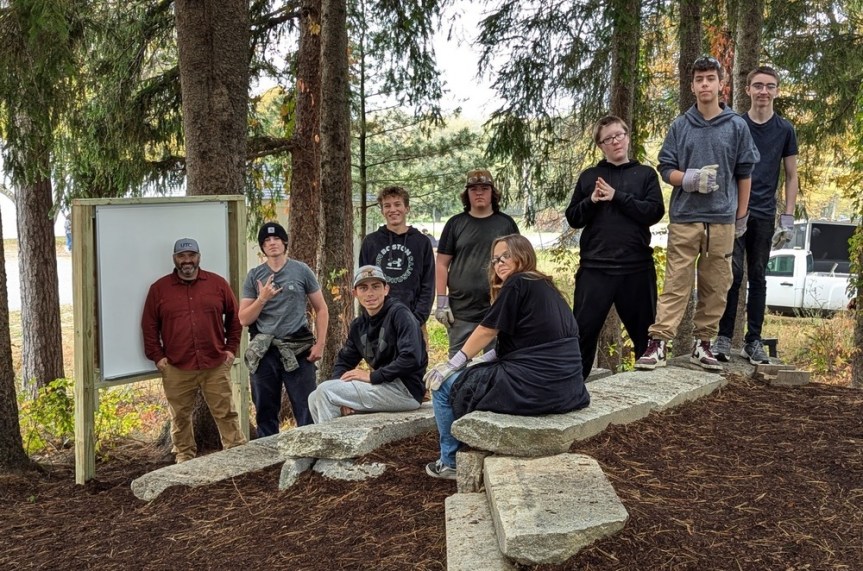
A new instructor, Mr. Doug Depew, is leading the program at Central High School. Under Depew’s guidance, students have already achieved impressive results, like transforming a nearby forest area into a new outdoor learning space with granite blocks that were left unused for years. Their efforts have resulted in a unique area for classes and hands-on activities.

The Central High School program has also provided opportunities for students to be involved in practical projects, like installing French drains to redirect rainwater away from the shop entrances. Students have also helped with trench excavation, installing grates and pipes to ensure proper drainage.

“It’s going incredibly well, and the work these students have completed thus far is exciting,” Peterson said.

This partnership has also rejuvenated the shop program at UTC, creating a wealth of new opportunities for students at both schools.

As the colder months approach, Mr. Depew has many more plans in store, with much of the activity shifting indoors.

“Congratulations to Mr. Depew and his hardworking students!” Peterson said. “Together, we look forward to seeing what comes next.”

Information for this story was provided by the United Technologies Center (UTC). To share good news from your school, please fill out the Maine DOE good news submission form.


Maine Curriculum Leaders Association Offers Professional Learning Opportunities for Educators

The Maine Curriculum Leaders Association (MCLA) is offering two professional learning opportunities in early 2025: Differentiation for Leaders and Crucial Conversations. You can find more information about these opportunities below:

Differentiation for Leaders

Participate in this online learning opportunity to sustain differentiation within your school district. These meetings will take place virtually for four sessions with Cheryl Dobbertin, a leader in professional development, proficiency-based learning, and differentiation.

Descriptions of each session are as follows:

  1. January 15: Differentiation that Makes a Difference – What is high-quality differentiated instruction This session will explore a comprehensive model of differentiated instruction and include discussions about common misconceptions.
  2. February 12: Structures that Support Sustainable Differentiation – This session will help leaders to understand the communication, professional development, and coaching plans necessary to implement quality differentiated instructional plans.
  3. March 12: Barriers to Quality Differentiation – This session will dive into the sometimes-invisible barriers that keep differentiated instruction from becoming a way of life in a school and/or district.
  4. April 2: Integrating Differentiated Instruction into Other Structures – How does differentiation work for students who need intervention or enrichment? How might it be part of your Multi-Tiered Systems of Support (MTSS) plan or Social Emotional Learning work? This session will review how differentiation can fit into all plans and structures when it’s well understood, helping leaders to create classrooms that allow all learners to thrive.

The cost for Differentiation for Leaders is $200 for MCLA members and $300 for non-members.

Register here.

The Maine Curriculum Leaders Association will reach out to those who register to determine the best time for sessions for the majority of registrants. For more information, please contact MCLA at director@mainecla.org.

Crucial Conversations

A Crucial Conversation is a discussion between two or more people where the stakes are high, opinions vary, and emotions run strong. When conversations turn crucial, people tend to follow one of two ineffective paths: They either speak directly and abrasively to get the results they want but harm relationships, or they remain silent with the hope of preserving relationships only to sacrifice results. Crucial Conversations® for Mastering Dialogue gives people the skills to step into disagreement—rather than over or around it—and turn disagreement into dialogue for improved relationships and results.

“The health of any relationship, team, or organization can be measured by the lag between identifying and discussing problems,” Joseph Grenny, coauthor of Crucial Conversations said.

Crucial Conversations® for Mastering Dialogue teaches nine powerful skillsets grounded in decades of social science research. The course helps learners develop these vital skills through instruction, application, practice, group discussion, and self-reflection all based on educational scenarios. This opportunity will include 12 hours of professional development, a digital copy of the learner guide, model cards, cue cards, and a digital copy of the book Crucial Conversations.

MCLA Executive Director Deb McIntyre will lead the training sessions and has previously delivered this professional development. Sessions are scheduled from 12:30-2:30 p.m. via Zoom on the following dates:

  • January 28
  • February 4
  • February 11
  • February 25
  • March 4
  • March 11

This course is appropriate for all school district leaders and is more powerful if you have a team that attends. The cost is $400 for MCLA members and $500 for non-members.

Register here

To provide this excellent learning opportunity, MCLA must have at least 25 participants to run this offering. For more information, please contact MCLA at director@mainecla.org.


RESCHEDULED: Integrating Literacy through Background Knowledge Workshop with Josie Cameron

The Interdisciplinary Instruction team at the Maine Department of Education’s (DOE) Office of Teaching and Learning is excited to present a half-day workshop with educator and author Josie Cameron.

The Integrating Literacy through Background Knowledge workshop has been rescheduled for April 7, 8:00 a.m. to noon, at the Wells Conference Center at the University of Maine at Orono.

A 2020 study published in Reading Psychology found that preexisting knowledge is “foundational to increasing competency in reading” and that teaching from a foundation of what students already know is key to advancing their learning.

In this workshop, participants will explore, discuss, and engage with:

  • The role of preexisting or background knowledge in literacy development.
  • How background knowledge supports comprehension and meaning making.
  • How background knowledge facilitates the transfer of new information.
  • Practical strategies for incorporating background knowledge into classroom instruction.

This workshop is free to all Maine educators. In-person spots are limited and will be filled on a first-come, first-served basis. Participants can also join virtually via Zoom. This session will be recorded and shared with educators following the event, and four contact hours will be available to participants. To register for this event, please use this registration link.

If you have any questions about this workshop, please contact Kathy Bertini at Kathy.Bertini@maine.gov or Heather Martin at Heather.Martin@maine.gov.

This workshop is the third of four workshops presented by the Maine DOE Interdisciplinary Team on the topic of Integrating Literacy through Applied Learning. All events are available in-person and virtually.


Maine DOE to Host Third Annual Computer Science Education Showcase

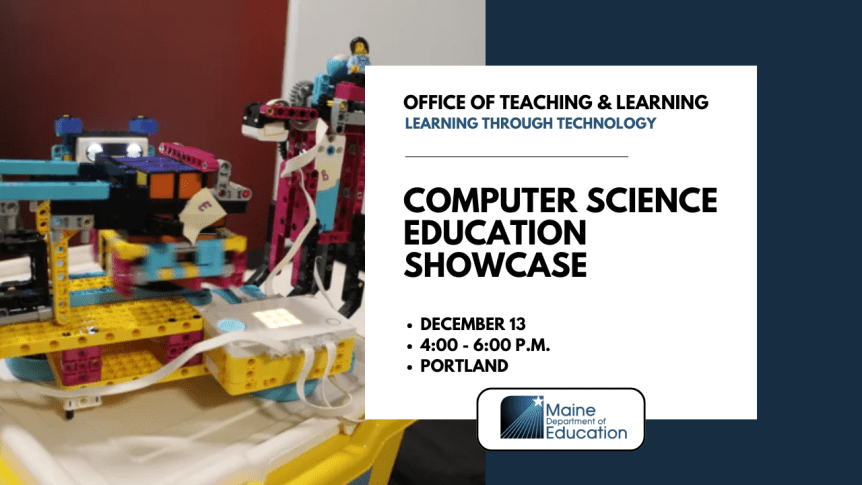
The Maine Department of Education (DOE), in partnership with Educate Maine, is hosting its third annual Computer Science Education Showcase as part of the 2024 Educate Maine Symposium in December!

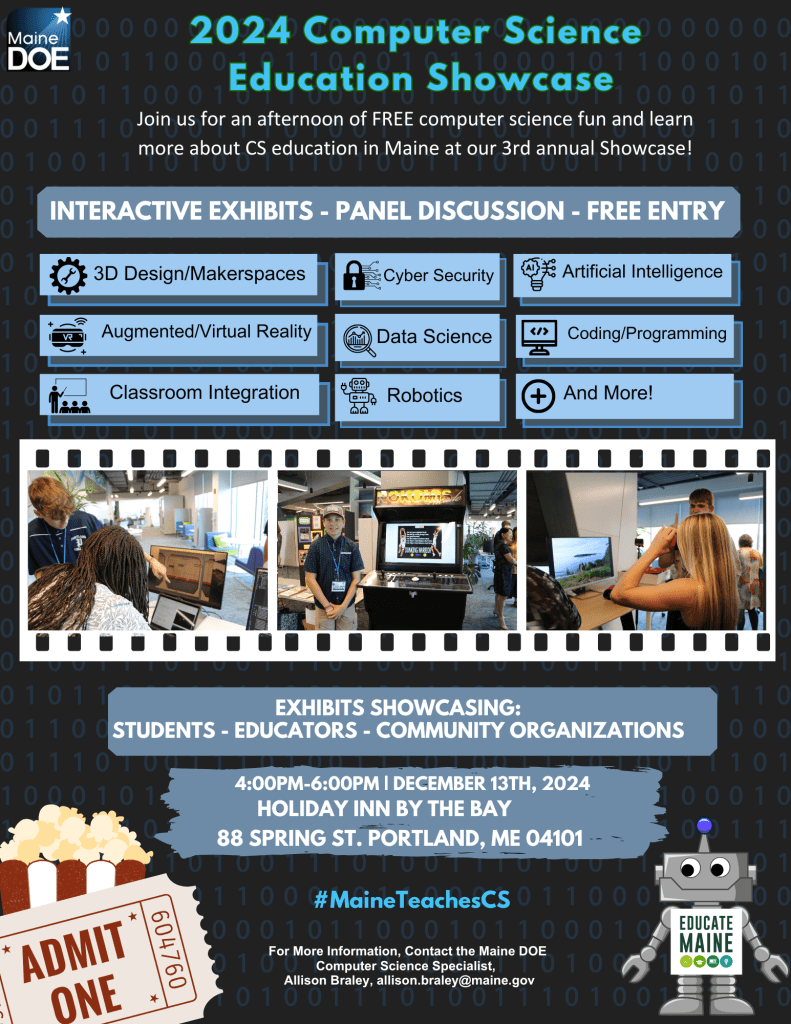
Join the Maine DOE at this event for an afternoon of computer science fun and learning! The showcase highlights educators, students, community organizations, and other partners who are teaching, learning, and expanding access to and participation in computer science education statewide. Whether you’re new to computer science, aren’t sure what exactly computer science is, or want to learn more about the ways that computer science is taught across Maine—this is the event for you.

The Computer Science Education Showcase is scheduled for Friday, December 13 from 4-6 p.m. at the Holiday Inn by the Bay in Portland. You can register here to attend. If you’re interested in exhibiting something you’re doing with computer science education, please fill out this brief form.

Check out the media release regarding last year’s showcase to learn more.

If you have questions or would like more information about the Computer Science Education Showcase, please reach out to Maine DOE Computer Science Specialist Allison Braley at allison.braley@maine.gov.

CS Showcase Flyer

Teacher Advisor Opportunity Available at Maine State Museum

The Maine State Museum is seeking a teacher advisor to help design a project that highlights Maine student voices through virtual displays. These displays — which will appear in-person and online — will be a special feature of the Maine State Museum’s reopening in late 2025 or early 2026.

Maine State Museum - Teacher Advisor GraphicThe goal of this project is to create an educational program and lesson plan that can be replicated and that will engage a range of Maine schools and students, bringing young voices and perspectives into the museum. Students involved in this project will choose a person, place, or thing from their own lives that they feel is worth honoring in a museum. They will then conduct background research and write a museum-standard label with basic information, as well as their own perspective regarding why the item they chose is important to their lives and the story of Maine.

The teacher advisor will collaborate on planning this project and write a state standards-aligned lesson plan that museum educators can use to work with partner teachers. This is a pilot project, and just a handful of schools will be selected to participate in the 2025-2026 school year.

The teacher advisor will be a contractor with the Maine State Museum. The ideal candidate will have extensive classroom experience and the ability to scale materials for K-12 grade levels. Applicants from a range of disciplines and backgrounds are invited to apply.

The teacher advisor will receive a stipend of $2,000 in compensation for their work. The contract will not include state employee benefits. No travel is required. The schedule is very flexible, and work can be completed between January and June of 2025.

See the full teacher advisor description and find information about how to apply.

For further questions, please reach out to Maine State Museum Education Program Specialist Kate Webber at kate.webber@maine.gov.