The Maine Department of Education’s (DOE) Interdisciplinary Instruction Team has created new resources for supporting PK-12 literacy instruction. The Integration of Literacy and Neuroscience suite of resources reflects current research-based practices through a combination of asynchronous professional learning modules, strategies, and additional resources to support student engagement and reading comprehension through the lens of neuroscience. These modules focus on multiple aspects of literacy, including:
Active self-regulation includes engagement and motivation, executive functioning skills, and strategy use in literacy, with the goal of developing engaged, motivated, independent readers.
Word Recognition includes literacy foundational skills such as phonological awareness, alphabetic principles, phonics, decoding, and sight words.
Language Comprehension focuses on Cultural and Other Content Knowledge, including work on the role of students’ prior and background knowledge in improving reading and Theory of Mind, which refers to a reader’s ability to empathize with characters or people in books.
Bridging processes are the tools that readers use to move between word recognition and language comprehension with increasing fluency. Bridging processes are how readers begin to weave together word recognition and language comprehension skills to become more fluent readers.
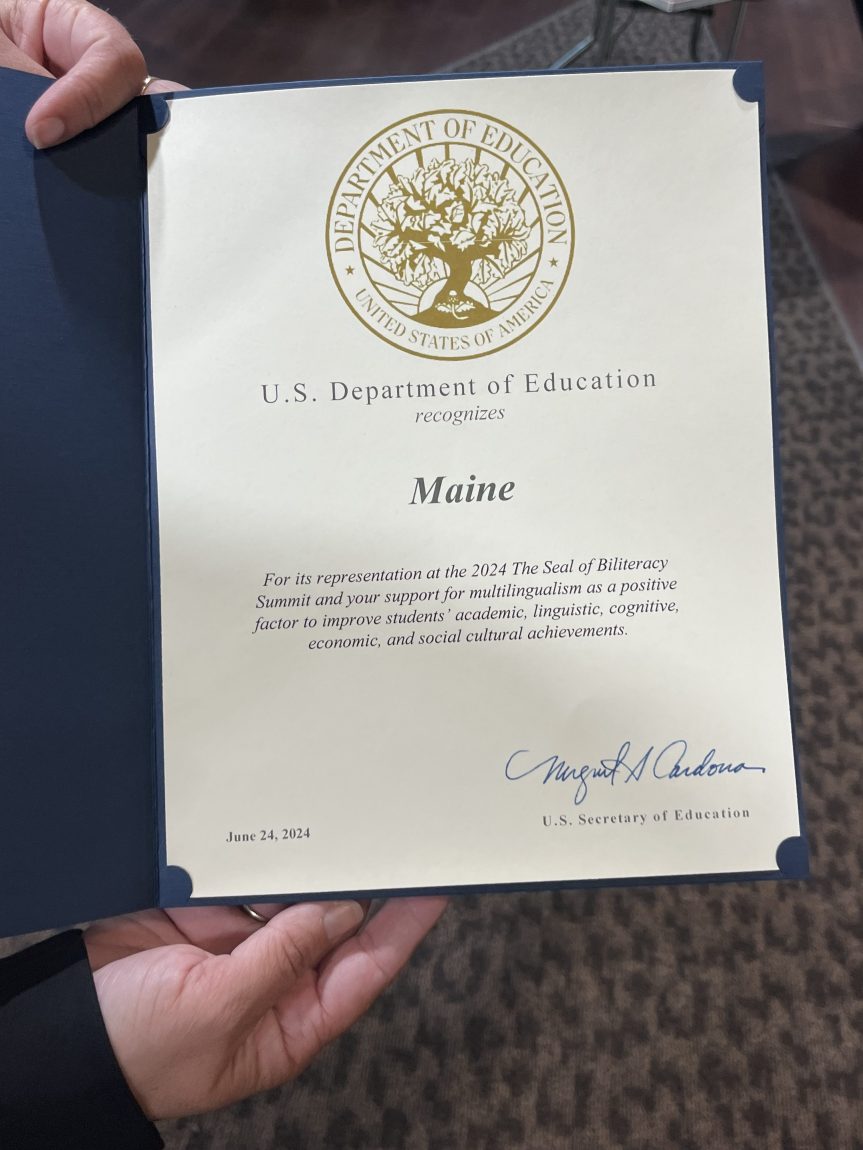
The first national Seal of Biliteracy Summit took place in Washington, DC, recently, and representatives from the Maine Department of Education (DOE) attended. The event brought together educators, policymakers, and language advocates to celebrate and promote multilingual education. It highlighted the achievements of students who earned the Seal of Biliteracy, an award recognizing proficiency in English and an additional language.
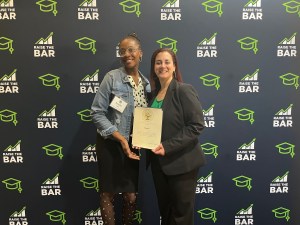
Left to Right: Ayesha Hall, Maine DOE Director of Strategic Partnerships, and Beth Lambert, Maine’s Chief Officer of Teaching and Learning.
Among the attendees were Beth Lambert, Maine’s Chief Officer of Teaching and Learning, and Ayesha Hall, Maine DOE Director of Strategic Partnerships. The Maine DOE plans to use this celebratory platform to continue promoting equitable access to global engagement opportunities for all Maine students. The Maine DOE’s Office of Innovation and Office of Teaching and Learning are working together to create a more inclusive experience for all students by presenting Maine’s multilingual learning and world languages programs as collaborative efforts at the state level.
The Seal of Biliteracy, endorsed by the Maine DOE and awarded to students in many Maine schools, acknowledges students who have demonstrated high proficiency levels in both English and another language through rigorous assessments. The Seal, which appears on students’ transcripts, enhances their post-secondary and career opportunities by showcasing their bilingual skills.
In Maine, the program includes various languages, such as Mandarin, Arabic, Chinese, French, Spanish, and Somali. The recent awarding process has been streamlined, allowing schools to confer the Seal of Biliteracy directly, making the recognition more accessible to students across the state.
The summit aimed to expand the Seal of Biliteracy’s reach and impact, encouraging more states and districts to adopt similar programs and highlighting the importance of multilingualism in an increasingly globalized world.
For more information about the Seal of Biliteracy in Maine, visit the Maine DOE website.
The Maine Department of Education (DOE) would like to remind school administrative units (SAUs) of the following data reports and due dates that are coming up.
Truancy and Daily Attendance Certifications
The final certifications for Truancy and Daily Attendance for the 2023-2024 school year are due on July 15th. Superintendents must certify these reports once data specialists and SAU data teams have reviewed and updated them.
NEO Staff was rolled to the 2024-2025 school year on July 1. All staff were updated to “pending” status during this rollover. All staff must be updated to reflect their current position. Please review all staff positions in NEO, add new staff if necessary, and update salary, contact, and position information to reflect each staff member’s position for this school year.
Resources:
NEO Staff Data Entry Webinar 9/3 at 12 pm Register Here
Graduation Report
This report allows SAUs to validate graduation counts for the school year. Students still working toward finishing their graduation requirements have until August 15th to complete them for this reporting cycle. Students who finish their requirements over the summer can be exited from State Synergy on the date of the graduation ceremony. The graduation date must be prior to 6/30.
Starting this July, the Maine Department of Education (DOE) Interdisciplinary Instruction Team will offer two asynchronous book studies.
The first book is “Dispositions” by Arthur Costa and Bena Kallick. It discusses how educators can nurture and develop positive student dispositions. It emphasizes the importance of attitudes, habits of mind, and character traits that contribute to successful learning.
The second book is “Assessing Student Learning by Design” by Jay McTighe and Steve Ferrara. This book explores the methods for aligning assessment with learning and designing assessments that provide meaningful feedback to students. It covers key concepts such as formative and summative assessments, performance tasks, and using assessment data to inform instruction.
Both asynchronous book studies include a free copy of the book, which will be mailed to you, and discussions on integrating the concepts into instruction, reflection, and collaboration through the EnGiNE learning management system. You can sign up for one or both book studies, and since they are asynchronous, you can work on them at your own pace.
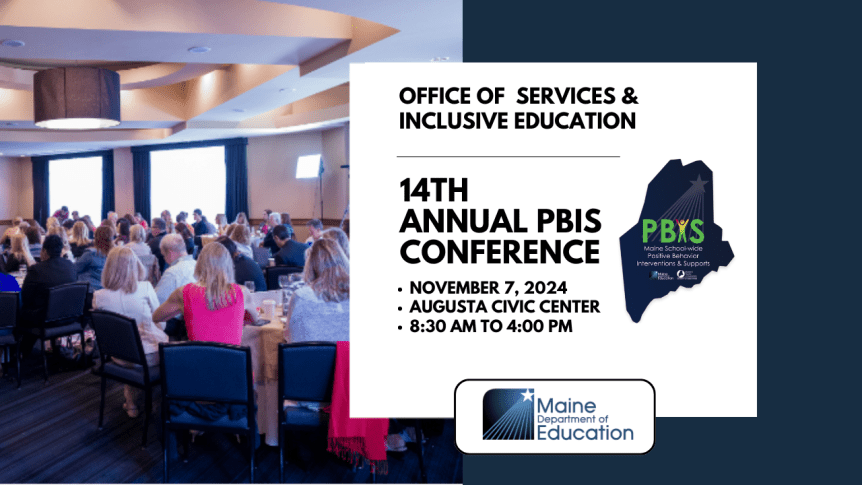
The Maine Department of Education’s (DOE) Office of Special Services & Inclusive Education will host the 14th Annual Maine PBIS Conference on Thursday, November 7, 2024, at the Augusta Civic Center from 8:30 AM to 4:00 PM.
Celebrate, learn, and network with Positive Behavioral Interventions and Supports (PBIS) leaders and implementers from across Maine and beyond! There will be inspiring keynote speakers and breakout sessions that are both interesting and practical for your classrooms, schools, and districts!
This spring, the Maine Department of Education (DOE) awarded a $400,000 Strengthening Maine’s Workforce Grant to Ignite Presque Isle and SAD 1 Adult & Community Education’s workforce development partnership.
The Maine DOE awarded a total of $4 million in Strengthening Maine’s Workforce Grants between 2022 and 2023. These initiatives are funded through Governor Mills’ Maine Jobs & Recovery Plan.
Ignite PI is an organization committed to innovation and excellence in the Presque Isle area. Through dedicated training and professional development programs, Ignite PI strives to enhance the standards of the hospitality industry and create meaningful career opportunities for individuals in the area. SAD 1 Adult & Community Education provides comprehensive educational programs, ranging from basic education to vocational training, designed for adult students. Together, the two organizations have created a workforce development partnership that provides free hospitality training for workers.
The Strengthening Maine’s Workforce Grant has been imperative to the program’s success. Since the organization’s start in 2022, it has provided more than 4,686 hours of training for Ignite PI employees and 240 hours for non-employees. 135 workers total (94 Ignite PI employees and 41 non-employees) have undergone comprehensive hospitality training. 19 distinct training programs were designed to elevate the skillset of hospitality workers for 15 different local businesses. Not only have job opportunities increased, but the standard of service at multiple establishments has improved due to this training.
“We are thrilled with the progress and positive outcomes of this partnership,” said LeRae Kinney, CEO of Ignite PI. “The training programs have not only improved the capabilities of our employees at Ignite PI but have also contributed significantly to the broader community. This grant has allowed us to offer high-quality education and training free of charge, which is a tremendous asset.”
This program has been incredibly beneficial for businesses in the Presque Isle region. The supervisor of Dean’s Motor Lodge (whose staff attended the B.A.S.I.C.S training) remarked that “the training that my staff received was incredible! By having the opportunity to have face to face conversations and bringing up case scenarios, they were able to better understand the laws.”
The supervisor of Parkhurst Siding Pub (whose staff attended both B.A.S.I.C.S training and ServSafe noted that “It’s certainly nice to be able to hold trainings and elevate our workforce’s knowledge and marketability. These are skills they will keep with them their whole lives. A lot of these are public safety issues at their core so the whole community benefits as well.”
The Strengthening Maine’s Workforce Grant was originally set to end in June 2024; however, it has now been extended to June 2025 due to its success. Ignite PI, SAD 1 Adult & Community Education, and the Maine Department of Education hope that this extension allows for continued support and expansion of hospitality training programs and access to all who want to enhance their skills. The prolonged grand and positive feedback from business owners highlights the region’s ongoing need for skilled hospitality workers.
“The collaboration between Ignite PI and SAD 1 Adult & Community Education demonstrates the power of community partnerships in addressing workforce development needs,” remarked Shara Page, director of SAD 1 Adult & Community Education. “We are excited to continue this journey and look forward to training even more individuals in the coming year.”
To learn more about Ignite PI, SAD 1 Adult & Community Education, and hospitality training programs, please get in touch with LeRae Kinney lkinney@ignitepi.com or Shara Page pages@sad1.org.
As part of The Maine Department of Education’s (DOE) work to elevate the expertise of Maine’s education field, we are looking to hire Maine educators as Fellows in the following areas: Civics, Financial Literacy, and Arts Integration. These educators will be provided a stipend through this program to:
Create and distribute regular communication to the field in their focus area;
Maintain webpage content on the Maine DOE website related to their focus area;
Provide a monthly, 1-hour long professional learning opportunity for Maine educators. The professional learning will be based on requested needs from the field and will be offered virtually, synchronously, and archived for asynchronous access on the Maine DOE YouTube channel;
Provide Maine educators technical assistance regarding classroom-specific best practices in their focus area and
Fellows will form a community of practice led by the Chief Teaching and Learning Officer and will meet monthly to share best practices and engage in a book study to help support their work.
The Fellows will be selected from Maine’s field of exceptional educators through a competitive process. Applicants must demonstrate that they have experience as classroom educators (all levels welcome to apply), have demonstrated innovative approaches in their classroom, have knowledge and experience in the focus area, and have been involved in learning communities throughout Maine.
Since the fellowship is in addition to their regular teaching job, fellows will work remotely and outside of their contracted school hours.
Fellows will begin work as soon as suitable candidates are found and continue through June 2025. Fellows will be expected to work up to 20 hours/month for a stipend of up to $2,000/month.
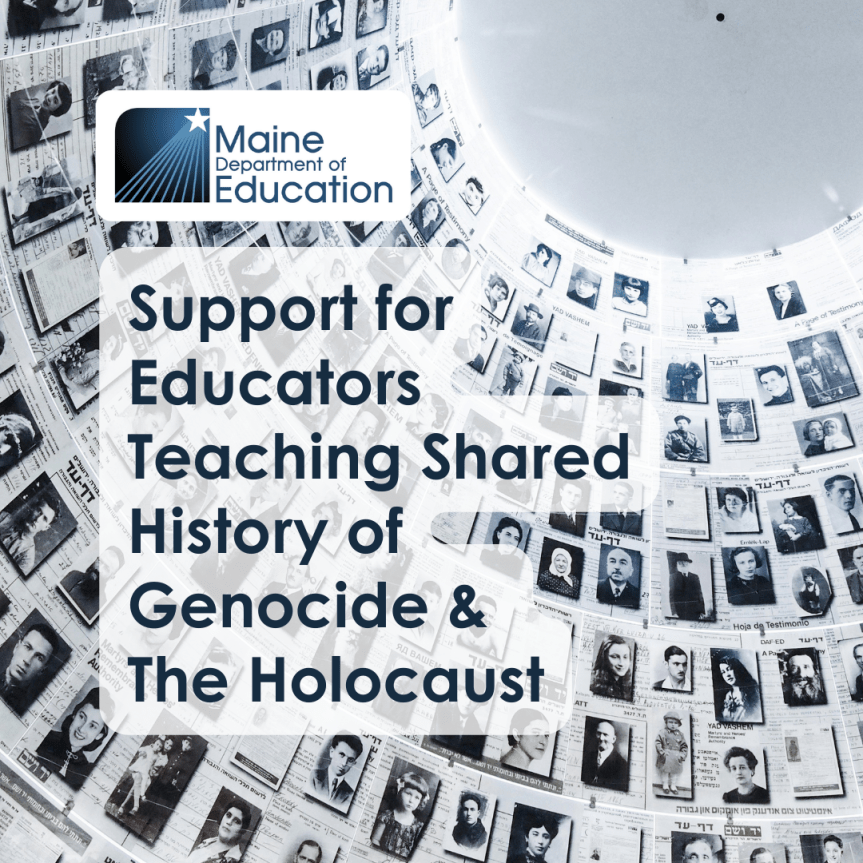
Helping students understand the complex and painful truths of the history of genocide and the Holocaust is not always easy. The Maine Department of Education (DOE) and its partners have many resources available to Maine educators to support them personally and professionally in this work.
Follow the links below to learn more and get access to high-quality resources on teaching the history of genocide and the Holocaust:
The MOOSE Project previously partnered with the Holocaust and Human Rights Center (HHRC) of Maine to develop learning modules for grades PreK-12. These modules help students transition from learning about empathy and care in early grades, into learning about the events contributing to and characterizing genocides (including The Holocaust), and finally into the moral and ethical discussions that help students process their thoughts and emotions and become active architects of a world where these atrocities no longer occur. Check out the multi-day workshops the HHRC has scheduled this summer that can earn educators up to 12 CEUs upon completion.
Maine Shared History is a collaboration between the Maine State Archives, Maine State Library, and Maine State Museum to help educators use local historical articles, documents, and other artifacts with their students. Primary source sets and teaching materials related to Genocide and The Holocaust are provided across grades 3-12 in sections related to Freedom & Captivity and Maine’s Bicentennial.
Remember that you can always contact the Maine DOE for resources and support on your professional learning journey! For more information or questions, contact Jennifer Page at jennifer.page@maine.gov.
The Maine Department of Education (DOE) joins the Alternative Education Association of Maine in congratulating the 2024 Alternative Educators of the Year. The Alternative Education Association of Maine selects the recipients of the Maine Alternative Education Teachers of the Year for their hard work and determination as alternative education teachers in the State of Maine.
Please join us in celebrating the following individuals for their outstanding work with some of Maine’s most at-risk students! Their positive influence on student success is changing lives daily.
John Hawley
John Hawley Teacher, Mt. Ararat High School
John Hawley has been working in alternative education for 6 years. He is described by his colleagues as someone who always advocates for students. Moving them beyond the “at-risk” label, he provides students with opportunities to actively engage in their learning, helping them feel connected to school and each other.
Each day is an opportunity and John Hawley fights for the Alternative Education program at every level, both community and state. All of this excites his students and makes every day another opportunity to learn, all while having the very best of times doing it. Hawley serves as a pillar of the Mt. Ararat Middle School Community, always bringing people together to better serve students both inside and outside his classroom. His goal is to always build the best possible Alternative Education Program for his students.
“My approach is to develop a collaborative team of students working on their grade level project-based curriculum,” said Hawley.
Christine “Cappy” Caprio
Christine “Cappy” Caprio Teacher and Program Coordinator, York High School
Christine Caprio wrote the grant that provided the funding for an alternative education. program at York High School 19 years ago and has led the program to where they serve more than 30 students each year. Through her commitment to the program, she graduates close to 100% of her students within four years. She has implemented a project-based curriculum for York students that emphasizes student ownership and relevance to the curriculum.
She exemplifies a lifelong learner having attained multiple degrees in education. It is very rare to find someone who creates an alternative education and continues teaching in the program for over 15 years. During the covid outbreak in 2020, Ms. Caprio delivered food to her students weekly and forged a connection with them to check on their academic and mental health. She individually taught her students in their driveways to help them pass courses and graduate.
“In my thirty years in education I know of no other educator who has given so much and done so much for her students than Christine Caprio,” said a close colleague of Caprio.
“My work with students is rooted in community and connection; I seek to foster students’ natural curiosity and to challenge and engage them with meaningful, relevant project-based learning curriculum,” said Caprio.
Jacqui Holmes
Jacqui Holmes and Ed Sharood Teachers, Kennebunk High School
Jacqui Holmes and Ed Sharood have shaped and built a vision for expanding the scope and reach of alternative education in Kennebunk. Their innovative programming takes students off of the school campus and into the community where students work in and for local partners. Students who have not found purpose or connection in traditional education are welcomed and challenged in tasks which have tangible real-world impact.
Ed Sharood
Holmes and Sharood, with 8 and 18 years in alternative education, respectively, traveled to the National Alternative Education Association Conference as ambassadors of Maine Alternative Education and advocates of purpose-driven, innovative curricular design. They became the first presenters from Maine in recent memory and drew both accolades and attention for their work.
“These two are simply inspiring,” described one of their colleagues. “They have given so much of themselves to create an environment where each student experiences purpose, challenge, and respect. After talking with Jackie and Ed, I feel like I want to do my own job better.”
“Through a project and community-based curriculum, we strive to create a space where students feel a sense of belonging and are empowered to take ownership of their own education,” said the dynamic duo in a collective statement.
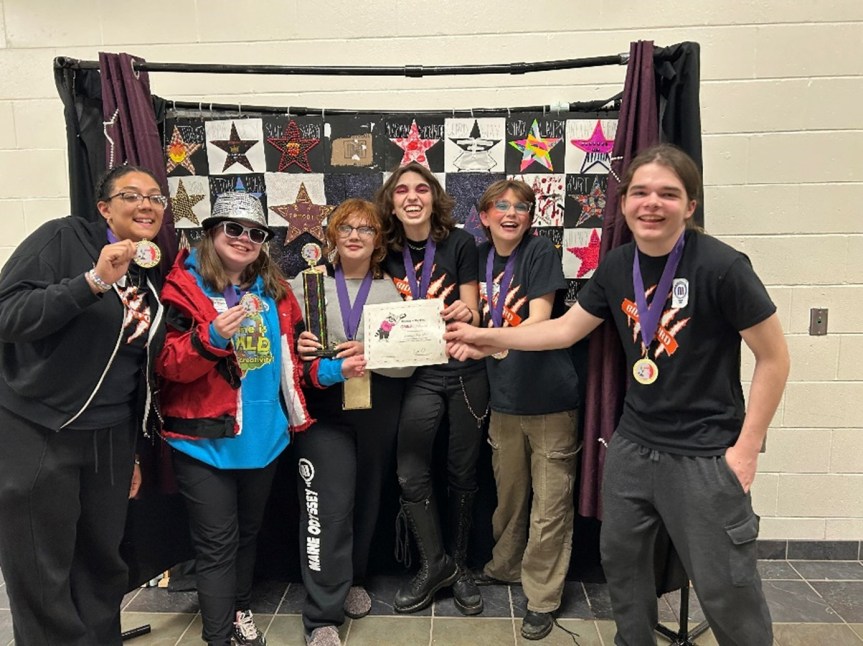
(Pictured: Biddeford High School’s Performance Team, a Maine State Odyssey of the Mind State Champion and World Finalist. Left to Right: Ahlany Martinez, Kyleigh Froehlich, Emily Michael, Layla Keddy, Elliot Aranovitch, and Harvey Giddings.)
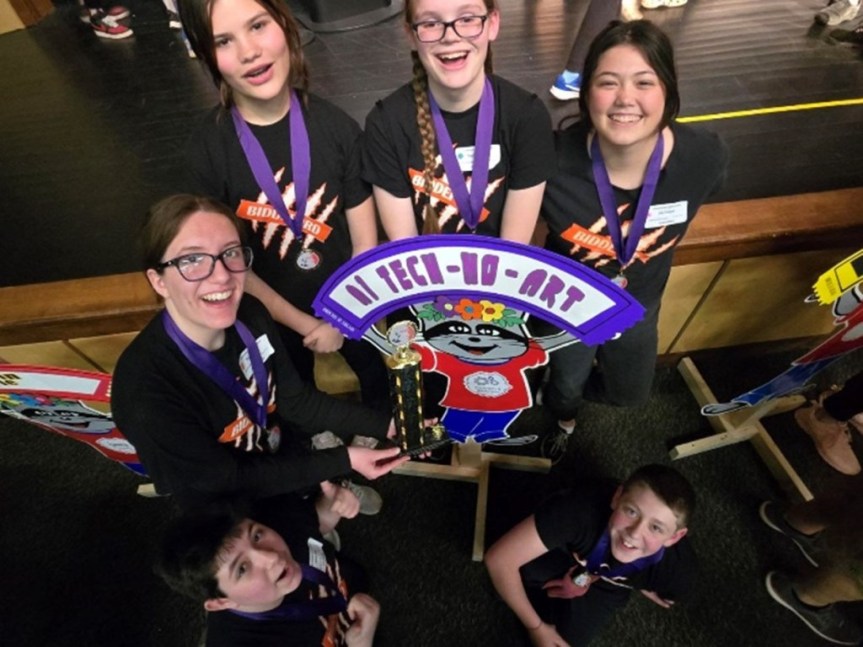
Biddeford High and Middle Schools had sweeping success in the recent Odyssey of the Mind State Championship, with six out of the nine teams placing in the State Championship, four teams placing in the top three of their respective divisions, and four teams moving on to the World Finals in Ames, Iowa.
Odyssey of the Mind is a competition series where competitors utilize original problem-solving skills. In practice, teams will be presented with a long-term problem and then present their found solution at a competition. These solutions can be presented in a way that is either verbal or hands-on. Students work in small teams (up to seven) with very limited coach guidance. Some solutions to problems have included building vehicles that travel courses, creating machines to solve impossible tasks, building and ‘crushing’ a tower made of balsa wood, and performing humorous, witty skits. Odyssey of the Mind teaches teamwork, time management, budgeting, public speaking, thinking/troubleshooting skills, and inspiring individual and team growth.
Odyssey of the Mind has competitors ranging from kindergarteners to college students. This recent win isn’t surprising for Biddeford, as they have a long history of success.
“It is so exciting to see Biddeford students working so well collaboratively and excelling at problem-solving to consistently place at the State Tournament and move on to the World Finals every year since 2015,” says Odyssey of the Mind District Coordinator Victoria Salo. “We have had a strong team of coaches this year, which most certainly helps our students prepare for the state competition. Our teams were excited to head to the World Finals.”
Both the high school Technical and Performance Teams were named State Champions and World Finalists at the tournament. The middle and intermediate school Performance Teams placed second, also qualifying for World Finals. Biddeford teams have now earned the top three places in the State Championship 13 times and advanced to the World Finals 11 times.
Biddeford High School’s Technical Team named Maine State Odyssey of the Mind State Champions and World Finalists. Left to right: James Cote, Emma Cote, Lara Galiardi, Kayla Arsenault, Ella Ireland, and Kyle Perkins.
The Biddeford Primary School even had three of their teams compete against fourteen others. Although they did not receive scores in their competition, they learned how to perform in front of an audience and answer questions from the judges.
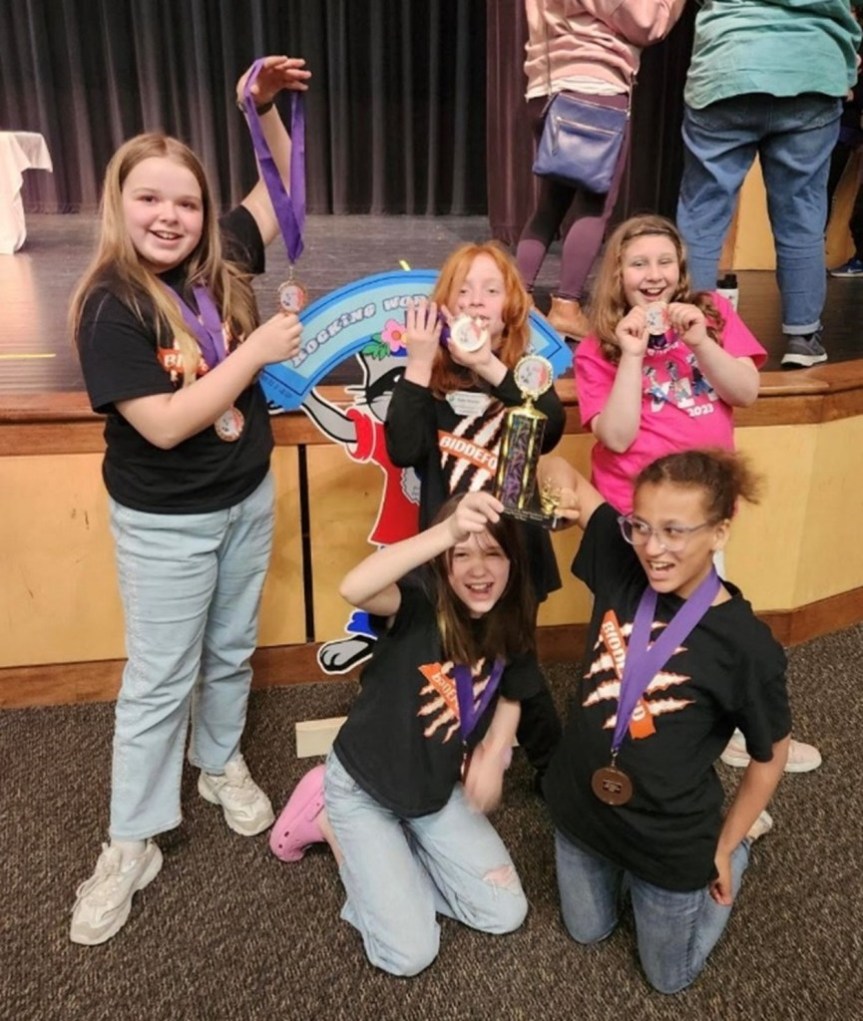
Biddeford Middle School’s Performance Team is a Maine State Odyssey of the Mind 2nd place winner and World Finalist. Front row (left to right): Amelia Ireland and Adalina Morrill; Back row (left to right): Maisie Giddings, Baxter Belanger, and Kalina Simard (not pictured: Anja Lunianski).
In the past two years, the Biddeford Odyssey of the Mind program has more than doubled in size. In 2017, Biddeford only had two teams, consisting of 14 students at the high school Division I and III levels. Today, the program has grown to encompass nine teams, consisting of 50 students in Division I, II, and III in all age categories. The teams cumulate many different demographics, such as special education students and top academic performers, and encompass many different interests, such as drama, athletics, and STEM.
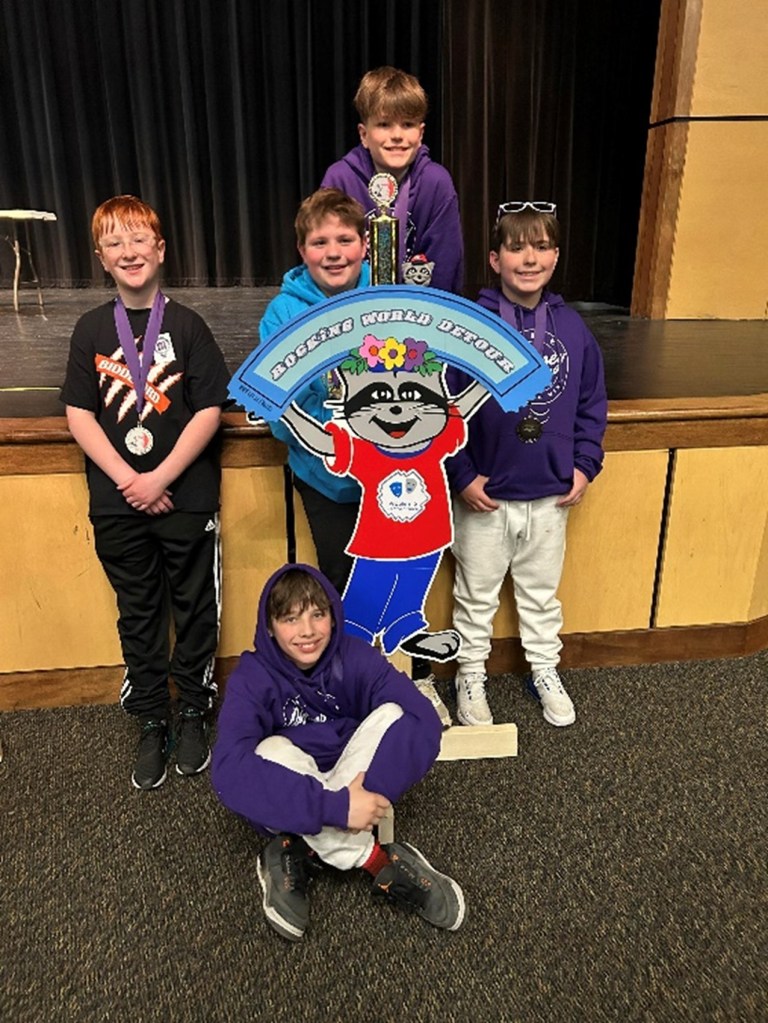
Biddeford Middle School’s Performance Team is a Maine State Odyssey of the Mind 2nd place winner and World finalist. Left to right: Cooper Crockett, Bentley Hale (floor), Harrison Buchanan, Wyatt Harper, and Anthony Ramunno.
Odyssey of the Mind has become increasingly popular throughout Maine, with 85 teams from 30 schools, ranging from Limestone to South Berwick, participating in the 2024 season. Turnout at the official state tournament, the Maine Odyssey Spring Fling, was record-high, with 550 students, 120 volunteer coaches, and many families attending. Nine Maine teams qualified for the World Finals, and four of them placed in the top 20.
Maine has been fortunate enough to be one of three teams in the world for a new pilot program, Odyssey Inclusive. OI is an adapted version of a traditional Odyssey of the Mind program, modified for neurodiverse students. The Lamoine Consolidated School OI team, coached by 2023 Hancock County Teacher of the Year Miranda Engstrom, did an amazing job presenting their solution at the State Championships, proving that Odyssey of the Mind is for all.
Jason Wheeler, the Association Director of Maine’s Odyssey of the Mind Program, has been involved with Odyssey since the age of nine. As a student who didn’t consider himself to be academically gifted, Odyssey of the Mind helped him develop a love of learning and problem-solving, as well as an identity beyond the classroom. He has made it his mission to ensure that the program is accessible to everyone in Maine, as being an environment that rewards risk-taking, encourages out-of-the-box experimentation, and reinforces the concept that there are “no bad ideas” is incredibly beneficial. Jason’s favorite part of Odyssey of the Mind is watching students transform into more confident and willing learners.
At the State Championship, the Biddeford Performance Team and coaches Victoria Salo and Suzanne Tighe (both teachers in the Biddeford School District) were presented with OMER awards. This award is named After the Odyssey of the Mind’s mascot, the raccoon, and honors all who serve as exemplary role models through their actions and/or words and team members who exhibit exceptional skill and/or talent.
The teams performed exceptionally at the World Competition, with the high school Technical Team placing 7th and the middle school Classics Team placing 35th. Congratulations to Kayla Arsenault, Emma Cote, James Cote, Galiardi, Ella Ireland, Kyle Perkins, and Coach Suzanne Tighe on the Technical Team, and Harrison Buchanan, Cooper Crockett, Bentley Hale, Wyatt Harper, Anthony Ramunno, and Coach Karen Ramunno on the Classics Team. The students’ hard work and dedication paid off, and they are looking forward to their next season.







 Maine DOE Newsroom