FY26 Funding Estimates for Opening or Expanding Public Pre-K Programs – Survey Due by Friday, Nov. 8

If your school administrative unit (SAU) is opening or expanding a pre-K program in the 2025-2026 school year, you are eligible to receive funding on your FY26 ED279 for children you enroll in these new or expanded pre-K programs in 2025. This means you will receive the funding for enrollment in the same year that you enroll the pre-K children, without a year delay.

If you are planning to start and/or expand public pre-K in the 2025-2026 school year and would like to receive an FY26 estimate pre-K allocation, please notify the Maine Department of Education (DOE) by completing the FY26 Estimate Pre-K Count Data Collection Form before Friday, November 8, 2024. There are three questions to be answered on the survey:

  1. What is your SAU? (Choose your SAU from a drop-down list.)
  2. Do you have an existing pre-K program (FY25)? (Yes or No.)
  3. What is your SAU’s Pre-K Estimated Increase Count (new slots available in new or expanding programs)?

SAUs completing this form must also complete the Pre-K Program Application with the Office of Teaching and Learning’s Early Learning Team by April 30, 2025 and obtain program approval.

The FY26 Estimate Pre-K Count Data Collection Form is meant to capture the FY26 estimate for new and expanding pre-K program enrollment. The estimated student count data, in addition to the current (FY25) enrollment in an existing pre-K program, will be used to provide funding for the FY26 ED279. An SAU’s pre-K total enrollment number, as reported and verified on October 1, 2025, should match the combined existing and estimated increase total that was used to calculate funds in the ED279. After October 1, 2025, an adjustment, based on actual enrollment reported in NEO on October 1, 2025, will be made to the pre-K allocation assigned on the FY26 ED279. Please note that this may increase or decrease funding.

For more information about establishing or expanding a pre-K program, please check out the webpage on the topic, or contact Early Childhood Specialist Nicole Madore at nicole.madore@maine.gov.

For questions specific to FY26 ED279 estimates, please contact Donna Tiner at donna.tiner@maine.gov.

Register for McKinney-Vento Fall Regional Meetings 2024 Through the Maine Department of Education

The Maine Department of Education (DOE) is hosting McKinney-Vento Fall Regional Meetings to provide updates on federal, state, and local policies and discuss resources available to students and families experiencing homelessness or housing instability. Participants will learn about strategies for increasing local capacity to support McKinney-Vento-eligible students. They will also receive a brief training on the practical implementation of emotional intelligence and restorative practices to create a culture of care and “felt safety” in school from Stacey Barlow and Kellie Doyle Bailey of the Maine DOE.

During these meetings, participants will have an opportunity to brainstorm solution-oriented strategies for affected youth in their schools and communities and to network with colleagues from other schools and organizations.

The scheduled meetings are as follows:

  • Androscoggin, Franklin, and Oxford Counties
    Central Office at Lewiston Public Schools, 36 Oak St., Lewiston
    Tuesday, Oct. 22
    8:30-11 a.m.
  • Aroostook County
    Maine Department of Labor, 66 Spruce St., Presque Isle
    Thursday, Nov. 21
    9-11:30 a.m.
  • Mid-Coast, Kennebec, and Somerset Counties
    Burton M. Cross Office Building Room 103 A and B, 111 Sewall St., Augusta
    Wednesday, Oct. 30
    8:30-11 a.m.
  • Penobscot and Piscataquis Counties
    Wings for Children and Families, 900 Hammond St. #915, Bangor
    Wednesday, Nov. 20
    8:05-10:30 a.m.
  • Washington and Hancock Counties
    Maine DHHS Regional Office, 38 Prescott Dr., Machias
    Wednesday, Nov. 20
    1-3:30 p.m.
  • York & Cumberland Counties
    People’s Choice Credit Union, 23 Industrial Park Rd., Saco
    Wednesday, Nov. 13
    9:30 a.m.-noon

Registration for the McKinney-Vento Fall Regional Meetings 2024 is required. There is no cost to participate. This event is appropriate for any school staff or community-based organizations (CBOs) that support families and students experiencing housing instability. It is intended to be a space for connection and collaboration. You can find more information and register here.

Download our shareable flyer for the event (PDF)

If you have questions, please contact Susan Lieberman, American Rescue Plan McKinney-Vento Homeless Specialist, at susan.lieberman88@gmail.com or Signe Lynch, Interim McKinney-Vento Homeless Education Specialist, at signe.lynch@maine.gov.


Caribou Technology Center Criminal Justice Students Host 9/11 Memorial Stair Climb

On Wednesday, Sept. 11, 2024, students in the Caribou Technology Center’s Criminal Justice program collaborated with the Caribou Fire Department to hold a 9/11 Memorial Stair Climb at the Caribou Community School.

The event began with an opening ceremony held outside by a tapestry of ladder trucks, American flags, and antique fire trucks. Among the crowd of community members and school district staff were first responders in full dress uniform, federal agents wearing ballistic vests, and students dressed in turnout gear. Special guests included Caribou Community School teacher Rodney Deschaine, who conducted the opening blessing; Civil Air Patrol for the Presentation of Colors, AJ Mierzwa, who sang the national anthem; Chief Brian Lajoie of the Caribou Fire Department, who made opening remarks; Boy Scout Troop 184, who did the flag-folding presentation; and community member Tammy Soucy, who played taps.

After the ceremony, the crowd moved inside the school, where the sound of recorded air traffic control transmissions played in the hallways, decorated with pictures from that horrifying day. The main staircase, covered in glowing lights, represented the climb that 9/11 first responders had to make to get to the top of the World Trade Center towers. On Wednesday, each Caribou participant clung to tags with the names of fallen heroes, as they began their trek up and down the staircase for the equivalent of 110 flights.

“Emotions were bittersweet, as we witnessed children, first responders, students, teachers, parents, and community members pay their tribute by climbing this staircase,” said Caribou Technology Center’s Criminal Justice program instructor Amanda Baker.

Criminal Justice students knew climbers would need help counting, so they created a system. At the base of the stairs was a table with a pool of rocks. Every time a climber completed five flights of stairs, they would take a rock. Once they earned 11 rocks, they knew their climb was complete.

Those who attended the ceremony recognized this event would not have been possible without the many hours of work the Caribou Technology Center’s Criminal Justice students dedicated to this class project.

“As their teacher, I’m so incredibly proud of their focus on details and the pride they demonstrated in the end product,” said Baker.  “They were professional as individuals and worked together as a team to make sure everything went as planned. I look forward to watching them thrive this school year.”

Caribou Technology Center provided information for this story. Complete the Maine DOE Good News submission form to submit good news from your school.

Integrating Literacy Through Map-Making with David Sobel

The Interdisciplinary Instruction team in the Maine Department of Education’s (DOE) Office of Teaching and Learning is excited to welcome David Sobel, educator and author of Mapmaking with Children, to Maine on Friday, Nov. 8 for an all-day workshop exploring the connections between map-making and literacy.

Map-making builds and strengthens the cognitive frameworks of reading, writing, and communicating by using symbols, structures, and perspectives analogous to grammar, punctuation, and composition. Whether mapping the relationships of their family members or the landmarks in their neighborhood, kids use maps to bring order to their world, create meaning out of their experiences, and share their knowledge with others.

This workshop will run from 9 a.m. to 3 p.m. at The Steele House in Rockland, Maine. It is free to all Maine educators. Limited in-person spots are available and will be filled, as people sign up. People can also participate virtually via Zoom, and the workshop will be recorded and shared with educators. Contact hours are available to participants.

To register for this event, please use this link.

If you have any questions about this workshop, please contact Kathy Bertini at Kathy.Bertini@maine.gov or Heather Martin at Heather.Martin@maine.gov.

This workshop is the second of four presented by the Interdisciplinary Team on the topic of Integrating Literacy through Applied Learning. All events are available in person and virtually. The remaining workshops are listed below:

December 12, 2024, 8 a.m.-noon: “Integrating Literacy through Background Knowledge” with Josie Cameron at the Wells Conference Center, 169 Hilltop Rd., Orono. Use this registration link to spend the day learning with Josie Cameron.

January 15, 2025, 8 a.m.-noon: “Integrating Literacy through Applied Science” with Katie Coppens at the Curtis Memorial Library, 23 Pleasant St., Brunswick. Use this registration link to spend the day learning with Katie Coppens.


Maine DOE Seeking Applicants for Assessment RFP Evaluation Committee 

The Maine Department of Education (DOE) is seeking proposals for a statewide reading and mathematics assessment, per State of Maine procurement regulations. A critical step in the Request for Proposals (RFP) process is the scoring of proposals. Maine DOE is seeking the involvement of Maine educators in this process through participation in the RFP Evaluation Committee.

The RFP Evaluation Committee will be responsible for reviewing submitted proposals, completing both individual notes, and in-person consensus scoring. Maine DOE is looking for representation from across geographical regions and areas of educational expertise. If selected, RFP Evaluation Committee members must be available for independent review of proposals between November 15-20, 2024. Additionally, in-person consensus scoring with the Committee will take place on November 21, 22, and 25 in Augusta at the Maine DOE offices.

Please do not complete this application if you do not have the authorization and capacity to participate on these dates.

To apply to be a member of the RFP Evaluation Committee, please complete the application here.

To read the full Request for Proposals, click here.

Maine Department of Education Provides Free Professional Learning Opportunities Through the Pine Project

The Pine Project. This first-in-the-nation Maine DOE initiative aims to foster inclusive school environments by helping readers to explore themes of immigration, diversity, and belonging.

In September, every school administrative unit (SAU) in Maine received a Welcoming Library: Pine Collection, made up of 30 picture books that reflect the diverse experiences of immigrant families and their children. Embedded in these books are social-emotional learning (SEL) discussion questions that educators can refer to when facilitating impactful classroom conversations. Alongside the library, The Pine Project also offers a professional learning series, which features self-guided training for educators on how to use these books to teach critical skills like self-awareness, self-management, social awareness, relationship building, and responsible decision-making.

The Pine Project professional learning modules follow the Collaborative for Academic, Social, and Emotional Learning (CASEL) framework. Educators are encouraged to engage with the modules sequentially, taking time for reflection, deeper thinking, and personal engagement before advancing to the next module. The training focuses on key themes like identity, agency, belonging, collaborative problem-solving, and curiosity, featuring insights from leading Maine educators, as well as immigrant and first-generation authors.

You can access The Pine Project’s free professional learning modules here.

Melanie Junkins, Multilingual and Bilingual Education Specialist with the Maine DOE, and Kirsten Cappy of I’m Your Neighbor Books are leading The Pine Project. Content creators include lead educator Michelle Amato, consulting educator Melissa Guerrette, and project assistants Ange Ishimwe and Dhananji Rathnayake. Other team members are Michelle Amato, Aris Ayala Cruz, Dezh Azaad, Abusana Micky Bondo, Xavier Botana, Kirsten Cappy, Leonarda Carranza, Louise El Yaafouri, Melissa Guerrette, Ange Ishimwe, Terry Catasús Jennings, Francie Latour, Anne Sibley O’Brien, Muon Thi Van, Andrea Wang, and M.O. Yuksel.

The Pine Project represents a significant advancement in promoting equity and understanding in Maine schools. Educators are encouraged to fully utilize these resources, revisiting unfamiliar topics as needed and exploring the concepts further using the available online tools.

The Pine Project is part of Maine’s Whole Student Pandemic response and was developed through Federal Emergency Relief Funding. Visit the Maine DOE website to learn more.


Upcoming Fall Reporting Due Dates

Fall reports are due soon for validation and/or certification by School Administrative Units! All reports require review, validation, and/or certification by superintendents.

Due October 15:

  • Dropout Certification
  • Quarter 1 Behavior Validation
  • Quarter 1 Bullying Validation

Due October 30 (opening for certification October 16):

  • EF-S-05 Part 1 Special Education Child Count. This must be certified before October 1 Student Enrollment can be certified.
  • October 1 Student Enrollment

Due October 30:

  • EF-S-05 Part 2 Special Education Staff FTEs Certification. This must be certified before Staff Certification Report can be certified.
  • Staff Certification Report

The following reports are experiencing issues, and therefore, validation is being rolled into Quarter 2 reporting for January:

  • Quarter 1 Attendance Validation
  • Quarter 1 Truancy Validation

Guidance and instructions for reporting, as well as webinars about these reports, can be found on the MEDMS Data Systems Support page. For questions about these reports, please email MEDMS.Support@maine.gov or call 207-624-6896.

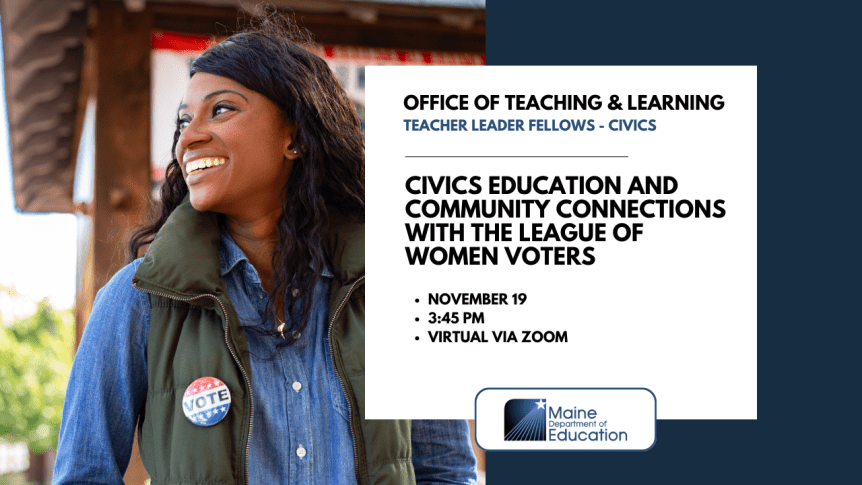
Join Maine DOE Civics Teacher Leader Fellow for a Q&A Session with the National Constitution Center!

Join Breanna Bellefontaine-Krupski, the Maine Department of Education (DOE) Civics Teacher Leader Fellow, in the Office of Teaching and Learning, as she hosts the National Constitution Center’s Education Team in a webinar exploring resources the Constitution Center has available for civics teachers.

The session is geared toward middle and high school civics teachers in Maine. The team at the National Constitution Center will highlight available resources on civil dialogue, elections, and opportunities for teachers to invite experts digitally into their classrooms via their Scholar Exchange Programs. The National Constitution Center is a non-partisan organization dedicated to helping teachers educate students about government by providing them with rich resources about our constitutional founding and the three branches.

Please join us on Wednesday, October 23 at 4 p.m.. The link to join can be found here (no need to register in advance).

For further information, reach out to Breanna Bellefontaine-Krupski at breanna.krupski@maine.gov.


Maine Department of Education Launches Math Pathways Toolkit to Support Student Success

The Maine Department of Education (DOE) is excited to announce the launch of the Math Pathways Toolkit, a comprehensive resource designed to enhance mathematical learning and decision-making for students, educators, and families across the state.

The Math Pathways Toolkit provides clear guidance on various pathways for students, allowing them to choose the right courses based on their individual needs and future goals. This toolkit is an essential component of the Maine DOE’s commitment to ensuring that every student has access to high-quality math education.

Key features of the Math Pathways Toolkit include:

  • Student Decision-Making Resources: A dedicated section that helps students and families understand the different math pathways available to them, empowering informed decisions about course selection. Learn more here.
  • Implementation Guides for Educators: Comprehensive resources for educators to effectively implement the Math Pathways in their classrooms, ensuring that all students receive personalized and relevant math instruction. Explore the implementation resources.
  • Support for Educators: Tailored materials and best practices aimed at helping educators enhance their teaching strategies and foster a supportive learning environment. Access educator resources.
  • Statewide Commitment: The toolkit reflects the Maine Department of Education’s dedication to providing a consistent and high-quality math education across the state, aligning with Maine’s educational goals and standards. Discover Maine’s commitment.

“The launch of the Math Pathways Toolkit is a significant step toward improving math education in Maine,” said Beth Lambert, Chief Teaching and Learning Officer at the Maine Department of Education. “By offering clear pathways and resources, we are empowering students and educators to work together in achieving mathematical proficiency and confidence.”

The Math Pathways Toolkit is now available on the Maine DOE’s website, providing a user-friendly platform for all stakeholders to access these resources. To explore the toolkit and start utilizing its features, visit the Math Pathways page.

If you have questions about this or other Teaching and Learning Initiatives of the Maine DOE, please contact Beth Lambert, Chief Teaching and Learning Officer, at beth.lambert@maine.gov.


Webinar: Arts Integration in Schools – Enhancing Cognitive Development and Social-Emotional Learning

Join Maine Department of Education Arts Integration Teacher Fellow Joshua Chard in the Office of Teaching and Learning for this 45-minute webinar, “Arts Integration in Schools –  Enhancing Cognitive Development and Social-Emotional Learning,” designed for all PreK-12 teachers.

The Webinar will explore how integrating the arts into core subjects supports cognitive growth and social-emotional learning (SEL). Attendees will learn about the neuroscience behind arts integration, its impact on memory, attention, and executive functioning, and how the arts foster student empathy, self-awareness, and collaboration. Case studies and practical examples from music, visual arts, and drama will demonstrate real-world applications. The webinar will conclude with best practices for implementing arts integration and strategies for addressing diverse learning needs.

Please join us Monday, October 28, from 4:15 to 5:15 p.m. The link to join the Webinar can be found here (no need to register in advance).

For further information, reach out to Joshua Chard at joshua.chard@maine.gov.