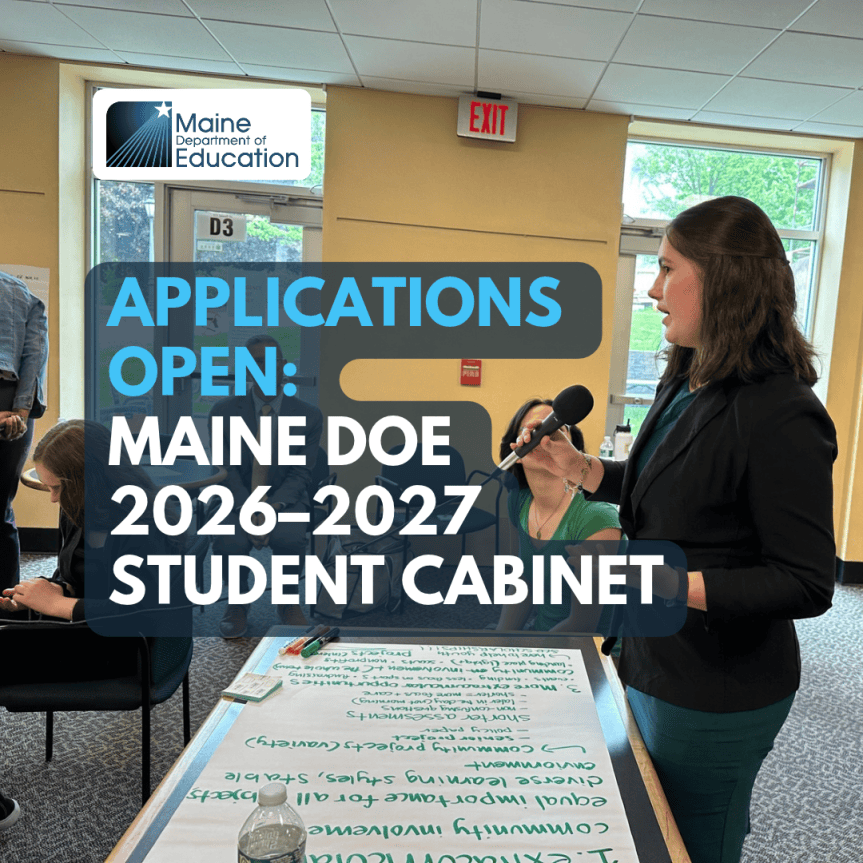
Applications Open for Maine DOE 2026–2027 Student Cabinet – Deadline Extended to 11/20

The Maine Department of Education (DOE) is accepting applications for its 2026–2027 Student Cabinet, a group of students who meet with DOE leaders to share perspectives on educational initiatives, opportunities, improvements, and policy. The application deadline has been extended to November 20, 2026.

Now in its sixth year, the Student Cabinet provides a forum for student voices to inform conversations and decisions that affect Maine students. Past Cabinets have explored topics including mental health, racial equity, school safety, individualized learning, and educator workforce diversification.

During the 2025–2026 school year, Cabinet members also provided input on the DOE’s Measure What Matters initiative, mental wellness, climate education, and other issues affecting Maine schools.

Celebrating Student Bright Spots

In April and May of 2026, Cabinet members took the lead by sharing a “Bright Spot”—a 3-to-4-minute presentation highlighting something positive happening in their school or community.

Students shared stories of student leadership, service, inclusion, creativity, and connection through clubs, performing arts, unified sports, wellness initiatives, Extended Learning Opportunities, student media, community partnerships, and more.

Explore some of the 2025-2026 Student Cabinet members’ Bright Spots:

  1. Scarborough High School Bright Spot by Michael Winchenbach (Video)
  2. Mount Blue High School Bright Spot by Nicholas DeMarco (Video)
  3. Waterville High School Bright Spot by Thresia Reddy (Video)
  4. Camden Hills Regional High School Bright Spot by Iris Bolduc (Video)
  5. Hampden Academy Bright Sport by Shelby Gray (Video)
  6. Brunswick Junior High School Bright Spot by Campbell Frazee (Video)
  7. Old Town High School Bright Spot by Romlah Ojugbele (Video)
  8. Scarborough High School Bright Spot by Abigail Rasquinha (Video)
  9. Cape Elizabeth High School Bright Spot by Brendan Oakley (Video)
  10. Saco Middle School Bright Spot by Jackson Pfeiffenberger (Video)
  11. Cherryfield Elementary Bright Spot by Eliza Farnsworth (Video)
  12. Windham High School Bright Spot by Maggie Soule (Video)
  13. Gorham High School Bright Spot by Fatima Beshir (Video)
  14. Messalonskee High School Bright Sport by Isabella Castner (PDF/PPT)
  15. Camden Hills Regional High School Bright Spot by Maliyah Summer (PDF/PPT)
  16. Portland High School Bright Spot by Wyatt Clegg (PDF/PPT)
  17. Baxter Academy Bright Spot by Avron Williams (PDF/PPT)
  18. Lincoln Academy Bright Sport by Ori Taylor (PDF/PPT)

Apply for the 2026–2027 Student Cabinet

Students in grades 4–12 and those in their first year of college are eligible to apply. Cabinet members will serve from December 2026 through May 2027 and are expected to attend scheduled meetings, prepare as needed, collaborate with peers and DOE staff, and share their perspectives openly, constructively, and respectfully.

Meetings will be held virtually on the following dates:

  • Tuesday, December 15, 2026, 3:30 – 5:00 p.m., virtual via Zoom
  • Tuesday, January 19, 2027, 3:30 – 5:00 p.m., virtual via Zoom
  • Tuesday, February 23, 2027, 3:30 – 5:00 p.m., virtual via Zoom
  • Tuesday, March 16, 2027, 3:30 – 5:00 p.m., virtual via Zoom
  • Tuesday, April 27, 2027, 3:30 – 5:00 p.m., virtual via Zoom
  • Tuesday, May 18, 2027, 3:30 – 5:00 p.m., virtual via Zoom

Applications are due by November 20. Apply to the Student Cabinet.

For more information, contact Rachel Paling, Communications & Outreach Manager, at rachel.paling@maine.gov.

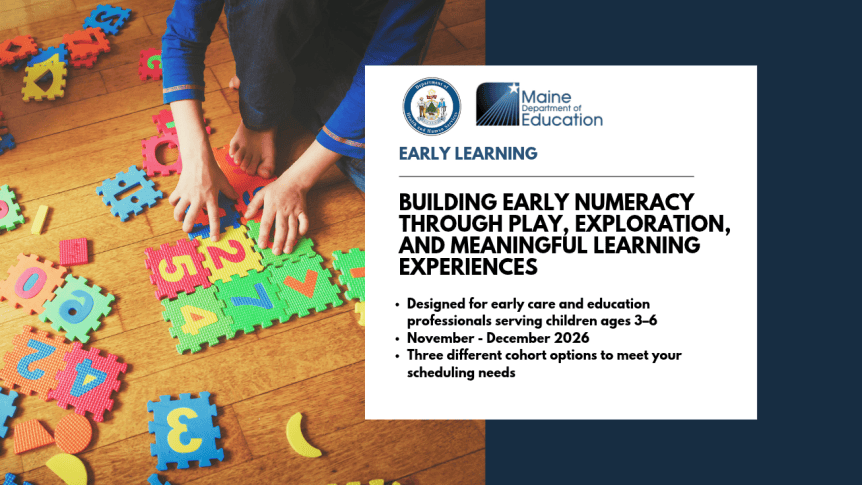
Professional Learning Opportunity: Building Early Numeracy Through Play, Exploration, and Meaningful Learning Experiences (Updated Info)

The Maine Department of Education (DOE), in collaboration with the Maine Department of Health and Human Services (DHHS) Office of Child and Family Services, is pleased to offer Young Mathematicians— a professional learning opportunity designed for early care and education professionals serving children ages 3–6. The dates and location for Track 1 have been updated.

Delivered by Education Development Center (EDC), this learning series will help educators strengthen their understanding of early numeracy and create learning environments where young children can develop mathematical thinking through play, exploration, and everyday experiences. Participants will explore ways to recognize and build on the mathematical thinking children demonstrate throughout the day and learn strategies to intentionally support foundational numeracy skills. The series will also help educators engage families in supporting early numeracy at home.

Three distinct learning tracks are available at no cost for educators with different schedules and learning preferences. Space is limited in each track. Educators are encouraged to select the track that best fits their schedule and setting. Before registering, educators should confirm that they can attend all sessions in their selected track.

Track 1: In-person + Online Learning Registration

Limited to 50 participants: This track offers school-based, Head Start, and childcare educators (preschool through kindergarten) an opportunity to begin their learning together in person before continuing virtually.

**Updated dates/location:

In-person:
November 16, 2026, 8:30-3:30pm
Location: 109 Capitol St., Augusta, ME (Lunch will be provided)

Virtual follow-up sessions:

  • Tuesday, Dec. 1, 2026, 3:30-5:30pm
  • Tuesday, Dec. 15, 2026, 3:30-5:30pm

Track 2: Fully Virtual

Limited to 100 participants: This track offers a fully virtual option for school-based, Head Start, and childcare educators (preschool through kindergarten) who prefer to participate remotely.

All sessions will be held online on Wednesdays from 3:30-6:00 p.m.:

  • October 28, 2026
  • November 4, 2026
  • November 18, 2026
  • December 2, 2026

Track 3: Fully Virtual – Evening

Limited to 50 participants: This track is designed for family childcare providers and other educators who are available only during evening hours.

All sessions will be held online on Mondays from 6:00–7:30 p.m.:

  • October 26, 2026
  • November 9, 2026
  • November 23, 2026
  • December 7, 2026

Registration for all three tracks will remain open while space is available. Once a track reaches capacity, registration for that track will close. To ask about a waitlist or for more information, please contact Maine DOE Early Childhood Specialist Nicole Madore at nicole.madore@maine.gov.

Preschool Development Grant funds received from the U.S. Department of Health and Human Services (HHS) support the implementation of this project. The project has an award totaling $45,091 funded and directly attributed to project implementation. The contents are those of the author(s) and do not necessarily represent the official views of, nor an endorsement by, HHS or the U.S. government.

Launching Dirigo Schools of Distinction Framework in 2026-2027 School Year

We are excited to share the Dirigo Schools of Distinction (DSD) framework as a resource for Maine schools.  DSD is intended to celebrate Maine schools that are making a meaningful difference for students, staff, and communities. DSD also offers a clear, supportive roadmap for schools and school administrative units (SAUs), as they consider where to focus time, energy, and resources to strengthen student outcomes.

Through extensive conversations and data collection across the state, the Measure What Matters initiative identified the conditions, practices, and outcomes that Mainers consistently value and have deemed the most important in their public schools. From this data, a report was published and used to create a framework called “Dirigo Schools of Distinction.” That framework is organized into seven pillars, each with a set of indicators that reflect the priorities voiced by Mainers. Across all pillars, DSD emphasizes a set of critical life skills identified through the Measure What Matters initiative and aligned closely with Maine’s Guiding Principles.

The framework will be a living document, informed by the DSD Advisory Committee (including DOE team members and experts from the field) who will make recommendations for updates and additions each spring. You can find more about this initiative along with a pdf version of the framework and a webform application here. 

The DSD framework features seven pillars of excellence:

  • Excellence in Academics and Instructional Practices
  • Excellence in Community and Family Engagement
  • Excellence in Health and Wellness
  • Excellence in Culture and Climate
  • Excellence in Innovation and Innovative Practices
  • Excellence in School Leadership, Educators, and Staff
  • Excellence in Student Engagement

Each year, beginning in the 2026-2027 school year, schools may apply to be recognized for excellence in one of these DSD pillars. Those who opt to participate will complete an online application that contains the rubric for the pillar for which they are applying. The DSD Advisory Committee will review application submissions and select awardees.

To be eligible to apply for a DSD pillar of excellence, a school must first complete the Outcomes and Continuous Growth section of the DSD rubric. Many of the listed Measures are data points that are already collected for state reporting each year and those can be pre-filled to support ease of application. A school may choose to mark Outcomes if it has achieved the indicated Measure. If a school has not achieved the indicated Measure but has seen significant improvement in that area, it may choose to mark Continuous Growth and provide a brief supporting narrative. Elementary schools must achieve three Outcomes/Continuous Growth Measures to be eligible for a DSD recognition. Middle/high schools must achieve five.

For those seeking a DSD recognition, scoring will work as follows:

  1.  Each indicator within a pillar has an “evidence of practice” measure, based on the extent to which an indicator is in place. The applicant school self-assesses to determine this score, explaining the rationale in a brief narrative.
  1. = emerging/partly in place/a practice or quality in some classrooms or teams
  2. = mostly in place/a practice or quality across the school
  3. = fully in place/a practice or quality that is generalized throughout the school
  1. A “Priority Multiplier” is pre-filled in the rubric for each indicator to recognize that some indicators are more important or more complex, requiring more commitment and effort than others.
  2. The evidence of practice measures are multiplied by their priority multipliers, generating a total for the pillar.

DSD Advisory Committee members will provide peer review of self-scoring through a collaborative process with applicant schools, and additional evidence may be included during this process.

To be recognized for a DSD pillar, a school must achieve at least 90% of the total possible score indicated on the rubric. (The total possible score for each pillar may vary slightly for elementary).      

If you are interested in participating in the inaugural year of the DSD initiative, please complete this online application by January 30, 2027. Schools that are ultimately recognized for a DSD pillar will earn a DSD Badge of Excellence for that school year and be celebrated during a statewide event in the spring.

With questions or for more information, please contact Page Nichols, Maine DOE Chief Innovation Officer, at page.nichols@maine.gov.

We look forward to celebrating excellence in your schools!

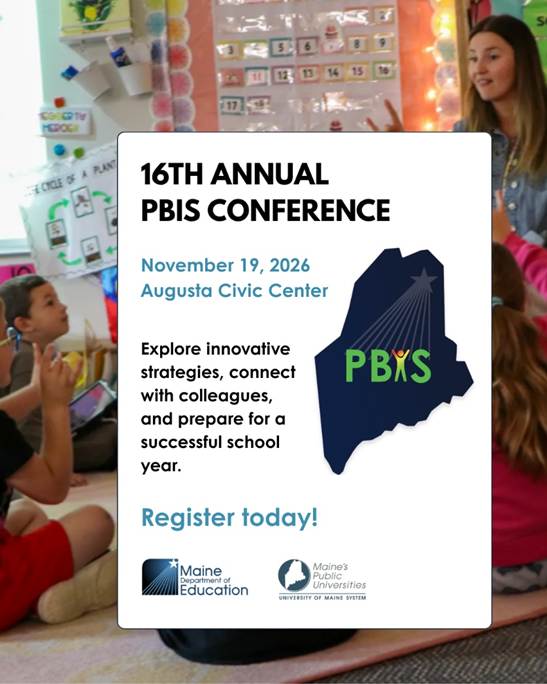
Registration Open for 16th Annual PBIS Conference

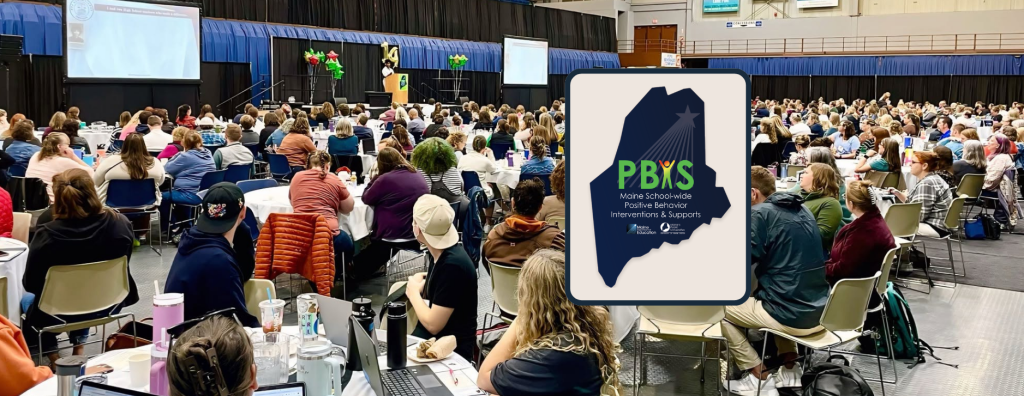
Maine’s Positive Behavioral Interventions and Supports (Maine PBIS) program, a collaboration between the Maine Department of Education (DOE) and the University of Maine System (UMS), will host its annual conference on November 19, 2026, from 8:30 a.m. to 4 p.m. at the Augusta Civic Center.

In its 16th year, the conference theme will be, “The Fabric of Maine Schools: Braiding Academics, Behavior and Belonging.” The conference will feature a captivating keynote presented by Kathleen Lynne Lane, Ph.D., BCAB-D, CF-L2 from the University of Kansas, “Creating Positive, Productive School Environments: Data-informed Instruction in Integrated Tiered Systems to Meet Students’ Multiple Needs.”

Following the keynote will be a choice of over 30 breakout sessions that will allow participants to walk away with new ideas and a renewed sense of connection with students and their teaching methods. Breakout sessions include integrating academics and behavior within the Multi-tiered Systems of Support (MTSS) model, behavior supports and strategies for preschool, elementary, middle, and high school, implementing and sustaining PBIS, and family engagement.

Conference pricing:

  • After October 15: $210.00
  • Complimentary registration will be provided (up to 3 educators per school) for educators who work in schools identified as part of Maine’s Model of School Support.

Please visit the PBIS Conference website for more information and to register.

School culture does not transform by accident, it happens when we connect, collaborate, and celebrate together. That is exactly what is happening at this year’s Maine PBIS Conference. Join us for a day to rejuvenate your teaching practices, braiding instructional applications, positive student interactions, and educator well-being into a strong educational experience for all!

For more information, please contact Maine DOE Special Projects & Educator Supports Program staff, Anne-Marie Adamson at anne-marie.adamson@maine.gov.

Maine DOE’s Annual Back to School Backpack of Resources 

Happy back to school! The Maine Department of Education (DOE) has put together a virtual Back to School Backpack of resources and information to assist school and School Administrative Unit (SAU) leaders as a new school year begins. The Backpack contains resources related to school and student supports, health and safety, school nutrition, school administration and operations, teaching and learning supports, and strengthening the education workforce. You can access the DOE’s Back to School Backpack here.  

You’ll find links to forms and information schools often need at the start of a new school year, resources that educators can use in the classroom, instructional supports and programs, and much more.  

We wish you a wonderful back to school and a new school year filled with excitement, powerful learning, connection, and joy. Thank you for everything that you do for Maine schools and students.