Webinar: Asking the Right Questions

The “Asking the Right Questions” webinar will review methods and resources focused on the art of framing questions for the best possible student growth. The webinar will offer practical classroom methods and approaches for all grades–from pre-K to high school–that are supported by current research and instructor experiences. It will also include a host of useful resources readily available for teacher use, and end with a Q&A session where participants can explore concepts further, offer their own experiences, and exchange ideas.

  • When: Thursday, February 29, 04:00 PM – 05:00 PM
  • How: Register here
  • Additional Info: Continuing Education credits will be offered.

We hope you will join us for this informative and engaging webinar. For more information reach out to Maine DOE Humanities Teacher Fellowship Team – James St. Pierre  James.St.Pierre.@maine.gov and Dorie Tripp Dorie.Tripp@maine.gov.

Pilot Opportunity for ‘2nd Grade for ME’ Instructional Program

As part of the Maine Department of Education’s (DOE) efforts to adapt and offer open-source, interdisciplinary, Whole Student instructional programming for the early elementary grades, the Maine DOE will be conducting a pilot for its 2nd Grade for ME program during the 2024-25 school year. To date, the Maine DOE has piloted, adapted, and posted the Pre-K for ME,  K for ME and 1st Grade for ME instructional programs, all of which are based on the Boston Public Schools’ Focus programs.  Participation in the pilot will provide pilot teachers with the materials and ongoing professional learning needed to implement the program. The process will also encourage pilot teachers to test and suggest adaptations/enhancements specific for Maine.

If you are a grade 2 teacher interested in being part of the pilot, please consult with your building principal and consider attending an overview session. Principals and curriculum leaders are also encouraged to attend. Details about the 2nd Grade for ME program, the pilot timeline, and the responsibilities of school participants and the DOE in the pilot process will be shared. Time for questions will also be provided.

2nd Grade for ME Overview Session
February 29 from 3:30-4:30 p.m.
Register here

The February 29 session will be recorded and a link to the recording will be shared with anyone who registers but is unable to attend.

Please contact Lee Anne Larsen, Early Learning Team Coordinator (Leeann.Larsen@maine.gov) with any questions.

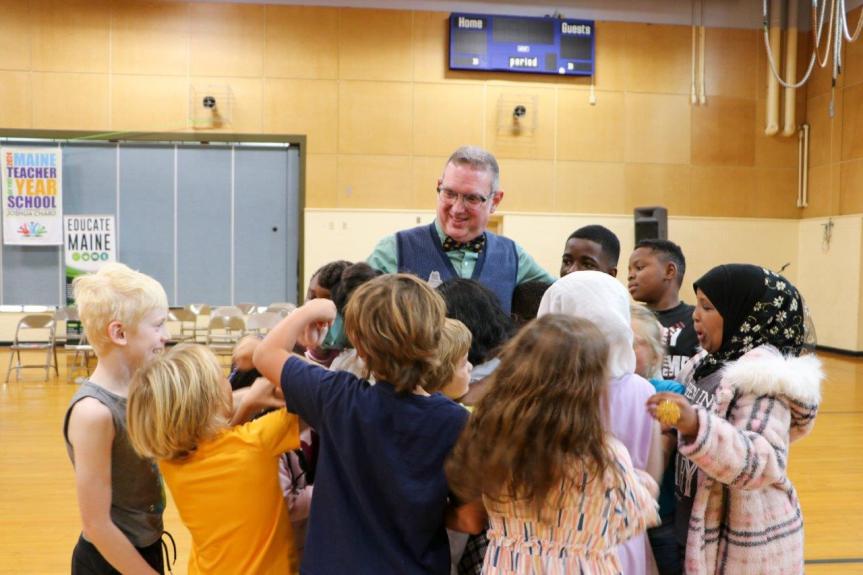
Q&A With Maine’s 2024 Teacher of the Year Joshua Chard

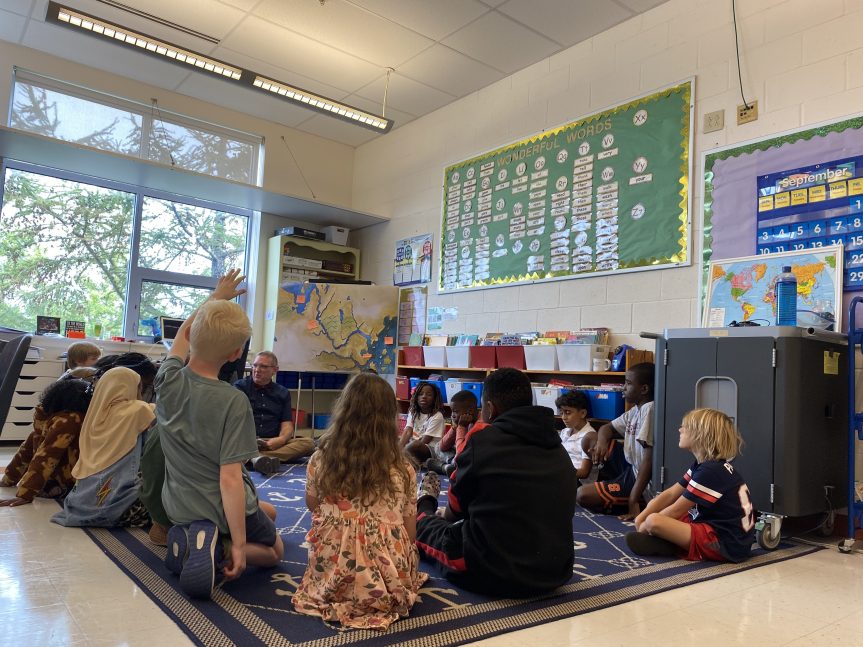
Get to know Maine’s 2024 Teacher of the Year Joshua Chard, a second and third-grade looping teacher at East End Community School in Portland. Joshua sat down for this Q&A as he begins his year of service.

How long have you been a teacher and what do you teach? 

I started working in Portland Public Schools in 1992 as an ed tech. I was hired to teach fifth grade in Portland in 1996 after I finished my degree in education, which I got by going to school part-time while working in a school all day.

I have taught upper elementary school, I’ve been an instructional coach, and this is my fourth year as a second and third-grade looping teacher at East End Community School. I also direct theater by and for young people.

What made you want to be a teacher? 

I decided I was going to be an elementary school teacher when I was in fifth grade. I was one of those kids whose teachers winced in anticipation of my coming to their classroom and I knew it. It didn’t feel good to know that was how I was labeled.

I went into Mrs. Breau’s fifth grade class and she was pretty no-nonsense, but she was also the coolest person I had ever met. She made her own clothes, wore wacky jewelry, and played the guitar. She was also really demanding academically. She told me that what I was doing in school wasn’t good enough but that she believed in me. She cared about me and loved me for all of my quirkiness and uniqueness but she said she also expected me to do my work and to do it well. That was a major turnaround for me. It started with Mrs. Breau and then I met a whole host of other teachers along the way who lifted up this artsy kid who loved to sing and act and make music. They said, “There’s a place for you here, and we think that the person that you are is amazing and we want to help you become even better.” I knew that I wanted to be that kind of teacher.

You’re unique in that you’re an elementary school teacher, but you also lead high school drama. Can you talk a little bit about that journey? 

I think that one of the things that makes me a good teacher is that I have really strong outside interests, and one of my side gigs is that I’m a freelance theater director. About four years ago, right in the middle of COVID, the opportunity came along to take over the drama program at Deering High School. It was a program that had once been glorious but it was definitely in a time of transition. Doing this in the middle of a pandemic was a challenge, but my background as an actor and a director and my education in theater compelled me to take on this program and see what I could make of it.

When I started, there were eight students involved in the drama program. I’m really excited to say that this year we’re going to one act competitions with more than 30 students and nearly 50 students will have been involved with our three productions this year.

One of the things that makes my drama program unique is that we’re less about the product at the end and more about the social aspect of celebrating and lifting up students who may not find that they fit in other places in high school. I’m really proud that the Deering Players has become a place where kids find safety and celebration and are able to walk in those auditorium doors at the end of the school day and be 100 percent their true and honest selves.

I describe my drama program as a place where we come together, we support each other, we love each other, we lift each other up, we build community, and in the end, we happen to also put on a really good play.

It seems to me that having a theater and acting background helps in your teaching role as well. Have you viewed that as an asset? 

Absolutely. In fact, I joke that Mr. Chard is a character I play from 7:30 in the morning until 2:15 in the afternoon. I am definitely someone who brings a lot of enthusiasm to what I’m doing, I’m very playful, and we’re very imaginative in everything we’re doing in our classroom. That drama background and that improvisation background come in handy, especially since when you’re teaching second grade you never know what’s going to be thrown your way minute to minute or hour to hour. The skills that you build as an actor are kind of like jumping out of a plane without a parachute. Because all manner of things can happen while you’re in front of a class, I think this applies to the classroom too.

When you think about it, putting on a show is a form of play and playing is so important for our young students. We can’t forget the importance of letting them be imaginative and playful.

With decades of teaching experience under your belt, what do you love about it? What gets you going every day?

There are a lot of things that I love about it. It’s a child’s eyes lighting up the first time they decode words on their own and suddenly are able to read an entire page of a book without any help or support.

It’s the student who has sat quietly for months and months, who suddenly raises their hand and makes such an insightful observation about what you’re discussing that you nearly fall out of your chair.

It’s the fact that I get to come and be playful and joyful all day long with a bunch of small people who want nothing more than to be joyful and playful with me all day long.

I really get to make a difference. I get to teach children how to read. I get to teach children how to do math. I get to help students develop their writer’s voice. I get to teach children about their world. But most importantly, I get to help young people discover who they are and all that they can be.

I get to be like Mrs. Breau and say, “I love you just the way you are. Let’s find out who that is, and let’s celebrate that and make that your path moving forward.” How cool is that?

I’m sure getting to teach the same kids for two years really increases that ability to watch them grow and blossom. 

Absolutely. I think that to me the most powerful thing I’ve ever done as a teacher is to join a looping team where I have a two-year cycle with students. My relationship with the students is obviously a critical component of that, but it’s also the ability and the opportunity to build relationships with parents and families that makes such a difference. You build a really trusting, caring, and enthusiastic relationship with families when you spend two years collaborating and working together lifting their children up and helping them be the most successful humans that they can be. The relationships that I build with my diverse families enriches my life and makes me a better human. I’m pretty lucky.

It is absolutely my plan to spend the rest of my career as a second and third-grade looping teacher. I cannot imagine anything else bringing me such fulfillment.

Every moment you get you take to celebrate the amazing things that are happening at your school. What makes your school special and why do you love it so much?

We are one of the most culturally diverse elementary schools north of Boston. More than 50 percent of our students are English language learners at all different levels, 76 percent of our students are BIPOC, and 85 percent of our students are identified as living below the poverty level, and I’m here to tell you that the most creative, passionate, devoted teachers that I have ever met are the teachers who work in schools like ours. Innovation thrives at East End Community School and that innovation is reflected in the enthusiasm of our happy, hardworking students.

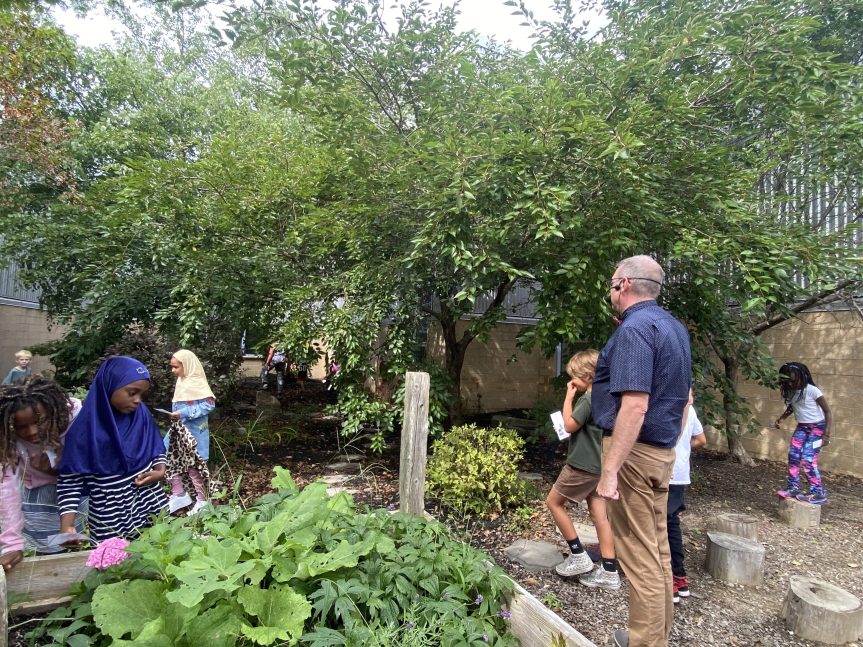
The Munjoy Hill neighborhood in Portland is a diverse and vibrant community and our school is an anchor in the community. I want to shout from the rooftops that we are East End Community School! Come see our garden, come to our monthly community dinners, come into our classrooms and volunteer, come talk to our amazing and insightful students. Want to feel optimistic about the future? Come spend a day volunteering in my school.

I have enthusiastically spent my entire career teaching in Portland. East End Community School embodies everything that is amazing about urban education.
You’ve had quite a year as county teacher of the year and then being named Maine Teacher of the Year. Talk a little bit about what that experience has been for you and what you’ve learned over that journey.

I think that the first thing that I would say is that it’s surprising and unexpected. I’m a veteran teacher. I’ve been teaching for a long time and I have been doing my thing fairly anonymously.

Teachers work really hard, and we do extraordinary things with our students every day. That’s just our ordinary. Sometimes it goes unnoticed and unseen, and sometimes people misunderstand what actually happens in the complex ecosystem that is a classroom. From the moment I got an email informing me that I had been nominated by my administration for County Teacher of the Year, I suddenly felt noticed in a way that I hadn’t in a long time. That’s not to say I was burned out or unhappy; I was very content, but it was amazing to feel like I was really being seen and that someone was noticing and celebrating the effort that I was putting in every day with my students.  

When I was named Cumberland County Teacher of the Year, and got to meet my cohort for the first time, it was really surprising to me how quickly we connected and how we came together as true and genuine friends. It’s a diverse cohort. I teach in an urban school, but that’s an outlier for the state of Maine. Most of the teachers in the state teach in more rural communities. On its face, it could seem like our schools were very different. But as we got together in a room and started talking, we discovered that we’re all facing the same challenges and we’re all experiencing the same joys in our professions. I never would have met any of these amazing people without this recognition and now they are my friends for life. Every teacher should have the opportunity to experience such joy.

Can you talk a little bit about what you plan to focus on as Maine’s 2024 Teacher of the Year?

I want to focus on celebrating everything that is amazing in our state’s schools. I want to be a voice for teachers across the state to share what is happening in their schools, what they are proud of, and what they want to celebrate. I am hoping to have the opportunity to visit schools across the state to meet with educators and hear about the amazing and innovative practices that are happening in classrooms all across the state.

At the same time, I want to recognize that we share some similar challenges, and I want to be an advocate for educational policy change in a way that benefits every learner in the state of Maine and creates equity for all of our learners across the state.

What is your message to somebody thinking about becoming a teacher?

Teachers make a difference in people’s lives in ways that they don’t even know are happening.

When it was announced that I was Maine teacher of the year I got a letter from someone who told me that she had been in the classroom where I had done my pre-service teaching when I was 18 years old, and that I had changed her life. I didn’t even know. That’s how profoundly we can affect our students.

In the 30-plus years that I’ve been working in education, I’ve worked with and taught more than 700 students. If I change the trajectory of one person’s life every year, that trajectory then impacts the trajectory of their children’s lives and their grandchildren’s lives, and it spreads exponentially. Who else gets to do that?

Plus, it’s really fun. I laugh all day long. My students are hilarious, insightful, brilliant, creative, and passionate. They’re an amazing group of humans to spend my time with and they make me a better person.

Anything else you want to share with the folks reading this?  

I’m blessed that I get to be an artist and an educator in Maine, which I would argue is the most beautiful place in the world to live. I can’t imagine why every person wouldn’t want to move here tomorrow!
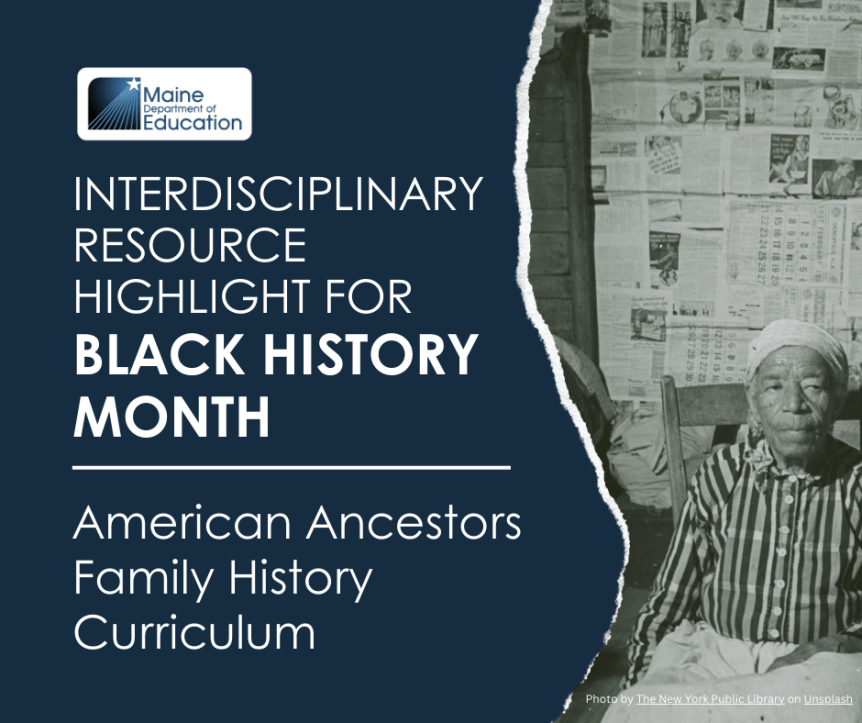
Interdisciplinary Resource Highlight for Black History Month: American Ancestors Family History Curriculum

The Maine Department of Education’s (DOE) Interdisciplinary Instruction team has curated resources of content and instructional approaches to help educators include and highlight the important contributions of Black and African-American Mainers in authentic ways. These project-based strategies include finding local historical figures and guest speakers, researching local history, and bridging content areas.

Our first resource highlight is the American Ancestors Family History Curriculum. Developed by experts at American Ancestors (a project of the New England Historic Genealogical Society), this free-to-access national curriculum is designed to expose students in grades 4 through 8 to the concepts, benefits, and joys of family history. Each lesson incorporates authentic methodologies used by professional genealogists that include but go beyond the family tree. Grounded in inquiry-based practices, these methods include:

  • developing research skills
  • conducting interviews
  • examining primary sources
  • empowers students to create a historical narrative for and about themselves

Using case studies, which are compilations of primary sources about a person, is one strategy to make genealogy accessible and a way to incorporate Black and African-American history into classrooms. In a collaborative effort, the Maine DOE offers case studies of important Mainers that support the American Ancestors/NEHGS curriculum. Two case studies highlight the important contributions of African American Mainers. Students can use these case studies to explore the life of Gerald E. Talbot, Maine’s first African-American legislator, and John Jenkins, the first African American to be elected to the Maine State Senate.

Download this clickable PDF for a full list of Maine case studies.

For more resources on an interdisciplinary approach to teaching Black History click on this link.

For more information about interdisciplinary instruction, please contact Kathy Bertini, Interdisciplinary Instruction Coordinator at kathy.bertini@maine.gov

Celebrate National School Counseling Week Feb. 5–9

National School Counseling Week 2024, “School Counseling: Standards-Based, Student-Focused,” sponsored by the American School Counselor Association (ASCA), will be celebrated from Feb. 5–9, 2024, to focus public attention on the unique contribution of school counselors within U.S. school systems and how students are positively impacted as a result of what school counselors do. National School Counseling Week highlights the tremendous impact school counselors can have in helping students achieve school success and plan for a career.

School counselors are actively engaged in helping students examine their abilities, strengths, interests, and talents; in working in partnership with parents as they encounter the challenges of raising children in today’s world; in focusing on positive ways to enhance students’ academic, career and social/emotional development; and working with teachers and other educators to provide an educational system where students can realize their potential and set healthy, realistic and optimistic aspirations for themselves.

“School counselors work with all students to remove barriers to learning by addressing students’ academic concerns, career options and social/emotional skills,” said Jill Cook, ASCA executive director. “School counseling programs help to increase student achievement and provide a much-needed resource for students, parents, teachers and administrators. School counselors are integral to student success.”

More than 100,000 school counselors nationwide will be participating in the week’s festivities. Many schools will be hosting special events and activities to call attention to the countless benefits of a comprehensive school counseling program.

As part of its celebration for National School Counseling Week, the Maine School Counselor Association (MESCA) will be gathering in the Hall of Flags at the State House on February 9th at 2:30pm. School counselors, educators, and administrators are invited to join our school counselors in recognizing their positive contributions to Maine schools.

For more information, please contact Ken Rautiola, Mental Health Distinguished Educator, Maine Department of Education at kenneth.a.rautiola@maine.gov – office hours 8:00 am – 5:00 pm, Monday through Friday.

Maine Learning Technology Initiative (MLTI) Opens Spring Application for Teaching and Learning Technology Grant #TeachWithTech

The Maine Department of Education (DOE) Maine Learning through Technology Initiative (MLTI) is pleased to announce the release of the spring application of the #TeachWithTech grant. This grant is available to all MLTI school districts to provide supplemental technology and related professional learning to support innovative teaching and learning with technology. This program aims to provide funding opportunities to educators who want to bring technology into their schools in ways that are innovative, impactful, and intriguing.

A few examples of eligible technology include:

  • 3D Printing
  • Video Production Equipment
  • Audio / Podcasting Equipment
  • Robotics & Coding Kits
  • Drones
  • Digital Microscopes & Doc Cameras
  • Specialized cameras (GoPro, 360, etc.)
  • And so much more!

This grant is designed to offer supplemental technology that is not already provided through the MLTI program; device applications will not be considered. Instead, districts are encouraged to think about innovative learning through technology and submit an application to invest in technology that will create transformative learning experiences for students and supplement the devices already provided through MLTI.

Priority will be given to applicants who:

  • Focus on the greatest student impact.
  • Serve socioeconomically disadvantaged school districts.
  • Prioritize student populations traditionally underrepresented in technology.
  • Demonstrate a commitment to pursuing high-quality teaching and learning through technology.
  • Show a commitment to effective implementation and long-term success.

We’ve streamlined the application and reporting process to create more ease every step of the way. Applications will be reviewed as they come in and awardees will be notified once the evaluation is complete.

Interested, but not sure where to start? Register for a Q&A session, check out our FAQ, and connect with the Maine DOE’s Learning Through Technology team to learn more.

Register for a Q&A session via the links in the “Important Dates” section below.

Important Dates

  • Friday, January 30th; Application Window Opens
  • Tuesday, February 13th, 2024, 3pm; Q&A Session #1
  • Thursday, February 29th, 2024, 8am; Q&A Session #2
  • Tuesday March 12th, 2024, 3:00pm; Q&A Session #3
  • Friday, April 30th, 2024; Application Window Closes
  • July 1st, 2024; Grant Awardees Contract Begin

Click here to access the #TeachWithTech FAQ.

Click here to review the application and apply!

Have questions? Want more information? Contact the Learning Through Technology team at doe-ltt@maine.gov

Asynchronous Course: Introduction to the Question Formulation Technique

In February, the Maine Department of Education (DOE) Interdisciplinary Instruction Team celebrates the love of the question by hosting a course called Question, Reflect, Repeat: Introduction to the Question Formulation Technique.  In collaboration with the Right Question Institute, the Maine DOE is hosting a three-week asynchronous course on the Question Formulation Technique (QFT).  The QFT is a questioning strategy that:

  • Facilitates student curiosity and engagement
  • Helps students build confidence to ask questions and become empowered to seek answers
  • Improves student questions that support deeper learning
  • Improves the skills and strategies students need beyond the classroom

Some of the Learning Goals for this course are:

  • Understand the what, how, and why behind the QFT
  • Identify best practices for effective ways to design, facilitate, and adapt the QFT for specific purposes, including interdisciplinary and conceptual learning
  • Create, revise, and implement a plan for using the QFT in your own setting

On February 29th, the asynchronous portion of the course begins as we leap into the love of questions.  On March 5th, there is a Zoom kick-off webinar from 3:30-4:30pm.  The live webinar is an active, collaborative, experiential learning experience that lays important groundwork for the rest of the course. If possible, please arrange to attend live. If this is not feasible, the webinar will be recorded and available 24 hours after.

  • Intended Audience: PK-12 Teachers & Administrators
  • When: February 29-March 28; March 5th – a live webinar from 3:30-4:30
  • Where: Maine DOE EnGiNE Platform; one Zoom webinar
  • Contact Hours: 12 contact hours available upon completion
  • How: Click here to register.

For more information on this course, please contact Jaime Beal, Interdisciplinary Instruction Specialist at jaime.beal@maine.gov

This opportunity is a collaboration between the Maine Online Open-Source Education (MOOSE) project and the Interdisciplinary Instruction Team. The MOOSE project is funded entirely (100%) through Federal money under the Coronavirus Response and Relief Supplemental Appropriations Act (CRRSA) and American Rescue Plan (ARP) totaling $4,598,000 for the current 2023-2024 funding cycle.

Maine Curriculum Leaders Association to Host Spring Conference in April

Join the Maine Curriculum Leaders Association (MCLA) for a spring conference, “From Obstacles to Opportunities: The Power of Learning!”

The conference features keynote speaker Trevor Ragan, the founder of The Learner Lab, along with various discussions on three key areas as leaders:

  1. Why learning matters
  2. Identifying the individual and group obstacles that can limit learning
  3. Development and exploring the tools to help us overcome these obstacles

In the afternoon the conference will host a series of roundtable discussions focused on various topics including multi-tiered systems of support (MTSS), literacy, growth mindset, and more!

MCLA Spring Conference: From Obstacles to Opportunities: The Power of Learning
April 8, 2024 
Hilton Garden Inn Freeport
Learn more and register here

For further questions, reach out to MCLA at information@mainecla.org.

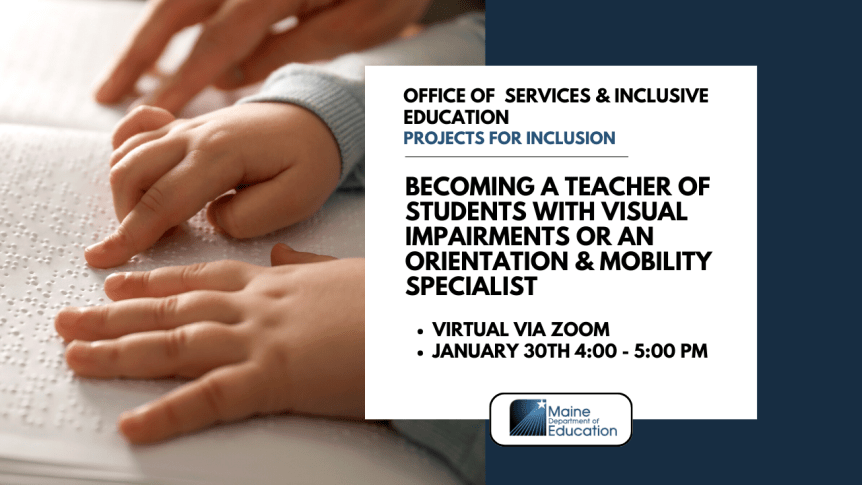
Webinar: Becoming a Teacher of Students with Visual Impairment or an Orientation and Mobility Specialist

Please join the Maine Department of Education (DOE) Office of Special Services and Inclusive Education, Education Services for Blind and Visually Impaired Children, and Catholic Charities Maine for a joint presentation about how to become a teacher of students with visual impairments or an orientation and mobility specialist.

Do you have a Bachelor’s Degree? Would you like a free Master’s degree?  Do you enjoy working with children? Do you like variety in your job settings and enjoy travel? Are you looking to expand your professional skills? If you answered yes to these questions…

Please join us for a webinar to learn more about becoming a teacher of students with visual impairment or an orientation and mobility specialist.

Tuesday, January 30th
4:00 – 5:00 pm
Held virtually via Zoom – Register here

After registering, you will receive a confirmation email containing information about joining the meeting. This webinar will be recorded for you to view at your convenience.

For additional information or questions please contact Amanda Castner at amanda.castner@maine.gov.

Two Request for Proposals Now Open for Workforce Innovation and Opportunity Act (WIOA) Grant Funding

The Maine Department of Education (DOE) is pleased to announce the release of two requests for proposals (RFP) as required by the Workforce Innovation and Opportunity Act (WIOA), to award multi-year funding to eligible agencies for the provision of WIOA Title II Adult Education and Family Literacy Act (AEFLA) 231 services and the provision of WIOA Title II Adult Education and Family Literacy Act (AEFLA) Section 243, Integrated English Literacy and Civics Education/Integrated Education and Training (IELCE).

It is the purpose of Maine Adult Education under WIOA to provide adult education and literacy services that align with the goals in the State of Maine Unified Plan and encourage the growth of educational opportunities and, where applicable, to ensure career, citizenship, and college readiness for all Maine adults (Maine Education and School Statutes 20-A, 8601).

Signed into law in 2014, the Workforce Innovation and Opportunity Act (WIOA) requires the alignment of workforce, education, and economic development systems to support access to high-quality, comprehensive, and accessible workforce services for all individuals, including those with significant barriers to employment. Title II of WIOA retains and expands the purposes of the Adult Education and Family Literacy Act (AEFLA), which aims to help adults, including immigrants, acquire the skills and knowledge necessary to obtain employment, become full partners in the educational development of their children, improve economic opportunities for their family, and aid in the transition to postsecondary education and training.

The request for proposal (RFP), which includes information regarding eligibility, program requirements, and more, is available here.

Below is the anticipated timeline for the Department’s current AEFLA grant competitions:

Timeline AEFLA 231
(Link to RFP here: 202312252)
AEFLA 243 (IELCE)
(Link to RPF here: 202401001)
RFP Released to Public January 23, 2024 January 17,2024
Bidders Conference February 5, 2024 n/a
Deadline for Submission of Questions in Response to RFP February 9, 2024 January 25, 2024
Proposal Deadline March 7, 2024 February 29, 2024
Grant Award Notifications May 2024 May 2024
Grant Award Start Date July 2024 July 2024

Please be advised that the dates above are subject to change. Interested organizations must consult the RFP document for the most accurate dates and deadlines regarding this opportunity.

For more information on AEFLA 231 and 243 , contact State Adult Education Director Megan Dichter at megan.dichter@maine.gov.