Meroby Elementary School Improves Student Attendance with Family Engagement Opportunities

As student absenteeism became a persistent issue at Meroby Elementary School, three school leaders worked together in a successful effort that decreased the school’s chronically absent rate by more than 40% over the course of a school year.

Jodi Ellis, Hillary Cayer, and Nicole Pinkham – who serve as the school’s principal, social worker, and school nurse respectively – knew they needed to address student absenteeism during the 2022-2023 school year, as the previous year’s chronically absent rate was over 70%. In October, the team of three took the lead in creating a strategic plan to improve attendance.

The first significant change that took place was shifting the responsibility of absenteeism to Ellis, Cayer, and Pinkham who were ready, and had the capacity to take it on. Previously, absenteeism was the responsibility of the school’s leadership team Pinto Collaborative which had too much on their plates and the shift provided a better balance for everyone.

“I then started asking teachers to make phone calls to families when a student had been absent for three days, and to report back to Hillary, Nicole, and I about the outcomes of that conversation.  When the student was absent for 5 days, Hillary, Nicole, and I would make the phone call and start conversations about what we could do to help the family with getting the student to school.  At 7 days absent, we would request an in-person meeting to talk about solutions.  We would then continue to monitor student attendance and continue to have follow-up conversations with families,” explained Ellis.

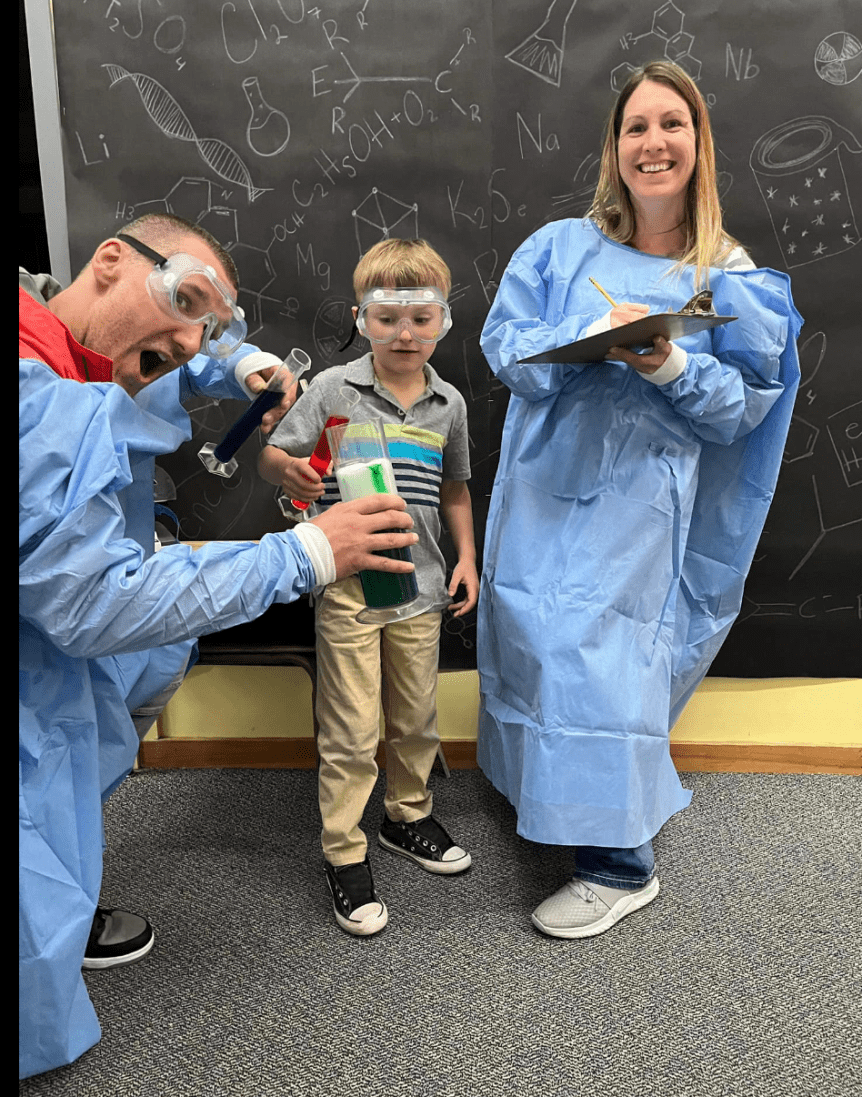
While Ellis, Cayer, and Pinkham worked directly with teachers and families to monitor and address individual cases of absenteeism, the Pinto Collaborative created numerous family engagement nights. These events included an ice cream social, a fall festival, and STEAM night.

“Not only do we invite families to these events,” says Ellis, “but we also invite local businesses [and] organizations to set up booths that families can visit to see what resources are available in the community.” These family engagement opportunities aim to make families feel more supported and welcomed by the school and school community, thus encouraging student attendance.

Here are a few photos from some of Meroby’s family fun nights:

Through attention to individual absences and increased opportunities for family engagement, the chronically absent rate at Meroby Elementary decreased to below 30% this past school year – a success made possible by the leadership and hard work of Ellis, Cayer, and Pinkham and the involvement and support of school and community members.

Looking toward the upcoming school year, the team hopes to keep the momentum going. “Our goal is to decrease our chronically absent rate by an additional 10% this year,” says Ellis. To do so, they plan on continuing their work from last year while providing even more family engagement opportunities and levels of support for students and families.

Ellis would like to thank the following community partners for their support in increasing student attendance at Meroby: Team Long Run/Friends of the River Valley, Mexico Public Library, Rumford Public Library, The Fitch Company, Mexico Fire Department, Mexico and Rumford Police Department, Rumford Hospital, Oxford Federal Credit Union, and Hope Association.

Powerful Practices Professional Learning Community (PLC) Sessions: Reflection

Want to develop a reflective practice and need some support? Although many educators know reflection is important, it can be challenging to carve out the time to do it.  This workshop series provides teachers with the resources and time to start (or restart) reflecting on their practice.   

During these sessions, teachers will select a problem of practice to focus on and have time to reflect, collaborate with other teachers, and make an action plan.  As a result, educators will have the necessary time and tools to develop their reflective practice. 

Intended Audience: PK-12 Teachers 

To accommodate a variety of schedules, we are offering two sessions.  Please register for one session. 

Session 1 

September 19, 26, October 3, 10 

3:00 – 3:45 PM

Register here 

Session 2 

September 21, 28, October 5, 12 

3:45 – 4:30 PM 

Register here 

For more information on these workshops, please contact Jaime Beal, Interdisciplinary Instruction Specialist at jaime.beal@maine.gov 

The Maine DOE encourages all schools and districts across the State of Maine to learn more about interdisciplinary instruction on our website or by contacting the Interdisciplinary Instruction Team Coordinator at Kathy.bertini@maine.gov 

Second Annual ELO Conference Sparks Learning, Collaboration, and Celebration of Career Exploration Programs in Maine Schools  

The Maine Department of Education (DOE) and Jobs for Maine Graduates (JMG) partnered to host the 2nd Annual ELO (Extended Learning Opportunities) conference at the University of Maine at Orono (UMaine) recently. The event brought together more than 75 ELO coordinators, mostly from difference school administrative units, across three days. 

The conference offered sessions on an array of topics important to ELO coordinators looking to start up and/or expand their career exploration programming. Sessions included how to expand reach to students, how to share information with local school boards, civic dialogue, and engagement, working with community partners, using technology to enhance programming, establishing programming, special education, working with local businesses, regional work, curriculums, expanding ELOs to involve classroom teachers, and so much more. 

In addition to the dynamic and diverse set of sessions offered at the conference, Maine DOE and JMG also took time to celebrate all that they have accomplished in recent years with the support of the Maine Jobs and Recovery Program (MJRP) funding. This funding has given Maine the ability to award grants to 180 schools/districts across Maine to start or expand ELO programs, provide customizable pre-designed ELO programs, networking opportunities, and ongoing technical support and professional learning, while also highlighting the work of ELO coordinators to showcase the positive impact the expansion of ELO programming has had on Maine youth and the future workforce here in Maine. 

Highlights included small group conversations with Maine Education Commissioner Pender Makin, a State of the State Address from JMG Vice President of Extended Learning Opportunities Samantha Brink, and a student presentation and panel by students from Windham High School’s ELO Program. The students presented their senior project which aims to examine ELO programs across Maine in hopes of breaking down barriers to career exploration for Maine students to help inform and improve Maine’s ELO programing.  

During the event, Maine DOE and JMG recognized recent ELO grant awardees with a special ceremony and provided awardees with time to provide Maine DOE with feedback to help contribute to the ongoing improvement of ELO education practices and policies. 

To learn more about ELO programs in Maine, including opportunities for learning, assistance, and information, visit the Maine DOE website or reach out to Rick Wilson at rick.wilson@maine.gov. 

Applications Open for 2023-2024 MOOSE Instructional Designers 

The Maine Department of Education (DOE) is currently looking for dynamic, creative, and collaborative educators to join the MOOSE Team! 

Now in its fourth year, Maine’s Online Open-Source Education (MOOSE) platform continues to grow. We have been expanding our module library in areas of identified need, creating a robust resource for Maine students designed by Maine educators. These modules are student-driven and center on interdisciplinary, project-based learning experiences that are accessible, inclusive, and available for free online.  

This year, MOOSE extends our work in Data Science and Wabanaki Studies and adds exploration in the United Nations Sustainable Development Goals (UNSDG). We will continue collaborating with a group of educators for our Iteration & Improvement Team, who work with existing content to augment functionality and ensure even greater accessibility. We will also be adding an Educator Resource Team that will be working to create educator materials for existing modules. All teams will be set up in two stipend phases (September 18, 2023 – January 12, 2024; January 22 –  May 24, 2024). 

The Data Science and UNSDG Teams will be set up in a single creation session with the two work phases corresponding to the stipend phases (Designers are committing to the year-long process due to the connected nature of the phases). 

  • Phase 1 (Sept 18 – Jan 12): Training and orientation begins the week of September 18th with full student-facing learning progressions created by January 12th. 
  • Phase 2 (Jan 22 – May 24): Creation of educator materials and/or additional modules begins the week of January 22nd and completes by May 24th. During this time, Designers will create educator materials for the modules they just created AND additional educator materials for other modules or new modules within their topic (exact plans to be determined by the Team Leader). 

The Wabanaki Studies Team will expand the reach of the material and continue to create material that supports Maine educators to implement Wabanaki Studies in their classrooms across all disciplines. 

The Iteration & Improvement Team and the Educator Resource Team will work with their Team Leader to make progress on addressing the needs of MOOSE’s extensive library of existing modules. Designers will coordinate with their Team Leader to address multiple modules throughout that time at a pace of roughly 6-8 hours of work weekly. Priority on these teams will be given to applicants who have worked on MOOSE previously and have demonstrated capacity with designing on the platform and instructional design. 

We are looking for Maine educators including, but not limited to, teachers, curriculum leaders, and representatives from Maine educational community organizations (e.g., museums, libraries, educational centers, etc.). You do not need to have expertise in the topic area you are interested in or a strong background in technology, just a commitment to learning. Our work benefits from having a diverse range of perspectives and experiences (e.g., grades, disciplines, training, etc.) represented on each team. We value your years of experience as Maine educators and your willingness to embrace creativity and innovation. Each topic will be supported by a full-time Team Leader and dedicated Module Coach to help Designers through the process. 

You can learn more about MOOSE on the MOOSE website. When you are ready to apply you can access the application here. Applications close Sunday, September 10th and folks will be notified about their status by Wednesday, September 13th 

If you are interested in applying but still have questions, MOOSE will hold Q&A sessions with recordings that will be posted on the DOE MOOSE website following the session.  

MOOSE will also be running a Pilot Program again this year. Applications to pilot a MOOSE module and provide feedback for a stipend will be coming soon with the first round starting October 4th. 

For more information about MOOSE or if you have follow-up questions, please contact Project Manager Jenn Page, jennifer.page@maine.gov 

The Maine Online Open-Source Education (MOOSE) project is funded entirely (100%) through Federal money under the Coronavirus Response and Relief Supplemental Appropriations Act (CRRSA) and American Rescue Plan (ARP) totaling $4,598,000 for the current 2023-2024 funding cycle. 

Maine DOE RREV Team Hosts Second Annual Coaches Summit 

The Maine Department of Education (DOE) Rethinking Responsive Education Ventures (RREV ) initiative is a U.S. DOE grant that provides federal funds to Maine’s educators, allowing for innovative, integrative learning opportunities to be incorporated into curriculums. Supported by the Office of Innovation at the Maine DOE, the RREV grant has been implemented for the past two years. At each RREV awardee school, the pilot implementation process is overseen by a RREV coach, who offers guidance and support to the pilot teams. This summer, these coaches met for a two-day Coaches Summit, and this is what they learned.

One year ago, the RREV coaches met for the first annual coaches summit, establishing it as a place to introduce the coaching framework – provided by thought partners at the Comprehensive Center. The coaches summit acted as a place for coaches to connect, and to introduce new coaches to the coaching process. In the latest meeting, these coaches had lived the framework for a year, and came together to share their experiences and learn from both the RREV team and each other. The goal of the first coaches summit was to understand the coaching framework, but this year the RREV team aimed to deepen their understanding of the art of coaching for the coming year.  

In the past year, the focus for coaches was centered around building the habit of meeting with their teams. Within this regular connection, coaches utilized the structure of the pre-established coaching framework – consisting of 6 steps to incorporate into their pilot interactions. The first step of the coaching framework is centered around understanding the pilot, the second applies a logic model, and the third analyzes the data. The final steps are focused on sustainability, as the fourth strengthens the innovation, the fifth facilitates stakeholder engagement, and the sixth supports planning for growth and sustainability. These steps offer guidance to coaches, and ensure that pilot schools are meeting all of the components for a successful implementation process. 

At the coaches summit, the first day was structured around a reflection on the ‘what’ of coaching, with the second day focused on the ‘how’, or ‘art’ of coaching. The purpose of this summit was to serve as professional development, as well as a time for coaches to engage in collaborative brainstorming. On day one, coaches were able to reflect on their experience through a journey map, which outlined the steps of the coaching framework, and allowed coaches to rate their level of comfort with each step. They also learned about a variety of tools to support innovation teams such as logic models, retrospectives, and more. On the second day, coaches engaged in scenarios that might arise during the implementation process. They brainstormed and discussed how they could support their pilot teams through these scenarios, and received guidance from the RREV team surrounding this process.

In the coming year, the coaches will use their knowledge from the coaches summit, as well as their coaching experience thus far, to aid RREV awardee schools as they continue to implement their pilot and focus on the sustainability of the pilot’s impact. As the coaches look forward to this next year, they are well equipped to evolve and refine the coaching process, with a shifted focus towards the ‘art’ of coaching, rather than the ‘what’ of coaching. In the years following, the coaching process utilized with the RREV initiative will be further explored, to aid in ongoing and future initiatives. 


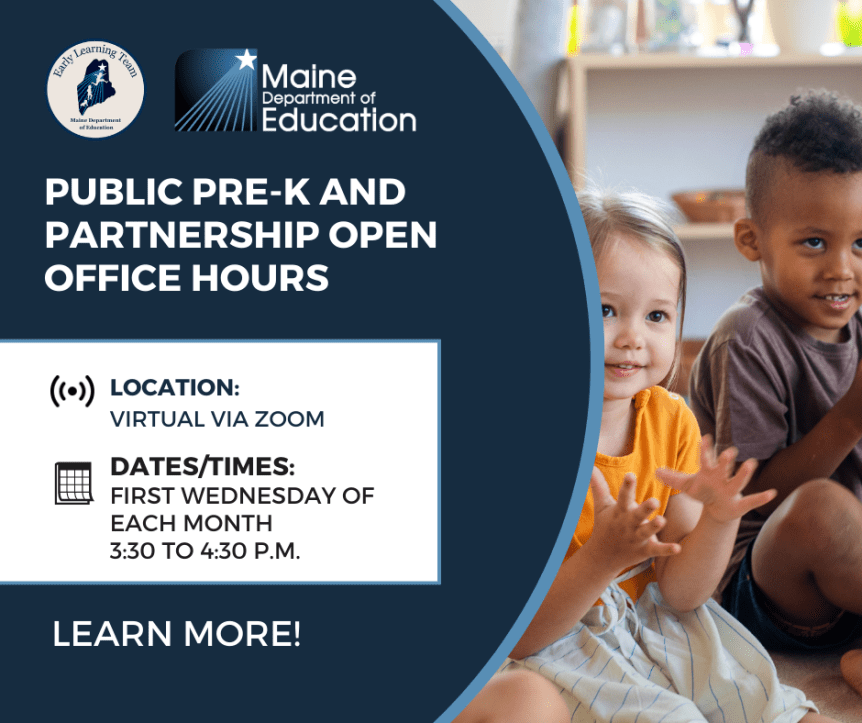
Public Pre-K and Partnership Open Office Hours Scheduled

The Maine Department of Education (DOE) Early Learning Team is pleased to offer Open Office Hours focusing on technical assistance for public pre-k.

These office hours will feature Marcy Whitcomb, Public Pre-K Consultant, as well as Sue Gallant and Julie Raymond, Public Pre-K Expansion Consultants. Sessions are meant to be a time for educators, pre-k coordinators and administrators to come together to ask questions, celebrate successes and/or work through problems of practice in public pre-k that educators, administrators, and partnership programs may be experiencing.

Office hours are offered as part of the Maine DOE’s Pre-K Technical Assistance program and are intended to meaningfully support addressing questions and needs as well as provide networking opportunities; participants can join for the full hour, or just a part; for each session or only to obtain an answer to a question.

Pre-K Open Office Hour Sessions will be held the first Wednesday of each month, from 3:30 to 4:30 p.m., on the following schedule:

Month Day Topic
September 6th Starting the Year:  Family Engagement in the Classroom
October 4th ECCP classroom support with challenging behaviors
November 1st Student assessment and reporting
December 6th Celebrations and challenges
January 3rd Routine Reboot – coming back from the break
February 7th Bringing the outside in – nature-based play in winter
March 6th Incorporating STEM and technology in the pre-k classroom
April 3rd Transitioning our students – pre-k to k
May 1st Looking toward next year:  screenings, child find, enrollment

Please use and save the following Zoom link and password to access each meeting (the meeting link will be the same for each office hour session):

Public Pre-K Office Hours (1st Wednesday of the month) – Zoom link
Meeting ID: 831 6398 7276
Passcode: 07691734

To submit a topic or question prior to a session and/or for more information please email Marcy Whitcomb, Public Pre-K Consultant, at: Marcy.r.whitcomb@maine.gov

Webinar: SY 23-24 Enrollment – August 29, 2023

Join the Maine Department of Education (DOE Data Team for a webinar about entering student enrollments for 2023-2024. All students have been exited from Synergy and must be reenrolled for the new school year, this webinar will review the procedure for enrolling students manually and via uploads to State Synergy.

This webinar will be recorded and posted to the Maine DOE Data Youtube Playlist. It may take a few days for the recording to be posted, however, it will be available as soon as possible. Additional information about this webinar can be found on the Webinars page of the Helpdesk Website.

Please note that if this webinar is canceled there will be a notice posted on the Helpdesk Website at the top of the page.

Synergy Enrollment Webinar:

August 29th at 10:0 am – Join the Live event here


For questions about data reporting webinars please contact Alexandra.Cookson@maine.gov. For technical assistance with data management, contact the Help Desk at MEDMS.Helpdesk@maine.gov or 207-624-6896

Graduation Report Due August 30, 2023

Graduation reporting is due on August 30th by midnight. Synergy is now in the 2023-2024 School Year, which has locked all 2022-2023 student data. If updates to 22-23 exit codes need to be made for graduating students, please email MEDMS.Helpdesk@maine.gov or call 207-624-6896.

Resources:

For technical assistance with data management, contact the Help Desk at MEDMS.Helpdesk@maine.gov or 207-624-6896


We Are Hiring: CDS/AmeriCorps First4 Partnership Member Positions

The Maine Department of Education is recruiting 17 AmeriCorps members to serve and support children with disabilities with building social-emotional skills and school readiness for children enrolled in CDS preschools across the state.  The investment in members will not only serve to ensure positive preschool experiences and improve child outcomes for those children, this opportunity will also provide important, dynamic training, 1:1 mentoring, and experience for each volunteer to utilize toward certification in the educational field. See the below job description for further details, including how to apply.

_______________________________________

Position Title:  CDS/AmeriCorps First4 Partnership Member
Location of position:  CDS Preschools at 9 CDS sites
Terms:  30 weeks at 23+ hours per week (1200 hr. members), 17 weeks at13 hours per eek (675 hr. members)
Living Allowance:  $1200-$1900/mo.
Incentives:  Training/PD toward Ed. Tech or 282 Certification funded and provided

About and/or mission statement:  CDS/AmeriCorps First 4 Partnership will recruit, train and empower 17 AmeriCorps members to serve and support children with disabilities with building social emotional skills and school readiness children enrolled in CDS preschools across the state.  The investment in members will not only serve to ensure positive preschool experiences and improve child outcomes for those children, this opportunity will also provide important, dynamic training, 1:1 mentoring and experience for each volunteer to utilize toward certification in the educational field.

Goals: CDS preschools serve children ages 3-5 with varying abilities and disabilities and are currently experiencing one of the most challenging times with staffing shortages and increasing numbers of students enrolling with social emotional and school readiness deficits post-pandemic that need support. Studies show that the early years of a child’s education are the most important for learning and development and all early learners deserve the opportunity and foundation that positive preschool experiences with ample supports can offer to thrive in their future educational years.  The CDS/AmeriCorps Partnership will provide those needed added supports and service, building and increasing social emotional skills, resiliency, and school readiness to improve upon child outcomes and also providing volunteers with dynamic experience including trainings and 1:1 mentoring to empower them to meet the needs of students now and in the future.

Position Overview: Members offer direct service and supports to CDS children and preschool classrooms.  They receive professional training and 1:1 mentoring with a classroom teacher in evidence-based special education and early childhood education practices including curriculum, data collection and analysis, and social-emotional learning.  Members will also participate in community efforts for recruitment and service.

Service activities:

  • provide direct support to children with disabilities in Child Development Services Preschool classrooms
  • build strong relationships & secure attachments with the children, which we know is vital for resilience & lifelong success
  • receive training to better understand special education policies and practices including understanding IEP and goals training, trauma-informed teaching & social-emotional development
  • collaborate with a team of like-minded people eager to impact children’s futures

Skills Required:

  • Ability to work with a team and interest in serving children with disabilities
  • Strong organizational skills and utilization of a database to manage trainings and service
  • Experience in community-based networking
  • Strong communication skills
  • Strong problem solving skills, adaptability

Apply: Jacquelyn.N.Hersom@maine.gov or   https://serviceyear.org/MaineDOE

19 Elkins Lane, Room 105, 105 State House Station, Augusta, ME 04333-0105 Phone: (207) 624-7792 • Email: Service.Commission@maine.govhttp://www.VolunteerMaine.gov EXAMPLE 2 – AYCC AmeriCorps Mentoring Program

The Maine Educational Technology Directors Association Launches New Mentorship Program

The Maine Educational Technology Directors Association (METDA) will be launching a new mentorship program this fall that will provide a state-wide approach to providing professional development and support specific to Technology Directors who are in their first years as district decision-makers, resource managers, and instructional leaders.

Mentees will receive coaching from experienced mentors and have access to the expertise and resources of technology leaders in our state and beyond. The program will serve to elevate the success of Technology Directors in serving the needs of their local stakeholders while also building collective efficacy around best practices with educational technology across districts in Maine.

For more information, complete this form by 9/1/23.