The following virtual workshop is being hosted by MaineHealth to Maine schools.
We are facing an unprecedented mental health crisis across the country, especially in the wake of the acute pandemic. The literature indicates it will take many strategies across community and clinical settings to address this.
MindUP is one school and community-based strategy that is based firmly in neuroscience and has proven to be effective to improve stress regulation, to enhance tools for self-regulation, and has demonstrated positive effects on reducing aggression and managing stress, including through four randomized control trials. Although its use and research has been focused in K-12 schools, MindUP can easily be taught in other settings and with adults.
We are fortunate to have implemented MindUP in several schools in Maine, including with the leadership of the Spruce Mountain public schools (RSU 73) in Jay, Livermore Falls, and Livermore and the Healthy Community Coalition at Franklin Community Health Network. David Evans Shaw, a Maine-based philanthropist, has generously funded the efforts to bring MindUP to Maine.
If you or others are interested in learning more and how you can bring MindUP to your school or community setting, please join leaders from RSU 73, Franklin Community Health Network, and MindUP for a one-hour informational zoom on Thursday February 16th, 11:00 am ET – 12:00 pm ET.
We ask that you register here in advance for this meeting. After registering, you will receive a confirmation email containing information about joining the meeting. The meeting will be recorded, and registrants will receive a link to the recording afterward.
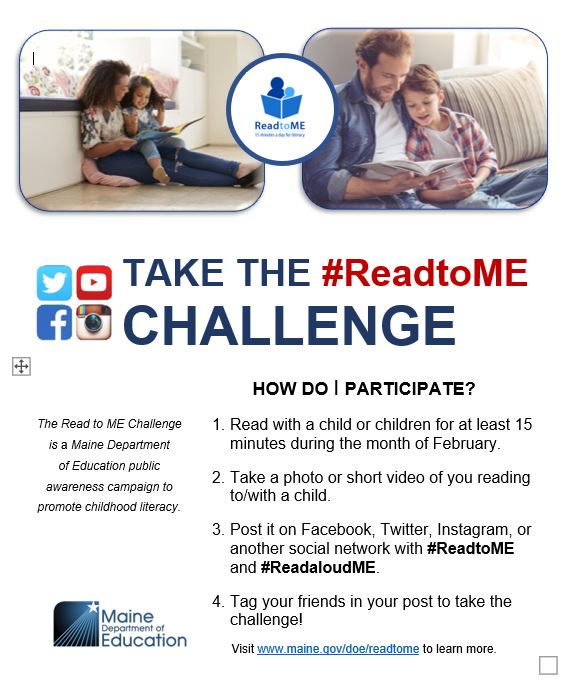
The Maine Department of Education (DOE) is pleased to announce that Commissioner Pender Makin will kick off the 8th annual Read to ME Challenge on Wednesday, February 1, 2023. You can watch a live stream of the event on the Maine DOE YouTube Channel.
The Read to ME Challenge is a month-long public awareness campaign held in February to promote childhood literacy in Maine. The challenge is an opportunity to promote children’s literacy growth by reading aloud to one or more children for at least 15 minutes. Part of the challenge is capturing the moment via a photo or video and then posting it on social media (with the hashtag #ReadtoME and tag the Maine DOE at @mdoenews on Twitter and @MaineDepartmentofEducation1 on Facebook! Keep watching the Maine DOE social media sites to see who has accepted the challenge of sharing the joy of reading with a child.
For more information, contact Dee Saucier (danielle.m.saucier@maine.gov), Inclusive Education Literacy Specialist for the Maine DOE Office of Special Services and Inclusive Education.
The 2023 Alternative Education Association (AEA) of Maine’s Spring Conference will take place at Thomas College on March 10th from 8:30-2:30. AEA will offer six contact hours for participants of this conference.
If interested, please take a moment to fill out the Choices for Conference Presentation form, which will help the AEA define the topics that will be presented at the conference.
If you are ready to register for the conference, please submit the Conference Registration Form – all individuals must fill out the form, even if multiple people are attending from one school district. Step two of the registration process is to print out the AEA of Maine Conference Invoice and send it to Dawn Matthews with your payment. (address and conference information is on the form) If you have already paid your dues for the Association this year, you DO NOT need to do Step 2. If you are not sure, send Dawn an email at dawn.matthews@rsu29.org
For further information and questions about the conference reach out to Lenny Holmes Leonard Holmes at lholmes@bonnyeagle.org.
The Mission of the Alternative Education Association of Maine is to provide support, guidance and direction to Maine Alternative Educators and the students they serve. The AEA’s purpose is to be an advocate and provide resources for all those in Maine who are involved in Alternative Education. Learn more about AEA here.
The 2023 Mitchell Scholarship online application is now open until April 1. You can find the application link, requirements, and a few additional college and scholarship resources on the Mitchell Institute’s web site.
New for the 2023 Mitchell Scholarship application season!
The Mitchell Institute is pleased to announce an expanded commitment to increasing college access for Maine students. In addition to the longstanding commitment of awarding at least one $10,000 scholarship annually to a graduating student from each of the 135 public high schools in Maine, the Institute will award 20 more scholarships across the state, bringing its annual total to $1.55M in support for the class of 2023 Mitchell Scholars. Visit this site more information: The 2023 Mitchell Scholarship Application is Now Open
In addition to the $10,000 scholarship that the Mitchell Institute will award to a graduating student from every public high school in the state, they provide numerous resources and programs for Mitchell Scholars:
Leadership and career development events
Access to a wide array of professional networks
Customized career advising and personal support through individual meetings with Mitchell Institute staff and community members
Fellowship Awards of up to $1,500 to support internships and personal/professional growth opportunities
Emergency financial assistance for unexpected financial challenges
Mitchell Scholarships are awarded to students planning to attend two- or four-year degree programs at colleges either in- or out-of-state. Candidates are evaluated based on the following criteria: academics, community impact, and financial need. Please encourage any graduating college-bound students from Maine’s public high schools to apply before the April 1 deadline.
The Maine Department of Education is pleased to present “Functional Communication: More than just a new app!”
Please join us on February 1st from 3:30-5:00 pm for a free virtual workshop presented by Fran Bodkin, MA CCC-SLP, in order to support all school personnel in understanding students with communication needs. Communication is vital to participating in society at all levels; school, home and community. Students who have difficulty expressing themselves and getting their needs met frequently experience frustration and may exhibit interfering behaviors in attempting to communicate what they need and want.
In this presentation you will learn:
How functional communication impacts students across settings
What is a functional communication evaluation and who can do one?
How to seek an evaluation or alternate supports
Different levels of assistive technology to support communication
How you can support students across settings
How to help students reach their full potential
How to leverage communication to support positive behaviors
How to have fun with communication!
1.5 contact hours will be offered to participants of this webinar.
Maine PBIS is offering a 3 day Functional Behavior Assessment (FBA) Training for our Maine PBIS schools. A FBA is the process used to assess a specific behavior that is interfering with a student’s academic, social, emotional and behavioral goals. This team-based training will support your school staff in identifying why the behavior is happening through a variety of assessment tools and procedures leading to the development of a positive behavior support plan individualized to the student’s strengths and needs.
Team-based training, minimum of three team members per school
In-person training 8:30-3:00 pm (3/21, 4/4, 4/25)
The training is cumulative, participants will need to attend all three sessions – 18 contact hours are available to participants who attend all 3 sessions.
In-person at University of Southern Maine, Gorham Campus: 37 College Ave, 8 Bailey Hall – Room 301/301C in Gorham, ME
The Maine Department of Education and the Maine Association for the Education of Young Children (MaineAEYC) invite you to join us in celebrating the Week of the Young Child®, an annual celebration sponsored by the National Association for the Education of Young Children (NAEYC), during the week of April 1-7, 2023. While the Week of the Young Child is still a couple of months away, the Maine DOE and MaineAEYC are providing a couple of informational sessions in early February to help schools and communities start to plan for how they will celebrate.
Consider registering to attend one of the following virtual informational sessions:
NAEYC is the world’s largest early childhood education association with close to 60,000 members and a network of 52 Affiliates, committed to promoting high-quality early learning for all young children, birth through age 8. Their collective vision is that all young children thrive and learn in a society dedicated to ensuring they reach their full potential.
The purpose of Week of the Young Child® is two fold. First, it aims to focus public attention on the needs of young children and their families while recognizing the early childhood programs, services and providers who meet those needs. Second, it calls on citizens and communities to consider and plan how we can better meet the needs of young children and families at the local, state and national levels.
Week of the Young Child® is an exciting series of fun filled daily themes that celebrate young children, their families, their teachers and the communities that support them.
It is our hope that programs serving young children and their families will plan and participate in activities that support the daily themes and call attention to the important work you are doing. This is a great opportunity for schools, child care centers, home child care programs, before & after care programs, public libraries, museums, and community organizations to come together to collaborate and organize celebrations in communities across the state. MaineAEYC and the DOE have several activities planned for the week, including ECE STATE HOUSE DAY in Augusta on April 5th from 8:00am to 12:00pm. We hope to see you there!
Want to learn more about the Week of the Young Child (WOYC)? Interested in being a part of WOYC, but not sure how? Want to plan a WOYC event, but looking for ideas? Want to learn more about WOYC mini grants being offered by MaineAEYC?
You can find Week of the Young Child® resources, including a guidebook and mini-grant opportunity, at the MaineAEYC, DOE and NAEYC websites. For more information please feel free to contact:.
Morgan Hart Tolin, M.Ed Professional Learning Director Maine Association for the Education of Young Children morgan@maineaeyc.org
Nicole Madore
Early Childhood Specialist
Maine Department of Education Nicole.Madore@maine.gov
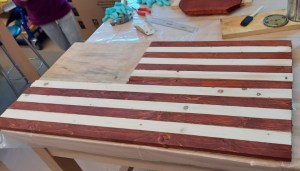
A finished student independent project from wood and stain
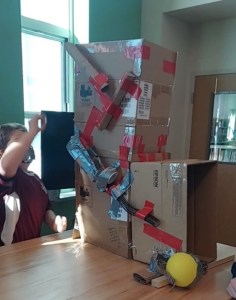
Monmouth Memorial School has some innovative ideas on how to involve more of its students with their makerspace. Not only is this makerspace available to whole classes and individuals throughout the day, but students in grades 6-8 also take a unified arts class where they are exposed to many different components of the makerspace, including 3D printing, motors and electronics, woodworking, sewing, all the way to virtual and augmented reality. By the time the students finish middle school, they will have developed makerspace skills, learned about the design process, and completed an independent project. These projects can be hands-on, virtual, or anything in between with some projects including a YouTube instructional video on quilt sewing, marble runs, an American Flag made out of wood and stain, safety guides on tools in the makerspace, and a three-foot-tall basketball hoop.
Monmouth Memorial’s studio space
The makerspace projects are spearheaded by Elizabeth Bellegarde, the district librarian, and Seth Mitchell, who is the school’s technology integrator and the 2022 Kennebec County Teacher of the Tear. Bellegarde feels the system is a great fit for their school, saying “I feel as though the set-up we have is ideal for our school’s structure, allowing the maximum amount of student access.” That structure allows for many different projects happening all at once, with one space designed as a work area that involves everything from power tools and snap circuits as well as materials for the Lego Robotics and VEX Robotics teams, which competed in the 2022 Vex Robotics World Championship.
In the makerspace unified arts class, 6th-8th grade students will be working on a wide array of projects simultaneously, with Bellegarde moving between groups to provide support when needed. Students enthusiastically switch between low-tech and high-tech skills to complete their projects, but the energy and excitement from the students is constantly pulpable.
“It takes time to build that culture,” Mitchell says, “having administration who see the value in this program makes it even more successful.”
A student’s marble run project
Attached to the main makerspace area is Monmouth’s studio space. This area contains a wide array of materials including a sound board, iPad teleprompter, green screen walls, and resources for video editing. “Students and teachers have this wonderful resource available [that can] extend learning in a way that wasn’t previously possible,” Bellegarde says. “By using the makerspace this way, classes become more fun with memorable experiences that will increase retention.” For many students in the makerspace unified arts class, having flexibility between both learning spaces gives them even more options to create unique projects.
Bellegarde wants to continue making these learning resources available for as many students as possible. “We are still working on making more students aware of this opportunity, the makerspace unified arts class is a huge part of that,” she says, “but the students who do take advantage of the makerspace find it to be a rewarding experience.” Not only can students participate in the unified arts class, classroom teachers can use the space for whole-class learning experiences as well as individual students working independently during study halls and available times throughout the day. Bellegarde sees these learning experiences leading to the development of lifelong design, critical thinking, decision-making, and independent skills. “For me, this is the best part of the makerspace.”
This story was written and coordinated by MLTI Ambassador Joshua Schmidt as part of the Maine Schools Sharing the Success Campaign. To learn more, or to submit a story or an idea for a story, email rachel.paling@maine.gov.
The Every Student Succeeds Act (ESSA) was signed into law on December 10, 2015, amending the Elementary and Secondary Education Act of 1965 (ESEA). ESSA contains provisions related to protections for children in foster care and requires the Maine Department of Education ( DOE) and Maine school administrative units (SAUs) to collaborate with the Maine Department of Health and Human Services (DHHS) Office of Children and Family Services (OCFS) to ensure educational stability for children in foster care.
Join the Maine DOE’s Office of School and Student Supports Director Julie Smyth and Associate Director of Child Welfare Services Bobbi Johnson on Tuesday, January 31st via Zoom for a 4:00 pm Annual Foster Care Training for Point Of Contacts (POCs). Participants receive a certificate upon successful completion of a post-session quiz.
The goal of ESSA is for children in foster care to experience minimal disruption in their education because of being placed in foster care and that they are given the same opportunities to develop the necessary skills to be successful as children who are not in foster care.
Under ESSA the Maine DOE and OCFS must work together to ensure:
A child in foster care will enroll or remain enrolled in the child’s school of origin unless a determination is made that it is not in the child’s best interest to attend that school.
If a determination is made that is not in the child’s best interest to remain in the school of origin, the child will immediately be enrolled in a new school, even if the child and/or his or her guardians are unable to produce records normally required for enrollment; and
The child’s new school must immediately contact the school of origin to obtain relevant records.
Register here.After registering, you will receive a confirmation email containing further information about joining the meeting.
For questions, please contact Julie Smyth, Director of the Office of School, and Student Supports – at 207.592.0949 or julie.a.smyth@maine.gov .




 Maine DOE Newsroom